light Peugeot 508 2018 Repair Manual
[x] Cancel search | Manufacturer: PEUGEOT, Model Year: 2018, Model line: 508, Model: Peugeot 508 2018Pages: 320, PDF Size: 10.09 MB
Page 213 of 320
211
Freezing of the AdBlue®
AdBlue® freezes at temperatures below
around -11°C.
The SCR system includes a heater for the
AdBlue
® tank, allowing you to continue
driving in very cold conditions.
Supply of AdBlue®
It is recommended that the AdBlue® is
topped up as soon as the first alert is
issued indicating that the reser ve level
has
been reached.
In order to ensure that the SCR system
operates correctly:
-
U
se only AdBlue
® fluid that meets the
ISO 22241 standard.
-
N
ever transfer AdBlue
® to another
container: it would lose its purity.
-
N
ever dilute AdBlue
® with water.
You can obtain AdBlue
® from a PEUGEOT
dealer or a qualified workshop. You can also visit a ser vice station
equipped with AdBlue
® pumps specially
designed for passenger vehicles.
Never top up from an AdBlue
® dispenser
reserved for heavy goods vehicles.
Recommendations on storage
AdBlue® freezes at about -11°C and deteriorates
above 25°C. Containers should be stored in a
cool area and protected from direct sunlight.
Under these conditions, the fluid can be kept
for at least a year.
If the fluid has frozen, it can be used once it
has completely thawed out.
Never store AdBlue
® containers in your
vehicle.
Precautions for use
the event of contact with the eyes, immediately
rinse the eyes with large amounts of water
or with an eye wash solution for at least 15
minutes. If a burning sensation or irritation
persists, get medical attention.
If swallowed, immediately wash out the mouth
with clean water and then drink plenty of water.
In certain conditions (high temperature, for
example), the risk of release of ammonia
cannot be excluded: do not inhale the fluid.
Ammonia vapour has an irritant effect on
mucous membranes (eyes, nose and throat).
Keep AdBlue
® out of the reach of children,
in its original container.
Procedure
Before starting the top-up procedure, ensure
that the vehicle is parked on a flat and level
sur face.
In winter, check that the temperature of the
vehicle is above -11°C. If not, due to freezing,
the AdBlue
® cannot be poured into the tank.
Park your vehicle somewhere warmer for a few
hours before topping up.
AdBlue
® is a urea-based solution. This fluid
is non-flammable, colourless and odourless
(stored in a cool place).
In the event of contact with the skin, wash the
affected area with soap and running water. In
7
Practical information
Page 225 of 320
223
After changing a wheel
With a "space-saver" type spare wheel
Driving with more than one "space-saver"
type spare wheel is prohibited.Visit a PEUGEOT dealer or a qualified
workshop as soon as possible to have the
tightness of the bolts and the pressure of
the spare wheel checked.
Have the punctured tyre examined. After
inspection, the technician will advise you
on whether the tyre can be repaired or if it
must be replaced.
Changing a bulb
The headlamps have polycarbonate
lenses with a protective coating:
F
d
o not clean them using a dr y or
abrasive cloth, nor with a detergent
or solvent product,
F
u
se a sponge and soapy water or a pH
neutral product,
F
w
hen using a high pressure washer
on persistent marks, do not keep the
lance directed towards the lamps or
their edges for too long, so as not to
damage their protective coating and
seals. Changing a bulb must only be done with
the ignition off and after the lamp has
been switched off for several minutes –
Risk of serious burns!
F
D
o not touch the bulb directly with your
fingers, use a lint-free cloth.
It is essential only to use anti-ultraviolet
(UV) type bulbs, so as not to damage the
headlamp.
Always replace a failed bulb with a new
bulb with the same type and specification.
In some weather conditions (e.g. low
temperature or humidity), the presence
of misting on the internal sur face of the
glass of the headlamps and rear lamps
is
normal; it disappears after the lamps
have been on for a few minutes.
Light-emitting diodes (LED)
For the replacement of this type of bulb,
you must contact a PEUGEOT dealer or
a
qualified workshop.
F
T
ighten the other bolts using wheelbrace
5
o n l y.
F
R
efit the bolt covers to each of the bolts
(depending on equipment).
F
S
tore the tools.
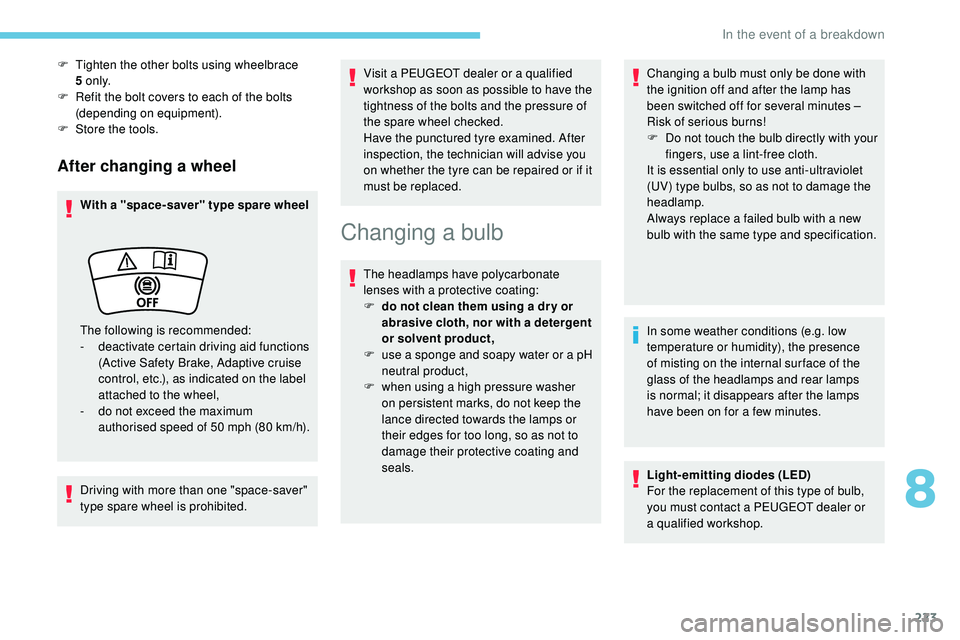
The following is recommended:
-
d
eactivate certain driving aid functions
(Active Safety Brake, Adaptive cruise
control, etc.), as indicated on the label
attached to the wheel,
-
d
o not exceed the maximum
authorised speed of 50 mph (80
km/h).
8
In the event of a breakdown
Page 226 of 320
224
Halogen bulbs
To ensure good quality lighting, check
that the bulb is correctly positioned in its
housing.
Front lamps
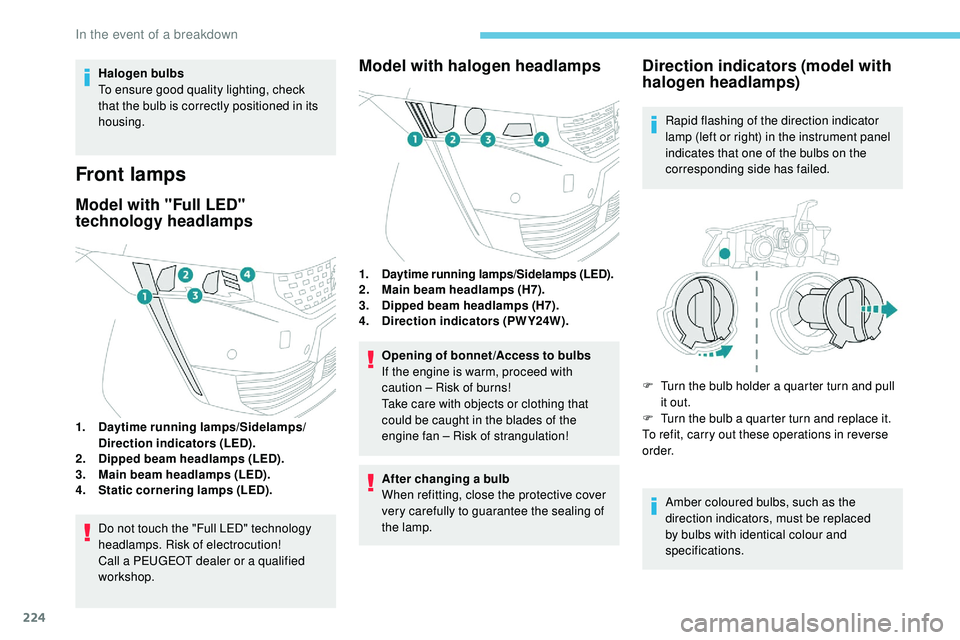
Model with "Full LED"
technology headlamps
1.Daytime running lamps/Sidelamps/
Direction indicators (LED).
2. Dipped beam headlamps (LED).
3. Main beam headlamps (LED).
4. Static cornering lamps (LED).
Do not touch the "Full LED" technology
headlamps. Risk of electrocution!
Call a PEUGEOT dealer or a qualified
workshop.
Model with halogen headlamps
1.Daytime running lamps/Sidelamps (LED).2.Main beam headlamps (H7).
3. Dipped beam headlamps (H7).
4. Direction indicators (PWY24W).
Opening of bonnet /Access to bulbs
If the engine is warm, proceed with
caution – Risk of burns!
Take care with objects or clothing that
could be caught in the blades of the
engine fan – Risk of strangulation!
After changing a bulb
When refitting, close the protective cover
very carefully to guarantee the sealing of
the lamp.
Direction indicators (model with
halogen headlamps)
Rapid flashing of the direction indicator
lamp (left or right) in the instrument panel
indicates that one of the bulbs on the
corresponding side has failed.
F
T
urn the bulb holder a quarter turn and pull
it out.
F
T
urn the bulb a quarter turn and replace it.
To refit, carry out these operations in reverse
o r d e r.
Amber coloured bulbs, such as the
direction indicators, must be replaced
by bulbs with identical colour and
specifications.
In the event of a breakdown
Page 227 of 320
225
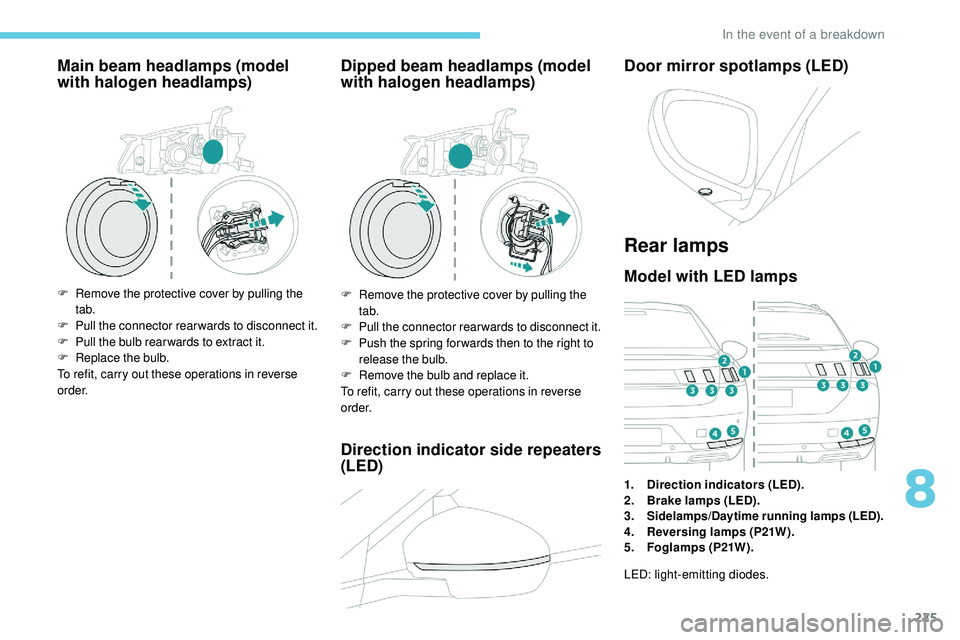
Main beam headlamps (model
with halogen headlamps)
F Remove the protective cover by pulling the tab.
F
P
ull the connector rear wards to disconnect it.
F
P
ull the bulb rear wards to extract it.
F
R
eplace the bulb.
To refit, carry out these operations in reverse
o r d e r.
Dipped beam headlamps (model
with halogen headlamps)
F Remove the protective cover by pulling the tab.
F
P
ull the connector rear wards to disconnect it.
F
P
ush the spring for wards then to the right to
release the bulb.
F
R
emove the bulb and replace it.
To refit, carry out these operations in reverse
o r d e r.
Direction indicator side repeaters
(LED) Door mirror spotlamps (LED)
Rear lamps
Model with LED lamps
1.
Direction indicators (LED).
2. Brake lamps (LED).
3.
Sidelamps/Daytime running lamps (LED).4. Reversing lamps (P21W).
5. Foglamps (P21W).
LED: light-emitting diodes.
8
In the event of a breakdown
Page 228 of 320
226
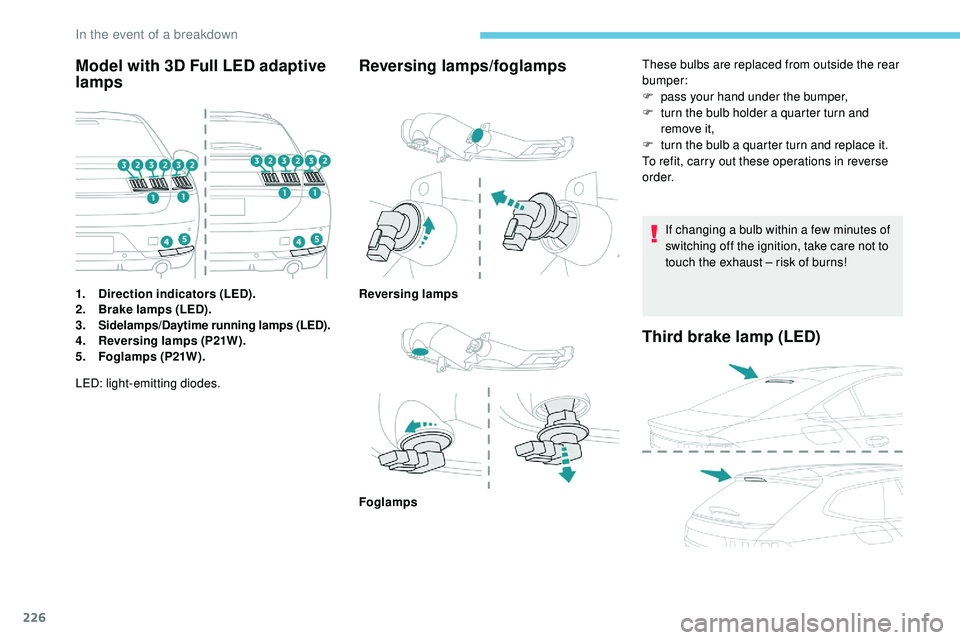
Model with 3D Full LED adaptive
lamps
1.Direction indicators (LED).
2. Brake lamps (LED).
3.
Sidelamps/Daytime running lamps (LED).4. Reversing lamps (P21W).
5. Foglamps (P21W).
Reversing lamps/foglamps
LED: light-emitting diodes. These bulbs are replaced from outside the rear
bumper:
F
p
ass your hand under the bumper,
F
t
urn the bulb holder a quarter turn and
remove it,
F
t
urn the bulb a quarter turn and replace it.
To refit, carry out these operations in reverse
o r d e r.
If changing a bulb within a few minutes of
switching off the ignition, take care not to
touch the exhaust – risk of burns!
Reversing lamps
Foglamps
Third brake lamp (LED)
In the event of a breakdown
Page 231 of 320
229
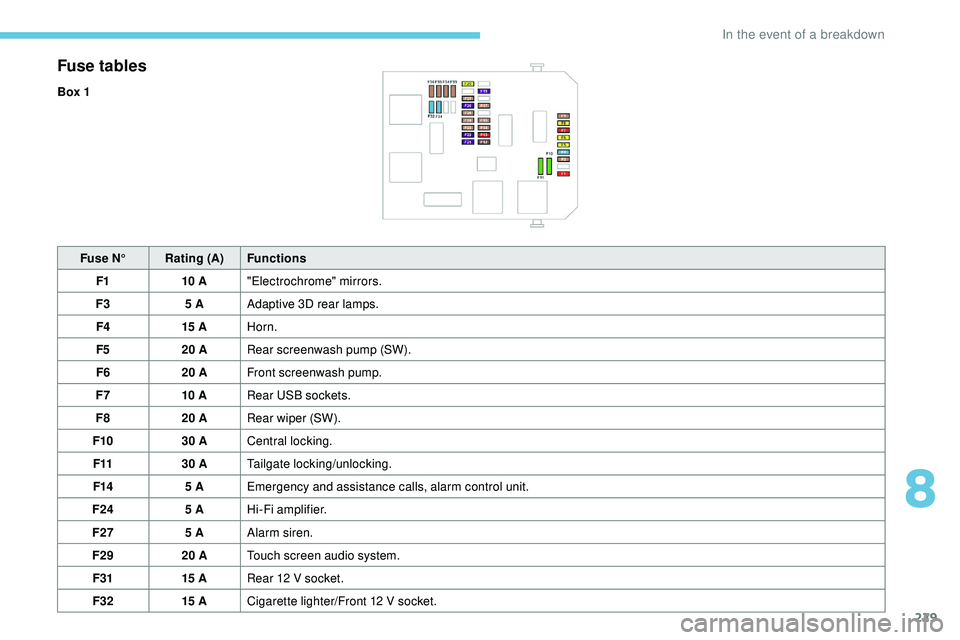
Fuse tables
Box 1Fuse N° Rating (A) Functions
F1 10 A"Electrochrome" mirrors.
F3 5 AAdaptive 3D rear lamps.
F4 15 AHorn.
F5 20 ARear screenwash pump (SW).
F6 20 AFront screenwash pump.
F7 10 ARear USB sockets.
F8 20 ARear wiper (SW).
F10 30 ACentral locking.
F11 30 ATailgate locking/unlocking.
F14 5 AEmergency and assistance calls, alarm control unit.
F24 5 AHi-Fi amplifier.
F27 5 AAlarm siren.
F29 20 ATouch screen audio system.
F31 15 ARear 12 V socket.
F32 15 ACigarette lighter/Front 12 V socket.
8
In the event of a breakdown
Page 233 of 320
231
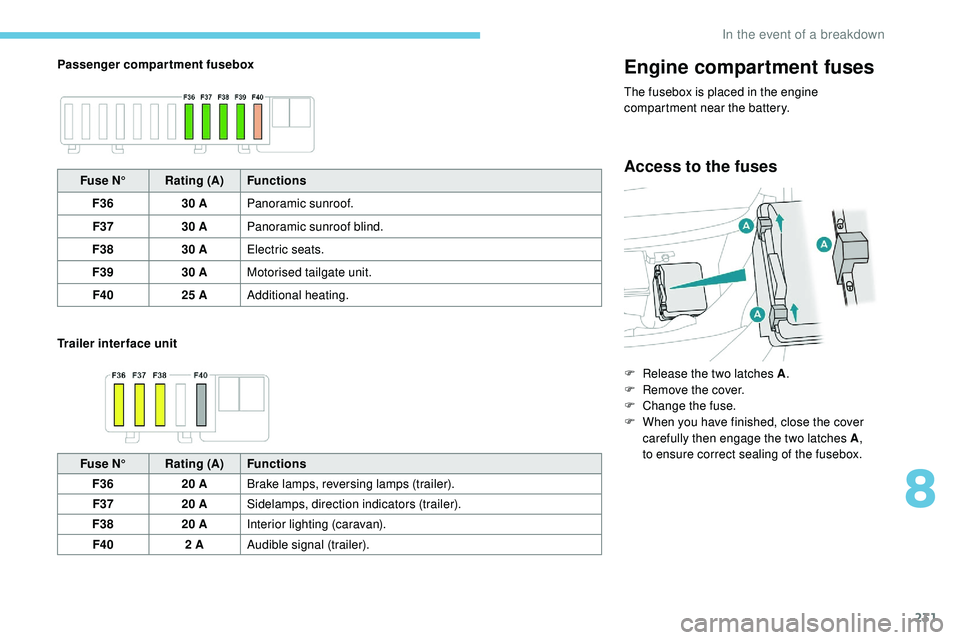
Passenger compartment fusebox
Trailer interface unitEngine compartment fuses
The fusebox is placed in the engine
compartment near the battery.
Access to the fusesFuse N°Rating (A) Functions
F36 30 APanoramic sunroof.
F37 30 APanoramic sunroof blind.
F38 30 AElectric seats.
F39 30 AMotorised tailgate unit.
F40 25 AAdditional heating.
Fuse N° Rating (A) Functions
F36 20 ABrake lamps, reversing lamps (trailer).
F37 20 ASidelamps, direction indicators (trailer).
F38 20 AInterior lighting (caravan).
F40 2 AAudible signal (trailer). F
R
elease the two latches A.
F
R
emove the cover.
F
C
hange the fuse.
F
W
hen you have finished, close the cover
carefully then engage the two latches A ,
to
ensure correct sealing of the fusebox.
8
In the event of a breakdown
Page 235 of 320
233
12 V battery
Procedure for starting the engine using another
battery or charging a discharged battery.
General points
Lead-acid starter batteries
Batteries contain harmful substances
such as sulphuric acid and lead.
They must be disposed of in accordance
with regulations and must not, in any
circumstances, be discarded with
household waste.
Take used remote control batteries and
vehicle batteries to a special collection
point.
Protect your eyes and face before
handling the battery.
All operations on the battery must be
carried out in a well ventilated area and
away from naked flames and sources of
sparks, so as to avoid the risk of explosion
or fire.
Wash your hands afterwards.
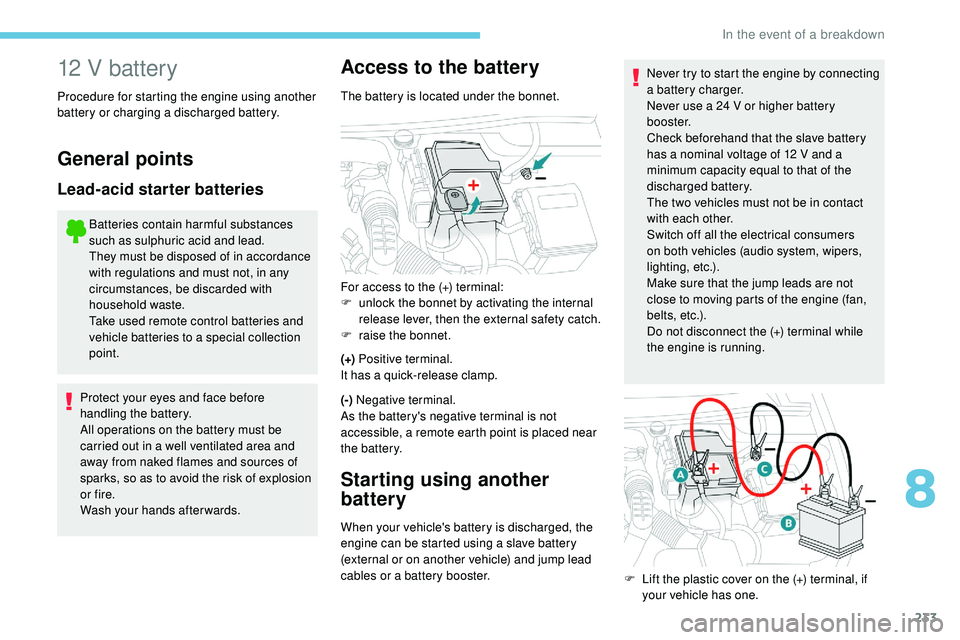
Access to the battery
The battery is located under the bonnet.
(+) Positive terminal.
It has a quick-release clamp.
(-) Negative terminal.
As the battery's negative terminal is not
accessible, a remote earth point is placed near
the battery.
Starting using another
battery
When your vehicle's battery is discharged, the
engine can be started using a slave battery
(external or on another vehicle) and jump lead
cables or a battery booster. Never try to start the engine by connecting
a battery charger.
Never use a 24 V or higher battery
b o o s t e r.
Check beforehand that the slave battery
has a nominal voltage of 12 V and a
minimum capacity equal to that of the
discharged battery.
The two vehicles must not be in contact
with each other.
Switch off all the electrical consumers
on both vehicles (audio system, wipers,
lighting, etc.).
Make sure that the jump leads are not
close to moving parts of the engine (fan,
belts, etc.).
Do not disconnect the (+) terminal while
the engine is running.
For access to the (+) terminal:
F
u
nlock the bonnet by activating the internal
release lever, then the external safety catch.
F
r
aise the bonnet.
F
L
ift the plastic cover on the (+) terminal, if
your vehicle has one.
8
In the event of a breakdown
Page 236 of 320
234
F Start the engine of the vehicle with the good battery and leave it running for a few
minutes.
F
O
perate the starter on the broken down
vehicle and let the engine run.
If the engine does not start straight away,
switch off the ignition and wait a few moments
before trying again.
F
W
ait for it to return to idle.
F
D
isconnect the jump lead cables in reverse
order .
F
R
efit the plastic cover to the (+) terminal,
if
your vehicle has one.
F
A
llow the engine to run for at least
30
minutes, by driving or with the vehicle
stationary, so that the battery reaches an
adequate state of charge.
If your vehicle has an automatic gearbox,
never try to start the engine by pushing
the vehicle.
Charging the battery using
a battery charger
For optimum ser vice life of the battery, it is
essential to maintain an adequate state of
charge.
In some circumstances it may be necessary to
charge the battery:
-
i
f you only use your vehicle for short
journeys,
-
i
f the vehicle is to be taken off the road for
several weeks.
Contact a PEUGEOT dealer or a qualified
workshop.
If you wish to charge your vehicle's battery
yourself, use only a charger compatible
with lead-acid batteries with a nominal
voltage of 12 V.
Follow the instructions provided by the
manufacturer of the charger.
Never reverse polarities.
It is not necessary to disconnect the
battery.
F
S
witch off the ignition.
F
S
witch off all electrical consumers (audio
system, lighting, wipers, etc.).
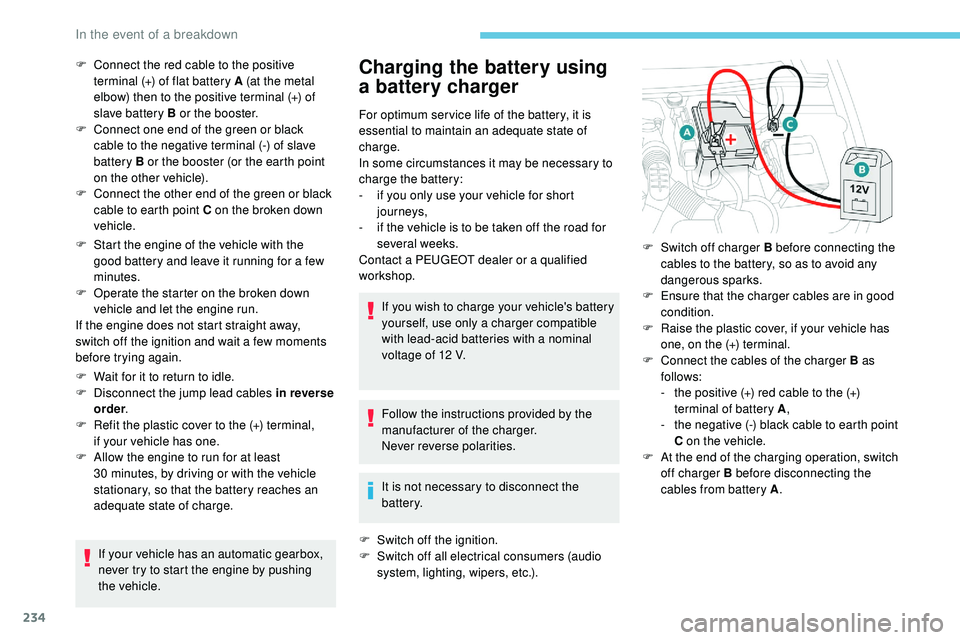
F
C
onnect the red cable to the positive
terminal (+) of flat battery A (at the metal
elbow) then to the positive terminal (+) of
slave battery B or the booster.
F
C
onnect one end of the green or black
cable to the negative terminal (-) of slave
battery B or the booster (or the earth point
on the other vehicle).
F
C
onnect the other end of the green or black
cable to earth point C on the broken down
vehicle.
F
S
witch off charger B before connecting the
cables to the battery, so as to avoid any
dangerous sparks.
F
E
nsure that the charger cables are in good
condition.
F
R
aise the plastic cover, if your vehicle has
one, on the (+) terminal.
F
C
onnect the cables of the charger B as
follows:
-
t
he positive (+) red cable to the (+)
terminal of battery A ,
-
t
he negative (-) black cable to earth point
C on the vehicle.
F
A
t the end of the charging operation, switch
off charger B before disconnecting the
cables from battery A .
In the event of a breakdown
Page 237 of 320
235
Never try to charge a frozen battery – risk
of explosion!
If the battery has frozen, have it checked
by a PEUGEOT dealer or by a qualified
workshop who will check that the internal
components have not been damaged and
that the container has not cracked, which
would mean a risk of toxic and corrosive
acid leaking.
Some functions, including Stop & Start,
are not available if the battery is not
sufficiently charged.
Disconnecting the battery
In order to maintain an adequate state of charge
for starting the engine, it is recommended that
the battery be disconnected if the vehicle is
taken out of ser vice for a long period.
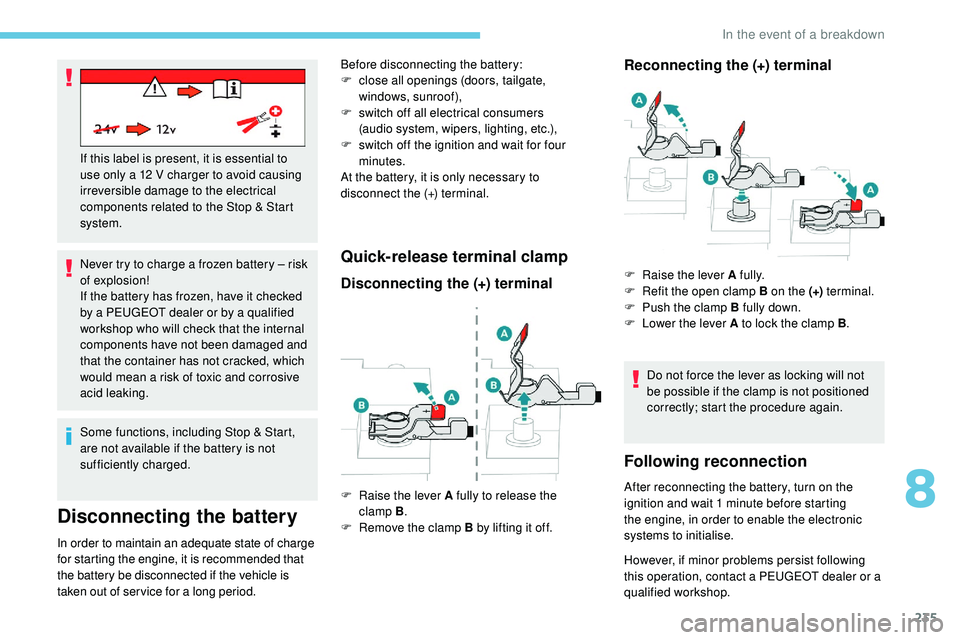
Quick-release terminal clamp
Disconnecting the (+) terminalReconnecting the (+) terminal
Do not force the lever as locking will not
be possible if the clamp is not positioned
correctly; start the procedure again.
Following reconnection
After reconnecting the battery, turn on the
ignition and wait 1 minute before starting
the engine, in order to enable the electronic
systems to initialise.
If this label is present, it is essential to
use only a 12 V charger to avoid causing
irreversible damage to the electrical
components related to the Stop & Start
system.
F
Ra
ise the lever A fully to release the
clamp
B .
F
R
emove the clamp B by lifting it off.
Before disconnecting the battery:
F
c
lose all openings (doors, tailgate,
windows,
sunroof),
F
s
witch off all electrical consumers
(audio
system, wipers, lighting, etc.),
F
s
witch off the ignition and wait for four
minutes.
At the battery, it is only necessary to
disconnect the (+) terminal.
F
Ra
ise the lever A fully.
F
R
efit the open clamp B on the (+)
terminal.
F
P
ush the clamp B fully down.
F
L
ower the lever A to lock the clamp B
.
However, if minor problems persist following
this operation, contact a PEUGEOT dealer or a
qualified workshop.
8
In the event of a breakdown