sent Peugeot 508 2019 Owner's Manual
[x] Cancel search | Manufacturer: PEUGEOT, Model Year: 2019, Model line: 508, Model: Peugeot 508 2019Pages: 320, PDF Size: 10.09 MB
Page 3 of 320
Welcome
The descriptions and illustrations are given as indications only.
Automobiles PEUGEOT reser ves the right to modify the technical data,
equipment and accessories without having to update this edition of the
guide.
In this document you will find all of the instructions and
recommendations on use that will allow you to enjoy your vehicle to the
fullest. It is strongly recommended that you familiarise yourself with it
as well as the Warranty and Maintenance Record which will provide you
with information about warranties, servicing and roadside assistance
associated with your vehicle. This document presents the information and recommendations required
for you to be able to explore your vehicle in complete safety. Thank you for choosing a Peugeot 508.
Your vehicle will be fitted with only some of the equipment described in
this document, depending on its trim level, version and the specification
for the country in which it was sold.
If ownership of your vehicle is transferred, please ensure this
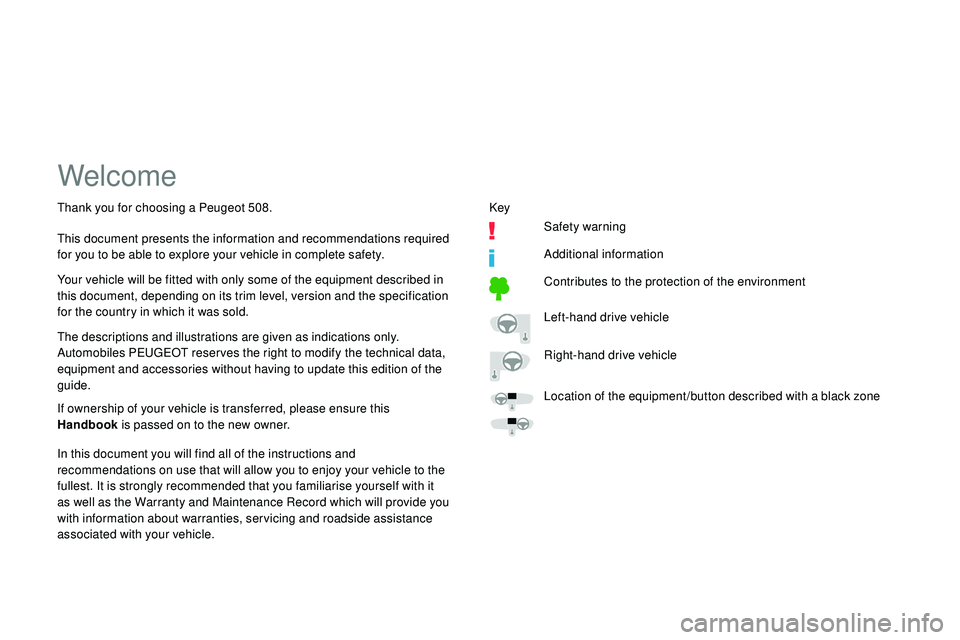
Handbook is passed on to the new owner. Key
Safety warning
Additional information
Contributes to the protection of the environment
Left-hand drive vehicle
Right-hand drive vehicle
Location of the equipment /button described with a black zone
Page 10 of 320
8
Head-up digital screen
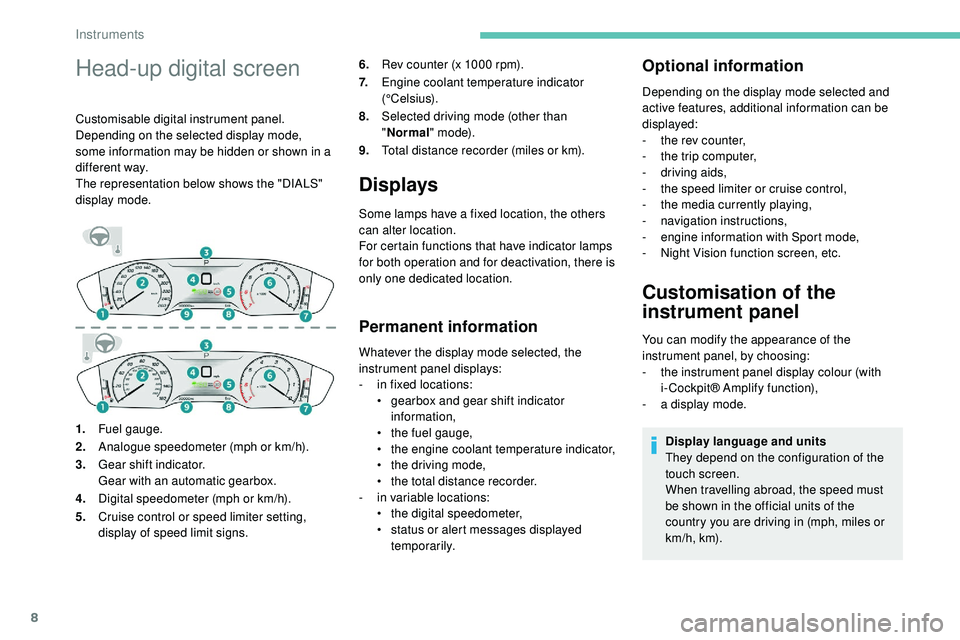
Customisable digital instrument panel.
Depending on the selected display mode,
some information may be hidden or shown in a
different way.
The representation below shows the "DIALS"
display mode.6.
Rev counter (x 1000 rpm).
7. Engine coolant temperature indicator
(°Celsius).
8. Selected driving mode (other than
"Normal " m o d e).
9. Total distance recorder (miles or km).
Displays
Some lamps have a fixed location, the others
can alter location.
For certain functions that have indicator lamps
for both operation and for deactivation, there is
only one dedicated location.
Permanent information
Whatever the display mode selected, the
instrument panel displays:
-
i
n fixed locations:
•
g
earbox and gear shift indicator
information,
•
t
he fuel gauge,
•
t
he engine coolant temperature indicator,
•
t
he driving mode,
•
t
he total distance recorder.
-
i
n variable locations:
•
t
he digital speedometer,
•
s
tatus or alert messages displayed
temporarily.
Optional information
Depending on the display mode selected and
active features, additional information can be
displayed:
-
t
he rev counter,
-
t
he trip computer,
-
d
riving aids,
-
t
he speed limiter or cruise control,
-
t
he media currently playing,
-
n
avigation instructions,
-
e
ngine information with Sport mode,
-
Nig
ht Vision function screen, etc.
Customisation of the
instrument panel
You can modify the appearance of the
instrument panel, by choosing:
-
t
he instrument panel display colour (with
i- Cockpit® Amplify function),
-
a d
isplay mode.
Display language and units
They depend on the configuration of the
touch screen.
When travelling abroad, the speed must
be shown in the official units of the
country you are driving in (mph, miles or
km/h, km).
1.
Fuel gauge.
2. Analogue speedometer (mph or km/h).
3. Gear shift indicator.
Gear with an automatic gearbox.
4. Digital speedometer (mph or km/h).
5. Cruise control or speed limiter setting,
display of speed limit signs.
Instruments
Page 17 of 320
15
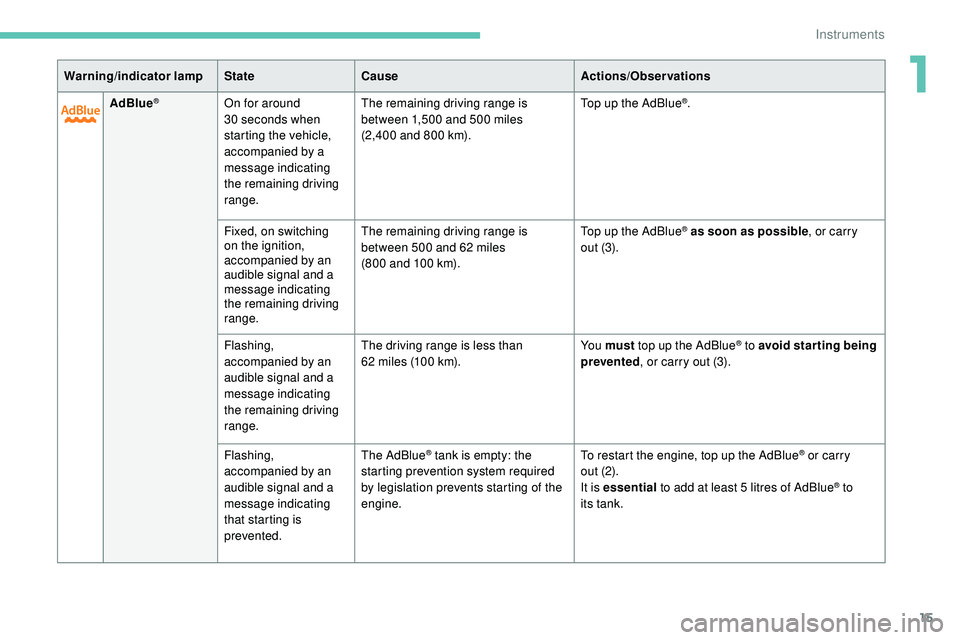
AdBlue®On for around
30 seconds when
starting the vehicle,
accompanied by a
message indicating
the remaining driving
range. The remaining driving range is
between 1,500 and 500 miles
(2,400
and 800 km).Top up the AdBlue®.
Fixed, on switching
on the ignition,
accompanied by an
audible signal and a
message indicating
the remaining driving
range. The remaining driving range is
between 500 and 62 miles
(800 and 100 km).
Top up the AdBlue
® as soon as possible
, or carry
out
(3).
Flashing,
accompanied by an
audible signal and a
message indicating
the remaining driving
range. The driving range is less than
62
miles (100
km). Yo u must
top up the AdBlue
® to avoid star ting being
prevented , or carry out (3).
Flashing,
accompanied by an
audible signal and a
message indicating
that starting is
prevented. The AdBlue
® tank is empty: the
starting prevention system required
by legislation prevents starting of the
engine. To restart the engine, top up the AdBlue® or carry
out
(2).
It is essential to add at least 5 litres of AdBlue
® to
its
tank.
Warning/indicator lamp
StateCause Actions/Observations
1
Instruments
Page 26 of 320
24
Retrieving the service
information
The ser vice information can be
accessed via the "Check/Diagnostics "
button in the Driving/Vehicle menu of
the touch screen.
Engine oil level indicator
(Depending on version.)
On versions fitted with an electric oil level
indicator, the state of the engine oil level is
displayed in the instrument panel for a few
seconds after switching the ignition on, after
the servicing information.
The level read will only be correct if the
vehicle is on level ground and the engine
has been off for more than 30 minutes.
Low oil level
This is indicated by the display of a message
prompting you to top up, accompanied by the
Service warning lamp and an audible signal.
If the low oil level is confirmed by a check using
the dipstick, the level must be topped up to
avoid damage to the engine. For more information on Checking levels
,
refer to the corresponding section.
Oil level indicator fault
This is signalled by the display of the " Oil
level measurement invalid " message in the
instrument panel.
Contact a PEUGEOT dealer or a qualified
workshop.
In the event of a fault with the electric
indicator, the oil level is no longer
monitored.
If the system is faulty, you must check the
engine oil level using the manual dipstick
located under the bonnet.
For more information on Checking levels ,
refer to the corresponding section.
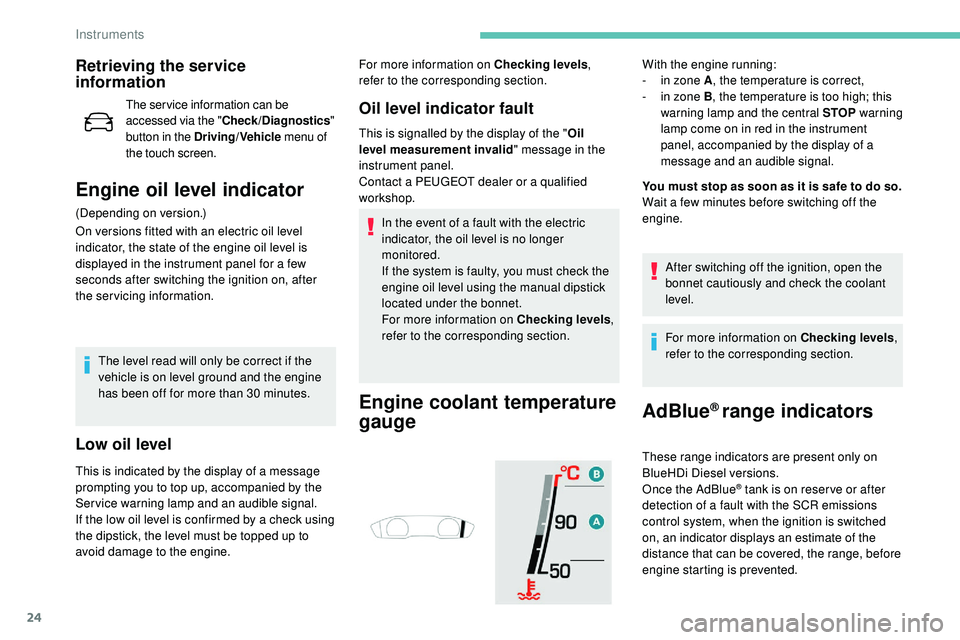
Engine coolant temperature
gauge
With the engine running:
- i n zone A , the temperature is correct,
-
i
n zone B , the temperature is too high; this
warning lamp and the central STOP warning
lamp come on in red in the instrument
panel, accompanied by the display of a
message and an audible signal.
You must stop as soon as it is safe to do so.
Wait a few minutes before switching off the
engine.
After switching off the ignition, open the
bonnet cautiously and check the coolant
level.
For more information on Checking levels ,
refer to the corresponding section.
AdBlue® range indicators
These range indicators are present only on
BlueHDi Diesel versions.
Once the AdBlue
® tank is on reser ve or after
detection of a fault with the SCR emissions
control system, when the ignition is switched
on, an indicator displays an estimate of the
distance that can be covered, the range, before
engine starting is prevented.
Instruments
Page 27 of 320
25
In the event of the risk of non-
starting related to a lack of
AdBlue
®
The engine starting prevention system
required by regulations is activated
automatically once the AdBlue
® tank is
e m pt y.
Range greater than 1,500 miles (2,400 km)
When the ignition is switched on, no
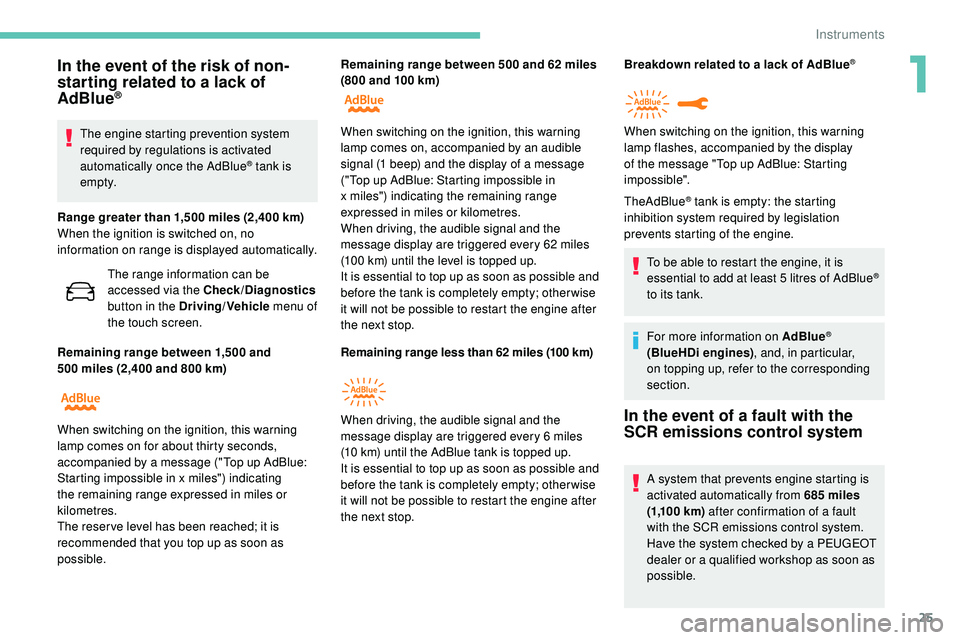
information on range is displayed automatically. The range information can be
accessed via the Check/Diagnostics
button in the Driving/Vehicle menu of
the touch screen.
Remaining range between 1,500 and
500
miles (2,400 and 800
km) Remaining range between 500 and 62 miles
(800 and 100
km)
Remaining range less than 62 miles (100 km)
When driving, the audible signal and the
message display are triggered every 6 miles
(10 km) until the AdBlue tank is topped up.
It is essential to top up as soon as possible and
before the tank is completely empty; other wise
it will not be possible to restart the engine after
the next stop. Breakdown related to a lack of AdBlue
®
TheAdBlue® tank is empty: the starting
inhibition system required by legislation
prevents starting of the engine.
To be able to restart the engine, it is
essential to add at least 5 litres of AdBlue
®
to its tank.
For more information on AdBlue
®
(BlueHDi engines) , and, in particular,
on topping up, refer to the corresponding
section.
When switching on the ignition, this warning
lamp comes on for about thirty seconds,
accompanied by a message ("Top up AdBlue:
Starting impossible in x miles") indicating
the remaining range expressed in miles or
kilometres.
The reser ve level has been reached; it is
recommended that you top up as soon as
possible. When switching on the ignition, this
warning
lamp comes on, accompanied by an audible
signal (1 beep) and the display of a message
("Top up AdBlue: Starting impossible in
x miles") indicating the remaining range
expressed in miles or kilometres.
When driving, the audible signal and the
message display are triggered every 62 miles
(100 km) until the level is topped up.
It is essential to top up as soon as possible and
before the tank is completely empty; other wise
it will not be possible to restart the engine after
the next stop. When switching on the ignition, this warning
lamp flashes, accompanied by the display
of the message "Top up AdBlue: Starting
impossible".
In the event of a fault with the
SCR emissions control system
A system that prevents engine starting is
activated automatically from 685 miles
(1,10 0 k m)
after confirmation of a fault
with the SCR emissions control system.
Have the system checked by a PEUGEOT
dealer or a qualified workshop as soon as
possible.
1
Instruments
Page 50 of 320
48
When selective unlocking is activated, the
electronic key must be close to the rear of
the vehicle.
The tailgate is not designed to hold a
bicycle carrier.
Closing the tailgate
F Lower the tailgate using the interior grips.
F R elease the grips and press down on the
outside of the tailgate to close it.
If the tailgate is not properly closed: In the event of a fault or difficulties felt in
manoeuvring the tailgate when opening
or closing it, have it quickly checked by a
PEUGEOT dealer or a qualified workshop
to stop this issue getting worse and so
as to not cause the tailgate to drop, and
serious injuries.
Back-up release
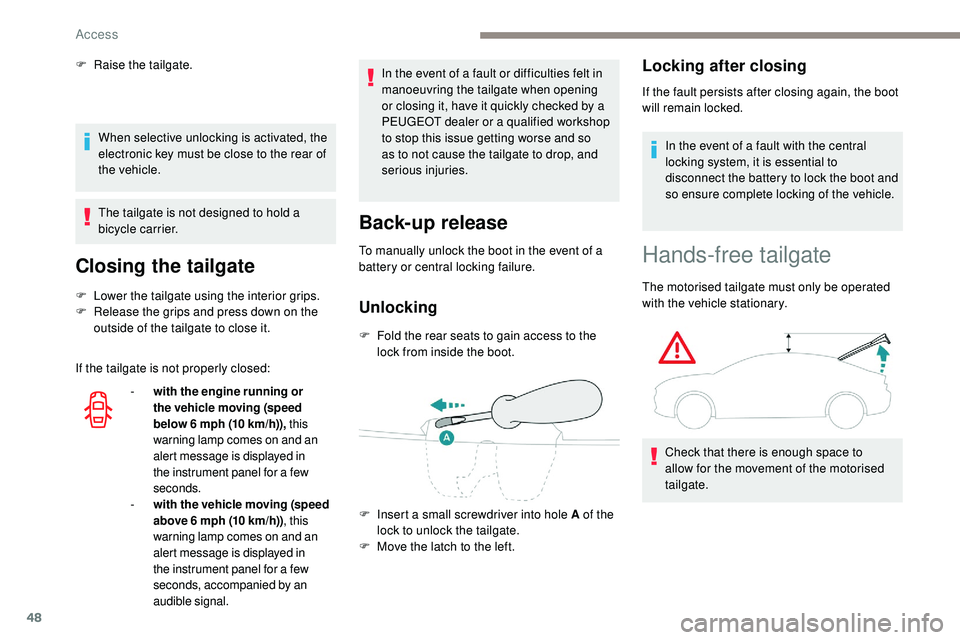
To manually unlock the boot in the event of a
battery or central locking failure.
Unlocking
F Fold the rear seats to gain access to the
lock from inside the boot.
F
I
nsert a small screwdriver into hole A of the
lock to unlock the tailgate.
F
M
ove the latch to the left.
Locking after closing
If the fault persists after closing again, the boot
will remain locked.In the event of a fault with the central
locking system, it is essential to
disconnect the battery to lock the boot and
so ensure complete locking of the vehicle.
F
Ra
ise the tailgate.
-
w
ith the engine running or
the vehicle moving (speed
below 6
mph (10
km/h)), this
warning lamp comes on and an
alert message is displayed in
the instrument panel for a few
seconds.
-
w
ith the vehicle moving (speed
above 6 mph (10
km/h)) , this
warning lamp comes on and an
alert message is displayed in
the instrument panel for a few
seconds, accompanied by an
audible signal.
Hands-free tailgate
The motorised tailgate must only be operated
with the vehicle stationary.
Check that there is enough space to
allow for the movement of the motorised
tailgate.
Access
Page 51 of 320
49
Never introduce a finger in the locking
system of the motorised tailgate – risk of a
serious injury!
Safety anti-pinch
The motorised tailgate has an obstacle
detection system that automatically interrupts
and reverses its movement by a few degrees to
allow the obstacle to be cleared.
Please note that this anti-pinch system is not
active at the end of the closing travel (around
1
cm from completely closed). To avoid the risk of injury through pinching
or trapping, before and during operation of
the motorised tailgate:
-
e
nsure that there is no-one close to the
rear of the vehicle,
-
w
atch the activity of your passengers,
particularly any children.
Bicycle carrier/Towing device
The motorised tailgate is not designed to
support a bicycle carrier.
When installing a bicycle carrier on towing
device with connection of a cable to the towing
socket, the motorised operation of the tailgate
will be automatically deactivated.
If using a towing device or bicycle carrier not
recommended by PEUGEOT, it is essential
to deactivate the motorised operation of the
tailgate.
Motorised operation
Activation/deactivation of the
motorised operation of the tailgate is
done in the Driving/Vehicle
menu of
the touch screen.
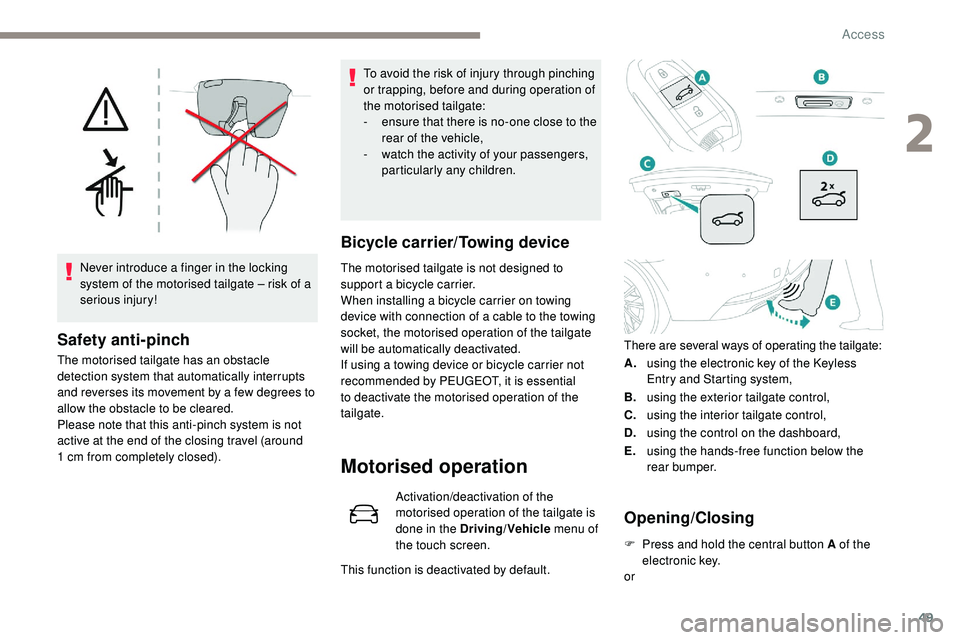
This function is deactivated by default. There are several ways of operating the tailgate:
Opening/Closing
A.
using the electronic key of the Keyless
Entry and Starting system,
B. using the exterior tailgate control,
C. using the interior tailgate control,
D. using the control on the dashboard,
E. using the hands-free function below the
rear bumper.
F
P
ress and hold the central button A of the
electronic key.
or
2
Access
Page 54 of 320
52
After installing a towing device, it is
essential to contact a PEUGEOT dealer
or a qualified workshop so that it is taken
into account by the detection system.
Other wise, there is a risk of hands-free
function failure.
Electric windows
For more information about the Electric child
lock, refer to the corresponding section.
Manual operation
To open or close the window, press or pull the
switch gently, without exceeding the point of
resistance. The window stops as soon as the
switch is released.
Automatic operation
To open or close the window, press or pull the
switch fully, beyond the point of resistance: the
window opens or closes completely when the
switch is released. Pressing the switch again
stops the movement of the window.
The electric window switches remain
operational for approximately 45 seconds
after switching off the ignition.
Once this time has elapsed, the electric
windows will not operate. To reactivate
them, switch the ignition on again.
Safety anti-pinch
When the window rises and meets an obstacle,
it stops and immediately partially lowers again.
To reset normal operation , press the switch
until the window opens completely, then
pull the switch immediately until the window
closes fully. Continue to hold the switch for
approximately one more second.
Deactivation of the rear
controls for the rear electric
windows
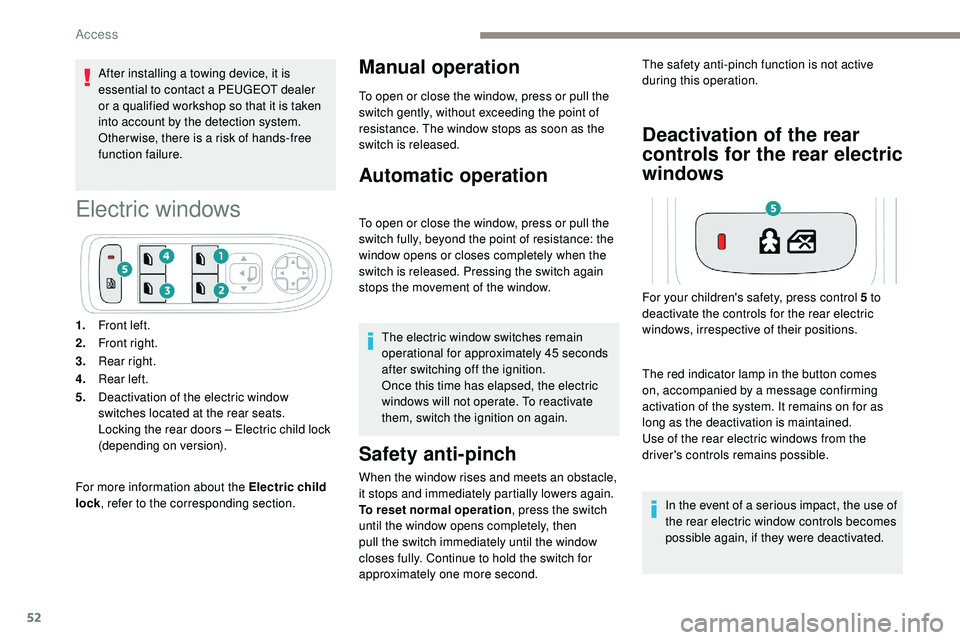
1. Front left.
2. Front right.
3. Rear right.
4. Rear left.
5. Deactivation of the electric window
switches located at the rear seats.
Locking the rear doors – Electric child lock
(depending on version). The safety anti-pinch function is not active
during this operation.
The red indicator lamp in the button comes
on, accompanied by a message confirming
activation of the system. It remains on for as
long as the deactivation is maintained.
Use of the rear electric windows from the
driver's controls remains possible. In the event of a serious impact, the use of
the rear electric window controls becomes
possible again, if they were deactivated.
For your children's safety, press control 5 to
deactivate the controls for the rear electric
windows, irrespective of their positions.
Access
Page 55 of 320
53
Reinitialising the electric
windows
Following reconnection of the battery, the
safety anti-pinch function must be reinitialised.
The safety anti-pinch function is not active
during these operations.
For each window:
-
b
ring the window down completely,
then bring it back up. It will go up by a
few centimetres each time. Repeat the
operation until the window is fully closed,
-
c
ontinue to pull the switch for at least one
second after reaching the window closed
position. In the event of contact (pinching) during
operation of the windows, you must
reverse the movement of the window.
To
do this, press the switch concerned.
When operating the passenger electric
window switches, the driver must ensure
that nothing is preventing correct closing
of the windows.
The driver must ensure that the
passengers use the electric windows
c o r r e c t l y.
Be particularly aware of children when
operating the windows.
Be aware of passengers or other persons
present when closing the windows using
the electronic key or the "Keyless Entry
and Starting" system.
Before any change of or operation on the
battery, slightly lower the four windows.
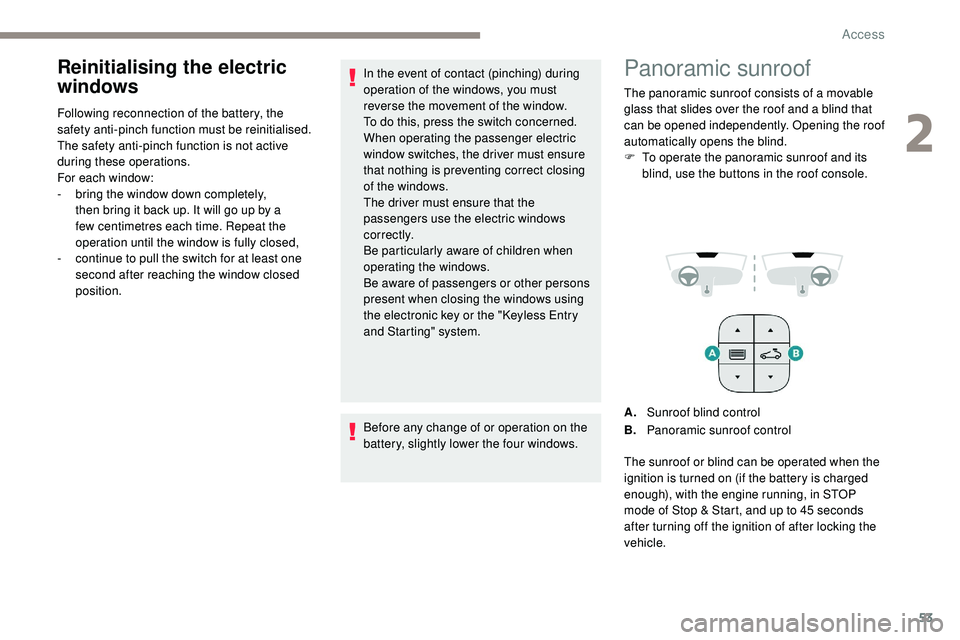
Panoramic sunroof
The panoramic sunroof consists of a movable
glass that slides over the roof and a blind that
can be opened independently. Opening the roof
automatically opens the blind.
F
T
o operate the panoramic sunroof and its
blind, use the buttons in the roof console.
A. Sunroof blind control
B. Panoramic sunroof control
The sunroof or blind can be operated when the
ignition is turned on (if the battery is charged
enough), with the engine running, in STOP
mode of Stop & Start, and up to 45
seconds
after turning off the ignition of after locking the
vehicle.
2
Access
Page 59 of 320
57
If your vehicle has electric door mirrors,
the ignition must be on to adjust them.
When driving
Maintain a good driving position and hold the
steering wheel with both hands at the "quarter
to three" position, so that you can quickly reach
the controls on and near the steering wheel.Never adjust the seats or steering wheel
when driving.
Always keep your feet on the floor.
Front seats
Front head restraints
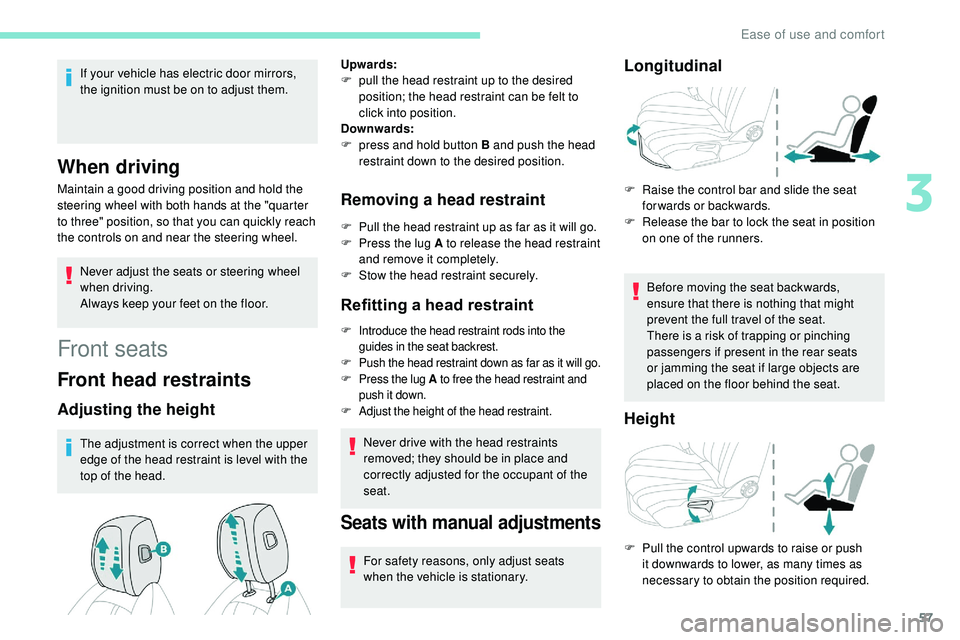
Adjusting the height
The adjustment is correct when the upper
edge of the head restraint is level with the
top of the head.
Removing a head restraint
F Pull the head restraint up as far as it will go.
F P ress the lug A to release the head restraint
and remove it completely.
F
S
tow the head restraint securely.
Refitting a head restraint
F Introduce the head restraint rods into the guides in the seat backrest.
F
P
ush the head restraint down as far as it will go.
F
P
ress the lug A to free the head restraint and
push it down.
F
A
djust the height of the head restraint.
Never drive with the head restraints
removed; they should be in place and
correctly adjusted for the occupant of the
seat.
Upwards:
F
p
ull the head restraint up to the desired
position; the head restraint can be felt to
click into position.
Downwards:
F
p
ress and hold button B and push the head
restraint down to the desired position.
Seats with manual adjustments
For safety reasons, only adjust seats
when the vehicle is stationary.
Longitudinal
F Raise the control bar and slide the seat forwards or backwards.
F
R
elease the bar to lock the seat in position
on one of the runners.
Before moving the seat backwards,
ensure that there is nothing that might
prevent the full travel of the seat.
There is a risk of trapping or pinching
passengers if present in the rear seats
or jamming the seat if large objects are
placed on the floor behind the seat.
Height
F Pull the control upwards to raise or push it downwards to lower, as many times as
necessary to obtain the position required.
3
Ease of use and comfort