ABS Peugeot 508 Hybrid 2014 Owner's Manual
[x] Cancel search | Manufacturer: PEUGEOT, Model Year: 2014, Model line: 508 Hybrid, Model: Peugeot 508 Hybrid 2014Pages: 380, PDF Size: 10.94 MB
Page 22 of 380
20
Warning / indicator lampStateCause Action / Observations
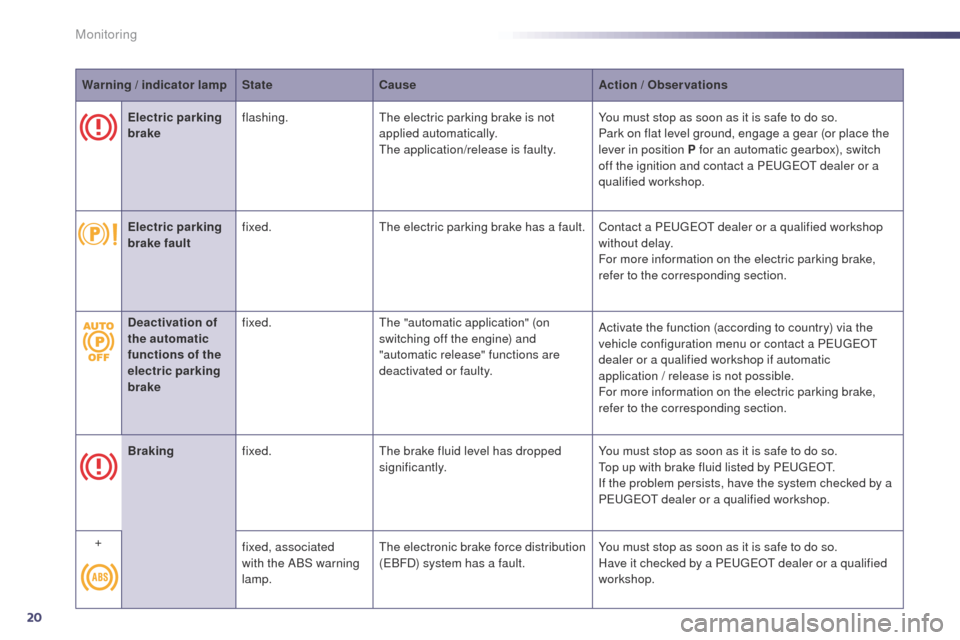
Electric parking
brake flashing.
th
e electric parking brake is not
applied automatically.
th
e application/release is faulty.You must stop as soon as it is safe to do so.
Park on flat level ground, engage a gear (or place the
lever in position P for an automatic gearbox), switch
off the ignition and contact a P
e
uge
Ot
dealer or a
qualified workshop.
Electric parking
brake fault fixed.
th
e electric parking brake has a fault. Contact a P
e
uge
Ot
dealer or a qualified workshop
without delay.
For more information on the electric parking brake,
refer to the corresponding section.
Braking fixed.
th
e brake fluid level has dropped
significantly. You must stop as soon as it is safe to do so.
to
p up with brake fluid listed by P
e
uge
Ot.
I
f the problem persists, have the system checked by a
P
e
uge
Ot
dealer or a qualified workshop.
+ fixed, associated
with the ABS warning
lamp.
th
e electronic brake force distribution
(
eB
FD) system has a fault.You must stop as soon as it is safe to do so.
Have it checked by a P
e
uge
Ot
dealer or a qualified
workshop.
Deactivation of
the automatic
functions of the
electric parking
brake
fixed.
th
e "automatic application" (on
switching off the engine) and
"automatic release" functions are
deactivated or faulty. Activate the function (according to country) via the
vehicle configuration menu or contact a P
e
uge
Ot
dealer or a qualified workshop if automatic
application
/ release is not possible.
For more information on the electric parking brake,
refer to the corresponding section.
Monitoring
Page 23 of 380
21
Warning / indicator lampStateCause Action / Observations
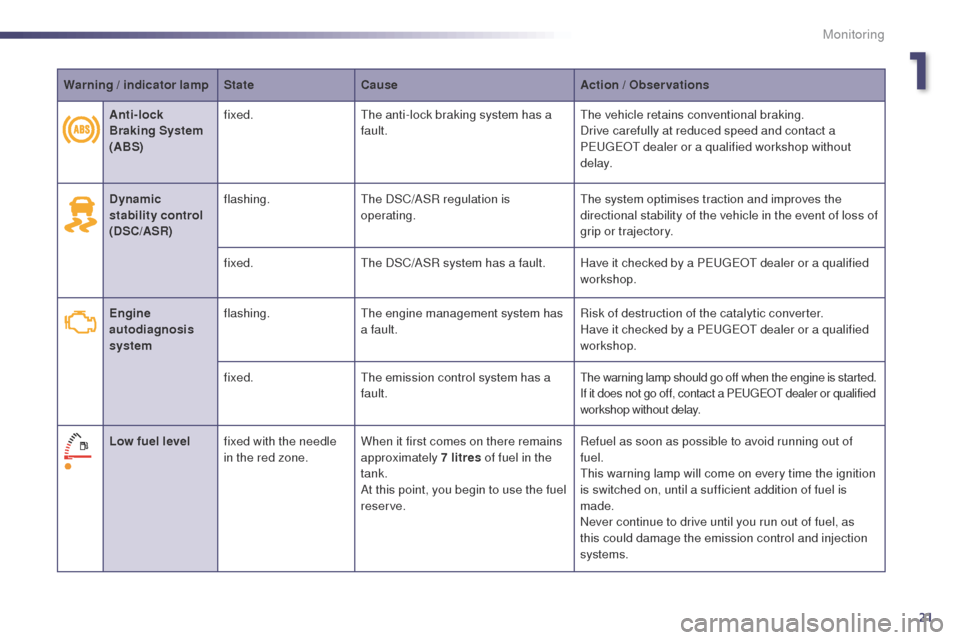
Dynamic
stability control
(DSC/ASR) flashing.
th
e DSC/ASR regulation is
operating.
th
e system optimises traction and improves the
directional stability of the vehicle in the event of loss of
grip or trajectory.
fixed.
th
e DSC/ASR system has a fault. Have it checked by a P
e
uge
Ot
dealer or a qualified
workshop.
Engine
autodiagnosis
system flashing.
the
engine management system has
a fault. Risk of destruction of the catalytic converter.
Have it checked by a P
e
uge
Ot
dealer or a qualified
workshop.
fixed.
th
e emission control system has a
fault.
the warning lamp should go off when the engine is started.
If it does not go off, contact a Pe ugeOt dealer or qualified
workshop without delay.
Low fuel level fixed with the needle
in the red zone. When it first comes on there remains
approximately 7 litres of fuel in the
tank.
At this point, you begin to use the fuel
reserve. Refuel as soon as possible to avoid running out of
fuel.
th
is warning lamp will come on every time the ignition
is switched on, until a sufficient addition of fuel is
made.
Never continue to drive until you run out of fuel, as
this could damage the emission control and injection
systems.
Anti-lock
Braking System
(ABS)
fixed.
th
e anti-lock braking system has a
fault.
th
e vehicle retains conventional braking.
Drive carefully at reduced speed and contact a
P
e
uge
Ot
dealer or a qualified workshop without
d e l ay.
1
Monitoring
Page 33 of 380
31
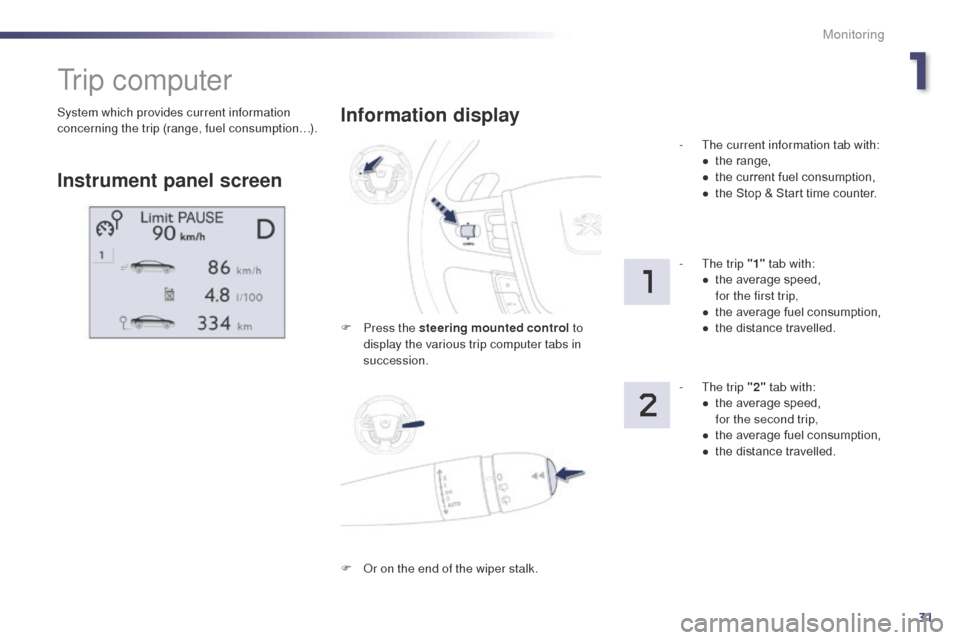
System which provides current information
concerning the trip (range, fuel consumption…).
tr i p c o m p u t e r
Instrument panel screenInformation display
F Press the steering mounted control
to
display the various trip computer tabs in
succession. -
t
h
e current information tab with:
●
t
he range,
●
t
he current fuel consumption,
●
t
he Stop & Start time counter.
- t
h
e trip "1"
tab with:
●
t
he average speed,
f
or the first trip,
●
t
he average fuel consumption,
● t he distance travelled.
- t
h
e trip "2" tab with:
●
t
he average speed,
f
or the second trip,
●
t
he average fuel consumption,
●
t
he distance travelled.
F
O
r on the end of the wiper stalk.
1
Monitoring
Page 35 of 380
33
Information display
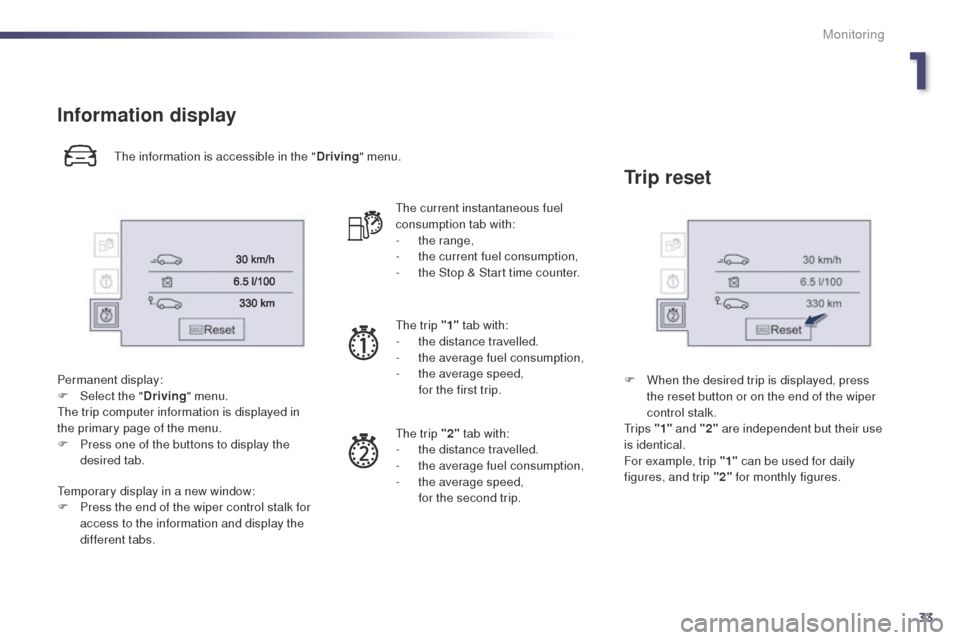
the information is accessible in the "Driving" menu.
Permanent display:
F
Sel
ect the " Driving" menu.
th
e trip computer information is displayed in
the primary page of the menu.
F
P
ress one of the buttons to display the
desired tab.
te
mporary display in a new window:
F
P
ress the end of the wiper control stalk for
access to the information and display the
different tabs.
th
e current instantaneous fuel
consumption tab with:
-
t
he range,
-
t
he current fuel consumption,
-
t
he Stop & Start time counter.
th
e trip "1" tab with:
-
t
he distance travelled.
-
t
he average fuel consumption,
-
t
he average speed,
f
or the first trip.
th
e trip "2" tab with:
-
t
he distance travelled.
-
t
he average fuel consumption,
-
t
he average speed,
f
or the second trip.
Trip reset
F When the desired trip is displayed, press the reset button or on the end of the wiper
control stalk.
t
r i p s "1" and "2" are independent but their use
is identical.
For example, trip "1" can be used for daily
figures, and trip "2" for monthly figures.
1
Monitoring
Page 55 of 380
53
508_en_Chap02_ouvertures_ed02-2014
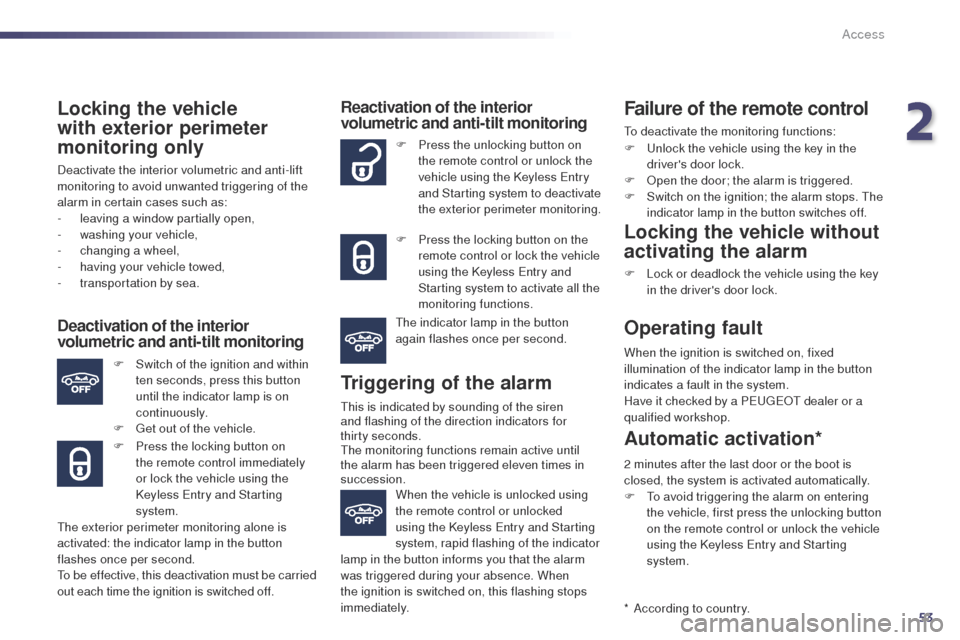
Locking the vehicle
with exterior perimeter
monitoring only
Deactivate the interior volumetric and anti-lift
monitoring to avoid unwanted triggering of the
alarm in certain cases such as:
-
l
eaving a window partially open,
-
w
ashing your vehicle,
-
c
hanging a wheel,
-
h
aving your vehicle towed,
-
t
ransportation by sea.
Deactivation of the interior
volumetric and anti-tilt monitoring
F Switch of the ignition and within ten seconds, press this button
until the indicator lamp is on
continuously.
F
g
e
t out of the vehicle.
F
P
ress the locking button on
the remote control immediately
or lock the vehicle using the
Keyless
e
n
try and Starting
system.
th
e exterior perimeter monitoring alone is
activated: the indicator lamp in the button
flashes once per second.
to b
e effective, this deactivation must be carried
out each time the ignition is switched off.
Reactivation of the interior
volumetric and anti-tilt monitoring
Triggering of the alarm
this is indicated by sounding of the siren
and flashing of the direction indicators for
thirty
seconds.
th
e monitoring functions remain active until
the alarm has been triggered eleven times in
succession. F
P
ress the unlocking button on
the remote control or unlock the
vehicle using the Keyless e
n
try
and Starting system to deactivate
the exterior perimeter monitoring.
F
P
ress the locking button on the
remote control or lock the vehicle
using the Keyless e
n
try and
Starting system to activate all the
monitoring functions.
th
e indicator lamp in the button
again flashes once per second.
When the vehicle is unlocked using
the remote control or unlocked
using the Keyless
e
n
try and Starting
system, rapid flashing of the indicator
lamp in the button informs you that the alarm
was triggered during your absence. When
the ignition is switched on, this flashing stops
immediately.
Failure of the remote control
to deactivate the monitoring functions:
F
u
n
lock the vehicle using the key in the
driver's door lock.
F
O
pen the door; the alarm is triggered.
F
S
witch on the ignition; the alarm stops. t
h
e
indicator lamp in the button switches off.
Locking the vehicle without
activating the alarm
F Lock or deadlock the vehicle using the key in the driver's door lock.
Operating fault
When the ignition is switched on, fixed
illumination of the indicator lamp in the button
indicates a fault in the system.
Have it checked by a P
e
uge
Ot
dealer or a
qualified workshop.
*
A
ccording to country.
Automatic activation*
2 minutes after the last door or the boot is
closed, the system is activated automatically.
F t
o a
void triggering the alarm on entering
the vehicle, first press the unlocking button
on the remote control or unlock the vehicle
using the Keyless
e
n
try and Starting
system.
2
Access
Page 173 of 380
171
508_en_Chap07_securite_ed02-2014
Safety
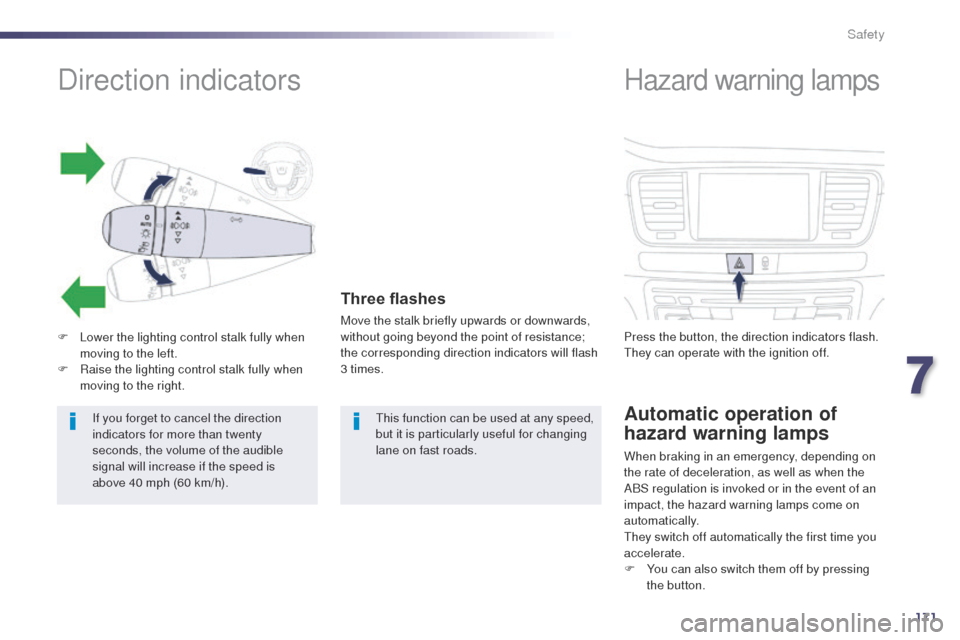
Direction indicators
F Lower the lighting control stalk fully when moving to the left.
F
R
aise the lighting control stalk fully when
moving to the right.
Three flashes
Move the stalk briefly upwards or downwards,
without going beyond the point of resistance;
the corresponding direction indicators will flash
3 times.
If you forget to cancel the direction
indicators for more than twenty
seconds, the volume of the audible
signal will increase if the speed is
above
40 mph (60 km/h).
Hazard warning lamps
Press the button, the direction indicators flash.th ey can operate with the ignition off.
Automatic operation of
hazard warning lamps
When braking in an emergency, depending on
the rate of deceleration, as well as when the
ABS regulation is invoked or in the event of an
impact, the hazard warning lamps come on
automatically.
th
ey switch off automatically the first time you
accelerate.
F
Y
ou can also switch them off by pressing
the button.
th
is function can be used at any speed,
but it is particularly useful for changing
lane on fast roads.
7
Page 178 of 380
176
508_en_Chap07_securite_ed02-2014
electronic Stability Control (eSC) incorporating
the following systems:
-
t
he anti-lock braking system (ABS) and the
electronic brake force distribution (
eB
FD),
-
t
he emergency braking assistance,
-
t
he anti-slip regulation (ASR) or traction
control,
-
t
he dynamic stability control (DSC).
electronic stability control (eS C)
Definitions
Anti-lock braking system (ABS)
and electronic brake force
distribution (EBFD)
this system improves the stability and
manoeuvrability of your vehicle when braking
and provides improved control in corners, in
particular on poor or slippery road sur faces.
th
e ABS prevents wheel lock in the event of
emergency braking.
th
e electronic brake force distribution system
manages the braking pressure wheel by wheel.
Emergency braking assistance
In an emergency, this system enables you to
reach the optimum braking pressure more
quickly and therefore reduce the stopping
distance.
It is triggered according to the speed at which
the brake pedal is pressed.
t
h
is is felt by a
reduction in the resistance of the pedal and an
increase in the effectiveness of the braking.
Anti-slip regulation (ASR)
the ASR system (also known as tr action
Control) optimises traction in order to limit
wheel slip by acting on the brakes of the driving
wheels and on the engine. It also improves
the directional stability of the vehicle on
acceleration.
Dynamic stability control (DSC)
If there is a difference between the path
followed by the vehicle and that required by
the driver, the DSC monitors each wheel and
automatically acts on the brake of one or more
wheels and on the engine to return the vehicle
to the required path, within the limits of the laws
of physics.
Safety
Page 179 of 380
177
508_en_Chap07_securite_ed02-2014
Snow driving assistance
(Intelligent Traction Control)
Your vehicle has a system to help driving on
snow: Intelligent Traction Control.
th
is automatic system continuously checks
for situations of difficult sur face adhesion that
could make it difficult to move off or make
progress on deep fresh snow or compacted
snow.
In these situations, Intelligent Traction
Control limits the amount of wheel slip to
provide the best traction and trajectory control.
In extremely severe conditions (deep snow,
mud…), it can be useful to temporarily
deactivate the wheel anti-slip regulation
system to allow a degree of wheel spin and so
recover grip.
It is recommended that the system be
reactivated as soon as possible.
Snow tyres are strongly recommended on
sur faces offering low levels of adhesion.
Operation
Anti-lock braking system (ABS)
and electronic brake force
distribution (EBFD)
In emergency braking, press
very firmly without releasing the
pressure. When changing wheels (tyres and rims),
make sure that these are approved for
your vehicle.
Normal operation of the ABS may make
itself felt by slight vibrations of the brake
pedal.
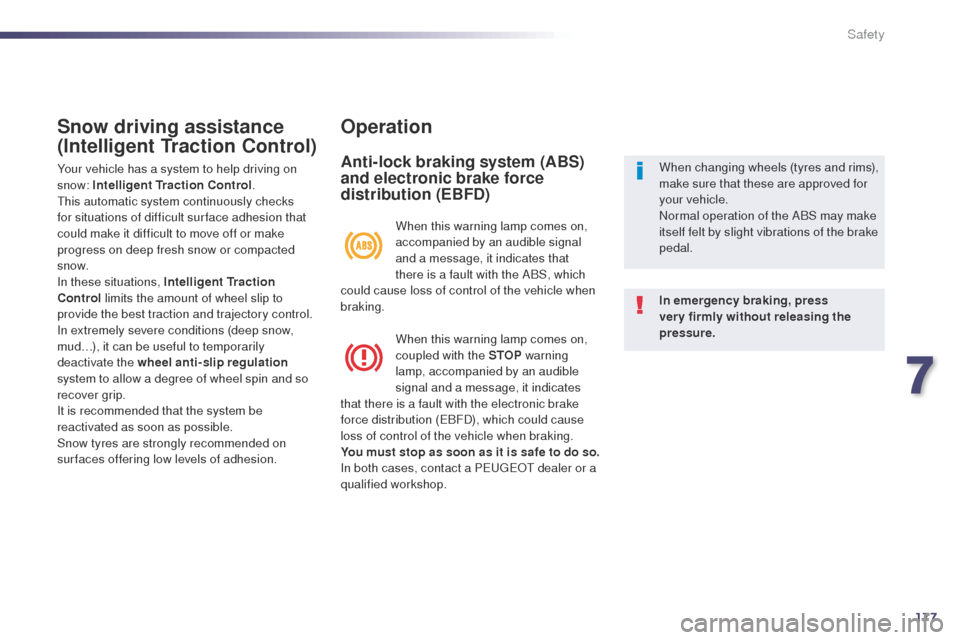
When this warning lamp comes on,
accompanied by an audible signal
and a message, it indicates that
there is a fault with the ABS, which
could cause loss of control of the vehicle when
braking.
When this warning lamp comes on,
coupled with the STOP warning
lamp, accompanied by an audible
signal and a message, it indicates
that there is a fault with the electronic brake
force distribution (
eB
FD), which could cause
loss of control of the vehicle when braking.
You must stop as soon as it is safe to do so.
In both cases, contact a P
e
uge
Ot
dealer or a
qualified workshop.
7
Safety
Page 205 of 380
203
508_en_Chap08_info-pratiques_ed02-2014
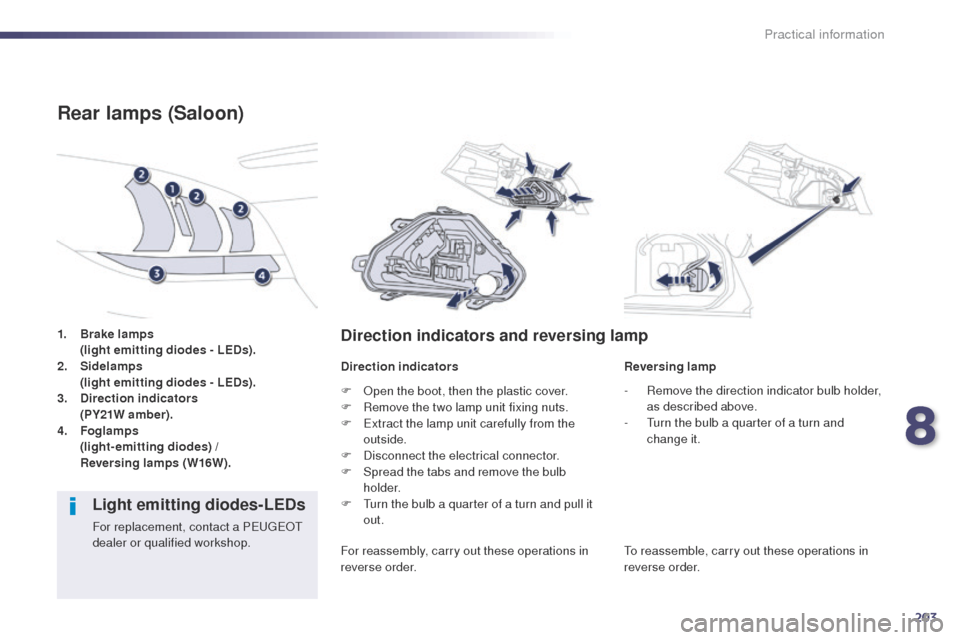
1. Brake lamps
( light emitting diodes - LEDs).
2.
Si
delamps
(
light emitting diodes - LEDs).
3.
D
irection indicators
(
PY21W amber).
4.
Fo
glamps
(
light-emitting diodes) /
R
eversing lamps (W16W).
Rear lamps (Saloon)
Direction indicators and reversing lamp
Direction indicators Reversing lamp
Light emitting diodes-LEDs
For replacement, contact a PeugeOt
dealer or qualified workshop. F
O
pen the boot, then the plastic cover.
F
R
emove the two lamp unit fixing nuts.
F e
x
tract the lamp unit carefully from the
outside.
F
D
isconnect the electrical connector.
F
S
pread the tabs and remove the bulb
h o l d e r.
F t
u
rn the bulb a quarter of a turn and pull it
out.
For reassembly, carry out these operations in
reverse order. -
R
emove the direction indicator bulb holder,
as described above.
- t
u
rn the bulb a quarter of a turn and
change it.
to r
eassemble, carry out these operations in
reverse order.
8
Practical information
Page 223 of 380
221
508_en_Chap08_info-pratiques_ed02-2014
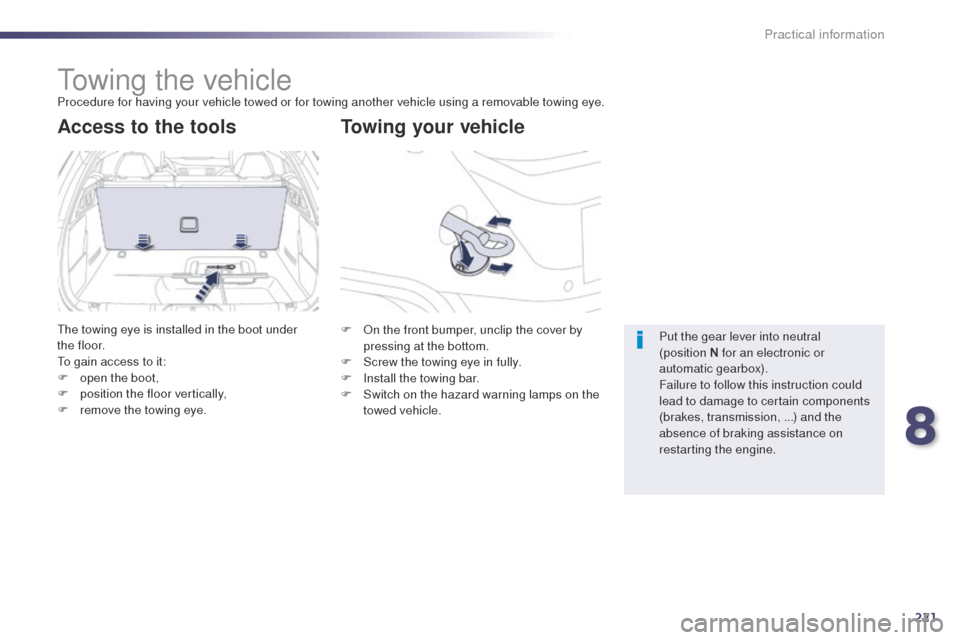
towing the vehicleProcedure for having your vehicle towed or for towing another vehicle using a removable towing eye.
Towing your vehicle
Access to the tools
the towing eye is installed in the boot under
t h e f l o o r.
to g
ain access to it:
F
o
pen the boot,
F
p
osition the floor vertically,
F
r
emove the towing eye. F
O n the front bumper, unclip the cover by
pressing at the bottom.
F
S
crew the towing eye in fully.
F
I
nstall the towing bar.
F
S
witch on the hazard warning lamps on the
towed vehicle. Put the gear lever into neutral
(position
N for an electronic or
automatic gearbox).
Failure to follow this instruction could
lead to damage to certain components
(brakes, transmission, ...) and the
absence of braking assistance on
restarting the engine.
8
Practical information