ignition Peugeot 807 2013 User Guide
[x] Cancel search | Manufacturer: PEUGEOT, Model Year: 2013, Model line: 807, Model: Peugeot 807 2013Pages: 234, PDF Size: 9.8 MB
Page 33 of 234
Instruments and controls
READY TO SET OFF
2
31
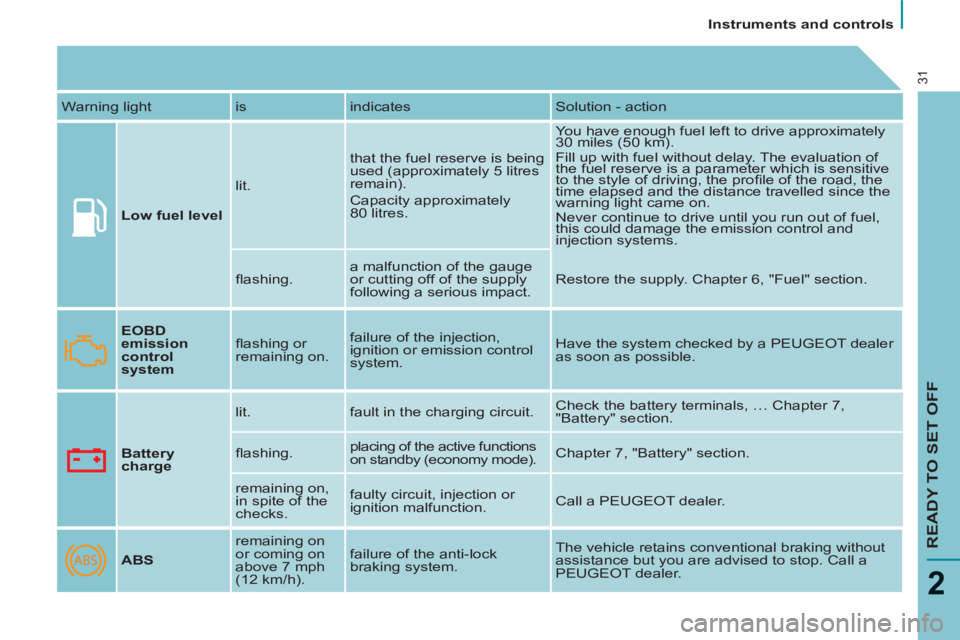
Warning light is indicates Solution - action
Low fuel level
lit. that the fuel reserve is being
used (approximately 5 litres
remain).
Capacity approximately
80 litres. You have enough fuel left to drive approximately
30 miles (50 km).
Fill up with fuel without delay. The evaluation of
the fuel reserve is a parameter which is sensitive
to the style of driving, the profi le of the road, the
time elapsed and the distance travelled since the
warning light came on.
Never continue to drive until you run out of fuel,
this could damage the emission control and
injection systems.
fl ashing. a malfunction of the gauge
or cutting off of the supply
following a serious impact. Restore the supply. Chapter 6, "Fuel" section.
EOBD
emission
control
system
fl ashing or
remaining on. failure of the injection,
ignition or emission control
system. Have the system checked by a PEUGEOT dealer
as soon as possible.
Battery
charge
lit. fault in the charging circuit. Check the battery terminals, … Chapter 7,
"Battery" section.
fl ashing. placing of the active functions
on standby (economy mode). Chapter 7, "Battery" section.
remaining on,
in spite of the
checks. faulty circuit, injection or
ignition malfunction. Call a PEUGEOT dealer.
ABS
remaining on
or coming on
above 7 mph
(12 km/h). failure of the anti-lock
braking system. The vehicle retains conventional braking without
assistance but you are advised to stop. Call a
PEUGEOT dealer.
Page 34 of 234
Instruments and controls
32
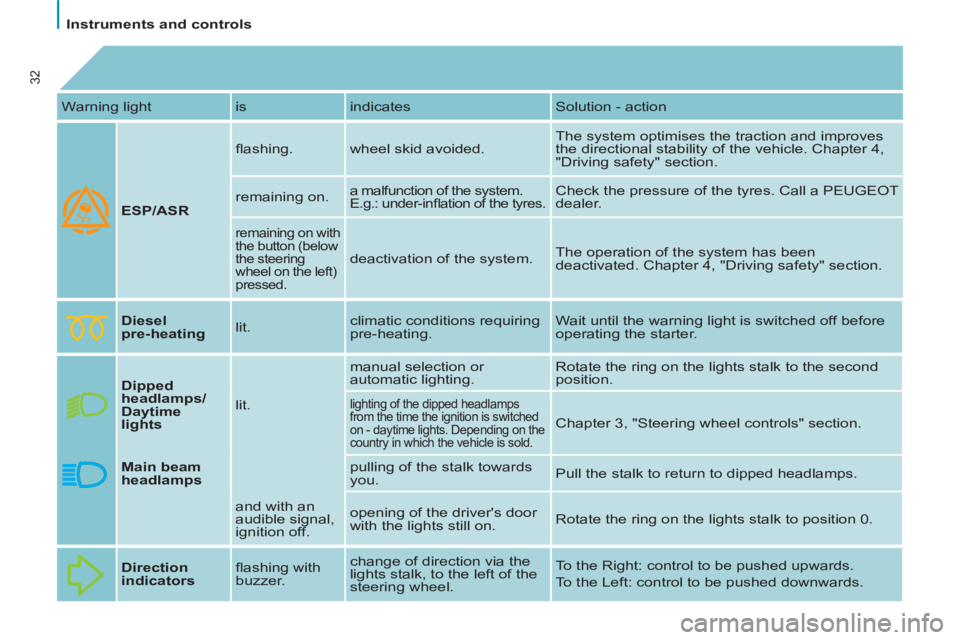
Warning light is indicates Solution - action
ESP/ASR
fl ashing. wheel skid avoided. The system optimises the traction and improves
the directional stability of the vehicle. Chapter 4,
"Driving safety" section.
remaining on.
a malfunction of the system.
E.g.: under-infl ation of the tyres.
Check the pressure of the tyres. Call a PEUGEOT
dealer.
remaining on with
the button (below
the steering
wheel on the left)
pressed.
deactivation of the system. The operation of the system has been
deactivated. Chapter 4, "Driving safety" section.
Diesel
pre-heating
lit. climatic conditions requiring
pre-heating. Wait until the warning light is switched off before
operating the starter.
Dipped
headlamps/
Daytime
lights
lit. manual selection or
automatic lighting. Rotate the ring on the lights stalk to the second
position.
lighting of the dipped headlamps
from the time the ignition is switched
on - daytime lights. Depending on the
country in which the vehicle is sold.
Chapter 3, "Steering wheel controls" section.
Main beam
headlamps
pulling of the stalk towards
you. Pull the stalk to return to dipped headlamps.
and with an
audible signal,
ignition off. opening of the driver's door
with the lights still on. Rotate the ring on the lights stalk to position 0.
Direction
indicators
fl ashing with
buzzer. change of direction via the
lights stalk, to the left of the
steering wheel. To the Right: control to be pushed upwards.
To the Left: control to be pushed downwards.
Page 36 of 234
Instruments and controls
34
Wait for the engine to cool before
topping up the level.
The cooling system is pressurised.
In the event of a breakdown and in
order to avoid any risk of scalding,
unscrew the cap two turns to allow the
pressure to drop.
When the pressure has dropped,
remove the cap and top up the level.
Contact a PEUGEOT dealer.
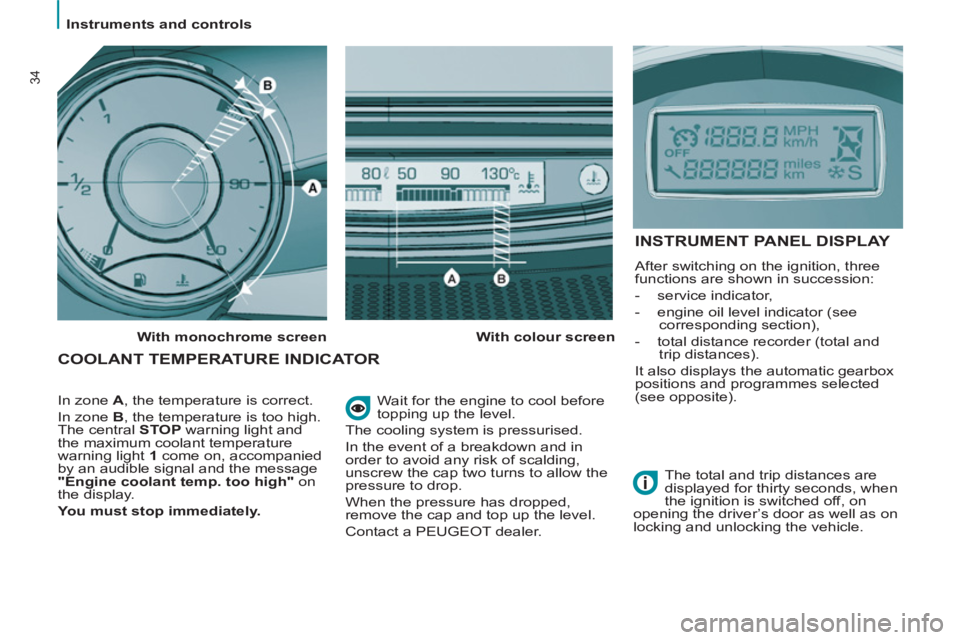
COOLANT TEMPERATURE INDICATOR
In zone A
, the temperature is correct.
In zone B
, the temperature is too high.
The central STOP
warning light and
the maximum coolant temperature
warning light 1
come on, accompanied
by an audible signal and the message
"Engine coolant temp. too high"
on
the display.
You must stop immediately.
With monochrome screen
With colour screen
INSTRUMENT PANEL DISPLAY
After switching on the ignition, three
functions are shown in succession:
- service indicator,
- engine oil level indicator (see
corresponding section),
- total distance recorder (total and
trip distances).
It also displays the automatic gearbox
positions and programmes selected
(see opposite).
The total and trip distances are
displayed for thirty seconds, when
the ignition is switched off, on
opening the driver’s door as well as on
locking and unlocking the vehicle.
Page 37 of 234
Instruments and controls
READY TO SET OFF
2
35
Service indicator
The display, located in the control
block, informs you when the next
service will be due in accordance
with the "Manufacturer’s" servicing
schedule indicated in the servicing
booklet. This information is determined
in relation to the distance travelled
since the previous service.
A few seconds after the ignition is
switched on, the oil level is displayed,
then the total distance recorder
resumes normal operation showing the
total and trip distances.
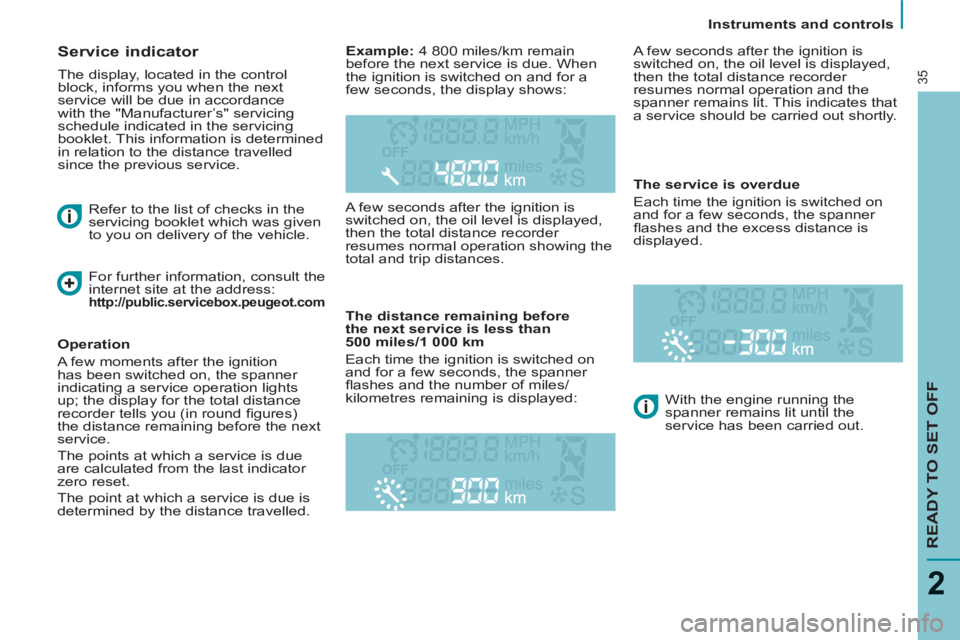
The distance remaining before
the next service is less than
500 miles/1 000 km
Each time the ignition is switched on
and for a few seconds, the spanner
fl ashes and the number of miles/
kilometres remaining is displayed: A few seconds after the ignition is
switched on, the oil level is displayed,
then the total distance recorder
resumes normal operation and the
spanner remains lit. This indicates that
a service should be carried out shortly.
The service is overdue
Each time the ignition is switched on
and for a few seconds, the spanner
fl ashes and the excess distance is
displayed.
With the engine running the
spanner remains lit until the
service has been carried out.
Example:
4 800 miles/km remain
before the next service is due. When
the ignition is switched on and for a
few seconds, the display shows:
Refer to the list of checks in the
servicing booklet which was given
to you on delivery of the vehicle.
Operation
A few moments after the ignition
has been switched on, the spanner
indicating a service operation lights
up; the display for the total distance
recorder tells you (in round fi gures)
the distance remaining before the next
service.
The points at which a service is due
are calculated from the last indicator
zero reset.
The point at which a service is due is
determined by the distance travelled.
For further information, consult the
internet site at the address:
http://public.servicebox.peugeot.com
Page 38 of 234
Instruments and controls
36
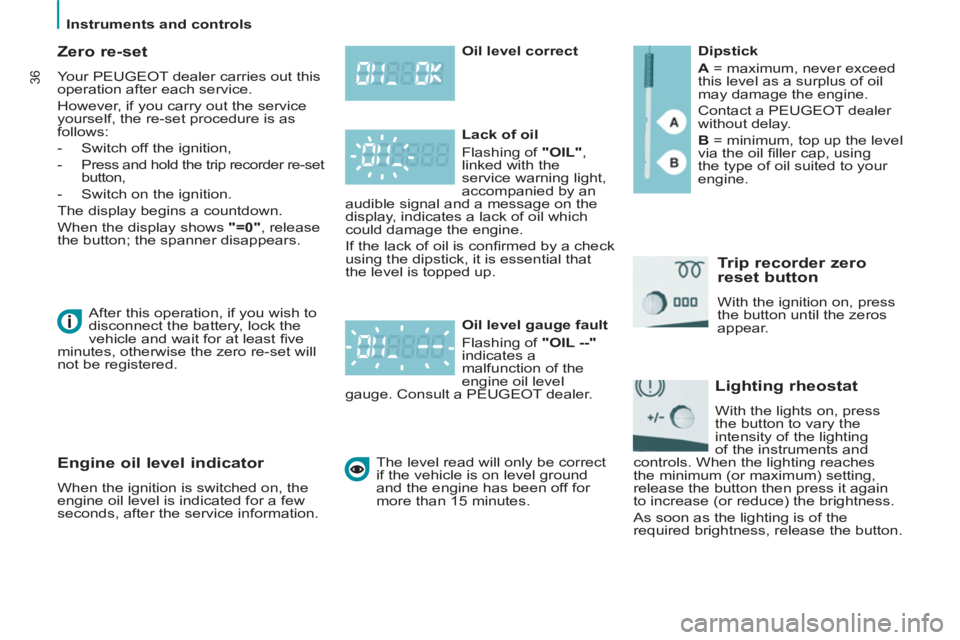
Zero re-set
Your PEUGEOT dealer carries out this
operation after each service.
However, if you carry out the service
yourself, the re-set procedure is as
follows:
- Switch off the ignition,
- Press and hold the trip recorder re-set
button,
- Switch on the ignition.
The display begins a countdown.
When the display shows "= 0 ", release
the button; the spanner disappears.
Engine oil level indicator
When the ignition is switched on, the
engine oil level is indicated for a few
seconds, after the service information.
Oil level correct
Lack of oil
Flashing of "OIL"
,
linked with the
service warning light,
accompanied by an
audible signal and a message on the
display, indicates a lack of oil which
could damage the engine.
If the lack of oil is confi rmed by a check
using the dipstick, it is essential that
the level is topped up.
Oil level gauge fault
Flashing of "OIL --"
indicates a
malfunction of the
engine oil level
gauge. Consult a PEUGEOT dealer.
Dipstick
A
= maximum, never exceed
this level as a surplus of oil
may damage the engine.
Contact a PEUGEOT dealer
without delay.
B
= minimum, top up the level
via the oil fi ller cap, using
the type of oil suited to your
engine.
Trip recorder zero
reset button
With the ignition on, press
the button until the zeros
appear.
Lighting rheostat
With the lights on, press
the button to vary the
intensity of the lighting
of the instruments and
controls. When the lighting reaches
the minimum (or maximum) setting,
release the button then press it again
to increase (or reduce) the brightness.
As soon as the lighting is of the
required brightness, release the button. The level read will only be correct
if the vehicle is on level ground
and the engine has been off for
more than 15 minutes. After this operation, if you wish to
disconnect the battery, lock the
vehicle and wait for at least fi ve
minutes, otherwise the zero re-set will
not be registered.
Page 44 of 234
42
Starting and stopping
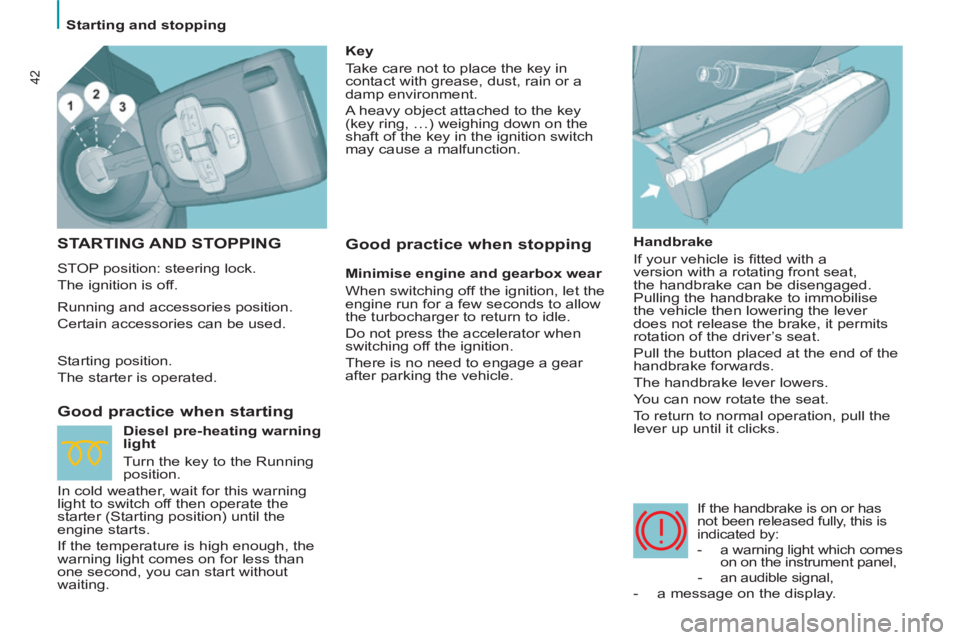
STARTING AND STOPPING
STOP position: steering lock.
The ignition is off.
Good practice when starting
Handbrake
If your vehicle is fi tted with a
version with a rotating front seat,
the handbrake can be disengaged.
Pulling the handbrake to immobilise
the vehicle then lowering the lever
does not release the brake, it permits
rotation of the driver’s seat.
Pull the button placed at the end of the
handbrake forwards.
The handbrake lever lowers.
You can now rotate the seat.
To return to normal operation, pull the
lever up until it clicks.
If the handbrake is on or has
not been released fully, this is
indicated by:
- a warning light which comes
on on the instrument panel,
- an audible signal,
- a message on the display.
Key
Take care not to place the key in
contact with grease, dust, rain or a
damp environment.
A heavy object attached to the key
(key ring, …) weighing down on the
shaft of the key in the ignition switch
may cause a malfunction.
Running and accessories position.
Certain accessories can be used.
Starting position.
The starter is operated.
Diesel pre-heating warning
light
Turn the key to the Running
position.
In cold weather, wait for this warning
light to switch off then operate the
starter (Starting position) until the
engine starts.
If the temperature is high enough, the
warning light comes on for less than
one second, you can start without
waiting.
Good practice when stopping
Minimise engine and gearbox wear
When switching off the ignition, let the
engine run for a few seconds to allow
the turbocharger to return to idle.
Do not press the accelerator when
switching off the ignition.
There is no need to engage a gear
after parking the vehicle.
Page 46 of 234
Steering mounted controls
44
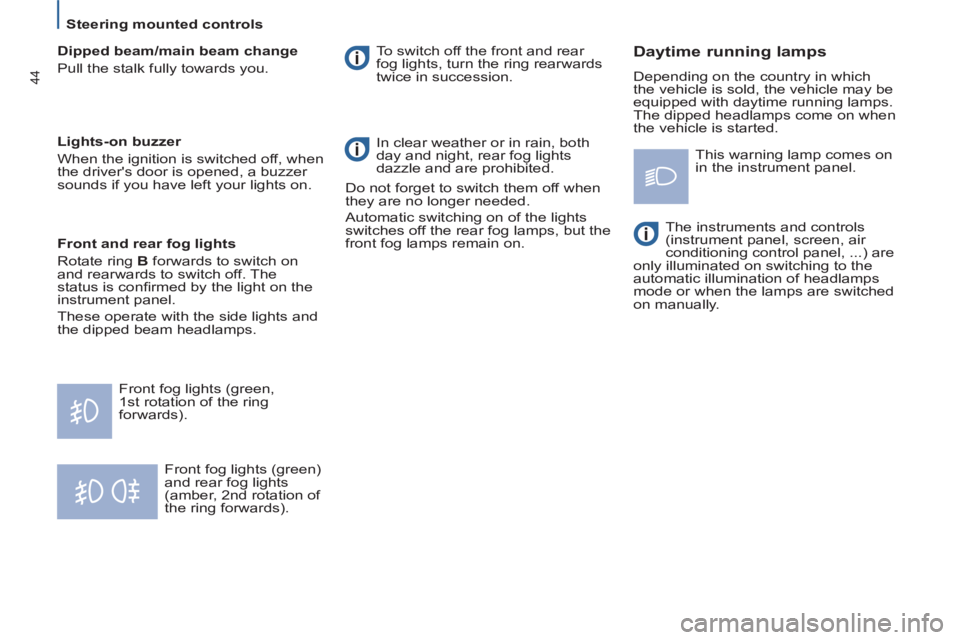
Front fog lights (green)
and rear fog lights
(amber, 2nd rotation of
the ring forwards). To switch off the front and rear
fog lights, turn the ring rearwards
twice in succession.
Front and rear fog lights
Rotate ring B
forwards to switch on
and rearwards to switch off. The
status is confi rmed by the light on the
instrument panel.
These operate with the side lights and
the dipped beam headlamps. In clear weather or in rain, both
day and night, rear fog lights
dazzle and are prohibited.
Do not forget to switch them off when
they are no longer needed.
Automatic switching on of the lights
switches off the rear fog lamps, but the
front fog lamps remain on.
Daytime running lamps
Depending on the country in which
the vehicle is sold, the vehicle may be
equipped with daytime running lamps.
The dipped headlamps come on when
the vehicle is started.
The instruments and controls
(instrument panel, screen, air
conditioning control panel, ...) are
only illuminated on switching to the
automatic illumination of headlamps
mode or when the lamps are switched
on manually.
Dipped beam/main beam change
Pull the stalk fully towards you.
Front fog lights (green,
1st rotation of the ring
forwards).
Lights-on buzzer
When the ignition is switched off, when
the driver's door is opened, a buzzer
sounds if you have left your lights on. This warning lamp comes on
in the instrument panel.
Page 47 of 234
Steering wheel controls
EASE OF USE and COMFORT
3
45
Automatic "Follow-Me-Home"
lighting
With the ignition off, when you leave
your vehicle with the automatic
switching on of the lights function
activated
, the side lights and dipped
headlamps remain on for the selected
duration.
To deactivate or activate this
function, go to the display
confi guration menu.
The duration of the timed period must
also be set (15, 30, 60 seconds), via
the display confi guration menu.
Carry out these operations when the
vehicle is stationary.
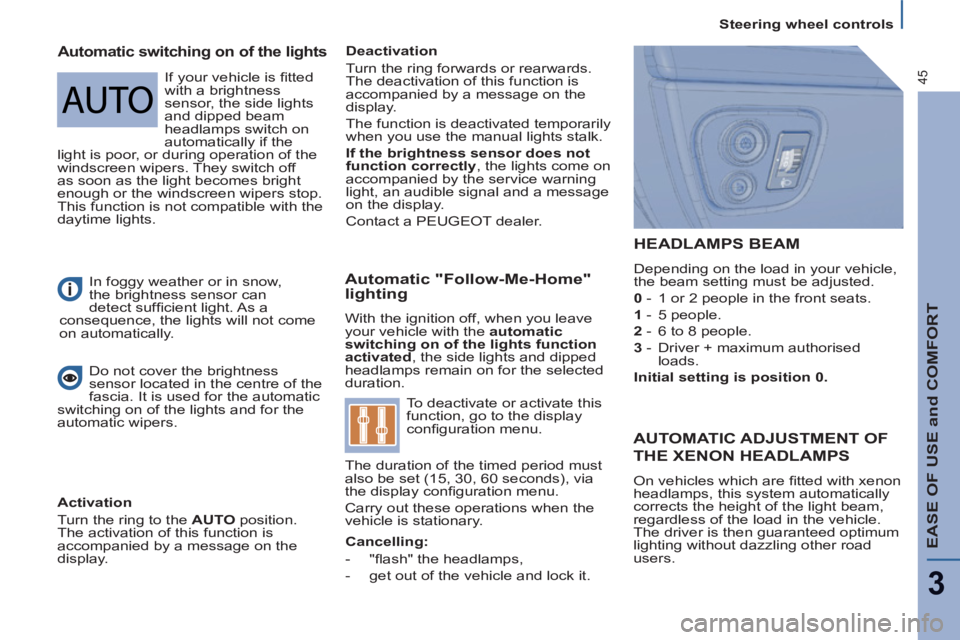
HEADLAMPS BEAM
Depending on the load in your vehicle,
the beam setting must be adjusted.
0
- 1 or 2 people in the front seats.
1
- 5 people.
2
- 6 to 8 people.
3
- Driver + maximum authorised
loads.
Initial setting is position 0.
In foggy weather or in snow,
the brightness sensor can
detect suffi cient light. As a
consequence, the lights will not come
on automatically.
Automatic switching on of the lights
Deactivation
Turn the ring forwards or rearwards.
The deactivation of this function is
accompanied by a message on the
display.
The function is deactivated temporarily
when you use the manual lights stalk.
If the brightness sensor does not
function correctly
, the lights come on
accompanied by the service warning
light, an audible signal and a message
on the display.
Contact a PEUGEOT dealer.
Do not cover the brightness
sensor located in the centre of the
fascia. It is used for the automatic
switching on of the lights and for the
automatic wipers.
Activation
Turn the ring to the AUTO
position.
The activation of this function is
accompanied by a message on the
display.
AUTOMATIC ADJUSTMENT OF
THE XENON HEADLAMPS
On vehicles which are fi tted with xenon
headlamps, this system automatically
corrects the height of the light beam,
regardless of the load in the vehicle.
The driver is then guaranteed optimum
lighting without dazzling other road
users.
Cancelling:
- "fl ash" the headlamps,
-
get out of the vehicle and lock it.
If your vehicle is fi tted
with a brightness
sensor, the side lights
and dipped beam
headlamps switch on
automatically if the
light is poor, or during operation of the
windscreen wipers. They switch off
as soon as the light becomes bright
enough or the windscreen wipers stop.
This function is not compatible with the
daytime lights.
Page 48 of 234
Steering mounted controls
46
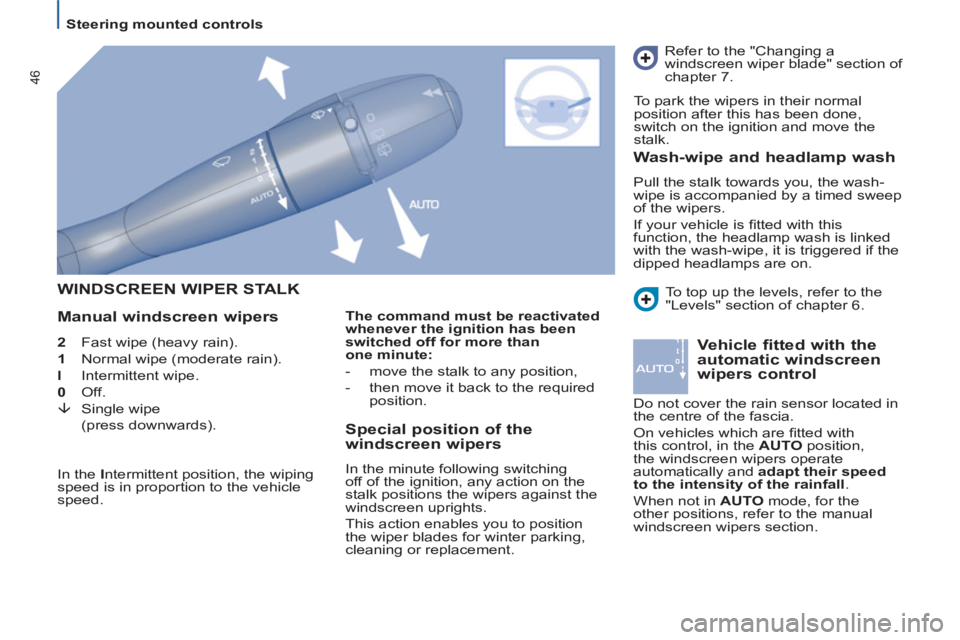
WINDSCREEN WIPER STALK
Manual windscreen wipers
Special position of the
windscreen wipers
In the minute following switching
off of the ignition, any action on the
stalk positions the wipers against the
windscreen uprights.
This action enables you to position
the wiper blades for winter parking,
cleaning or replacement.
Vehicle fitted with the
automatic windscreen
wipers control
Do not cover the rain sensor located in
the centre of the fascia.
On vehicles which are fi tted with
this control, in the AUTO
position,
the windscreen wipers operate
automatically and adapt their speed
to the intensity of the rainfall
.
When not in AUTO
mode, for the
other positions, refer to the manual
windscreen wipers section.
The command must be reactivated
whenever the ignition has been
switched off for more than
one minute:
-
move the stalk to any position,
-
then move it back to the required
position.
2
Fast wipe (heavy rain).
1
Normal wipe (moderate rain).
l
Intermittent wipe.
0
Off.
È
Single wipe
(press downwards). Refer to the "Changing a
windscreen wiper blade" section of
chapter 7.
Wash-wipe and headlamp wash
Pull the stalk towards you, the wash-
wipe is accompanied by a timed sweep
of the wipers.
If your vehicle is fi tted with this
function, the headlamp wash is linked
with the wash-wipe, it is triggered if the
dipped headlamps are on. To park the wipers in their normal
position after this has been done,
switch on the ignition and move the
stalk.
To top up the levels, refer to the
"Levels" section of chapter 6.
In the I
ntermittent position, the wiping
speed is in proportion to the vehicle
speed.
Page 49 of 234
Steering wheel controls
EASE OF USE and COMFORT
3
47
Activation
Press the control downwards.
Activation of the function is
accompanied by a message on the
display.
The automatic windscreen wipers
function must be reactivated
if the
ignition has been switched off for more
than one minute, by pressing the stalk
downwards.
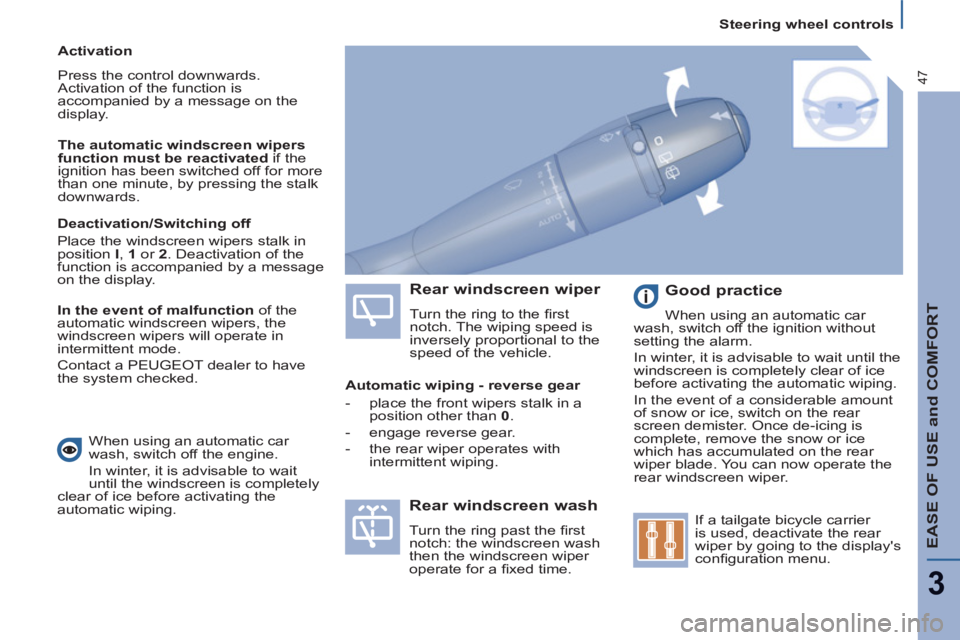
Rear windscreen wiper
Turn the ring to the fi rst
notch. The wiping speed is
inversely proportional to the
speed of the vehicle.
Rear windscreen wash
Turn the ring past the fi rst
notch: the windscreen wash
then the windscreen wiper
operate for a fi xed time.
Good practice
When using an automatic car
wash, switch off the ignition without
setting the alarm.
In winter, it is advisable to wait until the
windscreen is completely clear of ice
before activating the automatic wiping.
In the event of a considerable amount
of snow or ice, switch on the rear
screen demister. Once de-icing is
complete, remove the snow or ice
which has accumulated on the rear
wiper blade. You can now operate the
rear windscreen wiper.
If a tailgate bicycle carrier
is used, deactivate the rear
wiper by going to the display's
confi guration menu.
Deactivation/Switching off
Place the windscreen wipers stalk in
position I
, 1
or 2
. Deactivation of the
function is accompanied by a message
on the display.
In the event of malfunction
of the
automatic windscreen wipers, the
windscreen wipers will operate in
intermittent mode.
Contact a PEUGEOT dealer to have
the system checked.
Automatic wiping - reverse gear
- place the front wipers stalk in a
position other than 0
.
- engage reverse gear.
- the rear wiper operates with
intermittent wiping.
When using an automatic car
wash, switch off the engine.
In winter, it is advisable to wait
until the windscreen is completely
clear of ice before activating the
automatic wiping.