tow Peugeot 807 2013 User Guide
[x] Cancel search | Manufacturer: PEUGEOT, Model Year: 2013, Model line: 807, Model: Peugeot 807 2013Pages: 234, PDF Size: 9.8 MB
Page 70 of 234
68
Seats
Rear head restraints
The rear head restraints can be
removed and have two positions:
- high, position for use,
- low, storage position.
To raise or lower a head restraint, pull
it forwards sliding it at the same time.
To remove it, place it in the high
position, push the lug and pull it
forwards and upwards.
To refi t it, engage the head restraint
rods in the holes taking care to remain
in the centreline of the seat back.
Never drive with the head
restraints removed, they must be
in place and correctly adjusted.
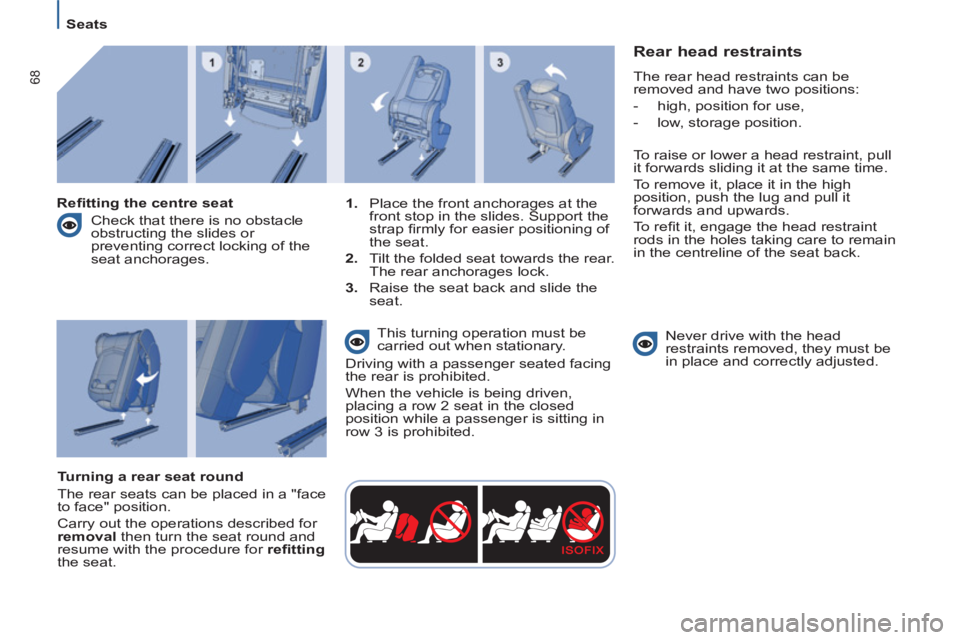
Refi tting the centre seat
Check that there is no obstacle
obstructing the slides or
preventing correct locking of the
seat anchorages.
1.
Place the front anchorages at the
front stop in the slides. Support the
strap fi rmly for easier positioning of
the seat.
2.
Tilt the folded seat towards the rear.
The rear anchorages lock.
3.
Raise the seat back and slide the
seat.
Turning a rear seat round
The rear seats can be placed in a "face
to face" position.
Carry out the operations described for
removal
then turn the seat round and
resume with the procedure for refi tting
the seat
. This turning operation must be
carried out when stationary.
Driving with a passenger seated facing
the rear is prohibited.
When the vehicle is being driven,
placing a row 2 seat in the closed
position while a passenger is sitting in
row 3 is prohibited.
Page 71 of 234
EASE OF USE and COMFORT
3
69
Seats
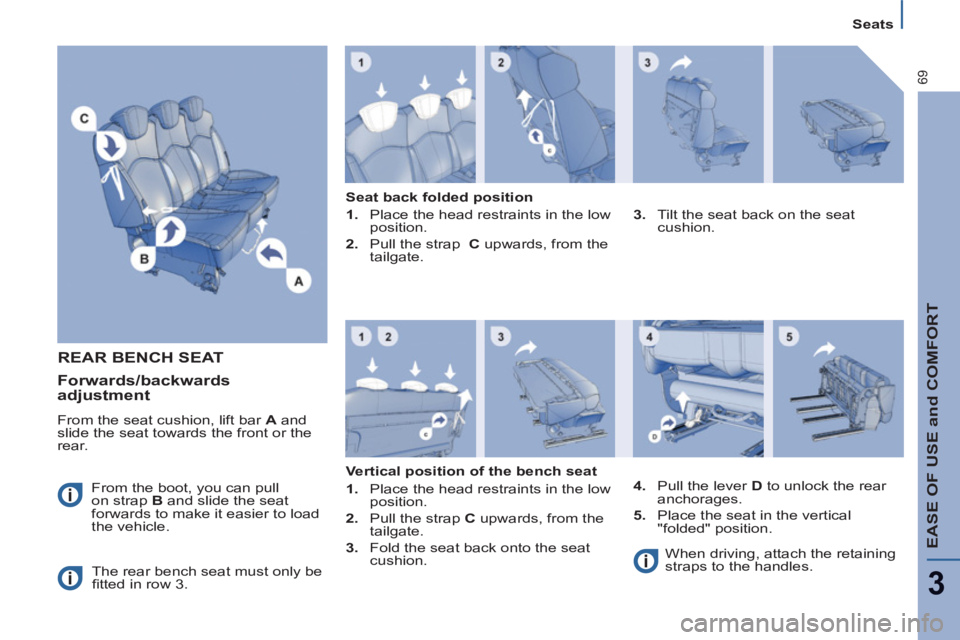
REAR BENCH SEAT
From the boot, you can pull
on strap B
and slide the seat
forwards to make it easier to load
the vehicle.
The rear bench seat must only be
fi tted in row 3.
Seat back folded position
1.
Place the head restraints in the low
position.
2.
Pull the strap C
upwards, from the
tailgate.
3.
Tilt the seat back on the seat
cushion.
Vertical position of the bench seat
1.
Place the head restraints in the low
position.
2.
Pull the strap C
upwards, from the
tailgate.
3.
Fold the seat back onto the seat
cushion.
4.
Pull the lever D
to unlock the rear
anchorages.
5.
Place the seat in the vertical
"folded" position.
When driving, attach the retaining
straps to the handles.
Forwards/backwards
adjustment
From the seat cushion, lift bar A
and
slide the seat towards the front or the
rear.
Page 77 of 234
EASE OF USE and COMFORT
3
75
Practical information
FRONT SEAT LAYOUT
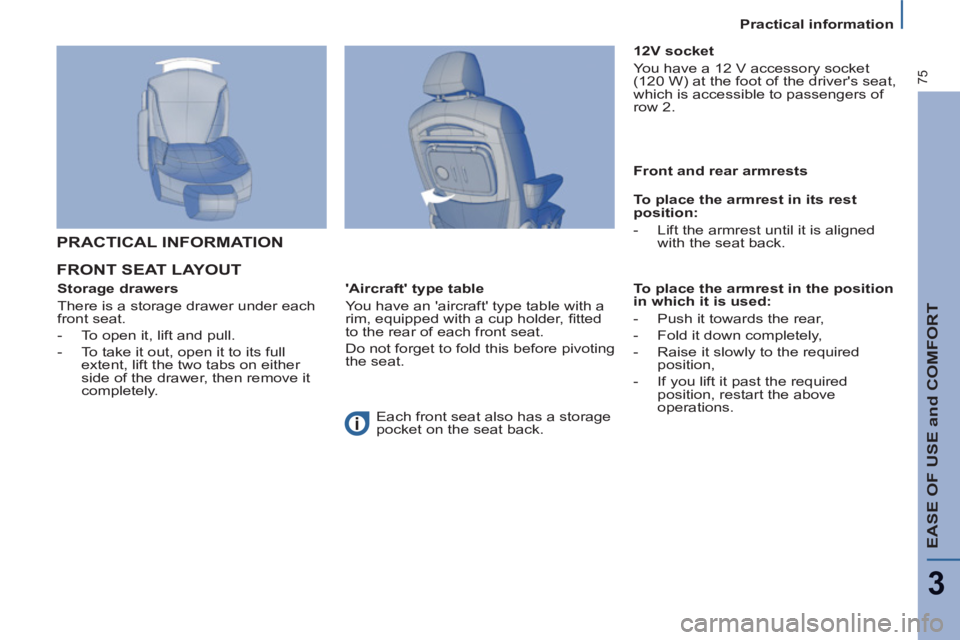
Storage drawers
There is a storage drawer under each
front seat.
- To open it, lift and pull.
- To take it out, open it to its full
extent, lift the two tabs on either
side of the drawer, then remove it
completely.
PRACTICAL INFORMATION
'Aircraft' type table
You have an 'aircraft' type table with a
rim, equipped with a cup holder, fi tted
to the rear of each front seat.
Do not forget to fold this before pivoting
the seat.
12V socket
You have a 12 V accessory socket
(120 W) at the foot of the driver's seat,
which is accessible to passengers of
row 2.
Front and rear armrests
To place the armrest in its rest
position:
- Lift the armrest until it is aligned
with the seat back.
Each front seat also has a storage
pocket on the seat back.
To place the armrest in the position
in which it is used:
- Push it towards the rear,
- Fold it down completely,
- Raise it slowly to the required
position,
- If you lift it past the required
position, restart the above
operations.
Page 81 of 234
EASE OF USE and COMFORT
3
79
Practical information
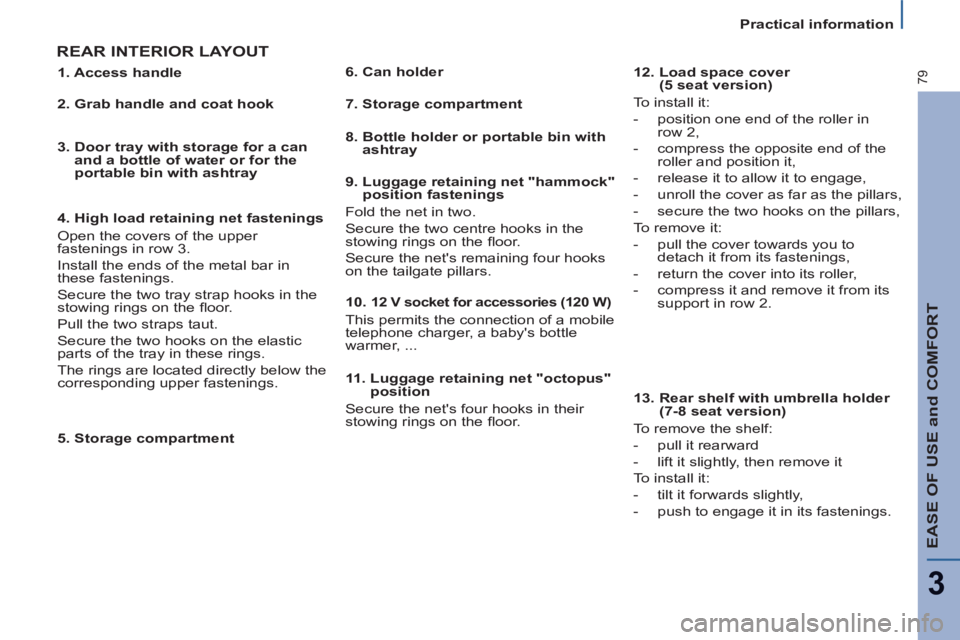
REAR INTERIOR LAYOUT
5. Storage compartment
11. Luggage retaining net "octopus"
position
Secure the net's four hooks in their
stowing rings on the fl oor.
1. Access handle
2. Grab handle and coat hook
3. Door tray with storage for a can
and a bottle of water or for the
portable bin with ashtray
4. High load retaining net fastenings
Open the covers of the upper
fastenings in row 3.
Install the ends of the metal bar in
these fastenings.
Secure the two tray strap hooks in the
stowing rings on the fl oor.
Pull the two straps taut.
Secure the two hooks on the elastic
parts of the tray in these rings.
The rings are located directly below the
corresponding upper fastenings.
6. Can holder
7. Storage compartment
8. Bottle holder or portable bin with
ashtray
9. Luggage retaining net "hammock"
position fastenings
Fold the net in two.
Secure the two centre hooks in the
stowing rings on the fl oor.
Secure the net's remaining four hooks
on the tailgate pillars.
10.
12 V socket for accessories (120 W)
This permits the connection of a mobile
telephone charger, a baby's bottle
warmer, ...
12. Load space cover
(5 seat version)
To install it:
- position one end of the roller in
row 2,
- compress the opposite end of the
roller and position it,
- release it to allow it to engage,
- unroll the cover as far as the pillars,
- secure the two hooks on the pillars,
To remove it:
- pull the cover towards you to
detach it from its fastenings,
- return the cover into its roller,
- compress it and remove it from its
support in row 2.
13. Rear shelf with umbrella holder
(7-8 seat version)
To remove the shelf:
- pull it rearward
- lift it slightly, then remove it
To install it:
- tilt it forwards slightly,
- push to engage it in its fastenings.
Page 88 of 234
86
Driving safely
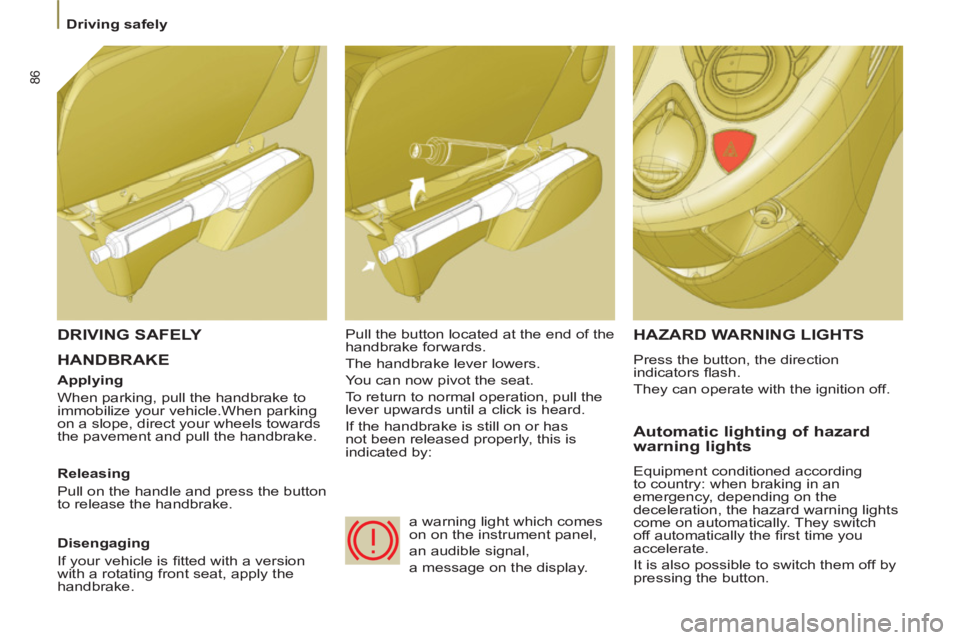
HANDBRAKE
HAZARD WARNING LIGHTS
Press the button, the direction
indicators fl ash.
They can operate with the ignition off.
Automatic lighting of hazard
warning lights
Equipment conditioned according
to country: when braking in an
emergency, depending on the
deceleration, the hazard warning lights
come on automatically. They switch
off automatically the fi rst time you
accelerate.
It is also possible to switch them off by
pressing the button.
DRIVING SAFELY
Applying
When parking, pull the handbrake to
immobilize your vehicle.When parking
on a slope, direct your wheels towards
the pavement and pull the handbrake.
Releasing
Pull on the handle and press the button
to release the handbrake. Pull the button located at the end of the
handbrake forwards.
The handbrake lever lowers.
You can now pivot the seat.
To return to normal operation, pull the
lever upwards until a click is heard.
If the handbrake is still on or has
not been released properly, this is
indicated by:
Disengaging
If your vehicle is fi tted with a version
with a rotating front seat, apply the
handbrake. a warning light which comes
on on the instrument panel,
an audible signal,
a message on the display.
Page 89 of 234
SAFETY
87
Parking sensors
4
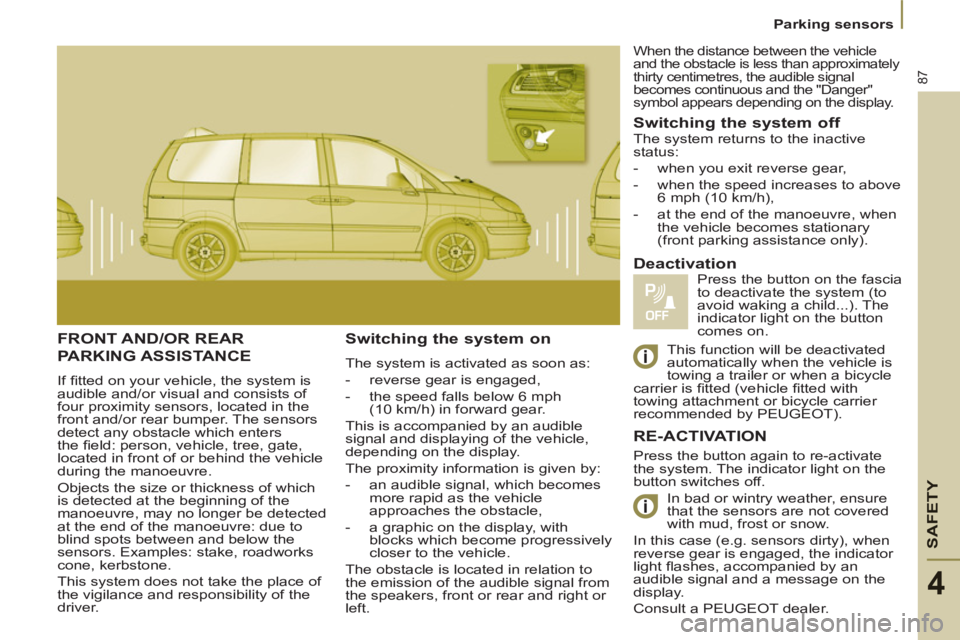
FRONT AND/OR REAR
PARKING ASSISTANCE
If fi tted on your vehicle, the system is
audible and/or visual and consists of
four proximity sensors, located in the
front and/or rear bumper. The sensors
detect any obstacle which enters
the fi eld: person, vehicle, tree, gate,
located in front of or behind the vehicle
during the manoeuvre.
Objects the size or thickness of which
is detected at the beginning of the
manoeuvre, may no longer be detected
at the end of the manoeuvre: due to
blind spots between and below the
sensors. Examples: stake, roadworks
cone, kerbstone.
This system does not take the place of
the vigilance and responsibility of the
driver.
Switching the system on
The system is activated as soon as:
- reverse gear is engaged,
- the speed falls below 6 mph
(10 km/h) in forward gear.
This is accompanied by an audible
signal and displaying of the vehicle,
depending on the display.
The proximity information is given by:
- an audible signal, which becomes
more rapid as the vehicle
approaches the obstacle,
- a graphic on the display, with
blocks which become progressively
closer to the vehicle.
The obstacle is located in relation to
the emission of the audible signal from
the speakers, front or rear and right or
left.
Switching the system off
Press the button again to re-activate
the system. The indicator light on the
button switches off.
In bad or wintry weather, ensure
that the sensors are not covered
with mud, frost or snow.
In this case (e.g. sensors dirty), when
reverse gear is engaged, the indicator
light fl ashes, accompanied by an
audible signal and a message on the
display.
Consult a PEUGEOT dealer.
Deactivation
Press the button on the fascia
to deactivate the system (to
avoid waking a child...). The
indicator light on the button
comes on. The system returns to the inactive
status:
- when you exit reverse gear,
- when the speed increases to above
6 mph (10 km/h),
- at the end of the manoeuvre, when
the vehicle becomes stationary
(front parking assistance only).
RE-ACTIVATION
When the distance between the vehicle
and the obstacle is less than approximately
thirty centimetres, the audible signal
becomes continuous and the "Danger"
symbol appears depending on the display.
This function will be deactivated
automatically when the vehicle is
towing a trailer or when a bicycle
carrier is fi tted (vehicle fi tted with
towing attachment or bicycle carrier
recommended by PEUGEOT).
Page 97 of 234
SAFETY
95
Airbags
4
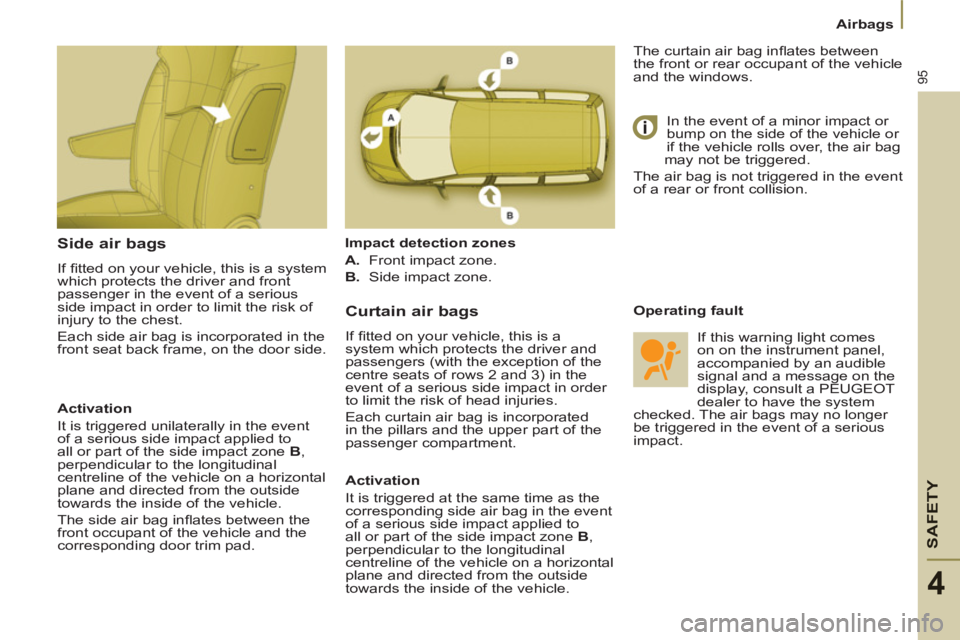
Side air bags
If fi tted on your vehicle, this is a system
which protects the driver and front
passenger in the event of a serious
side impact in order to limit the risk of
injury to the chest.
Each side air bag is incorporated in the
front seat back frame, on the door side. The curtain air bag infl ates between
the front or rear occupant of the vehicle
and the windows.
Impact detection zones
A.
Front impact zone.
B.
Side impact zone.
In the event of a minor impact or
bump on the side of the vehicle or
if the vehicle rolls over, the air bag
may not be triggered.
The air bag is not triggered in the event
of a rear or front collision.
Operating fault
Curtain air bags
If fi tted on your vehicle, this is a
system which protects the driver and
passengers (with the exception of the
centre seats of rows 2 and 3) in the
event of a serious side impact in order
to limit the risk of head injuries.
Each curtain air bag is incorporated
in the pillars and the upper part of the
passenger compartment.
Activation
It is triggered unilaterally in the event
of a serious side impact applied to
all or part of the side impact zone B
,
perpendicular to the longitudinal
centreline of the vehicle on a horizontal
plane and directed from the outside
towards the inside of the vehicle.
The side air bag infl ates between the
front occupant of the vehicle and the
corresponding door trim pad.
Activation
It is triggered at the same time as the
corresponding side air bag in the event
of a serious side impact applied to
all or part of the side impact zone B
,
perpendicular to the longitudinal
centreline of the vehicle on a horizontal
plane and directed from the outside
towards the inside of the vehicle. If this warning light comes
on on the instrument panel,
accompanied by an audible
signal and a message on the
display, consult a PEUGEOT
dealer to have the system
checked. The air bags may no longer
be triggered in the event of a serious
impact.
Page 98 of 234
96
Airbags
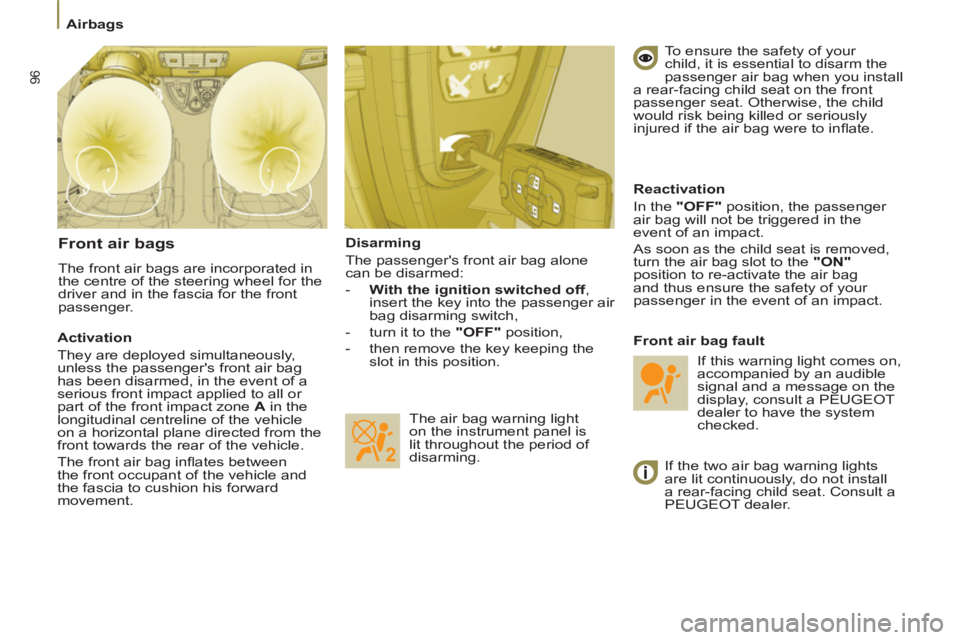
Disarming
The passenger's front air bag alone
can be disarmed:
- With
the
ignition
switched
off
,
insert the key into the passenger air
bag disarming switch,
- turn it to the "OFF"
position,
-
then remove the key keeping the
slot in this position.
Front air bags
The front air bags are incorporated in
the centre of the steering wheel for the
driver and in the fascia for the front
passenger.
Front air bag fault
Reactivation
In the "OFF"
position, the passenger
air bag will not be triggered in the
event of an impact.
As soon as the child seat is removed,
turn the air bag slot to the "ON"
position to re-activate the air bag
and thus ensure the safety of your
passenger in the event of an impact. To ensure the safety of your
child, it is essential to disarm the
passenger air bag when you install
a rear-facing child seat on the front
passenger seat. Otherwise, the child
would risk being killed or seriously
injured if the air bag were to infl ate.
The air bag warning light
on the instrument panel is
lit throughout the period of
disarming.
If the two air bag warning lights
are lit continuously, do not install
a rear-facing child seat. Consult a
PEUGEOT dealer.
Activation
They are deployed simultaneously,
unless the passenger's front air bag
has been disarmed, in the event of a
serious front impact applied to all or
part of the front impact zone A
in the
longitudinal centreline of the vehicle
on a horizontal plane directed from the
front towards the rear of the vehicle.
The front air bag infl ates between
the front occupant of the vehicle and
the fascia to cushion his forward
movement. If this warning light comes on,
accompanied by an audible
signal and a message on the
display, consult a PEUGEOT
dealer to have the system
checked.
Page 105 of 234
103
Towing a trailer
ACCESSORIES
5
TOWING A TRAILER, CARAVAN, BOAT, ETC...
Refer to the administrative
documents (V5, ...) or to the Diesel
"Dimensions, weights and towed
loads" section of chapter 8.
Distribution of loads:
distribute the
load in the trailer so that the heaviest
loads are as close as possible to the
axle and the nose weight is close
to the maximum authorised without,
however, exceeding it.
Cooling:
towing a trailer on a slope
increases the coolant temperature.
As the fan is electrically controlled, its
cooling capacity is not dependent on
the engine speed.
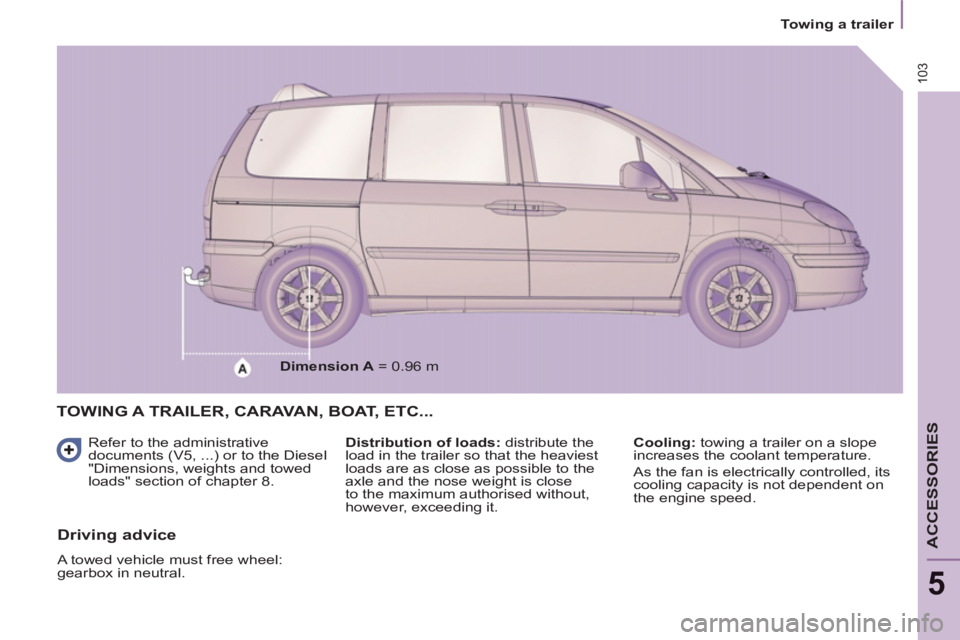
Dimension A
= 0.96 m
Driving advice
A towed vehicle must free wheel:
gearbox in neutral.
Page 106 of 234
104
Towing a trailer
On the contrary, use a high gear to
lower the engine speed and reduce
your speed.
In all cases, pay attention to the
coolant temperature.
Brakes:
towing increases the braking
distance. Drive at a moderate speed,
change down early and brake
gradually. Please contact a PEUGEOT dealer
fi rst for further information.
Automatic adjustment
For vehicles with Xenon bulbs, and if
the change in load makes it necessary,
this system automatically corrects the
height of the beam after approximately
2 minutes. The driver is then assured
of having optimum lighting and not
causing a nuisance to other road
users.
In certain cases of particularly
arduous use (towing the
maximum load up a steep slope
in high temperatures), the engine
automatically limits its power. In this
case, cutting off the air conditioning
allows the engine power to be
recovered, and therefore the towing
speed to be signifi cantly increased
(approximately 12 mph [20 km/h]
more). Sequential control of the
gearbox may also become unavailable.
Lighting
Bicycle carrier
Refer to the "Identifi cation
features" section of chapter 8. Refer to the "Steering wheel
controls" section of chapter 3.
When using a trailer connection,
you must add a fuse. Refer to
the "Changing a fuse" section of
chapter 7.
If the coolant temperature warning light
comes on, stop the vehicle and switch
off the engine as soon as possible.
Tyres:
check the tyre pressures of
the towing vehicle and of the trailer,
observing the recommended pressure.
Side wind:
sensitivity to side wind is
increased. Drive smoothly and at a
moderate speed.
Towbar
We recommend the use of original
PEUGEOT towbars, which have been
tested for endurance from the design
stage of your vehicle.
Towing equipment must be fi tted in
accordance with the manufacturer's
instructions, with particular attention to
the towing capacities of your vehicle,
the load towed, the nose weight and
the electrical connection. As this fi tting
should be carried out by a professional,
we recommend that you entrust the
fi tting of this equipment to a PEUGEOT
dealer.
In accordance with the general
instructions referred to above, we draw
your attention to the risk connected
with fi tting a towbar or other electrical
accessory which is not recommended
by the PEUGEOT network. Fitting such
equipment could result in a failure of
your vehicle's electronic system.
Manual adjustment
Adjust your headlamps so as not to
dazzle other road users. Check the
electrical signalling of the trailer.
If you fi t a bicycle carrier on
the tailgate, deactivate the
rear wiper from the display's
confi guration menu.