lock Peugeot Boxer 2008.5 Owner's Guide
[x] Cancel search | Manufacturer: PEUGEOT, Model Year: 2008.5, Model line: Boxer, Model: Peugeot Boxer 2008.5Pages: 167, PDF Size: 4.17 MB
Page 106 of 167
Seat belts
107
5
SAFETY
The force limiter reduces the pressure of the
seat belt against the body of the occupants.
The pretensioning seat belts are active when
the ignition is switched on.
The inertia reels are fitted with a device
which automatically locks the strap in the
event of a collision or emergency braking or
if the vehicle rolls over.
You can unfasten the seat belt by pressing
the red button on the buckle. Guide the seat
belt after unfastening. Good practice
The driver must ensure that passengers use
the seat belts correctly and that they are all
strapped in securely before moving off.
Wherever you are seated in the vehicle,
always fasten your seat belt, even for short
journeys.
The seat belts are fitted with an inertia reel
which automatically adjusts the length of
the strap to your size.
Do not use accessories (clothes pegs, clips,
safety pins, etc.) which permit a clearance
with the seat belt straps.
Ensure that the seat belt is rolled up
correctly after use.
After folding or moving a seat or a rear
bench seat, ensure that the seat belt is
rolled up correctly and that the buckle is
ready to accommodate the tongue.
Depending on the nature and seriousness
of any impact, the pretensioning device may
be triggered before and independently of
inflation of the air bags. It instantly tightens
the seat belts against the body of the
occupants.
Triggering of the pretensioners is
accompanied by a slight discharge of
harmless smoke and a noise, due to the
activation of the pyrotechnic cartridge
incorporated in the system. The air bag warning light comes
on if the pretensioners are
triggered. Consult a PEUGEOT
dealer.
In order to be effective, a seat belt must:
- restrain one person only,
- must not be twisted, check by pulling in front of you with an even movement,
- be tightened as close to the body as possible.
The upper part of the seat belt should be
positioned in the hollow of the shoulder.
The lap part should be placed as low as
possible on the pelvis.
Do not invert the seat belt buckles as they
will not fulfil their role completely. If the seats are fitted with armrests, the lap
part of the seat belt should always pass
under the armrest.
Check that the seat belt is fastened correctly
by pulling the strap firmly.
Recommendations for children:
- use a suitable child seat if the
passenger is less than 12 years old or
shorter than one metre fifty,
- never allow a child to travel on your lap, even with the seat belt fastened.
For further information regarding child
seats, refer to the "Children on board"
section of chapter 5.
In accordance with current safety
regulations, your PEUGEOT dealer
guarantees all work or any checks, from
testing to maintenance, on your seat belt
equipment.
Have the seat belts checked regularly
(even after a minor impact) by a PEUGEOT
dealer: they must not show any signs of
wear, cutting or fraying and they must not be
transformed or modified.
Clean the seat belt straps with soapy
water or a textile cleaning product, sold
by PEUGEOT dealers.
Page 107 of 167
108
Improved safety and security
IMPROVED SAFETY AND SECURITY
IMPACT RESISTANCE
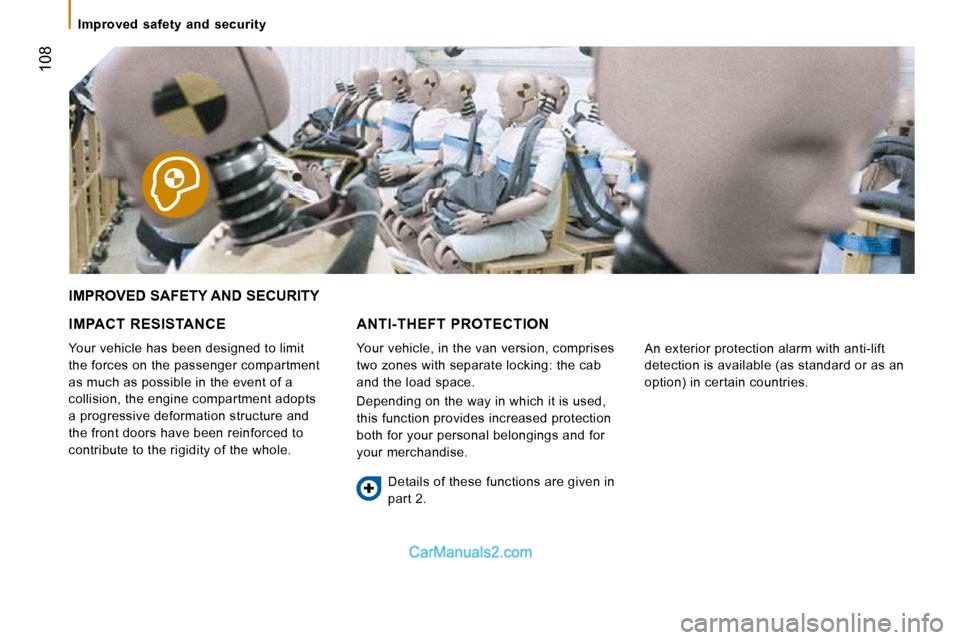
Your vehicle has been designed to limit
the forces on the passenger compartment
as much as possible in the event of a
collision, the engine compartment adopts
a progressive deformation structure and
the front doors have been reinforced to
contribute to the rigidity of the whole.
ANTI-THEFT PROTECTION
Your vehicle, in the van version, comprises
two zones with separate locking: the cab
and the load space.
Depending on the way in which it is used,
this function provides increased protection
both for your personal belongings and for
your merchandise.
Details of these functions are given in
part 2. An exterior protection alarm with anti-lift
detection is available (as standard or as an
option) in certain countries.
Page 115 of 167
114
Child safety
"ISOFIX" MOUNTINGS
Your vehicle has been approved
in accordance with the new
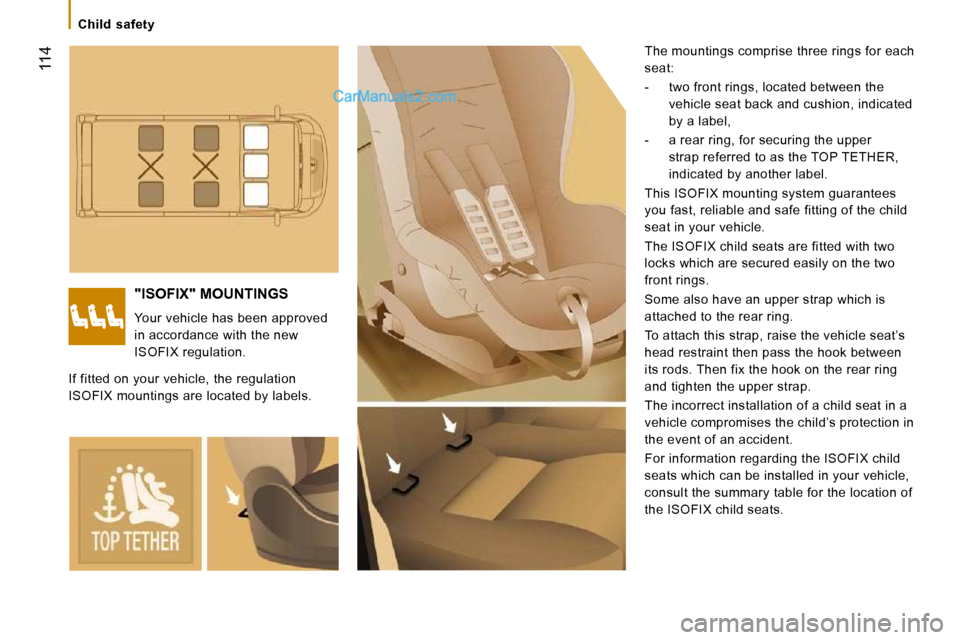
ISOFIX regulation. The mountings comprise three rings for each
seat:
- two front rings, located between the
vehicle seat back and cushion, indicated
by a label,
- a rear ring, for securing the upper strap referred to as the TOP TETHER,
indicated by another label.
This ISOFIX mounting system guarantees
you fast, reliable and safe fitting of the child
seat in your vehicle.
The ISOFIX child seats are fitted with two
locks which are secured easily on the two
front rings.
Some also have an upper strap which is
attached to the rear ring.
To attach this strap, raise the vehicle seat’s
head restraint then pass the hook between
its rods. Then fix the hook on the rear ring
and tighten the upper strap.
The incorrect installation of a child seat in a
vehicle compromises the child’s protection in
the event of an accident.
For information regarding the ISOFIX child
seats which can be installed in your vehicle,
consult the summary table for the location of
the ISOFIX child seats.
If fitted on your vehicle, the regulation
ISOFIX mountings are located by labels.
Page 120 of 167
Child safety
119
5
SAFETY
ADVICE ON CHILD SEATS
The incorrect installation of a child seat in a
vehicle compromises the child's protection in
the event of an accident.
Remember to fasten the seat belts or the
child seat harnesses keeping the slack in
relation to the child's body to a minimum ,
even for short journeys.
For optimum installation of the "forward
facing" child seat, ensure that the back of
the child seat is in contact with the back of
the vehicle's seat and that the head restraint
does not cause any discomfort.
If the head restraint has to be removed,
ensure that it is stored or attached securely
to prevent it from being thrown around the
vehicle in the event of sharp braking.
Children under the age of 10 must not travel
in the "forward facing" position on the front
passenger seat, unless the rear seats are
already occupied by other children, cannot
be used or are absent. Disarm the passenger air bag when a "rear
facing" child seat is installed on the front
seat.
Otherwise, the child would risk being
seriously injured or killed if the air bag were
to inflate.
As a safety precaution, do not leave:
- one or more children alone and
unsupervised in a vehicle,
- a child or an animal in a vehicle which is exposed to the sun, with the windows
closed,
- the keys within reach of children inside the vehicle.
To prevent accidental opening of the doors,
use the "Child Lock".
Take care not to open the rear windows by
more than one third.
To protect young children from the rays of
the sun, fit side blinds to the rear windows.
Installing a booster seat
The chest part of the seat belt must be
positioned on the child's shoulder without
touching the neck.
Ensure that the lap part of the seat belt
passes correctly over the child's thighs.
PEUGEOT recommends the use of a
booster seat which has a back, fitted with a
seat belt guide at shoulder level.
Crew cab
Do not install child seats, booster cushions
or carrycots on the rear seats of the cab.
Page 126 of 167
124
Opening the bonnet
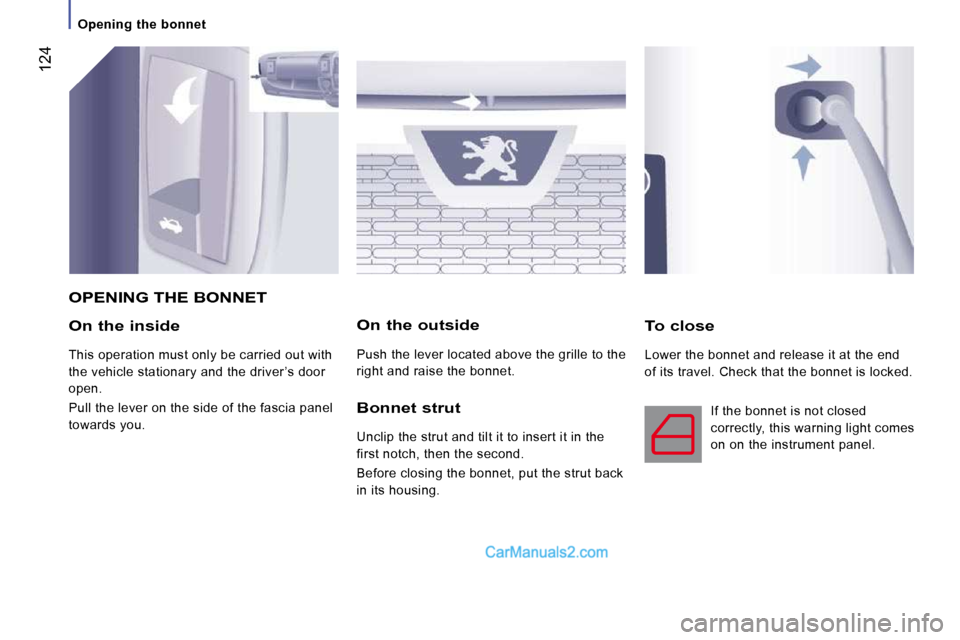
On the inside
This operation must only be carried out with
the vehicle stationary and the driver ’s door
open.
Pull the lever on the side of the fascia panel
towards you.
On the outside
Push the lever located above the grille to the
right and raise the bonnet.
To close
Lower the bonnet and release it at the end
of its travel. Check that the bonnet is locked.
OPENING THE BONNET
Bonnet strut
Unclip the strut and tilt it to insert it in the
first notch, then the second.
Before closing the bonnet, put the strut back
in its housing. If the bonnet is not closed
correctly, this warning light comes
on on the instrument panel.
Page 131 of 167
130
Fuel
Low fuel level
When the fuel tank level E
(Empty) is reached, this warning
light comes on. At this moment,
you have enough fuel left to
drive approximately 30 miles (50 km) ,
depending on the driving conditions, the
engine and the profile of the road. Fill up
without delay to avoid running out of fuel. The fuel tank must be filled
with the engine
off.
- Open the fuel filler flap.
- Support the cap with one hand.
- With the other hand, insert the key, then turn it anticlockwise.
- Remove the cap and hook it onto the clip located on the inside of the flap.
A label affixed to the inside of the flap
reminds you of the type of fuel to be used.
When filling the fuel tank, do not continue
after the 3rd cut-off of the nozzle. This could
cause malfunctions.
The capacity of the fuel tank is
approximately 90 litres.
- After filling the fuel tank, lock the cap and close the flap.
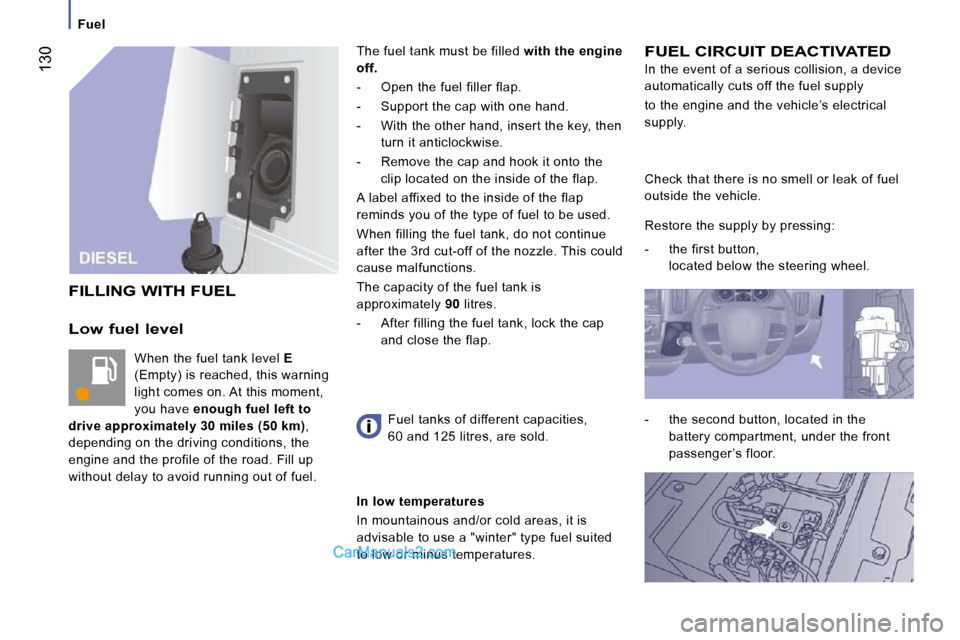
FUEL CIRCUIT DEACTIVATED
In the event of a serious collision, a device
automatically cuts off the fuel supply
to the engine and the vehicle’s electrical
supply.
FILLING WITH FUEL
Fuel tanks of different capacities,
60 and 125 litres, are sold. Check that there is no smell or leak of fuel
outside the vehicle.
Restore the supply by pressing:
- the first button,
located below the steering wheel.
- the second button, located in the battery compartment, under the front
passenger ’s floor.
In low temperatures
In mountainous and/or cold areas, it is
advisable to use a "winter" type fuel suited
to low or minus temperatures.
Page 133 of 167
132
Battery
The batteries contain harmful
substances such as sulphuric acid and
lead. They must be discarded in accordance
with the provisions of the law and must not,
in any circumstances, be discarded with
household waste.
Take used batteries to a special collection
point. It is advisable to disconnect the negative (-)
terminal of the battery if the vehicle is not to
be used for a period of more than one month.
Before disconnecting the battery, you must
wait for 2 minutes after switching off the
ignition.
Never disconnect a terminal when the
engine is running.
Never charge a battery without first
disconnecting the terminals.
Close the windows and doors before
disconnecting the battery.
After every reconnection of the battery,
switch on the ignition and wait 1 minute
before starting to allow the electronic
systems to be initialised. If slight difficulties
are experienced after this, please contact a
PEUGEOT dealer. If the battery has been disconnected
for some time, it may be necessary to
reinitialise the following functions:
- the display parameters (date, time,
language, distance unit and
temperature unit),
- the radio stations,
- the central locking.
Some settings are cleared and must be
reprogrammed, consult a PEUGEOT.
If your vehicle is fitted with a
chronotachograph or an alarm,
disconnection of the negative (-) terminal of
the battery (located under the floor on the
left-hand side, in the cab) is recommended if
the vehicle is not to be used for a period of
more than 5 days.
Page 135 of 167
Changing a wheel
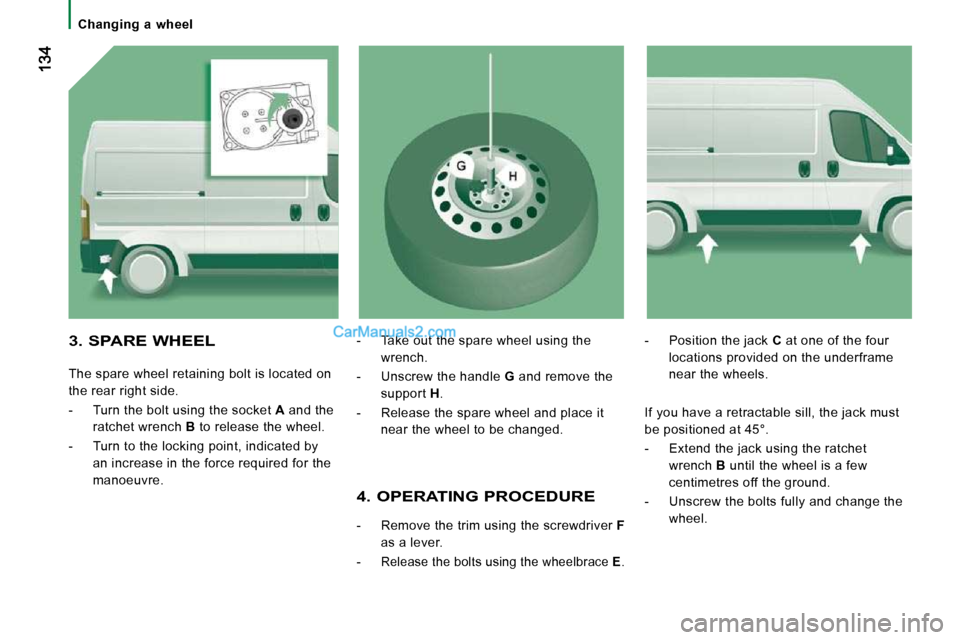
4. OPERATING PROCEDURE
- Remove the trim using the screwdriver F
as a lever.
-
Release the bolts using the wheelbrace E .
- Position the jack C at one of the four
locations provided on the underframe
near the wheels. 3. SPARE WHEEL
The spare wheel retaining bolt is located on
the rear right side.
- Turn the bolt using the socket A and the
ratchet wrench B to release the wheel.
- Turn to the locking point, indicated by an increase in the force required for the
manoeuvre. - Take out the spare wheel using the
wrench.
- Unscrew the handle G and remove the
support H .
- Release the spare wheel and place it near the wheel to be changed. If you have a retractable sill, the jack must
be positioned at 45°.
- Extend the jack using the ratchet
wrench B until the wheel is a few
centimetres off the ground.
- Unscrew the bolts fully and change the wheel.
Page 139 of 167
138
Changing a bulb
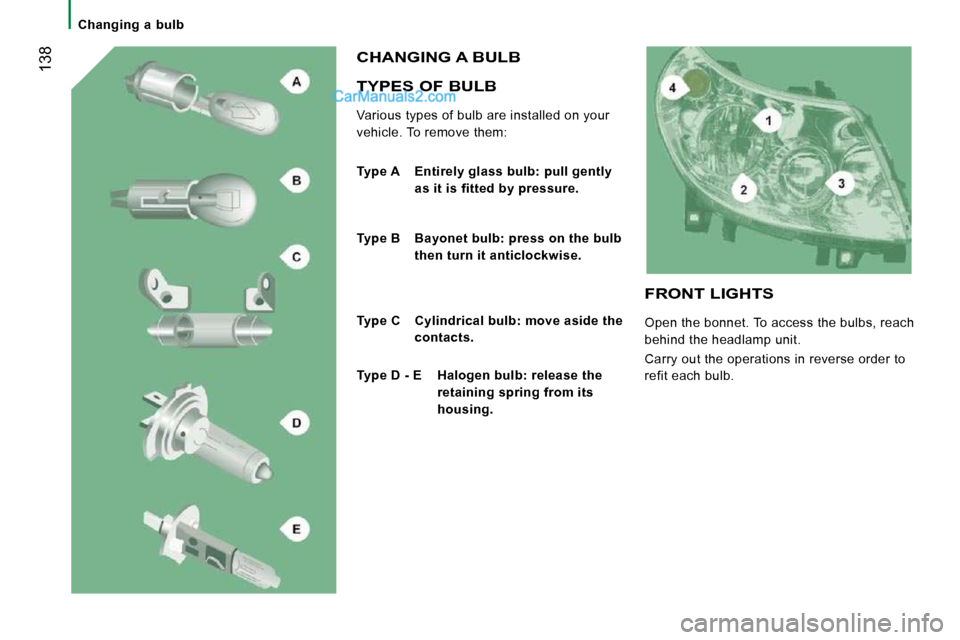
TYPES OF BULB
Various types of bulb are installed on your
vehicle. To remove them:
CHANGING A BULB
Type A Entirely glass bulb: pull gently
as it is fitted by pressure.
Type B Bayonet bulb: press on the bulb
then turn it anticlockwise.
Type C Cylindrical bulb: move aside the
contacts.
Type D - E Halogen bulb: release the
retaining spring from its
housing.
FRONT LIGHTS
Open the bonnet. To access the bulbs, reach
behind the headlamp unit.
Carry out the operations in reverse order to
refit each bulb.
Page 140 of 167
Changing a bulb
139
TROUBLESHOOTING
8
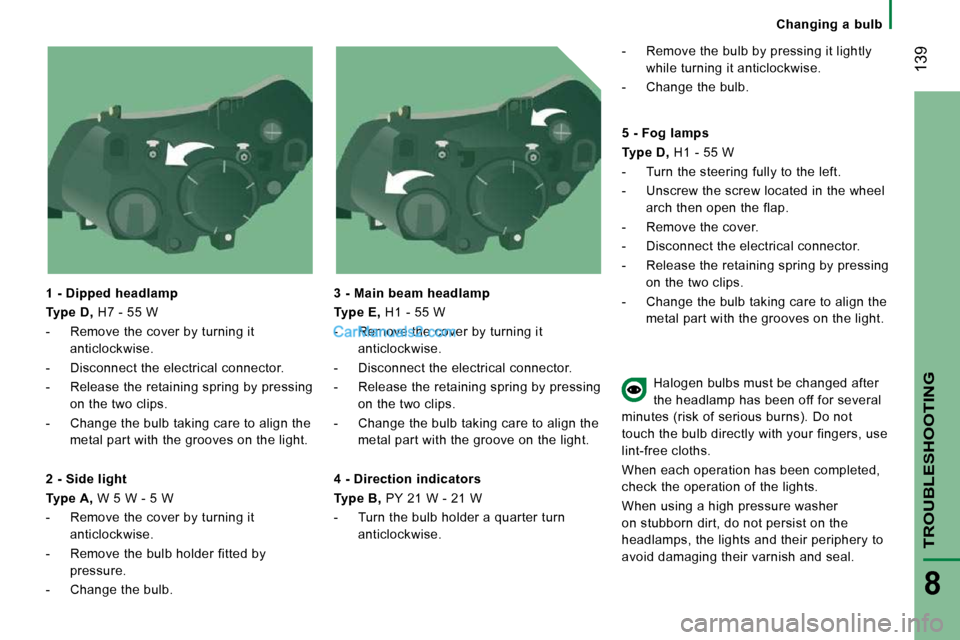
1 - Dipped headlamp
Type D, H7 - 55 W
- Remove the cover by turning it anticlockwise.
- Disconnect the electrical connector.
- Release the retaining spring by pressing on the two clips.
- Change the bulb taking care to align the metal part with the grooves on the light. 3 - Main beam headlamp
Type E, H1 - 55 W
- Remove the cover by turning it anticlockwise.
- Disconnect the electrical connector.
- Release the retaining spring by pressing on the two clips.
- Change the bulb taking care to align the metal part with the groove on the light.
2 - Side light
Type A, W 5 W - 5 W
- Remove the cover by turning it anticlockwise.
- Remove the bulb holder fitted by pressure.
- Change the bulb. 4 - Direction indicators
Type B, PY 21 W - 21 W
- Turn the bulb holder a quarter turn anticlockwise. - Remove the bulb by pressing it lightly
while turning it anticlockwise.
- Change the bulb.
5 - Fog lamps
Type D, H1 - 55 W
- Turn the steering fully to the left.
- Unscrew the screw located in the wheel arch then open the flap.
- Remove the cover.
- Disconnect the electrical connector.
- Release the retaining spring by pressing on the two clips.
- Change the bulb taking care to align the metal part with the grooves on the light.
Halogen bulbs must be changed after
the headlamp has been off for several
minutes (risk of serious burns). Do not
touch the bulb directly with your fingers, use
lint-free cloths.
When each operation has been completed,
check the operation of the lights.
When using a high pressure washer
on stubborn dirt, do not persist on the
headlamps, the lights and their periphery to
avoid damaging their varnish and seal.