warning Peugeot Boxer 2010 Owner's Guide
[x] Cancel search | Manufacturer: PEUGEOT, Model Year: 2010, Model line: Boxer, Model: Peugeot Boxer 2010Pages: 167, PDF Size: 4.33 MB
Page 128 of 167
126
Levels
LEVELS
These regular maintenance operations
will keep your vehicle in good running
order. Ask for advice at a PEUGEOT dealer
or consult the servicing booklet enclosed in
the handbook pack. To maintain the reliability of engines and
emission control systems, the use of
additives in engine oil is prohibited.
Changing the brake fluid
The brake fluid must be changed at
the intervals stated, according to the
manufacturer's servicing schedule.
Use fluids recommended by the
manufacturer, which fulfil DOT4 standards.
The level must be between the
MIN and
MAX marks on the reservoir.
If fluid has to be added frequently, this
indicates a failure which must be checked by
a PEUGEOT dealer as soon as possible.
If you have to remove/refit the engine
style cover, handle it with care to avoid
damaging the fixing clips.
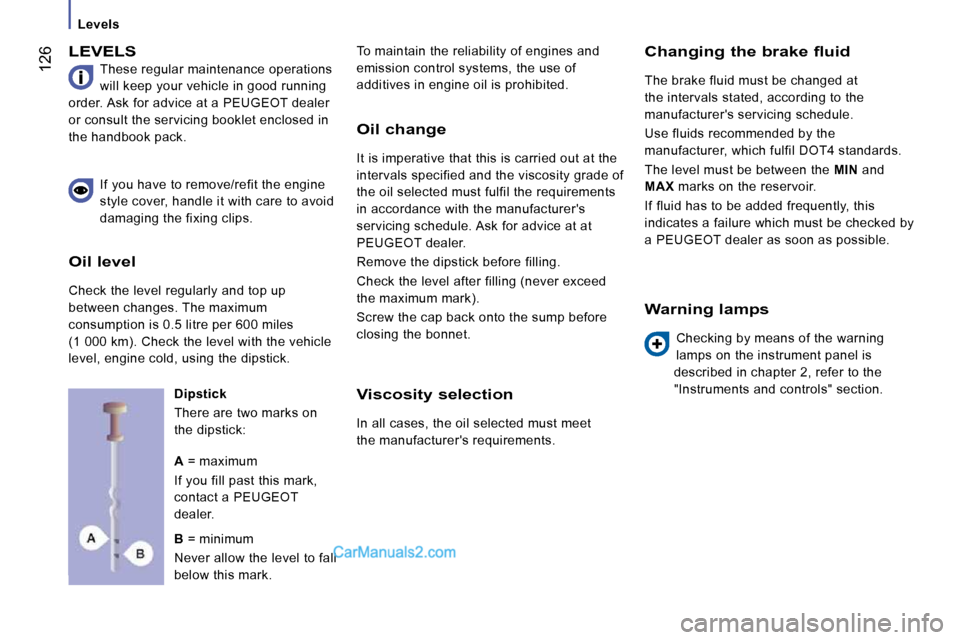
Dipstick
There are two marks on
the dipstick:
Oil change
It is imperative that this is carried out at the
intervals specified and the viscosity grade of
the oil selected must fulfil the requirements
in accordance with the manufacturer's
servicing schedule. Ask for advice at at
PEUGEOT dealer.
Remove the dipstick before filling.
Check the level after filling (never exceed
the maximum mark).
Screw the cap back onto the sump before
closing the bonnet.
Viscosity selection
In all cases, the oil selected must meet
the manufacturer's requirements.
Warning lamps
Checking by means of the warning
lamps on the instrument panel is
described in chapter 2, refer to the
"Instruments and controls" section.
A = maximum
If you fill past this mark,
contact a PEUGEOT
dealer.
B = minimum
Never allow the level to fall
below this mark.
Oil level
Check the level regularly and top up
between changes. The maximum
consumption is 0.5 litre per 600 miles
(1 000 km). Check the level with the vehicle
level, engine cold, using the dipstick.
Page 130 of 167
Checks
CHECKS
Air filter and passenger compartment filter
A clogged passenger compartment filter
may reduce the performance of the
air conditioning system and generate
undesirable odours. The replacement
intervals for these components are indicated
in the servicing booklet.
Depending on the environment (dusty
atmosphere...) and the use of the vehicle
(urban driving...), change them twice as
often if necessary, refer to the "Under the
bonnet" section of chapter 7.
Manual gearbox
Have the level checked in accordance with
the manufacturer's servicing schedule. To check the main levels and certain
components, in accordance with the
manufacturer's servicing schedule, refer to
the pages of the servicing booklet which
correspond to your vehicle's engine.
Only use products recommended by
PEUGEOT or products of equivalent quality
and specification.
In order to optimise the operation of units as
important as the braking system, PEUGEOT
selects and offers specific products.
In order to avoid damaging the electrical
units, high pressure washing to clean the
engine compartment is strictly prohibited.
Parking brake
Where the parking brake travel is too great
or there is a reduction in the performance
of the system, the parking brake should be
adjusted, even between services.
Have the system checked by a PEUGEOT
dealer.
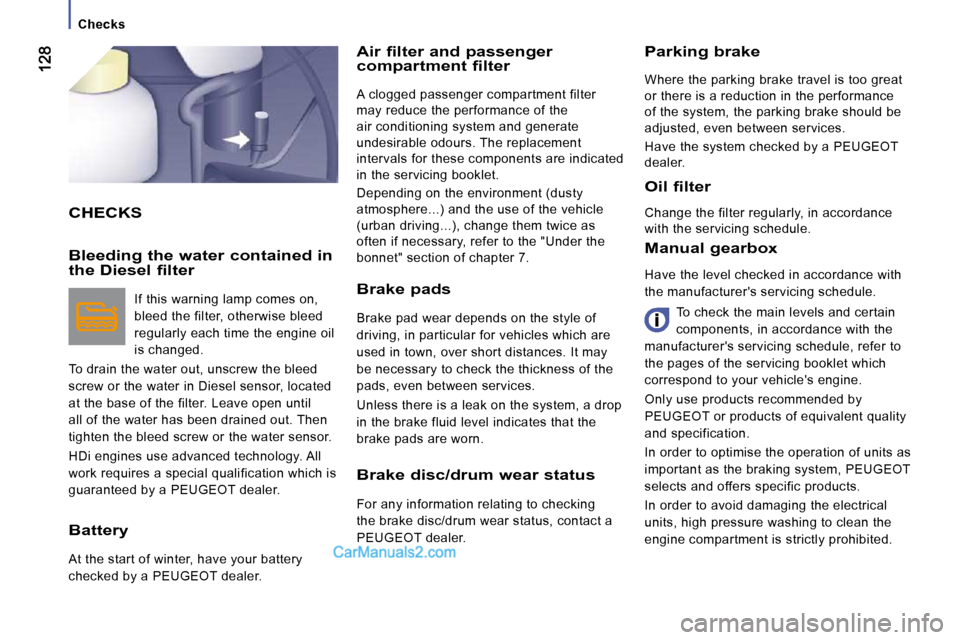
Bleeding the water contained in the Diesel filter
If this warning lamp comes on,
bleed the filter, otherwise bleed
regularly each time the engine oil
is changed.
To drain the water out, unscrew the bleed
screw or the water in Diesel sensor, located
at the base of the filter. Leave open until
all of the water has been drained out. Then
tighten the bleed screw or the water sensor.
HDi engines use advanced technology. All
work requires a special qualification which is
guaranteed by a PEUGEOT dealer.
Battery
At the start of winter, have your battery
checked by a PEUGEOT dealer.
Brake pads
Brake pad wear depends on the style of
driving, in particular for vehicles which are
used in town, over short distances. It may
be necessary to check the thickness of the
pads, even between services.
Unless there is a leak on the system, a drop
in the brake fluid level indicates that the
brake pads are worn.
Brake disc/drum wear status
For any information relating to checking
the brake disc/drum wear status, contact a
PEUGEOT dealer.
Oil filter
Change the filter regularly, in accordance
with the servicing schedule.
Page 131 of 167
130
Fuel
Low fuel level
When the fuel tank level E
(Empty) is reached, this warning
lamp comes on. At this moment,
you have enough fuel left to
drive approximately 30 miles (50 km) ,
depending on the driving conditions, the
engine and the profile of the road. Fill up
without delay to avoid running out of fuel. The fuel tank must be filled
with the engine
off.
- Open the fuel filler flap.
- Support the cap with one hand.
- With the other hand, insert the key, then turn it anticlockwise.
- Remove the cap and hook it onto the clip located on the inside of the flap.
A label affixed to the inside of the flap
reminds you of the type of fuel to be used.
When filling the fuel tank, do not continue
after the 3rd cut-off of the nozzle. This could
cause malfunctions.
The capacity of the fuel tank is
approximately 90 litres.
- After filling the fuel tank, lock the cap and close the flap.
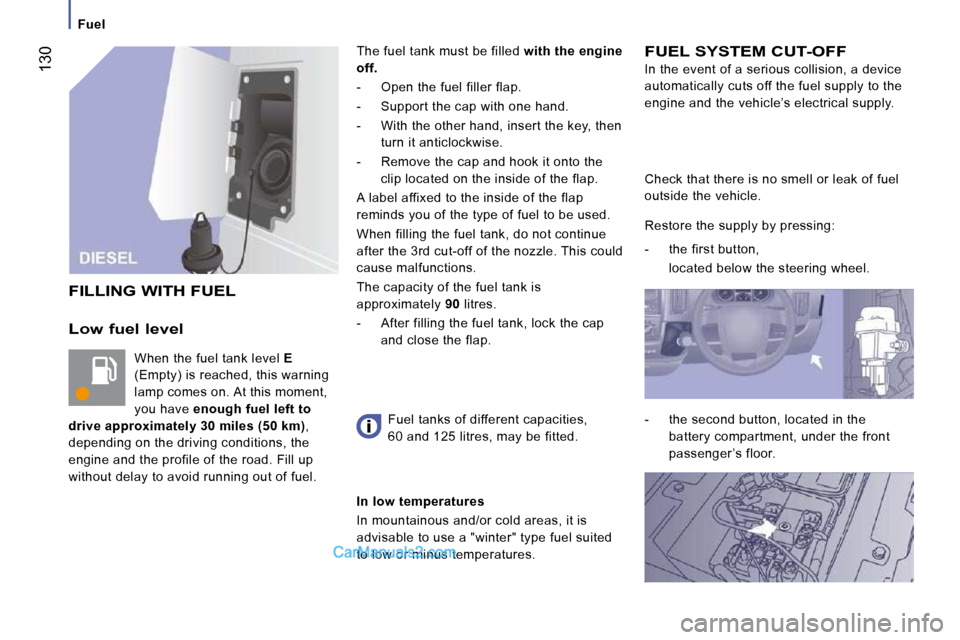
FUEL SYSTEM CUT-OFF
In the event of a serious collision, a device
automatically cuts off the fuel supply to the
engine and the vehicle’s electrical supply.
FILLING WITH FUEL
Fuel tanks of different capacities,
60 and 125 litres, may be fitted. Check that there is no smell or leak of fuel
outside the vehicle.
Restore the supply by pressing:
- the first button,
located below the steering wheel.
- the second button, located in the
battery compartment, under the front
passenger ’s floor.
In low temperatures
In mountainous and/or cold areas, it is
advisable to use a "winter" type fuel suited
to low or minus temperatures.
Page 134 of 167
133
QUICK HELP
8
Changing a wheel
1. PARKING THE VEHICLE
As far as possible, park the vehicle on level,
stable and non-slippery ground.
Apply the parking brake, switch off the
ignition and engage first gear.
Put on a high visibility jacket and position
the warning triangle.
If possible, place a chock under the
wheel diagonally opposite the wheel to be
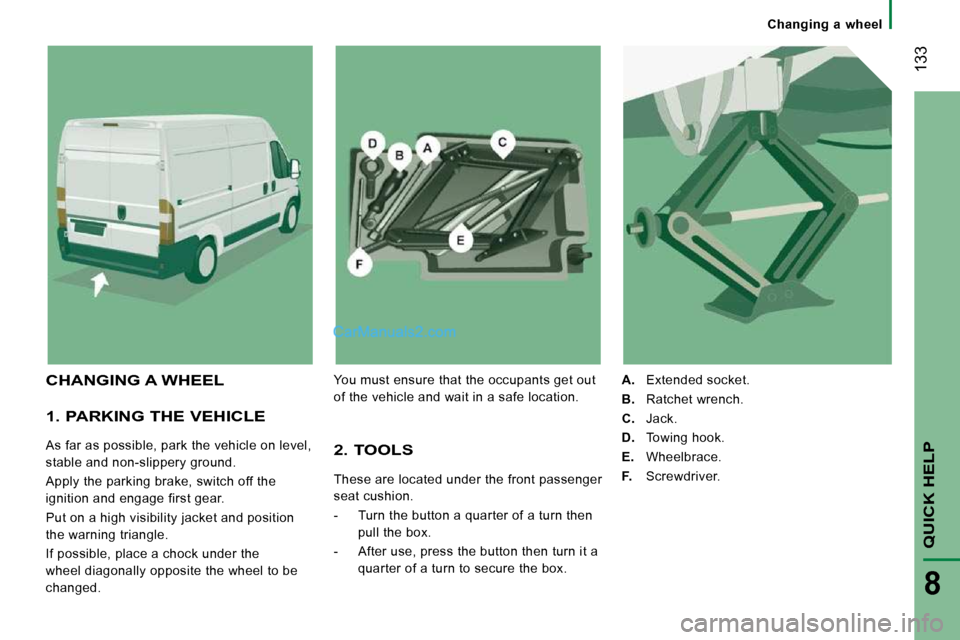
changed. 2. TOOLS
These are located under the front passenger
seat cushion.
- Turn the button a quarter of a turn then pull the box.
- After use, press the button then turn it a quarter of a turn to secure the box.
A. Extended socket.
B. Ratchet wrench.
C. Jack.
D. Towing hook.
E. Wheelbrace.
F. Screwdriver.
CHANGING A WHEEL You must ensure that the occupants get out
of the vehicle and wait in a safe location.
Page 144 of 167
143
QUICK HELP
8
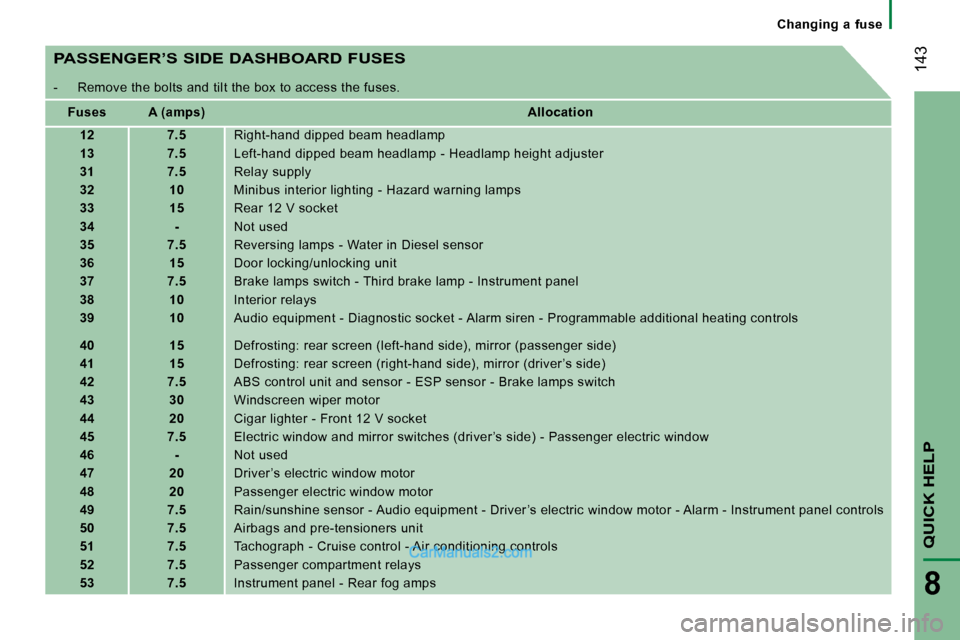
Changing a fuse
PASSENGER’S SIDE DASHBOARD FUSES
- Remove the bolts and tilt the box to access the fuses.
Fuses A (amps)
Allocation
12 7.5 Right-hand dipped beam headlamp
13 7.5 Left-hand dipped beam headlamp - Headlamp heigh t adjuster
31 7.5 Relay supply
32 10 Minibus interior lighting - Hazard warning lamp s
33 15 Rear 12 V socket
34 - Not used
35 7.5 Reversing lamps - Water in Diesel sensor
36 15 Door locking/unlocking unit
37 7.5 Brake lamps switch - Third brake lamp - Instrum ent panel
38 10 Interior relays
39 10 Audio equipment - Diagnostic socket - Alarm sir en - Programmable additional heating controls
40 15 Defrosting: rear screen (left-hand side), mirro r (passenger side)
41 15 Defrosting: rear screen (right-hand side), mirr or (driver ’s side)
42 7.5 ABS control unit and sensor - ESP sensor - Brak e lamps switch
43 30 Windscreen wiper motor
44 20 Cigar lighter - Front 12 V socket
45 7.5 Electric window and mirror switches (driver ’s s ide) - Passenger electric window
46 - Not used
47 20 Driver ’s electric window motor
48 20 Passenger electric window motor
49 7.5 Rain/sunshine sensor - Audio equipment - Driver ’s electric window motor - Alarm - Instrument panel controls
50 7.5 Airbags and pre-tensioners unit
51 7.5 Tachograph - Cruise control - Air conditioning controls
52 7.5 Passenger compartment relays
53 7.5 Instrument panel - Rear fog amps