warning Peugeot Boxer 2010 Owner's Guide
[x] Cancel search | Manufacturer: PEUGEOT, Model Year: 2010, Model line: Boxer, Model: Peugeot Boxer 2010Pages: 167, PDF Size: 4.33 MB
Page 103 of 167
5
Driving safely
SAFETY
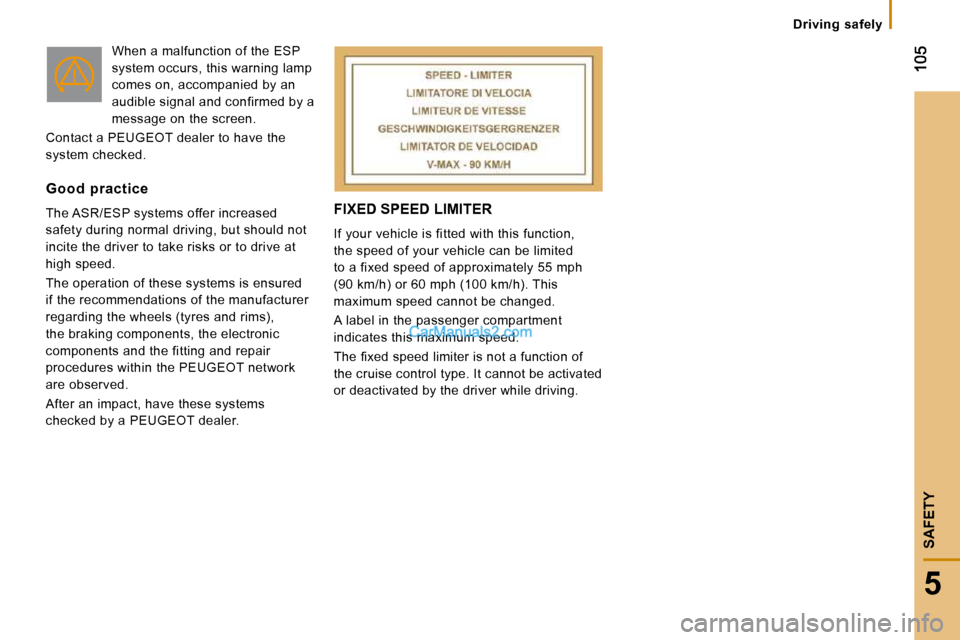
FIXED SPEED LIMITER
If your vehicle is fitted with this function,
the speed of your vehicle can be limited
to a fixed speed of approximately 55 mph
(90 km/h) or 60 mph (100 km/h). This
maximum speed cannot be changed.
A label in the passenger compartment
indicates this maximum speed.
The fi xed speed limiter is not a function of
the cruise control type. It cannot be activated
or deactivated by the driver while driving.
When a malfunction of the ESP
system occurs, this warning lamp
comes on, accompanied by an
audible signal and confirmed by a
message on the screen.
Contact a PEUGEOT dealer to have the
system checked.
Good practice
The ASR/ESP systems offer increased
safety during normal driving, but should not
incite the driver to take risks or to drive at
high speed.
The operation of these systems is ensured
if the recommendations of the manufacturer
regarding the wheels (tyres and rims),
the braking components, the electronic
components and the fitting and repair
procedures within the PEUGEOT network
are observed.
After an impact, have these systems
checked by a PEUGEOT dealer.
Page 104 of 167
5
Driving safely
SAFETY
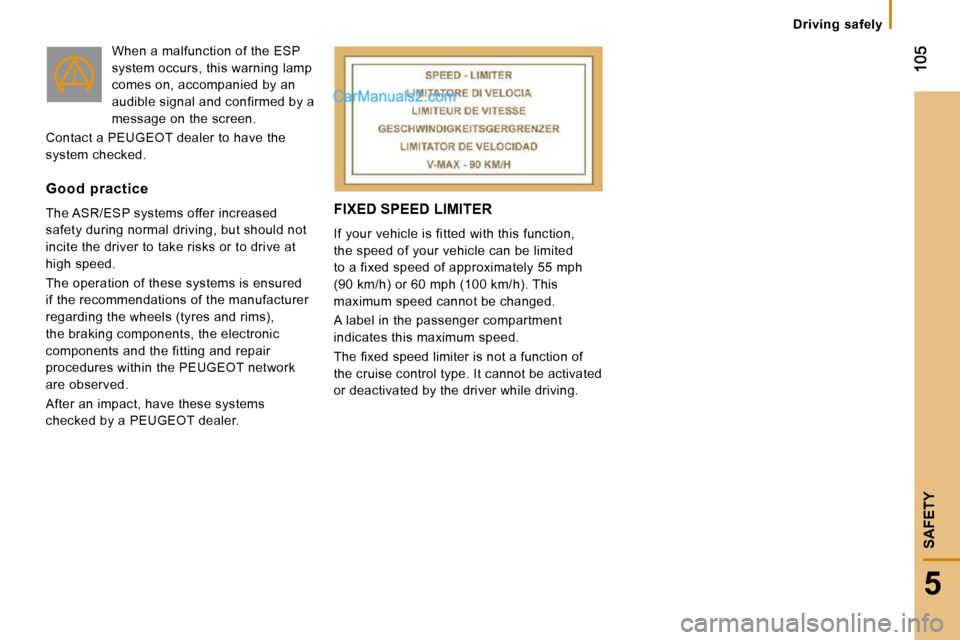
FIXED SPEED LIMITER
If your vehicle is fitted with this function,
the speed of your vehicle can be limited
to a fixed speed of approximately 55 mph
(90 km/h) or 60 mph (100 km/h). This
maximum speed cannot be changed.
A label in the passenger compartment
indicates this maximum speed.
The fi xed speed limiter is not a function of
the cruise control type. It cannot be activated
or deactivated by the driver while driving.
When a malfunction of the ESP
system occurs, this warning lamp
comes on, accompanied by an
audible signal and confirmed by a
message on the screen.
Contact a PEUGEOT dealer to have the
system checked.
Good practice
The ASR/ESP systems offer increased
safety during normal driving, but should not
incite the driver to take risks or to drive at
high speed.
The operation of these systems is ensured
if the recommendations of the manufacturer
regarding the wheels (tyres and rims),
the braking components, the electronic
components and the fitting and repair
procedures within the PEUGEOT network
are observed.
After an impact, have these systems
checked by a PEUGEOT dealer.
Page 105 of 167
106
Seat belts
SEAT BELTS
CAB SEAT BELTS
The front seats are fitted with pre-tensioners
and force limiters. REAR SEAT BELTS
The seats/bench seats are fitted with
three-point seat belts and inertia reels.
The centre seat has a seat belt guide and
inertia reel, solid with the seat back.
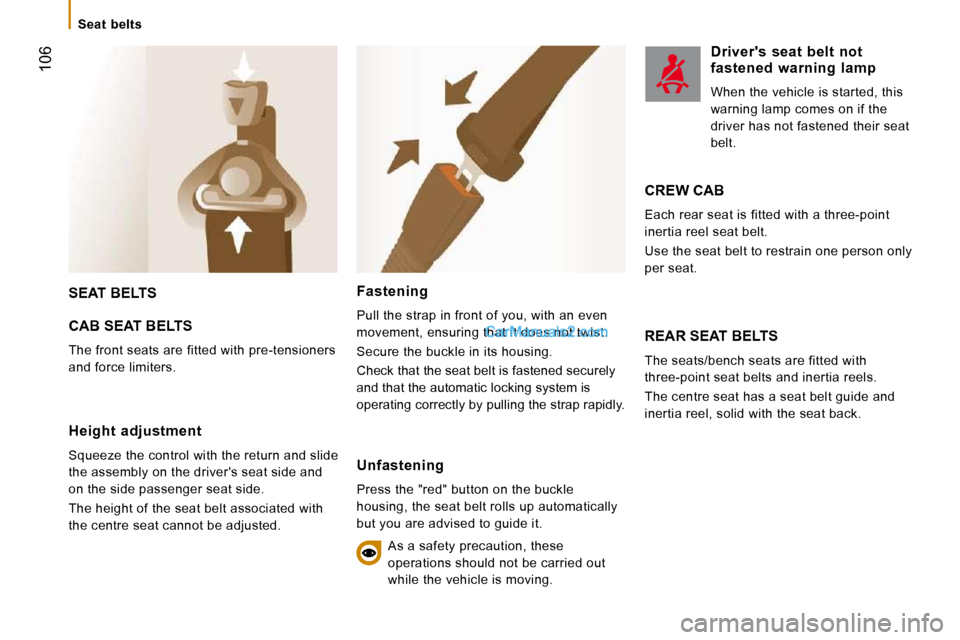
Height adjustment
Squeeze the control with the return and slide
the assembly on the driver's seat side and
on the side passenger seat side.
The height of the seat belt associated with
the centre seat cannot be adjusted.
Fastening
Pull the strap in front of you, with an even
movement, ensuring that it does not twist.
Secure the buckle in its housing.
Check that the seat belt is fastened securely
and that the automatic locking system is
operating correctly by pulling the strap rapidly.
Unfastening
Press the "red" button on the buckle
housing, the seat belt rolls up automatically
but you are advised to guide it. As a safety precaution, these
operations should not be carried out
while the vehicle is moving.
Driver's seat belt not fastened warning lamp
When the vehicle is started, this
warning lamp comes on if the
driver has not fastened their seat
belt.
CREW CAB
Each rear seat is fitted with a three-point
inertia reel seat belt.
Use the seat belt to restrain one person only
per seat.
Page 106 of 167
107
5
SAFETY
Seat belts
The force limiter reduces the pressure of the
seat belt against the body of the occupants.
The pretensioning seat belts are active when
the ignition is switched on.
The inertia reels are fitted with a device
which automatically locks the strap in the
event of a collision or emergency braking or
if the vehicle rolls over.
You can unfasten the seat belt by pressing
the red button on the buckle. Guide the seat
belt after unfastening. Good practice
The driver must ensure that passengers use
the seat belts correctly and that they are all
strapped in securely before moving off.
Wherever you are seated in the vehicle, always
fasten your seat belt, even for short journeys.
The seat belts are fitted with an inertia reel
which automatically adjusts the length of
the strap to your size.
Do not use accessories (clothes pegs, clips,
safety pins, etc.) which permit a clearance
with the seat belt straps.
Ensure that the seat belt has reeled in
correctly after use.
After folding or moving a seat or a rear
bench seat, ensure that the seat belt has
reeled in correctly and that the buckle is
ready to accommodate the tongue.
Depending on the nature and seriousness
of any impact, the pretensioning device may
be triggered before and independently of
inflation of the airbags. It instantly tightens
the seat belts against the body of the
occupants.
Triggering of the pretensioners is
accompanied by a slight discharge of
harmless smoke and a noise, due to the
activation of the pyrotechnic cartridge
incorporated in the system. The airbag warning lamp comes
on if the pretensioners are
triggered. Consult a PEUGEOT
dealer.
In order to be effective, a seat belt must:
- restrain one person only,
- must not be twisted, check by pulling in front of you with an even movement,
- be tightened as close to the body as possible.
The upper part of the seat belt should be
positioned in the hollow of the shoulder.
The lap part should be placed as low as
possible on the pelvis.
Do not invert the seat belt buckles as they
will not fulfil their role completely. If the seats are fitted with armrests, the lap
part of the seat belt should always pass
under the armrest.
Check that the seat belt is fastened correctly
by pulling the strap firmly.
Recommendations for children:
- use a suitable child seat if the
passenger is less than 12 years old or
shorter than one metre fifty,
- never allow a child to travel on your lap, even with the seat belt fastened.
For more information on child seats,
refer to the "Child safety" section of
chapter 5.
Your PEUGEOT dealer can ensure that
all work or any checks, from testing to
maintenance on your seat belt equipment
meets current regulations.
Have the seat belts checked regularly
(even after a minor impact) by a PEUGEOT
dealer: they must not show any signs of
wear, cutting or fraying and they must not be
converted or modified.
Clean the seat belt straps with soapy
water or a textile cleaning product, sold
by PEUGEOT dealers.
Page 108 of 167
109
5
SAFETY
Airbags
AIRBAGS
The airbags have been designed to
maximise the safety of the occupants in the
event of a serious collision; they work in
conjunction with the force limiting seat belts.
In the event of a serious collision, the
electronic detectors record and analyse any
abrupt deceleration of the vehicle:
if the triggering threshold is reached, the
airbags inflate instantly and protect the
occupants of the vehicle.
Immediately after the impact, the airbags
deflate rapidly, so that they do not hinder the
visibility of the occupants nor their possible
exit from the vehicle. The airbags will not be deployed in collisions
which are not serious, for which the seat belt
is sufficient to provide maximum protection.
The seriousness of the collision depends on
the nature of the obstacle and the speed of
the vehicle at the moment of impact.
Airbags
only operate when the ignition is
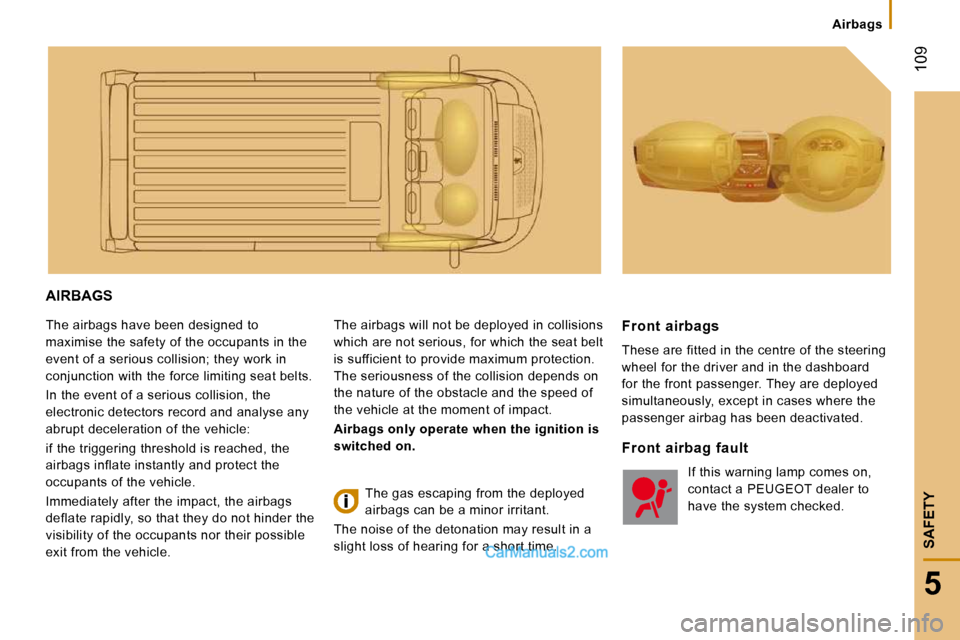
switched on. Front airbags
These are fitted in the centre of the steering
wheel for the driver and in the dashboard
for the front passenger. They are deployed
simultaneously, except in cases where the
passenger airbag has been deactivated.
The gas escaping from the deployed
airbags can be a minor irritant.
The noise of the detonation may result in a
slight loss of hearing for a short time.
Front airbag fault
If this warning lamp comes on,
contact a PEUGEOT dealer to
have the system checked.
Page 109 of 167
kmC I T Y
110
Airbags
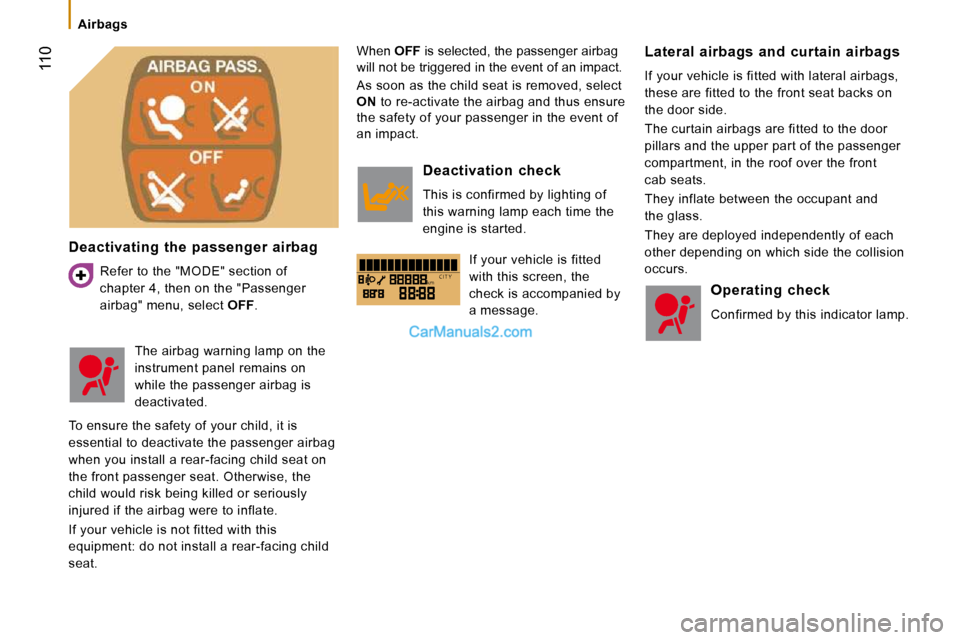
Deactivating the passenger airbag
Refer to the "MODE" section of
chapter 4, then on the "Passenger
airbag" menu, select OFF . When
OFF is selected, the passenger airbag
will not be triggered in the event of an impact.
As soon as the child seat is removed, select
ON to re-activate the airbag and thus ensure
the safety of your passenger in the event of
an impact.
Lateral airbags and curtain airbags
If your vehicle is fitted with lateral airbags,
these are fitted to the front seat backs on
the door side.
The curtain airbags are fitted to the door
pillars and the upper part of the passenger
compartment, in the roof over the front
cab seats.
They inflate between the occupant and
the glass.
They are deployed independently of each
other depending on which side the collision
occurs.
The airbag warning lamp on the
instrument panel remains on
while the passenger airbag is
deactivated.
To ensure the safety of your child, it is
essential to deactivate the passenger airbag
when you install a rear-facing child seat on
the front passenger seat. Otherwise, the
child would risk being killed or seriously
injured if the airbag were to inflate.
If your vehicle is not fitted with this
equipment: do not install a rear-facing child
seat.
Deactivation check
This is confirmed by lighting of
this warning lamp each time the
engine is started.
If your vehicle is fitted
with this screen, the
check is accompanied by
a message.
Operating check
Confirmed by this indicator lamp.
Page 111 of 167
kmC I T Y
110
Airbags
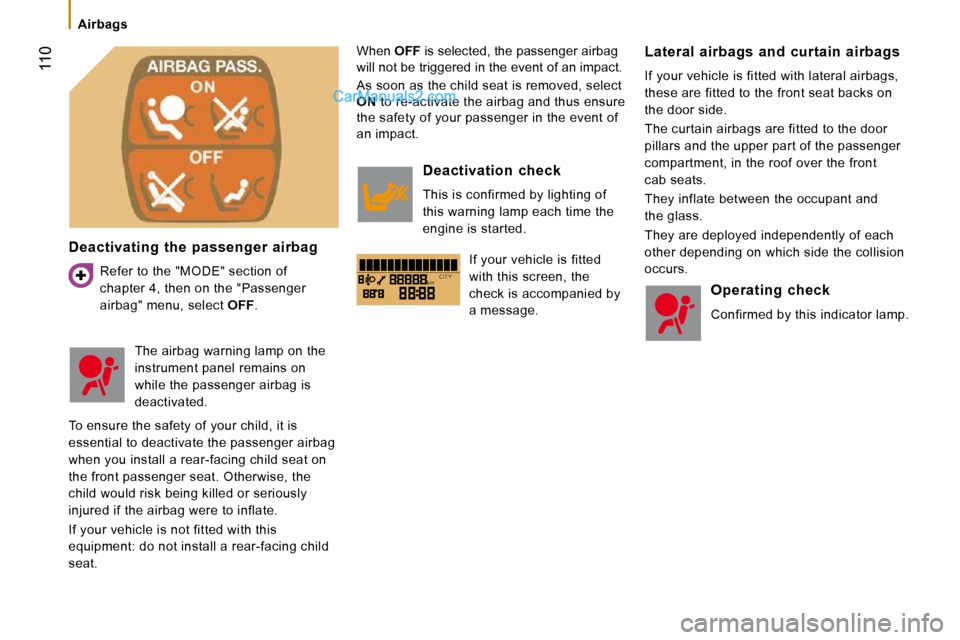
Deactivating the passenger airbag
Refer to the "MODE" section of
chapter 4, then on the "Passenger
airbag" menu, select OFF . When
OFF is selected, the passenger airbag
will not be triggered in the event of an impact.
As soon as the child seat is removed, select
ON to re-activate the airbag and thus ensure
the safety of your passenger in the event of
an impact.
Lateral airbags and curtain airbags
If your vehicle is fitted with lateral airbags,
these are fitted to the front seat backs on
the door side.
The curtain airbags are fitted to the door
pillars and the upper part of the passenger
compartment, in the roof over the front
cab seats.
They inflate between the occupant and
the glass.
They are deployed independently of each
other depending on which side the collision
occurs.
The airbag warning lamp on the
instrument panel remains on
while the passenger airbag is
deactivated.
To ensure the safety of your child, it is
essential to deactivate the passenger airbag
when you install a rear-facing child seat on
the front passenger seat. Otherwise, the
child would risk being killed or seriously
injured if the airbag were to inflate.
If your vehicle is not fitted with this
equipment: do not install a rear-facing child
seat.
Deactivation check
This is confirmed by lighting of
this warning lamp each time the
engine is started.
If your vehicle is fitted
with this screen, the
check is accompanied by
a message.
Operating check
Confirmed by this indicator lamp.
Page 122 of 167
121
6
Towing a trailer
ACCESSORIES
Cooling: towing a trailer on a slope
increases the coolant temperature.
As the fan is electrically controlled, its
cooling capacity is not dependent on the
engine speed.
On the contrary, use a high gear to lower the
engine speed and reduce your speed.
In all cases, pay attention to the coolant
temperature.
Tyres: check the tyre pressures of the
towing vehicle (see the "Identification
markings" section of chapter 9) and of
the trailer, observing the recommended
pressures.
We recommend the use of original
PEUGEOT towbars and their harnesses,
which have been tested and approved from
the design stage of your vehicle and that
the fitting of this equipment is entrusted to a
PEUGEOT dealer.
If this equipment is not fitted by a PEUGEOT
dealer, it is imperative that it is fitted using
the electrical pre-equipment installed at the
rear of the vehicle and in accordance with
the manufacturer's instructions.
Good practice
In certain cases of particularly arduous
use (towing the maximum load up a steep
slope in high temperatures), the engine
automatically limits its power. In this
case, the automatic cutting off of the air
conditioning allows the engine power to be
recovered.
If the coolant temperature
warning lamp comes on, stop the
vehicle and switch off the engine
as soon as possible.
See the "Levels" section of chapter 7.
Brakes: towing increases the braking
distance. Drive at a moderate speed,
change down early and brake gradually.
Side wind: sensitivity to side wind is
increased. Drive smoothly and at a
moderate speed.
ABS: the system only controls the vehicle,
not the trailer.
Rear parking
sensors
: the system does not
operate while the vehicle is towing.
Page 125 of 167
123
6
Equipment
ACCESSORIES
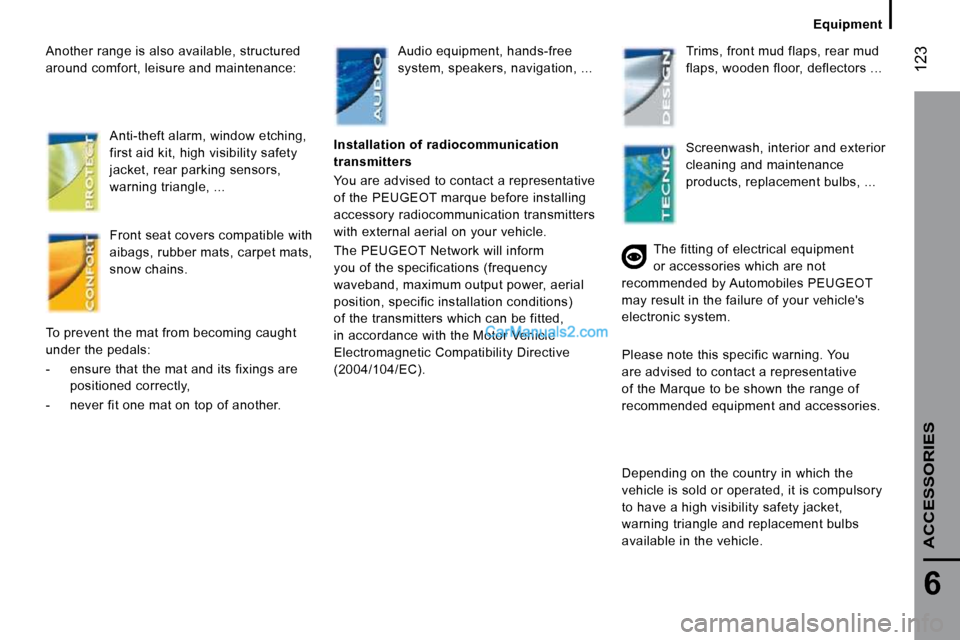
Another range is also available, structured
around comfort, leisure and maintenance: Anti-theft alarm, window etching,
first aid kit, high visibility safety
jacket, rear parking sensors,
warning triangle, ...
Front seat covers compatible with
aibags, rubber mats, carpet mats,
snow chains.
To prevent the mat from becoming caught
under the pedals:
- ensure that the mat and its fixings are positioned correctly,
- never fit one mat on top of another. Audio equipment, hands-free
system, speakers, navigation, ...
Trims, front mud flaps, rear mud
flaps, wooden floor, deflectors ...
Installation of radiocommunication
transmitters
You are advised to contact a representative
of the PEUGEOT marque before installing
accessory radiocommunication transmitters
with external aerial on your vehicle.
The PEUGEOT Network will inform
you of the specifications (frequency
waveband, maximum output power, aerial
position, specific installation conditions)
of the transmitters which can be fitted,
in accordance with the Motor Vehicle
Electromagnetic Compatibility Directive
(2004/104/EC). Screenwash, interior and exterior
cleaning and maintenance
products, replacement bulbs, ...
The fitting of electrical equipment
or accessories which are not
recommended by Automobiles PEUGEOT
may result in the failure of your vehicle's
electronic system.
Please note this specific warning. You
are advised to contact a representative
of the Marque to be shown the range of
recommended equipment and accessories.
Depending on the country in which the
vehicle is sold or operated, it is compulsory
to have a high visibility safety jacket,
warning triangle and replacement bulbs
available in the vehicle.
Page 126 of 167
124
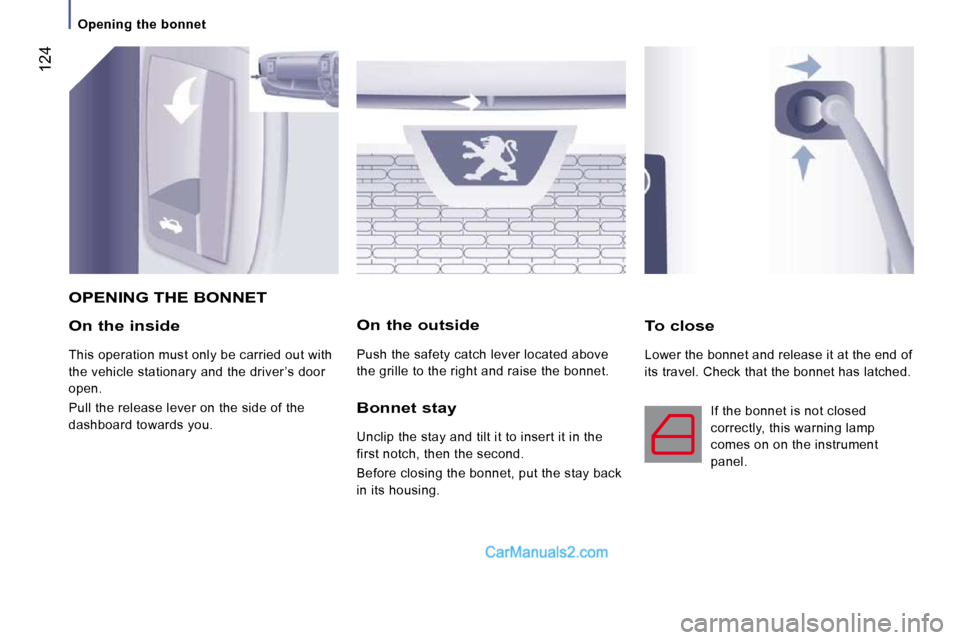
Opening the bonnet
On the inside
This operation must only be carried out with
the vehicle stationary and the driver ’s door
open.
Pull the release lever on the side of the
dashboard towards you.
On the outside
Push the safety catch lever located above
the grille to the right and raise the bonnet.
To close
Lower the bonnet and release it at the end of
its travel. Check that the bonnet has latched.
OPENING THE BONNET
Bonnet stay
Unclip the stay and tilt it to insert it in the
first notch, then the second.
Before closing the bonnet, put the stay back
in its housing. If the bonnet is not closed
correctly, this warning lamp
comes on on the instrument
panel.