battery Peugeot Boxer 2013 User Guide
[x] Cancel search | Manufacturer: PEUGEOT, Model Year: 2013, Model line: Boxer, Model: Peugeot Boxer 2013Pages: 184, PDF Size: 4.53 MB
Page 146 of 184
Fuel
144
Low fuel level
When the fuel tank level E
(Empty) is reached, this warning
lamp comes on. At this moment,
you have enough fuel left to
drive approximately 30 miles (50 km)
,
depending on the driving conditions, the
engine and the profile of the road. Fill up
without delay to avoid running out of fuel. The fuel tank must be filled with the engine
off.
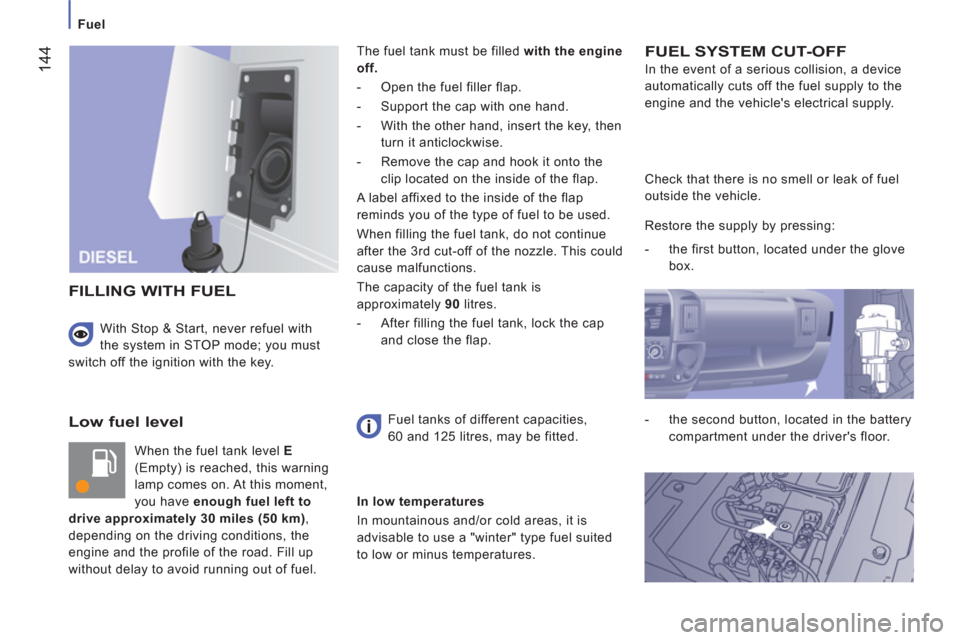
- Open the fuel filler flap.
- Support the cap with one hand.
- With the other hand, insert the key, then
turn it anticlockwise.
- Remove the cap and hook it onto the
clip located on the inside of the flap.
A label affixed to the inside of the flap
reminds you of the type of fuel to be used.
When filling the fuel tank, do not continue
after the 3rd cut-off of the nozzle. This could
cause malfunctions.
The capacity of the fuel tank is
approximately 90
litres.
- After filling the fuel tank, lock the cap
and close the flap.
FUEL SYSTEM CUT-OFF
In the event of a serious collision, a device
automatically cuts off the fuel supply to the
engine and the vehicle's electrical supply.
FILLING WITH FUEL
Fuel tanks of different capacities,
60 and 125 litres, may be fitted. Check that there is no smell or leak of fuel
outside the vehicle.
Restore the supply by pressing:
- the first button, located under the glove
box.
- the second button, located in the battery
compartment under the driver's floor.
In low temperatures
In mountainous and/or cold areas, it is
advisable to use a "winter" type fuel suited
to low or minus temperatures.
With Stop & Start, never refuel with
the system in STOP mode; you must
switch off the ignition with the key.
Page 147 of 184
14
5
Battery
QUICK HELP
8
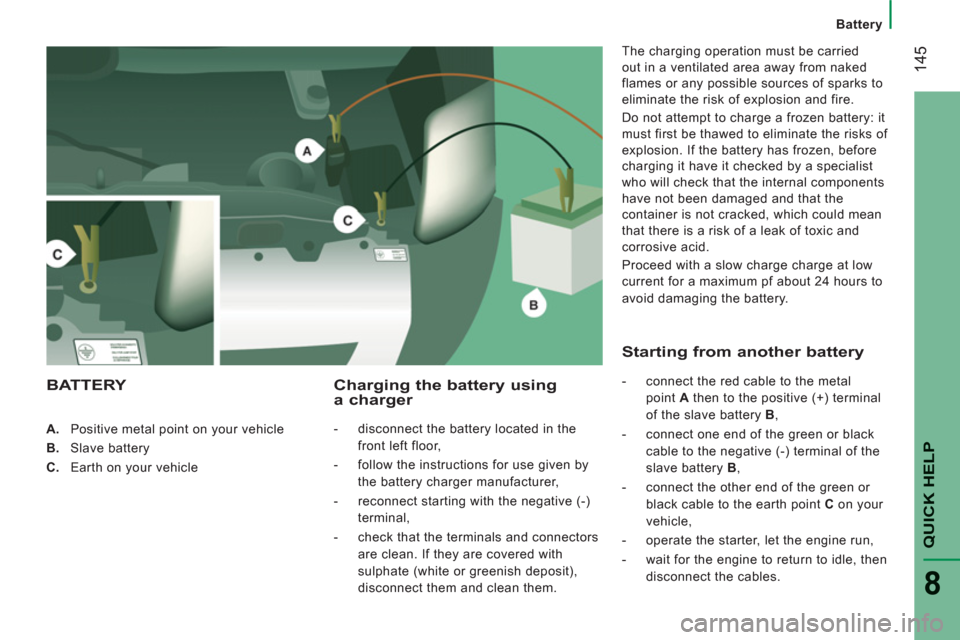
A.
Positive metal point on your vehicle
B.
Slave battery
C.
Earth on your vehicle
Charging the battery using a charger
- disconnect the battery located in the
front left floor,
- follow the instructions for use given by
the battery charger manufacturer,
- reconnect starting with the negative (-)
terminal,
- check that the terminals and connectors
are clean. If they are covered with
sulphate (white or greenish deposit),
disconnect them and clean them.
The charging operation must be carried
out in a ventilated area away from naked
flames or any possible sources of sparks to
eliminate the risk of explosion and fire.
Do not attempt to charge a frozen battery: it
must first be thawed to eliminate the risks of
explosion. If the battery has frozen, before
charging it have it checked by a specialist
who will check that the internal components
have not been damaged and that the
container is not cracked, which could mean
that there is a risk of a leak of toxic and
corrosive acid.
Proceed with a slow charge charge at low
current for a maximum pf about 24 hours to
avoid damaging the battery.
BATTERY
Starting from another battery
- connect the red cable to the metal
point A
then to the positive (+) terminal
of the slave battery B
,
- connect one end of the green or black
cable to the negative (-) terminal of the
slave battery B
,
- connect the other end of the green or
black cable to the earth point C
on your
vehicle,
- operate the starter, let the engine run,
- wait for the engine to return to idle, then
disconnect the cables.
Page 148 of 184
14
6
Battery
The batteries contain harmful
substances such as sulphuric acid and
lead. They must be discarded in accordance
with the provisions of the law and must not,
in any circumstances, be discarded with
household waste.
Take used batteries to a special collection
point.
It is advisable to disconnect the
negative (-) terminal of the battery if the
vehicle is not to be used for a period of
more than one month.
The description of the battery charging
procedure is given as an indication only.
Before disconnecting the battery, you must
wait for 2 minutes after switching off the
ignition.
Never disconnect a terminal when the
engine is running.
Never charge a battery without first
disconnecting the terminals.
Close the windows and doors before
disconnecting the battery.
After every reconnection of the battery,
switch on the ignition and wait 1 minute
before starting to allow the electronic
systems to be initialised. If slight difficulties
are experienced after this, please contact
a PEUGEOT dealer.
If the battery has been disconnected
for some time, it may be necessary to
reinitialise the following functions:
- the display parameters (date, time,
language, distance unit and temperature
unit),
- the radio stations,
- the central locking.
Some settings are cleared and must be
reprogrammed, consult a PEUGEOT.
If your vehicle is fitted with a tachograph or
an alarm, disconnection of the negative (-)
terminal of the battery (located under the
floor on the left-hand side, in the cab) is
recommended if the vehicle is not to be used
for a period of more than 5 days.
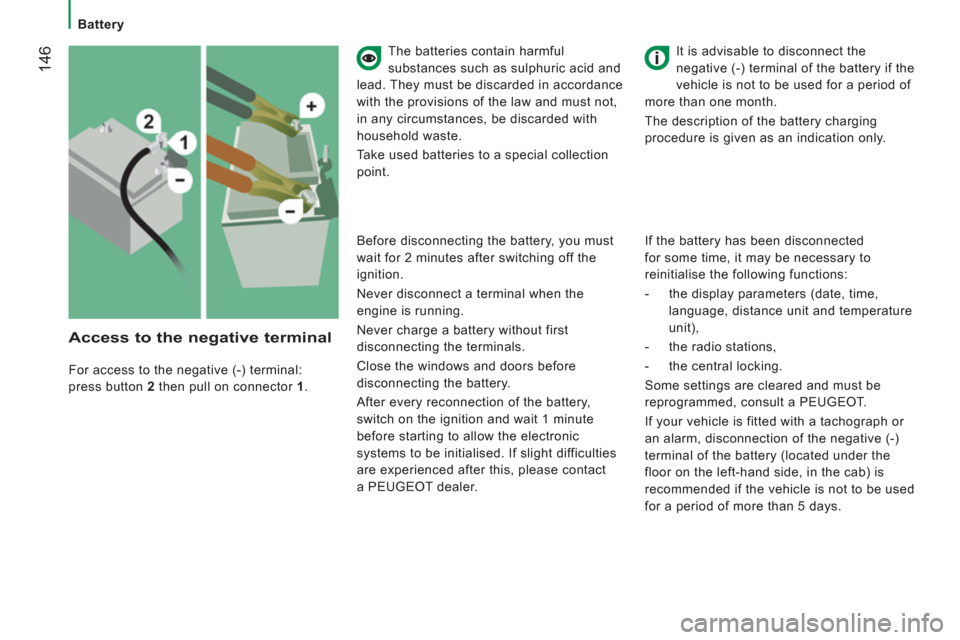
For access to the negative (-) terminal:
press button 2
then pull on connector 1
.
Access to the negative terminal
Page 149 of 184
14
7
Battery
QUICK HELP
8
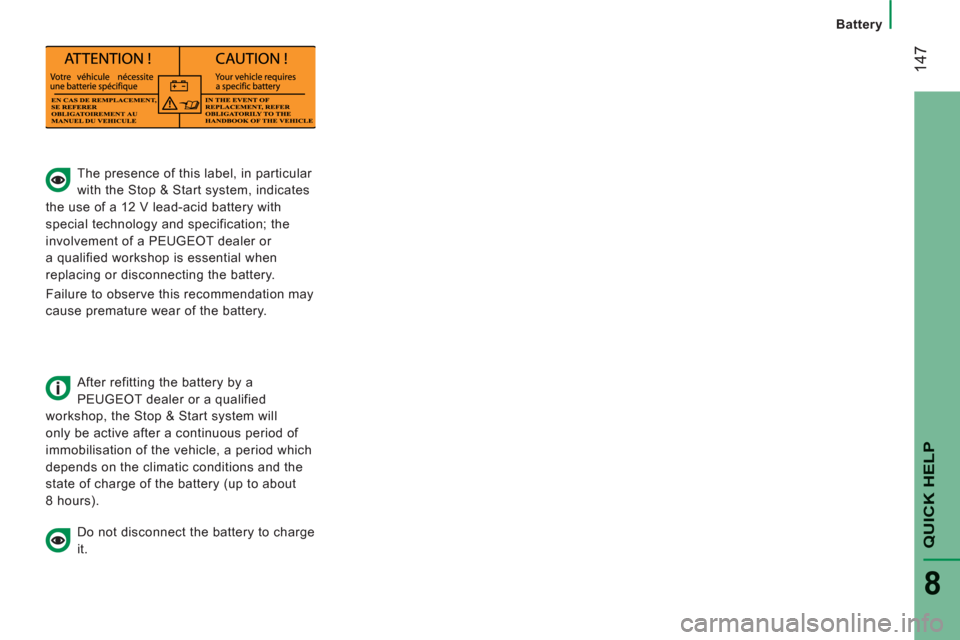
The presence of this label, in particular
with the Stop & Start system, indicates
the use of a 12 V lead-acid battery with
special technology and specification; the
involvement of a PEUGEOT dealer or
a qualified workshop is essential when
replacing or disconnecting the battery.
Failure to observe this recommendation may
cause premature wear of the battery.
After refitting the battery by a
PEUGEOT dealer or a qualified
workshop, the Stop & Start system will
only be active after a continuous period of
immobilisation of the vehicle, a period which
depends on the climatic conditions and the
state of charge of the battery (up to about
8 hours).
Do not disconnect the battery to charge
it.
Page 160 of 184
Changing a fuse
158
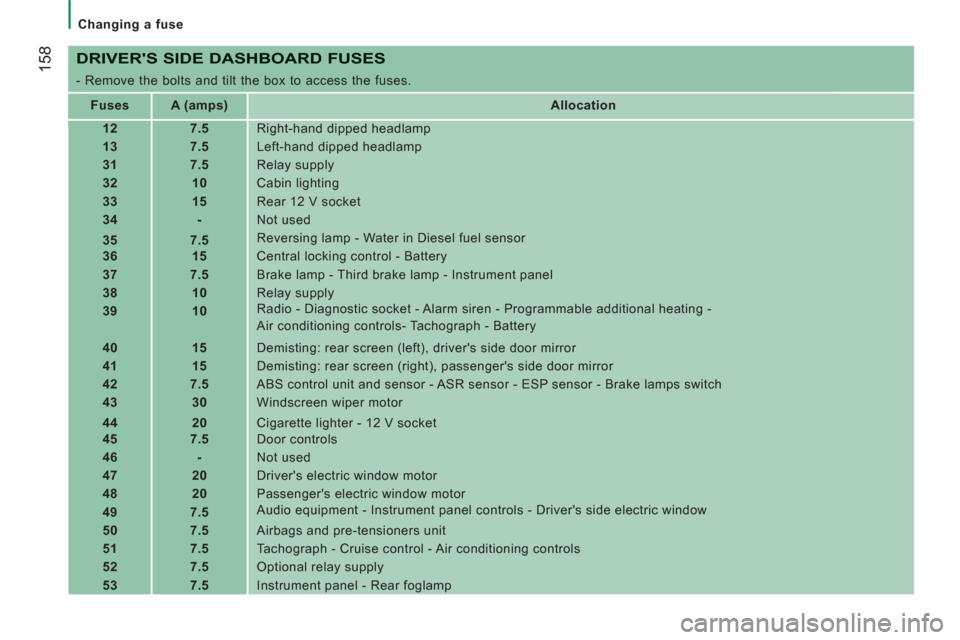
DRIVER'S SIDE DASHBOARD FUSES
- Remove the bolts and tilt the box to access the fuses.
Fuses
A (amps)
Allocation
12
7.5
Right-hand dipped headlamp
13
7.5
Left-hand dipped headlamp
31
7.5
Relay supply
32
10
Cabin lighting
33
15
Rear 12 V socket
34
-
Not used
35
7.5
Reversing lamp - Water in Diesel fuel sensor
36
15
Central locking control - Battery
37
7.5
Brake lamp - Third brake lamp - Instrument panel
38
10
Relay supply
39
10
Radio - Diagnostic socket - Alarm siren - Programmable additional heating -
Air conditioning controls- Tachograph - Battery
40
15
Demisting: rear screen (left), driver's side door mirror
41
15
Demisting: rear screen (right), passenger's side door mirror
42
7.5
ABS control unit and sensor - ASR sensor - ESP sensor - Brake lamps switch
43
30
Windscreen wiper motor
44
20
Cigarette lighter - 12 V socket
45
7.5
Door controls
46
-
Not used
47
20
Driver's electric window motor
48
20
Passenger's electric window motor
49
7.5
Audio equipment - Instrument panel controls - Driver's side electric window
50
7.5
Airbags and pre-tensioners unit
51
7.5
Tachograph - Cruise control - Air conditioning controls
52
7.5
Optional relay supply
53
7.5
Instrument panel - Rear foglamp
Page 176 of 184
174
Exterior
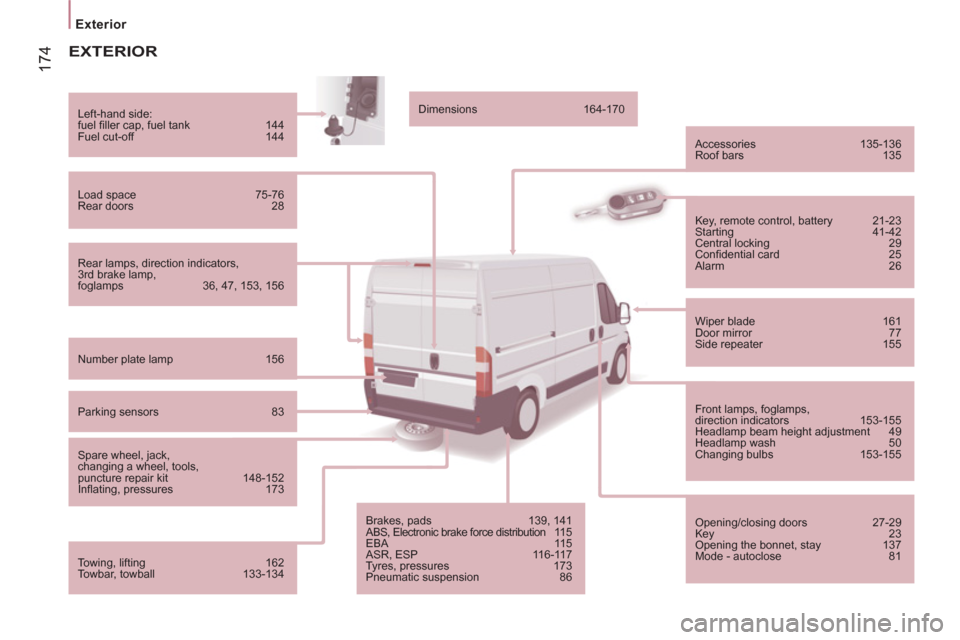
EXTERIOR
Rear lamps, direction indicators,
3 rd brake lamp,
foglamps 36, 47, 153, 156
Left-hand side:
fuel fi ller cap, fuel tank 144
Fuel cut-off 144
Load space 75-76
Rear doors 28
Number plate lamp 156
Parking sensors 83
Spare wheel, jack,
changing a wheel, tools,
puncture repair kit 148-152
Infl ating, pressures 173
Towing, lifting 162
Towbar, towball 133-134
Dimensions 164-170
Accessories 135-136
Roof bars 135
Brakes, pads 139, 141
ABS, Electronic brake force distribution 115
EBA 115
ASR, ESP 116-117
Tyres, pressures 173
Pneumatic suspension 86
Key, remote control, battery 21-23
Starting 41-42
Central locking 29
Confi dential card 25
Alarm 26
Wiper blade 161
Door mirror 77
Side repeater 155
Front lamps, foglamps,
direction indicators 153-155
Headlamp beam height adjustment 49
Headlamp wash 50
Changing bulbs 153-155
Opening/closing doors 27-29
Key 23
Opening the bonnet, stay 137
Mode - autoclose 81
Page 179 of 184
17
7
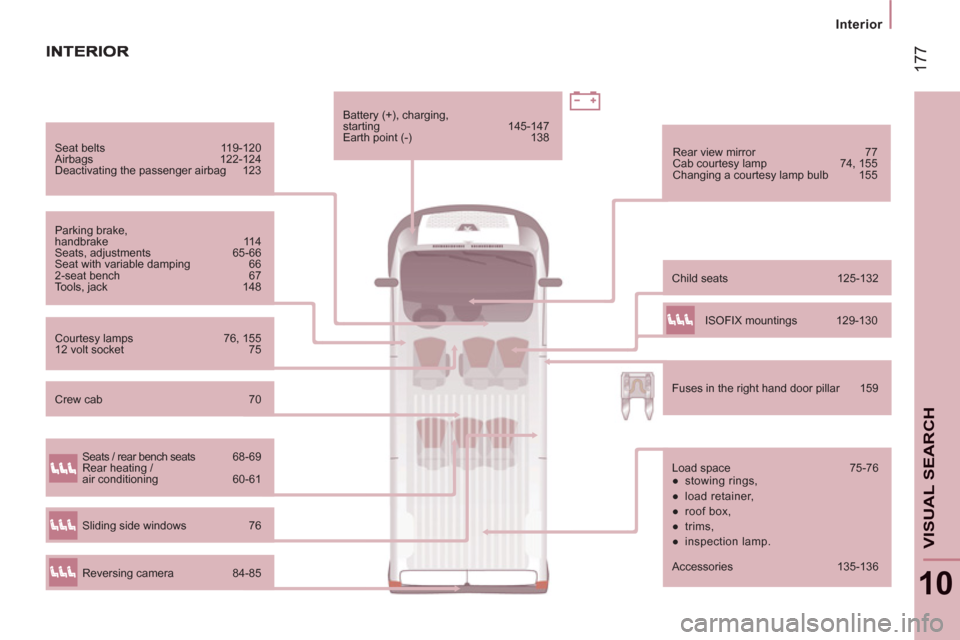
Interior
10
VISUAL SEARCH
Seat belts 119-120
Airbags 122-124
Deactivating the passenger airbag 123
Parking brake,
handbrake 114
Seats, adjustments 65-66
Seat with variable damping 66
2-seat bench 67
Tools, jack 148
Child seats 125-132
Rear view mirror 77
Cab courtesy lamp 74, 155
Changing a courtesy lamp bulb 155
Courtesy lamps 76, 155
12 volt socket 75
Battery (+), charging,
starting 145-147
Earth point (-) 138
Fuses in the right hand door pillar 159
Load space 75-76
●
stowing rings,
●
load retainer,
●
roof box,
●
trims,
●
inspection lamp.
Seats / rear bench seats 68-69
Rear heating /
air conditioning 60-61
Reversing camera 84-85
Sliding side windows 76
ISOFIX mountings 129-130
Crew cab 70
Accessories 135-136
Page 180 of 184
17
8
Technical data - Maintenance
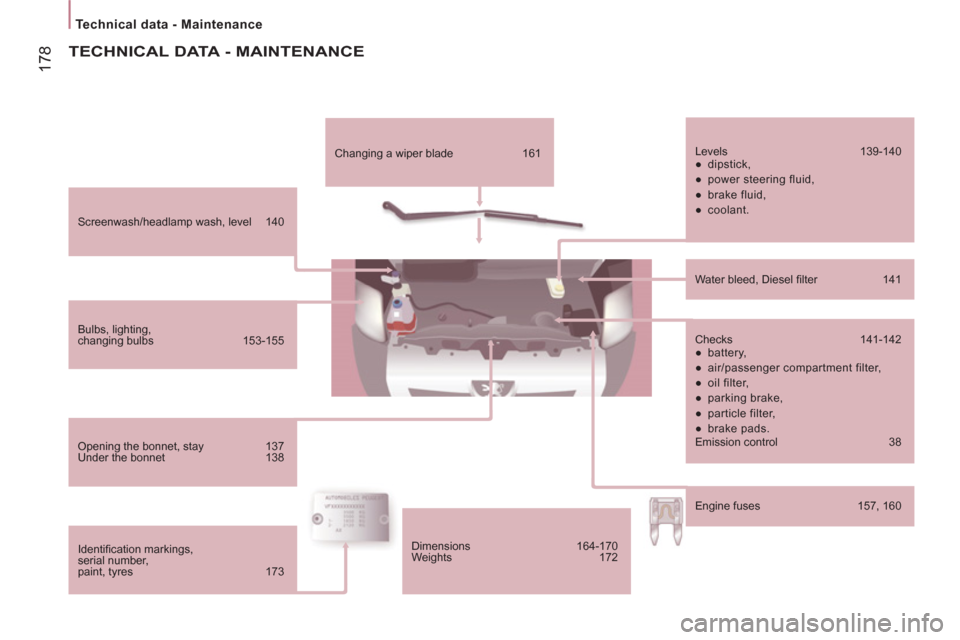
Screenwash/headlamp wash, level 140
Bulbs, lighting,
changing bulbs 153-155
Opening the bonnet, stay 137
Under the bonnet 138
Identifi cation markings,
serial number,
paint, tyres 173
Changing a wiper blade 161
Levels 139-140
●
dipstick,
●
power steering fluid,
●
brake fluid,
●
coolant.
Water bleed, Diesel fi lter 141
Checks 141-142
●
battery,
●
air/passenger compartment filter,
●
oil filter,
●
parking brake,
●
particle filter,
●
brake pads.
Emission control 38
Engine fuses 157, 160
TECHNICAL DATA - MAINTENANCE
Dimensions 164-170
Weights 172