light Peugeot Boxer 2013 Owner's Guide
[x] Cancel search | Manufacturer: PEUGEOT, Model Year: 2013, Model line: Boxer, Model: Peugeot Boxer 2013Pages: 184, PDF Size: 4.53 MB
Page 117 of 184
11
5
5
Driving safely
SAFETY
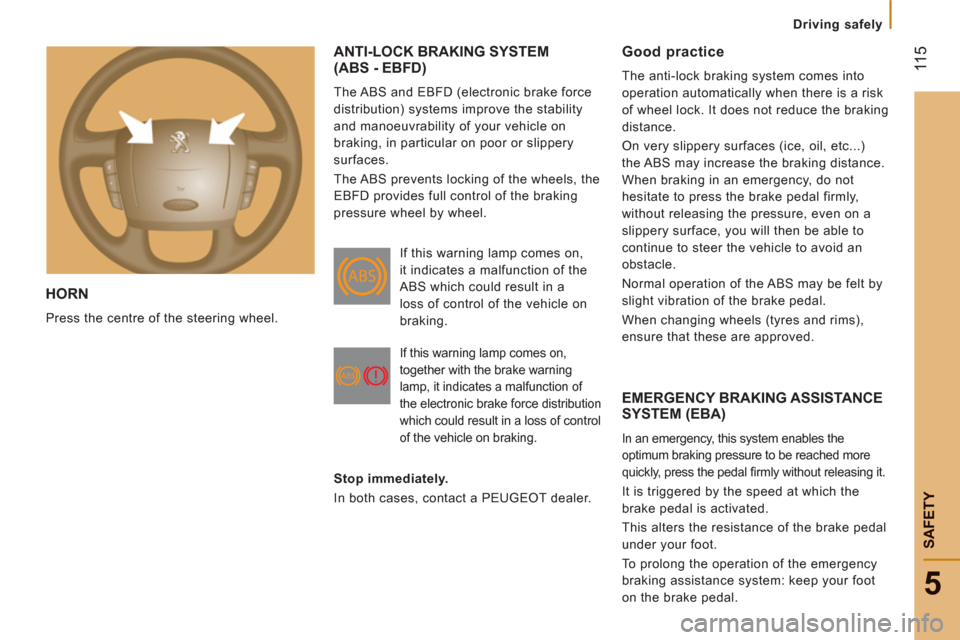
HORN
Press the centre of the steering wheel.
ANTI-LOCK BRAKING SYSTEM(ABS - EBFD)
The ABS and EBFD (electronic brake force
distribution) systems improve the stability
and manoeuvrability of your vehicle on
braking, in particular on poor or slippery
surfaces.
The ABS prevents locking of the wheels, the
EBFD provides full control of the braking
pressure wheel by wheel.
EMERGENCY BRAKING ASSISTANCE
SYSTEM (EBA)
In an emergency, this system enables the
optimum braking pressure to be reached more
quickly, press the pedal fi rmly without releasing it.
It is triggered by the speed at which the
brake pedal is activated.
This alters the resistance of the brake pedal
under your foot.
To prolong the operation of the emergency
braking assistance system: keep your foot
on the brake pedal.
Good practice
The anti-lock braking system comes into
operation automatically when there is a risk
of wheel lock. It does not reduce the braking
distance.
On very slippery surfaces (ice, oil, etc...)
the ABS may increase the braking distance.
When braking in an emergency, do not
hesitate to press the brake pedal firmly,
without releasing the pressure, even on a
slippery surface, you will then be able to
continue to steer the vehicle to avoid an
obstacle.
Normal operation of the ABS may be felt by
slight vibration of the brake pedal.
When changing wheels (tyres and rims),
ensure that these are approved. If this warning lamp comes on,
it indicates a malfunction of the
ABS which could result in a
loss of control of the vehicle on
braking.
If this warning lamp comes on,
together with the brake warning
lamp, it indicates a malfunction of
the electronic brake force distribution
which could result in a loss of control
of the vehicle on braking.
Stop immediately.
In both cases, contact a PEUGEOT dealer.
Page 122 of 184
Seat belts
12
0
The force limiter reduces the pressure of the
seat belt against the body of the occupants.
The pretensioning seat belts are active when
the ignition is switched on.
The inertia reels are fitted with a device
which automatically locks the strap in the
event of a collision or emergency braking or
if the vehicle rolls over.
You can unfasten the seat belt by pressing
the red button on the buckle. Guide the seat
belt after unfastening.
Good practice
The driver must ensure that passengers use
the seat belts correctly and that they are all
strapped in securely before moving off.
Wherever you are seated in the vehicle,
always fasten your seat belt, even for short
journeys.
The seat belts are fitted with an inertia reel
which automatically adjusts the length of the
strap to your size.
Do not use accessories (clothes pegs, clips,
safety pins, etc.) which permit a clearance
with the seat belt straps.
Ensure that the seat belt has reeled in
correctly after use.
After folding or moving a seat or a rear
bench seat, ensure that the seat belt has
reeled in correctly and that the buckle is
ready to accommodate the tongue.
Depending on the nature and seriousness
of any impact, the pretensioning device may
be triggered before and independently of
inflation of the airbags. It instantly tightens
the seat belts against the body of the
occupants. Triggering of the pretensioners
is accompanied by a slight discharge of
harmless smoke and a noise, due to the
activation of the pyrotechnic cartridge
incorporated in the system. The airbag warning lamp comes
on if the pretensioners are
triggered. Consult a PEUGEOT
dealer.
In order to be effective, a seat belt must:
- restrain one person only,
- must not be twisted, check by pulling in
front of you with an even movement,
- be tightened as close to the body as
possible.
The upper part of the seat belt should be
positioned in the hollow of the shoulder.
The lap part should be placed as low as
possible on the pelvis.
Do not invert the seat belt buckles as they
will not fulfil their role completely. If the seats are fitted with armrests, the lap
part of the seat belt should always pass
under the armrest.
Check that the seat belt is fastened correctly
by pulling the strap firmly.
Recommendations for children:
- use a suitable child seat if the
passenger is less than 12 years old or
shorter than one metre fifty,
- never allow a child to travel on your lap,
even with the seat belt fastened.
For more information on child seats,
refer to the "Child safety" section of
chapter 5.
Your PEUGEOT dealer can ensure that
all work or any checks, from testing to
maintenance on your seat belt equipment
meets current regulations.
Have the seat belts checked regularly
(even after a minor impact) by a PEUGEOT
dealer: they must not show any signs of
wear, cutting or fraying and they must not be
converted or modified.
Clean the seat belt straps with soapy
water or a textile cleaning product, sold
by PEUGEOT dealers.
Page 124 of 184
Airbags
122
AIRBAGS
The airbags have been designed to optimise
the safety of the occupants in the event of
a serious collision; they work in conjunction
with the force limiting seat belts.
In the event of a serious collision, electronic
detectors record and analyse any abrupt
deceleration of the vehicle:
- in the event of a serious collision, the
airbags are deployed instantly and
contribute towards better protection of
occupants of the vehicle; immediately
after the impact, the airbags rapidly
deflate so as to not hinder visibility or
the possible exit by the occupants,
- in the event of a less serious impact,
an impact to the rear and in certain
conditions of rollover, the airbags are not deployed; the seat belts alone contribute
towards providing protection in these
situations.
Airbags only operate when the ignition is
switched on.
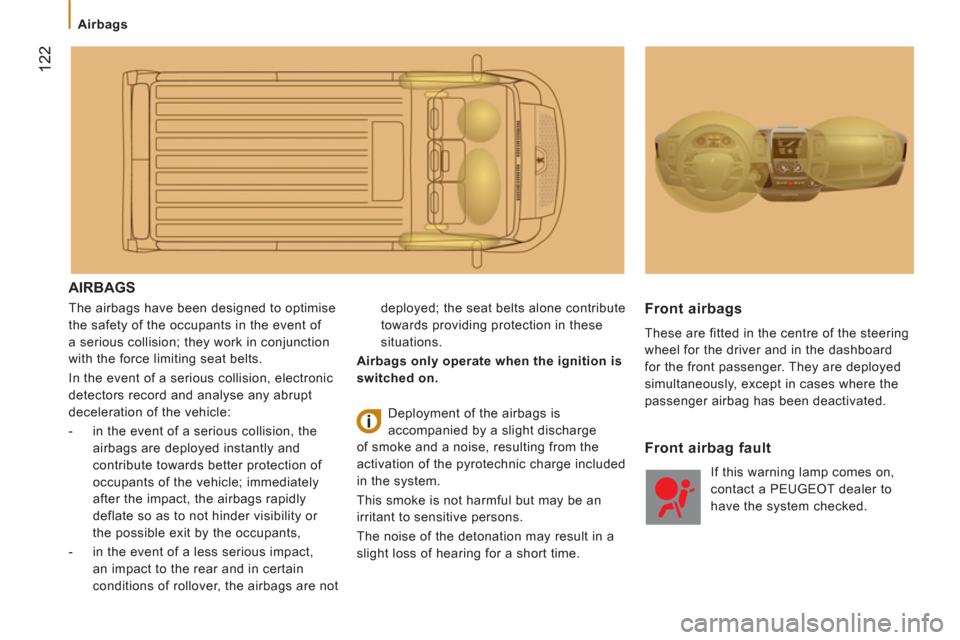
Front airbags
These are fitted in the centre of the steering
wheel for the driver and in the dashboard
for the front passenger. They are deployed
simultaneously, except in cases where the
passenger airbag has been deactivated.
Deployment of the airbags is
accompanied by a slight discharge
of smoke and a noise, resulting from the
activation of the pyrotechnic charge included
in the system.
This smoke is not harmful but may be an
irritant to sensitive persons.
The noise of the detonation may result in a
slight loss of hearing for a short time.
Front airbag fault
If this warning lamp comes on,
contact a PEUGEOT dealer to
have the system checked.
Page 125 of 184
Airbags
12
3
SAFETY
5
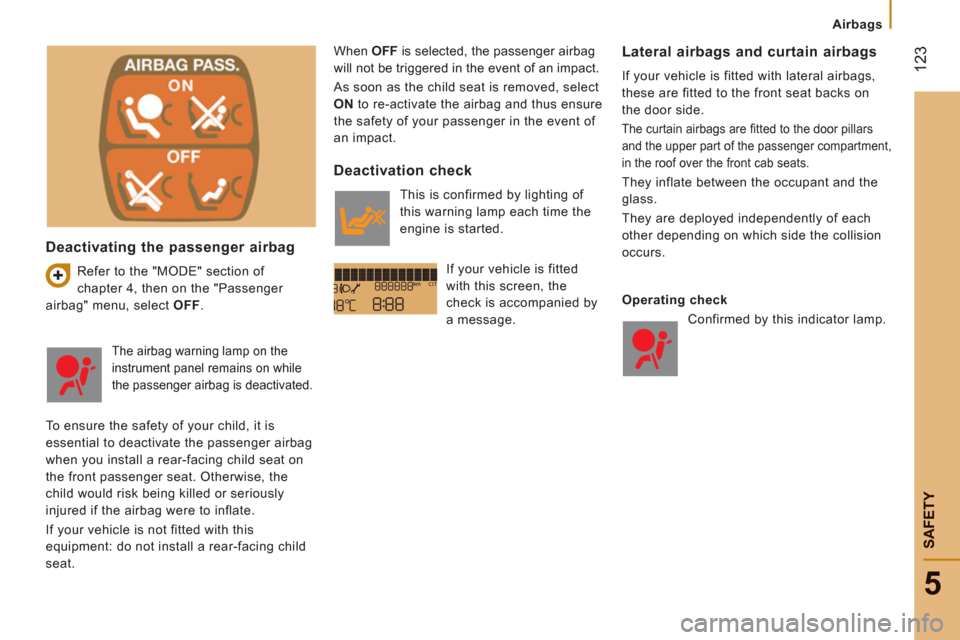
Deactivating the passenger airbag
Refer to the "MODE" section of
chapter 4, then on the "Passenger
airbag" menu, select OFF
. When OFF
is selected, the passenger airbag
will not be triggered in the event of an impact.
As soon as the child seat is removed, select
ON
to re-activate the airbag and thus ensure
the safety of your passenger in the event of
an impact.
Lateral airbags and curtain airbags
If your vehicle is fitted with lateral airbags,
these are fitted to the front seat backs on
the door side.
The curtain airbags are fi tted to the door pillars
and the upper part of the passenger compartment,
in the roof over the front cab seats.
They inflate between the occupant and the
glass.
They are deployed independently of each
other depending on which side the collision
occurs.
The airbag warning lamp on the
instrument panel remains on while
the passenger airbag is deactivated.
To ensure the safety of your child, it is
essential to deactivate the passenger airbag
when you install a rear-facing child seat on
the front passenger seat. Otherwise, the
child would risk being killed or seriously
injured if the airbag were to inflate.
If your vehicle is not fitted with this
equipment: do not install a rear-facing child
seat.
Deactivation check
This is confirmed by lighting of
this warning lamp each time the
engine is started.
If your vehicle is fitted
with this screen, the
check is accompanied by
a message.
Operating check
Confirmed by this indicator lamp.
Page 148 of 184
14
6
Battery
The batteries contain harmful
substances such as sulphuric acid and
lead. They must be discarded in accordance
with the provisions of the law and must not,
in any circumstances, be discarded with
household waste.
Take used batteries to a special collection
point.
It is advisable to disconnect the
negative (-) terminal of the battery if the
vehicle is not to be used for a period of
more than one month.
The description of the battery charging
procedure is given as an indication only.
Before disconnecting the battery, you must
wait for 2 minutes after switching off the
ignition.
Never disconnect a terminal when the
engine is running.
Never charge a battery without first
disconnecting the terminals.
Close the windows and doors before
disconnecting the battery.
After every reconnection of the battery,
switch on the ignition and wait 1 minute
before starting to allow the electronic
systems to be initialised. If slight difficulties
are experienced after this, please contact
a PEUGEOT dealer.
If the battery has been disconnected
for some time, it may be necessary to
reinitialise the following functions:
- the display parameters (date, time,
language, distance unit and temperature
unit),
- the radio stations,
- the central locking.
Some settings are cleared and must be
reprogrammed, consult a PEUGEOT.
If your vehicle is fitted with a tachograph or
an alarm, disconnection of the negative (-)
terminal of the battery (located under the
floor on the left-hand side, in the cab) is
recommended if the vehicle is not to be used
for a period of more than 5 days.
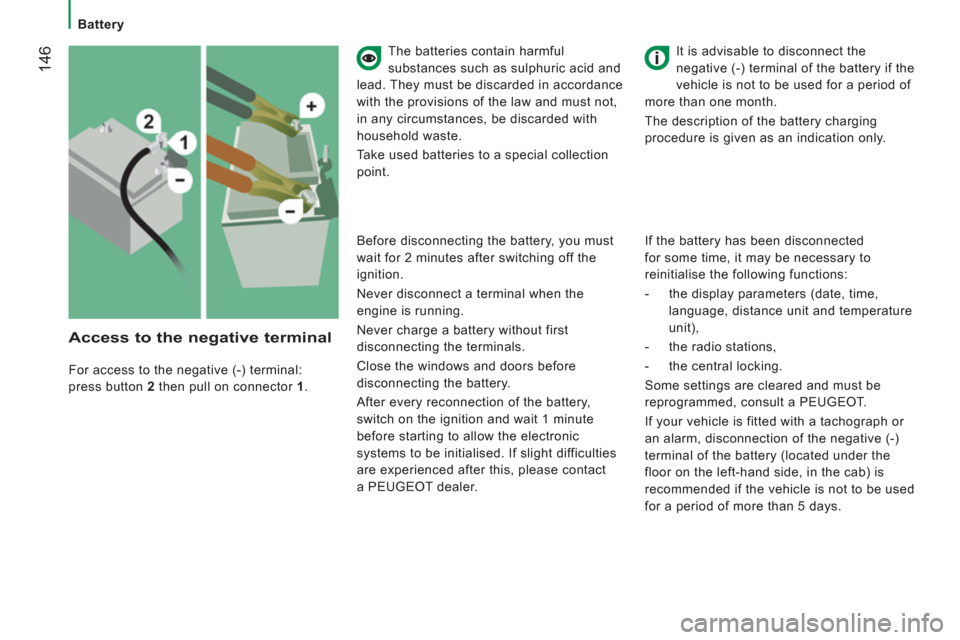
For access to the negative (-) terminal:
press button 2
then pull on connector 1
.
Access to the negative terminal
Page 156 of 184
154
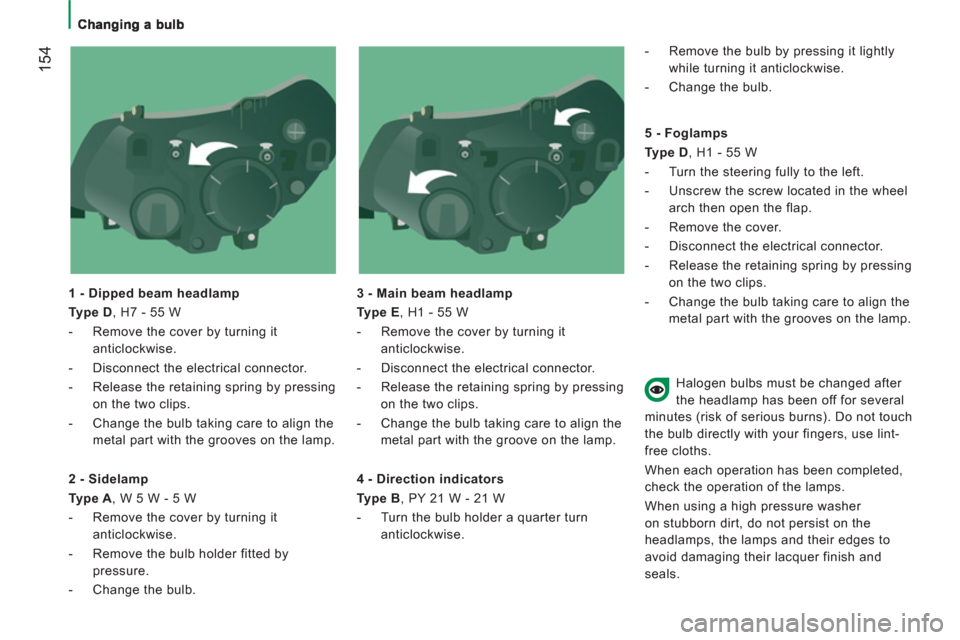
1 - Dipped beam headlamp
Type D
, H7 - 55 W
- Remove the cover by turning it
anticlockwise.
- Disconnect the electrical connector.
- Release the retaining spring by pressing
on the two clips.
- Change the bulb taking care to align the
metal part with the grooves on the lamp.
3 - Main beam headlamp
Type E
, H1 - 55 W
- Remove the cover by turning it
anticlockwise.
- Disconnect the electrical connector.
- Release the retaining spring by pressing
on the two clips.
- Change the bulb taking care to align the
metal part with the groove on the lamp.
2 - Sidelamp
Type A
, W 5 W - 5 W
- Remove the cover by turning it
anticlockwise.
- Remove the bulb holder fitted by
pressure.
- Change the bulb.
4 - Direction indicators
Type B
, PY 21 W - 21 W
- Turn the bulb holder a quarter turn
anticlockwise.
- Remove the bulb by pressing it lightly
while turning it anticlockwise.
- Change the bulb.
5 - Foglamps
Type D
, H1 - 55 W
- Turn the steering fully to the left.
- Unscrew the screw located in the wheel
arch then open the flap.
- Remove the cover.
- Disconnect the electrical connector.
- Release the retaining spring by pressing
on the two clips.
- Change the bulb taking care to align the
metal part with the grooves on the lamp.
Halogen bulbs must be changed after
the headlamp has been off for several
minutes (risk of serious burns). Do not touch
the bulb directly with your fingers, use lint-
free cloths.
When each operation has been completed,
check the operation of the lamps.
When using a high pressure washer
on stubborn dirt, do not persist on the
headlamps, the lamps and their edges to
avoid damaging their lacquer finish and
seals.
Page 158 of 184
Changing a bulb
156
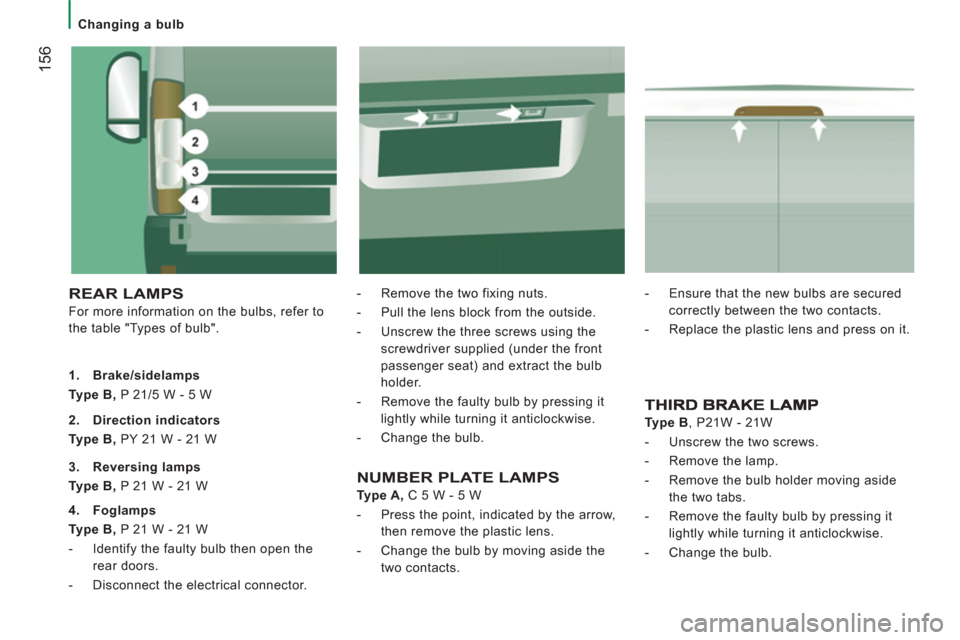
REAR LAMPS
For more information on the bulbs, refer to
the table "Types of bulb".
- Remove the two fixing nuts.
- Pull the lens block from the outside.
- Unscrew the three screws using the
screwdriver supplied (under the front
passenger seat) and extract the bulb
holder.
- Remove the faulty bulb by pressing it
lightly while turning it anticlockwise.
- Change the bulb.
1.
Brake/sidelamps
Type B,
P 21/5 W - 5 W
Type B
, P21W - 21W
- Unscrew the two screws.
- Remove the lamp.
- Remove the bulb holder moving aside
the two tabs.
- Remove the faulty bulb by pressing it
lightly while turning it anticlockwise.
- Change the bulb.
2.
Direction indicators
Type B,
PY 21 W - 21 W
3.
Reversing lamps
Type B,
P 21 W - 21 W
4.
Foglamps
Type B,
P 21 W - 21 W
- Identify the faulty bulb then open the
rear doors.
- Disconnect the electrical connector.
NUMBER PLATE LAMPS
Type A,
C 5 W - 5 W
- Press the point, indicated by the arrow,
then remove the plastic lens.
- Change the bulb by moving aside the
two contacts.
- Ensure that the new bulbs are secured
correctly between the two contacts.
- Replace the plastic lens and press on it.
Page 160 of 184
Changing a fuse
158
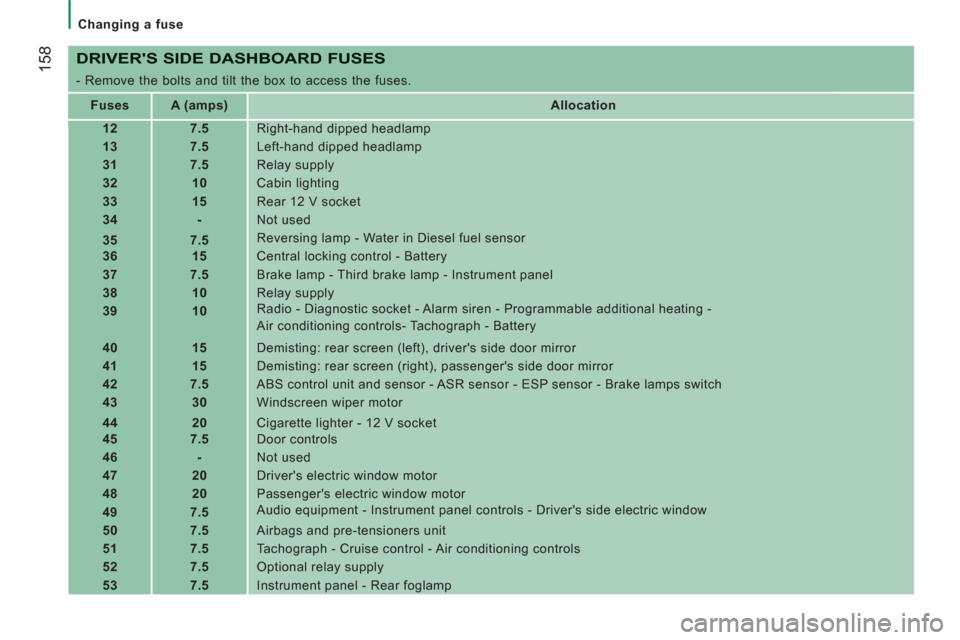
DRIVER'S SIDE DASHBOARD FUSES
- Remove the bolts and tilt the box to access the fuses.
Fuses
A (amps)
Allocation
12
7.5
Right-hand dipped headlamp
13
7.5
Left-hand dipped headlamp
31
7.5
Relay supply
32
10
Cabin lighting
33
15
Rear 12 V socket
34
-
Not used
35
7.5
Reversing lamp - Water in Diesel fuel sensor
36
15
Central locking control - Battery
37
7.5
Brake lamp - Third brake lamp - Instrument panel
38
10
Relay supply
39
10
Radio - Diagnostic socket - Alarm siren - Programmable additional heating -
Air conditioning controls- Tachograph - Battery
40
15
Demisting: rear screen (left), driver's side door mirror
41
15
Demisting: rear screen (right), passenger's side door mirror
42
7.5
ABS control unit and sensor - ASR sensor - ESP sensor - Brake lamps switch
43
30
Windscreen wiper motor
44
20
Cigarette lighter - 12 V socket
45
7.5
Door controls
46
-
Not used
47
20
Driver's electric window motor
48
20
Passenger's electric window motor
49
7.5
Audio equipment - Instrument panel controls - Driver's side electric window
50
7.5
Airbags and pre-tensioners unit
51
7.5
Tachograph - Cruise control - Air conditioning controls
52
7.5
Optional relay supply
53
7.5
Instrument panel - Rear foglamp
Page 177 of 184
17
5
Instruments and controls
10
VISUAL SEARCH
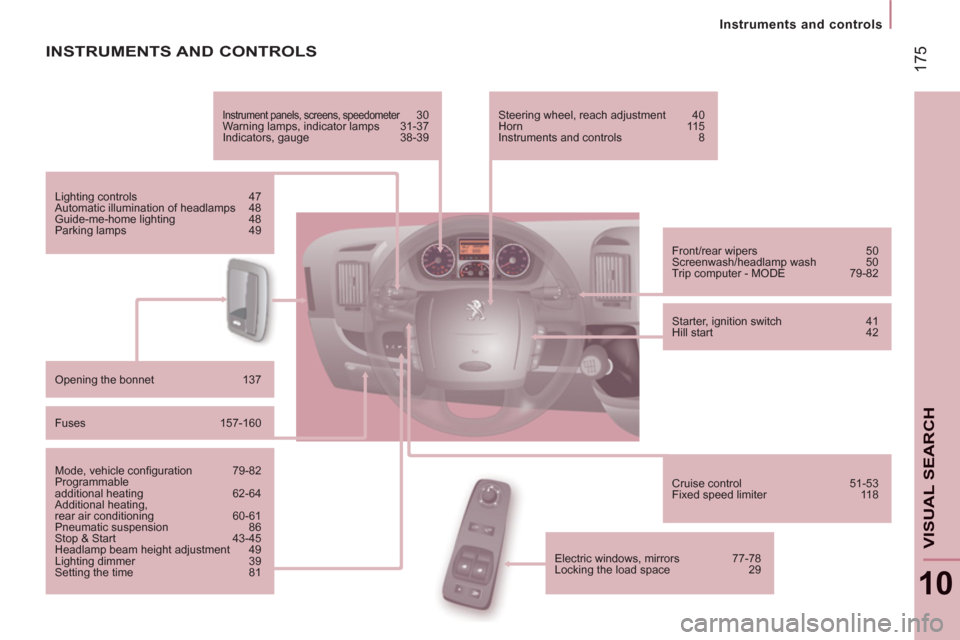
INSTRUMENTS AND CONTROLS
Instrument panels, screens, speedometer 30
Warning lamps, indicator lamps 31-37
Indicators, gauge 38-39
Lighting controls 47
Automatic illumination of headlamps 48
Guide-me-home lighting 48
Parking lamps 49
Opening the bonnet 137
Fuses 157-160
Mode, vehicle confi guration 79-82
Programmable
additional heating 62-64
Additional heating,
rear air conditioning 60-61
Pneumatic suspension 86
Stop & Start 43-45
Headlamp beam height adjustment 49
Lighting dimmer 39
Setting the time 81
Front/rear wipers 50
Screenwash/headlamp wash 50
Trip computer - MODE 79-82
Starter, ignition switch 41
Hill start 42
Cruise control 51-53
Fixed speed limiter 118
Steering wheel, reach adjustment 40
Horn 115
Instruments and controls 8
Electric windows, mirrors 77-78
Locking the load space 29
Page 178 of 184
17
6
Instruments and controls
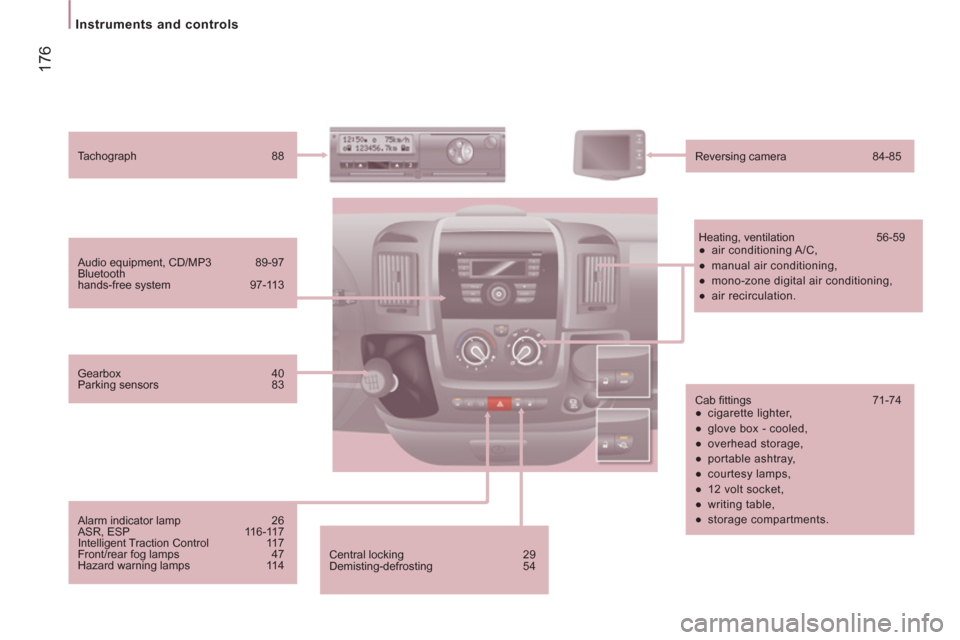
Central locking 29
Demisting-defrosting 54
Audio equipment, CD/MP3 89-97
Bluetooth
hands-free system 97-113
Tachograph 88
Reversing camera 84-85
Heating, ventilation 56-59
●
air conditioning A/C,
●
manual air conditioning,
●
mono-zone digital air conditioning,
●
air recirculation.
Cab fi ttings 71-74
●
cigarette lighter,
●
glove box - cooled,
●
overhead storage,
●
portable ashtray,
●
courtesy lamps,
●
12 volt socket,
●
writing table,
●
storage compartments.
Gearbox 40
Parking sensors 83
Alarm indicator lamp 26
ASR, ESP 116-117
Intelligent Traction Control 117
Front/rear fog lamps 47
Hazard warning lamps 114