warning light Peugeot Boxer 2018 User Guide
[x] Cancel search | Manufacturer: PEUGEOT, Model Year: 2018, Model line: Boxer, Model: Peugeot Boxer 2018Pages: 232, PDF Size: 9.09 MB
Page 91 of 232
89
Cooling
Towing a trailer on a slope increases the
t emperature of the coolant.
As the fan is electrically controlled, its cooling
capacity is not dependent on the engine speed.
F
T
o lower the engine speed, reduce your
speed.
The maximum towable load on an incline
depends on the gradient and the exterior
temperature.
In all cases, keep a
check on the coolant
temperature.
F
I
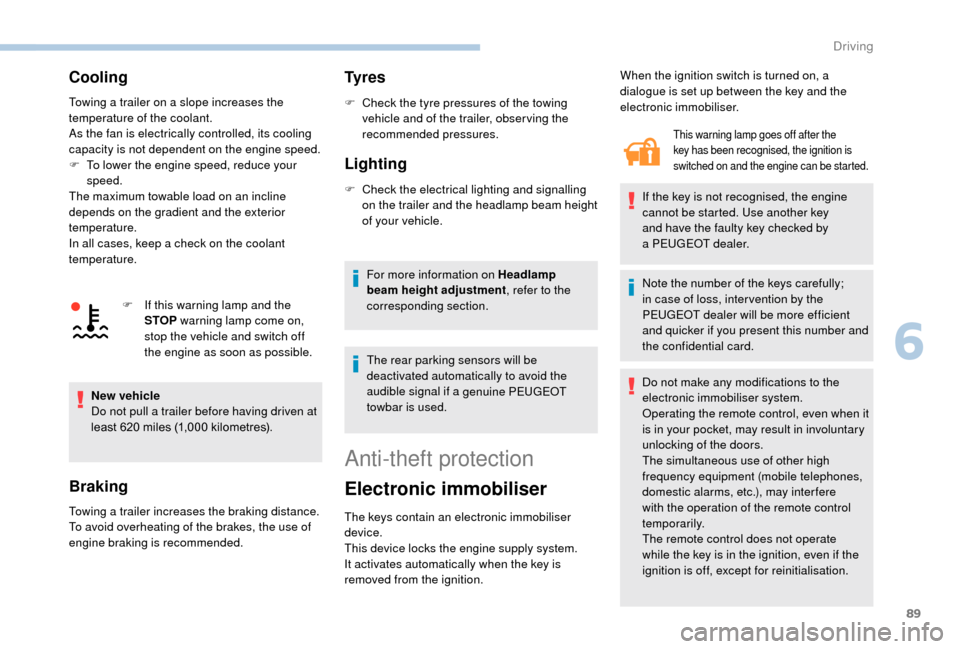
f this warning lamp and the
STOP warning lamp come on,
stop the vehicle and switch off
the engine as soon as possible.
New vehicle
Do not pull a
trailer before having driven at
least 620
miles (1,000 kilometres).
Braking
Towing a trailer increases the braking distance.
T o avoid overheating of the brakes, the use of
engine braking is recommended.
Ty r e s
F Check the tyre pressures of the towing vehicle and of the trailer, observing the
recommended pressures.
Lighting
F Check the electrical lighting and signalling on the trailer and the headlamp beam height
of your vehicle.
For more information on Headlamp
beam height adjustment , refer to the
corresponding section.
The rear parking sensors will be
deactivated automatically to avoid the
audible signal if a
genuine PEUGEOT
towbar is used.
Anti-theft protection
Electronic immobiliser
The keys contain an electronic immobiliser
device.
This device locks the engine supply system.
It activates automatically when the key is
removed from the ignition.
This warning lamp goes off after the
key has been recognised, the ignition is
switched on and the engine can be started.
If the key is not recognised, the engine
cannot be started. Use another key
and have the faulty key checked by
a
PEUGEOT dealer.
Note the number of the keys carefully;
in case of loss, inter vention by the
PEUGEOT dealer will be more efficient
and quicker if you present this number and
the confidential card.
When the ignition switch is turned on, a
dialogue is set up between the key and the
electronic immobiliser.
Do not make any modifications to the
electronic immobiliser system.
Operating the remote control, even when it
is in your pocket, may result in involuntary
unlocking of the doors.
The simultaneous use of other high
frequency equipment (mobile telephones,
domestic alarms, etc.), may inter fere
with the operation of the remote control
temporarily.
The remote control does not operate
while the key is in the ignition, even if the
ignition is off, except for reinitialisation.
6
Driving
Page 94 of 232
92
Releasing
When the vehicle is being driven,
this warning lamp coming on
indicates that the parking brake is
still applied or has not been fully
released.
Manual gearbox
To change gear easily, always depress the
clutch pedal fully.
To prevent the mat from becoming caught
under the pedal:
-
e
nsure that the mat is positioned
correctly,
-
n
ever fit one mat on top of another.
Avoid leaving your hand on the gear knob as
the force exerted, even if slight, may wear the
internal components of the gearbox over time.
Engaging reverse gear
Never engage reverse gear before the
vehicle is completely stationary.
If your vehicle is fitted with parking
sensors, the system comes into operation
when reverse gear is engaged; an audible
signal is heard.
For more information on Rear parking
sensors , refer to the corresponding
section.
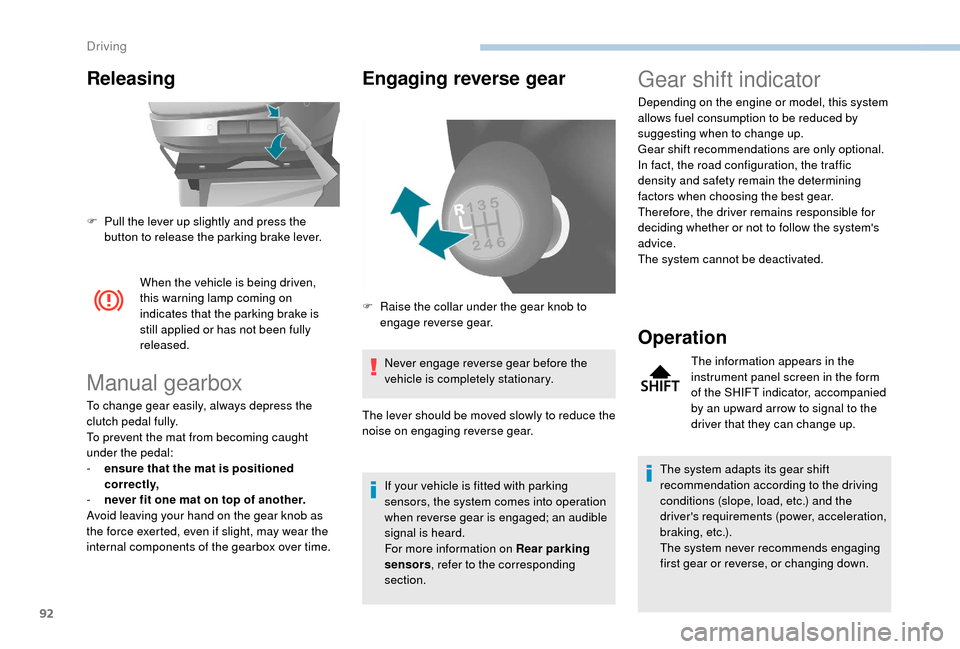
F
P
ull the lever up slightly and press the
button to release the parking brake lever.
Gear shift indicator
Depending on the engine or model, this system
allows fuel consumption to be reduced by
suggesting when to change up.
Gear shift recommendations are only optional.
In fact, the road configuration, the traffic
density and safety remain the determining
factors when choosing the best gear.
Therefore, the driver remains responsible for
deciding whether or not to follow the system's
advice.
The system cannot be deactivated.
Operation
The information appears in the
instrument panel screen in the form
of the SHIFT indicator, accompanied
by an upward arrow to signal to the
driver that they can change up.
The system adapts its gear shift
recommendation according to the driving
conditions (slope, load, etc.) and the
driver's requirements (power, acceleration,
b r a k i n g , e t c .) .
The system never recommends engaging
first gear or reverse, or changing down.
F
R
aise the collar under the gear knob to
engage reverse gear.
The lever should be moved slowly to reduce the
noise on engaging reverse gear.
Driving
Page 109 of 232
107
The system is automatically deactivated
if the Stop & Start system is active.
The system will restart and check the
operating conditions again when the
vehicle moves off. Detection may be impeded:
-
i
f the markings on the road are worn,
-
i
f there is little contrast between the
markings on the road and the road
sur face.
The system may suffer inter ference or not
work correctly:
-
w
hen the vehicle is carrying a very
heavy load (even more so if the load is
not evenly spread),
-
w
hen the conditions of visibility are
poor (rain, fog, snow, etc.),
-
w
hen the lighting conditions are poor
(dazzling sun, shade, etc.),
-
i
f the windscreen is dirty or damaged
near the camera,
-
i
f any of the ABS, DSC, ASR or
Intelligent Traction Control systems are
out of service.
Malfunction
If a malfunction occurs, this warning
l amp comes on, accompanied by
an audible signal and confirmed by
a
message in the screen.
Have the system checked by a
PEUGEOT
dealer or a
qualified workshop.
6
Driving
Page 118 of 232
116
Fuel
The capacity of the tank is about 90 litres.
F uel tanks of different capacities may be fitted,
60
and 120 litres, depending on the engine.
Low fuel level
When the E (Empty) level is
reached, this warning lamp lights up.
You then have around 10
to 12 litres in
reser ve, depending on the capacity of the tank
and the engine.
Refuel without delay to avoid running out of
fuel.
Refilling
The fuel tank must be filled with the engine
off.
F
O
pen the fuel filler flap.
F
H
old the black cap with one hand.
F
W
ith the other hand, insert the key, then
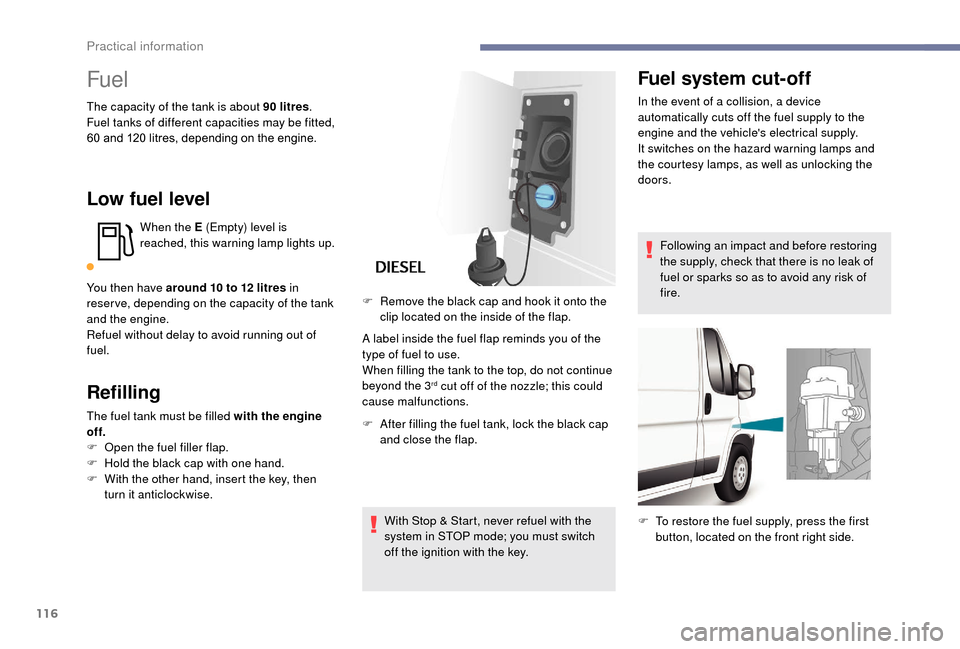
turn it anticlockwise. A label inside the fuel flap reminds you of the
type of fuel to use.
When filling the tank to the top, do not continue
beyond the 3
rd cut off of the nozzle; this could
cause malfunctions.
F
A
fter filling the fuel tank, lock the black cap
and close the flap.
With Stop & Start, never refuel with the
system in STOP mode; you must switch
off the ignition with the key.
F
R
emove the black cap and hook it onto the
clip located on the inside of the flap.
Fuel system cut-off
In the event of a collision, a device
a utomatically cuts off the fuel supply to the
engine and the vehicle's electrical supply.
It switches on the hazard warning lamps and
the courtesy lamps, as well as unlocking the
doors.
Following an impact and before restoring
the supply, check that there is no leak of
fuel or sparks so as to avoid any risk of
fire.
F
T
o restore the fuel supply, press the first
button, located on the front right side.
Practical information
Page 133 of 232
131
Brake disc wear
For information on checking brake
disc wear, contact a PEUGEOT
dealer or a
qualified workshop.
Parking brake
If excessive travel or a loss of
e ffectiveness of this system is
noticed, the parking brake must
be checked, even between two
services.
This system must be checked by a
PEUGEOT
dealer or a
qualified workshop.
Diesel fuel filter
The Diesel fuel filter is located under the
bonnet, close to the brake fluid reser voir. If this warning lamp comes on, the
filter must be purged to remove
water.
You can also purge the fuel filter
regularly, every time the engine oil
is changed.
Purging water from the filterThe HDi engines use advanced technology.
All work must be done by personnel that
have had special training, which can be
ensured by going to a
PEUGEOT dealer or
a
qualified workshop.
Only use products recommended by
PEUGEOT or products of equivalent
quality and specification.
In order to optimise the operation of
components as important as those in the
braking system, PEUGEOT selects and
offers very specific products.
After washing the vehicle, dampness, or
in wintry conditions, ice can form on the
brake discs and pads: braking efficiency
may be reduced. Make light brake
applications to dry and defrost the brakes.
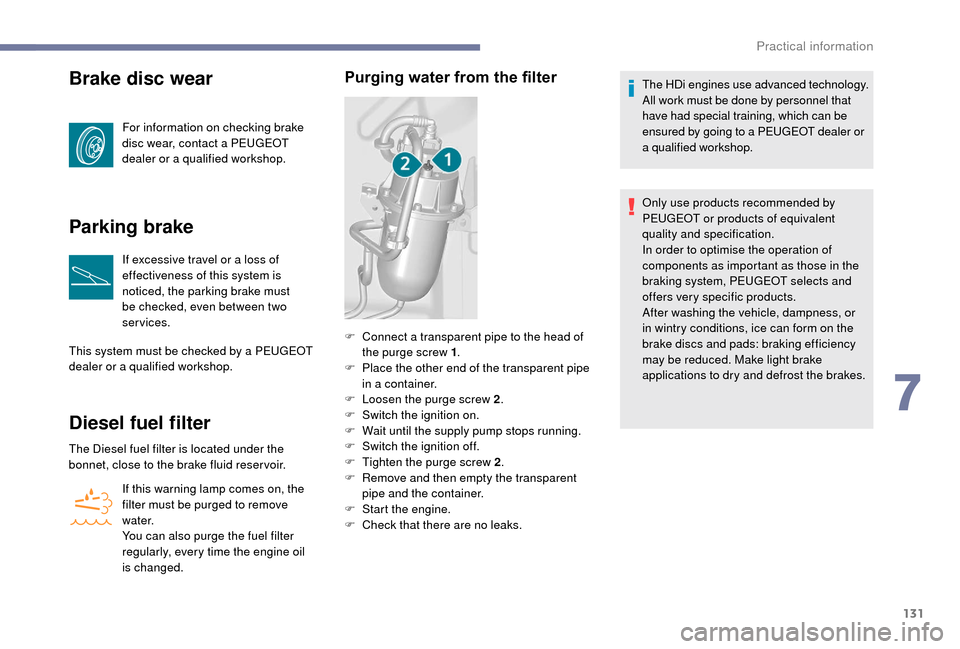
F
C
onnect a
transparent pipe to the head of
the purge screw 1 .
F
P
lace the other end of the transparent pipe
in a
container.
F
L
oosen the purge screw 2 .
F
S
witch the ignition on.
F
W
ait until the supply pump stops running.
F
S
witch the ignition off.
F
T
ighten the purge screw 2 .
F
R
emove and then empty the transparent
pipe and the container.
F
S
tart the engine.
F
C
heck that there are no leaks.
7
Practical information
Page 152 of 232
150
Dashboard, left-hand side,
fuses
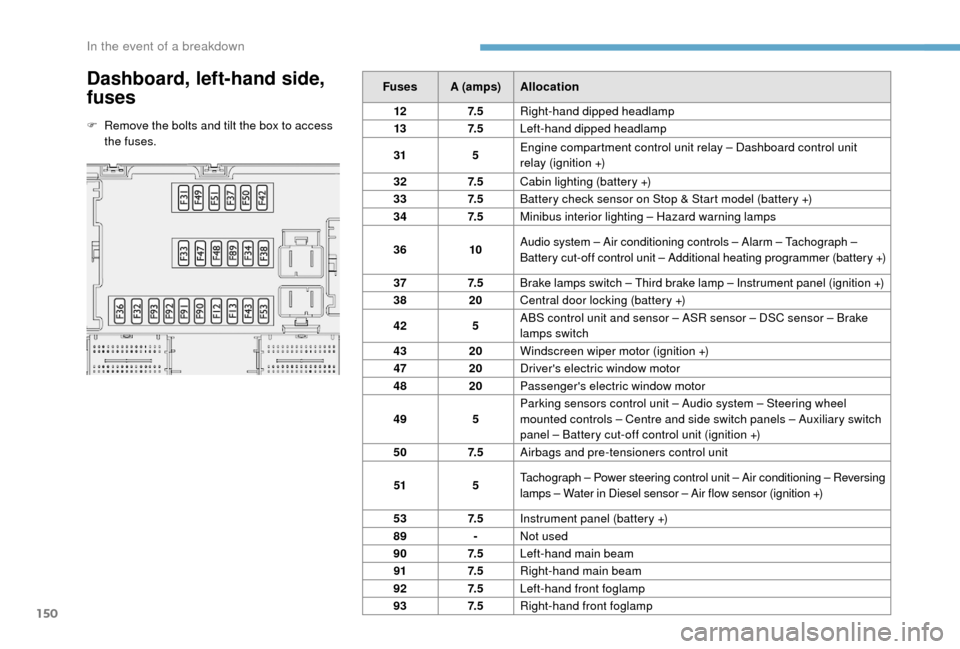
F Remove the bolts and tilt the box to access the fuses. Fuses A (amps)
Allocation
12 7. 5Right-hand dipped headlamp
13 7. 5Left-hand dipped headlamp
31 5Engine compartment control unit relay – Dashboard control unit
relay (ignition +)
32 7. 5Cabin lighting (battery +)
33 7. 5Battery check sensor on Stop & Start model (battery +)
34 7. 5Minibus interior lighting – Hazard warning lamps
36 10Audio system – Air conditioning controls – Alarm – Tachograph –
Battery cut-off control unit – Additional heating programmer (battery +)
37 7. 5
Brake lamps switch – Third brake lamp – Instrument panel (ignition +)
38 20Central door locking (battery +)
42 5ABS control unit and sensor – ASR sensor – DSC sensor – Brake
lamps switch
43 20Windscreen wiper motor (ignition +)
47 20Driver's electric window motor
48 20Passenger's electric window motor
49 5Parking sensors control unit – Audio system – Steering wheel
mounted controls – Centre and side switch panels – Auxiliary switch
panel – Battery cut-off control unit (ignition +)
50 7. 5Airbags and pre-tensioners control unit
51 5Tachograph – Power steering control unit – Air conditioning – Reversing
lamps – Water in Diesel sensor – Air flow sensor (ignition +)
53 7. 5Instrument panel (battery +)
89 -Not used
90 7. 5Left-hand main beam
91 7. 5Right-hand main beam
92 7. 5Left-hand front foglamp
93 7. 5Right-hand front foglamp
In the event of a breakdown
Page 184 of 232
182
Weights and towed loads
(kg)
With load transfer, the braked trailer weight can
be increased, on condition that the equivalent
of this load is removed from the vehicle so that
the GTW is not exceeded. Warning: towing with
a lightly loaded towing vehicle may have an
adverse effect on its road holding.
The kerb weight is equal to the weight without
load + driver (75
kg) + fuel tank filled to 90%.
Hydraulic system
These precautions are mandator y for any
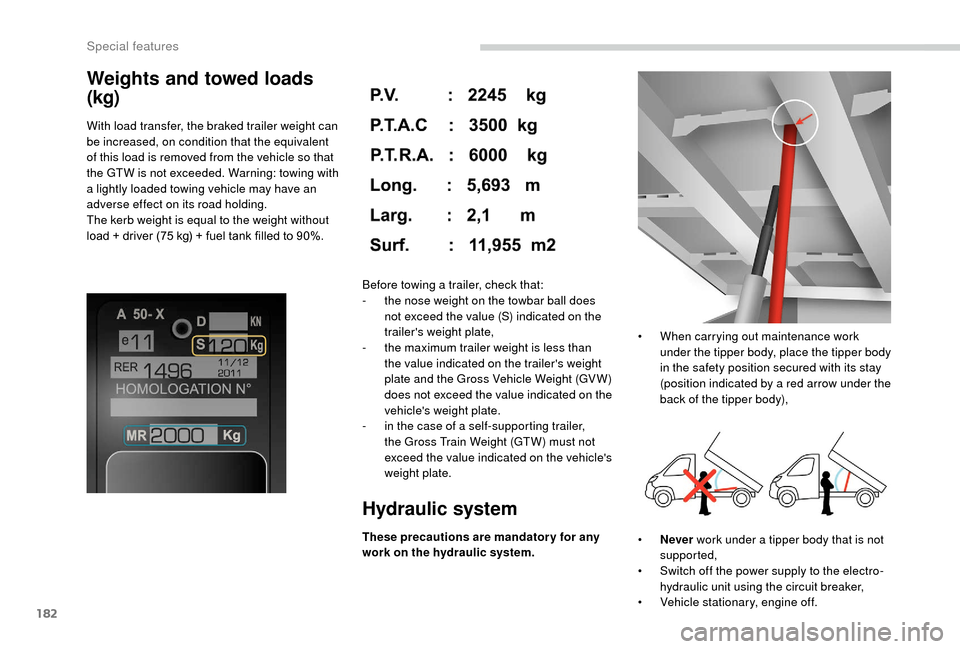
work on the hydraulic system. Before towing a trailer, check that:
-
t
he nose weight on the towbar ball does
not exceed the value (S) indicated on the
trailer's weight plate,
-
t
he maximum trailer weight is less than
the value indicated on the trailer's weight
plate and the Gross Vehicle Weight (GV W)
does not exceed the value indicated on the
vehicle's weight plate.
-
i
n the case of a self-supporting trailer,
the Gross Train Weight (GTW) must not
exceed the value indicated on the vehicle's
weight plate.
• N ever work under a tipper body that is not
supported,
•
S
witch off the power supply to the electro-
hydraulic unit using the circuit breaker,
•
V
ehicle stationary, engine off.
•
W
hen carrying out maintenance work
under the tipper body, place the tipper body
in the safety position secured with its stay
(position indicated by a red arrow under the
back of the tipper body),
Special features
Page 226 of 232
186
Hazard warning lamps ....................................68
Headlamp flash ............................................... 61
Headlamps, dipped beam
...............................61
Headlamps, main beam
............................16, 61
Head restraints, front
...................................... 37
Heating
............................................................ 43
H
eating, additional
.................................... 46 - 47
Hill Descent Control
................................... 71-72
Hill start assist
................................................. 95
Horn ................................................................. 68
Immobiliser, electronic
....................................89
Indicator, coolant temperature
........................20
Indicator, engine oil level
...........................18 -19
Indicator lamps, operation
................................ 9
I
ndicators, direction
........................................ 61
Information, vehicle ......................................... 14
Instrument panels
............................................. 7
Instruments and controls
..................................4
Intelligent Traction Control
..............................71Kit, hands-free
.......................................
1
2-13, 5
Jack
...............................
................................
7, 4Pads, brake
............................................
12 9 -131
Parking brake
........................
11, 91-92, 129 -131
Player, USB ................................................
6 - 7, 4
Port, USB ...................................................
6 - 7, 4
Pre-tensioning seat belts
................................
74
Protecting children
..............................
75, 77, 79
Radio ......................................................4, 7, 2-3
Radio, digital (Digital Audio Broadcasting – DAB)
......................................5
Range, AdBlue
................................................21
Regeneration of the particle filter
..........12 9 -13 0
Remote control
..........................................30, 89
Replacing bulbs
..................................... 14
3 -14 4
Replacing the air filter
................................... 12
9
Replacing the oil filter
................................... 12
9
Replacing the passenger compartment filter
....12 9
Resetting the service indicator
..................18 -19
Rev counter
.......................................................7
Safety, children
...................................75, 77, 79
Screen, colour
................................................... 4
S
creen menu map
.........................4, 6, 9, 12, 14
Screenwash fluid
...................................126 -128
SCR (Selective Catalytic Reduction)
............132
Seat belts
...................................................7 2 -74
Seat belts, rear
................................................73
Seats, heated
..................................................38
Service indicator
........................................18 -19
Servicing
.................................................... 1
8 -19
Settings, equipment
..................................22, 27
Oil, engine
..............................................126 -128
On-board tools
.......................................137-142
Opening the bonnet
......................................125
Overhead storage
............................... 5
2-54, 56
Menu
.......................................22, 4, 6, 9, 12, 14
Menus (audio)
...............................................4, 6
Mirrors, door .................................................... 42
Lane Departure Warning
System (LDWS)
...................................10 6 -107
Level, engine coolant
......................................20
Levels
.....................................................126 -128
Levels and checks
..............................
..........126
Lighting dimmer
................................................8
Low fuel level
..........................................2
0, 116
Lumbar
............................................................37H
I
K
JP
R
S
O
M
L
Gauge, fuel.............................................. 20, 116
Gearbox, manual .............................. 92, 94, 130
Gear shift indicator ~ Gear efficiency indicator
....................................... 17
Glove box
.................................................. 52-55G
Alphabetical index