Brake Peugeot Boxer 2018 Owner's Guide
[x] Cancel search | Manufacturer: PEUGEOT, Model Year: 2018, Model line: Boxer, Model: Peugeot Boxer 2018Pages: 232, PDF Size: 9.09 MB
Page 107 of 232
105
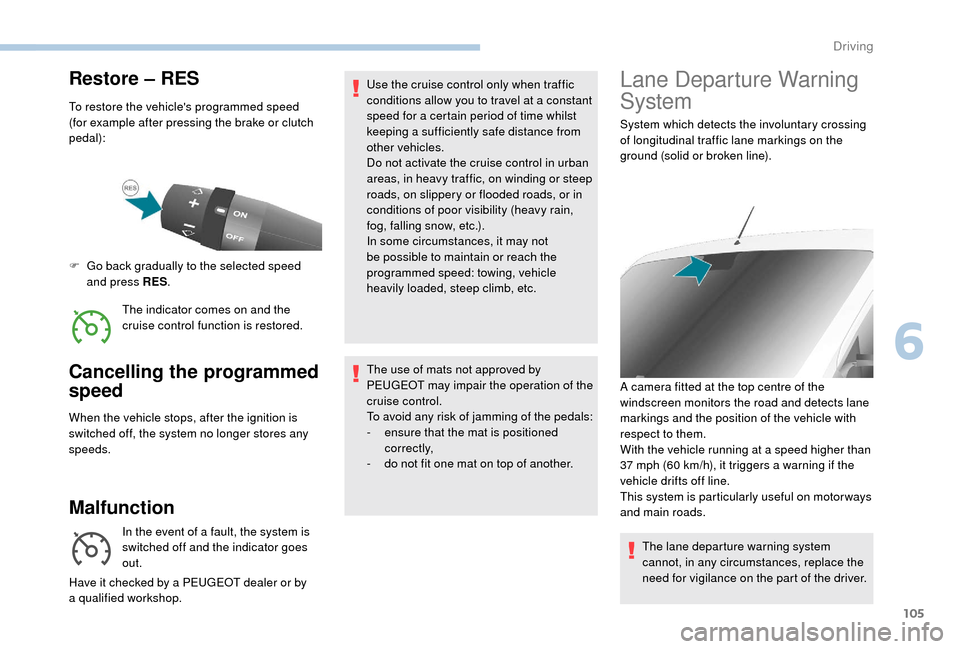
Restore – RES
To restore the vehicle's programmed speed
(for example after pressing the brake or clutch
pedal):The indicator comes on and the
cruise control function is restored.
F
G
o back gradually to the selected speed
and press RES .
Cancelling the programmed
speed
When the vehicle stops, after the ignition is
switched off, the system no longer stores any
speeds.
Malfunction
In the event of a fault, the system is
s witched off and the indicator goes
out.
Have it checked by a
PEUGEOT dealer or by
a
qualified workshop. Use the cruise control only when traffic
conditions allow you to travel at a
constant
speed for a certain period of time whilst
keeping a sufficiently safe distance from
other vehicles.
Do not activate the cruise control in urban
areas, in heavy traffic, on winding or steep
roads, on slippery or flooded roads, or in
conditions of poor visibility (heavy rain,
fog, falling snow, etc.).
In some circumstances, it may not
be possible to maintain or reach the
programmed speed: towing, vehicle
heavily loaded, steep climb, etc.
The use of mats not approved by
PEUGEOT may impair the operation of the
cruise control.
To avoid any risk of jamming of the pedals:
-
e
nsure that the mat is positioned
c o r r e c t l y,
-
d
o not fit one mat on top of another.
Lane Departure Warning
System
System which detects the involuntary crossing
of longitudinal traffic lane markings on the
ground (solid or broken line).
The lane departure warning system
cannot, in any circumstances, replace the
need for vigilance on the part of the driver.
A camera fitted at the top centre of the
windscreen monitors the road and detects lane
markings and the position of the vehicle with
respect to them.
With the vehicle running at a
speed higher than
37
mph (60 km/h), it triggers a warning if the
vehicle drifts off line.
This system is particularly useful on motor ways
and main roads.
6
Driving
Page 114 of 232
112
Switching off
F Move from reverse gear into neutral.
Malfunction
If this warning lamp comes on in the
instrument panel accompanied by
a message in the screen, contact
a
PEUGEOT dealer or a qualified
workshop.
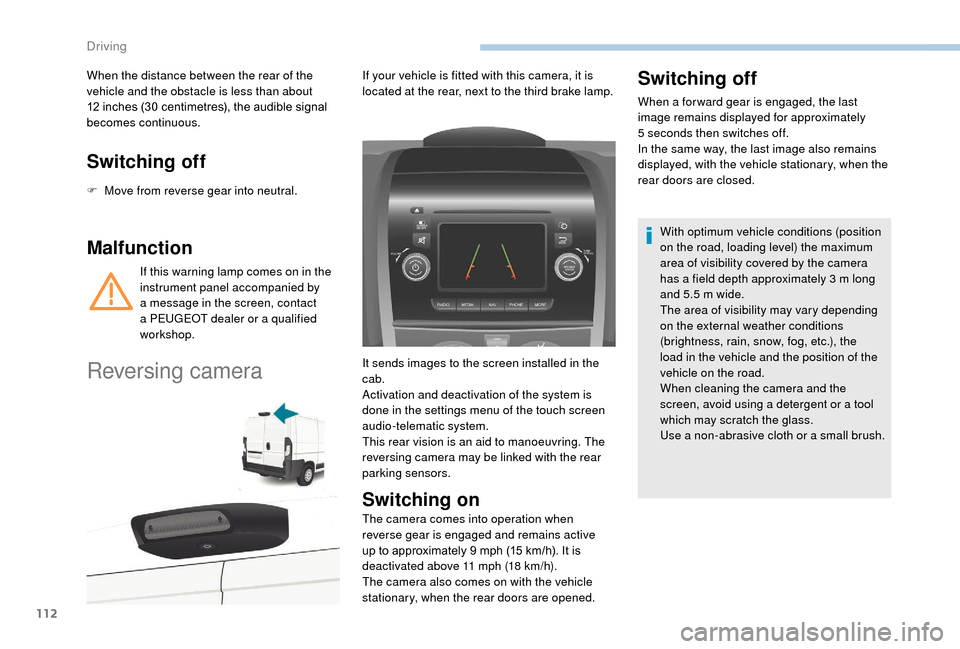
Reversing camera
If your vehicle is fitted with this camera, it is
located at the rear, next to the third brake lamp.
Switching on
The camera comes into operation when
reverse gear is engaged and remains active
up to approximately 9
mph (15 km/h). It is
deactivated above 11
mph (18 km/h).
The camera also comes on with the vehicle
stationary, when the rear doors are opened.
Switching off
When a for ward gear is engaged, the last
im age remains displayed for approximately
5
seconds then switches off.
In the same way, the last image also remains
displayed, with the vehicle stationary, when the
rear doors are closed.
With optimum vehicle conditions (position
on the road, loading level) the maximum
area of visibility covered by the camera
has a
field depth approximately 3 m long
and 5.5
m wide.
The area of visibility may vary depending
on the external weather conditions
(brightness, rain, snow, fog, etc.), the
load in the vehicle and the position of the
vehicle on the road.
When cleaning the camera and the
screen, avoid using a
detergent or a tool
which may scratch the glass.
Use a
non-abrasive cloth or a small brush.
It sends images to the screen installed in the
cab.
Activation and deactivation of the system is
done in the settings menu of the touch screen
audio-telematic system.
This rear vision is an aid to manoeuvring. The
reversing camera may be linked with the rear
parking sensors.
When the distance between the rear of the
vehicle and the obstacle is less than about
12 inches (30 centimetres), the audible signal
becomes continuous.
Driving
Page 121 of 232
119
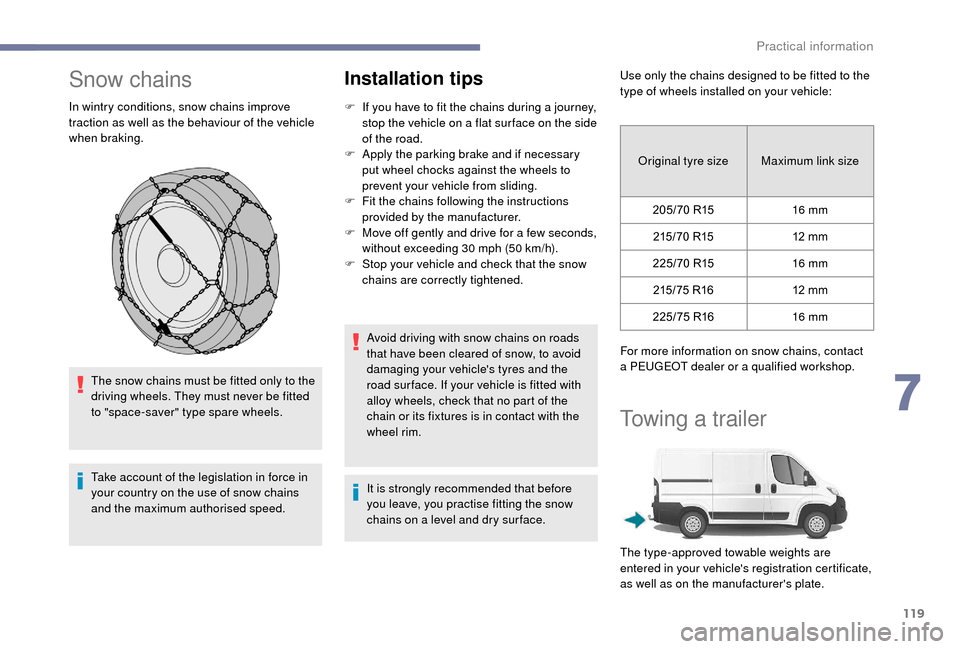
Snow chains
In wintry conditions, snow chains improve
traction as well as the behaviour of the vehicle
when braking.The snow chains must be fitted only to the
driving wheels. They must never be fitted
to "space-saver" type spare wheels.
Take account of the legislation in force in
your country on the use of snow chains
and the maximum authorised speed.
Installation tips
F If you have to fit the chains during a journey,
stop the vehicle on a flat sur face on the side
of the road.
F
A
pply the parking brake and if necessary
put wheel chocks against the wheels to
prevent your vehicle from sliding.
F
F
it the chains following the instructions
provided by the manufacturer.
F
M
ove off gently and drive for a few seconds,
without exceeding 30
mph (50 km/h).
F
S
top your vehicle and check that the snow
chains are correctly tightened.
Avoid driving with snow chains on roads
that have been cleared of snow, to avoid
damaging your vehicle's tyres and the
road sur face. If your vehicle is fitted with
alloy wheels, check that no part of the
chain or its fixtures is in contact with the
wheel rim.
It is strongly recommended that before
you leave, you practise fitting the snow
chains on a
level and dry sur face. Use only the chains designed to be fitted to the
type of wheels installed on your vehicle:
Original tyre size Maximum link size
205/70
R1516
mm
215/ 70
R
1512
mm
225/70
R1516
mm
215/75
R1612
mm
225/75
R1616
mm
For more information on snow chains, contact
a
PEUGEOT dealer or a qualified workshop.
Towing a trailer
The type-approved towable weights are
entered in your vehicle's registration certificate,
as well as on the manufacturer's plate.
7
Practical information
Page 128 of 232
126
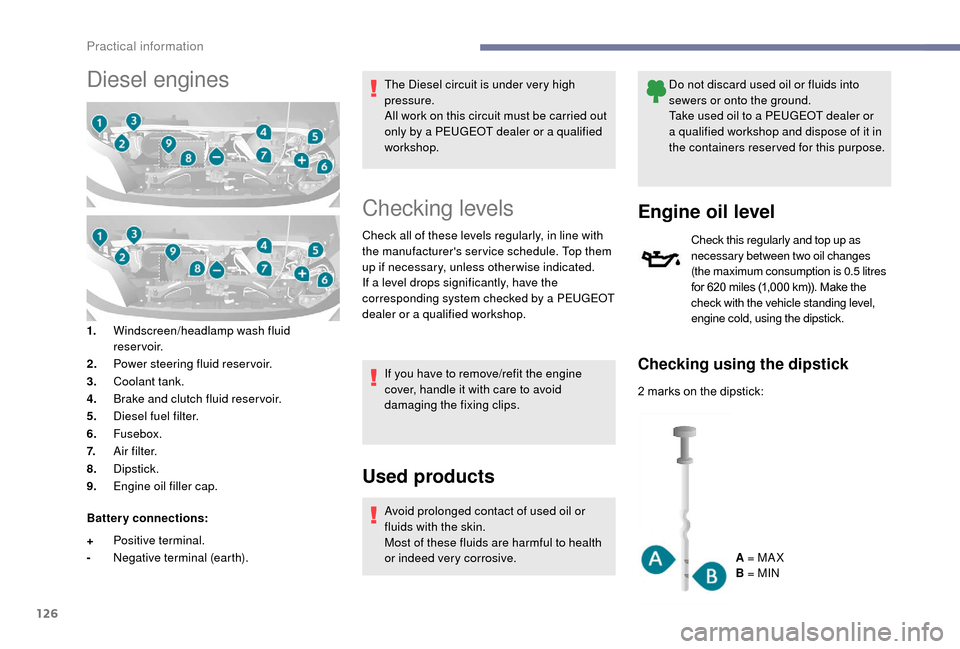
Diesel engines
1.Windscreen/headlamp wash fluid
reservoir.
2. Power steering fluid reservoir.
3. Coolant tank.
4. Brake and clutch fluid reser voir.
5. Diesel fuel filter.
6. Fusebox.
7. A i r f i l t e r.
8. Dipstick.
9. Engine oil filler cap.
Battery connections:
+ Positive terminal.
- Negative terminal (earth). The Diesel circuit is under very high
pressure.
All work on this circuit must be carried out
only by a
PEUGEOT dealer or a qualified
workshop.
Checking levels
Check all of these levels regularly, in line with
the manufacturer's service schedule. Top them
up if necessary, unless other wise indicated.
If a
level drops significantly, have the
corresponding system checked by a
PEUGEOT
dealer or a
qualified workshop.
If you have to remove/refit the engine
cover, handle it with care to avoid
damaging the fixing clips.
Used products
Avoid prolonged contact of used oil or
fluids with the skin.
Most of these fluids are harmful to health
or indeed very corrosive. Do not discard used oil or fluids into
sewers or onto the ground.
Take used oil to a
PEUGEOT dealer or
a qualified workshop and dispose of it in
the containers reser ved for this purpose.
Engine oil level
Check this regularly and top up as
necessary between two oil changes
(the maximum consumption is 0.5
litres
for 620
miles (1,000 km)). Make the
check with the vehicle standing level,
engine cold, using the dipstick.
Checking using the dipstick
2 marks on the dipstick:
A = MA X
B = MIN
Practical information
Page 129 of 232
127
If you find that the level is above the A mark or
below the B mark, do not star t the engine.
-
I
f the level is above the MAX mark (risk of
damage to the engine), contact a
PEUGEOT
dealer or a
qualified workshop.
-
I
f the level is below the MIN mark, you must
top up the engine oil.
To maintain the reliability of engines and
emission control systems, the use of additives
in engine oil is prohibited.
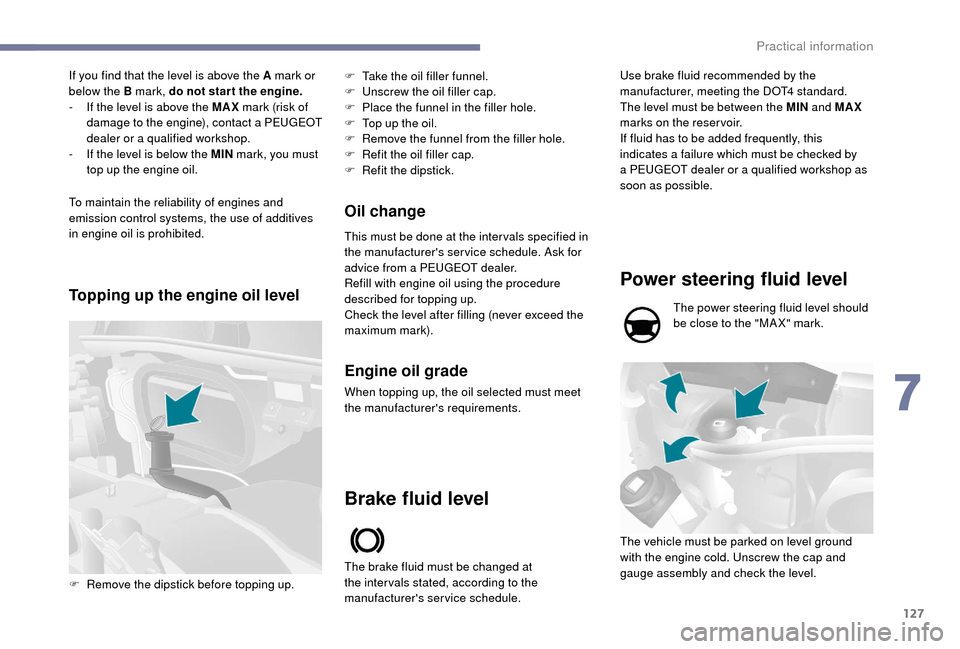
Topping up the engine oil level Oil change
This must be done at the inter vals specified in
the manufacturer's service schedule. Ask for
advice from a
PEUGEOT dealer.
Refill with engine oil using the procedure
described for topping up.
Check the level after filling (never exceed the
maximum mark). F
T
ake the oil filler funnel.
F
U
nscrew the oil filler cap.
F
P
lace the funnel in the filler hole.
F
T
op up the oil.
F
R
emove the funnel from the filler hole.
F
R
efit the oil filler cap.
F
R
efit the dipstick.
F
R
emove the dipstick before topping up.
Engine oil grade
When topping up, the oil selected must meet
the manufacturer's requirements.
Brake fluid level
The brake fluid must be changed at
the inter vals stated, according to the
manufacturer's service schedule.
Power steering fluid level
The power steering fluid level should
be close to the "MA X" mark.
The vehicle must be parked on level ground
with the engine cold. Unscrew the cap and
gauge assembly and check the level.
Use brake fluid recommended by the
manufacturer, meeting the DOT4
standard.
The level must be between the MIN and MAX
marks on the reservoir.
If fluid has to be added frequently, this
indicates a failure which must be checked by
a
PEUGEOT dealer or a qualified workshop as
soon as possible.
7
Practical information
Page 132 of 232
130
Operation
This filter, fitted in the exhaust system,
accumulates particles of soot. The engine
management unit controls the automatic
periodic elimination of the soot particles
(regeneration).
The regeneration procedure is triggered
depending on the amount of particles
accumulated and the vehicle use conditions.
During this phase, you may notice some
unusual phenomena – increased idling speed,
cooling fan running, increase in smoke and
higher exhaust gas temperature – which does
not affect the operation of the vehicle or the
environment.After prolonged idling or driving at very
low speeds, you may occasionally notice
water vapour being emitted from the
exhaust when accelerating. This is of no
consequence to the running of the vehicle
or to the environment. Because of the higher exhaust gas
temperature resulting from the normal
operation of the particle filter, it is
recommended that you do not park the
vehicle over inflammable materials (grass,
dry leaves, pine needles, etc.) so as to
avoid any risk of fire.
Saturation/Regeneration
If there is risk of blockage of the
filter, this warning lamp comes on in
the instrument panel.
This alert tells you that the particle filter is
starting to saturate (in conditions of urban
driving of exceptionally long duration: low
speeds, traffic jams, etc.).
To regenerate the filter, it is advised to drive
as soon as possible, when traffic conditions
and the law permit, at a
speed of at least
37
mph (60 km/h), with an engine speed above
2,000
rpm for about fifteen minutes (until the
warning lamp and/or the message disappears).
If possible, avoid switching off the engine
before the end of the filter regeneration;
repeated interruptions could cause premature
deterioration of the engine oil. It is not
recommended to end regeneration of the filter
with the vehicle stationary.
Malfunction
If this alert persists, do not ignore the warning;
it indicates that a fault has occurred in the
exhaust system/particle filter assembly.
Have the whole system checked by
a
PEUGEOT dealer or a qualified workshop.
Manual gearbox
The gearbox does not require any
maintenance (no oil change).
Brake pads
Brake wear depends on the style
of driving, particularly in the case
of vehicles used in town, over short
distances. It may be necessary to
have the condition of the brakes
checked, even between vehicle
services.
If this warning lamp comes on, have
the brake pad wear checked by
a
PEUGEOT dealer or a qualified
workshop.
Practical information
Page 133 of 232
131
Brake disc wear
For information on checking brake
disc wear, contact a PEUGEOT
dealer or a
qualified workshop.
Parking brake
If excessive travel or a loss of
e ffectiveness of this system is
noticed, the parking brake must
be checked, even between two
services.
This system must be checked by a
PEUGEOT
dealer or a
qualified workshop.
Diesel fuel filter
The Diesel fuel filter is located under the
bonnet, close to the brake fluid reser voir. If this warning lamp comes on, the
filter must be purged to remove
water.
You can also purge the fuel filter
regularly, every time the engine oil
is changed.
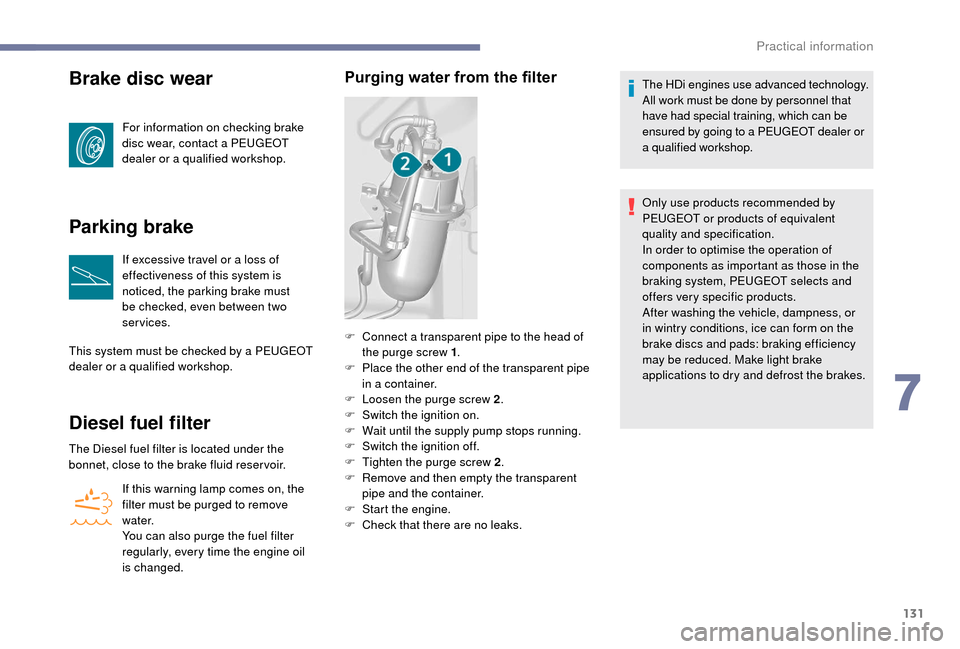
Purging water from the filterThe HDi engines use advanced technology.
All work must be done by personnel that
have had special training, which can be
ensured by going to a
PEUGEOT dealer or
a
qualified workshop.
Only use products recommended by
PEUGEOT or products of equivalent
quality and specification.
In order to optimise the operation of
components as important as those in the
braking system, PEUGEOT selects and
offers very specific products.
After washing the vehicle, dampness, or
in wintry conditions, ice can form on the
brake discs and pads: braking efficiency
may be reduced. Make light brake
applications to dry and defrost the brakes.
F
C
onnect a
transparent pipe to the head of
the purge screw 1 .
F
P
lace the other end of the transparent pipe
in a
container.
F
L
oosen the purge screw 2 .
F
S
witch the ignition on.
F
W
ait until the supply pump stops running.
F
S
witch the ignition off.
F
T
ighten the purge screw 2 .
F
R
emove and then empty the transparent
pipe and the container.
F
S
tart the engine.
F
C
heck that there are no leaks.
7
Practical information
Page 137 of 232
135
Temporary puncture
repair kit
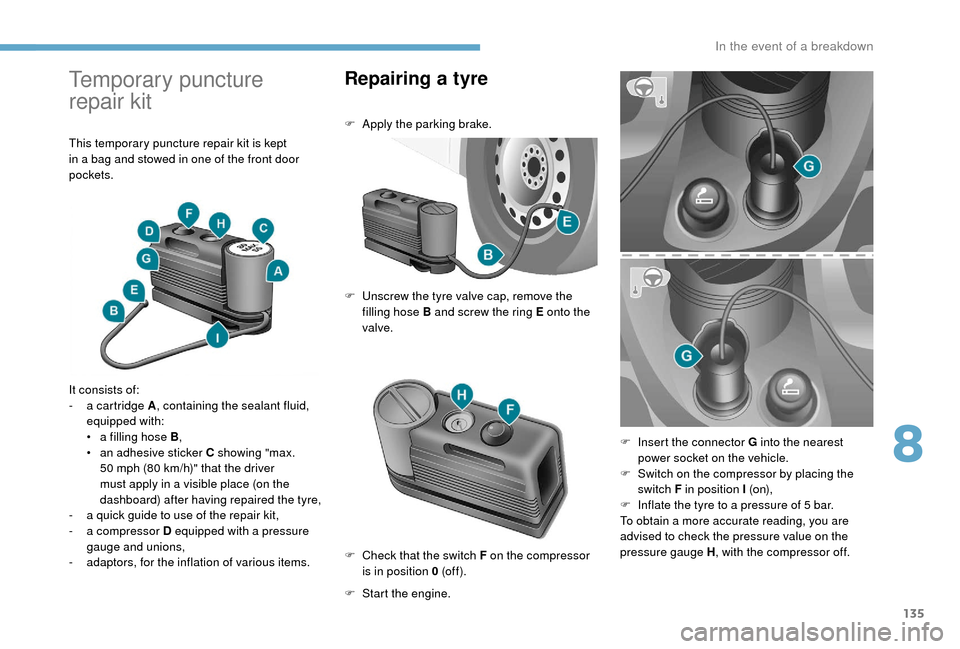
This temporary puncture repair kit is kept
in a bag and stowed in one of the front door
pockets.
It consists of:
-
a c
artridge A , containing the sealant fluid,
equipped with:
•
a f
illing hose B ,
•
a
n adhesive sticker C showing "max.
50
mph (80 km/h)" that the driver
must apply in a
visible place (on the
dashboard) after having repaired the tyre,
-
a q
uick guide to use of the repair kit,
-
a c
ompressor D equipped with a pressure
gauge and unions,
-
a
daptors, for the inflation of various items.
Repairing a tyre
F Apply the parking brake.
F
U
nscrew the tyre valve cap, remove the
filling hose B and screw the ring E onto the
valve.
F
S
tart the engine.
F
C
heck that the switch F on the compressor
is in position 0 (of f ). F
I
nsert the connector G into the nearest
power socket on the vehicle.
F
S
witch on the compressor by placing the
switch F in position I (o n),
F
I
nflate the tyre to a pressure of 5 bar.
To obtain a
more accurate reading, you are
advised to check the pressure value on the
pressure gauge H , with the compressor off.
8
In the event of a breakdown
Page 139 of 232
137
Special feature with pneumatic
suspension
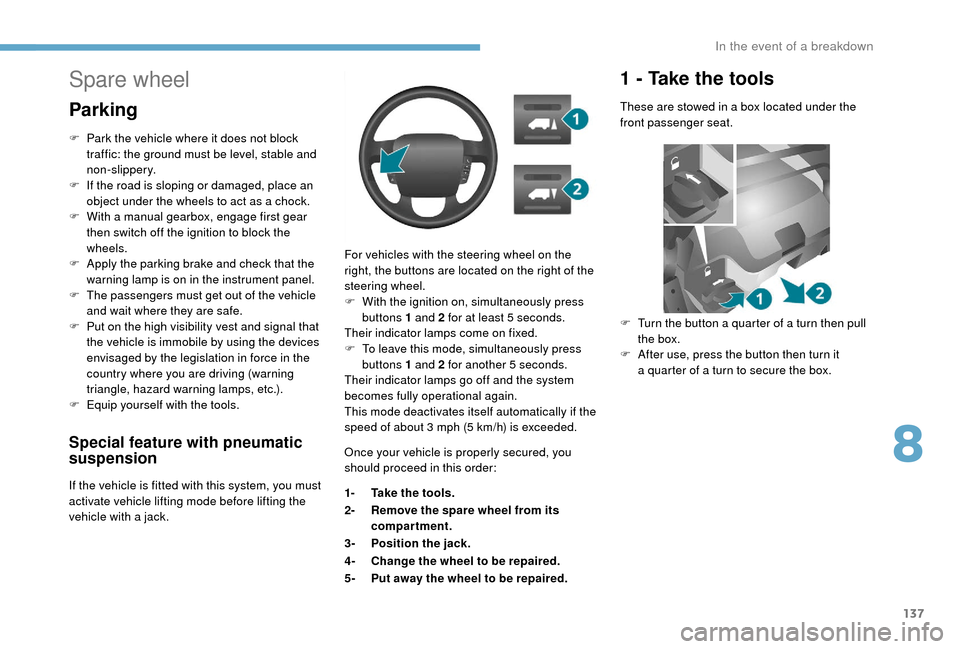
If the vehicle is fitted with this system, you must
activate vehicle lifting mode before lifting the
vehicle with a jack. For vehicles with the steering wheel on the
right, the buttons are located on the right of the
steering wheel.
F
W
ith the ignition on, simultaneously press
buttons 1 and 2 for at least 5 seconds.
Their indicator lamps come on fixed.
F
T
o leave this mode, simultaneously press
buttons 1 and 2 for another 5
seconds.
Their indicator lamps go off and the system
becomes fully operational again.
This mode deactivates itself automatically if the
speed of about 3 mph (5 km/h) is exceeded.
Spare wheel
Parking
F Park the vehicle where it does not block
traffic: the ground must be level, stable and
non-slippery.
F
I
f the road is sloping or damaged, place an
object under the wheels to act as a
chock.
F
W
ith a
manual gearbox, engage first gear
then switch off the ignition to block the
wheels.
F
A
pply the parking brake and check that the
warning lamp is on in the instrument panel.
F
T
he passengers must get out of the vehicle
and wait where they are safe.
F
P
ut on the high visibility vest and signal that
the vehicle is immobile by using the devices
envisaged by the legislation in force in the
country where you are driving (warning
triangle, hazard warning lamps, etc.).
F
E
quip yourself with the tools. Once your vehicle is properly secured, you
should proceed in this order:
1-Take the tools.
2- Remove the spare wheel from its
compartment.
3- Position the jack.
4- Change the wheel to be repaired.
5- Put away the wheel to be repaired.
1 - Take the tools
These are stowed in a box located under the
f ront passenger seat.
F
T
urn the button a quarter of a turn then pull
the box.
F
A
fter use, press the button then turn it
a
quarter of a turn to secure the box.
8
In the event of a breakdown
Page 149 of 232
147
Ty p e C , 12 V10W – 10W
Side marker lamps
Ty p e A , W5W – 5W
Courtesy lamps
F If your vehicle is fitted with these lamps
(L4 body), remove the two fixing screws.
F
P
ull the bulb holder to release it from the
lugs.
F
P
ull the bulb out and change it. Front/Rear
F P ress at the points indicated by the arrows,
then remove the courtesy lamp.
F
O
pen the protective flap.
F
C
hange the bulb by moving the two contacts
apart.
F
E
nsure that the new bulbs are secured
correctly between the two contacts.
F
C
lose the protective flap.
F
F
ix the courtesy lamp in its housing and
ensure that it is secured correctly.
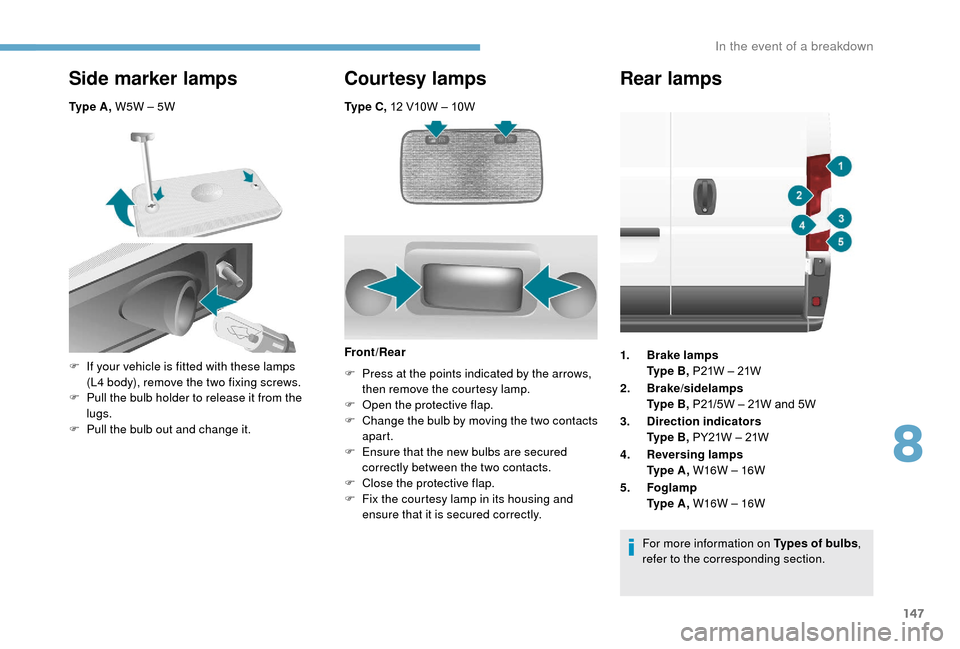
Rear lamps
1. Brake lamps
Ty p e B , P21W – 21W
2. Brake/sidelamps
Ty p e B , P21/5W – 21W and 5W
3. Direction indicators
Ty p e B , PY21W – 21W
4. Reversing lamps
Ty p e A , W16W – 16W
5. Foglamp
Ty p e A , W16W – 16W
For more information on Types of bulbs ,
refer to the corresponding section.
8
In the event of a breakdown