Temperature Peugeot Boxer 2018 Owner's Guide
[x] Cancel search | Manufacturer: PEUGEOT, Model Year: 2018, Model line: Boxer, Model: Peugeot Boxer 2018Pages: 232, PDF Size: 9.09 MB
Page 95 of 232
93
Stop & Start
The Stop & Start system puts the engine
temporarily into standby – STOP mode – during
stops in the traffic (red lights, traffic jams, etc.).
The engine restarts automatically – START
mode – as soon as you wish to move off.
Restart is instantaneous, quick and silent.
Per fect for urban use, the Stop & Start system
reduces fuel consumption and exhaust
emissions and offers the comfort of complete
silence when stationary.
Going into engine STOP
mode
With the vehicle stationary, put the gear lever
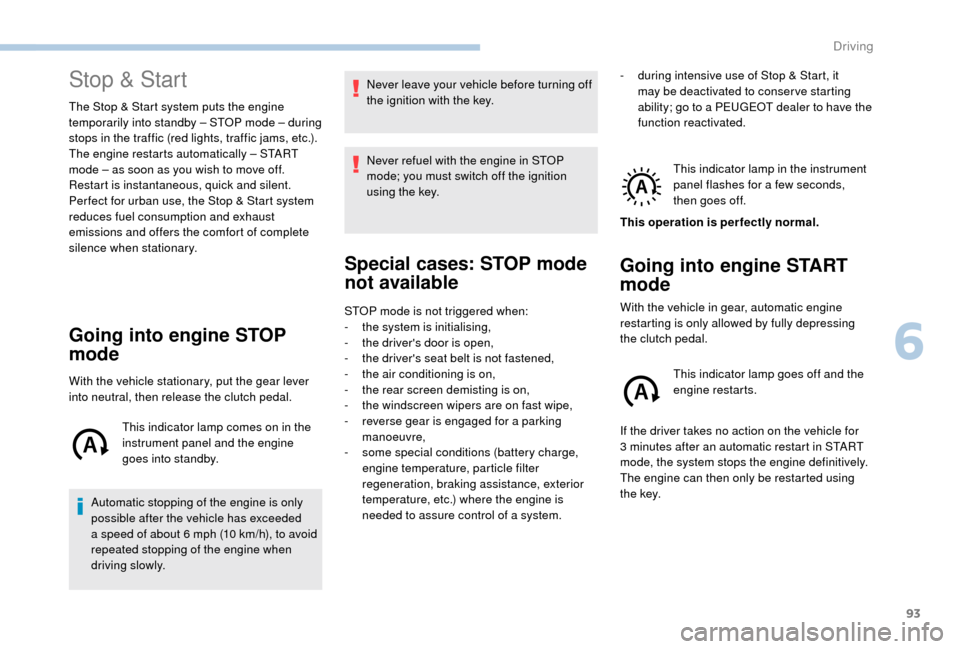
into neutral, then release the clutch pedal.This indicator lamp comes on in the
instrument panel and the engine
goes into standby.
Automatic stopping of the engine is only
possible after the vehicle has exceeded
a
speed of about 6 mph (10 km/h), to avoid
repeated stopping of the engine when
driving slowly. Never leave your vehicle before turning off
the ignition with the key.
Never refuel with the engine in STOP
mode; you must switch off the ignition
using the key.
Special cases: STOP mode
not available
STOP mode is not triggered when:
-
t he system is initialising,
-
t
he driver's door is open,
-
t
he driver's seat belt is not fastened,
-
t
he air conditioning is on,
-
t
he rear screen demisting is on,
-
t
he windscreen wipers are on fast wipe,
-
r
everse gear is engaged for a parking
manoeuvre,
-
s
ome special conditions (battery charge,
engine temperature, particle filter
regeneration, braking assistance, exterior
temperature, etc.) where the engine is
needed to assure control of a
system.-
d
uring intensive use of Stop & Start, it
may be deactivated to conser ve starting
ability; go to a PEUGEOT dealer to have the
function reactivated.
This indicator lamp in the instrument
panel flashes for a few seconds,
then goes off.
This operation is perfectly normal.
Going into engine START
mode
With the vehicle in gear, automatic engine
restarting is only allowed by fully depressing
the clutch pedal.
This indicator lamp goes off and the
engine restarts.
If the driver takes no action on the vehicle for
3
minutes after an automatic restart in START
mode, the system stops the engine definitively.
The engine can then only be restarted using
t h e key.
6
Driving
Page 96 of 232
94
Special cases: START mode
activated automatically
The START mode may be triggered
automatically in the following circumstances:
-
t
he vehicle is free-wheeling on a gradient,
-
t
he windscreen wipers are on fast wipe,
-
t
he air conditioning is on,
-
t
he engine has been stopped for around
3
minutes with Stop & Start,
-
s
ome special conditions (battery charge,
engine temperature, braking assistance, air
conditioning setting, etc.) where the engine
is needed to control a
system or the vehicle.
In this case, a message appears
in the instrument panel screen,
accompanied by this indicator lamp,
which flashes for a
few seconds,
then goes off.
This operation is perfectly normal. While in STOP mode with a
manual
gearbox, if a gear is engaged without fully
depressing the clutch pedal, restarting
may not take place.
An indicator lamp and/or message is
displayed in the instrument panel asking
you to fully depress the clutch pedal to
allow restarting.
With the engine stopped in STOP
mode, if the driver unfastens their
seat belt and opens a
front door, the
engine can only be restarted using
the ignition key. There is an audible
signal, accompanied by flashing of
this indicator lamp, and the display
of a
message.
Deactivation
If the system has been deactivated
in STOP mode, the engine restarts
immediately.
It is necessary to deactivate the
Stop & Start system if you want to
allow continuous operation of the air
conditioning.
The button indicator lamp remains on.
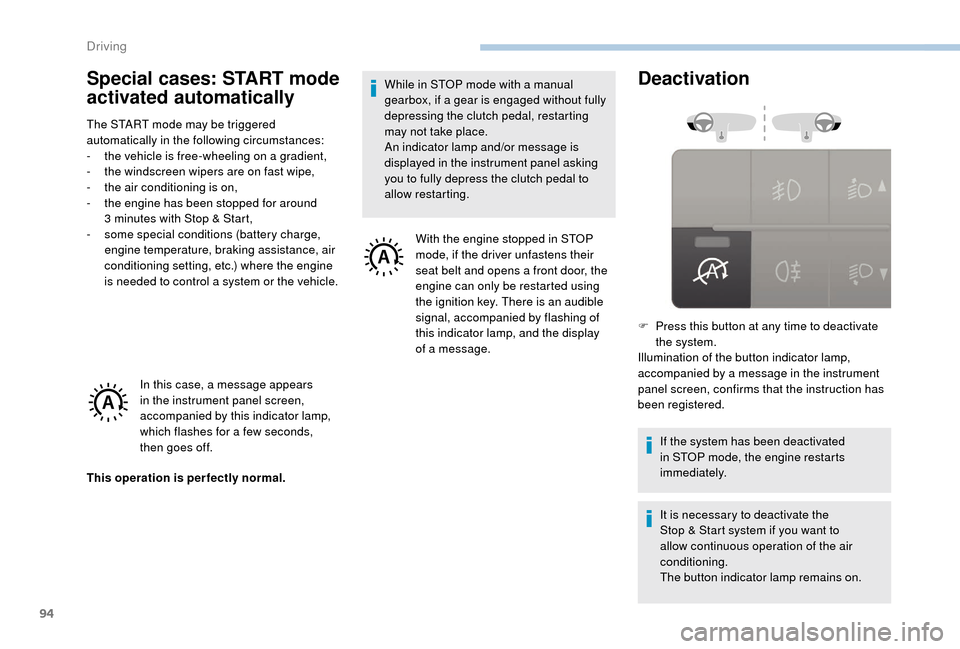
F
P
ress this button at any time to deactivate
the system.
Illumination of the button indicator lamp,
accompanied by a message in the instrument
panel screen, confirms that the instruction has
been registered.
Driving
Page 100 of 232
98
Additional traffic signs are filtered as follows:
- S igns related to snow or ice are displayed
only if the exterior temperature is below
3°C.
-
S
igns related to snow, rain or fog are
displayed only if the wipers are on and the
exterior temperature is below 3°C.
-
S
igns related to heavy goods vehicles are
only displayed if they apply to vehicles
weighing less than 4
tonnes.
-
S
igns related to farm vehicles are not
displayed.
Signs such as the no overtaking sign disappear
after about 40
seconds in the instrument panel.
Activation/Deactivation
The function is set with the MODE button; in
the "Traffic Sign" menu, select "ON" or "OFF".
For more information on Vehicle
configuration , refer to the corresponding
section.
Operating limits
The legislation on speed limits is specific to
each country.
The system does not take account of reduced
speed limits in the following cases:
-
p
oor weather (rain, snow),
-
a
tmospheric pollution,
-
t
railer, caravan,
-
d
riving with snow chains fitted,
-
d
riving with a non-genuine suspension kit,
-
p
uncture repair using the temporary repair
kit,
-
y
oung drivers. The following situations may interfere with
the operation of the system or prevent it
from working:
-
p
oor visibility (dazzling sun, inadequate
street lighting, falling snow, heavy rain,
dense fog, vehicle too far from the
traffic sign),
-
l
ow temperatures and particularly
severe climatic conditions,
-
w
indscreen area in front of the camera
being: dirty, misted up, frost-covered,
snow-covered, damaged or covered by
a
s t i c ke r,
-
f
ault with the camera,
-
o
bsolete or incorrect mapping,
-
o
bstructed road signs (by other
vehicles, vegetation, snow),
-
t
raffic signs that do not conform to the
standard, are damaged or distorted,
-
r
oad inclination causing the sign to be
out of the camera view (for example, to
one side).
-
v
ariation of load causing the camera
to be significantly inclined (the system
may not work for a
moment while the
camera recalibrates itself).
Driving
Page 116 of 232
114
Operating fault
If a fault occurs with the system, this
w arning lamp comes on.
Have the system checked by a
PEUGEOT
dealer or a
qualified workshop.
Driving with the suspension set too high
or too low poses a risk of damaging
components under the body.
The height may be adjusted automatically
to take account of changes in temperature
or loading.
You must avoid using this control in the
following circumstances:
-
w
hen working underneath the vehicle,
-
w
hen changing a
wheel,
-
w
hen the vehicle is being transported
by lorry, train, ferry, boat, etc.
To avoid damaging the vehicle or injuring
anyone, check that there is no object or
person that might be close to or come into
contact with the vehicle, before raising or
lowering the suspension.
Driving
Page 120 of 232
118
Compatibility of fuels
Fuel used for Diesel
engines
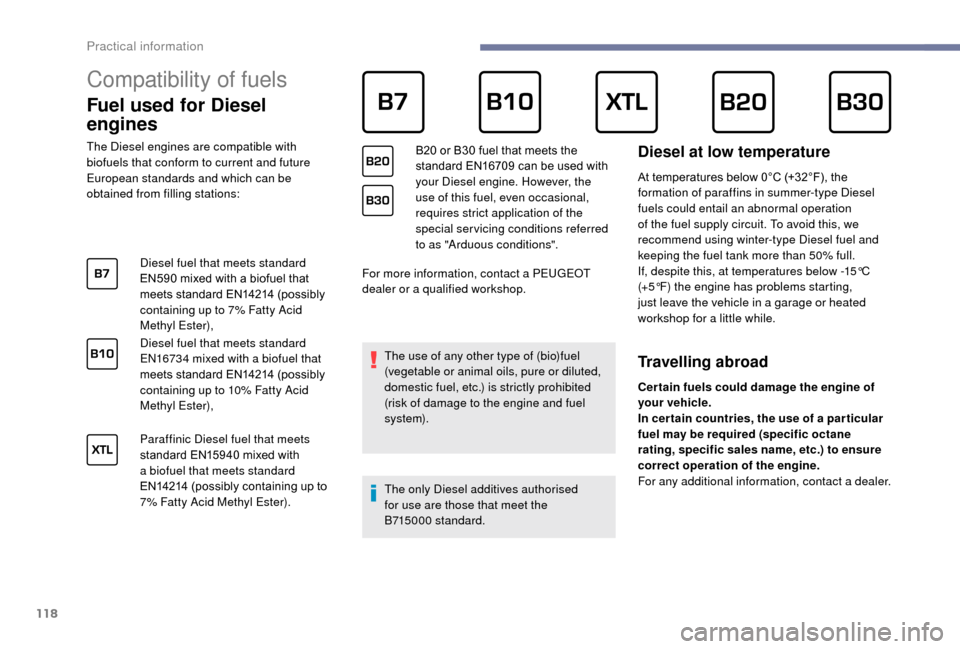
The Diesel engines are compatible with
biofuels that conform to current and future
European standards and which can be
obtained from filling stations:Diesel fuel that meets standard
EN590
mixed with a biofuel that
meets standard EN14214 (possibly
containing up to 7% Fatty Acid
Methyl Ester),
Diesel fuel that meets standard
EN16734
mixed with a biofuel that
meets standard EN14214 (possibly
containing up to 10% Fatty Acid
Methyl Ester),
Paraffinic Diesel fuel that meets
standard EN15940
mixed with
a
biofuel that meets standard
EN14214 (possibly containing up to
7% Fatty Acid Methyl Ester). For more information, contact a
PEUGEOT
dealer or a
qualified workshop.
The use of any other type of (bio)fuel
(vegetable or animal oils, pure or diluted,
domestic fuel, etc.) is strictly prohibited
(risk of damage to the engine and fuel
syste m).
The only Diesel additives authorised
for use are those that meet the
B715000
standard.Diesel at low temperature
At temperatures below 0°C (+32°F), the
formation of paraffins in summer-type Diesel
fuels could entail an abnormal operation
of the fuel supply circuit. To avoid this, we
recommend using winter-type Diesel fuel and
keeping the fuel tank more than 50% full.
If, despite this, at temperatures below -15°C
(+5°F) the engine has problems starting,
just leave the vehicle in a garage or heated
workshop for a
little while.
B20
or B30
fuel that meets the
standard EN16709
can be used with
your Diesel engine. However, the
use of this fuel, even occasional,
requires strict application of the
special servicing conditions referred
to as "Arduous conditions".
Travelling abroad
Cer tain fuels could damage the engine of
your vehicle.
In cer tain countries, the use of a
par ticular
fuel may be required (specific octane
rating, specific sales name, etc.) to ensure
correct operation of the engine.
For any additional information, contact a dealer.
Practical information
Page 130 of 232
128
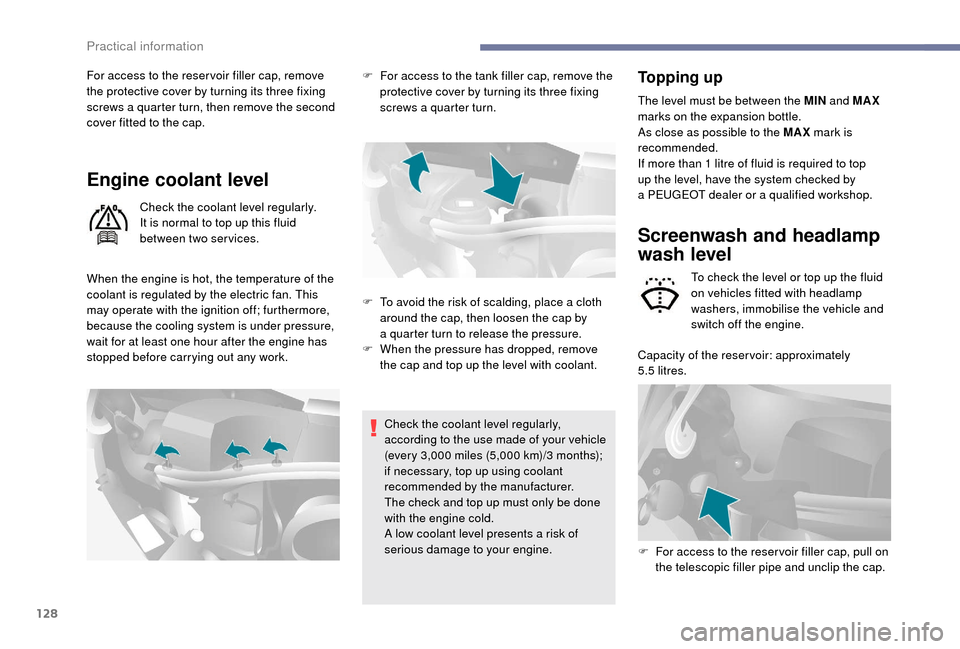
For access to the reser voir filler cap, remove
the protective cover by turning its three fixing
screws a quarter turn, then remove the second
cover fitted to the cap.
Engine coolant level
Check the coolant level regularly.
It is normal to top up this fluid
between two services.
Check the coolant level regularly,
according to the use made of your vehicle
(every 3,000
miles (5,000 km)/3 months);
if necessary, top up using coolant
recommended by the manufacturer.
The check and top up must only be done
with the engine cold.
A low coolant level presents a
risk of
serious damage to your engine.
When the engine is hot, the temperature of the
coolant is regulated by the electric fan. This
may operate with the ignition off; furthermore,
because the cooling system is under pressure,
wait for at least one hour after the engine has
stopped before carrying out any work. F
F
or access to the tank filler cap, remove the
protective cover by turning its three fixing
screws a
quarter turn.
F
T
o avoid the risk of scalding, place a cloth
around the cap, then loosen the cap by
a
quarter turn to release the pressure.
F
W
hen the pressure has dropped, remove
the cap and top up the level with coolant.
To p p i n g u p
The level must be between the MIN and MAX
marks on the expansion bottle.
As close as possible to the MAX mark is
recommended.
If more than 1
litre of fluid is required to top
up the level, have the system checked by
a
PEUGEOT dealer or a qualified workshop.
Screenwash and headlamp
wash level
To check the level or top up the fluid
on vehicles fitted with headlamp
washers, immobilise the vehicle and
switch off the engine.
Capacity of the reservoir: approximately
5.5
litres.
F
F
or access to the reser voir filler cap, pull on
the telescopic filler pipe and unclip the cap.
Practical information
Page 132 of 232
130
Operation
This filter, fitted in the exhaust system,
accumulates particles of soot. The engine
management unit controls the automatic
periodic elimination of the soot particles
(regeneration).
The regeneration procedure is triggered
depending on the amount of particles
accumulated and the vehicle use conditions.
During this phase, you may notice some
unusual phenomena – increased idling speed,
cooling fan running, increase in smoke and
higher exhaust gas temperature – which does
not affect the operation of the vehicle or the
environment.After prolonged idling or driving at very
low speeds, you may occasionally notice
water vapour being emitted from the
exhaust when accelerating. This is of no
consequence to the running of the vehicle
or to the environment. Because of the higher exhaust gas
temperature resulting from the normal
operation of the particle filter, it is
recommended that you do not park the
vehicle over inflammable materials (grass,
dry leaves, pine needles, etc.) so as to
avoid any risk of fire.
Saturation/Regeneration
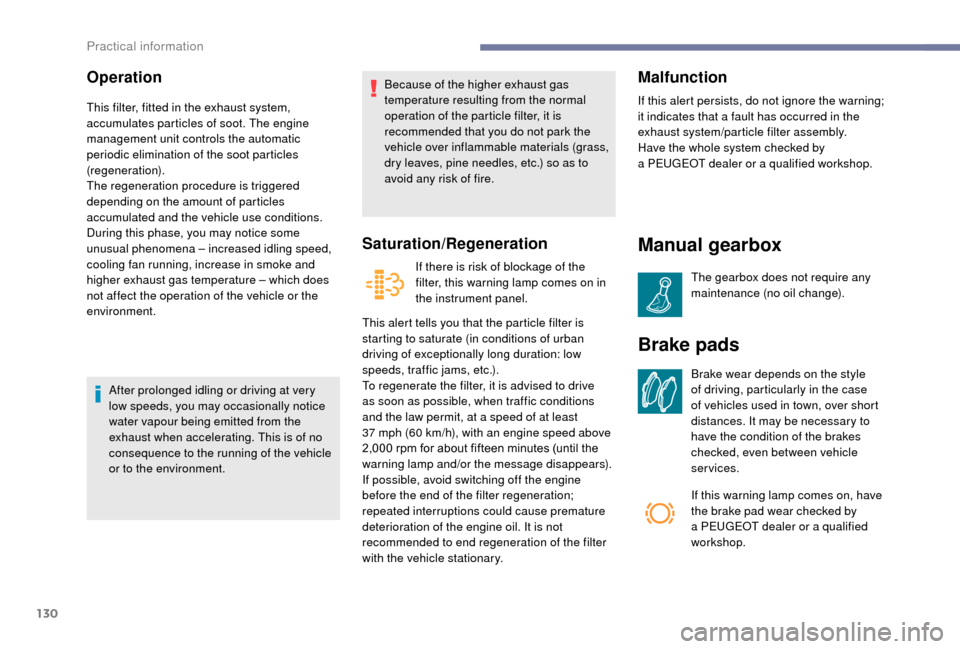
If there is risk of blockage of the
filter, this warning lamp comes on in
the instrument panel.
This alert tells you that the particle filter is
starting to saturate (in conditions of urban
driving of exceptionally long duration: low
speeds, traffic jams, etc.).
To regenerate the filter, it is advised to drive
as soon as possible, when traffic conditions
and the law permit, at a
speed of at least
37
mph (60 km/h), with an engine speed above
2,000
rpm for about fifteen minutes (until the
warning lamp and/or the message disappears).
If possible, avoid switching off the engine
before the end of the filter regeneration;
repeated interruptions could cause premature
deterioration of the engine oil. It is not
recommended to end regeneration of the filter
with the vehicle stationary.
Malfunction
If this alert persists, do not ignore the warning;
it indicates that a fault has occurred in the
exhaust system/particle filter assembly.
Have the whole system checked by
a
PEUGEOT dealer or a qualified workshop.
Manual gearbox
The gearbox does not require any
maintenance (no oil change).
Brake pads
Brake wear depends on the style
of driving, particularly in the case
of vehicles used in town, over short
distances. It may be necessary to
have the condition of the brakes
checked, even between vehicle
services.
If this warning lamp comes on, have
the brake pad wear checked by
a
PEUGEOT dealer or a qualified
workshop.
Practical information
Page 134 of 232
132
Freezing of the AdBlue®
AdBlue® freezes at temperatures below
around -11°C.
The SCR system includes a
heater for the
AdBlue
® tank, allowing you to continue
driving in very cold conditions.
Topping up with AdBlue®
Before topping up, please read the
following warnings carefully.
Precautions for use
AdBlue® is a urea-based solution. This fluid
is
non-flammable, colourless and odourless
(stored in a
cool place).
In the event of contact with the skin, wash the
affected area with soap and running water. In
the event of contact with the eyes, immediately
rinse the eyes with large amounts of water
or with an eye wash solution for at least
15
minutes. If a burning sensation or irritation
persists, get medical attention.
If swallowed, immediately wash out the mouth
with clean water and then drink plenty of water.
In certain conditions (high exterior temperature,
for example), the risk of ammonia being
released cannot be excluded: do not inhale
the vapours. Ammonia has an irritant effect on
mucous membranes (eyes, nose and throat).
AdBlue® (BlueHDi engines)
To respect the environment and ensure
compliance with the Euro 6 standard, without
adversely affecting the per formance or fuel
consumption of Diesel engines, PEUGEOT
has taken the decision to equip its vehicles
with a
system that associates SCR (Selective
Catalytic Reduction) with a
Diesel particle filter
(DPF) for the treatment of exhaust gases.
SCR system
Using a liquid called AdBlue® containing urea, a
catalytic converter turns up to 85% of nitrogen
oxides (NOx) into nitrogen and water, which are
harmless to health and the environment.
The AdBlue
® is contained in a special tank with
a
capacity of approximately 14 litres.
It has an exterior filler located behind the fuel
filler flap below the fuel filler cap and closed
with a
blue filler cap .
An alarm system is triggered once the
remaining range is 1,500
miles (2,400 km), in
other words once the reser ve level is reached. Once the AdBlue
® tank is empty, a
regulatory device prevents the engine
from being restarted.
If the SCR system is faulty, the level of
emissions from your vehicle no longer
meet the Euro 6
regulations: your vehicle
becomes polluting.
In the event of a
confirmed fault with the
SCR system, you must go to a
PEUGEOT
dealer or a
qualified workshop as soon
as possible: having travelled 250 miles
(400 km), a device will be triggered
automatically to prevent the engine from
starting.
Practical information
Page 135 of 232
133
Keep AdBlue® out of the reach of children,
in its original container or bottle.
Never transfer AdBlue
® to another
container: it would lose its purity.
Never dilute AdBlue
® with water.
Never pour AdBlue® into the Diesel fuel
tank.
Bottles or containers are available from
a
PEUGEOT dealer or a
qualified workshop.
Recommendations on storage
AdBlue® freezes at about -11°C and
deteriorates above 25°C. It should be stored in
a
cool place and protected from direct sunlight.
Under these conditions, the fluid can be kept
for at least a
year.
If the fluid has frozen, it can be used once it has
completely thawed out at room temperature.
Never store bottles or containers of
AdBlue
® in your vehicle.
Procedure
In cold weather, before topping up, ensure that
the temperature of the vehicle is above -11°C.
Otherwise the AdBlue
® may freeze and so
cannot be poured into its tank.
Park your vehicle in a
warmer area for a few
hours to allow the top up to be carried out.
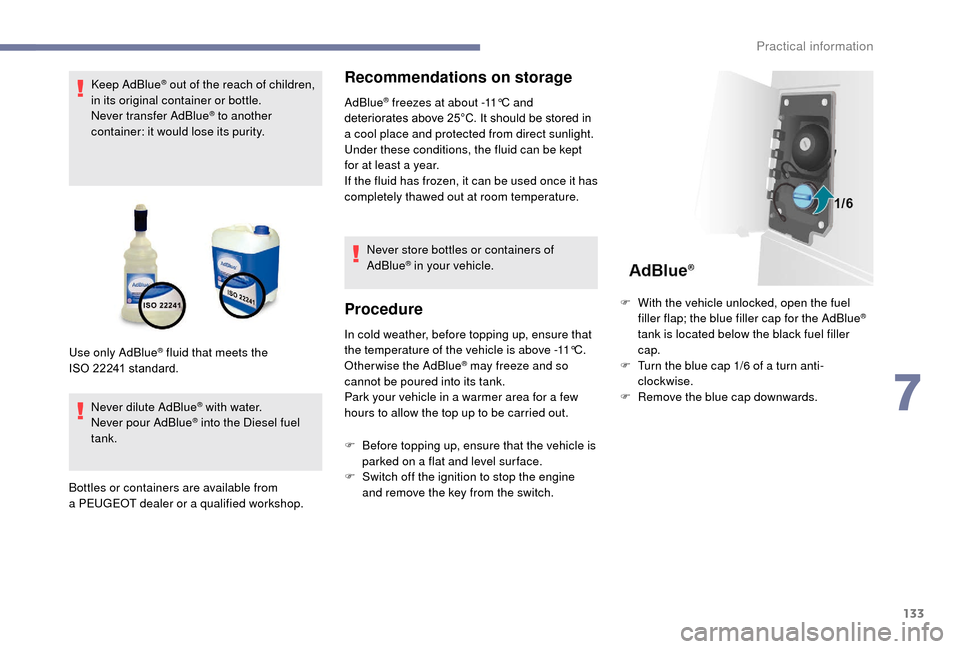
Use only AdBlue
® fluid that meets the
ISO
22241
standard.
F
B
efore topping up, ensure that the vehicle is
parked on a
flat and level sur face.
F
S
witch off the ignition to stop the engine
and remove the key from the switch. F
W
ith the vehicle unlocked, open the fuel
filler flap; the blue filler cap for the AdBlue
®
tank is located below the black fuel filler
cap.
F
T
urn the blue cap 1/6 of a turn anti-
clockwise.
F
R
emove the blue cap downwards.
7
Practical information
Page 146 of 232
144
In some weather conditions (e.g. low
temperature or humidity), the presence
of misting on the internal sur face of the
glass of the headlamps and rear lamps is
normal; it disappears after the lamps have
been on for a few minutes.
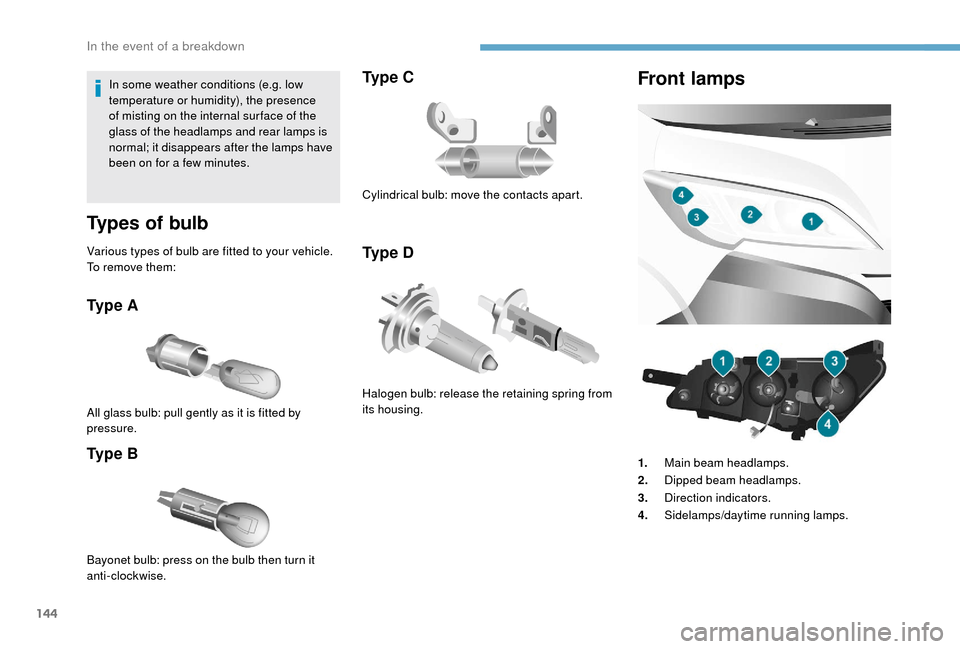
Types of bulb
Various types of bulb are fitted to your vehicle.
To remove them:
Ty p e A
Ty p e B
All glass bulb: pull gently as it is fitted by
pressure.
Ty p e C
Ty p e D
Bayonet bulb: press on the bulb then turn it
anti-clockwise. Cylindrical bulb: move the contacts apart.
Halogen bulb: release the retaining spring from
its housing.
Front lamps
1.
Main beam headlamps.
2. Dipped beam headlamps.
3. Direction indicators.
4. Sidelamps/daytime running lamps.
In the event of a breakdown