cab Peugeot Boxer 2018 Owner's Guide
[x] Cancel search | Manufacturer: PEUGEOT, Model Year: 2018, Model line: Boxer, Model: Peugeot Boxer 2018Pages: 232, PDF Size: 9.09 MB
Page 141 of 232
139
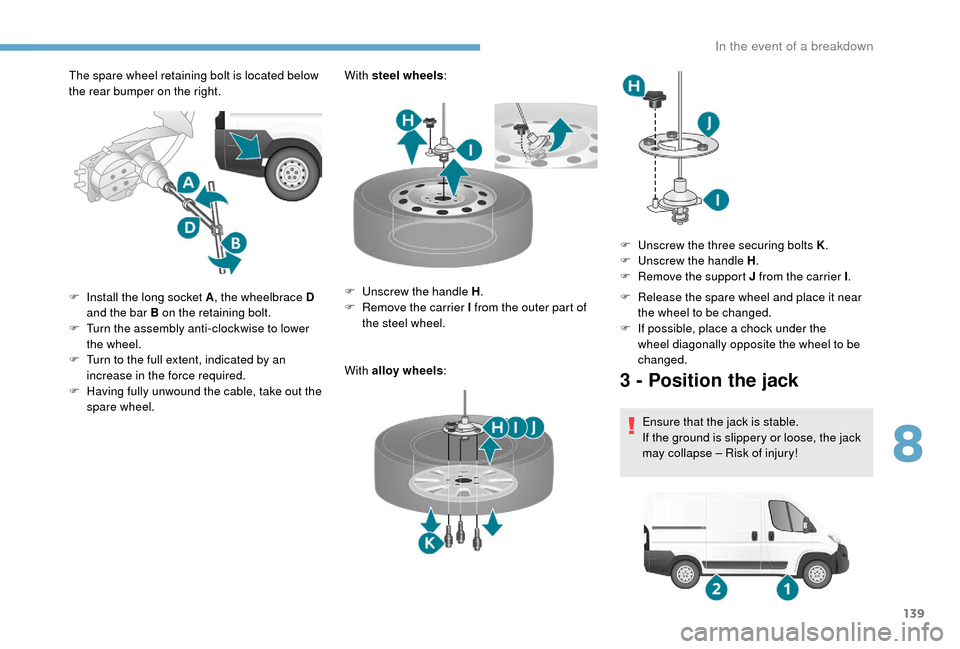
The spare wheel retaining bolt is located below
the rear bumper on the right.With steel wheels
:
With alloy wheels :
F
I
nstall the long socket A , the wheelbrace D
and the bar B on the retaining bolt.
F
T
urn the assembly anti-clockwise to lower
the wheel.
F
T
urn to the full extent, indicated by an
increase in the force required.
F
H
aving fully unwound the cable, take out the
spare wheel. F
U
nscrew the handle H.
F
R
emove the carrier I from the outer part of
the steel wheel. F
R
elease the spare wheel and place it near
the wheel to be changed.
F
I
f possible, place a chock under the
wheel diagonally opposite the wheel to be
changed.
3 - Position the jack
Ensure that the jack is stable.
If the ground is slippery or loose, the jack
may collapse – Risk of injury!
F
U
nscrew the three securing bolts K
.
F
U
nscrew the handle H
.
F
R
emove the support J from the carrier I
.
8
In the event of a breakdown
Page 145 of 232
143
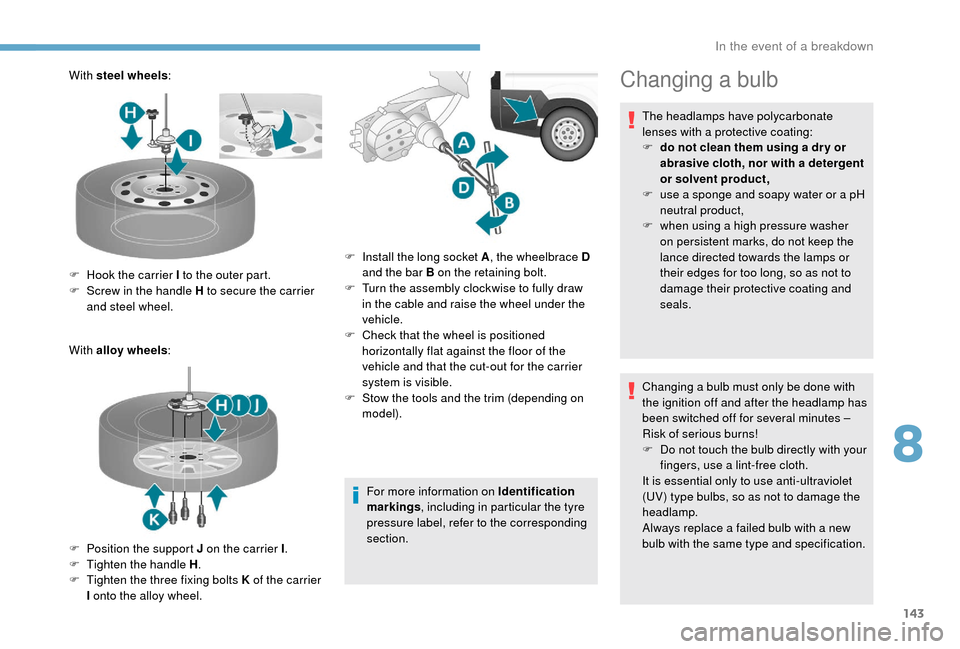
With steel wheels:
With alloy wheels :
For more information on Identification
markings, including in particular the tyre
pressure label, refer to the corresponding
section.
F
H
ook the carrier I to the outer part.
F
S
crew in the handle H to secure the carrier
and steel wheel.
F
P
osition the support J on the carrier I .
F
T
ighten the handle H .
F
T
ighten the three fixing bolts K of the carrier
I onto the alloy wheel. F
I
nstall the long socket A, the wheelbrace D
and the bar B on the retaining bolt.
F
T
urn the assembly clockwise to fully draw
in the cable and raise the wheel under the
vehicle.
F
C
heck that the wheel is positioned
horizontally flat against the floor of the
vehicle and that the cut-out for the carrier
system is visible.
F
S
tow the tools and the trim (depending on
model).Changing a bulb
The headlamps have polycarbonate
lenses with a
protective coating:
F
d
o not clean them using a dr y or
abrasive cloth, nor with a
detergent
or solvent product,
F
u
se a sponge and soapy water or a pH
neutral product,
F
w
hen using a high pressure washer
on persistent marks, do not keep the
lance directed towards the lamps or
their edges for too long, so as not to
damage their protective coating and
seals.
Changing a
bulb must only be done with
the ignition off and after the headlamp has
been switched off for several minutes –
Risk of serious burns!
F
D
o not touch the bulb directly with your
fingers, use a
lint-free cloth.
It is essential only to use anti-ultraviolet
(UV) type bulbs, so as not to damage the
headlamp.
Always replace a
failed bulb with a new
bulb with the same type and specification.
8
In the event of a breakdown
Page 152 of 232
150
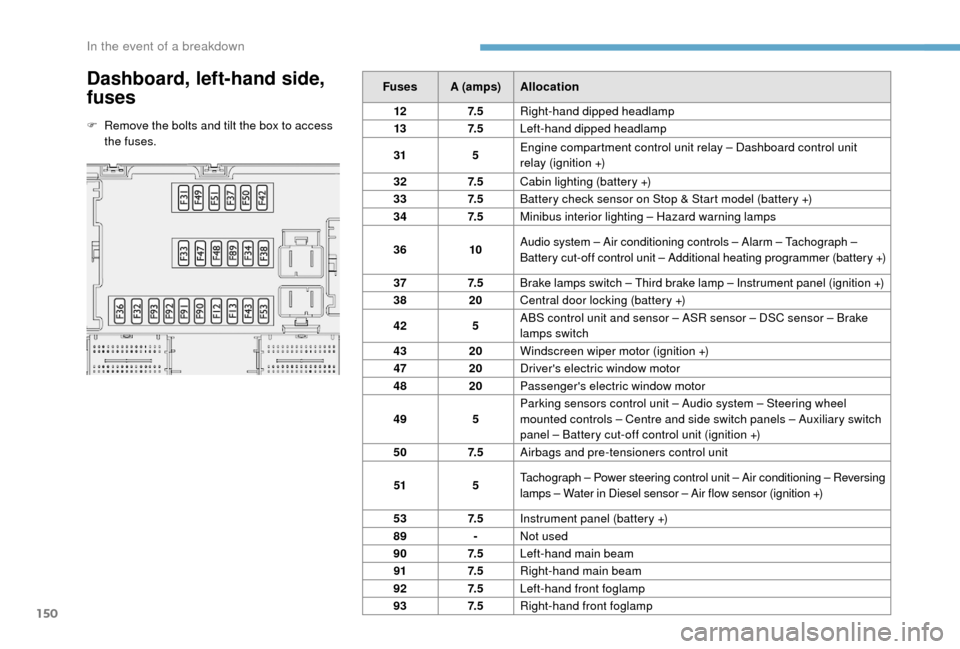
Dashboard, left-hand side,
fuses
F Remove the bolts and tilt the box to access the fuses. Fuses A (amps)
Allocation
12 7. 5Right-hand dipped headlamp
13 7. 5Left-hand dipped headlamp
31 5Engine compartment control unit relay – Dashboard control unit
relay (ignition +)
32 7. 5Cabin lighting (battery +)
33 7. 5Battery check sensor on Stop & Start model (battery +)
34 7. 5Minibus interior lighting – Hazard warning lamps
36 10Audio system – Air conditioning controls – Alarm – Tachograph –
Battery cut-off control unit – Additional heating programmer (battery +)
37 7. 5
Brake lamps switch – Third brake lamp – Instrument panel (ignition +)
38 20Central door locking (battery +)
42 5ABS control unit and sensor – ASR sensor – DSC sensor – Brake
lamps switch
43 20Windscreen wiper motor (ignition +)
47 20Driver's electric window motor
48 20Passenger's electric window motor
49 5Parking sensors control unit – Audio system – Steering wheel
mounted controls – Centre and side switch panels – Auxiliary switch
panel – Battery cut-off control unit (ignition +)
50 7. 5Airbags and pre-tensioners control unit
51 5Tachograph – Power steering control unit – Air conditioning – Reversing
lamps – Water in Diesel sensor – Air flow sensor (ignition +)
53 7. 5Instrument panel (battery +)
89 -Not used
90 7. 5Left-hand main beam
91 7. 5Right-hand main beam
92 7. 5Left-hand front foglamp
93 7. 5Right-hand front foglamp
In the event of a breakdown
Page 154 of 232
152
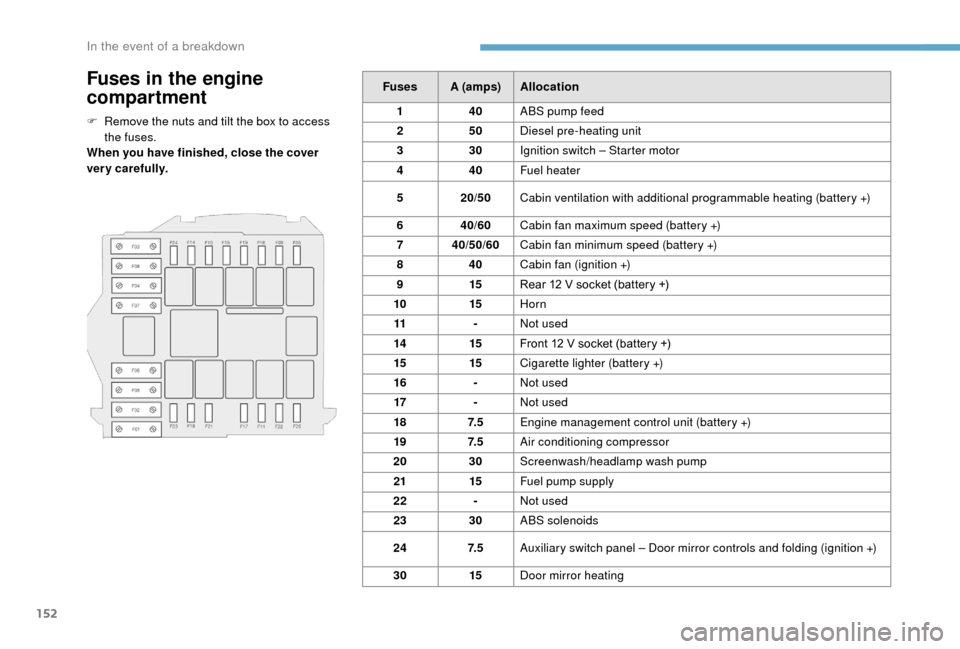
Fuses in the engine
compartment
F Remove the nuts and tilt the box to access the fuses.
When you have finished, close the cover
very carefully. Fuses A (amps)
Allocation
1 40ABS pump feed
2 50Diesel pre-heating unit
3 30Ignition switch – Starter motor
4 40Fuel heater
5 20/50Cabin ventilation with additional programmable heating (battery +)
6 40/60Cabin fan maximum speed (battery +)
7 40/50/60 Cabin fan minimum speed (battery +)
8 40Cabin fan (ignition +)
9 15Rear 12
V socket (battery +)
10 15Horn
11 -Not used
14 15Front 12
V socket (battery +)
15 15Cigarette lighter (battery +)
16 -Not used
17 -Not used
18 7. 5Engine management control unit (battery +)
19 7. 5Air conditioning compressor
20 30Screenwash/headlamp wash pump
21 15Fuel pump supply
22 -Not used
23 30ABS solenoids
24 7. 5Auxiliary switch panel – Door mirror controls and folding (ignition +)
30 15Door mirror heating
In the event of a breakdown
Page 156 of 232
154
Starting using another
battery
Never try to start the engine by connecting
a battery charger.
Never use a
24 V or higher battery
b o o s t e r.
Check beforehand that the backup
battery has a
nominal voltage of 12 V and
a
capacity at least equal to that of the
discharged battery.
The two vehicles must not be in contact
with each other.
Switch off all the electrical consumers
on both vehicles (audio system, wipers,
lighting, etc.).
Make sure that the jump leads are not
close to moving parts of the engine (fan,
belts, etc.).
Do not disconnect the (+) terminal while
the engine is running.
After every reconnection of the battery, switch
on the ignition and wait 1
minute before
starting to allow the electronic systems to be
initialised. If slight difficulties are experienced
after this, please contact a
PEUGEOT dealer or
a
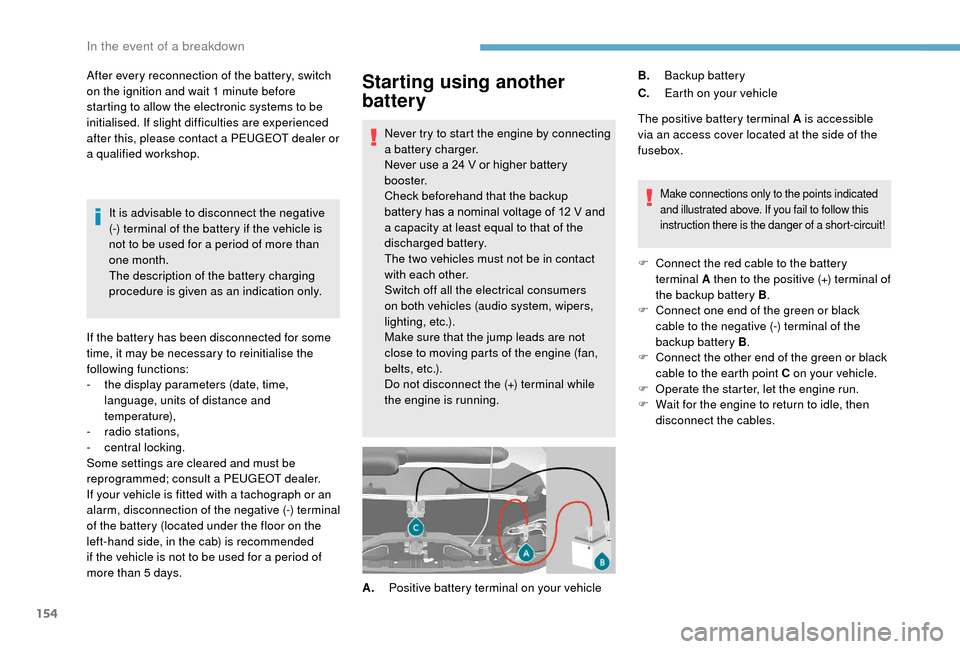
qualified workshop. The positive battery terminal A is accessible
via an access cover located at the side of the
fusebox.
Make connections only to the points indicated
and illustrated above. If you fail to follow this
instruction there is the danger of a
short-circuit!
F Connect the red cable to the battery terminal A then to the positive (+) terminal of
the backup battery B .
F
C
onnect one end of the green or black
cable to the negative (-) terminal of the
backup battery B .
F
C
onnect the other end of the green or black
cable to the earth point C on your vehicle.
F
O
perate the starter, let the engine run.
F
W
ait for the engine to return to idle, then
disconnect the cables.
A. Positive battery terminal on your vehicle B.
Backup battery
C. Earth on your vehicle
It is advisable to disconnect the negative
(-) terminal of the battery if the vehicle is
not to be used for a
period of more than
one month.
The description of the battery charging
procedure is given as an indication only.
If the battery has been disconnected for some
time, it may be necessary to reinitialise the
following functions:
-
t
he display parameters (date, time,
language, units of distance and
temperature),
-
r
adio stations,
-
c
entral locking.
Some settings are cleared and must be
reprogrammed; consult a
PEUGEOT dealer.
If your vehicle is fitted with a
tachograph or an
alarm, disconnection of the negative (-) terminal
of the battery (located under the floor on the
left-hand side, in the cab) is recommended
if the vehicle is not to be used for a
period of
more than 5
days.
In the event of a breakdown
Page 173 of 232
171
Crew cab
The crew cab is available on van
models and comprises a bench
seat, seat belts, a storage space
and side windows.
Rear bench seat Storage space
It is separated from the load space by a high-
s trength partition offering comfort and safety.
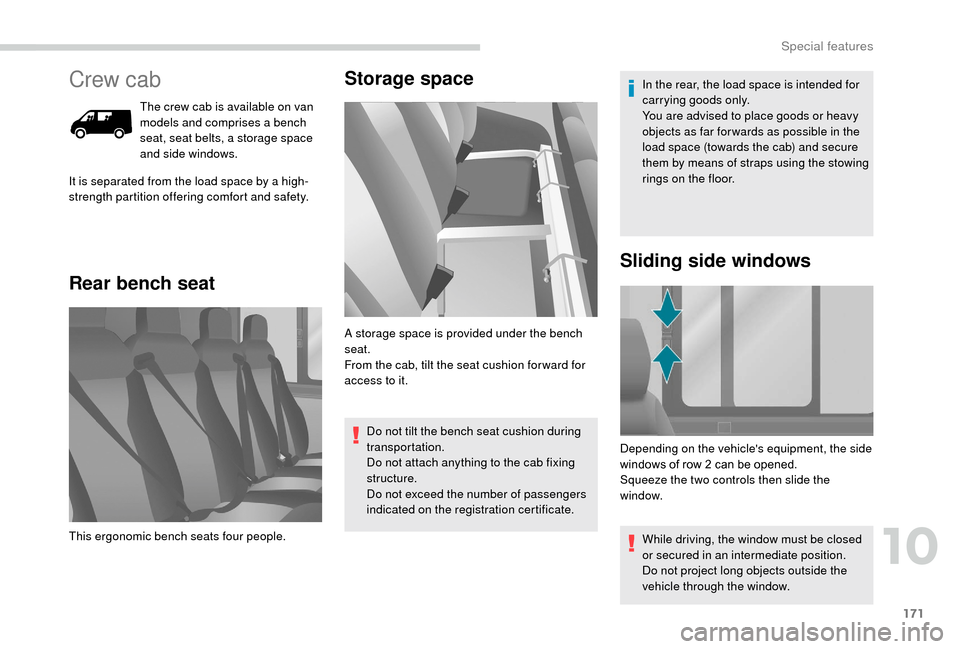
This ergonomic bench seats four people. A storage space is provided under the bench
seat.
From the cab, tilt the seat cushion for ward for
access to it.
Do not tilt the bench seat cushion during
transportation.
Do not attach anything to the cab fixing
structure.
Do not exceed the number of passengers
indicated on the registration certificate. In the rear, the load space is intended for
carrying goods only.
You are advised to place goods or heavy
objects as far for wards as possible in the
load space (towards the cab) and secure
them by means of straps using the stowing
rings on the floor.
Depending on the vehicle's equipment, the side
windows of row 2
can be opened.
Squeeze the two controls then slide the
window.
While driving, the window must be closed
or secured in an intermediate position.
Do not project long objects outside the
vehicle through the window.
Sliding side windows
10
Special features
Page 174 of 232
172
Seat belts
Fastening
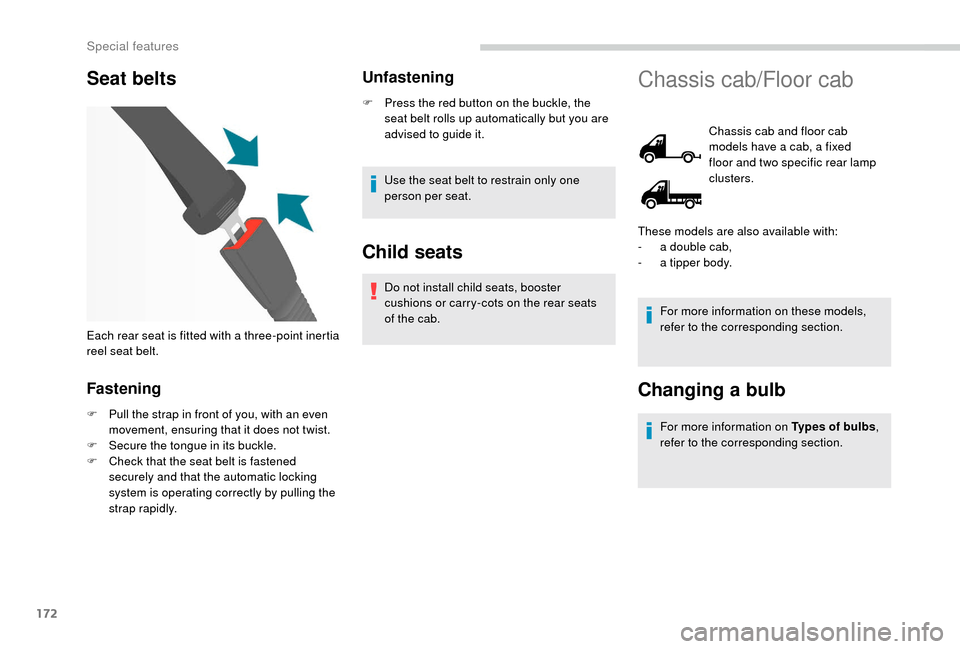
F Pull the strap in front of you, with an even movement, ensuring that it does not twist.
F
S
ecure the tongue in its buckle.
F
C
heck that the seat belt is fastened
securely and that the automatic locking
system is operating correctly by pulling the
strap rapidly.
Unfastening
F Press the red button on the buckle, the seat belt rolls up automatically but you are
advised to guide it.
Use the seat belt to restrain only one
person per seat.
Child seats
Do not install child seats, booster
cushions or carry-cots on the rear seats
of the cab.
Each rear seat is fitted with a
three-point inertia
reel seat belt.
Chassis cab/Floor cab
Chassis cab and floor cab
models have a cab, a fixed
floor and two specific rear lamp
clusters.
For more information on these models,
refer to the corresponding section.
Changing a bulb
For more information on Types of bulbs ,
refer to the corresponding section.
These models are also available with:
-
a d
ouble cab,
-
a t
ipper body.
Special features
Page 176 of 232
174
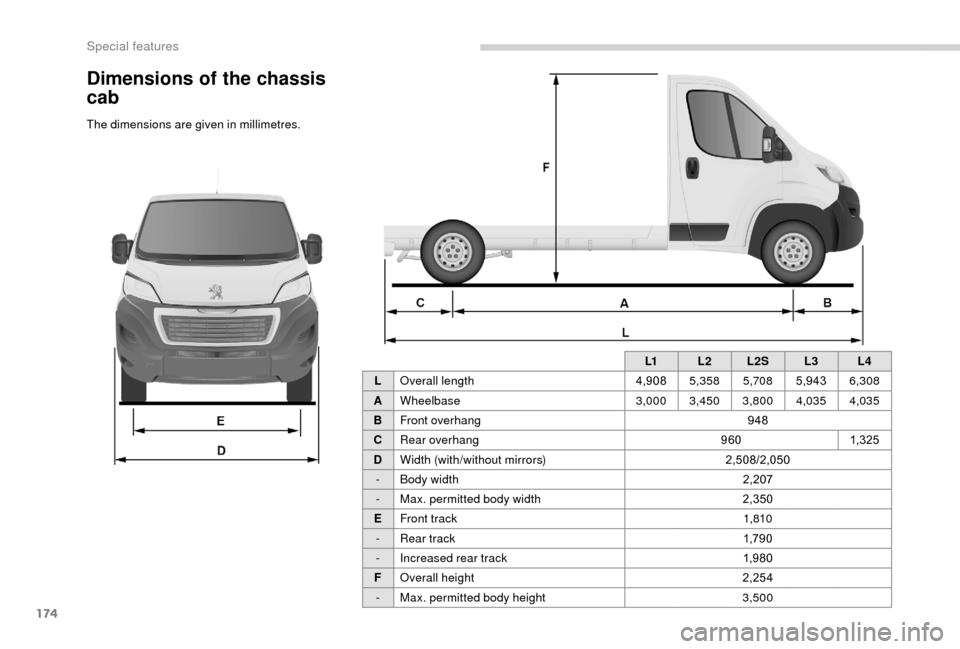
L1L2L2S L3L4
L Overall length 4,9085,358 5,7085,943 6,308
A Wheelbase 3,0003,450 3,800 4,035 4,035
B Front overhang 948
C Rear overhang 9601,325
D Width (with/without mirrors) 2,508/2,050
- Body width 2,207
- Max. permitted body width 2,350
E Front track 1,810
- Rear track 1,79 0
- Increased rear track 1,9 8 0
F Overall height 2,254
- Max. permitted body height 3,500
Dimensions of the chassis
cab
The dimensions are given in millimetres.
Special features
Page 177 of 232
175
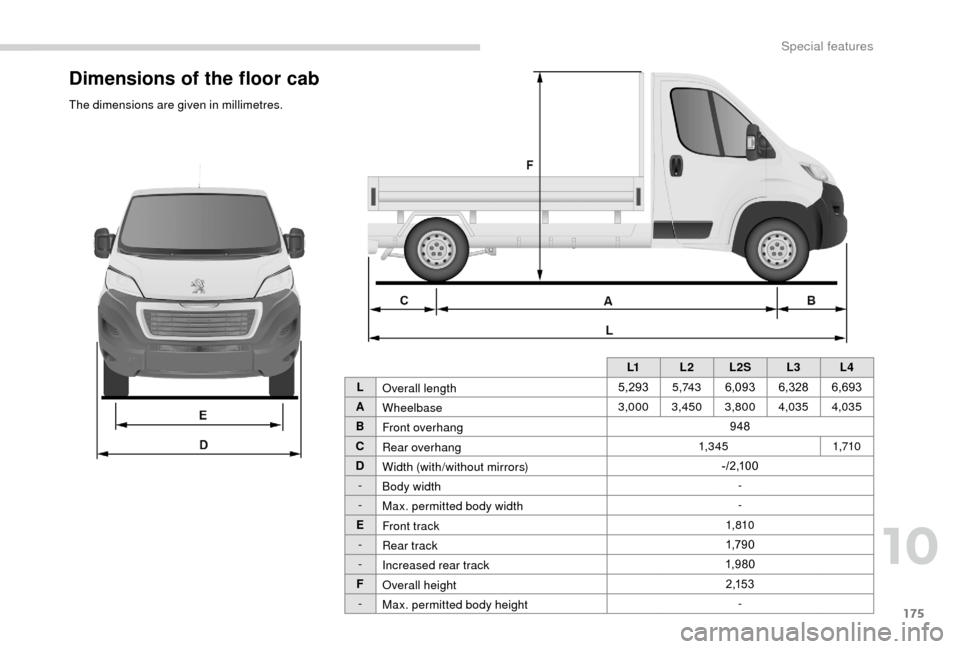
Dimensions of the floor cab
The dimensions are given in millimetres.L1L2L2S L3L4
L Overall length 5,293
5 ,74 36,093 6,3286,693
A Wheelbase 3,000
3,450 3,800 4,035 4,035
B Front overhang 948
C Rear overhang 1,3 4 5
1,710
D Width (with/without mirrors) - / 2 ,1 0 0
- Body width -
- Max. permitted body width -
E Front track 1,810
- Rear track 1,79 0
- Increased rear track 1,9 8 0
F Overall height 2 ,1 5 3
- Max. permitted body height -
10
Special features
Page 178 of 232
176
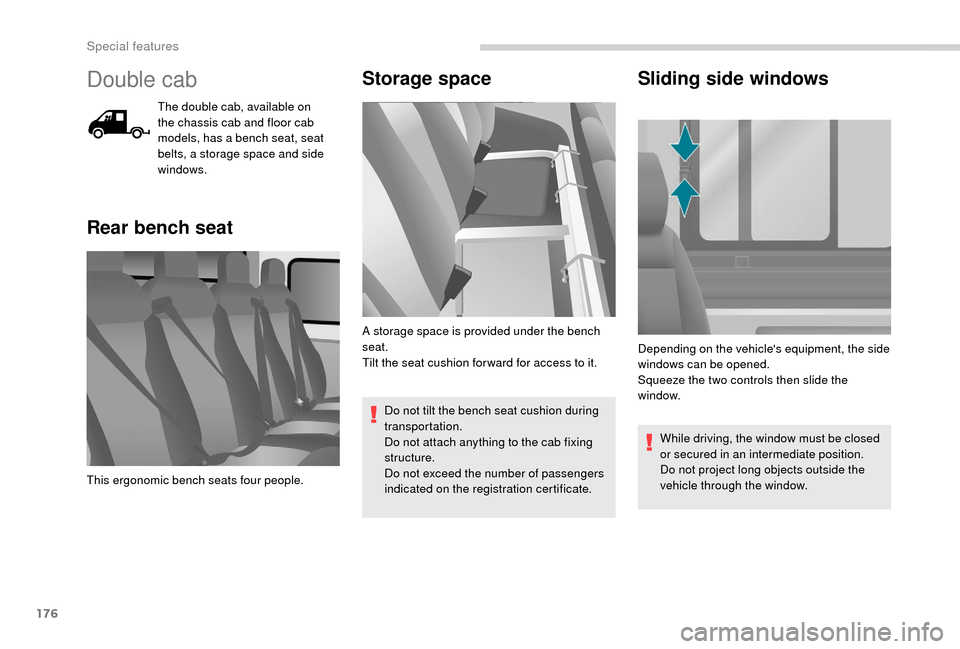
Double cab
The double cab, available on
the chassis cab and floor cab
models, has a bench seat, seat
belts, a storage space and side
windows.
Rear bench seat Storage space
Do not tilt the bench seat cushion during
transportation.
Do not attach anything to the cab fixing
structure.
Do not exceed the number of passengers
indicated on the registration certificate.
Sliding side windows
While driving, the window must be closed
or secured in an intermediate position.
Do not project long objects outside the
vehicle through the window.
This ergonomic bench seats four people. Depending on the vehicle's equipment, the side
windows can be opened.
Squeeze the two controls then slide the
window.
A storage space is provided under the bench
seat.
Tilt the seat cushion for ward for access to it.
Special features