cab Peugeot Boxer 2018 User Guide
[x] Cancel search | Manufacturer: PEUGEOT, Model Year: 2018, Model line: Boxer, Model: Peugeot Boxer 2018Pages: 232, PDF Size: 9.09 MB
Page 36 of 232
34
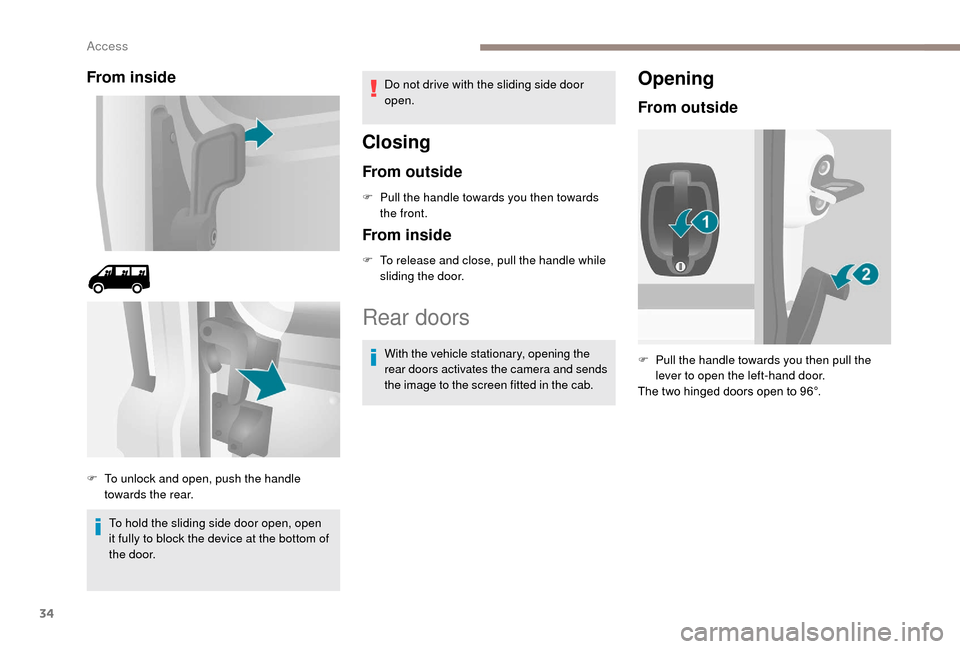
From inside
To hold the sliding side door open, open
it fully to block the device at the bottom of
the door.Do not drive with the sliding side door
open.
Closing
From outside
F Pull the handle towards you then towards
the front.
From inside
F To release and close, pull the handle while sliding the door.
F
T
o unlock and open, push the handle
towards the rear.
Rear doors
With the vehicle stationary, opening the
rear doors activates the camera and sends
the image to the screen fitted in the cab.
Opening
From outside
F Pull the handle towards you then pull the lever to open the left-hand door.
The two hinged doors open to 96°.
Access
Page 38 of 232
36
Deactivation using the
remote control
F Press this button.
Deactivation of the anti-tilt
protection
F Press this control to deactivate the protection (when towing the
vehicle with the alarm on, for
example).
Failure of the remote
control
F Unlock the doors by using the key in the door lock; the alarm is triggered.
F
S
witch on the ignition, recognition of the key
code stops the alarm.
Deactivation occurs when the vehicle is
unlocked.
(Depending on engine).
The protection remains active until the doors
are unlocked with the central locking.
Locking the doors using the key in the
door lock does not set the alarm. To deactivate the siren quickly
following a
false alarm:
F
s
witch on the ignition, recognition of
the key code stops the alarm,
F
p
ress the unlocking button (cab and
key) on the remote control.
To avoid setting the alarm, when washing
the vehicle for example, lock the vehicle
using the key.
Unlocking the vehicle using the remote
control deactivates the siren automatically.
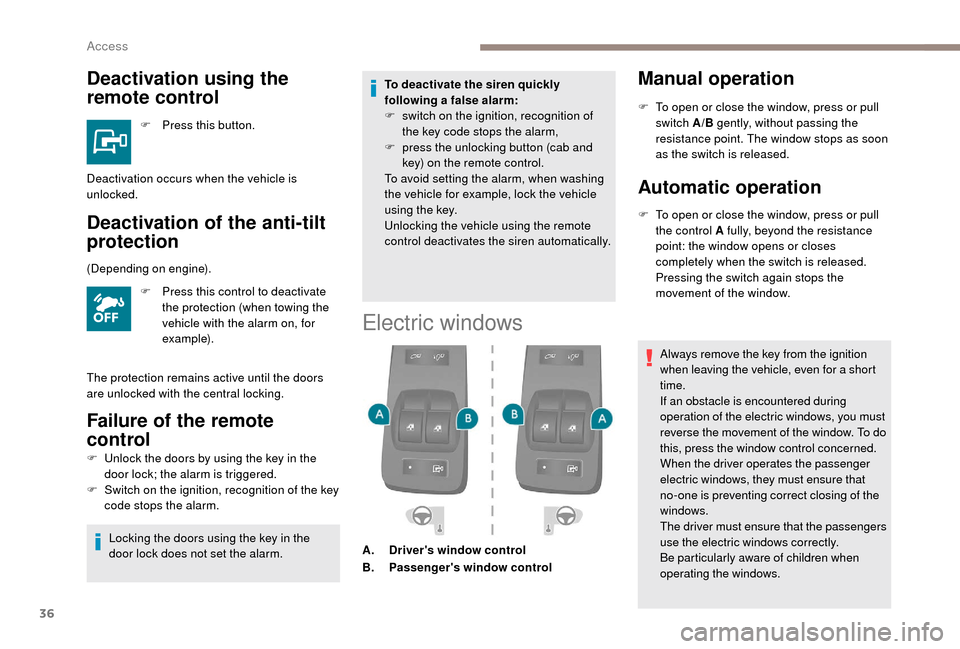
Electric windows
A. Driver's window control
B. Passenger's window control
Manual operation
F To open or close the window, press or pull
switch A/B gently, without passing the
resistance point. The window stops as soon
as the switch is released.
Automatic operation
F To open or close the window, press or pull the control A fully, beyond the resistance
point: the window opens or closes
completely when the switch is released.
Pressing the switch again stops the
movement of the window.
Always remove the key from the ignition
when leaving the vehicle, even for a
short
time.
If an obstacle is encountered during
operation of the electric windows, you must
reverse the movement of the window. To do
this, press the window control concerned.
When the driver operates the passenger
electric windows, they must ensure that
no-one is preventing correct closing of the
windows.
The driver must ensure that the passengers
use the electric windows correctly.
Be particularly aware of children when
operating the windows.
Access
Page 54 of 232
52
With Stop & Start, when the rear screen
demisting is switched on, STOP mode is
not available.
Cab layout
Sun visor
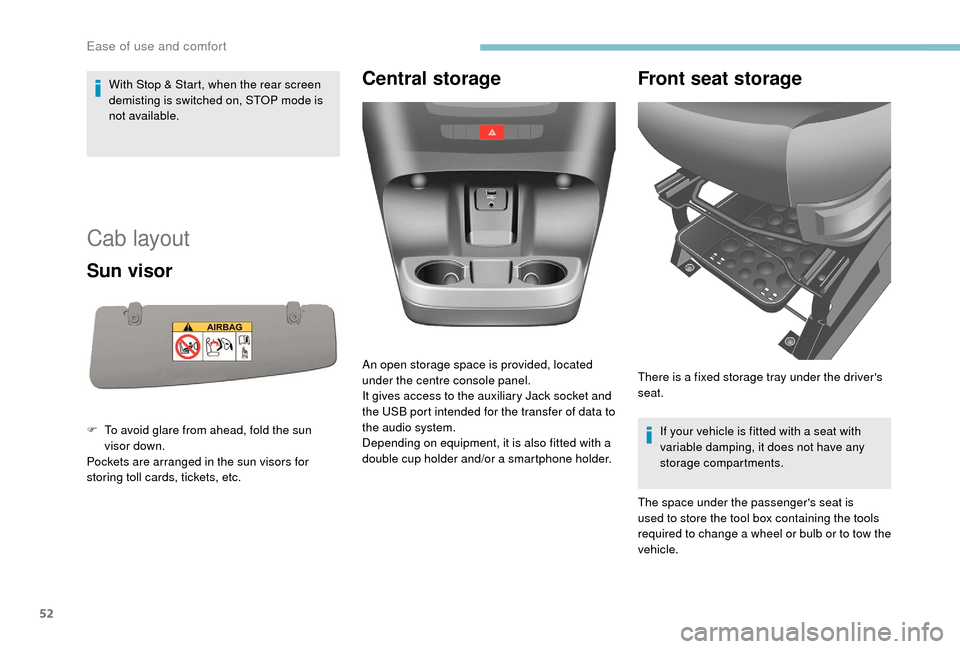
F To avoid glare from ahead, fold the sun visor down.
Pockets are arranged in the sun visors for
storing toll cards, tickets, etc.
Central storage Front seat storage
If your vehicle is fitted with a seat with
v ariable damping, it does not have any
storage compartments.
The space under the passenger's seat is
used to store the tool box containing the tools
required to change a
wheel or bulb or to tow the
vehicle.
An open storage space is provided, located
under the centre console panel.
It gives access to the auxiliary Jack socket and
the USB port intended for the transfer of data to
the audio system.
Depending on equipment, it is also fitted with a
double cup holder and/or a
smartphone holder. There is a
fixed storage tray under the driver's
seat.
Ease of use and comfort
Page 59 of 232
57
Rear fittings
Stowing rings
As a safety precaution in case of sharp
b raking, you are advised to place heavy
objects as far for wards towards the cab as
possible.
Support for stowing rail
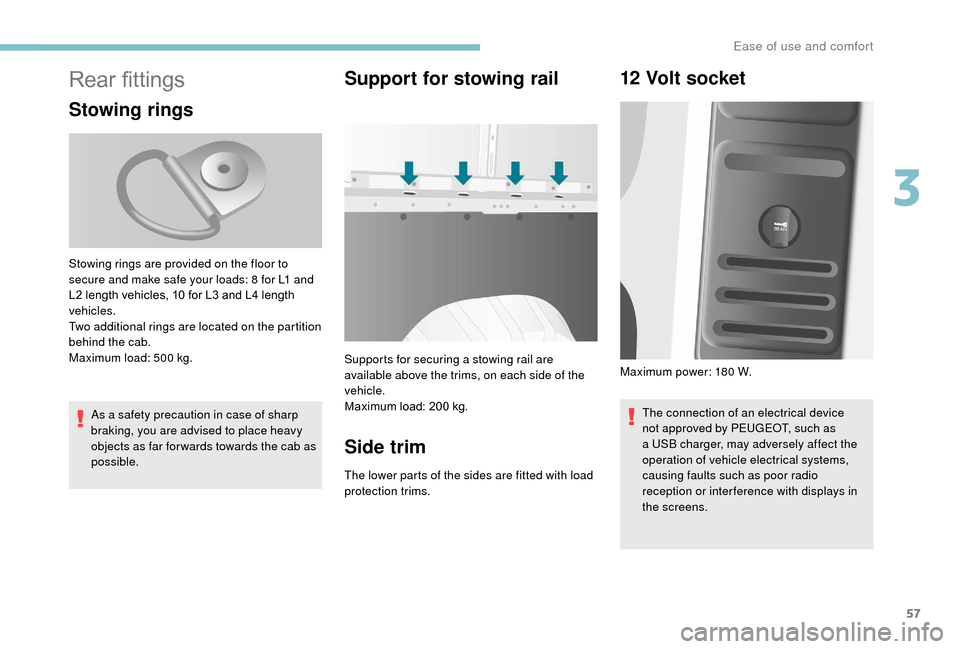
Supports for securing a stowing rail are
a vailable above the trims, on each side of the
vehicle.
Maximum load: 200
kg.
Side trim
The lower parts of the sides are fitted with load
protection trims.
Stowing rings are provided on the floor to
secure and make safe your loads: 8
for L1
and
L2
length vehicles, 10
for L3
and L4
length
vehicles.
Two additional rings are located on the partition
behind the cab.
Maximum load: 500
kg.
12 Volt socket
The connection of an electrical device
not approved by PEUGEOT, such as
a
USB charger, may adversely affect the
operation of vehicle electrical systems,
causing faults such as poor radio
reception or inter ference with displays in
the screens.
Maximum power: 180
W.
3
Ease of use and comfort
Page 60 of 232
58
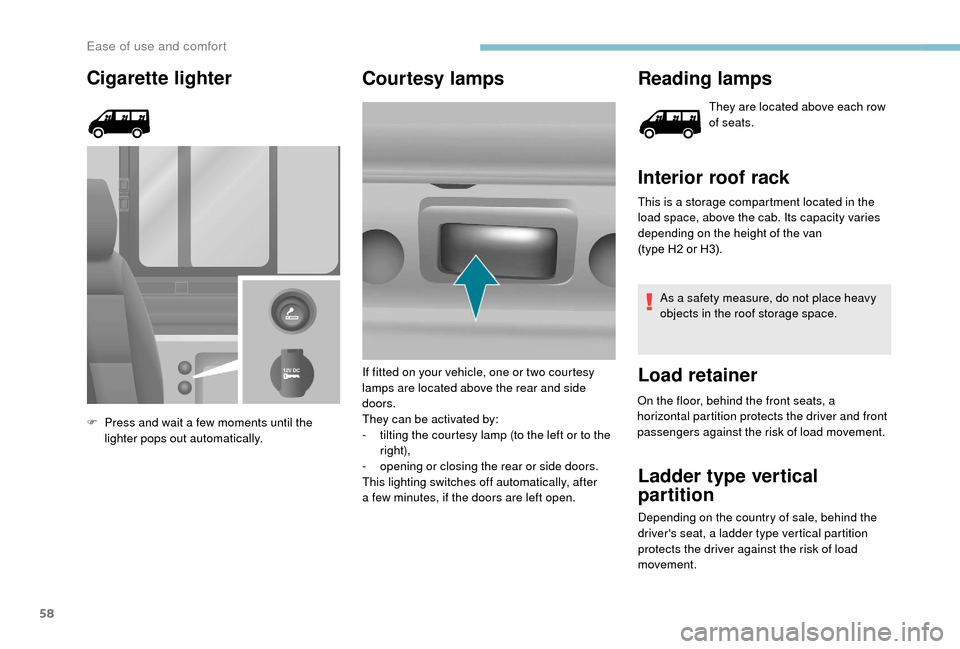
Cigarette lighter
F Press and wait a few moments until the
lighter pops out automatically.
Courtesy lamps Reading lamps
They are located above each row
of seats.
Interior roof rack
This is a storage compartment located in the
l oad space, above the cab. Its capacity varies
depending on the height of the van
(type H2
or H3).
As a
safety measure, do not place heavy
objects in the roof storage space.
Load retainerIf fitted on your vehicle, one or two courtesy
lamps are located above the rear and side
doors.
They can be activated by:
-
t
ilting the courtesy lamp (to the left or to the
right),
-
o
pening or closing the rear or side doors.
This lighting switches off automatically, after
a
few minutes, if the doors are left open. On the floor, behind the front seats, a
horizontal partition protects the driver and front
passengers against the risk of load movement.
Ladder type vertical
partition
Depending on the country of sale, behind the
driver's seat, a ladder type vertical partition
protects the driver against the risk of load
movement.
Ease of use and comfort
Page 61 of 232
59
Glazed partition
Depending on the country of sale, a glazed
partition separates the cabin from the load
space.
However, you can use the control to open/close
its sliding window.
To r c h
Remove the torch from its base by pressing the
button then pivoting the torch downwards by
90
de
grees.
To switch on the torch, slide the switch
forwards.
To change the 4
batteries (NiMH type), remove
the protective cover, located on the torch.
To put the torch back in place, engage it in the
notches on the base and pivot it upwards.
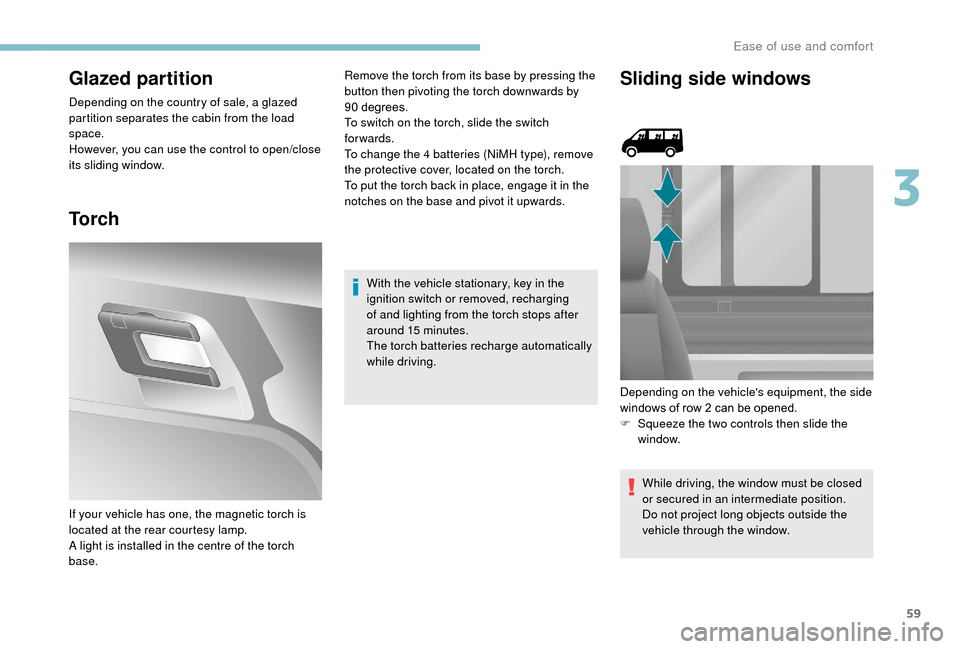
If your vehicle has one, the magnetic torch is
located at the rear courtesy lamp.
A light is installed in the centre of the torch
base. With the vehicle stationary, key in the
ignition switch or removed, recharging
of and lighting from the torch stops after
around 15
minutes.
The torch batteries recharge automatically
while driving.Sliding side windows
While driving, the window must be closed
or secured in an intermediate position.
Do not project long objects outside the
vehicle through the window.
Depending on the vehicle's equipment, the side
windows of row 2
can be opened.
F
S
queeze the two controls then slide the
window.
3
Ease of use and comfort
Page 77 of 232
75
AirbagsThe airbags do not operate when the
engine is not running.
This equipment will only deploy once. If
a second impact occurs (during the same
or a
subsequent accident), the airbag will
not be deployed again.
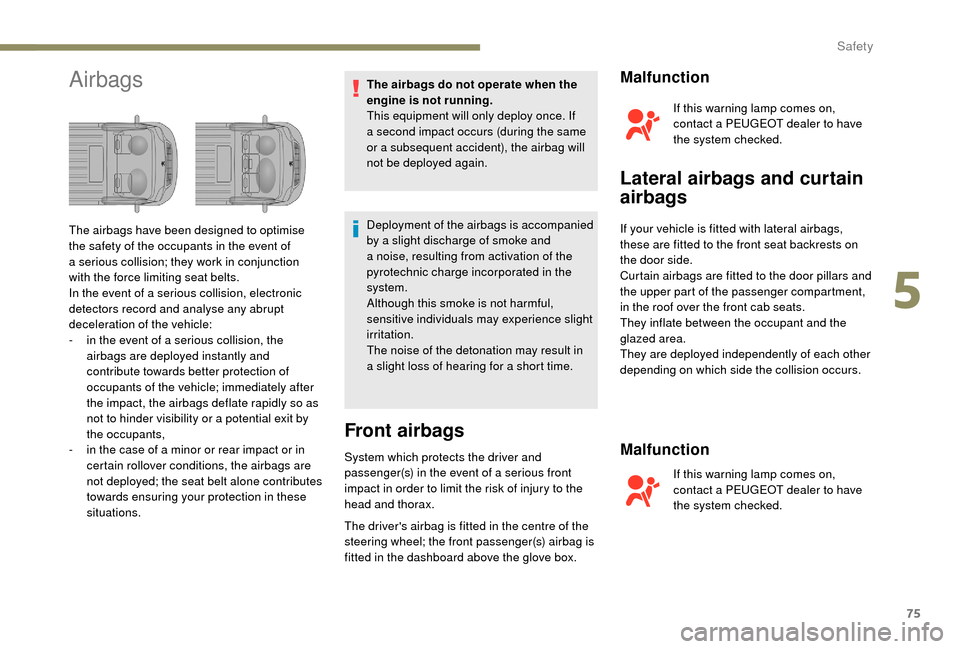
The airbags have been designed to optimise
the safety of the occupants in the event of
a
serious collision; they work in conjunction
with the force limiting seat belts.
In the event of a
serious collision, electronic
detectors record and analyse any abrupt
deceleration of the vehicle:
-
i
n the event of a
serious collision, the
airbags are deployed instantly and
contribute towards better protection of
occupants of the vehicle; immediately after
the impact, the airbags deflate rapidly so as
not to hinder visibility or a
potential exit by
the occupants,
-
i
n the case of a
minor or rear impact or in
certain rollover conditions, the airbags are
not deployed; the seat belt alone contributes
towards ensuring your protection in these
situations. Deployment of the airbags is accompanied
by a
slight discharge of smoke and
a
noise, resulting from activation of the
pyrotechnic charge incorporated in the
system.
Although this smoke is not harmful,
sensitive individuals may experience slight
irritation.
The noise of the detonation may result in
a
slight loss of hearing for a short time.
Front airbags
System which protects the driver and
passenger(s) in the event of a serious front
impact in order to limit the risk of injury to the
head and thorax.
The driver's airbag is fitted in the centre of the
steering wheel; the front passenger(s) airbag is
fitted in the dashboard above the glove box.
Malfunction
If this warning lamp comes on,
contact a PEUGEOT dealer to have
the system checked.
Lateral airbags and curtain
airbags
If your vehicle is fitted with lateral airbags,
these are fitted to the front seat backrests on
the door side.
Curtain airbags are fitted to the door pillars and
the upper part of the passenger compartment,
in the roof over the front cab seats.
They inflate between the occupant and the
glazed area.
They are deployed independently of each other
depending on which side the collision occurs.
Malfunction
If this warning lamp comes on,
contact a PEUGEOT dealer to have
the system checked.
5
5
Safety
Page 114 of 232
112
Switching off
F Move from reverse gear into neutral.
Malfunction
If this warning lamp comes on in the
instrument panel accompanied by
a message in the screen, contact
a
PEUGEOT dealer or a qualified
workshop.
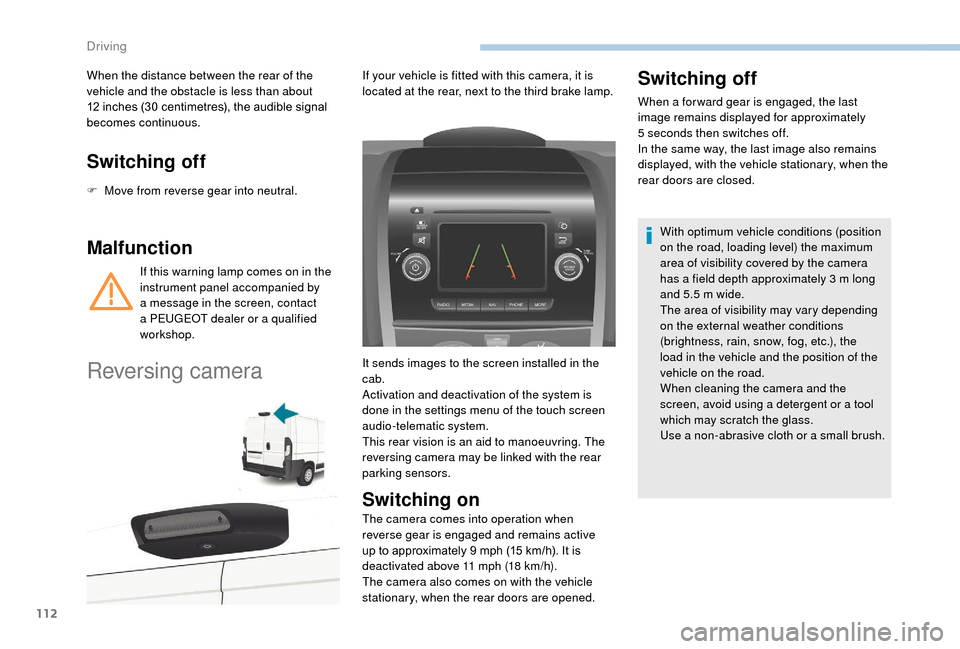
Reversing camera
If your vehicle is fitted with this camera, it is
located at the rear, next to the third brake lamp.
Switching on
The camera comes into operation when
reverse gear is engaged and remains active
up to approximately 9
mph (15 km/h). It is
deactivated above 11
mph (18 km/h).
The camera also comes on with the vehicle
stationary, when the rear doors are opened.
Switching off
When a for ward gear is engaged, the last
im age remains displayed for approximately
5
seconds then switches off.
In the same way, the last image also remains
displayed, with the vehicle stationary, when the
rear doors are closed.
With optimum vehicle conditions (position
on the road, loading level) the maximum
area of visibility covered by the camera
has a
field depth approximately 3 m long
and 5.5
m wide.
The area of visibility may vary depending
on the external weather conditions
(brightness, rain, snow, fog, etc.), the
load in the vehicle and the position of the
vehicle on the road.
When cleaning the camera and the
screen, avoid using a
detergent or a tool
which may scratch the glass.
Use a
non-abrasive cloth or a small brush.
It sends images to the screen installed in the
cab.
Activation and deactivation of the system is
done in the settings menu of the touch screen
audio-telematic system.
This rear vision is an aid to manoeuvring. The
reversing camera may be linked with the rear
parking sensors.
When the distance between the rear of the
vehicle and the obstacle is less than about
12 inches (30 centimetres), the audible signal
becomes continuous.
Driving
Page 122 of 232
120
For more information on the Technical
data of the vehicle and particularly on
weights and towable loads, refer to the
corresponding section.
You will then have information on your vehicle's
ability to tow a
trailer, a caravan, a boat, etc.
We recommend the use of genuine
PEUGEOT towbars and their harnesses
that have been tested and approved from
the design stage of your vehicle, and
that the fitting of the towbar is entrusted
to a
member of the PEUGEOT dealer
network.
These genuine towbars are compatible
with the operation of the rear parking
sensors and the reversing camera, if your
vehicle is so equipped.
If the towbar is not fitted by a
PEUGEOT
dealer, it must still be fitted in accordance
with the vehicle manufacturer's
instructions.Towbar with quickly
detachable towball
Presentation
This genuine manufacturer towball can be
fitted and removed quickly and easily. These
operations do not require the use of any tools.
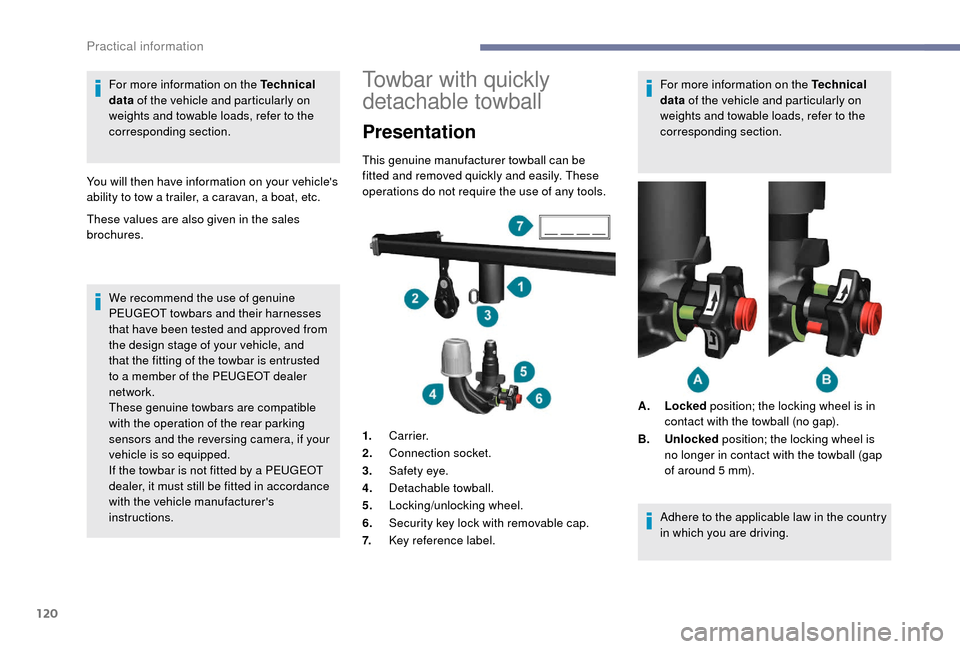
1. Carrier.
2. Connection socket.
3. Safety eye.
4. Detachable towball.
5. Locking/unlocking wheel.
6. Security key lock with removable cap.
7. Key reference label. For more information on the Technical
data
of the vehicle and particularly on
weights and towable loads, refer to the
corresponding section.
A. Locked position; the locking wheel is in
contact with the towball (no gap).
B. Unlocked position; the locking wheel is
no longer in contact with the towball (gap
of around 5
mm).
Adhere to the applicable law in the country
in which you are driving.
These values are also given in the sales
brochures.
Practical information
Page 124 of 232
122
Removing the towball
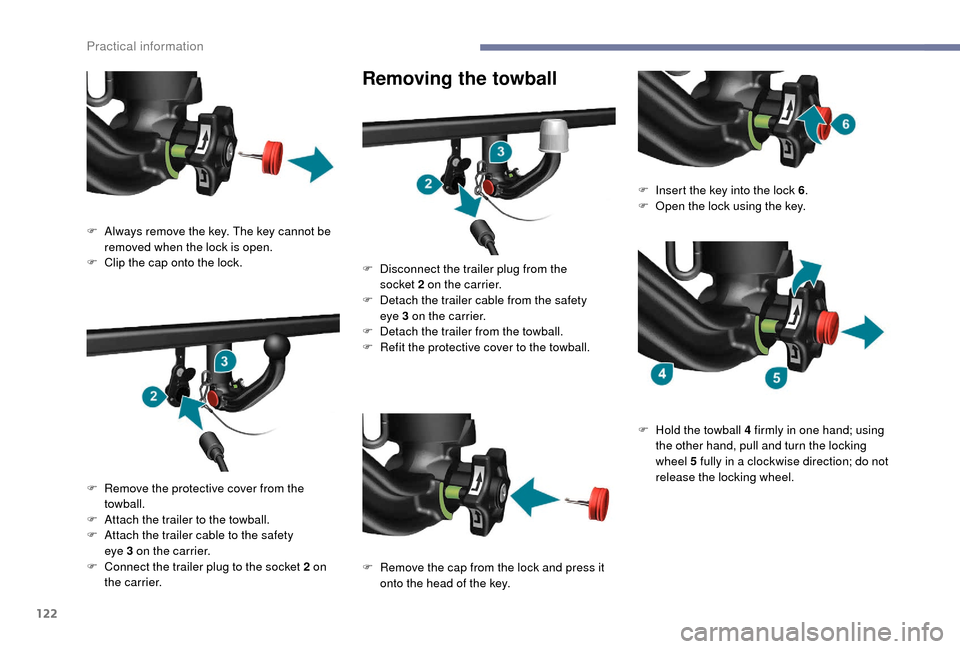
F Always remove the key. The key cannot be removed when the lock is open.
F
C
lip the cap onto the lock.
F
R
emove the protective cover from the
towball.
F
A
ttach the trailer to the towball.
F
A
ttach the trailer cable to the safety
eye 3
on the carrier.
F
C
onnect the trailer plug to the socket 2 on
the carrier. F
D
isconnect the trailer plug from the
socket 2
on the carrier.
F
D
etach the trailer cable from the safety
eye 3
on the carrier.
F
D
etach the trailer from the towball.
F
R
efit the protective cover to the towball.
F
R
emove the cap from the lock and press it
onto the head of the key. F
I
nsert the key into the lock 6
.
F
O
pen the lock using the key.
F
H
old the towball 4 firmly in one hand; using
the other hand, pull and turn the locking
wheel 5
fully in a clockwise direction; do not
release the locking wheel.
Practical information