gear Peugeot Boxer 2018 Owner's Manual
[x] Cancel search | Manufacturer: PEUGEOT, Model Year: 2018, Model line: Boxer, Model: Peugeot Boxer 2018Pages: 232, PDF Size: 9.09 MB
Page 5 of 232
3
.
.
10
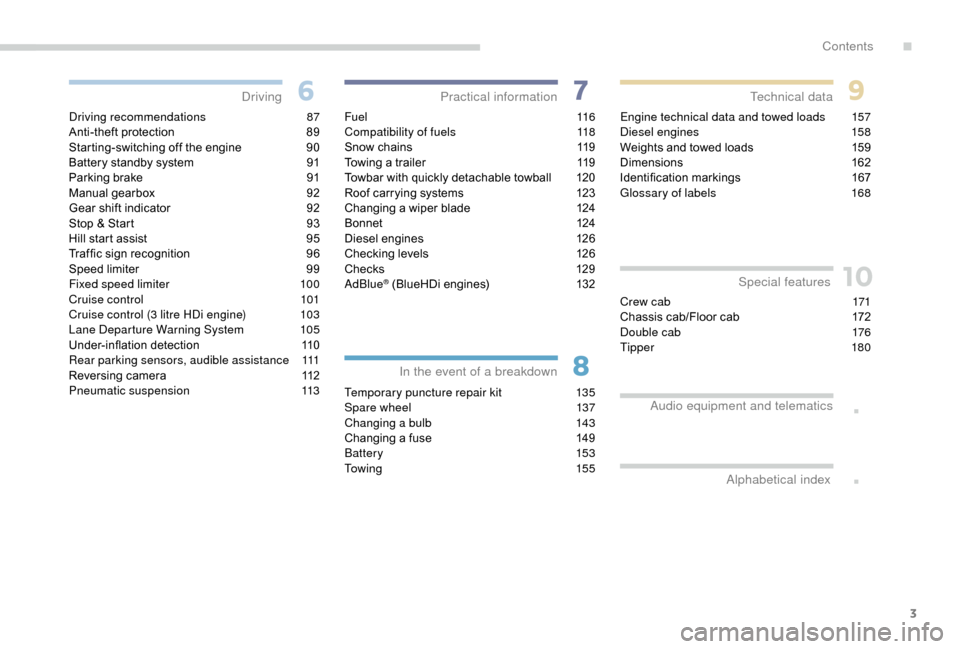
Driving recommendations 87
Anti-theft protection 8 9
Starting-switching off the engine
9
0
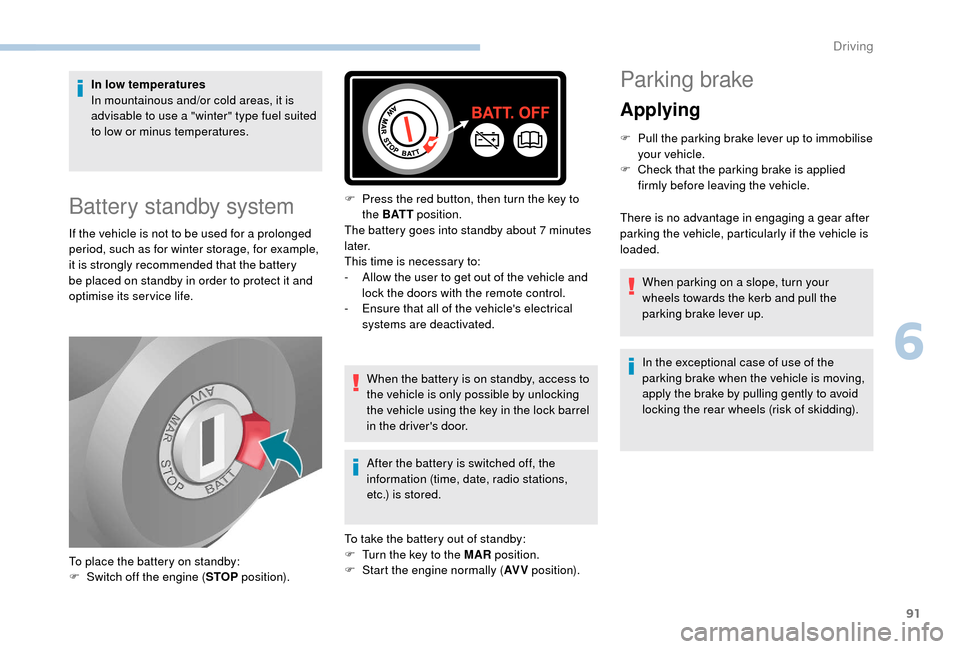
Battery standby system
9
1
Parking brake
9
1
Manual gearbox
9
2
Gear shift indicator
9
2
Stop & Start
9
3
Hill start assist
9
5
Traf fic sign recognition
9
6
Speed limiter
9
9
Fixed speed limiter
1
00
Cruise control
1
01
Cruise control (3
litre HDi engine)
1
03
Lane Departure Warning System
1
05
Under-inflation detection
1
10
Rear parking sensors, audible assistance
1
11
Reversing camera
1
12
Pneumatic suspension
1
13F u e l
11 6
Compatibility of fuels 1 18
Snow chains
1
19
Towing a
trailer
1
19
Towbar with quickly detachable towball
1
20
Roof carrying systems
1
23
Changing a
wiper blade
1
24
Bonnet
12
4
Diesel engines
1
26
Checking levels
1
26
Chec ks
12
9
AdBlue
® (BlueHDi engines) 1 32
Temporary puncture repair kit
1
35
Spare wheel
1
37
Changing a
bulb
1
43
Changing a
fuse
1
49
Battery
153
To w i n g
15 5Engine technical data and towed loads
1
57
Diesel engines
1
58
Weights and towed loads
1
59
Dimensions
1
62
Identification markings
1
67
Glossary of labels
1
68
Driving
Practical information
In the event of a breakdown Technical data
Alphabetical index Special features
Crew cab 1
71
Chassis cab/Floor cab 1 72
Double cab
1
76
Tipper
18
0
Audio equipment and telematics
.
Contents
Page 6 of 232
4
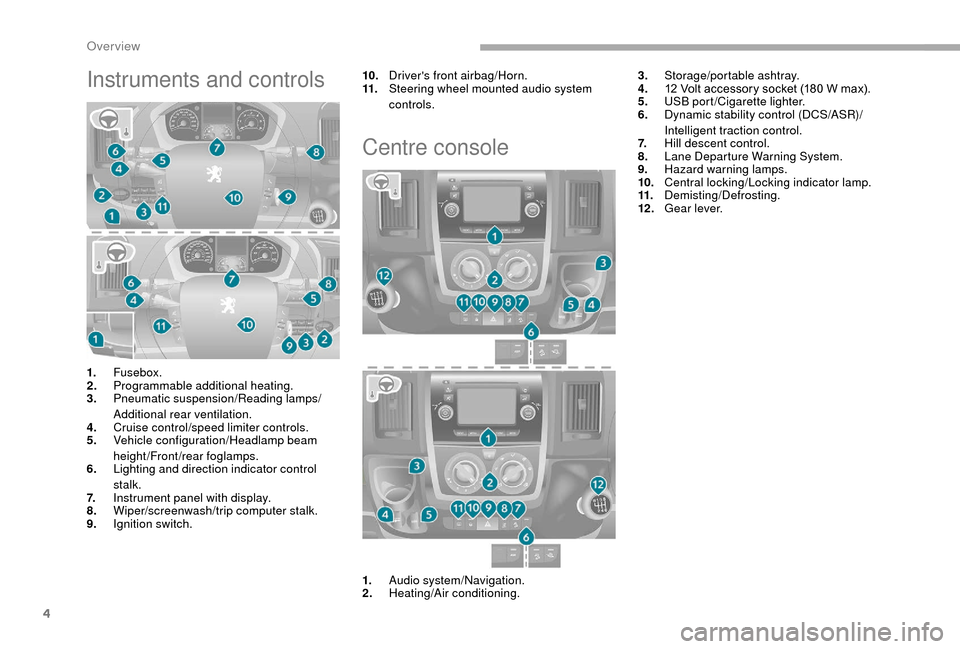
Instruments and controls10.Driver's front airbag/Horn.
11. Steering wheel mounted audio system
controls.
Centre console
3.Storage/portable ashtray.
4. 12
Volt accessory socket (180 W max).
5. USB port/Cigarette lighter.
6. Dynamic stability control (DCS/ASR)/
Intelligent traction control.
7. Hill descent control.
8. Lane Departure Warning System.
9. Hazard warning lamps.
10. Central locking/Locking indicator lamp.
11. Demisting/Defrosting.
12 . Gear lever.
1. Fusebox.
2. Programmable additional heating.
3. Pneumatic suspension/Reading lamps/
Additional rear ventilation.
4. Cruise control/speed limiter controls.
5. Vehicle configuration/Headlamp beam
height/Front/rear foglamps.
6. Lighting and direction indicator control
stalk.
7. Instrument panel with display.
8. Wiper/screenwash/trip computer stalk.
9. Ignition switch.
1.Audio system/Navigation.
2. Heating/Air conditioning.
Over view
Page 7 of 232
5
As a passenger, if you avoid connecting your
m ultimedia devices (film, music, video game,
etc.), you will contribute towards limiting the
consumption of electrical energy, and so of
fuel.
Disconnect your portable devices before
leaving the vehicle.
Eco- driving
Eco-driving is a range of everyday practices that allow the motorist to optimise their fuel consumption and CO2 emissions.
Optimise the use of your
gearbox
With a manual gearbox, move off gently
an d change up without waiting. During
acceleration, change up early.
With an automatic gearbox, give preference
to automatic mode and avoid pressing the
accelerator pedal heavily or suddenly.
The gear shift indicator invites you to engage
the most suitable gear: as soon as the
indication is displayed in the instrument panel,
follow it straight away.
For vehicles fitted with an automatic gearbox,
this indicator appears only in manual mode.
Drive smoothly
Maintain a safe distance between vehicles,
u se engine braking rather than the
brake pedal, and press the accelerator
progressively. These practices contribute
towards a
reduction in fuel consumption and
CO
2 emissions and also help reduce the
b
ackground traffic noise.
If your vehicle has cruise control, make use of
the system at speeds above 25
mph (40 km/h)
when the traffic is flowing well.
Control the use of your electrical
equipment
Before moving off, if the passenger
compartment is too warm, ventilate it by
opening the windows and air vents before
using the air conditioning.
Above 30
mph (50 km/h), close the windows
and leave the air vents open.
Consider using equipment that can help
keep the temperature in the passenger
compartment down (sunroof blind and window
blinds, etc.). Switch off the headlamps and front foglamps
when the ambient light level does not require
their use.
Avoid running the engine before moving off,
particularly in winter; your vehicle will warm up
much faster while driving. Unless it has automatic regulation, switch off
the air conditioning as soon as the desired
temperature has been reached.
Switch off the demisting and defrosting
controls, if these are not automatically
managed.
Switch off the heated seat as soon as
possible.
.
Eco-driving
Page 9 of 232
7
Instrument panels
Level 1 instrument panel/
d isplay screen
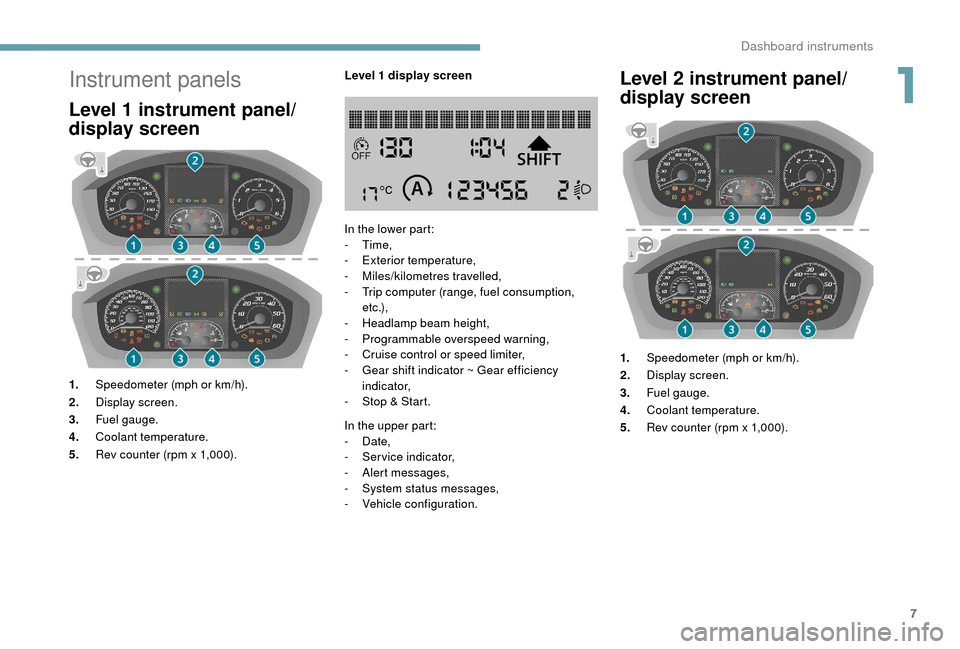
1. Speedometer (mph or km/h).
2. Display screen.
3. Fuel gauge.
4. Coolant temperature.
5. Rev counter (rpm x 1,000). Level 1
display screen
In the lower part:
- Time,
-
E
xterior temperature,
-
M
iles/kilometres travelled,
-
T
rip computer (range, fuel consumption,
e t c .),
-
H
eadlamp beam height,
-
P
rogrammable overspeed warning,
-
C
ruise control or speed limiter,
- G ear shift indicator ~ Gear efficiency
i n d i c a t o r,
-
S
top & Start.
In the upper part:
-
Date,
-
S
ervice indicator,
-
A
lert messages,
-
S
ystem status messages,
-
V
ehicle configuration.
Level 2 instrument panel/
d isplay screen
1. Speedometer (mph or km/h).
2. Display screen.
3. Fuel gauge.
4. Coolant temperature.
5. Rev counter (rpm x 1,000).
1
Dashboard instruments
Page 19 of 232
17
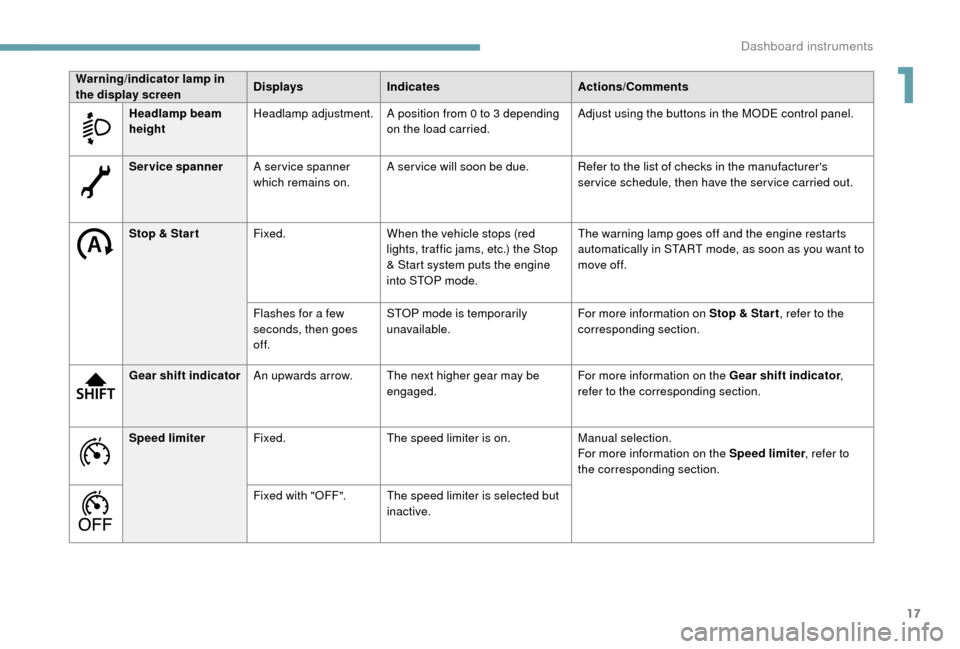
Service spannerA ser vice spanner
which remains on. A ser vice will soon be due. Refer to the list of checks in the manufacturer's
service schedule, then have the service carried out.
Stop & Star t Fixed. When the vehicle stops (red
lights, traffic jams, etc.) the Stop
& Start system puts the engine
into STOP mode. The warning lamp goes off and the engine restarts
automatically in START mode, as soon as you want to
move off.
Flashes for a
few
seconds, then goes
of f. STOP mode is temporarily
unavailable.
For more information on Stop & Star t
, refer to the
corresponding section.
Gear shift indicator An upwards arrow. The next higher gear may be
engaged. For more information on the Gear shift indicator
,
refer to the corresponding section.
Speed limiter Fixed. The speed limiter is on. Manual selection.
For more information on the Speed limiter , refer to
the corresponding section.
Fixed with "OFF". The speed limiter is selected but inactive.
Warning/indicator
lamp in
the display screen Displays
Indicates Actions/Comments
Headlamp beam
height Headlamp adjustment.
A position from 0 to 3 depending
on the load carried. Adjust using the buttons in the MODE control panel.
1
Dashboard instruments
Page 74 of 232
72
Seat belts
Front seat belts
The driver's seat is fitted with a pyrotechnic
p retensioner and a force limiter.
On models with a
passenger's front airbag,
the passenger's seat is also fitted with
a
pyrotechnic pretensioner and a force limiter.
The front bench seat is fitted with two seat
belts.
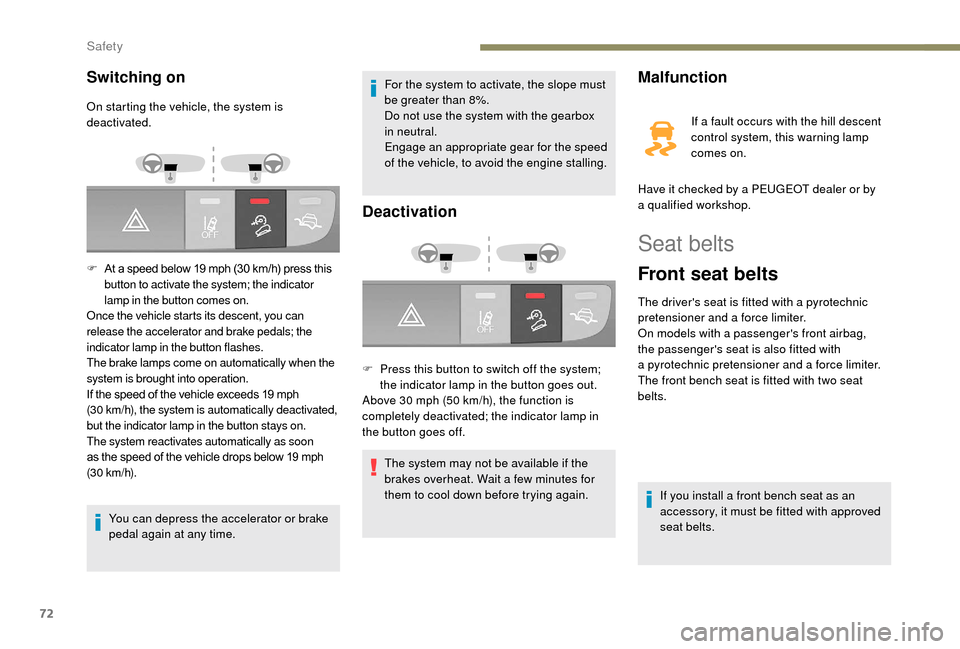
Switching on
On starting the vehicle, the system is
deactivated.
F
A
t a speed below 19 mph (30 km/h) press this
button to activate the system; the indicator
lamp in the button comes on.
Once the vehicle starts its descent, you can
release the accelerator and brake pedals; the
indicator lamp in the button flashes.
The brake lamps come on automatically when the
system is brought into operation.
If the speed of the vehicle exceeds 19
mph
(30
km/h), the system is automatically deactivated,
but the indicator lamp in the button stays on.
The system reactivates automatically as soon
as the speed of the vehicle drops below 19
mph
(30
km/h).You can depress the accelerator or brake
pedal again at any time. For the system to activate, the slope must
be greater than 8%.
Do not use the system with the gearbox
in neutral.
Engage an appropriate gear for the speed
of the vehicle, to avoid the engine stalling.
Deactivation
F Press this button to switch off the system;
the indicator lamp in the button goes out.
Above 30
mph (50 km/h), the function is
completely deactivated; the indicator lamp in
the button goes off.
The system may not be available if the
brakes overheat. Wait a
few minutes for
them to cool down before trying again.
Malfunction
If a fault occurs with the hill descent
c ontrol system, this warning lamp
comes on.
Have it checked by a
PEUGEOT dealer or by
a
qualified workshop.
If you install a
front bench seat as an
accessory, it must be fitted with approved
seat belts.
Safety
Page 89 of 232
87
Driving recommendations
Observe the driving regulations and remain
vigilant whatever the traffic conditions.
Pay close attention to the traffic and keep your
hands on the wheel so that you are ready to
react at any time to any eventuality.
As a safety measure, the driver should only
carry out any operations that require close
attention when the vehicle is stationary.
On a
long journey, a break every two hours is
strongly recommended.
In difficult weather, drive smoothly, anticipate
the need to brake and increase the distance
from other vehicles.
Never leave the engine running in
an enclosed area without adequate
ventilation: internal combustion engines
emit toxic exhaust gases, such as carbon
monoxide. There is a
risk of poisoning and
death!
In very severe wintry conditions
(temperatures below -23°C), to guarantee
correct operation and the longevity of
the mechanical elements of your vehicle,
engine and gearbox, the engine must be
left running for 4
minutes before driving.
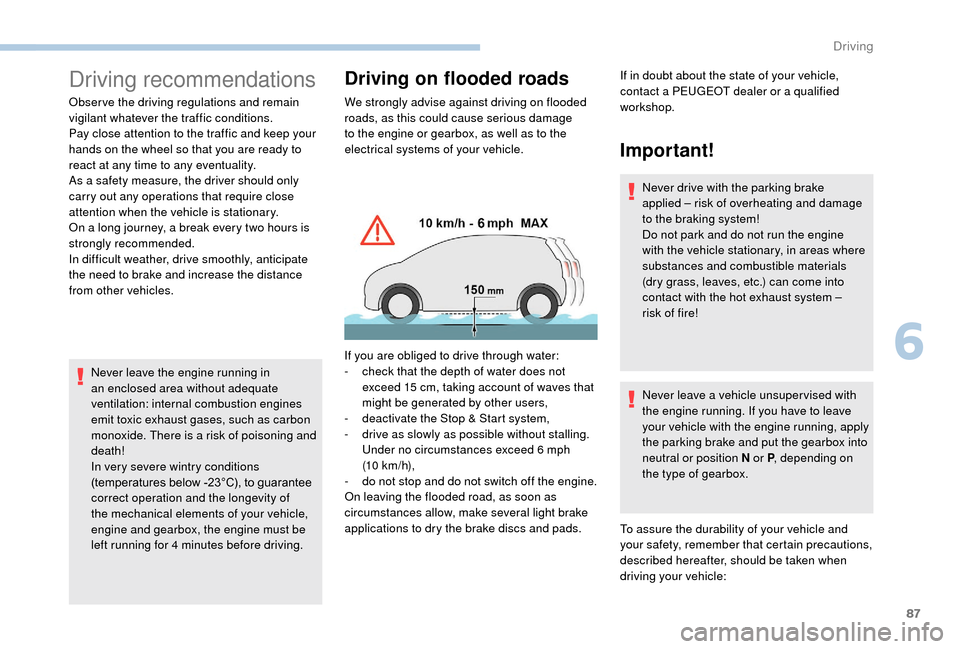
Driving on flooded roads
We strongly advise against driving on flooded
roads, as this could cause serious damage
to the engine or gearbox, as well as to the
electrical systems of your vehicle.
Important!
If you are obliged to drive through water:
- c heck that the depth of water does not
exceed 15
cm, taking account of waves that
might be generated by other users,
-
d
eactivate the Stop & Start system,
-
d
rive as slowly as possible without stalling.
Under no circumstances exceed 6
mph
(10
km/h),
-
d
o not stop and do not switch off the engine.
On leaving the flooded road, as soon as
circumstances allow, make several light brake
applications to dry the brake discs and pads. If in doubt about the state of your vehicle,
contact a
PEUGEOT dealer or a qualified
workshop.
Never drive with the parking brake
applied – risk of overheating and damage
to the braking system!
Do not park and do not run the engine
with the vehicle stationary, in areas where
substances and combustible materials
(dry grass, leaves, etc.) can come into
contact with the hot exhaust system –
risk of fire!
Never leave a vehicle unsuper vised with
the engine running. If you have to leave
your vehicle with the engine running, apply
the parking brake and put the gearbox into
neutral or position N or P , depending on
the type of gearbox.
To assure the durability of your vehicle and
your safety, remember that certain precautions,
described hereafter, should be taken when
driving your vehicle:
6
Driving
Page 92 of 232
90
Driving with the doors locked may make
access to the passenger compartment by
the emergency services more difficult in an
emergency.
As a safety precaution (with children on
board), remove the key from the ignition when
leaving the vehicle, even for a
short time.
When purchasing a second-hand
vehicle:
-
e
nsure that you are given the
confidential card,
-
h
ave the keys recorded by
a
PEUGEOT dealer to ensure that the
keys in your possession are the only
ones which can start the vehicle.
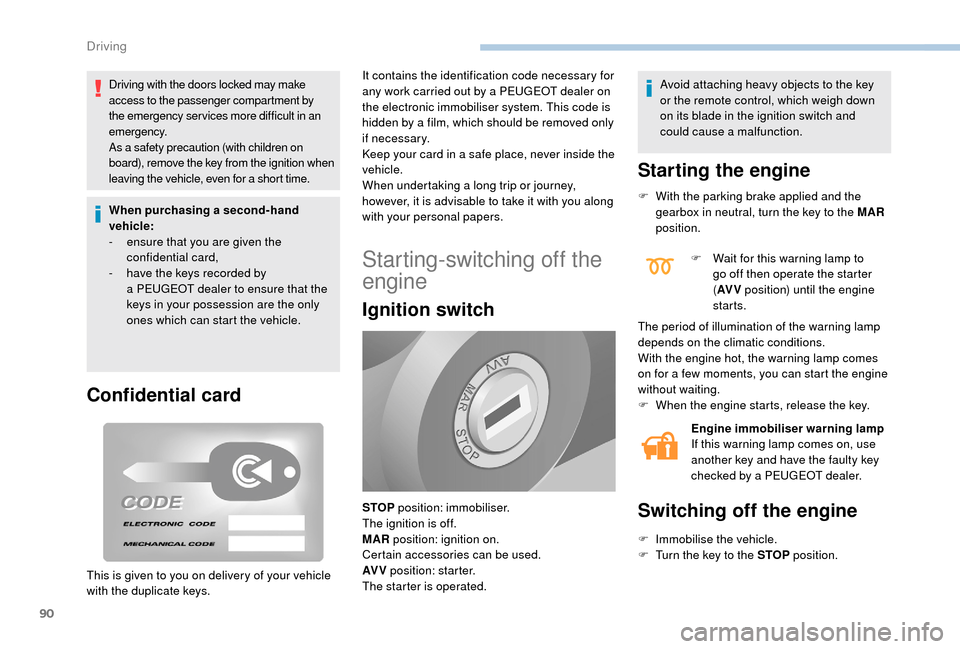
Confidential card
It contains the identification code necessary for
any work carried out by a PEUGEOT dealer on
the electronic immobiliser system. This code is
hidden by a
film, which should be removed only
if necessary.
Keep your card in a
safe place, never inside the
vehicle.
When undertaking a
long trip or journey,
however, it is advisable to take it with you along
with your personal papers.
Starting-switching off the
engine
Ignition switch
Avoid attaching heavy objects to the key
or the remote control, which weigh down
on its blade in the ignition switch and
could cause a
malfunction.
Starting the engine
F With the parking brake applied and the gearbox in neutral, turn the key to the MAR
position.
The period of illumination of the warning lamp
depends on the climatic conditions.
With the engine hot, the warning lamp comes
on for a
few moments, you can start the engine
without waiting.
F
W
hen the engine starts, release the key.Engine immobiliser warning lamp
If this warning lamp comes on, use
another key and have the faulty key
checked by a
PEUGEOT dealer.
Switching off the engine
F Immobilise the vehicle.
F T urn the key to the STOP position.
STOP
position: immobiliser.
The ignition is off.
MAR position: ignition on.
Certain accessories can be used.
AV V position: starter.
The starter is operated. F
W
ait for this warning lamp to
go off then operate the starter
( AV V position) until the engine
starts.
This is given to you on delivery of your vehicle
with the duplicate keys.
Driving
Page 93 of 232
91
In low temperatures
In mountainous and/or cold areas, it is
advisable to use a "winter" type fuel suited
to low or minus temperatures.
Battery standby system
If the vehicle is not to be used for a prolonged
p eriod, such as for winter storage, for example,
it is strongly recommended that the battery
be placed on standby in order to protect it and
optimise its ser vice life.
When the battery is on standby, access to
the vehicle is only possible by unlocking
the vehicle using the key in the lock barrel
in the driver's door.
After the battery is switched off, the
information (time, date, radio stations,
etc.) is stored.
To take the battery out of standby:
F
T
urn the key to the MAR position.
F
S
tart the engine normally (AV V position).
To place the battery on standby:
F
S
witch off the engine ( STOP position). F
P
ress the red button, then turn the key to
the B AT T position.
The battery goes into standby about 7 minutes
later.
This time is necessary to:
-
A
llow the user to get out of the vehicle and
lock the doors with the remote control.
-
E
nsure that all of the vehicle's electrical
systems are deactivated.
Parking brake
Applying
F Pull the parking brake lever up to immobilise your vehicle.
F
C
heck that the parking brake is applied
firmly before leaving the vehicle.
There is no advantage in engaging a
gear after
parking the vehicle, particularly if the vehicle is
loaded.
When parking on a
slope, turn your
wheels towards the kerb and pull the
parking brake lever up.
In the exceptional case of use of the
parking brake when the vehicle is moving,
apply the brake by pulling gently to avoid
locking the rear wheels (risk of skidding).
6
Driving
Page 94 of 232
92
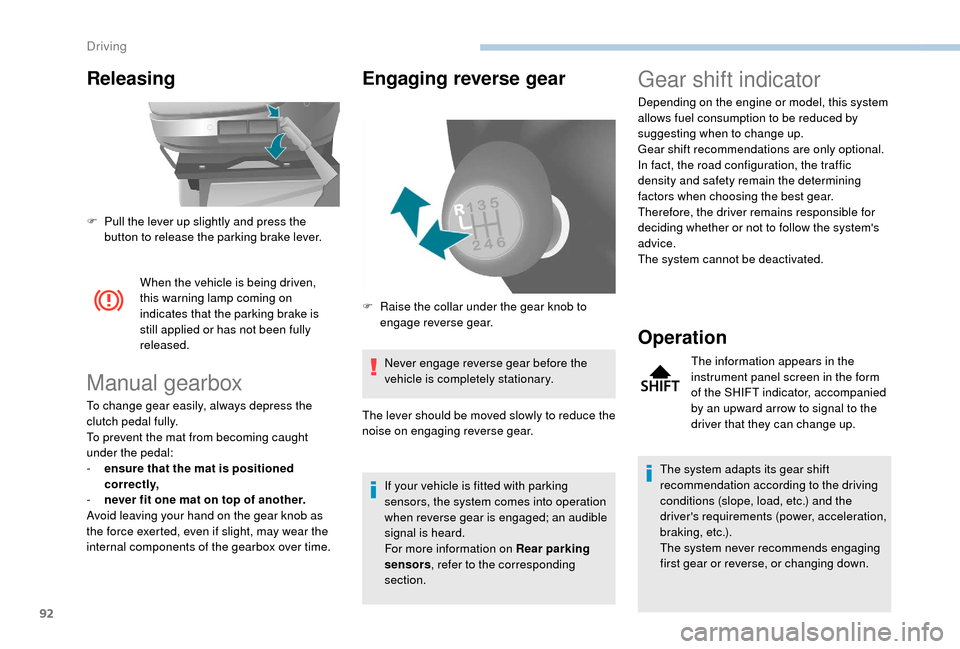
Releasing
When the vehicle is being driven,
this warning lamp coming on
indicates that the parking brake is
still applied or has not been fully
released.
Manual gearbox
To change gear easily, always depress the
clutch pedal fully.
To prevent the mat from becoming caught
under the pedal:
-
e
nsure that the mat is positioned
correctly,
-
n
ever fit one mat on top of another.
Avoid leaving your hand on the gear knob as
the force exerted, even if slight, may wear the
internal components of the gearbox over time.
Engaging reverse gear
Never engage reverse gear before the
vehicle is completely stationary.
If your vehicle is fitted with parking
sensors, the system comes into operation
when reverse gear is engaged; an audible
signal is heard.
For more information on Rear parking
sensors , refer to the corresponding
section.
F
P
ull the lever up slightly and press the
button to release the parking brake lever.
Gear shift indicator
Depending on the engine or model, this system
allows fuel consumption to be reduced by
suggesting when to change up.
Gear shift recommendations are only optional.
In fact, the road configuration, the traffic
density and safety remain the determining
factors when choosing the best gear.
Therefore, the driver remains responsible for
deciding whether or not to follow the system's
advice.
The system cannot be deactivated.
Operation
The information appears in the
instrument panel screen in the form
of the SHIFT indicator, accompanied
by an upward arrow to signal to the
driver that they can change up.
The system adapts its gear shift
recommendation according to the driving
conditions (slope, load, etc.) and the
driver's requirements (power, acceleration,
b r a k i n g , e t c .) .
The system never recommends engaging
first gear or reverse, or changing down.
F
R
aise the collar under the gear knob to
engage reverse gear.
The lever should be moved slowly to reduce the
noise on engaging reverse gear.
Driving