engine Peugeot Expert 2003 Owner's Guide
[x] Cancel search | Manufacturer: PEUGEOT, Model Year: 2003, Model line: Expert, Model: Peugeot Expert 2003Pages: 128, PDF Size: 5.15 MB
Page 53 of 128
22-04-2003
STEERING LOCK - IGNITION - STARTERII-1
40
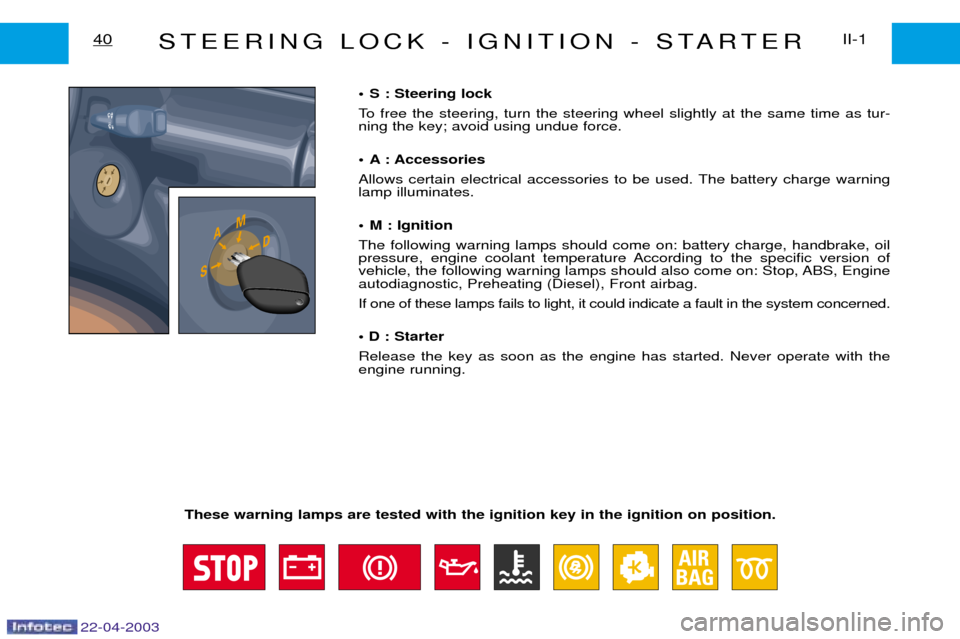
¥ S : Steering lock
To free the steering, turn the steering wheel slightly at the same time as tur- ning the key; avoid using undue force.
¥ A : Accessories
Allows certain electrical accessories to be used. The battery charge warning lamp illuminates.
¥ M : Ignition The following warning lamps should come on: battery charge, handbrake, oil
pressure, engine coolant temperature According to the specific version of
vehicle, the following warning lamps should also come on: Stop, ABS, Engineautodiagnostic, Preheating (Diesel), Front airbag. If one of these lamps fails to light, it could indicate a fault in the system concerned. ¥ D : Starter Release the key as soon as the engine has started. Never operate with the engine running.
These warning lamps are tested with the ignition key in the ignition on position.
Page 54 of 128
STEERING LOCK - IGNITION - STARTER41II-1
WARNING
NEVER REMOVE THE IGNITION KEY BEFORE THE VEHICLE IS COMPLETELY STATIONARY. NEVER ATTEMPT TO MOVE THE VEHICLE BEFORE STARTING THE ENGINE AND WAITING FOR THE HYDRAULIC LOW PRESSURE WAR-
NING LAMP TO GO OUT. IF THE ENGINE IS NOT RUNNING, THE STEERING
WILL NOT HAVE POWER ASSISTANCE AND THERE MAY BE NO RESERVE OF PRESSURE AVAILABLE TO OPERATE THE FOOTBRAKE. THERE IS ALSO ARISK OF THE STEERING LOCK ENGAGING AND THE SAFETY FEATURES NOT OPERATING IF THE IGNITION IS NOT SWITCHED ON. ONLY IN AN
EMERGENCY SITUATION SHOULD YOU ATTEMPT TO MOVE A VEHICLE
WITHOUT STARTING THE ENGINE. TAKE ALL THE NECESSARY SAFETY
PRECAUTIONS AND BE PREPARED TO USE THE PARKING BRAKE TO STOP THE VEHICLE.
When parking, remove the ignition key and turn the steering wheel until the steering column locking peg engages.
Steering lock
S With the key removed and the steering lock peg engaged, the steering column is locked; the lock peg will engage in
a number of positions of the steering wheel. The key can only be removed in position S.
A The steering is unlocked - to enable the key to be turned to position A, it may be necessary to turn the steering slightly.
M Running position.
D Starting position.
For starting and stopping the engine, see Ç Starting È.
22-04-2003
Page 55 of 128

22-04-2003
STARTINGII-2
42
Ensure that the gear lever is in the neutral position.
PETROL Starting the engine Do not depress the accelerator pedal. Operate the starter motor (maximum 10 seconds) until the engine starts.
At temperatures below 0¡C, depress the clutch pedal to ease starting, then release it slowly. Release the key as soon as the engine starts. Note: If it does not work at first, switch off the ignition, wait for ten seconds, then operate the starter again as described
above.
Page 56 of 128
STARTING43II-2
WARNING
DO NOT RUN THE ENGINE IN AN ENCLOSED OR POORLY VENTILATED AREA
DIESEL Starting the engine
Turn the ignition key to the ignition position. Wait for the preheater lamp to go out, then operate the starter motor until the engine starts.
If the engine does not start, switch off the ignition and start again.At temperatures below 0¡C, depress the clutch pedal to ease starting. Release the pedal slowly when the engine has started. Note:
Do not depress the accelerator pedal while operating the starter.
22-04-2003
Advice
Vehicles equipped with a Turbo:
Turbo equipped engines MUST be allowed to return to idle for several seconds before switching off the ignition. Failure to do so could cause serious damage to the turbo unit.
Flicking the throttle pedal as the ignition is turned off can lead to severe damage to the turbo unit.
Page 57 of 128
22-04-2003
BRAKESII-3
44
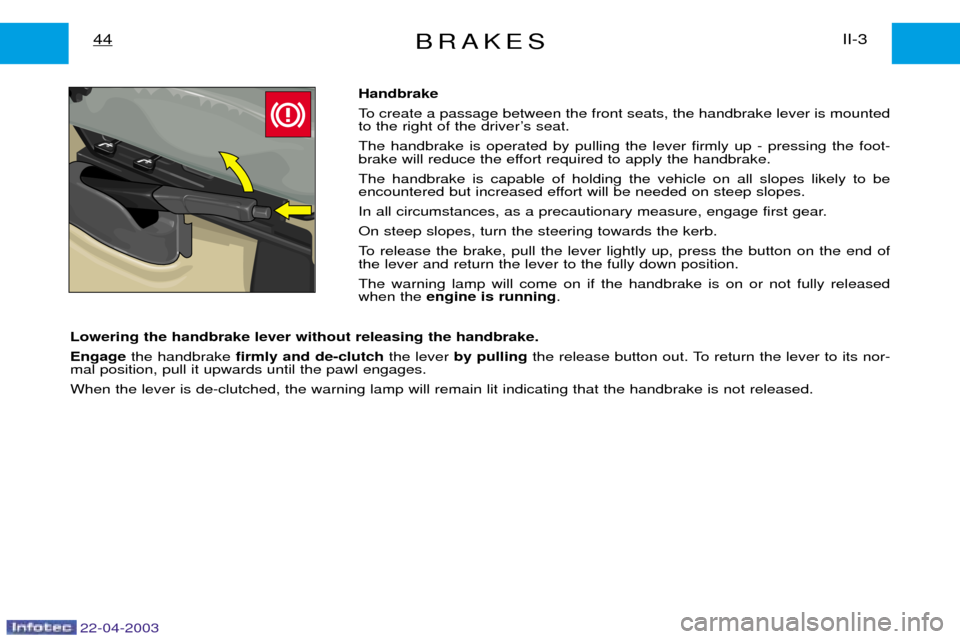
Lowering the handbrake lever without releasing the handbrake. Engage the handbrake firmly and de-clutch the lever by pulling the release button out. To return the lever to its nor-
mal position, pull it upwards until the pawl engages.When the lever is de-clutched, the warning lamp will remain lit indicating that the handbrake is not released. Handbrake
To create a passage between the front seats, the handbrake lever is mounted
to the right of the driverÕs seat. The handbrake is operated by pulling the lever firmly up - pressing the foot-
brake will reduce the effort required to apply the handbrake. The handbrake is capable of holding the vehicle on all slopes likely to be
encountered but increased effort will be needed on steep slopes.
In all circumstances, as a precautionary measure, engage first gear.On steep slopes, turn the steering towards the kerb.
To release the brake, pull the lever lightly up, press the button on the end of the lever and return the lever to the fully down position. The warning lamp will come on if the handbrake is on or not fully released when the
engine is running .
Page 59 of 128
22-04-2003
GEAR LEVERII-6
46
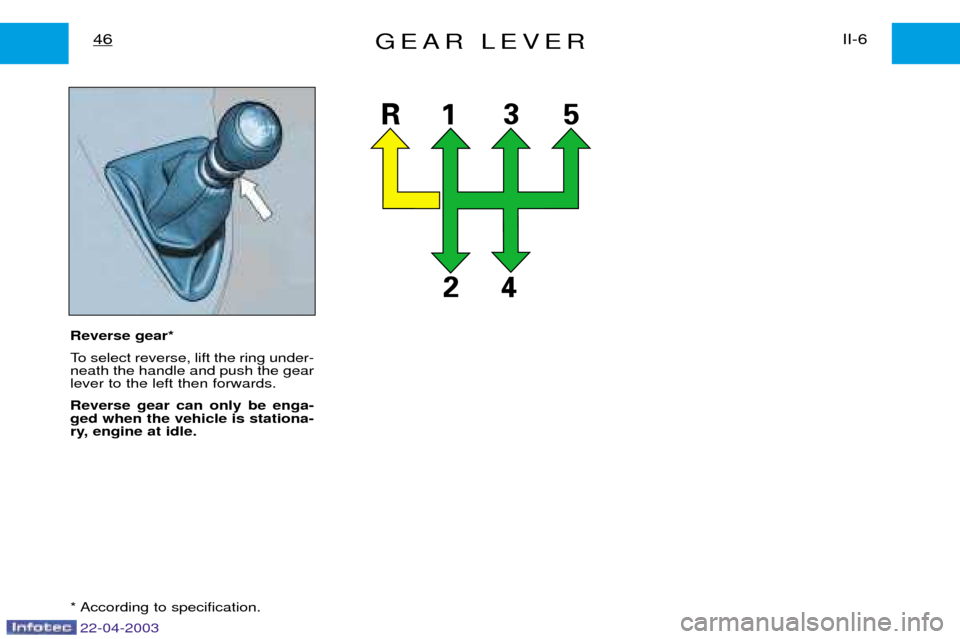
Reverse gear*
To select reverse, lift the ring under- neath the handle and push the gearlever to the left then forwards. Reverse gear can only be enga- ged when the vehicle is stationa-
ry, engine at idle.
* According to specification.
Page 64 of 128
22-04-2003
AIR CONDITIONING*III-2
50
Air conditioning
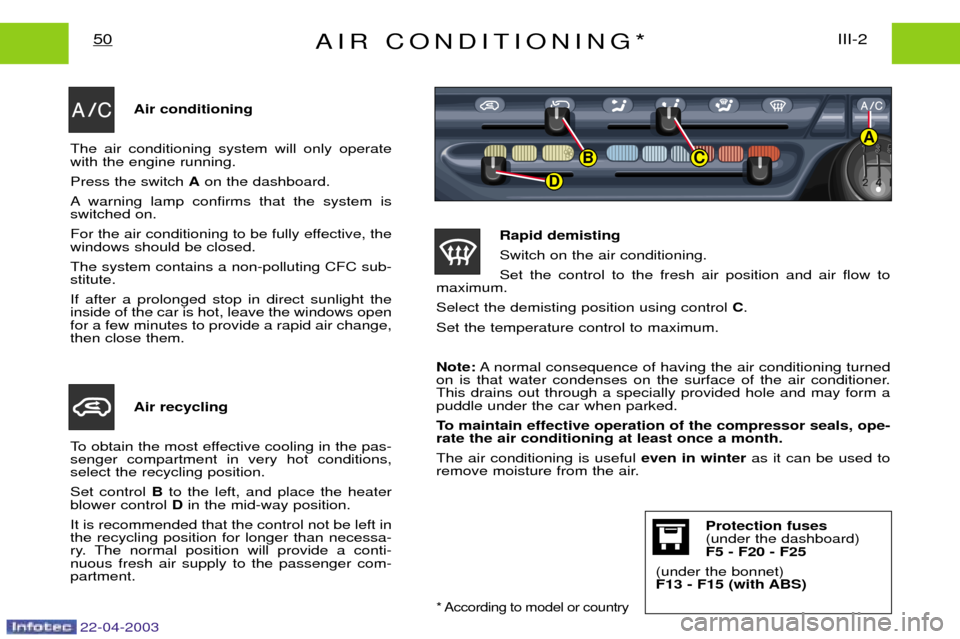
The air conditioning system will only operate with the engine running. Press the switch Aon the dashboard.
A warning lamp confirms that the system is switched on.
For the air conditioning to be fully effective, the windows should be closed. The system contains a non-polluting CFC sub- stitute. If after a prolonged stop in direct sunlight the inside of the car is hot, leave the windows openfor a few minutes to provide a rapid air change,then close them.
Air recycling
To obtain the most effective cooling in the pas-senger compartment in very hot conditions,select the recycling position. Set control Bto the left, and place the heater
blower control Din the mid-way position.
It is recommended that the control not be left in the recycling position for longer than necessa-
ry. The normal position will provide a conti-nuous fresh air supply to the passenger com-partment. Rapid demisting Switch on the air conditioning.Set the control to the fresh air position and air flow to
maximum.Select the demisting position using control C.
Set the temperature control to maximum. Note: A normal consequence of having the air conditioning turned
on is that water condenses on the surface of the air conditioner. This drains out through a specially provided hole and may form apuddle under the car when parked.
To maintain effective operation of the compressor seals, ope- rate the air conditioning at least once a month. The air conditioning is useful even in winteras it can be used to
remove moisture from the air.
* According to model or country
Protection fuses (under the dashboard)F5 - F20 - F25
(under the bonnet)
F13 - F15 (with ABS)
A
CB
D
Page 89 of 128
22-04-2003
BATTERYV- 1
70
Emergency starting with a slave battery
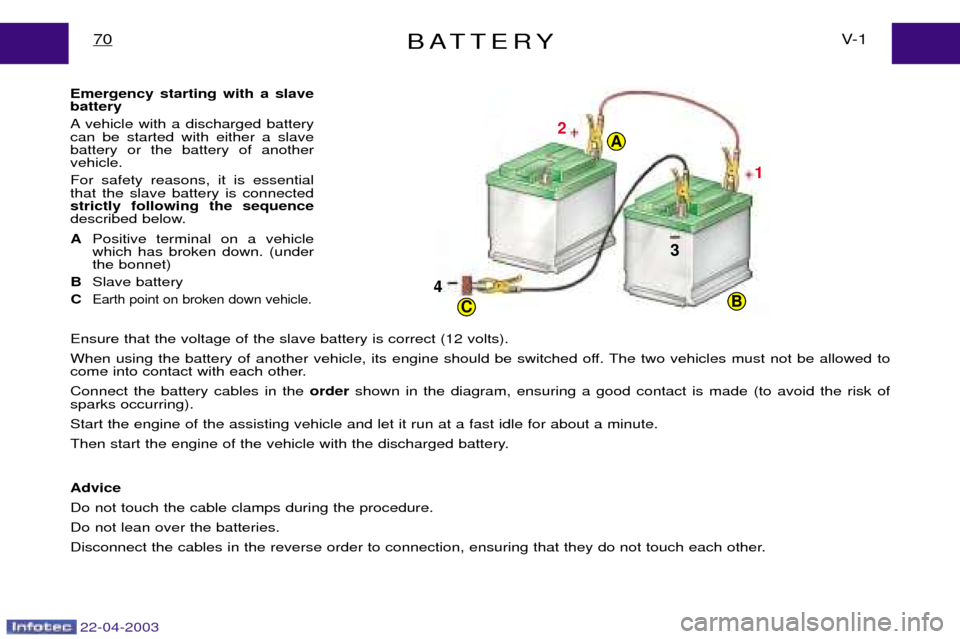
A vehicle with a discharged battery can be started with either a slavebattery or the battery of anothervehicle. For safety reasons, it is essential that the slave battery is connectedstrictly following the sequence
described below.
A Positive terminal on a vehiclewhich has broken down. (underthe bonnet)
B Slave battery
C
Earth point on broken down vehicle.
Ensure that the voltage of the slave battery is correct (12 volts).
When using the battery of another vehicle, its engine should be switched off. The two vehicles must not be allowed to
come into contact with each other. Connect the battery cables in the ordershown in the diagram, ensuring a good contact is made (to avoid the risk of
sparks occurring).Start the engine of the assisting vehicle and let it run at a fast idle for about a minute.
Then start the engine of the vehicle with the discharged battery. Advice Do not touch the cable clamps during the procedure.Do not lean over the batteries.
Disconnect the cables in the reverse order to connection, ensuring that they do not touch each other.
2
1
3
4
CB
A
Page 90 of 128
22-04-2003
BATTERY119
BEWARE
Never expose a battery to a naked flame or spark (explosive gases present).
The battery contains dilute sulphuric acid which is corrosive.
When handling a battery, protect the hands, eyes and face. In case of contact with the skin, rinse immediately and abundantly with clean water.
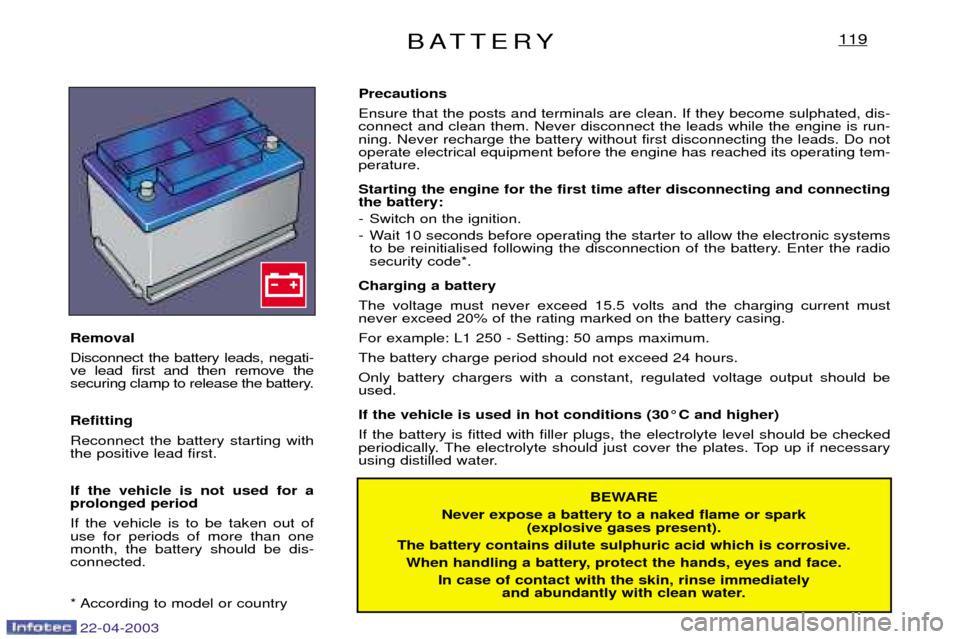
Removal Disconnect the battery leads, negati- ve lead first and then remove the
securing clamp to release the battery. Refitting Reconnect the battery starting with the positive lead first. If the vehicle is not used for a prolonged period If the vehicle is to be taken out of use for periods of more than onemonth, the battery should be dis-connected.
* According to model or country Precautions Ensure that the posts and terminals are clean. If they become sulphated, dis- connect and clean them. Never disconnect the leads while the engine is run-ning. Never recharge the battery without first disconnecting the leads. Do notoperate electrical equipment before the engine has reached its operating tem-perature. Starting the engine for the first time after disconnecting and connecting the battery:
- Switch on the ignition.
- Wait 10 seconds before operating the starter to allow the electronic systems
to be reinitialised following the disconnection of the battery. Enter the radio security code*.
Charging a battery The voltage must never exceed 15.5 volts and the charging current must never exceed 20% of the rating marked on the battery casing. For example: L1 250 - Setting: 50 amps maximum.The battery charge period should not exceed 24 hours.Only battery chargers with a constant, regulated voltage output should be used. If the vehicle is used in hot conditions (30¡C and higher) If the battery is fitted with filler plugs, the electrolyte level should be checked
periodically. The electrolyte should just cover the plates. Top up if necessary
using distilled water.
Page 97 of 128
22-04-2003
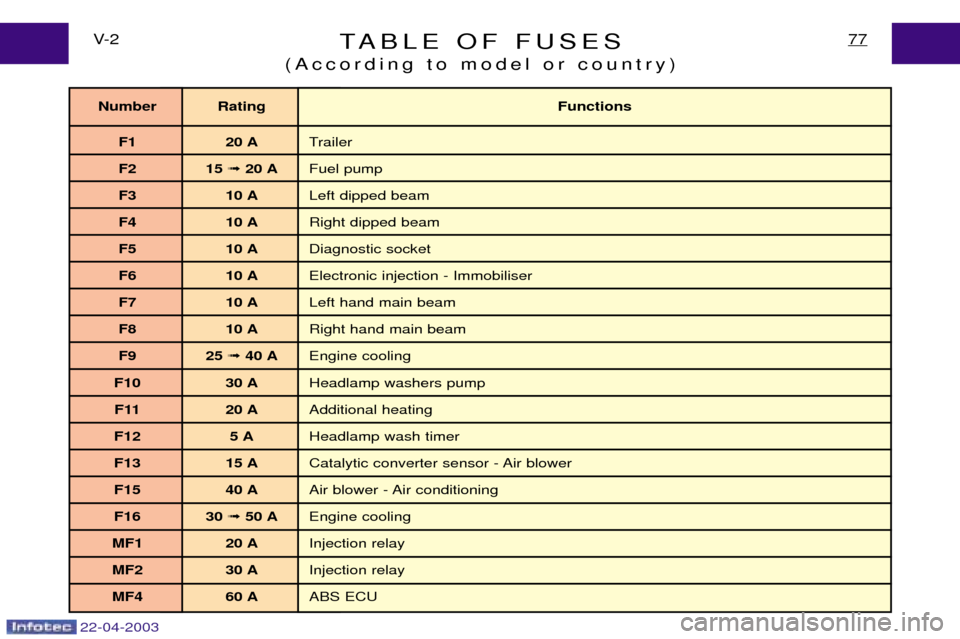
TABLE OF FUSES
(According to model or country)77V- 2
Number Rating Functions
F1 20 A Trailer
F2 15 ➟ 20 A Fuel pump
F3 10 A Left dipped beam
F4 10 A Right dipped beam
F5 10 A Diagnostic socket
F6 10 A Electronic injection - Immobiliser
F7 10 A Left hand main beam
F8 10 A Right hand main beam
F9 25 ➟ 40 A Engine cooling
F10 30 A Headlamp washers pump
F11 20 A Additional heating
F12 5 A Headlamp wash timer
F13 15 A Catalytic converter sensor - Air blower
F15 40 A Air blower - Air conditioning
F16 30 ➟ 50 A Engine cooling
MF1 20 A Injection relay
MF2 30 A Injection relay
MF4 60 A ABS ECU