instrument panel PEUGEOT EXPERT 2018 Owner's Manual
[x] Cancel search | Manufacturer: PEUGEOT, Model Year: 2018, Model line: EXPERT, Model: PEUGEOT EXPERT 2018Pages: 416, PDF Size: 14.12 MB
Page 62 of 416
60
Changing the battery
Battery type: CR2032 / 3 volts.
T his replacement battery is available from a
PEUGEOT dealer or a qualified workshop.
A message is displayed in the instrument panel
screen when replacement of the battery is
needed.
Do not throw the remote control
batteries away, they contain metals
which are harmful to the environment.
Take them to an approved collection
point.
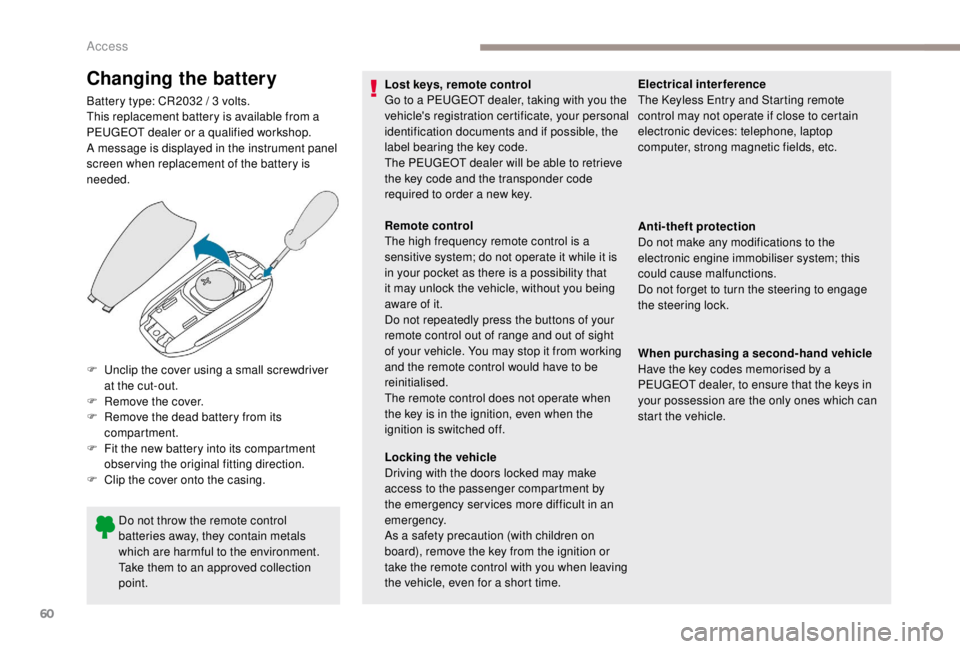
F
U
nclip the cover using a small screwdriver
at the cut-out.
F
R
emove the cover.
F
R
emove the dead battery from its
compartment.
F
F
it the new battery into its compartment
observing the original fitting direction.
F
C
lip the cover onto the casing. Lost keys, remote control
Go to a PEUGEOT dealer, taking with you the
vehicle's registration certificate, your personal
identification documents and if possible, the
label bearing the key code.
The PEUGEOT dealer will be able to retrieve
the key code and the transponder code
required to order a new key.
Remote control
The high frequency remote control is a
sensitive system; do not operate it while it is
in your pocket as there is a possibility that
it may unlock the vehicle, without you being
aware of it.
Do not repeatedly press the buttons of your
remote control out of range and out of sight
of your vehicle. You may stop it from working
and the remote control would have to be
reinitialised.
The remote control does not operate when
the key is in the ignition, even when the
ignition is switched off.
Locking the vehicle
Driving with the doors locked may make
access to the passenger compartment by
the emergency ser vices more difficult in an
emergency.
As a safety precaution (with children on
board), remove the key from the ignition or
take the remote control with you when leaving
the vehicle, even for a short time.Electrical interference
The
K eyless Entry and Starting remote
control may not operate if close to certain
electronic devices: telephone, laptop
computer, strong magnetic fields, etc.
Anti-theft protection
Do not make any modifications to the
electronic engine immobiliser system; this
could cause malfunctions.
Do not forget to turn the steering to engage
the steering lock.
When purchasing a second-hand vehicle
Have the key codes memorised by a
PEUGEOT dealer, to ensure that the keys in
your possession are the only ones which can
start the vehicle.
Access
Page 135 of 416

133
Switching on
F Turn the ring to the AUTO position. Activation of the function is associated with
the display of a message.
Switching off
F Turn the ring to another position. Deactivation of the function is accompanied
by the display of a message.
Malfunction
In the event of a malfunction of the
sunshine sensor, the lighting comes
on, this warning lamp is displayed
on the instrument panel, associated
with an audible signal and/or a
message.
Contact a PEUGEOT dealer or a qualified
workshop. In fog or snow, the sunshine sensor may
detect sufficient light. In this case, the
lighting will not come on automatically.
Do not cover the sunshine sensor
combined with the rain sensor and located
at the top of the windscreen behind the
rear view mirror; the associated functions
would no longer be controlled.
Manual guide-me-home
lighting
Temporarily keeping the dipped beam
headlamps on after the vehicle's ignition has
been switched off makes the driver's exit easier
when the light is poor.
Switching on
Switching off
Manual guide-me-home lighting goes off
automatically at the end of a given period of
time.
Automatic guide-me-home
lighting
F With the ignition off, "flash" the headlamps
using the lighting control stalk.
F
A f
urther "headlamp flash" switches the
function off.
When the automatic illumination of headlamps
is activated, if the ambient light level is
low, the dipped beam headlamps come on
automatically when switching off the ignition.
4
Lighting and visibility
Page 140 of 416

138
Model with manual wiping
(intermittent)
Model with AUTO wipingFront windscreen wipers
Raise or lower the control to the desired
position to change the wiping speed.
Fast wiping (heavy rain).
Normal wiping (moderate rain).
Intermittent wiping (proportional to
the speed of the vehicle).
Of f.
Single wipe (press downwards or
pull the stalk briefly towards you,
then release).
Or Automatic wiping (press down,
then release).
Single wipe (pull the stalk briefly
towards you).
Automatic windscreen
wipers
The windscreen wipers operate automatically
once rainfall is detected (sensor behind the
rear view mirror), adapting their speed to the
intensity of the rainfall without any action on the
part of the driver.
Switching on
Give a short downwards push to the
control.
A wiping cycle confirms that the
instruction has been accepted.
This warning lamp comes on in the
instrument panel and a message is
displayed.
Lighting and visibility
Page 141 of 416

139
Switching off
Give the control stalk a brief push
downwards or shift the control stalk
to a different position (Int, 1 or 2).
This warning lamp goes off in the
instrument panel and a message is
displayed.
The automatic rain sensitive windscreen
wipers must be reactivated by pushing the
control stalk downwards, if the ignition has
been off for more than one minute.
Operating fault
If a fault occurs with the automatic rain
sensitive wipers, the wipers will operate in
intermittent mode.
Have the system checked by a PEUGEOT
dealer or a qualified workshop. Do not cover the rain sensor combined
with the sunshine sensor and located at the
top of the windscreen behind the rear view
m i r r o r.
When using an automatic car wash, switch
off the automatic rain sensitive wipers.
In winter, it is advisable to wait until the
windscreen is completely clear of ice before
activating the automatic rain sensitive
wipers.
Rear wiper
Of f.
Intermittent wipe.
Wash-wipe (set duration).
Reverse gear
When reverse gear is engaged, the rear wiper
will come into operation automatically if the
windscreen wipers are operating.
Activation/Deactivation
The system is activated or deactivated via the
vehicle configuration menu. This system is activated by default.
If a significant accumulation of snow or ice
is present, or when using a bicycle carrier
on the boot, deactivate the automatic rear
w i p e r.
With audio system
In the "
Personalisation-
configuration " menu, activate/
deactivate " Rear wipe in reverse
gear ".
With touch screen
In the " Driving/Vehicle " menu,
activate/deactivate " Rear wiper in
reverse ".
4
Lighting and visibility
Page 142 of 416
140
Windscreen and headlamp
wash
On vehicles fitted with automatic air
conditioning, any action on the windscreen
wash control results in temporary closing
of the air intake to avoid odours inside the
passenger compartment.
Screenwash/headlamp wash
level low
In the case of vehicles fitted with
headlamp washers, when the fluid
reser voir low level is reached this
warning lamp comes on in the
instrument panel, accompanied by
an audible signal and a message.
The warning lamp comes on when the ignition
is switched on, or every time the stalk is
operated, until the reser voir is refilled.
Next time you stop, refill the screenwash/
headlamp wash reservoir.
Heated windscreen and
washer jets
(depending on country of sale)
This function heats the windscreen and washer
jets under cold conditions.
F
P
ull the wiper stalk towards you. The
windscreen wash, then the windscreen
wipers, operate for a pre-determined time.
The headlamp wash is only activated if the
dipped headlamps are on and the vehicle is
moving .
With daytime running lamps, to activate the
headlamp wash, position the lighting control
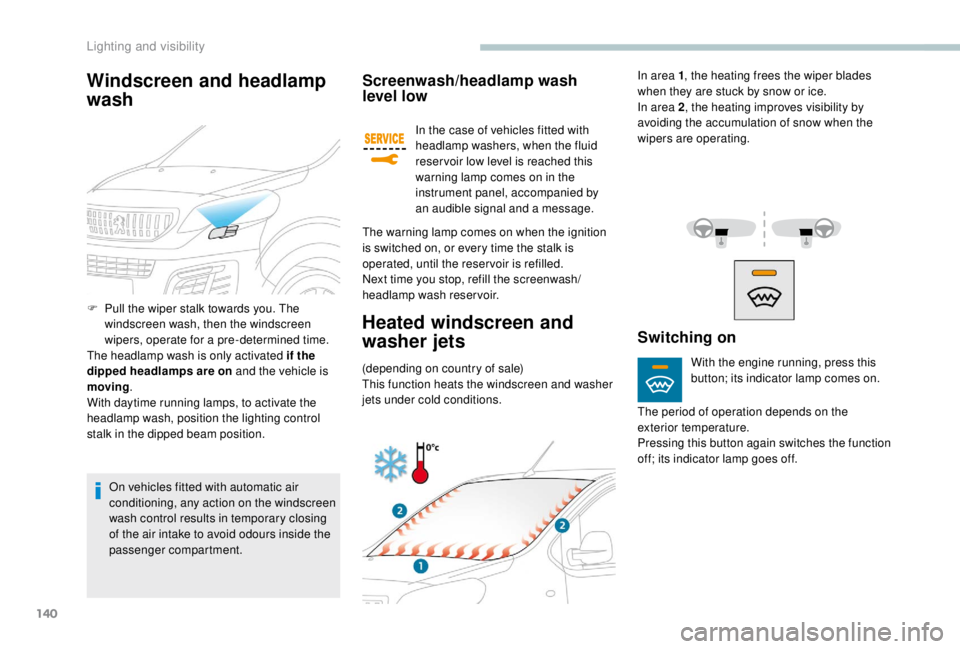
stalk in the dipped beam position. In area 1
, the heating frees the wiper blades
when they are stuck by snow or ice.
In area 2 , the heating improves visibility by
avoiding the accumulation of snow when the
wipers are operating.
Switching on
With the engine running, press this
button; its indicator lamp comes on.
The period of operation depends on the
exterior temperature.
Pressing this button again switches the function
off; its indicator lamp goes off.
Lighting and visibility
Page 149 of 416
147
If you need to brake in an emergency,
press the brake pedal ver y firmly and
keep the pressure applied.
After an impact, have the system checked
by a PEUGEOT dealer or a qualified
workshop.
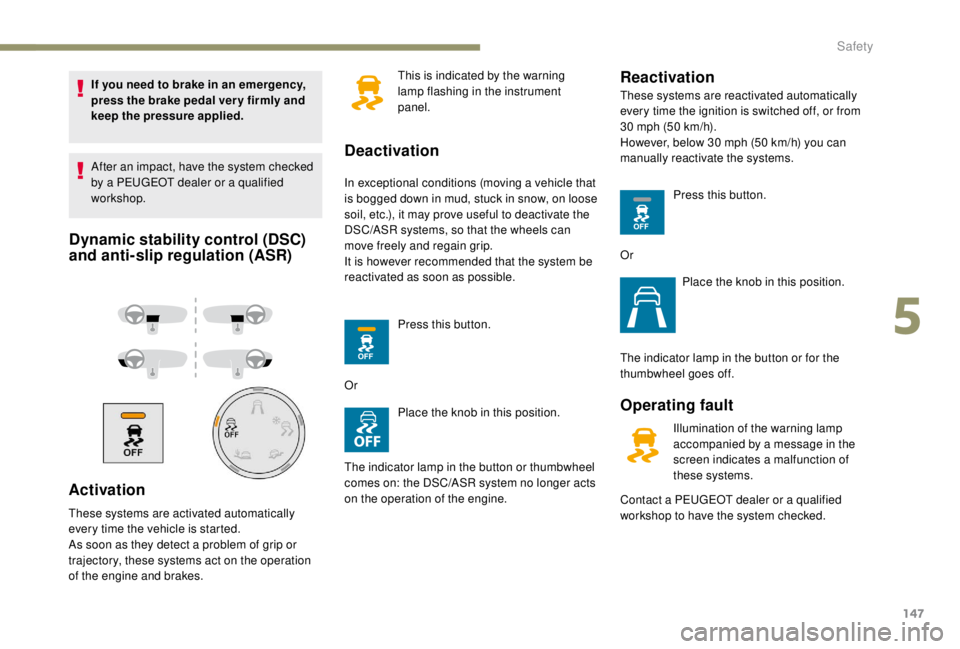
Dynamic stability control (DSC)
and anti-slip regulation (ASR)
Activation
These systems are activated automatically
every time the vehicle is started.
As soon as they detect a problem of grip or
trajectory, these systems act on the operation
of the engine and brakes. This is indicated by the warning
lamp flashing in the instrument
panel.
Deactivation
In exceptional conditions (moving a vehicle that
is bogged down in mud, stuck in snow, on loose
soil, etc.), it may prove useful to deactivate the
DSC/ASR systems, so that the wheels can
move freely and regain grip.
It is however recommended that the system be
reactivated as soon as possible.
Press this button.
Or Place the knob in this position.
The indicator lamp in the button or thumbwheel
comes on: the DSC/ASR system no longer acts
on the operation of the engine.
Reactivation
These systems are reactivated automatically
every time the ignition is switched off, or from
30 mph (50 km/h).
However, below 30
mph (50 km/h) you can
manually reactivate the systems.
Press this button.
Or Place the knob in this position.
The indicator lamp in the button or for the
thumbwheel goes off.
Operating fault
Illumination of the warning lamp
accompanied by a message in the
screen indicates a malfunction of
these systems.
Contact a PEUGEOT dealer or a qualified
workshop to have the system checked.
5
Safety
Page 154 of 416
152
For rows 2 and 3, fit each seat belt to its
c orrect buckle.
Do not interchange the belts or buckles for
the outer seats with the belt or buckle for
the centre seat.
When folding the outer seats or placing
a backrest in the table position, avoid
trapping the belt for the centre seat.
After folding a rear seat or bench seat,
ensure that the seat belt has reeled
in correctly and the buckle is ready to
receive the belt tongue.
When handling the outer seats (removing
or refitting) or for access to row 3, avoid
trapping the centre belt.
The seat belt reels for the outer seats in row
2
have force limiters.
The seats in row 3 have three-point seat belts
with inertia reels.
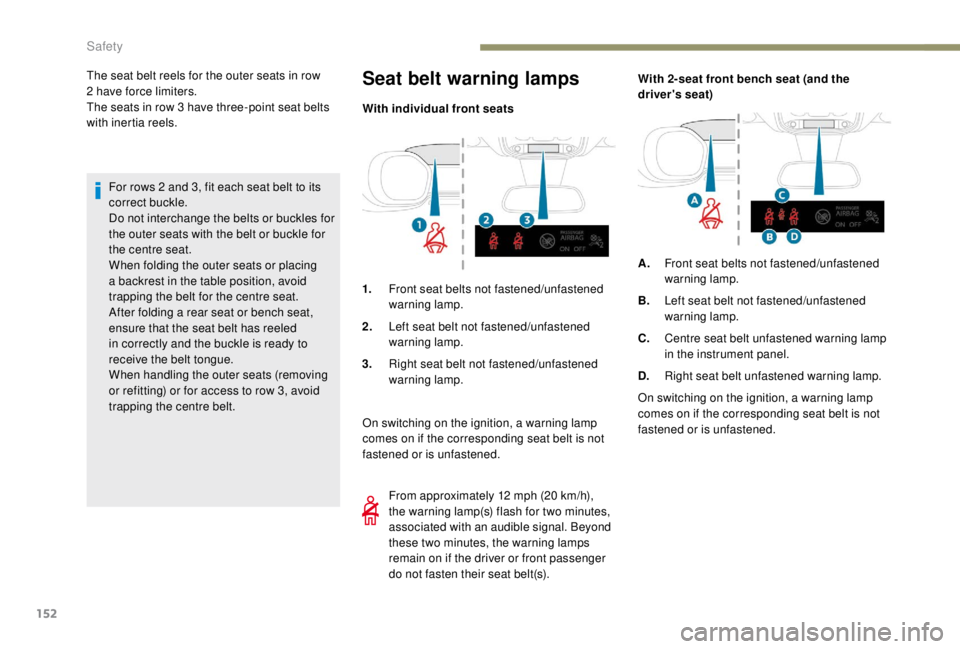
Seat belt warning lamps
With individual front seats
1. Front seat belts not fastened/unfastened
warning lamp.
2. Left seat belt not fastened/unfastened
warning lamp.
3. Right seat belt not fastened/unfastened
warning lamp.
On switching on the ignition, a warning lamp
comes on if the corresponding seat belt is not
fastened or is unfastened. From approximately 12
mph (20 km/h),
the warning lamp(s) flash for two minutes,
associated with an audible signal. Beyond
these two minutes, the warning lamps
remain on if the driver or front passenger
do not fasten their seat belt(s). With 2-seat front bench seat (and the
driver's seat)
On switching on the ignition, a warning lamp
comes on if the corresponding seat belt is not
fastened or is unfastened. A.
Front seat belts not fastened/unfastened
warning lamp.
B. Left seat belt not fastened/unfastened
warning lamp.
C. Centre seat belt unfastened warning lamp
in the instrument panel.
D. Right seat belt unfastened warning lamp.
Safety
Page 157 of 416
155
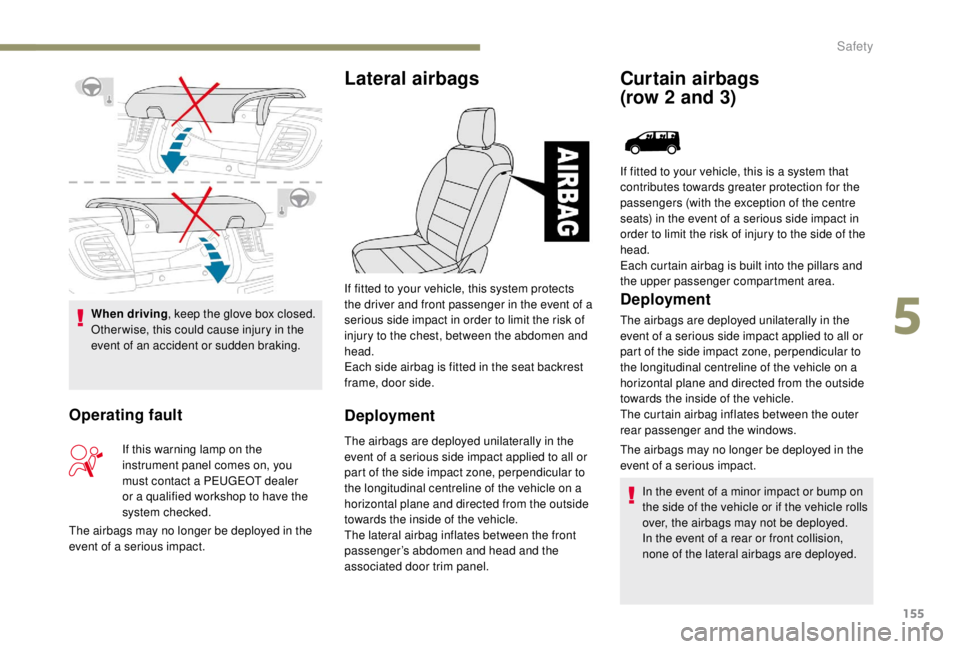
When driving, keep the glove box closed.
Other wise, this could cause injury in the
event of an accident or sudden braking.
Lateral airbags
Deployment
The airbags are deployed unilaterally in the
event of a serious side impact applied to all or
part of the side impact zone, perpendicular to
the longitudinal centreline of the vehicle on a
horizontal plane and directed from the outside
towards the inside of the vehicle.
The lateral airbag inflates between the front
passenger’s abdomen and head and the
associated door trim panel.
Curtain airbags
(row 2 and 3)
If fitted to your vehicle, this is a system that
contributes towards greater protection for the
passengers (with the exception of the centre
seats) in the event of a serious side impact in
order to limit the risk of injury to the side of the
head.
Each curtain airbag is built into the pillars and
the upper passenger compartment area.
If fitted to your vehicle, this system protects
the driver and front passenger in the event of a
serious side impact in order to limit the risk of
injury to the chest, between the abdomen and
head.
Each side airbag is fitted in the seat backrest
frame, door side.
Deployment
The airbags are deployed unilaterally in the
event of a serious side impact applied to all or
part of the side impact zone, perpendicular to
the longitudinal centreline of the vehicle on a
horizontal plane and directed from the outside
towards the inside of the vehicle.
The curtain airbag inflates between the outer
rear passenger and the windows.
The airbags may no longer be deployed in the
event of a serious impact.
Operating fault
If this warning lamp on the
instrument panel comes on, you
must contact a PEUGEOT dealer
or a qualified workshop to have the
system checked.
The airbags may no longer be deployed in the
event of a serious impact. In the event of a minor impact or bump on
the side of the vehicle or if the vehicle rolls
over, the airbags may not be deployed.
In the event of a rear or front collision,
none of the lateral airbags are deployed.
5
Safety
Page 181 of 416
179
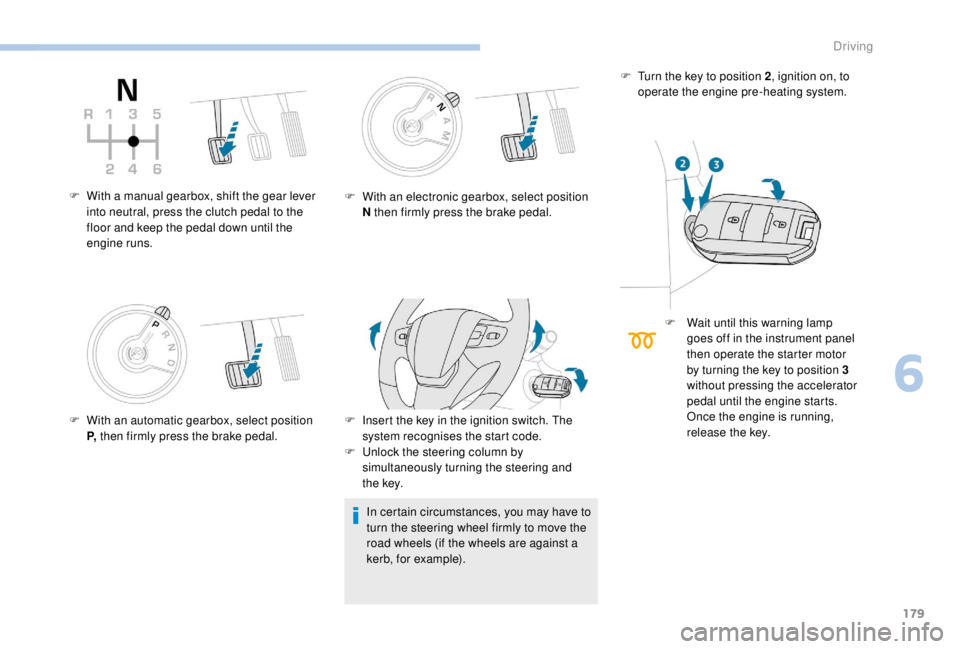
F With a manual gearbox, shift the gear lever into neutral, press the clutch pedal to the
floor and keep the pedal down until the
engine runs.
F
W
ith an automatic gearbox, select position
P, then firmly press the brake pedal. F
W ith an electronic gearbox, select position
N then firmly press the brake pedal.
In certain circumstances, you may have to
turn the steering wheel firmly to move the
road wheels (if the wheels are against a
kerb, for example). F
T
urn the key to position 2
, ignition on, to
operate the engine pre-heating system.
F
I
nsert the key in the ignition switch. The
system recognises the start code.
F
U
nlock the steering column by
simultaneously turning the steering and
t h e key. F
W
ait until this warning lamp
goes off in the instrument panel
then operate the starter motor
by turning the key to position 3
without pressing the accelerator
pedal until the engine starts.
Once the engine is running,
release the key.
6
Driving
Page 184 of 416
182
The indicator lamp does not come on
if the engine is hot. In some climatic
conditions, it is advised to follow the
recommendations below:
-
I
n temperate conditions, do not leave
the engine at idle to warm up but move
off straight away and drive at moderate
speed.
-
I
n wintry conditions, the pre-heater
warning lamp will stay on for a longer
period after switching on the ignition;
wait until it goes off before starting.
-
In very severe wintry conditions
(temperature below -23°C), to ensure
the correct operation and durability of
the mechanical components of your
vehicle (engine and gearbox), leave
the engine running for 4
minutes
before moving off.
Never leave the engine running in
an enclosed area without adequate
ventilation: internal combustion engines
emit toxic exhaust gases, such as carbon
monoxide. Risk of intoxication and death. For Diesel vehicles
, in sub-zero
temperatures the engine will not
start until the pre-heater warning
lamp has gone off.
If this warning lamp comes on
after pressing the "START/
STOP" button, press down on
the brake or clutch pedal until the
warning lamp goes off, without
pressing the "START/STOP"
button again, until the engine
starts and runs.
The presence in the recognition zone of
the remote control of the
K
eyless Entry
and Starting system is essential.
Never leave the vehicle with the engine
running and with the remote control on
your person.
If the remote control leaves the
recognition zone, a message is displayed.
Move the remote control into the zone to
be able to start the engine. If one of the starting conditions is not met,
a message appears on the instrument
panel. In some cases, it is necessary to
operate the steering wheel while pressing
the "START/STOP" button to help unlock
the steering column, a message appears.
Switching off
F Immobilise the vehicle.
F
W
ith the remote control in the
recognition zone, press the
" START/STOP " button.
The engine stops and the steering column is
locked.
If the vehicle is not immobilised, the
engine will not stop.
Driving