wheel PEUGEOT EXPERT 2018 Service Manual
[x] Cancel search | Manufacturer: PEUGEOT, Model Year: 2018, Model line: EXPERT, Model: PEUGEOT EXPERT 2018Pages: 416, PDF Size: 14.12 MB
Page 237 of 416
235
The alert is kept active until the system is
reinitialised.
Réinitialisation
The system must be reinitialised after any
adjustment to the pressures of one or more
tyres, and after changing one or more wheels.Before reinitialising the system, ensure
that the pressures of the four tyres
are correct for the conditions of use
of the vehicle and conform to the
recommendations on the tyre pressure
label.
The under-inflation alert can only be relied
on if the reinitialisation of the system has
been done with the pressures in the four
tyres correctly adjusted.
The under-inflation detection system
does not give a warning if a pressure is
incorrect at the time of reinitialisation. Initialisation of the system is done with the
ignition on and the vehicle stationary.
The new pressure parameters saved are
treated as reference values by the system.
With audio system
or
F i f it is not possible to make this check
immediately, drive carefully at reduced
speed. With touch screen
Operating fault
The flashing and then fixed illumination of the
under-inflation warning lamp accompanied
by illumination of the Ser vice warning lamp
indicates a fault with the system.
In this case, under-inflation monitoring of the
tyres is no longer assured.
Have the system checked by a PEUGEOT
dealer or a qualified workshop.
After carrying out any work on the system,
the pressures of the four tyres must be
checked and the system reinitialised.
In the "
Personalisation-
configuration " menu, select
"
Under-inflation initialisation ".In the "
Driving/Vehicle "
menu, select "
Under-inflation
initialisation ".
Press on " Ye s" to Confirm the command,
initialisation is confirmed by an audible signal
and a message.
Without audio system
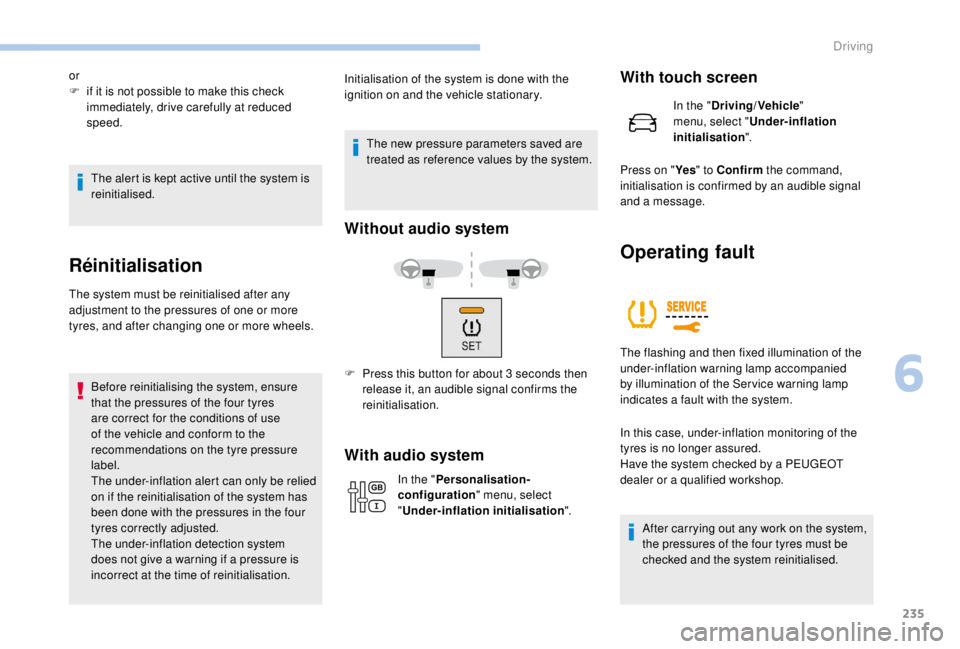
F Press this button for about 3 seconds then
release it, an audible signal confirms the
reinitialisation.
6
Driving
Page 243 of 416
241
Snow chains
In wintry conditions, snow chains improve
traction as well as the behaviour of the vehicle
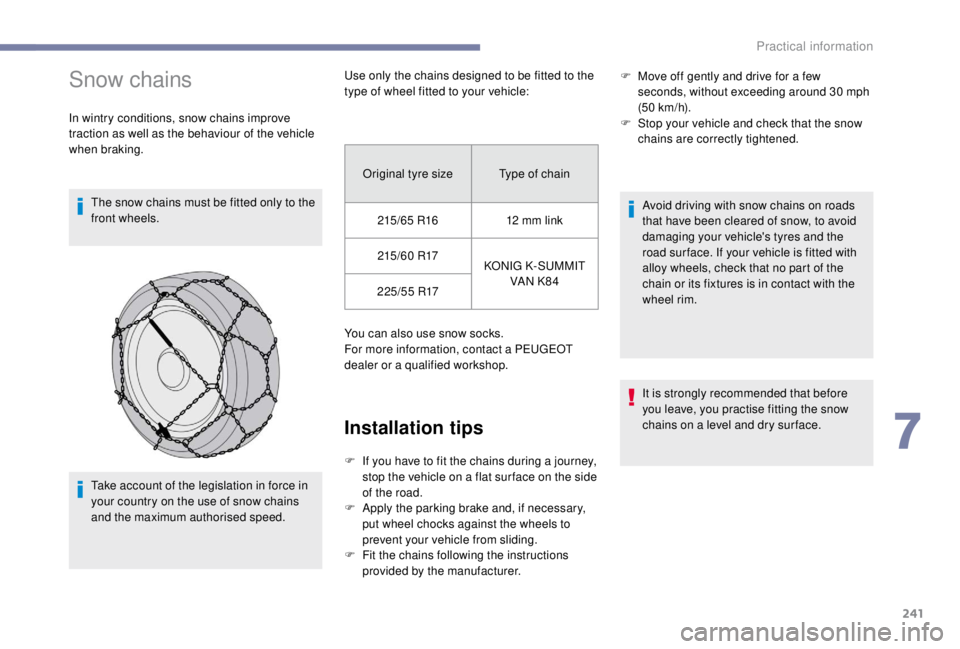
when braking.The snow chains must be fitted only to the
front wheels.
Take account of the legislation in force in
your country on the use of snow chains
and the maximum authorised speed. Use only the chains designed to be fitted to the
type of wheel fitted to your vehicle:
You can also use snow socks.
For more information, contact a PEUGEOT
dealer or a qualified workshop.
Installation tips
F Move off gently and drive for a few
seconds, without exceeding around 30 mph
(50
km/h).
F
S
top your vehicle and check that the snow
chains are correctly tightened.
Original tyre size Type of chain
215/65
R16 12
mm link
215/60
R17 KONIG K-SUMMIT
VA N K8 4
2 2 5 / 5 5
R17
F
I
f you have to fit the chains during a journey,
stop the vehicle on a flat sur face on the side
of the road.
F
A
pply the parking brake and, if necessary,
put wheel chocks against the wheels to
prevent your vehicle from sliding.
F
F
it the chains following the instructions
provided by the manufacturer. Avoid driving with snow chains on roads
that have been cleared of snow, to avoid
damaging your vehicle's tyres and the
road sur face. If your vehicle is fitted with
alloy wheels, check that no part of the
chain or its fixtures is in contact with the
wheel rim.
It is strongly recommended that before
you leave, you practise fitting the snow
chains on a level and dry sur face.
7
Practical information
Page 262 of 416
260
These tools are specific to your vehicle
and may vary according to its equipment.
Do not use them for any other purpose.
Temporary puncture
repair kit
This kit comprises a compressor and a sealant
cartridge.
It allows the temporary repair of a tyre.
You are then able to go to the nearest garage.
It is designed to repair most punctures which
could affect the tyre, located on the tyre tread
or shoulder.
Its compressor can be used to check and
adjust the pressure of the tyre.
Access to the kit
For more information on the Tool box ,
refer to the corresponding section.
List of tools
These tools are specific to your vehicle and
may vary according to the level of equipment.
Do not use them for any other purposes.
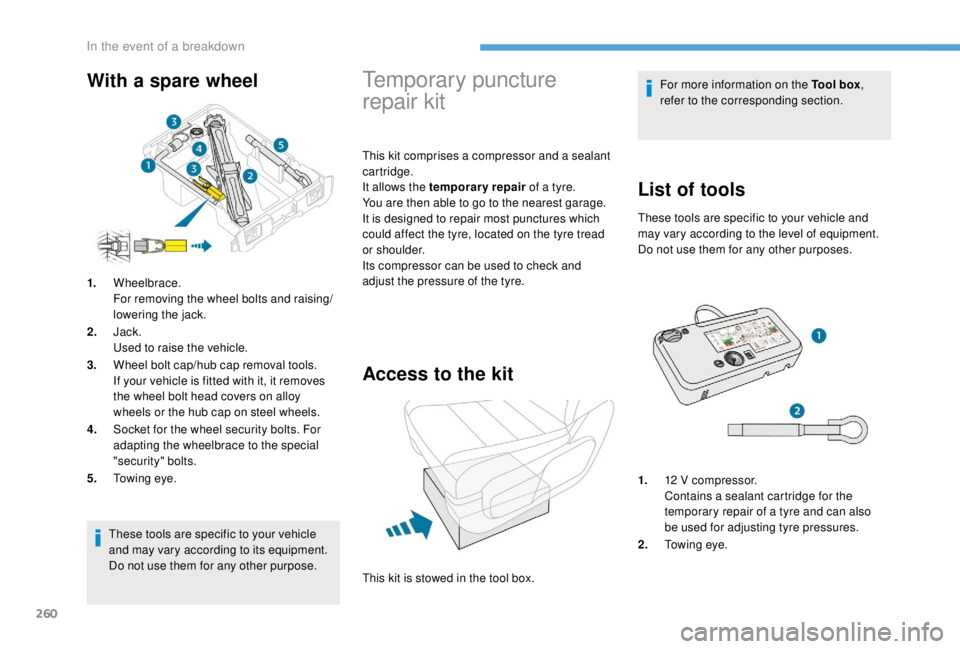
1. 12
V compressor.
Contains a sealant cartridge for the
temporary repair of a tyre and can also
be used for adjusting tyre pressures.
2. Towing eye.
With a spare wheel
1.Wheelbrace.
For removing the wheel bolts and raising/
lowering the jack.
2. Jack.
Used to raise the vehicle.
3. Wheel bolt cap/hub cap removal tools.
If your vehicle is fitted with it, it removes
the wheel bolt head covers on alloy
wheels or the hub cap on steel wheels.
4. Socket for the wheel security bolts. For
adapting the wheelbrace to the special
"security" bolts.
5. Towing eye.
This kit is stowed in the tool box.
In the event of a breakdown
Page 263 of 416
261
For more information on To w i n g, refer to
the corresponding section.
The tyre inflation pressures are given on
this label.
The vehicle's electric system allows the
connection of the compressor for long
enough to inflate a tyre after a puncture
repair.
Only use the two 12
V sockets, located at
the front , to connect your compressor.Kit content description
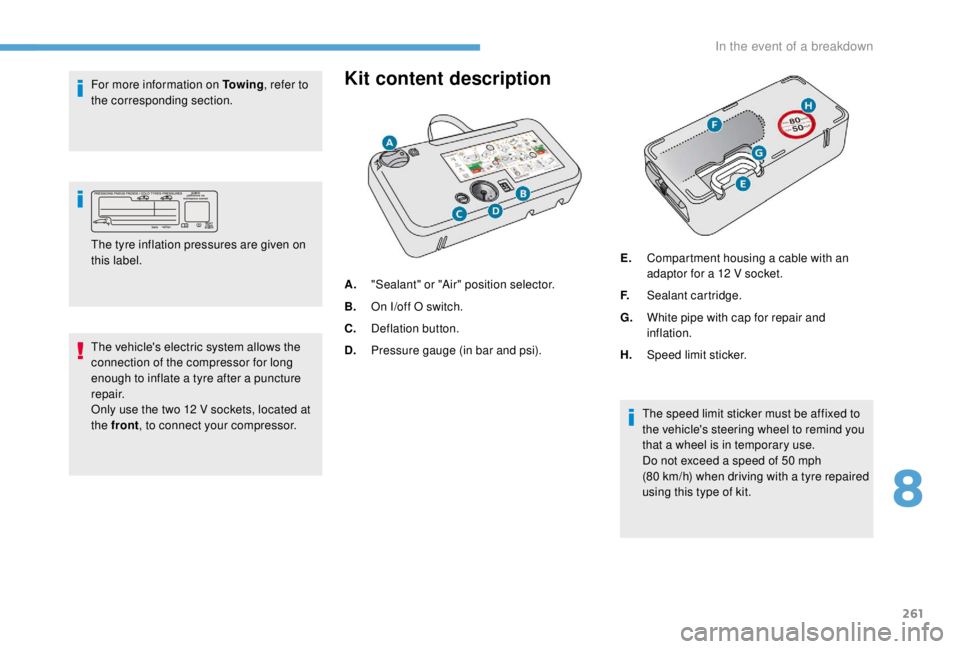
A."Sealant" or "Air" position selector.
B. On I/off O switch.
C. Deflation button.
D. Pressure gauge (in bar and psi). E.
Compartment housing a cable with an
adaptor for a 12 V socket.
F. Sealant cartridge.
G. White pipe with cap for repair and
inflation.
H. Speed limit sticker.
The speed limit sticker must be affixed to
the vehicle's steering wheel to remind you
that a wheel is in temporary use.
Do not exceed a speed of 50
mph
(80
km/h) when driving with a tyre repaired
using this type of kit.
8
In the event of a breakdown
Page 268 of 416
266
Spare wheel
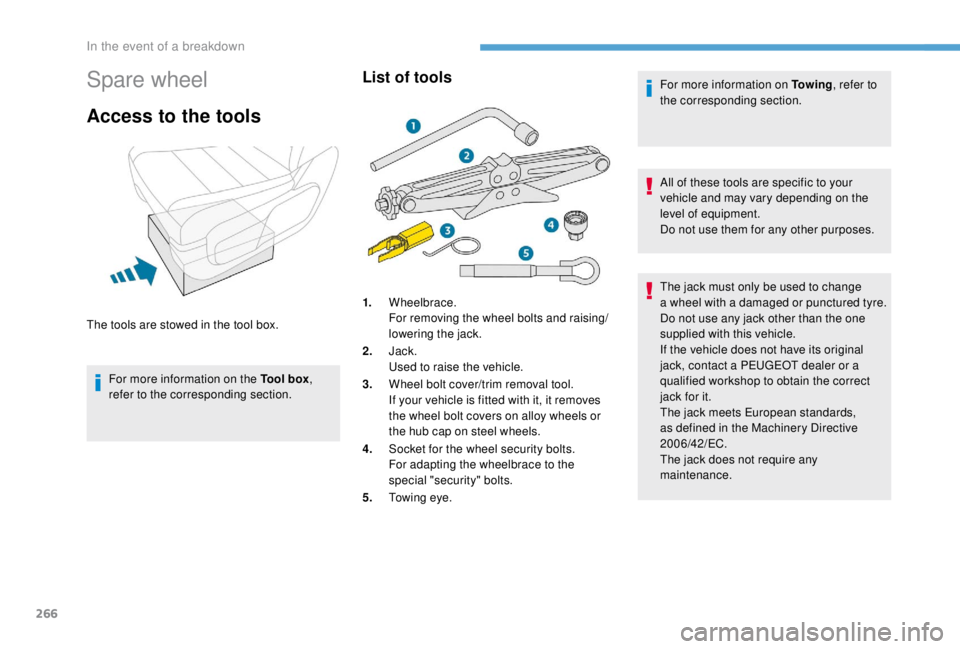
Access to the tools
For more information on the Tool box,
refer to the corresponding section.
List of toolsFor more information on To w i n g , refer to
the corresponding section.
All of these tools are specific to your
vehicle and may vary depending on the
level of equipment.
Do not use them for any other purposes.
The jack must only be used to change
a wheel with a damaged or punctured tyre.
Do not use any jack other than the one
supplied with this vehicle.
If the vehicle does not have its original
jack, contact a PEUGEOT dealer or a
qualified workshop to obtain the correct
jack for it.
The jack meets European standards,
as defined in the Machinery Directive
2006/42/EC.
The jack does not require any
maintenance.
The tools are stowed in the tool box.
1.
Wheelbrace.
For removing the wheel bolts and raising/
lowering the jack.
2. Jack.
Used to raise the vehicle.
3. Wheel bolt cover/trim removal tool.
If your vehicle is fitted with it, it removes
the wheel bolt covers on alloy wheels or
the hub cap on steel wheels.
4. Socket for the wheel security bolts.
For adapting the wheelbrace to the
special "security" bolts.
5. Towing eye.
In the event of a breakdown
Page 269 of 416
267
Access to the spare wheel
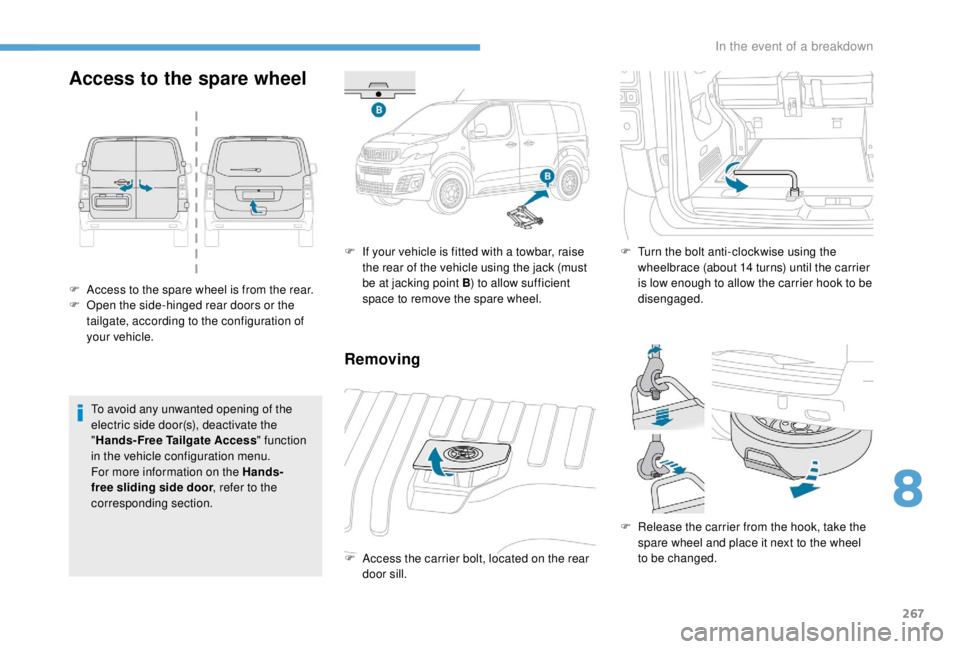
F Access to the spare wheel is from the rear.
F O pen the side-hinged rear doors or the
tailgate, according to the configuration of
your vehicle.
To avoid any unwanted opening of the
electric side door(s), deactivate the
" Hands-Free Tailgate Access " function
in the vehicle configuration menu.
For more information on the Hands-
free sliding side door , refer to the
corresponding section. F
I
f your vehicle is fitted with a towbar, raise
the rear of the vehicle using the jack (must
be at jacking point B ) to allow sufficient
space to remove the spare wheel.
Removing
F Access the carrier bolt, located on the rear door sill. F
T
urn the bolt anti-clockwise using the
wheelbrace (about 14 turns) until the carrier
is low enough to allow the carrier hook to be
disengaged.
F
R
elease the carrier from the hook, take the
spare wheel and place it next to the wheel
to be changed.
8
In the event of a breakdown
Page 270 of 416
268
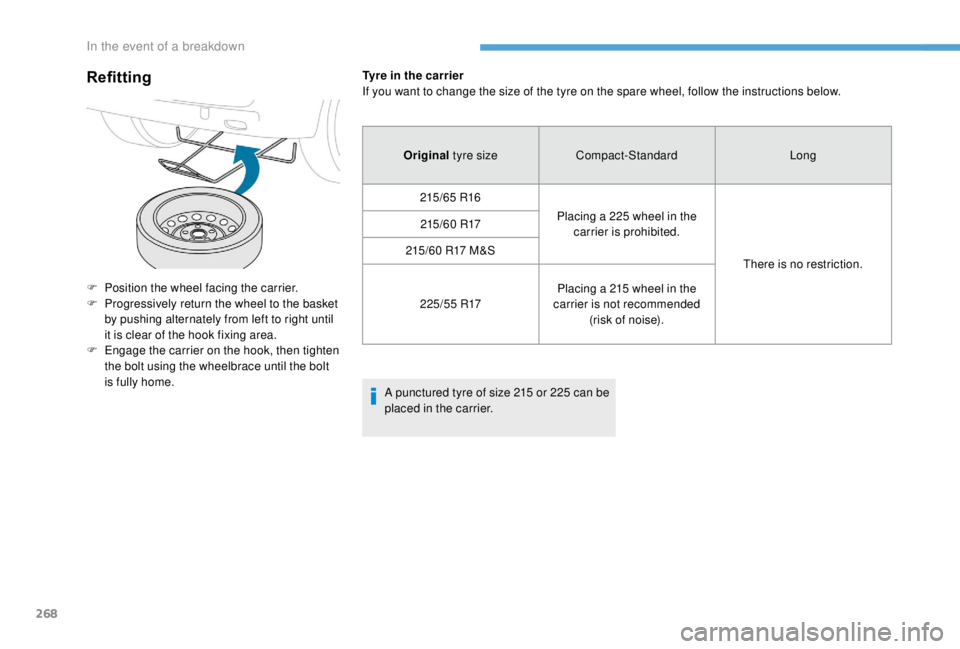
RefittingTyre in the carrier
If you want to change the size of the tyre on the spare wheel, follow the instructions below.A punctured tyre of size 215
or 225 can be
placed in the carrier.
F
P
osition the wheel facing the carrier.
F
P
rogressively return the wheel to the basket
by pushing alternately from left to right until
it is clear of the hook fixing area.
F
E
ngage the carrier on the hook, then tighten
the bolt using the wheelbrace until the bolt
is fully home. Original
tyre size Compact-Standard Long
215/65
R16Placing a 225
wheel in the
carrier is prohibited.
There is no restriction.
215/60
R17
215/60
R17 M&S
2 2 5 / 5 5
R17Placing a 215
wheel in the
carrier is not recommended (risk of noise).
In the event of a breakdown
Page 271 of 416
269
Removing a wheel
Parking the vehicle
Park the vehicle where it does not block
traffic: the ground must be level, stable
and non-slippery.
With a manual gearbox, engage first gear
then switch off the ignition to block the
wheels.
With an automatic gearbox, place the gear
selector to position P then switch off the
ignition to block the wheels.
With an electronic gearbox, place the gear
selector to position A then switch off the
ignition to block the wheels.
Apply the parking brake and check that
the warning lamp is on in the instrument
panel.
The passengers must get out of the
vehicle and wait where they are safe.
Never go underneath a vehicle raised
using a jack; use an axle stand.F
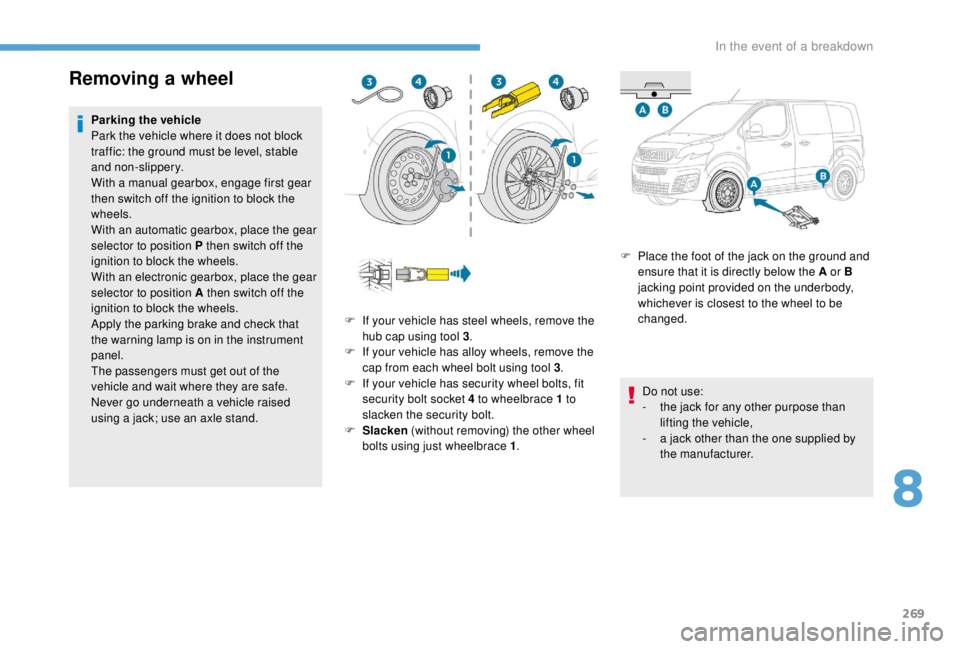
P
lace the foot of the jack on the ground and
ensure that it is directly below the A or B
jacking point provided on the underbody,
whichever is closest to the wheel to be
changed.
Do not use:
-
t
he jack for any other purpose than
lifting the vehicle,
-
a j
ack other than the one supplied by
the manufacturer.
F
I
f your vehicle has steel wheels, remove the
hub cap using tool 3 .
F
I
f your vehicle has alloy wheels, remove the
cap from each wheel bolt using tool 3 .
F
I
f your vehicle has security wheel bolts, fit
security bolt socket 4
to wheelbrace 1 to
slacken the security bolt.
F
S
lacken (without removing) the other wheel
bolts using just wheelbrace 1 .
8
In the event of a breakdown
Page 272 of 416
270
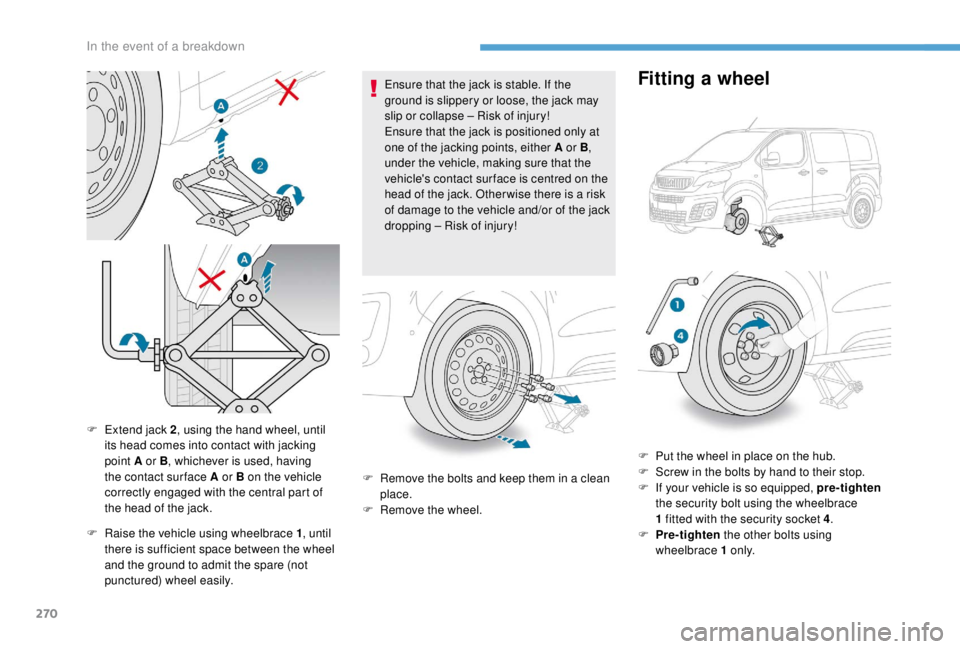
F Raise the vehicle using wheelbrace 1, until
there is sufficient space between the wheel
and the ground to admit the spare (not
punctured) wheel easily. Ensure that the jack is stable. If the
ground is slippery or loose, the jack may
slip or collapse – Risk of injury!
Ensure that the jack is positioned only at
one of the jacking points, either A or B
,
under the vehicle, making sure that the
vehicle's contact sur face is centred on the
head of the jack. Other wise there is a risk
of damage to the vehicle and/or of the jack
dropping – Risk of injury!
F
R
emove the bolts and keep them in a clean
place.
F
R
emove the wheel.
Fitting a wheel
F Put the wheel in place on the hub.
F
S crew in the bolts by hand to their stop.
F
I
f your vehicle is so equipped, pre-tighten
the security bolt using the wheelbrace
1
fitted with the security socket 4 .
F
P
re-tighten the other bolts using
wheelbrace 1
o n l y.
F
E
xtend jack 2
, using the hand wheel, until
its head comes into contact with jacking
point A or B , whichever is used, having
the contact sur face A or B on the vehicle
correctly engaged with the central part of
the head of the jack.
In the event of a breakdown
Page 273 of 416
271
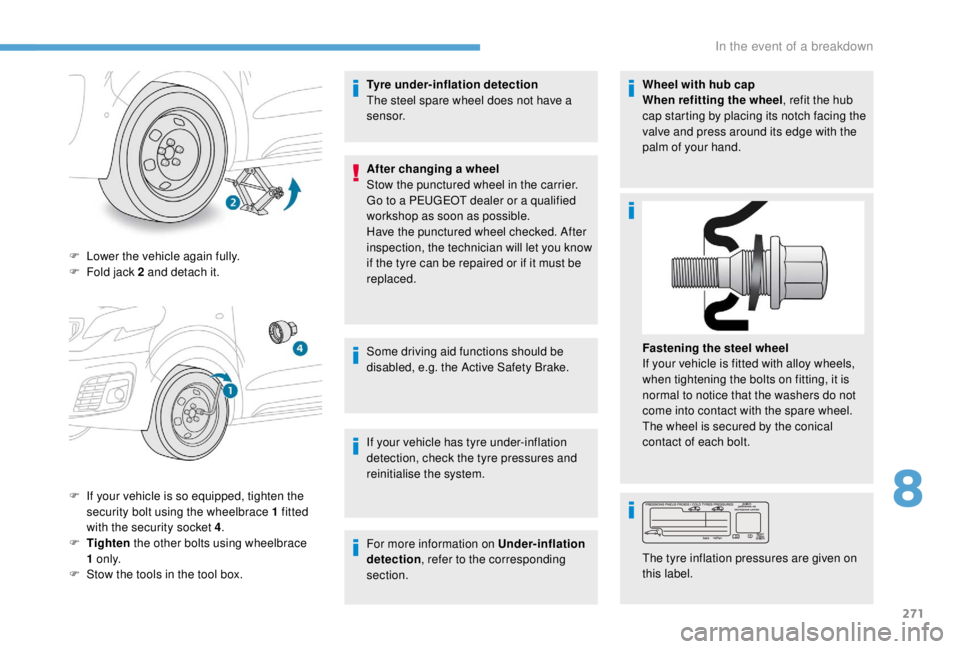
F Lower the vehicle again fully.
F F old jack 2 and detach it.
F
I
f your vehicle is so equipped, tighten the
security bolt using the wheelbrace 1
fitted
with the security socket 4 .
F
T
ighten the other bolts using wheelbrace
1
o n l y.
F
S
tow the tools in the tool box. Tyre under-inflation detection
The steel spare wheel does not have a
sensor.
After changing a wheel
Stow the punctured wheel in the carrier.
Go to a PEUGEOT dealer or a qualified
workshop as soon as possible.
Have the punctured wheel checked. After
inspection, the technician will let you know
if the tyre can be repaired or if it must be
replaced.
Some driving aid functions should be
disabled, e.g. the Active Safety Brake.
If your vehicle has tyre under-inflation
detection, check the tyre pressures and
reinitialise the system.
For more information on Under-inflation
detection
, refer to the corresponding
section. Wheel with hub cap
When refitting the wheel
, refit the hub
cap starting by placing its notch facing the
valve and press around its edge with the
palm of your hand.
Fastening the steel wheel
If your vehicle is fitted with alloy wheels,
when tightening the bolts on fitting, it is
normal to notice that the washers do not
come into contact with the spare wheel.
The wheel is secured by the conical
contact of each bolt.
The tyre inflation pressures are given on
this label.
8
In the event of a breakdown