wheel PEUGEOT EXPERT 2018 User Guide
[x] Cancel search | Manufacturer: PEUGEOT, Model Year: 2018, Model line: EXPERT, Model: PEUGEOT EXPERT 2018Pages: 416, PDF Size: 14.12 MB
Page 93 of 416
91
Additional adjustments
Adjusting the height of the
head restraint
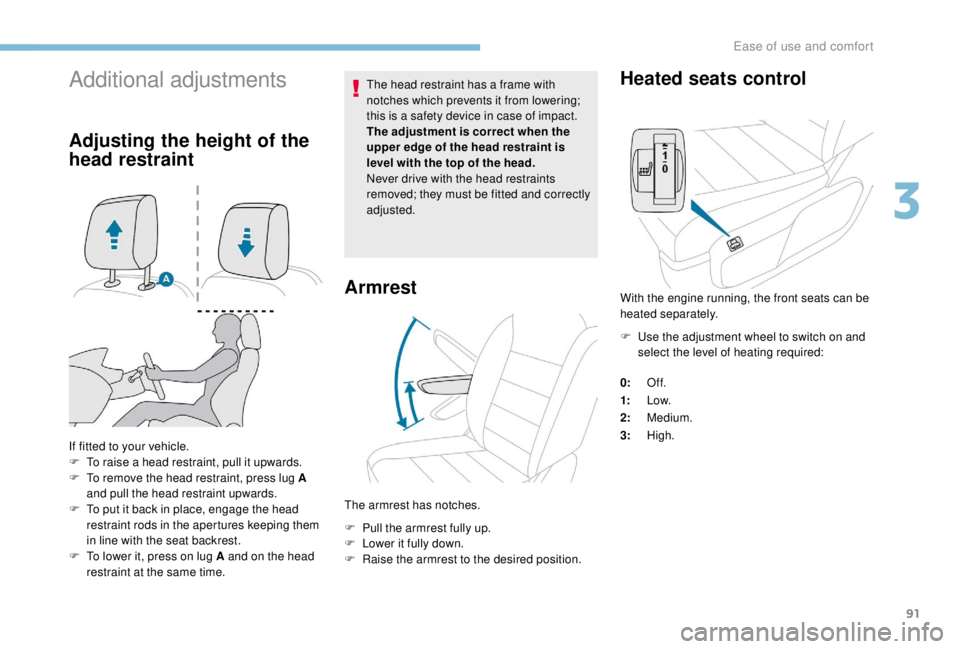
If fitted to your vehicle.
F T o raise a head restraint, pull it upwards.
F
T
o remove the head restraint, press lug A
and pull the head restraint upwards.
F
T
o put it back in place, engage the head
restraint rods in the apertures keeping them
in line with the seat backrest.
F
T
o lower it, press on lug A and on the head
restraint at the same time. The head restraint has a frame with
notches which prevents it from lowering;
this is a safety device in case of impact.
The adjustment is correct when the
upper edge of the head restraint is
level with the top of the head.
Never drive with the head restraints
removed; they must be fitted and correctly
adjusted.
Armrest
The armrest has notches.
F
P
ull the armrest fully up.
F
L
ower it fully down.
F
R
aise the armrest to the desired position.
Heated seats control
With the engine running, the front seats can be
heated separately.
F
U
se the adjustment wheel to switch on and
select the level of heating required:
0: Of f.
1: Low.
2: Medium.
3: High.
3
Ease of use and comfort
Page 95 of 416
93
Adjusting the height of the
head restraint
The head restraint has a frame with
notches which prevents it from lowering;
this is a safety device in case of impact.
The adjustment is correct when the
upper edge of the head restraint is
level with the top of the head.
Never drive with the head restraints
removed; they must be fitted and correctly
adjusted.
Heated bench seat
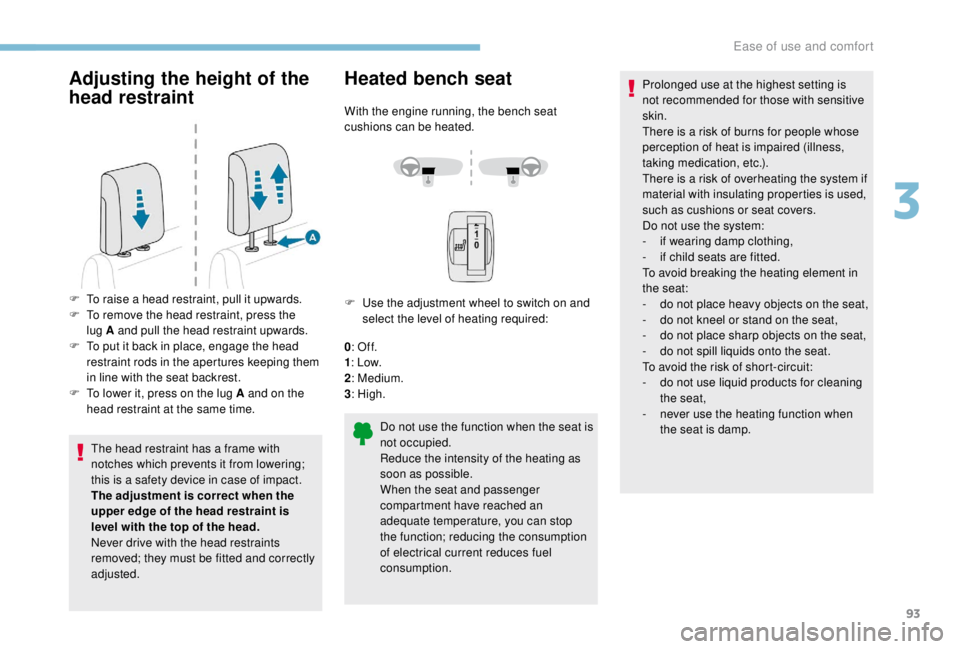
With the engine running, the bench seat
cushions can be heated.
F
U
se the adjustment wheel to switch on and
select the level of heating required:
0 : Of f.
1 : Low.
2 : Medium.
3 : High.
F
T
o raise a head restraint, pull it upwards.
F
T
o remove the head restraint, press the
lug A and pull the head restraint upwards.
F
T
o put it back in place, engage the head
restraint rods in the apertures keeping them
in line with the seat backrest.
F
T
o lower it, press on the lug A and on the
head restraint at the same time.
Do not use the function when the seat is
not occupied.
Reduce the intensity of the heating as
soon as possible.
When the seat and passenger
compartment have reached an
adequate temperature, you can stop
the function; reducing the consumption
of electrical current reduces fuel
consumption.Prolonged use at the highest setting is
not recommended for those with sensitive
skin.
There is a risk of burns for people whose
perception of heat is impaired (illness,
taking medication, etc.).
There is a risk of overheating the system if
material with insulating properties is used,
such as cushions or seat covers.
Do not use the system:
-
i
f wearing damp clothing,
-
i
f child seats are fitted.
To avoid breaking the heating element in
the seat:
-
d
o not place heavy objects on the seat,
-
d
o not kneel or stand on the seat,
-
d
o not place sharp objects on the seat,
-
d
o not spill liquids onto the seat.
To avoid the risk of short-circuit:
-
d
o not use liquid products for cleaning
the seat,
-
n
ever use the heating function when
the seat is damp.
3
Ease of use and comfort
Page 112 of 416
110
Front door pockets
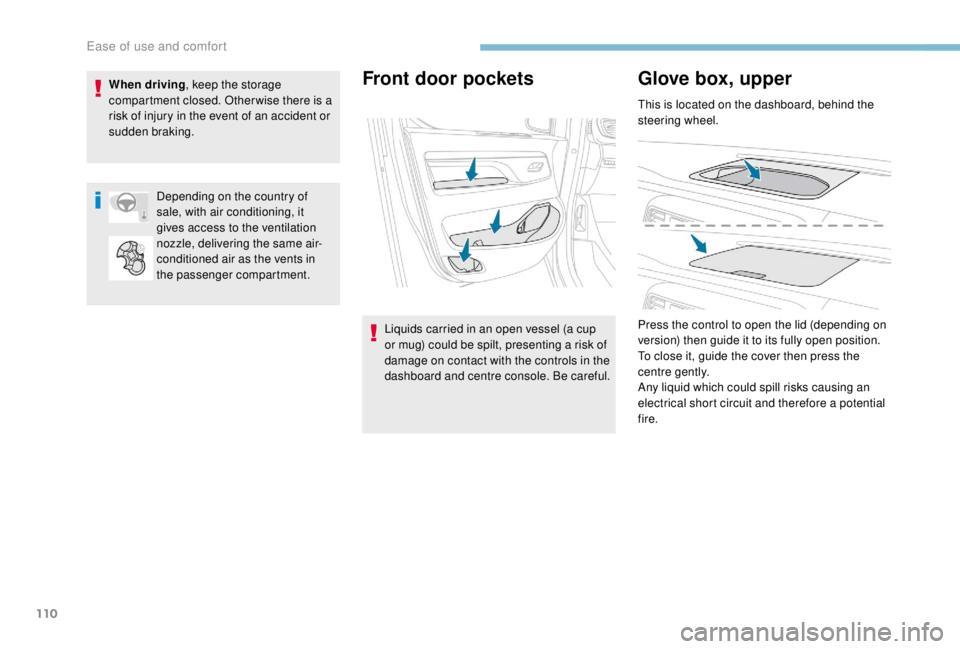
Liquids carried in an open vessel (a cup
or mug) could be spilt, presenting a risk of
damage on contact with the controls in the
dashboard and centre console. Be careful.
Glove box, upper
This is located on the dashboard, behind the
steering wheel.
Press the control to open the lid (depending on
version) then guide it to its fully open position.
To close it, guide the cover then press the
centre gently.
Any liquid which could spill risks causing an
electrical short circuit and therefore a potential
fire.
When driving
, keep the storage
compartment closed. Otherwise there is a
risk of injury in the event of an accident or
sudden braking.
Depending on the country of
sale, with air conditioning, it
gives access to the ventilation
nozzle, delivering the same air-
conditioned air as the vents in
the passenger compartment.
Ease of use and comfort
Page 117 of 416
115
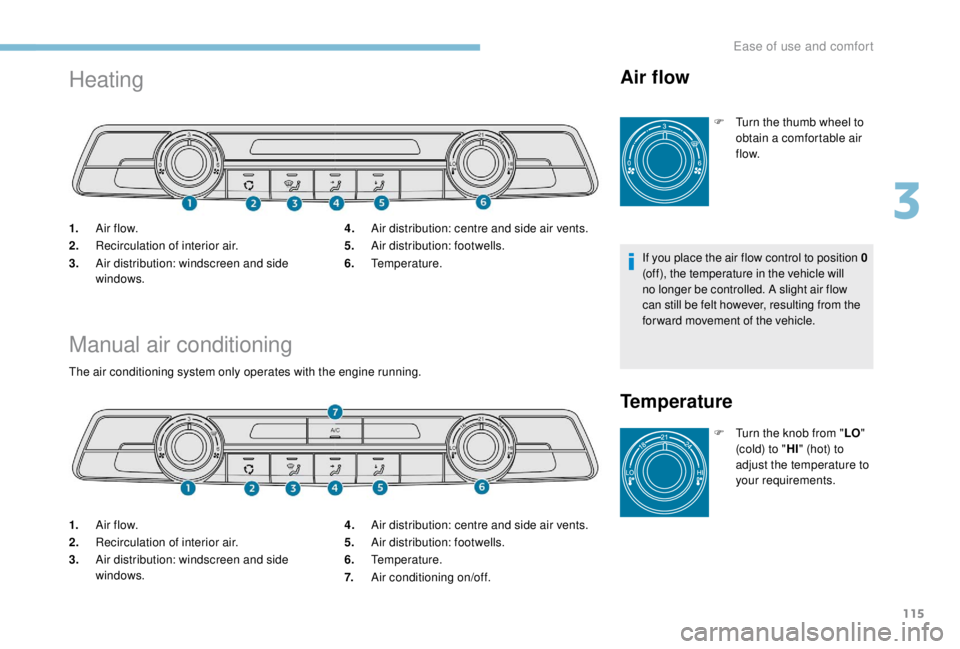
Heating
Manual air conditioning
The air conditioning system only operates with the engine running.
1.A ir f low.
2. Recirculation of interior air.
3. Air distribution: windscreen and side
windows. 4.
Air distribution: centre and side air vents.
5. Air distribution: footwells.
6. Temperature.
7. Air conditioning on/off.
Air flow
F Turn the thumb wheel to
obtain a comfortable air
f low.
If you place the air flow control to position 0
(off), the temperature in the vehicle will
no longer be controlled. A slight air flow
can still be felt however, resulting from the
for ward movement of the vehicle.
Temperature
F Turn the knob from " LO"
(cold) to " HI" (hot) to
adjust the temperature to
your requirements.
1.
A ir f low.
2. Recirculation of interior air.
3. Air distribution: windscreen and side
windows. 4.
Air distribution: centre and side air vents.
5. Air distribution: footwells.
6. Temperature.
3
Ease of use and comfort
Page 127 of 416
125
Activation/Deactivation
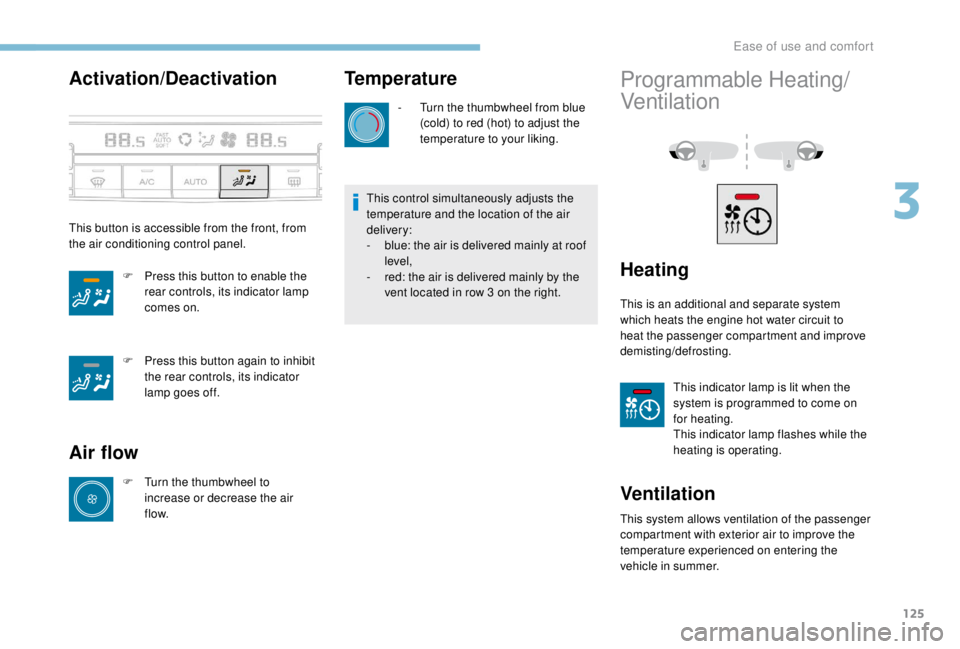
This button is accessible from the front, from
the air conditioning control panel.F
P
ress this button to enable the
rear controls, its indicator lamp
comes on.
F
P
ress this button again to inhibit
the rear controls, its indicator
lamp goes off.
Air flow
F Turn the thumbwheel to increase or decrease the air
f low.
Programmable Heating/
Ventilation
Heating
This is an additional and separate system
which heats the engine hot water circuit to
heat the passenger compartment and improve
demisting/defrosting.
This indicator lamp is lit when the
system is programmed to come on
for heating.
This indicator lamp flashes while the
heating is operating.
Ventilation
This system allows ventilation of the passenger
compartment with exterior air to improve the
temperature experienced on entering the
vehicle in summer.
Temperature
- Turn the thumbwheel from blue (cold) to red (hot) to adjust the
temperature to your liking.
This control simultaneously adjusts the
temperature and the location of the air
delivery:
-
b
lue: the air is delivered mainly at roof
level,
-
r
ed: the air is delivered mainly by the
vent located in row 3
on the right.
3
Ease of use and comfort
Page 137 of 416
135
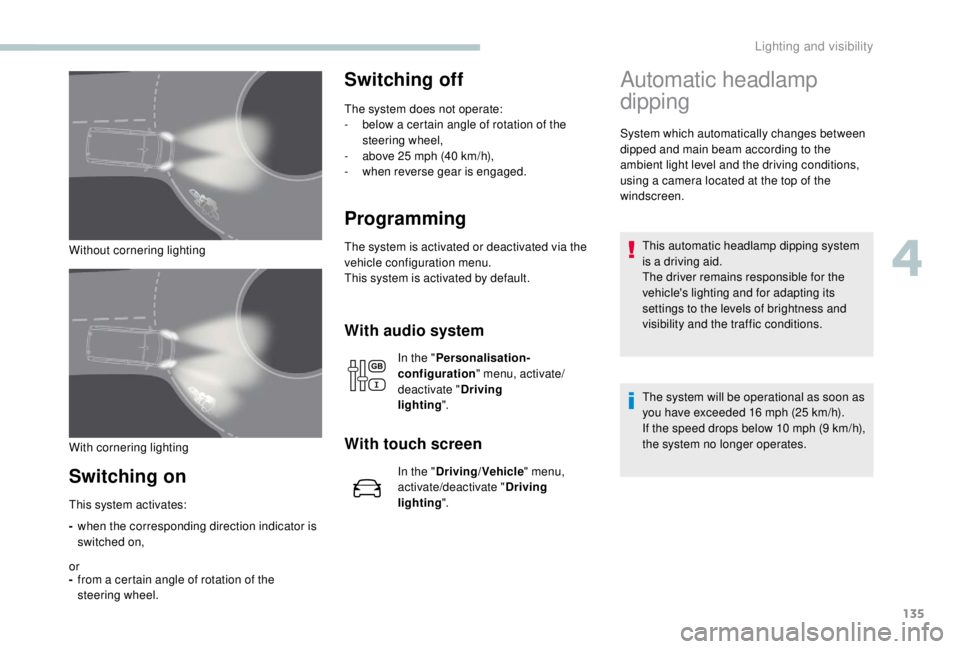
Without cornering lighting
Switching on
-when the corresponding direction indicator is
switched on,
or
- from a certain angle of rotation of the
steering wheel.
Switching off
The system does not operate:
-
b elow a certain angle of rotation of the
steering wheel,
-
a
bove 25 mph (40 km/h),
-
w
hen reverse gear is engaged.
Programming
The system is activated or deactivated via the
vehicle configuration menu.
This system is activated by default.
This system activates:
With audio system
In the " Personalisation-
configuration " menu, activate/
deactivate " Driving
lighting ".
With touch screen
In the "Driving/Vehicle " menu,
activate/deactivate " Driving
lighting ".
Automatic headlamp
dipping
System which automatically changes between
dipped and main beam according to the
ambient light level and the driving conditions,
using a camera located at the top of the
windscreen.
This automatic headlamp dipping system
is a driving aid.
The driver remains responsible for the
vehicle's lighting and for adapting its
settings to the levels of brightness and
visibility and the traffic conditions.
The system will be operational as soon as
you have exceeded 16
mph (25 km/h).
If the speed drops below 10
mph (9 km/h),
the system no longer operates.
With cornering lighting
4
Lighting and visibility
Page 147 of 416
145
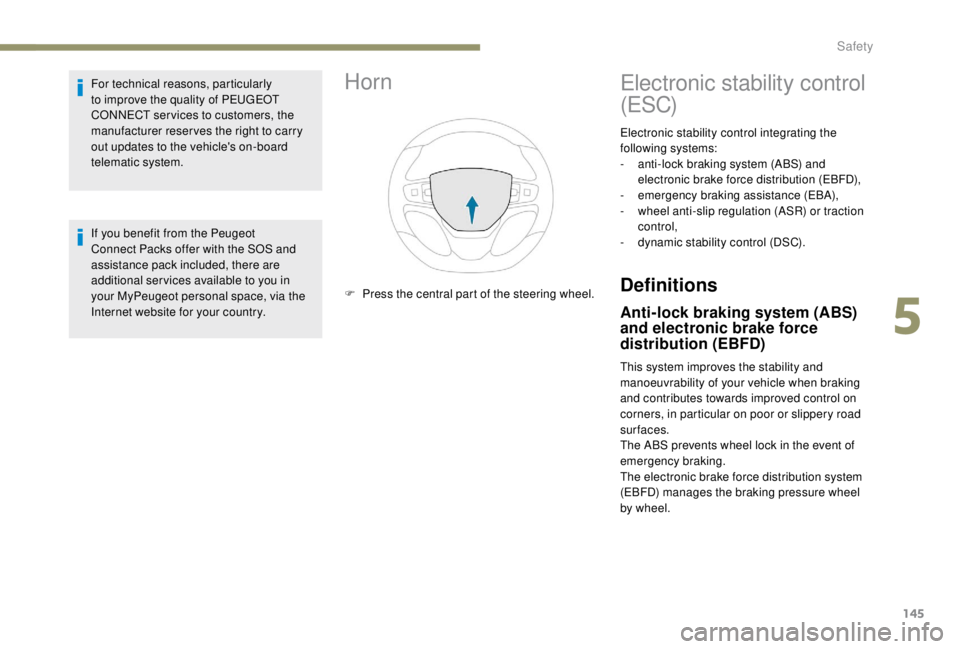
Horn
F Press the central part of the steering wheel.
Electronic stability control
(ESC)
Electronic stability control integrating the
following systems:
-
a
nti-lock braking system (ABS) and
electronic brake force distribution (EBFD),
-
em
ergency braking assistance (EBA),
-
w
heel anti-slip regulation (ASR) or traction
control,
-
d
ynamic stability control (DSC).
For technical reasons, particularly
to improve the quality of PEUGEOT
CONNECT ser vices to customers, the
manufacturer reser ves the right to carry
out updates to the vehicle's on-board
telematic system.
If you benefit from the Peugeot
Connect Packs offer with the SOS and
assistance pack included, there are
additional ser vices available to you in
your MyPeugeot personal space, via the
Internet website for your country.
Definitions
Anti-lock braking system (ABS)
and electronic brake force
distribution (EBFD)
This system improves the stability and
manoeuvrability of your vehicle when braking
and contributes towards improved control on
corners, in particular on poor or slippery road
surfaces.
The ABS prevents wheel lock in the event of
emergency braking.
The electronic brake force distribution system
(EBFD) manages the braking pressure wheel
by wheel.
5
Safety
Page 148 of 416
146
Emergency braking assistance
(EBA)
In an emergency, this system permits the
optimum braking pressure to be reached
more quickly, therefore reducing the stopping
distance.
It is triggered in relation to the speed at which
the brake pedal is pressed. The effect of this is
a reduction in the resistance of the pedal and
an increase in braking efficiency.
Anti-slip regulation (ASR)
The ASR system (also known as Traction
Control) optimises traction in order to limit
wheel slip by acting on the brakes of the driving
wheels and on the engine. It also improves
the directional stability of the vehicle on
acceleration.
Dynamic stability control (DSC)
If there is a difference between the path
followed by the vehicle and that required by
the driver, the DSC monitors each wheel and
automatically acts on the brake of one or more
wheels and on the engine to return the vehicle
to the required path, within the limits of the laws
of physics.
Intelligent traction control
If your vehicle has this system, it features a
system to help driving on snow: intelligent
traction control.
This system detects situations of difficult
sur face grip that could make it difficult to move
off or make progress on deep fresh snow or
compacted snow.
In these situations, the intelligent traction
control limits the amount of wheel spin to
provide the best traction and trajectory control
for your vehicle.
The use of snow tyres is strongly
recommended on sur faces offering low
levels of grip.
Anti-lock braking system
(ABS) and electronic brake
force distribution (EBFD)
The fixed illumination of this warning
lamp indicates that there is a fault
with the ABS.If this warning lamp comes on, in
conjunction with the STOP and
ABS warning lamps, an audible
signal and a message, it means
that the electronic brake force
distribution (EBFD) is defective.
You must stop as soon as it is
safe to do so.
In both cases, have the system
checked by a PEUGEOT dealer
or a qualified workshop as soon
as possible.
When changing wheels (tyres and rims),
ensure that these are approved for your
vehicle.
Normal operation of the ABS may make
itself felt by slight vibrations of the brake
pedal.
Safety
Page 149 of 416
147
If you need to brake in an emergency,
press the brake pedal ver y firmly and
keep the pressure applied.
After an impact, have the system checked
by a PEUGEOT dealer or a qualified
workshop.
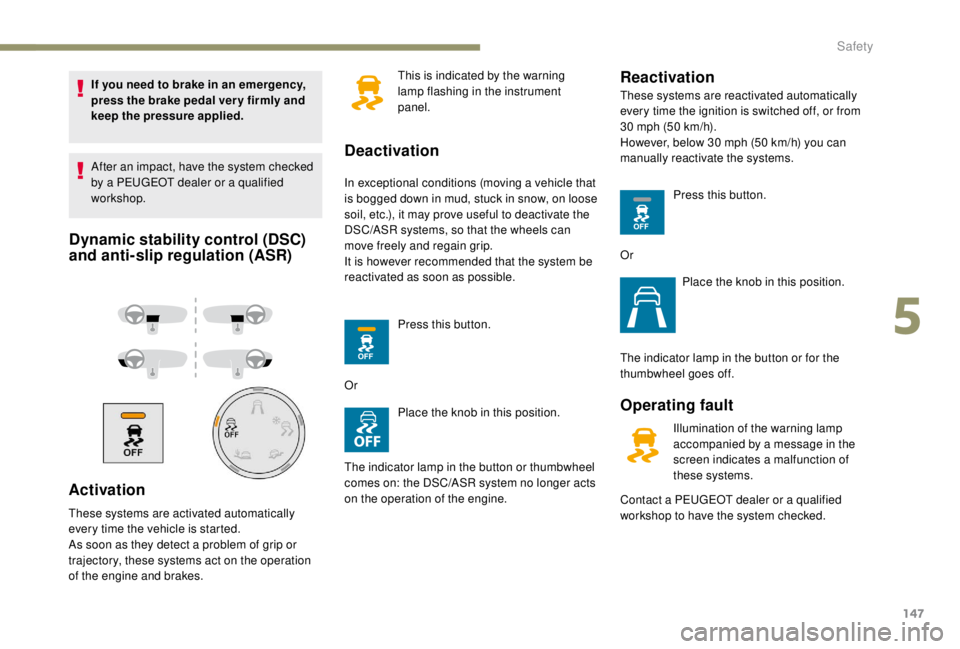
Dynamic stability control (DSC)
and anti-slip regulation (ASR)
Activation
These systems are activated automatically
every time the vehicle is started.
As soon as they detect a problem of grip or
trajectory, these systems act on the operation
of the engine and brakes. This is indicated by the warning
lamp flashing in the instrument
panel.
Deactivation
In exceptional conditions (moving a vehicle that
is bogged down in mud, stuck in snow, on loose
soil, etc.), it may prove useful to deactivate the
DSC/ASR systems, so that the wheels can
move freely and regain grip.
It is however recommended that the system be
reactivated as soon as possible.
Press this button.
Or Place the knob in this position.
The indicator lamp in the button or thumbwheel
comes on: the DSC/ASR system no longer acts
on the operation of the engine.
Reactivation
These systems are reactivated automatically
every time the ignition is switched off, or from
30 mph (50 km/h).
However, below 30
mph (50 km/h) you can
manually reactivate the systems.
Press this button.
Or Place the knob in this position.
The indicator lamp in the button or for the
thumbwheel goes off.
Operating fault
Illumination of the warning lamp
accompanied by a message in the
screen indicates a malfunction of
these systems.
Contact a PEUGEOT dealer or a qualified
workshop to have the system checked.
5
Safety
Page 150 of 416
148
Grip control
Special patented traction control system which
improves traction on snow, mud and sand.
This system, the operation of which has been
optimised for each situation, allows you to
manoeuvre in most conditions of poor grip
(encountered during touring use).
The accelerator pedal should be pressed
sufficiently to allow the system to use the power
of the engine. Operation at high engine speeds
is completely normal.
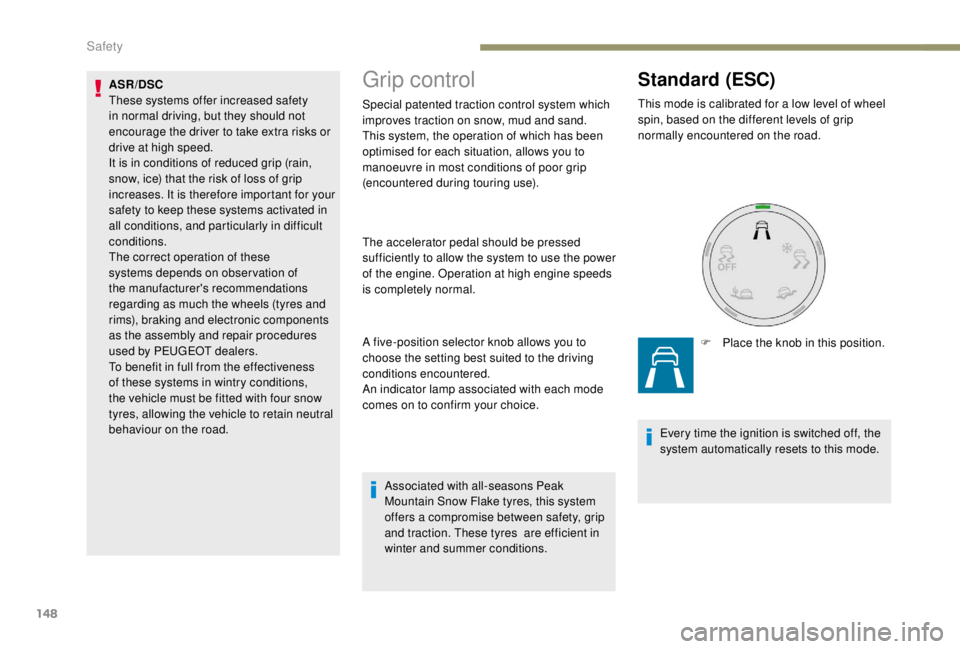
Standard (ESC)
F Place the knob in this position.
ASR/DSC
These systems offer increased safety
in normal driving, but they should not
encourage the driver to take extra risks or
drive at high speed.
It is in conditions of reduced grip (rain,
snow, ice) that the risk of loss of grip
increases. It is therefore important for your
safety to keep these systems activated in
all conditions, and particularly in difficult
conditions.
The correct operation of these
systems depends on obser vation of
the manufacturer's recommendations
regarding as much the wheels (tyres and
rims), braking and electronic components
as the assembly and repair procedures
used by PEUGEOT dealers.
To benefit in full from the effectiveness
of these systems in wintry conditions,
the vehicle must be fitted with four snow
tyres, allowing the vehicle to retain neutral
behaviour on the road.
A five-position selector knob allows you to
choose the setting best suited to the driving
conditions encountered.
An indicator lamp associated with each mode
comes on to confirm your choice.
Associated with all-seasons Peak
Mountain Snow Flake tyres, this system
offers a compromise between safety, grip
and traction. These tyres are efficient in
winter and summer conditions. This mode is calibrated for a low level of wheel
spin, based on the different levels of grip
normally encountered on the road.
Every time the ignition is switched off, the
system automatically resets to this mode.
Safety