Fuel Peugeot Expert 2019 Owner's Guide
[x] Cancel search | Manufacturer: PEUGEOT, Model Year: 2019, Model line: Expert, Model: Peugeot Expert 2019Pages: 324, PDF Size: 13.07 MB
Page 189 of 324
187
The vehicle is fitted with a catalytic converter
which reduces harmful substances in the
exhaust gases.If you have put in the wrong fuel for
your vehicle, you must have the fuel
tank drained and filled with the correct
fuel before star ting the engine.
Fuel cut- of f
Your vehicle is fitted with a safety system that
cuts off the supply of fuel in the event of an
impact.
Diesel misfuel prevention
Mechanical device which prevents filling the
tank of a Diesel vehicle with petrol. It helps
avoid the risk of engine damage that can result
from filling with the wrong fuel.
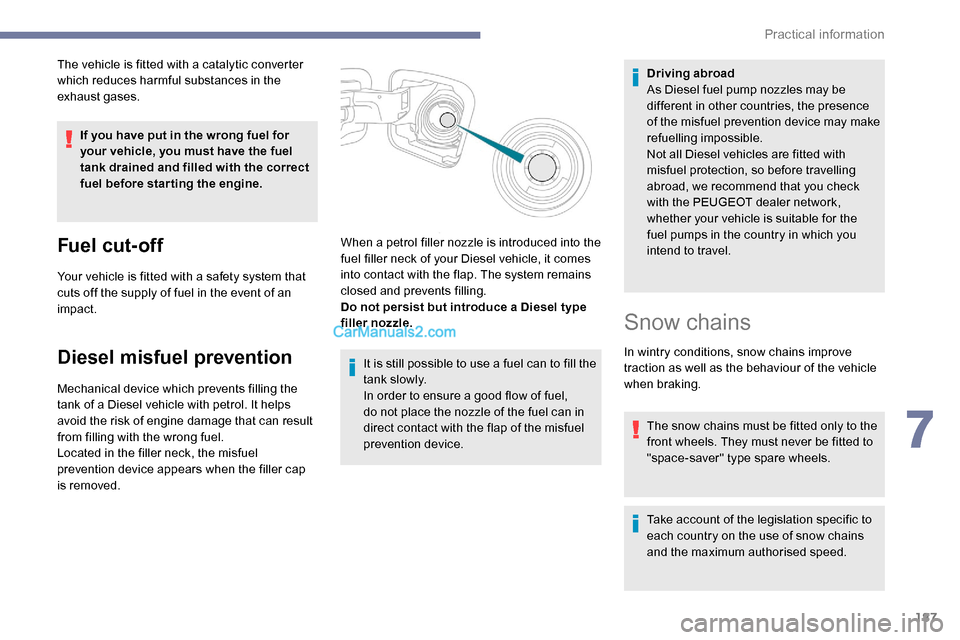
Located in the filler neck, the misfuel
prevention device appears when the filler cap
is removed. It is still possible to use a fuel can to fill the
t a n k s l ow l y.
In order to ensure a good flow of fuel,
do not place the nozzle of the fuel can in
direct contact with the flap of the misfuel
prevention device.Driving abroad
As Diesel fuel pump nozzles may be
different in other countries, the presence
of the misfuel prevention device may make
refuelling impossible.
Not all Diesel vehicles are fitted with
misfuel protection, so before travelling
abroad, we recommend that you check
with the PEUGEOT dealer network,
whether your vehicle is suitable for the
fuel pumps in the country in which you
intend to travel.
When a petrol filler nozzle is introduced into the
fuel filler neck of your Diesel vehicle, it comes
into contact with the flap. The system remains
closed and prevents filling.
Do not persist but introduce a Diesel type
filler nozzle.
Snow chains
In wintry conditions, snow chains improve
traction as well as the behaviour of the vehicle
when braking.
The snow chains must be fitted only to the
front wheels. They must never be fitted to
"space-saver" type spare wheels.
Take account of the legislation specific to
each country on the use of snow chains
and the maximum authorised speed.
7
Practical information
Page 195 of 324
193
During the 30 minutes after topping up the
oil, the check per formed with the oil level
indicator in the instrument panel when the
ignition is switched on is not valid.
Brake fluid
The level of this fluid should be
close to the "MAX" mark. If not,
check the brake pad wear.
To know how often the brake fluid should be
replaced, refer to the manufacturer's servicing
schedule. If topping up, clean the cap before
replacing it. Use only DOT4 brake fluid
from a sealed canister.
F
A
dd more oil if necessary.
F
A
fter checking the level, carefully refit the oil
filler cap and the dipstick in its tube.
Power steering fluid
The level of this fluid should be
close to the " MAX" mark. With the
engine cold and the vehicle standing
on level ground, check this by
reading the level on the filler neck.
Engine coolant
Check the engine coolant level
regularly.
It is normal to top up this fluid
between two services.
The check and top-up must only be done with
the engine cold.
A low level presents a risk of serious damage
to the engine.
The level of this fluid should be close to the
" MAX " mark but should never exceed it.
If the level is close to or below the " MIN” mark,
it is essential to top up. Once the pressure has dropped, remove the
cap and top up to the required level.
Screen and headlamp
washer fluid
Top up the reser voir when you next
stop the vehicle.
Fluid specification
The fluid must be topped up with a ready-to-
use mixture.
In winter (temperatures below zero), a liquid
containing an agent to prevent freezing must
be used which is appropriate for the prevailing
conditions, in order to protect the elements of
the system (pump, tank, ducts, jets, etc.).
When the engine is hot, the temperature of this
fluid is regulated by the fan.
In addition, as the cooling system is
pressurised, wait at least one hour after
switching off the engine before carrying out any
work.
To avoid the risk of scalding if you need to top
up in an emergency, wrap a cloth around the
cap and unscrew the cap by two turns to allow
the pressure to drop. Filling with pure water is prohibited
under all circumstances (risk of freezing,
limestone deposits, etc.).
Diesel fuel additive (Diesel
with particle filter)
or
The minimum level in the particle
filter additive tank is indicated by
fixed illumination of this warning
lamp, accompanied by an audible
warning and a message warning that
the level of additive is too low.
7
Practical information
Page 198 of 324
196
Wheels and tyres
The pressure must be checked on
all tyres, including the spare wheel,
when the tyres are "cold".
The pressures indicated on the tyre pressure
label are valid for "cold" tyres. If you have
driven for more than 10 minutes or more
than 6
miles (10 kilometres) at over 31 mph
(50
km/h), add 0.3 bar (30 kPa) to the values
indicated on the label.
Driving with under-inflated tyres increases
fuel consumption. Non-compliant tyre
pressure causes premature wear on tyres
and has an adverse effect on the vehicle's
road holding - risk of an accident!
Driving with worn or damaged tyres reduces
the braking and road holding per formance of
the vehicle. It is recommended to regularly
check the condition of the tyres (tread and
sidewalls) and wheel rims as well as the
presence of the valves.
Using different size wheels and tyres from
those specified can affect the lifetime of
tyres, wheel rotation, ground clearance, the
speedometer reading and have an adverse
effect on road holding.
AdBlue® (BlueHDi)
To respect the environment and ensure
compliance with the Euro 6 standard, without
adversely affecting the per formance or fuel
consumption of its Diesel engines, PEUGEOT
has taken the decision to equip its vehicles
with a system that associates SCR (Selective
Catalytic Reduction) with a Diesel particle filter
(DPF) for the treatment of exhaust gases.
SCR system
Using a liquid called AdBlue® that contains
urea, a catalytic converter turns up to 85%
of nitrogen oxides (NOx) into nitrogen and
water, which are harmless to health and the
environment.
The AdBlue
® is contained in a
special tank holding about 20
litres. Its capacity allows a driving range of
approximately 4,300
miles (7,000 km)
( highly dependent on your driving style
and the vehicle). An alert system is triggered
automatically when the remaining range
reaches 1,500 miles (2,400 km), i.e. once the
reserve level has been reached.
Several alerts are triggered successively during
the remaining 1,500 miles (2,400 km) before
the tank is empty and the vehicle is disabled.
If the estimated distance travelled by the
vehicle between two ser vices is greater than
3,700 miles (6,000 km), it will be necessary to
top up the AdBlue.
For more information on the Warning
and indicator lamps and the associated
alerts, or the Indicators , refer to the
corresponding sections.
Fitting different tyres on the front and rear axles
can cause the ESC to mistime.
Practical information
Page 200 of 324
198
Keep AdBlue® out of the reach of children,
in its original container.
Procedure
Before starting the top-up procedure, ensure
that the vehicle is parked on a flat and level
sur face.
In wintry conditions, ensure that the
temperature of the vehicle is above -11
°C.
Otherwise the AdBlue
® may be frozen and so
cannot be poured into its tank. Park the vehicle
in a warmer area for a few hours to allow the
top-up to be carried out.
Never put the AdBlue
® into the Diesel fuel
tank.
If any AdBlue
® is splashed, or if there
are any spillages on the bodywork, rinse
immediately with cold water or wipe with a
damp cloth.
If the fluid has crystallised, clean it off
using a sponge and hot water. F
S
witch off the ignition and remove the key
from the switch to switch off the engine.
or
F
W
ith Keyless Entry and Starting, press the
" START/STOP " button to switch off the
engine.
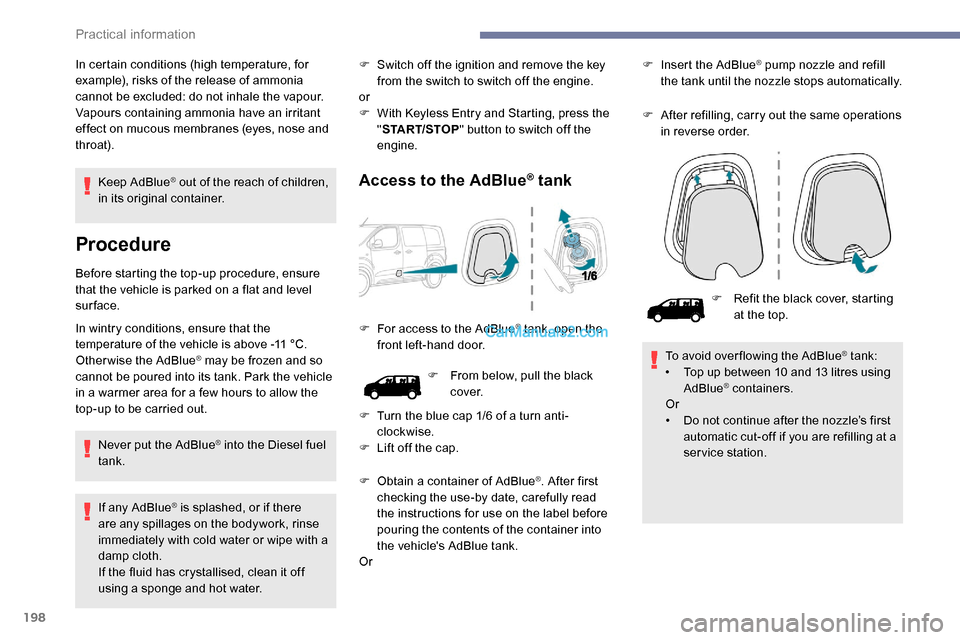
Access to the AdBlue® tank
F From below, pull the black c ove r.
In certain conditions (high temperature, for
example), risks of the release of ammonia
cannot be excluded: do not inhale the vapour.
Vapours containing ammonia have an irritant
effect on mucous membranes (eyes, nose and
throat).
F
T
urn the blue cap 1/6 of a turn anti-
clockwise.
F
L
ift off the cap.
F
O
btain a container of AdBlue
®. After first
checking the use-by date, carefully read
the instructions for use on the label before
pouring the contents of the container into
the vehicle's AdBlue tank.
Or F
I
nsert the AdBlue
® pump nozzle and refill
the tank until the nozzle stops automatically.
F
A
fter refilling, carry out the same operations
in reverse order.
F
R
efit the black cover, starting
at the top.
F
F
or access to the AdBlue
® tank, open the
front left-hand door. To avoid over flowing the AdBlue
® tank:
•
T
op up between 10 and 13 litres using
AdBlue
® containers.
Or
•
D
o not continue after the nozzle’s first
automatic cut-off if you are refilling at a
service station.
Practical information
Page 202 of 324
200
Warning triangle
This safety equipment should be used in
addition to the hazard warning lamps.
Placing the triangle on the
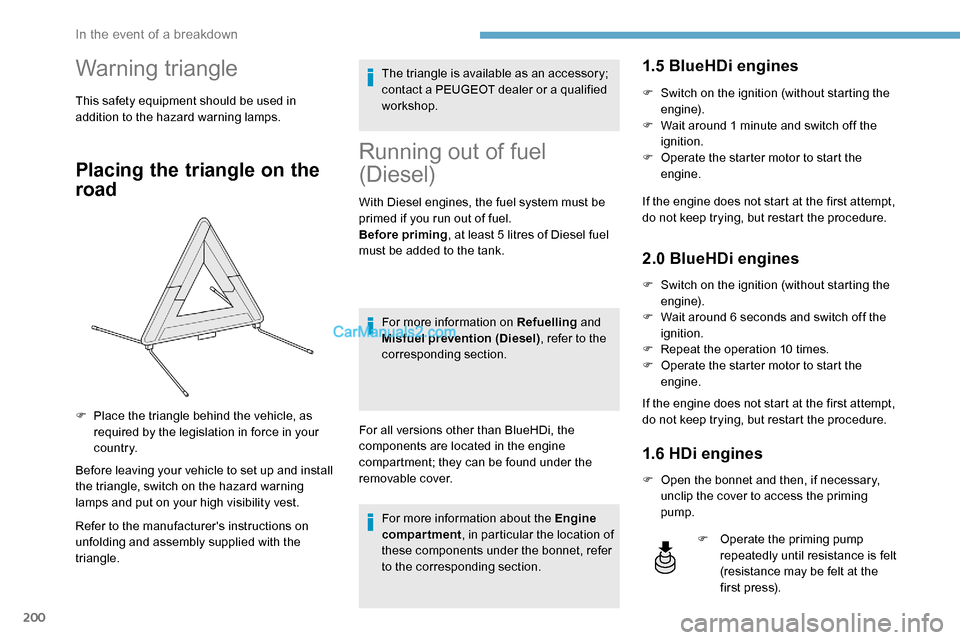
road
Before leaving your vehicle to set up and install
the triangle, switch on the hazard warning
lamps and put on your high visibility vest.
Refer to the manufacturer's instructions on
unfolding and assembly supplied with the
triangle.The triangle is available as an accessory;
contact a PEUGEOT dealer or a qualified
workshop.
Running out of fuel
(Diesel)
With Diesel engines, the fuel system must be
primed if you run out of fuel.
Before priming
, at least 5
litres of Diesel fuel
must be added to the tank.
For more information on Refuelling and
Misfuel prevention (Diesel) , refer to the
corresponding section.
For all versions other than BlueHDi, the
components are located in the engine
compartment; they can be found under the
removable cover. For more information about the Engine
compartment , in particular the location of
these components under the bonnet, refer
to the corresponding section.
1.5 BlueHDi engines
F Switch on the ignition (without starting the engine).
F
W
ait around 1 minute and switch off the
ignition.
F
O
perate the starter motor to start the
engine.
If the engine does not start at the first attempt,
do not keep trying, but restart the procedure.
2.0 BlueHDi engines
F Switch on the ignition (without starting the engine).
F
W
ait around 6 seconds and switch off the
ignition.
F
R
epeat the operation 10
times.
F
O
perate the starter motor to start the
engine.
If the engine does not start at the first attempt,
do not keep trying, but restart the procedure.
1.6 HDi engines
F Open the bonnet and then, if necessary, unclip the cover to access the priming
pump.
F
P
lace the triangle behind the vehicle, as
required by the legislation in force in your
c o u nt r y.
F
O
perate the priming pump
repeatedly until resistance is felt
(resistance may be felt at the
f i r st p r e s s).
In the event of a breakdown
Page 203 of 324
201
F Operate the starter motor to start the engine (if the engine does not start at the first
attempt, wait around 15 seconds before
trying again).
F
I
f the engine does not start after a few
attempts, operate the priming pump again,
then the starter motor.
F
P
ut the cover back in place and clip it in,
then close the bonnet.
2.0 HDi engines
F Open the bonnet and then, if necessary, unclip the cover to access the priming
pump.
F
L
oosen the degassing bolt. F
O
perate the priming pump until
fuel appears in the transparent
tube.
F
R
etighten the degassing bolt.
F
O
perate the starter motor until the engine
starts (if the engine does not start at the
first attempt, wait around 15
seconds before
trying again).
F
I
f the engine does not start after a few
attempts, operate the priming pump again,
then the starter motor.
F
P
ut the cover back in place and clip it in,
then close the bonnet.
Tool box
Access
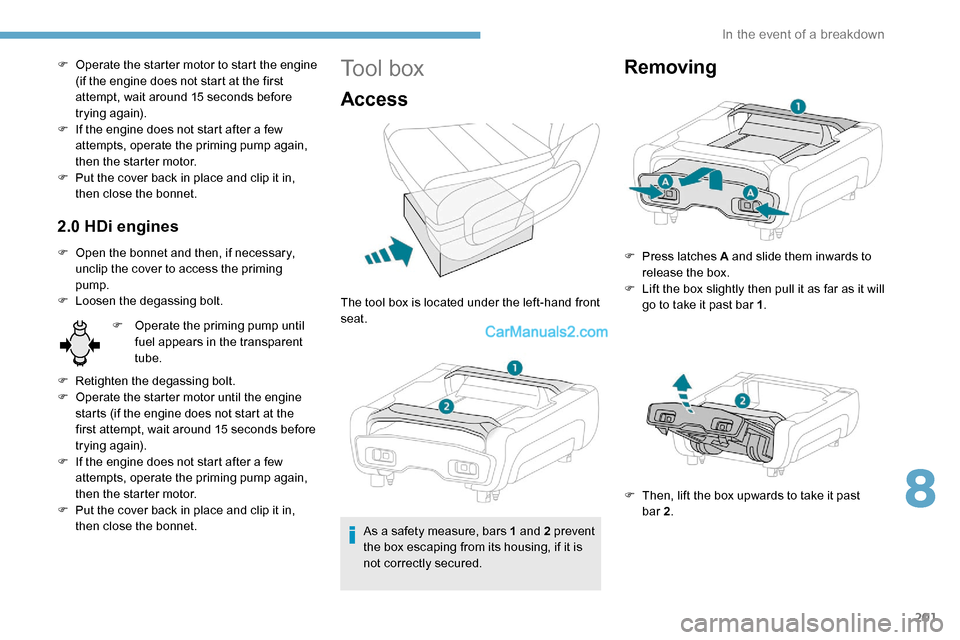
The tool box is located under the left-hand front
seat.
As a safety measure, bars 1 and 2 prevent
the box escaping from its housing, if it is
not correctly secured.
Removing
F Press latches A and slide them inwards to release the box.
F
L
ift the box slightly then pull it as far as it will
go to take it past bar 1 .
F
T
hen, lift the box upwards to take it past
bar
2.
8
In the event of a breakdown
Page 227 of 324
225
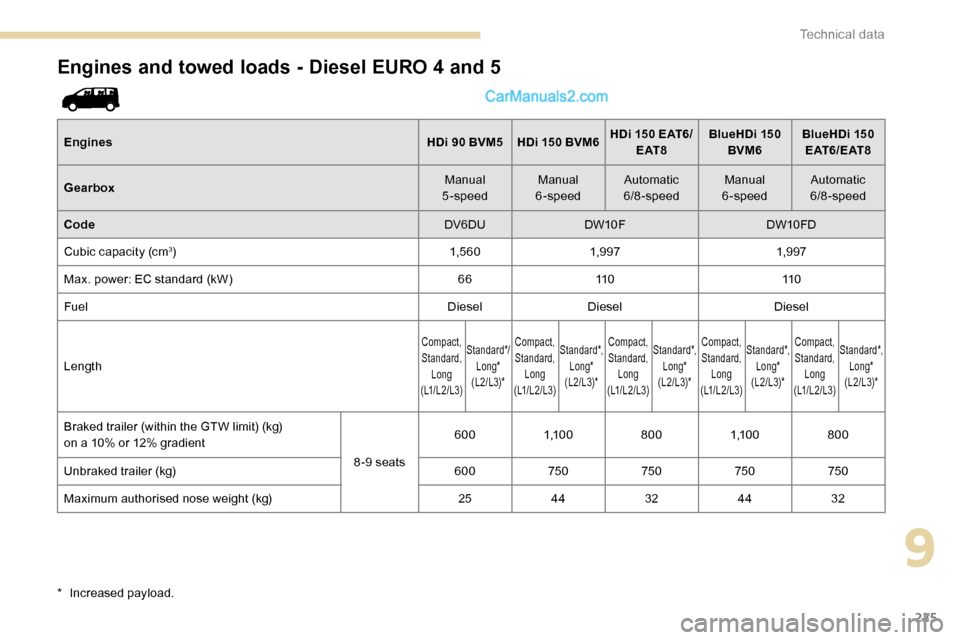
Engines and towed loads - Diesel EURO 4 and 5
EnginesHDi 90 BVM5 HDi 150 BVM6HDi 150 EAT6/
E AT 8 BlueHDi
150
BVM6 BlueHDi
150
E AT 6 / E AT 8
Gearbox Manual
5-speed Manual
6-speed Automatic
6/8-speed Manual
6-speed Automatic
6/8-speed
Code DV6DUDW10F DW10FD
Cubic capacity (cm
3) 1,5 6 01,9 97 1,9 97
Max. power: EC standard (kW) 6611 0 11 0
Fuel DieselDiesel Diesel
Length
Compact,
Standard,
Long
(L1/L2/L3) Standard*/
Long*
(L 2 / L3)* Compact,
Standard,
Long
(L1/L2/L3) Standard*,
Long*
(L 2 / L3)* Compact,
Standard,
Long
(L1/L2/L3) Standard*,
Long*
(L 2 / L3)* Compact,
Standard,
Long
(L1/L2/L3) Standard*,
Long*
(L 2 / L3)* Compact,
Standard,
Long
(L1/L2/L3) Standard*,
Long*
(L 2 / L3)*
Braked trailer (within the GTW limit) (kg)
on a 10% or 12% gradient
8-9 seats600
1,1 0 0 8001,1 0 0 800
Unbraked trailer (kg) 600750750750750
Maximum authorised nose weight (kg) 2544 3244 32
*
I
ncreased payload.
9
Technical data
Page 228 of 324
226
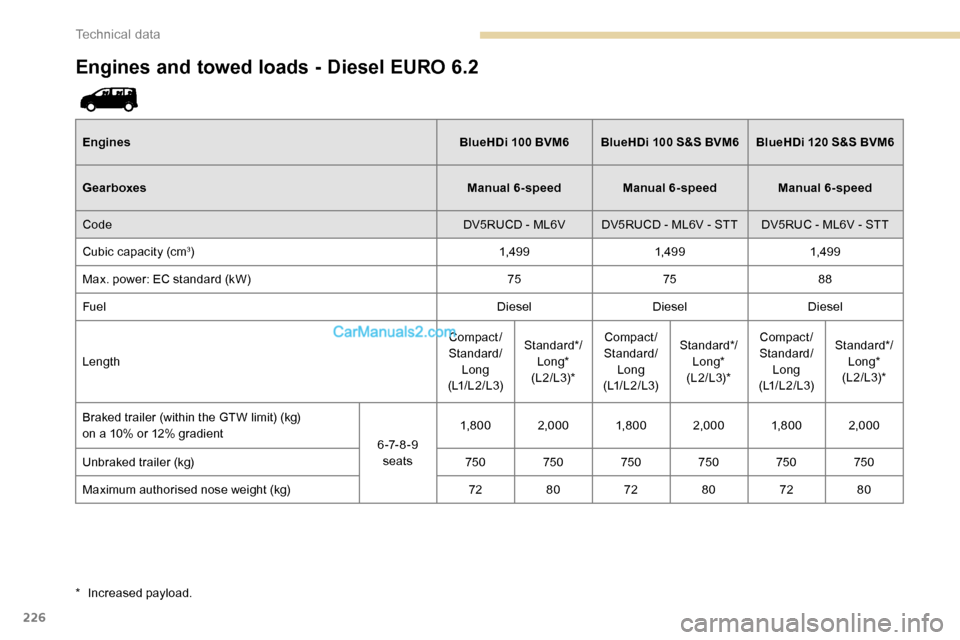
Engines and towed loads - Diesel EURO 6.2
EnginesBlueHDi 100 BVM6BlueHDi 100 S&S BVM6BlueHDi 120 S&S BVM6
Gearboxes Manual 6-speedManual 6-speedManual 6-speed
Code DV5RUCD - ML6V DV5RUCD - ML6V - STT DV5RUC - ML6V - STT
Cubic capacity (cm
3) 1,49 91,49 91,49 9
Max. power: EC standard (kW) 757588
Fuel DieselDieselDiesel
Length Compact/
Standard/ Long
(L1/L2/L3) Standard*/
Long*
(L 2 / L3)* Compact/
Standard/ Long
(L1/L2/L3) Standard*/
Long*
(L 2 / L3)* Compact/
Standard/ Long
(L1/L2/L3) Standard*/
Long*
(L 2 / L3)*
Braked trailer (within the GTW limit) (kg)
on a 10% or 12% gradient 6 -7- 8 - 9
seats 1,8 0 0
2,000 1,8 0 02,000 1,8 0 02,000
Unbraked trailer (kg) 750 750 750 750 750 750
Maximum authorised nose weight (kg) 7280 7280 7280
*
I
ncreased payload.
Technical data
Page 229 of 324
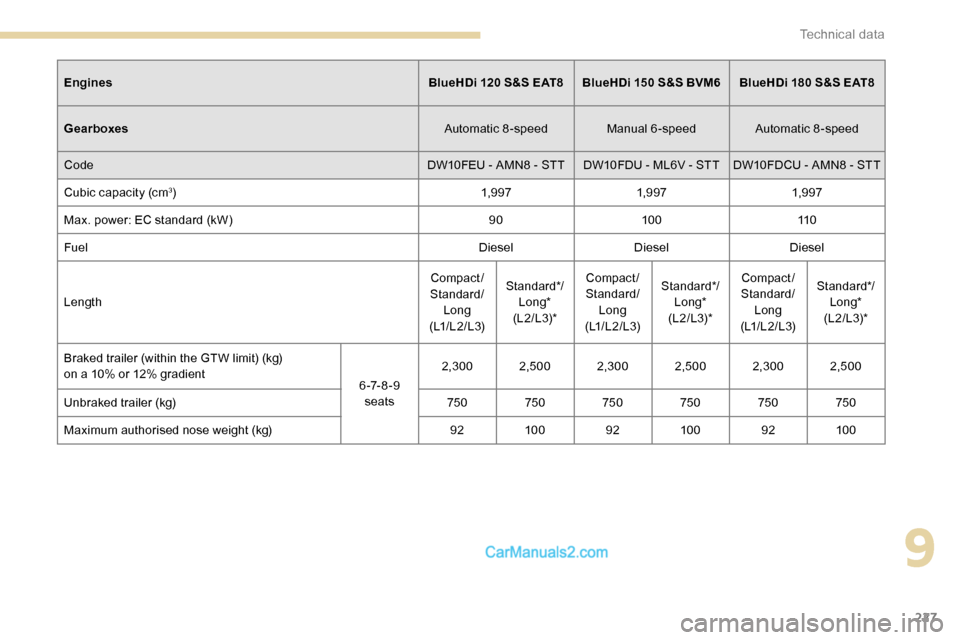
227
EnginesBlueHDi 120 S&S EAT8BlueHDi 150 S&S BVM6 BlueHDi 180 S&S EAT8
Gearboxes Automatic 8-speedManual 6-speedAutomatic 8-speed
Code DW10FEU - AMN8 - STT DW10FDU - ML6V - STT DW10FDCU - AMN8 - STT
Cubic capacity (cm
3) 1,9 971,9 971,9 97
Max. power: EC standard (kW) 9010 0 11 0
Fuel DieselDieselDiesel
Length Compact/
Standard/ Long
(L1/L2/L3) Standard*/
Long*
(L 2 / L3)* Compact/
Standard/ Long
(L1/L2/L3) Standard*/
Long*
(L 2 / L3)* Compact/
Standard/ Long
(L1/L2/L3) Standard*/
Long*
(L 2 / L3)*
Braked trailer (within the GTW limit) (kg)
on a 10% or 12% gradient 6 -7- 8 - 9
seats 2,300 2,500 2,300 2,500 2,300 2,500
Unbraked trailer (kg) 750 750 750 750 750 750
Maximum authorised nose weight (kg) 9210 0 9210 0 9210 0
9
Technical data
Page 267 of 324
15
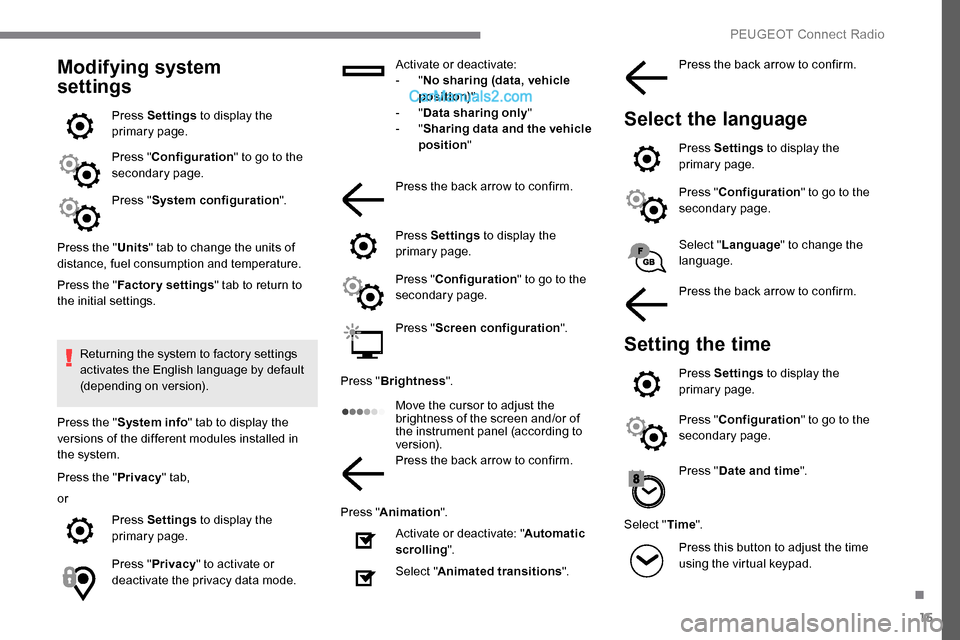
Modifying system
settings
Press Settings to display the
primary page.
Press " Configuration " to go to the
secondary page.
Press " System configuration ".
Press the " Units" tab to change the units of
distance, fuel consumption and temperature.
Press the " Factory settings " tab to return to
the initial settings.
Returning the system to factory settings
activates the English language by default
(depending on version).
Press the " System info " tab to display the
versions of the different modules installed in
the system.
Press the " Privacy" tab,
or Press Settings to display the
primary page.
Press " Privacy " to activate or
deactivate the privacy data mode. Activate or deactivate:
-
"
No sharing (data, vehicle
position) ".
- "
Data sharing only "
- "Sharing data and the vehicle
position "
Press the back arrow to confirm.
Press Settings to display the
primary page.
Press " Configuration " to go to the
secondary page.
Press " Screen configuration ".
Press " Brightness ".
Move the cursor to adjust the
brightness of the screen and/or of
the instrument panel (according to
ve r s i o n).
Press the back arrow to confirm.
Press " Animation ".
Activate or deactivate: " Automatic
scrolling ".
Select " Animated transitions ".Select "
Language " to change the
language.
Press the back arrow to confirm.
Setting the time
Press Settings to display the
primary page.
Press " Configuration " to go to the
secondary page.
Press " Date and time ".
Select " Time".
Press this button to adjust the time
using the virtual keypad. Press the back arrow to confirm.
Select the language
Press Settings to display the
primary page.
Press " Configuration " to go to the
secondary page.
.
PEUGEOT Connect Radio