electrical Peugeot Expert 2019 Owner's Manual
[x] Cancel search | Manufacturer: PEUGEOT, Model Year: 2019, Model line: Expert, Model: Peugeot Expert 2019Pages: 324, PDF Size: 13.07 MB
Page 3 of 324
Welcome
Thank you for choosing a Peugeot Expert or a Peugeot Traveller.
Your vehicle will be fitted with only some of the equipment described in
this document, depending on its trim level, version and the specification
for the country in which it was sold.
The descriptions and illustrations are given as indications only.
Automobiles PEUGEOT reser ves the right to modify the technical
specifications, equipment and accessories without having to update this
edition of the guide.
If ownership of your vehicle is transferred, please ensure this
Handbook is passed on to the new owner.
All of the operating instructions and recommendations are provided
in detail there to make the most of your vehicle. It is strongly
recommended that you familiarise yourself with it as well as the
Maintenance and Warranty Guide, which provides information about
the warranties, ser vicing and roadside assistance associated with the
vehicle.
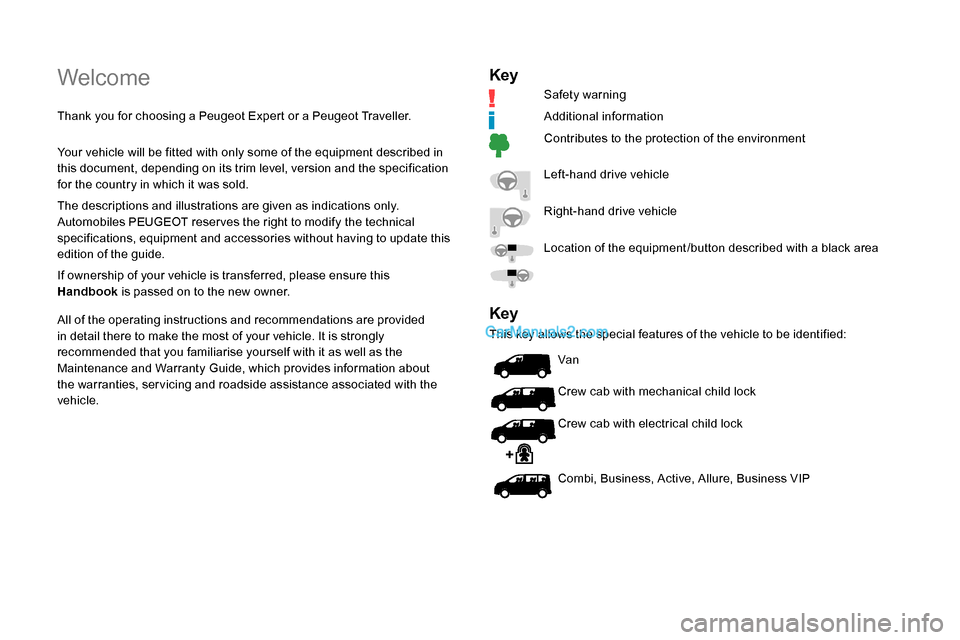
Key
Safety warning
Additional information
Contributes to the protection of the environment
Left-hand drive vehicle
Right-hand drive vehicle
Location of the equipment /button described with a black area
Key
This key allows the special features of the vehicle to be identified: Van
Crew cab with mechanical child lock
Crew cab with electrical child lock
Combi, Business, Active, Allure, Business VIP
Page 9 of 324
7
As a passenger, avoid connecting your
multimedia devices (film, music, video game,
etc.) to contribute towards reducing the
consumption of electrical energy, and so of
fuel.
Disconnect all portable devices before leaving
the vehicle.
Eco- driving
Optimise the use of your
gearbox
With a manual gearbox, move off gently and
change up without waiting. While accelerating,
change up early.
With an electronic gearbox, favour automatic
mode, without pressing the accelerator pedal
heavily or suddenly.
With an automatic gearbox, favour automatic
mode, without pressing the accelerator pedal
heavily or suddenly.
Drive smoothly
Maintain a safe distance between vehicles,
use engine braking rather than the brake
pedal and press the accelerator gradually.
These practices contribute towards a
reduction in fuel consumption and CO
2 emissions and also help to reduce the
background traffic noise.
If your vehicle has the steering-mounted
"CRUISE" control, make use of cruise control
at speeds above 25 mph (40 km/h) when the
traffic is flowing well.
Be proficient in the use of
electrical equipment
Before moving off, if the passenger
compartment is too warm, ventilate it by
opening the windows and air vents before
using the air conditioning.
Above 31
mph (50 km/h), close the windows
and leave the air vents open.
Consider using equipment that can help
keep the temperature in the passenger
compartment down (sunroof blind and window
blinds, etc.). Switch off the headlamps and front foglamps
when the visibility conditions do not require
their use.
Avoid running the engine before moving off,
particularly in winter; your vehicle will warm up
much faster while driving. Unless it has automatic regulation, switch off
the air conditioning as soon as the desired
temperature has been reached.
Switch off the demisting and defrosting
controls, if these are not automatically
managed.
Switch off the heated seat as soon as
possible.
Eco-driving is a range of everyday practices that allow the motorist to optimise their fuel consumption and CO
2 emissions.
The gear efficiency indicator invites you to
engage the most suitable gear: as soon as the
indication is displayed in the instrument panel,
follow it straight away.
With an electronic gearbox, this indicator
appears only in manual mode.
With an automatic gearbox, this indicator
appears only in manual mode.
.
Eco-driving
Page 13 of 324
11
Persistent warning lamp
When the engine is running or the vehicle is
being driven, the illumination of a red or orange
warning lamp indicates a fault that needs
further investigation, using any associated
message and the description of the warning
lamp in the documentation.
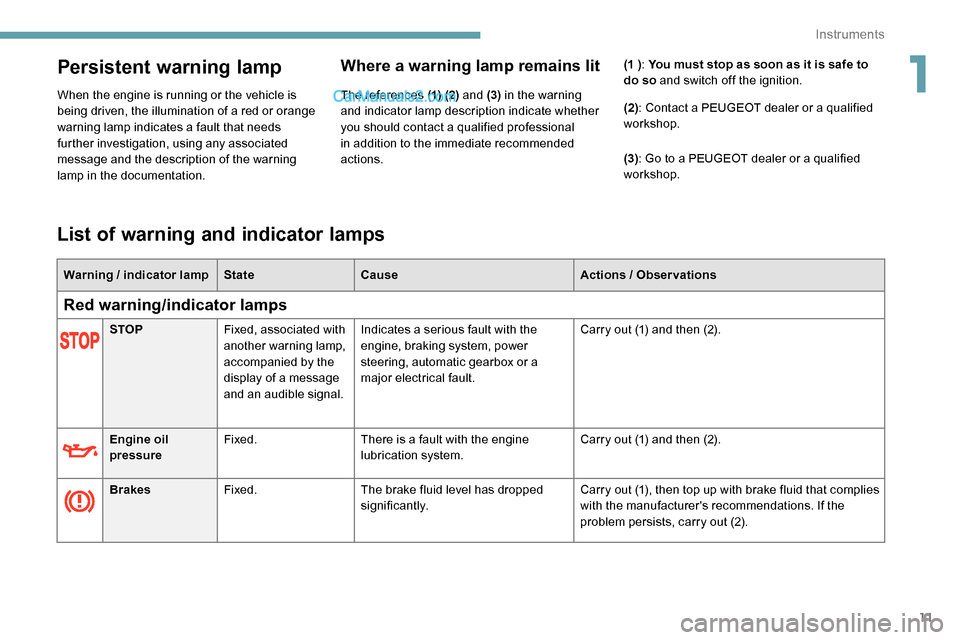
Where a warning lamp remains lit
The references (1) (2) and (3) in the warning
and indicator lamp description indicate whether
you should contact a qualified professional
in addition to the immediate recommended
actions. (1 )
: You must stop as soon as it is safe to
do so and switch off the ignition.
(2): Contact a PEUGEOT dealer or a qualified
workshop.
(3) : Go to a PEUGEOT dealer or a qualified
workshop.
STOP Fixed, associated with
another warning lamp,
accompanied by the
display of a message
and an audible signal. Indicates a serious fault with the
engine, braking system, power
steering, automatic gearbox or a
major electrical fault.
Carry out (1) and then (2).
Engine oil
pressure Fixed.
There is a fault with the engine
lubrication system. Carry out (1) and then (2).
Brakes Fixed. The brake fluid level has dropped
significantly. Carry out (1), then top up with brake fluid that complies
with the manufacturer's recommendations. If the
problem persists, carry out (2).
List of warning and indicator lamps
Warning
/ indicator lamp State Cause Actions / Observations
Red warning/indicator lamps
1
Instruments
Page 45 of 324
43
Automatic
The loading area is always locked when
driving.
To deactivate the automatic locking
function, go to a PEUGEOT dealer or a
qualified workshop.
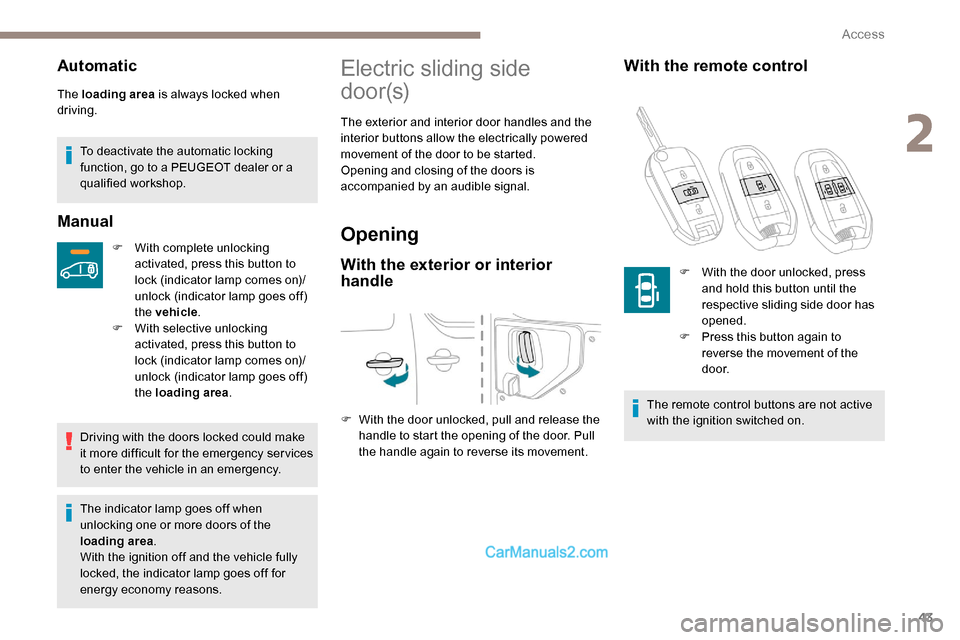
Manual
F With complete unlocking activated, press this button to
lock (indicator lamp comes on)/
unlock (indicator lamp goes off)
the vehicle .
F
W
ith selective unlocking
activated, press this button to
lock (indicator lamp comes on)/
unlock (indicator lamp goes off)
the loading area .
Electric sliding side
d o o r (s)
Opening
With the exterior or interior
handle
F With the door unlocked, pull and release the
handle to start the opening of the door. Pull
the handle again to reverse its movement.
Driving with the doors locked could make
it more difficult for the emergency ser vices
to enter the vehicle in an emergency.
The indicator lamp goes off when
unlocking one or more doors of the
loading area .
With the ignition off and the vehicle fully
locked, the indicator lamp goes off for
energy economy reasons. The exterior and interior door handles and the
interior buttons allow the electrically powered
movement of the door to be started.
Opening and closing of the doors is
accompanied by an audible signal.
With the remote control
F With the door unlocked, press
and hold this button until the
respective sliding side door has
opened.
F
P
ress this button again to
reverse the movement of the
d o o r.
The remote control buttons are not active
with the ignition switched on.
2
Access
Page 47 of 324
45
The button is not operational and pressing
it results in an audible signal, if the speed
of the vehicle is above 20 mph (30 km/h).
The button(s) at the front or on the door
pillar is not operational and pressing it
results in an audible signal, if:
-
t
he vehicle is moving,
-
t
he child lock is on (activated) (for the
buttons on the door pillars),
-
t
he vehicle has been locked or
deadlocked from outside (using
the key, remote control or Keyless
Entry and Starting, depending on
equipment).
The button for the left-hand door is not
operational and pressing it results in an
audible signal if the fuel filler flap is open.General
recommendations for the
sliding side doors
The doors must only be operated when
the vehicle is stationary.
For your safety and for that of your
passengers, as well as for correct
operation of the doors, you are strongly
advised not to drive with a door open.
Always check that it is safe to operate the
door and in particular, be sure not to leave
children or animals near the door controls
without supervision.
The audible warning, the illumination
of the "door open" warning lamp and
the message on the screen are there to
remind you. Contact a PEUGEOT dealer
or a qualified workshop to have this
warning deactivated.
Lock the vehicle when using an automatic
car wash. Before opening or closing or per forming
any movement of the doors, ensure that
no person, animal or object is in the
window frame or could block the desired
movement, inside or outside the vehicle.
If this advice is not followed, injuries or
damage may occur if a part of the body or
an object is trapped or caught.
The doors cannot be opened electrically
above 2 mph (3
km/h ):
-
H
owever, if the doors remained open
when starting, the speed must fall
below 19 mph (30
km/h) before they
can be closed.
-
A
ny attempt to open a door electrically
using the interior handle while driving
results in it only being possible to open
the door manually.
-
I
n this case, the audible warning will be
given, accompanied by the illumination
of the "door open" warning lamp and
the message on the screen. To release
the door and be able to operate it
again, it is necessary to stop the
vehicle.
2
Access
Page 48 of 324
46
Take care not to block the guide space
on the floor to allow the door to slide
c o r r e c t l y.
As a safety measure and for functional
reasons, do not drive with the sliding side
door open.
The electric controls are inhibited in the
event of an impact. Manual opening and
closing remain possible.
While starting the engine, the movement
of a door is interrupted and continues
once the engine is running.Depending on the engine, if the
door is closed and an attempt
is made to open it in Stop mode
of Stop & Start, the door opens
partially and stops. In Start mode,
when the engine restarts, the
door continues its movement.
To hold the sliding side door in the open
position, open the door fully to engage the
locking device (located at the bottom of
the door).Doors and their obstruction Safety/Obstacle detection
with electric door(s)
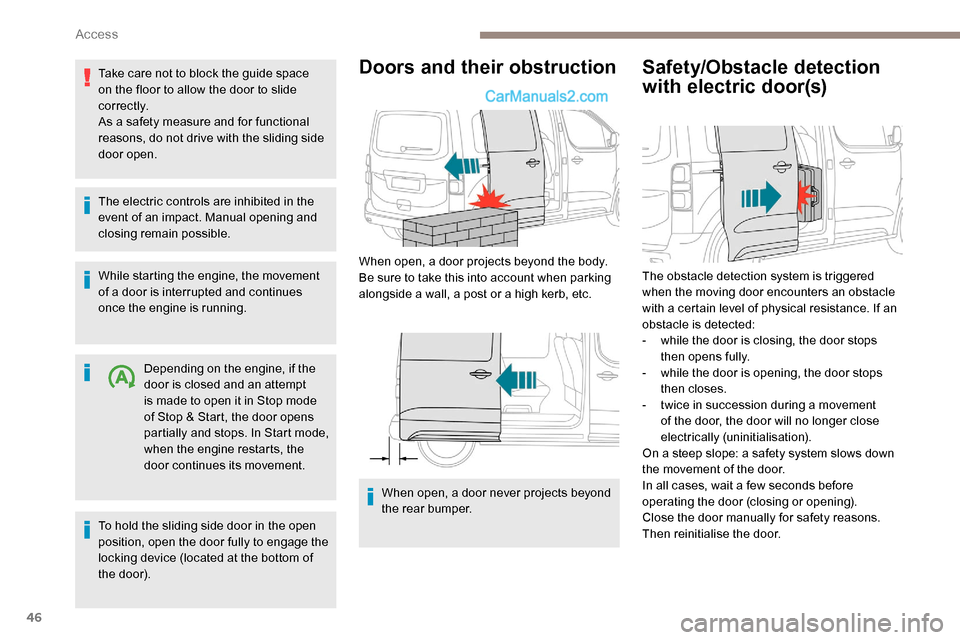
When open, a door projects beyond the body.
Be sure to take this into account when parking
alongside a wall, a post or a high kerb, etc.
When open, a door never projects beyond
the rear bumper. The obstacle detection system is triggered
when the moving door encounters an obstacle
with a certain level of physical resistance. If an
obstacle is detected:
-
w
hile the door is closing, the door stops
then opens fully.
-
w
hile the door is opening, the door stops
then closes.
-
t
wice in succession during a movement
of the door, the door will no longer close
electrically (uninitialisation).
On a steep slope: a safety system slows down
the movement of the door.
In all cases, wait a few seconds before
operating the door (closing or opening).
Close the door manually for safety reasons.
Then reinitialise the door.
Access
Page 49 of 324
47
Reinitialising electric doors
If electrical operations no longer work:
F
F
ully close the door(s) manually .
F
F
ully open the door(s) electrically .
F
C
lose the door(s) electrically .
On completion of this procedure, electric
operation of the doors is restored.
However, if a problem persists following this
procedure, contact a PEUGEOT dealer or a
qualified workshop.
On a steep slope
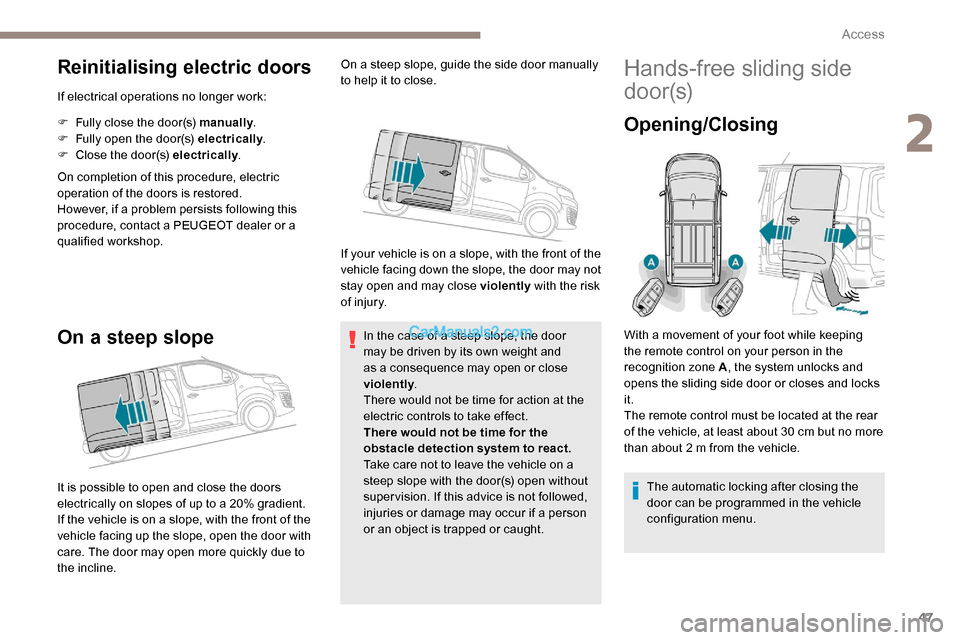
It is possible to open and close the doors
electrically on slopes of up to a 20% gradient.
If the vehicle is on a slope, with the front of the
vehicle facing up the slope, open the door with
care. The door may open more quickly due to
the incline. On a steep slope, guide the side door manually
to help it to close.
If your vehicle is on a slope, with the front of the
vehicle facing down the slope, the door may not
stay open and may close violently
with the risk
of injury.
In the case of a steep slope, the door
may be driven by its own weight and
as a consequence may open or close
violently .
There would not be time for action at the
electric controls to take effect.
There would not be time for the
obstacle detection system to react.
Take care not to leave the vehicle on a
steep slope with the door(s) open without
supervision. If this advice is not followed,
injuries or damage may occur if a person
or an object is trapped or caught.
Hands-free sliding side
d o o r (s)
Opening/Closing
The automatic locking after closing the
door can be programmed in the vehicle
configuration menu.
With a movement of your foot while keeping
the remote control on your person in the
recognition zone A
, the system unlocks and
opens the sliding side door or closes and locks
it.
The remote control must be located at the rear
of the vehicle, at least about 30 cm but no more
than about 2 m from the vehicle.
2
Access
Page 55 of 324
53
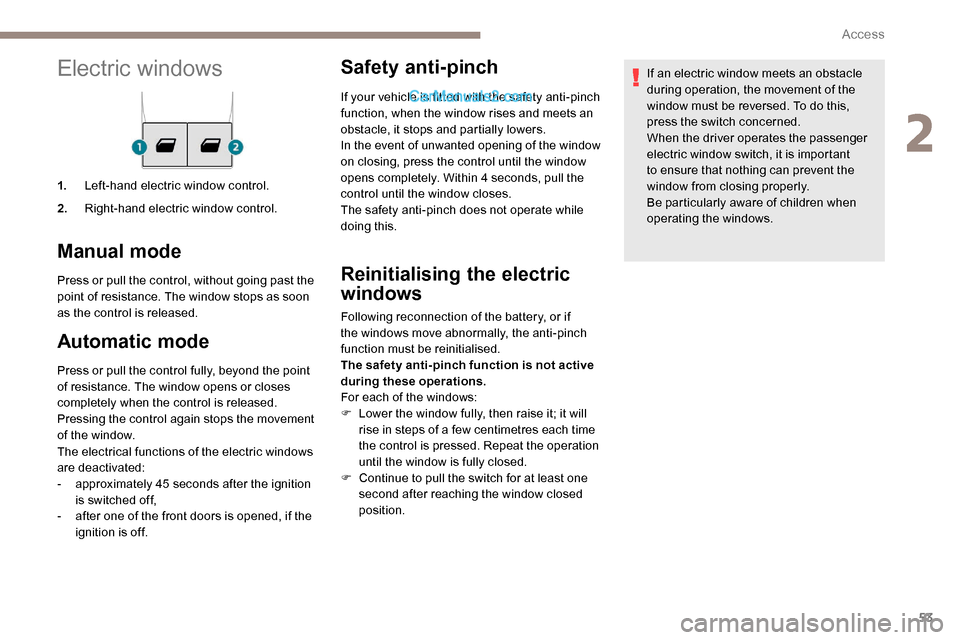
Electric windows
1.Left-hand electric window control.
2. Right-hand electric window control.
Manual mode
Press or pull the control, without going past the
point of resistance. The window stops as soon
as the control is released.
Automatic mode
Press or pull the control fully, beyond the point
of resistance. The window opens or closes
completely when the control is released.
Pressing the control again stops the movement
of the window.
The electrical functions of the electric windows
are deactivated:
-
a
pproximately 45 seconds after the ignition
is switched off,
-
a
fter one of the front doors is opened, if the
ignition is off.
Safety anti-pinch
If your vehicle is fitted with the safety anti-pinch
function, when the window rises and meets an
obstacle, it stops and partially lowers.
In the event of unwanted opening of the window
on closing, press the control until the window
opens completely. Within 4 seconds, pull the
control until the window closes.
The safety anti-pinch does not operate while
doing this.
Reinitialising the electric
windows
Following reconnection of the battery, or if
the windows move abnormally, the anti-pinch
function must be reinitialised.
The safety anti-pinch function is not active
during these operations.
For each of the windows:
F
L
ower the window fully, then raise it; it will
rise in steps of a few centimetres each time
the control is pressed. Repeat the operation
until the window is fully closed.
F
C
ontinue to pull the switch for at least one
second after reaching the window closed
position. If an electric window meets an obstacle
during operation, the movement of the
window must be reversed. To do this,
press the switch concerned.
When the driver operates the passenger
electric window switch, it is important
to ensure that nothing can prevent the
window from closing properly.
Be particularly aware of children when
operating the windows.
2
Access
Page 59 of 324
57
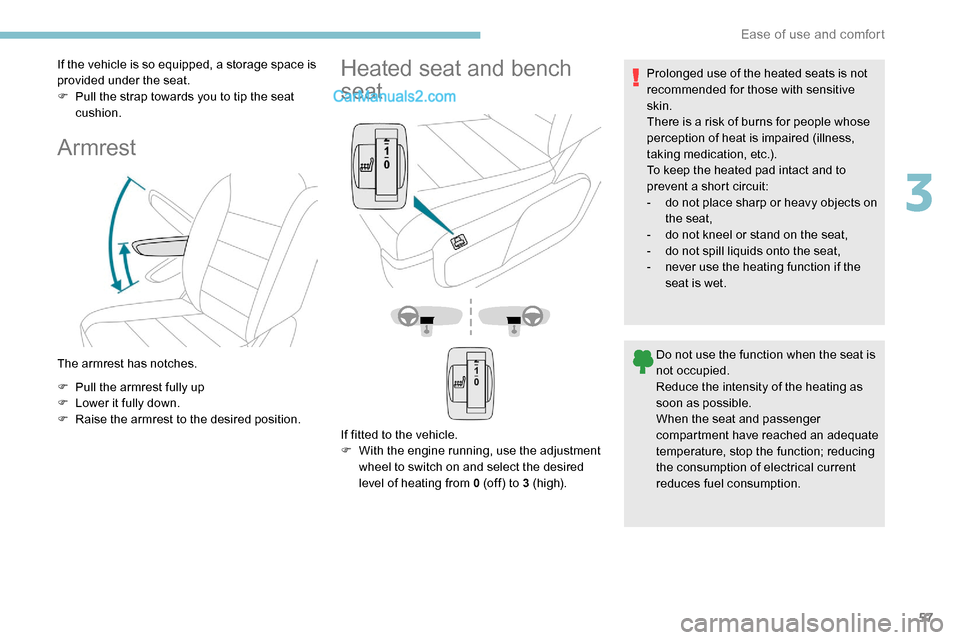
If the vehicle is so equipped, a storage space is
provided under the seat.
F
P
ull the strap towards you to tip the seat
cushion.
Armrest
The armrest has notches.
F
P
ull the armrest fully up
F
L
ower it fully down.
F
R
aise the armrest to the desired position.
Heated seat and bench
seat
If fitted to the vehicle.
F W ith the engine running, use the adjustment
wheel to switch on and select the desired
level of heating from 0
(off) to 3 (h i g h).Prolonged use of the heated seats is not
recommended for those with sensitive
skin.
There is a risk of burns for people whose
perception of heat is impaired (illness,
taking medication, etc.).
To keep the heated pad intact and to
prevent a short circuit:
-
d
o not place sharp or heavy objects on
the seat,
-
d
o not kneel or stand on the seat,
-
d
o not spill liquids onto the seat,
-
n
ever use the heating function if the
seat is wet.
Do not use the function when the seat is
not occupied.
Reduce the intensity of the heating as
soon as possible.
When the seat and passenger
compartment have reached an adequate
temperature, stop the function; reducing
the consumption of electrical current
reduces fuel consumption.
3
Ease of use and comfort
Page 61 of 324
59
Mirrors
Door mirrors
Manual adjustment
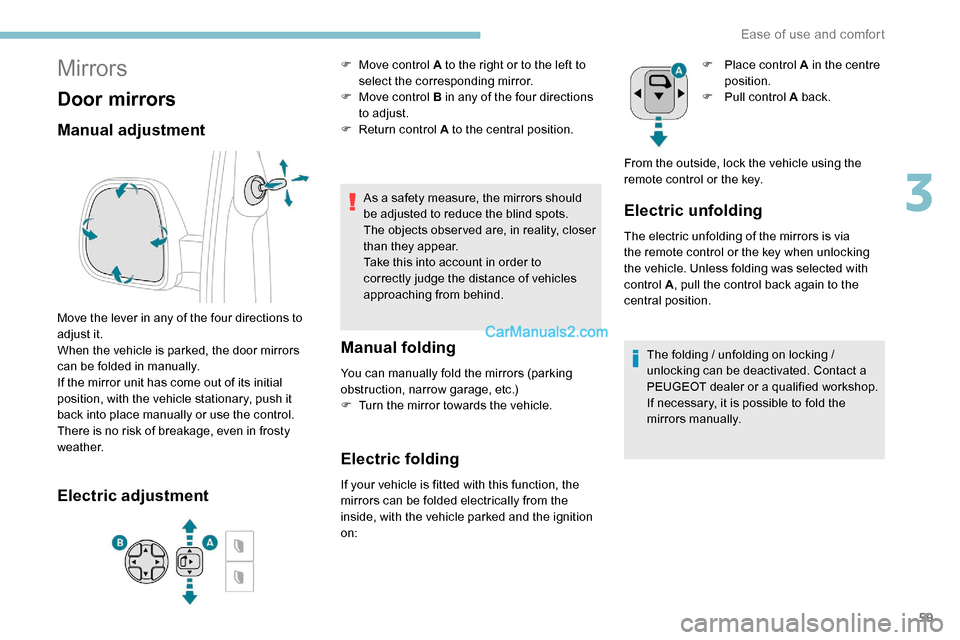
Move the lever in any of the four directions to
adjust it.
When the vehicle is parked, the door mirrors
can be folded in manually.
If the mirror unit has come out of its initial
position, with the vehicle stationary, push it
back into place manually or use the control.
There is no risk of breakage, even in frosty
weather.
Electric adjustment
F Move control A to the right or to the left to select the corresponding mirror.
F
M
ove control B in any of the four directions
to adjust.
F
R
eturn control A to the central position.
As a safety measure, the mirrors should
be adjusted to reduce the blind spots.
The objects obser ved are, in reality, closer
than they appear.
Take this into account in order to
correctly judge the distance of vehicles
approaching from behind.
Manual folding
You can manually fold the mirrors (parking
obstruction, narrow garage, etc.)
F
T
urn the mirror towards the vehicle.
Electric folding
If your vehicle is fitted with this function, the
mirrors can be folded electrically from the
inside, with the vehicle parked and the ignition
on:
Electric unfolding
The electric unfolding of the mirrors is via
the remote control or the key when unlocking
the vehicle. Unless folding was selected with
control A , pull the control back again to the
central position. F
P
lace control A in the centre
position.
F
P
ull control A back.
From the outside, lock the vehicle using the
remote control or the key.
The folding / unfolding on locking /
unlocking can be deactivated. Contact a
PEUGEOT dealer or a qualified workshop.
If necessary, it is possible to fold the
mirrors manually.
3
Ease of use and comfort