electrical Peugeot Expert 2019 User Guide
[x] Cancel search | Manufacturer: PEUGEOT, Model Year: 2019, Model line: Expert, Model: Peugeot Expert 2019Pages: 324, PDF Size: 13.07 MB
Page 78 of 324
76
Use the Velcro to connect the transverse mats
in row 2 with the longitudinal mats in rows 2
and 3.
Glove box
It houses the front passenger airbag
deactivation switch and can hold a bottle of
water, the vehicle's handbook pack, etc.Never drive with the glove box (if
equipped) open when a passenger is
sitting at the front. It may cause injury
during sharp deceleration.
Storage compartment
This can hold a bottle of water, the vehicle's
documentation, etc. F
T
o open the storage compartment, press
the left-hand end of the control and guide
the lid to its open position notch.
If your vehicle is so equipped, it is lit when the
lid is opened.
When driving , keep the storage
compartment closed. Otherwise, there is a
risk of injury in the event of an accident or
sudden braking.
Depending on the country of
sale, with air conditioning, it
gives access to the ventilation
nozzle, delivering the same air-
conditioned air as the vents in
the passenger compartment.
Front door storage pockets
Liquids carried in an open vessel (e.g.
a cup or mug) could be spilt, presenting
a risk of damage on contact with the
controls in the dashboard and centre
console. Be careful.
Upper glove box
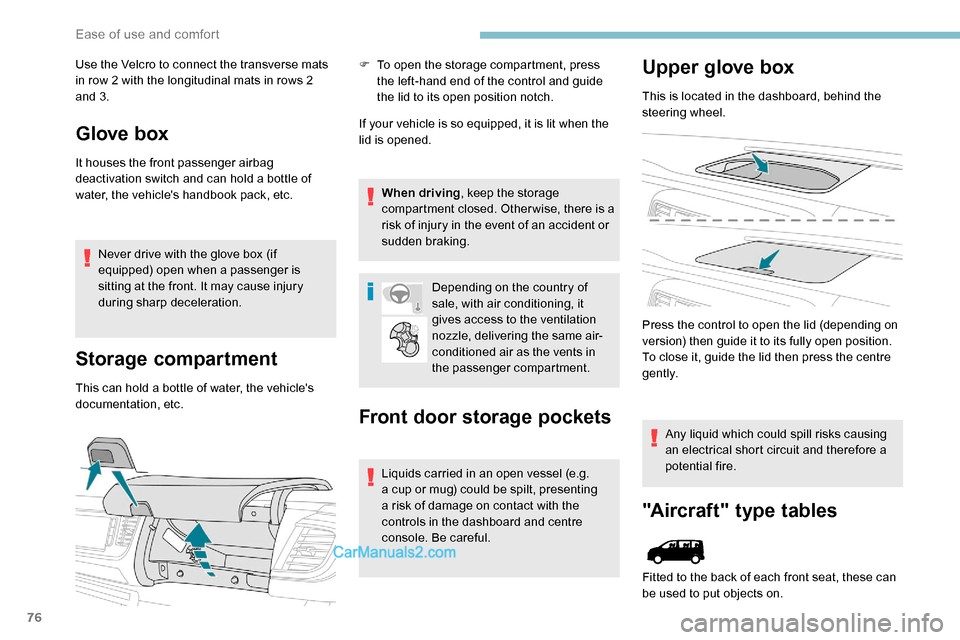
This is located in the dashboard, behind the
steering wheel.
Press the control to open the lid (depending on
version) then guide it to its fully open position.
To close it, guide the lid then press the centre
g e nt l y.
Any liquid which could spill risks causing
an electrical short circuit and therefore a
potential fire.
"Aircraft" type tables
Fitted to the back of each front seat, these can
be used to put objects on.
Ease of use and comfort
Page 79 of 324
77
On the passenger side, do not forget to
fold it before placing the seat in the "table"
position.
Do not place hard or heavy objects on
the table. They could become dangerous
projectiles in the event of emergency
braking or impact.
For more information on the Front seats
and, in particular, the "table" position of
the backrest, refer to the corresponding
section.
12 V socket(s)
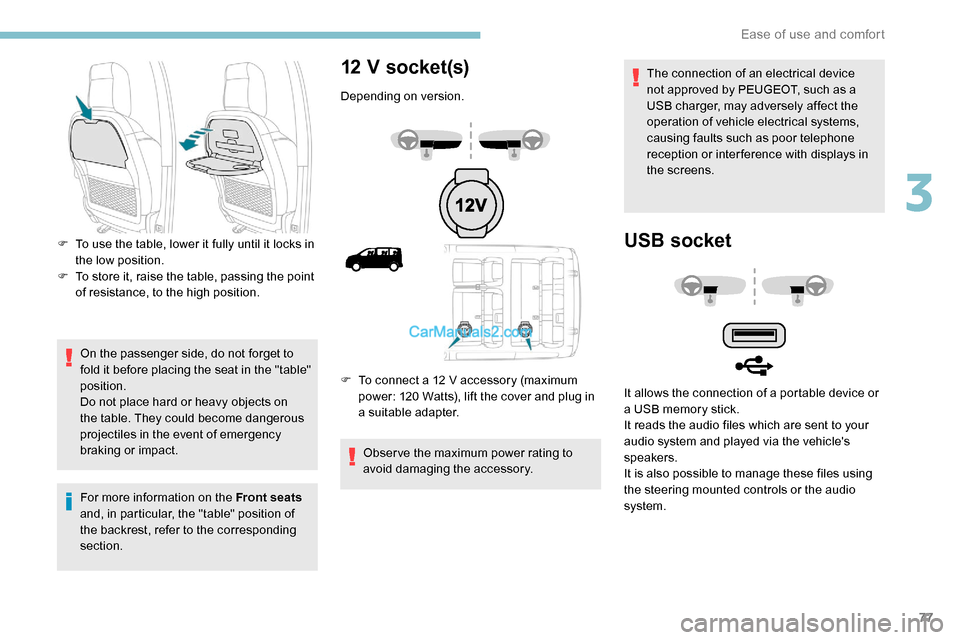
Depending on version.
F
T
o connect a 12 V accessory (maximum
power: 120 Watts), lift the cover and plug in
a suitable adapter.
Obser ve the maximum power rating to
avoid damaging the accessory. The connection of an electrical device
not approved by PEUGEOT, such as a
USB charger, may adversely affect the
operation of vehicle electrical systems,
causing faults such as poor telephone
reception or inter ference with displays in
the screens.
USB socketF To use the table, lower it fully until it locks in
the low position.
F
T
o store it, raise the table, passing the point
of resistance, to the high position.
It allows the connection of a portable device or
a USB memory stick.
It reads the audio files which are sent to your
audio system and played via the vehicle's
speakers.
It is also possible to manage these files using
the steering mounted controls or the audio
system.
3
Ease of use and comfort
Page 80 of 324
78
When the USB socket is used, the
portable device charges automatically.
While charging, a message is displayed
if the power consumption of the portable
device exceeds the amperage supplied by
the vehicle.
For more information on the use of this
equipment, refer to the Audio equipment
and telematics section.
JACK socket
This allows the connection of a portable device
for listening to audio files via the vehicle's
speakers.
The files are managed using the portable
device.
For more details on how to use this
equipment, refer to the Audio equipment
and telematics section.
220 V socket
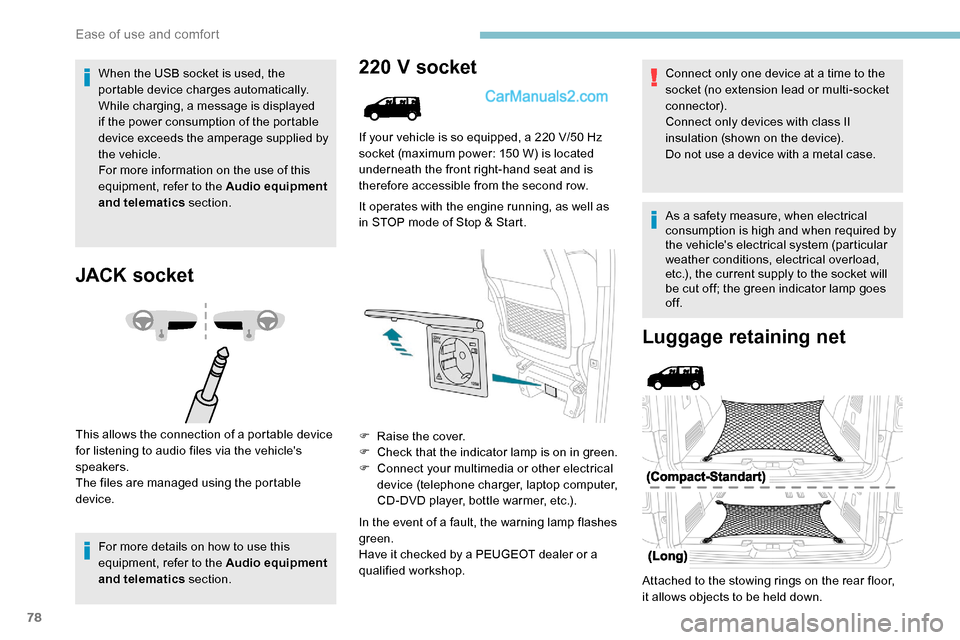
If your vehicle is so equipped, a 220 V/50 Hz
socket (maximum power: 150 W) is located
underneath the front right-hand seat and is
therefore accessible from the second row.
It operates with the engine running, as well as
in STOP mode of Stop & Start.
F
Ra
ise the cover.
F
C
heck that the indicator lamp is on in green.
F
C
onnect your multimedia or other electrical
device (telephone charger, laptop computer,
CD-DVD player, bottle warmer, etc.).
In the event of a fault, the warning lamp flashes
green.
Have it checked by a PEUGEOT dealer or a
qualified workshop.
Luggage retaining net
Attached to the stowing rings on the rear floor,
it allows objects to be held down. Connect only one device at a time to the
socket (no extension lead or multi-socket
connector).
Connect only devices with class II
insulation (shown on the device).
Do not use a device with a metal case.
As a safety measure, when electrical
consumption is high and when required by
the vehicle's electrical system (particular
weather conditions, electrical overload,
etc.), the current supply to the socket will
be cut off; the green indicator lamp goes
of f.
Ease of use and comfort
Page 94 of 324
92
Switch off the defrosting as soon as
it is no longer necessary, as reducing
the consumption of electrical current
reduces fuel consumption.
Demisting and defrosting only operates
with the engine running.
Rear heating - air
conditioning
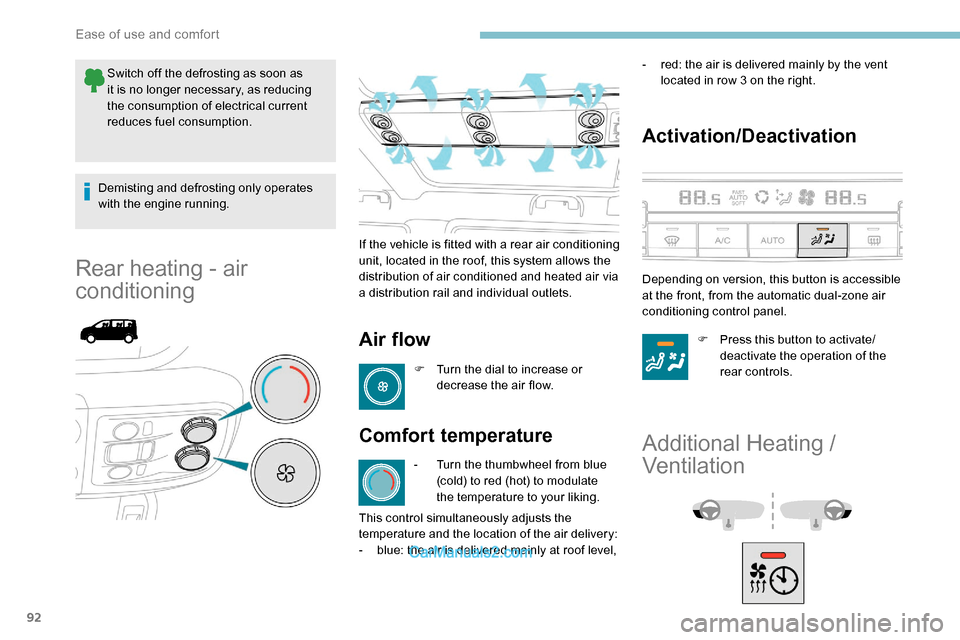
If the vehicle is fitted with a rear air conditioning
unit, located in the roof, this system allows the
distribution of air conditioned and heated air via
a distribution rail and individual outlets.
Air flow
F Turn the dial to increase or decrease the air flow.
Comfort temperature
- Turn the thumbwheel from blue (cold) to red (hot) to modulate
the temperature to your liking.
This control simultaneously adjusts the
temperature and the location of the air delivery:
-
b
lue: the air is delivered mainly at roof level, -
r
ed: the air is delivered mainly by the vent
located in row 3 on the right.
Activation/Deactivation
Depending on version, this button is accessible
at the front, from the automatic dual-zone air
conditioning control panel.
F
P
ress this button to activate/
deactivate the operation of the
rear controls.
Additional Heating /
Ventilation
Ease of use and comfort
Page 109 of 324
107
General safety
recommendations
Labels are affixed in different locations on
your vehicle. They include safety warnings
and vehicle identification information. Do
not remove them: they are an integral part
of your vehicle.
For any work on your vehicle, use a
qualified workshop that has the technical
information, skills and equipment required,
all of which a PEUGEOT dealer is able to
provide.
Depending on country regulations, some
safety equipment may be compulsory:
high visibility safety vests, warning
triangles, breathalysers, spare bulbs,
spare fuses, fire extinguisher, first aid kit,
mud flaps at the rear of the vehicle, etc.We draw your attention to the following
points:
-
T
he fitting of electrical equipment
or accessories not approved by
PEUGEOT may cause excessive
current consumption and faults and
failures with the electrical system of
your vehicle. Contact a PEUGEOT
dealer for information on the range of
recommended accessories.
-
A
s a safety measure, access to
the diagnostic socket, used for the
vehicle's electronic systems, is
reser ved strictly for PEUGEOT dealers
or qualified workshop, equipped
with the special tools required (risk
of malfunctions of the vehicle's
electronic systems that could cause
breakdowns or serious accidents).
The manufacturer cannot be held
responsible if this advice is not
followed.
-
A
ny modification or adaptation not
intended or authorised by PEUGEOT
or carried out without meeting the
technical requirements defined by
the manufacturer will result in the
suspension of the legal and contractual
warranties. Installation of accessory radio
communication transmitters
Before installing a radio communication
transmitter with an external aerial, you
must without fail contact a PEUGEOT
dealer for the specification of transmitters
which can be fitted (frequency, maximum
power, aerial position, specific installation
requirements), in line with the Vehicle
Electromagnetic Compatibility Directive
(2004/104/EC).
5
Safety
Page 129 of 324
127
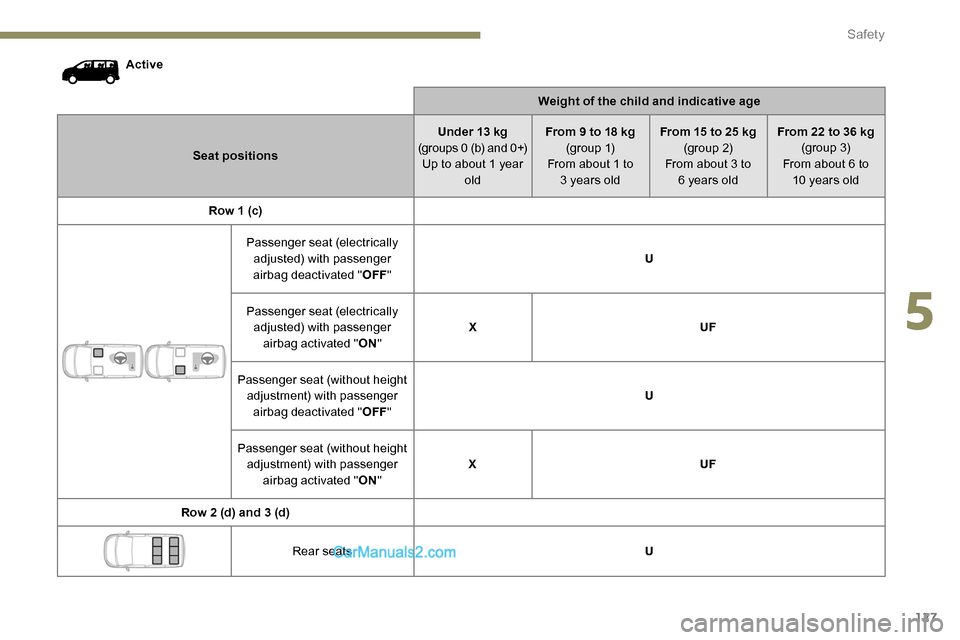
ActiveWeight of the child and indicative age
Seat positions Under 13 kg
(groups 0 (b) and 0+) Up to about 1 year old From 9 to 18 kg
(g r o u p 1)
From about 1 to 3 years old From 15 to 25 kg
(group 2)
From about 3 to 6 years old From 22 to 36 kg
(group 3)
From about 6 to 10 years old
Row 1 (c)
Passenger seat (electrically adjusted) with passenger
airbag deactivated " OFF" U
Passenger seat (electrically adjusted) with passenger airbag activated " ON" X
UF
Passenger seat (without height adjustment) with passenger airbag deactivated " OFF" U
Passenger seat (without height adjustment) with passenger airbag activated " ON" X
UF
Row 2 (d) and 3 (d) Rear seats U
5
Safety
Page 130 of 324
128
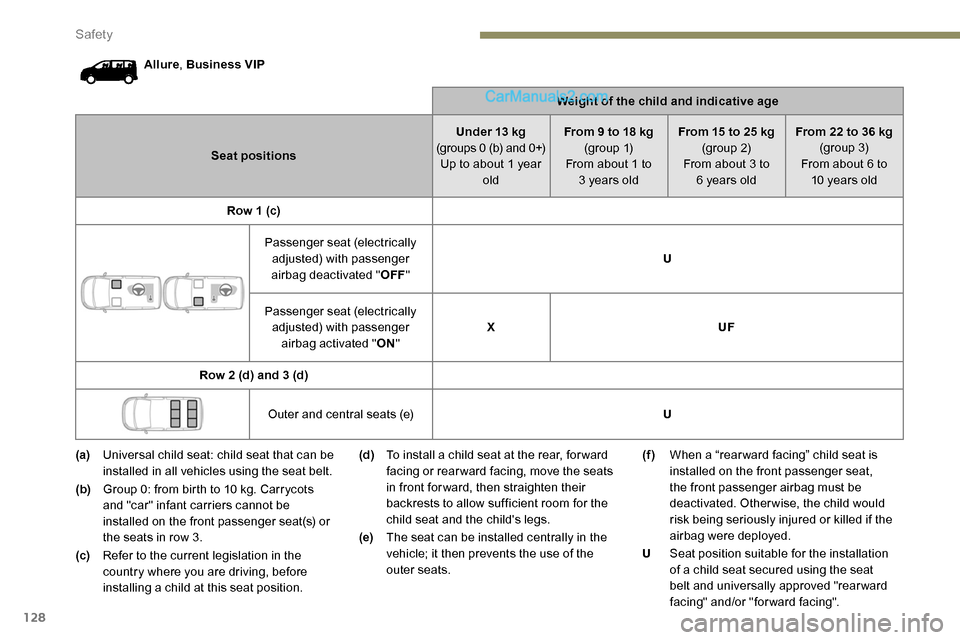
Allure, Business VIP
Weight of the child and indicative age
Seat positions Under 13 kg
(groups 0 (b) and 0+) Up to about 1 year old From 9 to 18 kg
(g r o u p 1)
From about 1 to 3 years old From 15 to 25 kg
(group 2)
From about 3 to 6 years old From 22 to 36 kg
(group 3)
From about 6 to 10 years old
Row 1 (c)
Passenger seat (electrically adjusted) with passenger
airbag deactivated " OFF" U
Passenger seat (electrically adjusted) with passenger airbag activated " ON" X
UF
Row 2 (d) and 3 (d) Outer and central seats (e) U
(a) Universal child seat: child seat that can be
installed in all vehicles using the seat belt.
(b) Group 0: from birth to 10 kg. Carrycots
and "car" infant carriers cannot be
installed on the front passenger seat(s) or
the seats in row 3.
(c) Refer to the current legislation in the
country where you are driving, before
installing a child at this seat position. (d)
To install a child seat at the rear, for ward
facing or rear ward facing, move the seats
in front for ward, then straighten their
backrests to allow sufficient room for the
child seat and the child's legs.
(e) The seat can be installed centrally in the
vehicle; it then prevents the use of the
outer seats. (f )
When a “rear ward facing” child seat is
installed on the front passenger seat,
the front passenger airbag must be
deactivated. Otherwise, the child would
risk being seriously injured or killed if the
airbag were deployed.
U Seat position suitable for the installation
of a child seat secured using the seat
belt and universally approved "rear ward
facing" and/or "forward facing".
Safety
Page 140 of 324
138
Driving recommendations
F Observe the driving regulations and remain vigilant whatever the traffic conditions.
F
M
onitor your environment and keep your
hands on the wheel to be able to react to
anything that may happen any time.
F
D
rive smoothly, anticipate the need for
braking and maintain a longer safety
distance, especially in bad weather.
F
S
top the vehicle to carry out operations
that require close attention (such as
adjustments).
F
D
uring long trips, take a break every two
hours.
To assure the durability of your vehicle and
for safety reasons, remember that certain
precautions, described hereafter, should be
taken when driving your vehicle:
Manoeuvre cautiously, at low
speed
The dimensions of this vehicle differ greatly
from those of a light vehicle, in width, in height,
as well as in length, and some obstacles will be
more difficult to notice.
Manoeuvre slowly.
Before turning, check that there are no
obstacles at mid-height along the sides.
Before reversing, check that there are no
obstacles, particularly at high level behind the
vehicle.
Be aware of the external dimensions, if ladders
are fitted.
Drive the vehicle in a cautious
and efficient way
Take corners gently.
Anticipate the need to brake as the stopping
distance is increased, particularly on wet or icy
roads.
Be aware of the effect of side winds on the
vehicle.
Be careful
The tyres must be inflated to at least the
pressures indicated on the label, even over-
inflated by 0.2 to 0.3 bar for long journeys.
Important!
Never leave the engine running in
a closed space without sufficient
ventilation. Internal combustion engines
emit toxic exhaust gases such as carbon
monoxide. Danger of poisoning and death!
In severe wintry conditions (temperature
below -23°C), let the engine run for 4
minutes before moving off, to ensure the
correct operation and durability of the
mechanical components of your vehicle
(engine and gearbox). Never drive with the parking brake
applied
. Risk of overheating and damage
to the braking system!
Do not park the vehicle or leave the
engine running on a flammable sur face
(dr y grass, dead leaves, etc.). The
exhaust system of your vehicle is very
hot, even several minutes after the engine
stops. Risk of fire!
Never leave a vehicle unattended with
the engine running. If you have to leave
your vehicle with the engine running, apply
the parking brake and put the gearbox into
neutral or position N or P (depending on
the type of gearbox).
Never leave children inside the vehicle
unsupervised .
On flooded roads
We strongly advise against driving on flooded
roads, as this could cause serious damage
to the engine or gearbox, as well as to the
electrical systems of your vehicle.
Driving
Page 141 of 324
139
In case of towing
Driving with a trailer places greater
demands on the towing vehicle and
requires extra care from the driver.Respect the maximum towable weights.
At altitude:
reduce the maximum load
by 10% per 1,000 metres of altitude; the
density of the air decreases with altitude
and the performance of the engine
reduces.
New vehicle: do not pull a trailer before
having driven at least 620 miles (1,000
kilometres).
If the outside temperature is high, let the
engine idle for 1 to 2 minutes after the
vehicle comes to a stop, to help it to cool.
Before setting off
Nose weight
F Distribute the load in the trailer so that the heaviest items are as close as possible to
the axle and the nose weight (at the point
where it joins your vehicle) approaches the
maximum permitted without exceeding it.
Ty r e s
F Check the tyre pressures of the towing vehicle and of the trailer, observing the
recommended pressures.
Lighting
F Check the electrical signalling on the trailer and the headlamp beam height of your
vehicle.
If a genuine PEUGEOT towing device
is used, the rear parking sensors will be
deactivated automatically to avoid the
audible signal.
When driving
Cooling
Towing a trailer uphill increases the
temperature of the coolant. The maximum
towable load depends on the gradient and the
exterior temperature. The cooling capacity of
the fan does not increase with engine speed.
F
T
o reduce the heating up, reduce the
vehicle speed and the engine speed.
In all cases, keep a check on the coolant
temperature.
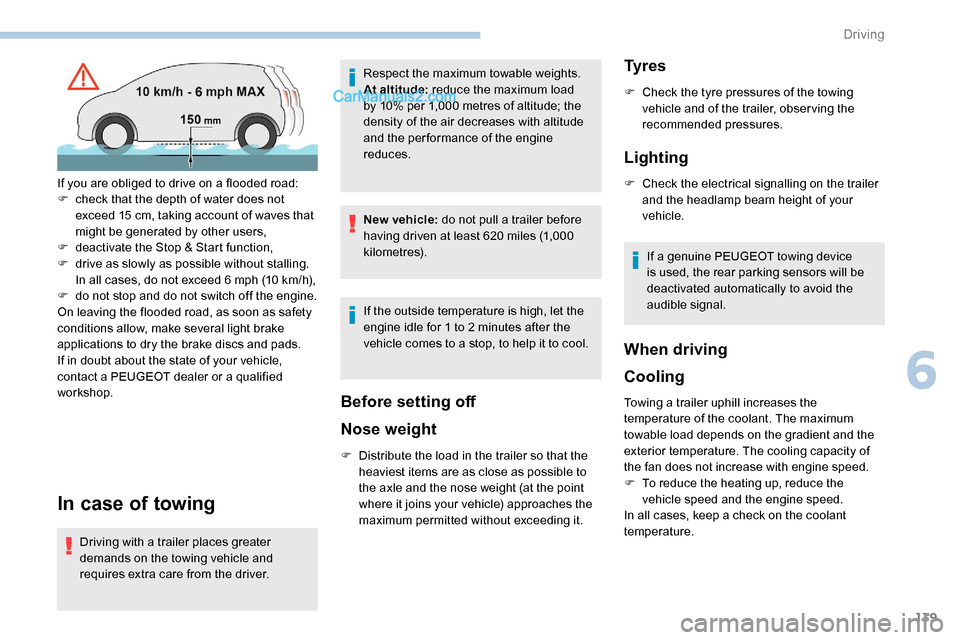
If you are obliged to drive on a flooded road:
F
c
heck that the depth of water does not
exceed 15
cm, taking account of waves that
might be generated by other users,
F
d
eactivate the Stop & Start function,
F
d
rive as slowly as possible without stalling.
In all cases, do not exceed 6 mph (10
km/h),
F
d
o not stop and do not switch off the engine.
On leaving the flooded road, as soon as safety
conditions allow, make several light brake
applications to dry the brake discs and pads.
If in doubt about the state of your vehicle,
contact a PEUGEOT dealer or a qualified
workshop.
6
Driving
Page 193 of 324
191
When the engine is hot, handle the
exterior safety catch and the bonnet
stay with care (risk of burns), using the
protected area.
When the bonnet is open, take care not to
damage the safety catch.
Do not open the bonnet under very windy
conditions.
The cooling fan may star t after
switching off the engine: take care
with articles and clothing that might be
caught by the fan blades.
Opening
F Open the door.
F
P
ull towards you the release lever ( 1),
located at the bottom of the door frame.
F
L
ift the safety catch ( 2), then raise the
bonnet. F
U
nclip the stay (
3) from its housing and
place it in the support slot to hold the bonnet
open.
Closing
F Take the stay out of the support slot.
F C lip the stay in its housing.
F
L
ower the bonnet and release it near the
end of its travel.
F
P
ull on the bonnet to check that it is fully
latched.
Because of the presence of electrical
equipment under the bonnet, it is
recommended that exposure to water
(rain, washing, etc.) be limited.
Engine
Diesel
The diesel circuit is under very high
pressure.
All work on this circuit must be carried out
only by a PEUGEOT dealer or a qualified
workshop.
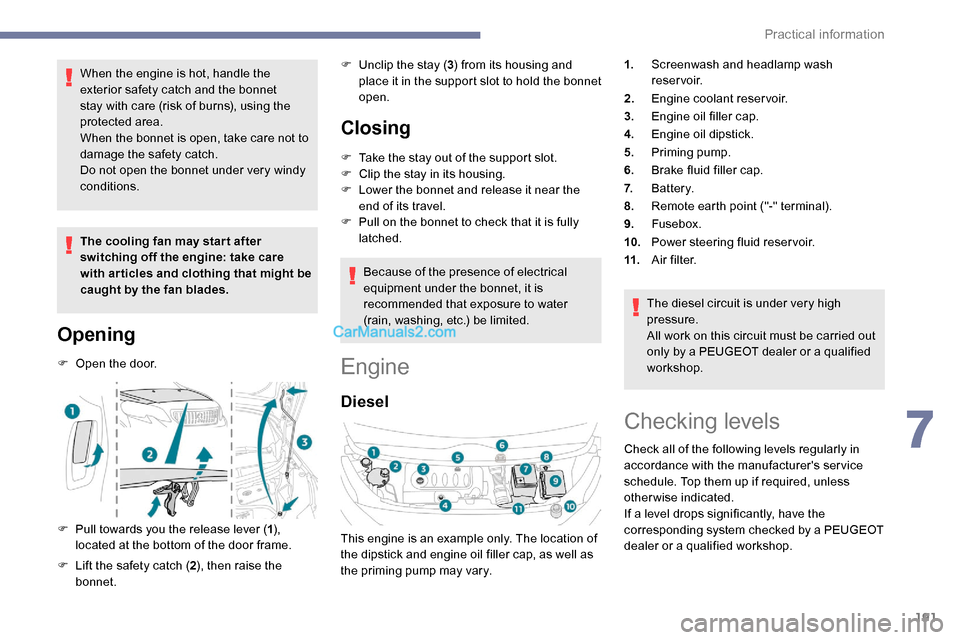
This engine is an example only. The location of
the dipstick and engine oil filler cap, as well as
the priming pump may vary. 1.
Screenwash and headlamp wash
reservoir.
2. Engine coolant reservoir.
3. Engine oil filler cap.
4. Engine oil dipstick.
5. Priming pump.
6. Brake fluid filler cap.
7. Battery.
8. Remote earth point ("-" terminal).
9. Fusebox.
10. Power steering fluid reservoir.
11. A i r f i l t e r.
Checking levels
Check all of the following levels regularly in
accordance with the manufacturer's service
schedule. Top them up if required, unless
otherwise indicated.
If a level drops significantly, have the
corresponding system checked by a PEUGEOT
dealer or a qualified workshop.
7
Practical information