fuel Peugeot Partner 2017 User Guide
[x] Cancel search | Manufacturer: PEUGEOT, Model Year: 2017, Model line: Partner, Model: Peugeot Partner 2017Pages: 260, PDF Size: 9.05 MB
Page 39 of 260
37
Partner-2-VU_en_Chap03_Pret-a-partir_ed02-2016
Instruments and controls
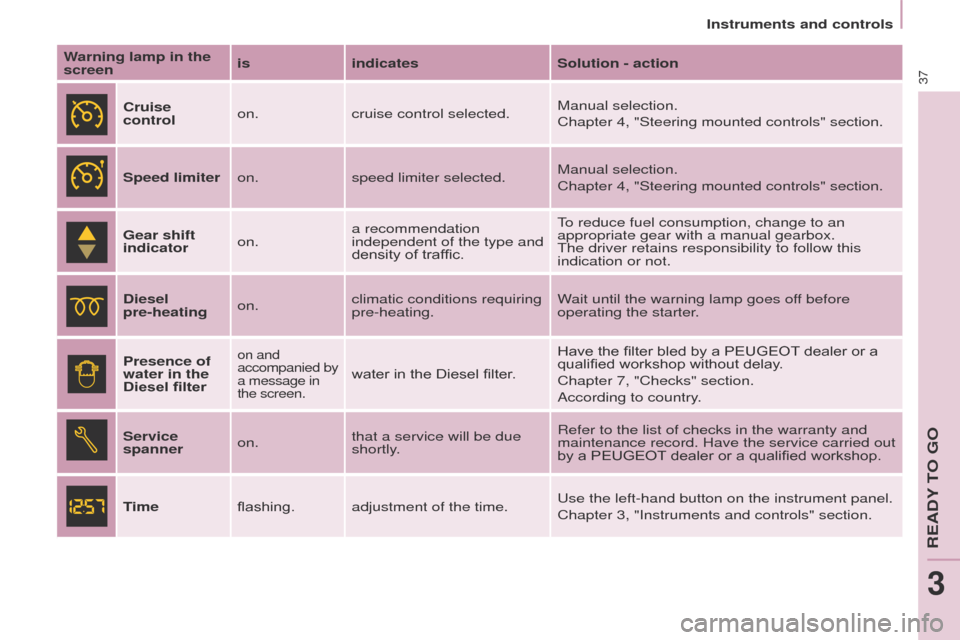
Warning lamp in the
screen is
indicates Solution - action
Cruise
control on.
cruise control selected. Manual selection.
Chapter 4, "Steering mounted controls" section.
Speed limiter on.speed limiter selected. Manual selection.
Chapter 4, "Steering mounted controls" section.
Gear shift
indicator on.a recommendation
independent of the type and
density of traffic. To reduce fuel consumption, change to an
appropriate gear with a manual gearbox.
The driver retains responsibility to follow this
indication or not.
Diesel
pre-heating on.climatic conditions requiring
pre-heating. Wait until the warning lamp goes off before
operating the starter.
Presence of
water in the
Diesel filter
on and
accompanied by
a message in
the screen.
water in the Diesel filter. Have the filter bled by a PEUGEOT dealer or a
qualified workshop without delay.
Chapter 7, "Checks" section.
According to country.
Service
spanner on.that a service will be due
shortly. Refer to the list of checks in the warranty and
maintenance record. Have the service carried out
by a PEUGEOT dealer or a qualified workshop.
Time flashing.adjustment of the time. Use the left-hand button on the instrument panel.
Chapter 3, "Instruments and controls" section.
READY TO GO
3
Page 42 of 260
40
Partner-2-VU_en_Chap03_Pret-a-partir_ed02-2016
Instruments and controls
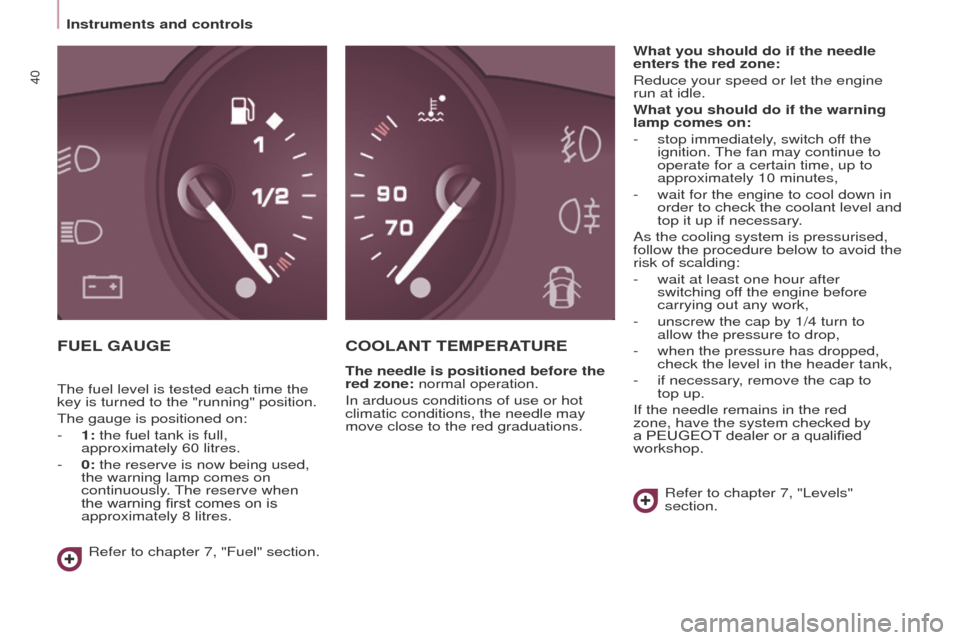
FUEL GAUGEC OOLANT TEMPERATURE
The needle is positioned before the
red zone: normal operation.
In arduous conditions of use or hot
climatic conditions, the needle may
move close to the red graduations.What you should do if the needle
enters the red zone:
Reduce your speed or let the engine
run at idle.
What you should do if the warning
lamp comes on:
-
stop immediately
, switch off the
ignition. The fan may continue to
operate for a certain time, up to
approximately 10 minutes,
-
wait for the engine to cool down in
order to check the coolant level and
top it up if necessary
.
As the cooling system is pressurised,
follow the procedure below to avoid the
risk of scalding:
-
wait at least one hour after
switching of
f the engine before
carrying out any work,
-
unscrew the cap by 1/4 turn to
allow the pressure to drop,
-
when the pressure has dropped,
check the level in the header tank,
-
if necessary , remove the cap to
top
up.
If the needle remains in the red
zone, have the system checked by
a PEUGEOT dealer or a qualified
workshop.
Refer to chapter 7, "Levels"
section.
Refer to chapter 7, "Fuel" section.
The fuel level is tested each time the
key is turned to the "running" position.
The gauge is positioned on:
-
1:
the fuel tank is full,
approximately 60 litres.
-
0:
the reserve is now being used,
the warning lamp comes on
continuously. The reserve when
the warning first comes on is
approximately 8 litres.
Page 43 of 260
41
Partner-2-VU_en_Chap03_Pret-a-partir_ed02-2016
Instruments and controls
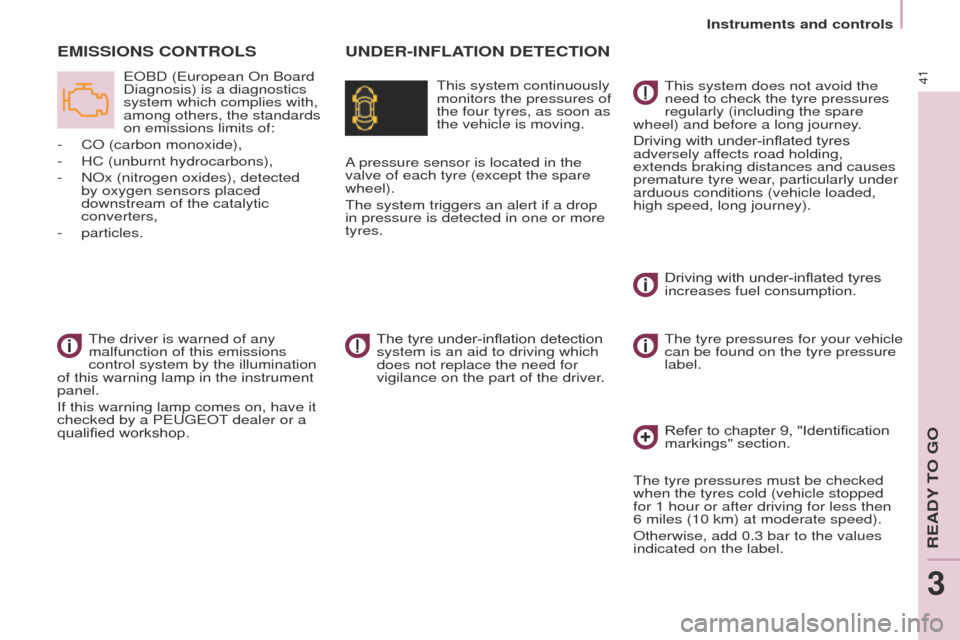
UNDER-INFLATION DETECTIONE
MISSIONS
CONTROLS
This system continuously
monitors the pressures of
the four tyres, as soon as
the vehicle is moving.
EOBD (European On Board
Diagnosis) is a diagnostics
system which complies with,
among others, the standards
on emissions limits of:
-
CO (carbon monoxide),
-
HC (unburnt hydrocarbons),
-
NOx (nitrogen oxides), detected
by oxygen sensors placed
downstream of the catalytic
converters,
-
particles. A
pressure sensor is located in the
valve of each tyre (except the spare
wheel).
The system triggers an alert if a drop
in pressure is detected in one or more
tyres.
The tyre under-inflation detection
system is an aid to driving which
does not replace the need for
vigilance on the part of the driver. This system does not avoid the
need to check the tyre pressures
regularly (including the spare
wheel) and before a long journey.
Driving with under-inflated tyres
adversely affects road holding,
extends braking distances and causes
premature tyre wear, particularly under
arduous conditions (vehicle loaded,
high speed, long journey).
Driving with under-inflated tyres
increases fuel consumption.
The tyre pressures for your vehicle
can be found on the tyre pressure
label.
Refer to chapter 9, "Identification
markings" section.
The tyre pressures must be checked
when the tyres cold (vehicle stopped
for 1 hour or after driving for less then
6 miles (10 km) at moderate speed).
Otherwise, add 0.3 bar to the values
indicated on the label.
The driver is warned of any
malfunction of this emissions
control system by the illumination
of this warning lamp in the instrument
panel.
If this warning lamp comes on, have it
checked by a PEUGEOT dealer or a
qualified workshop.
READY TO GO
3
Page 48 of 260
46
Partner-2-VU_en_Chap03_Pret-a-partir_ed02-2016
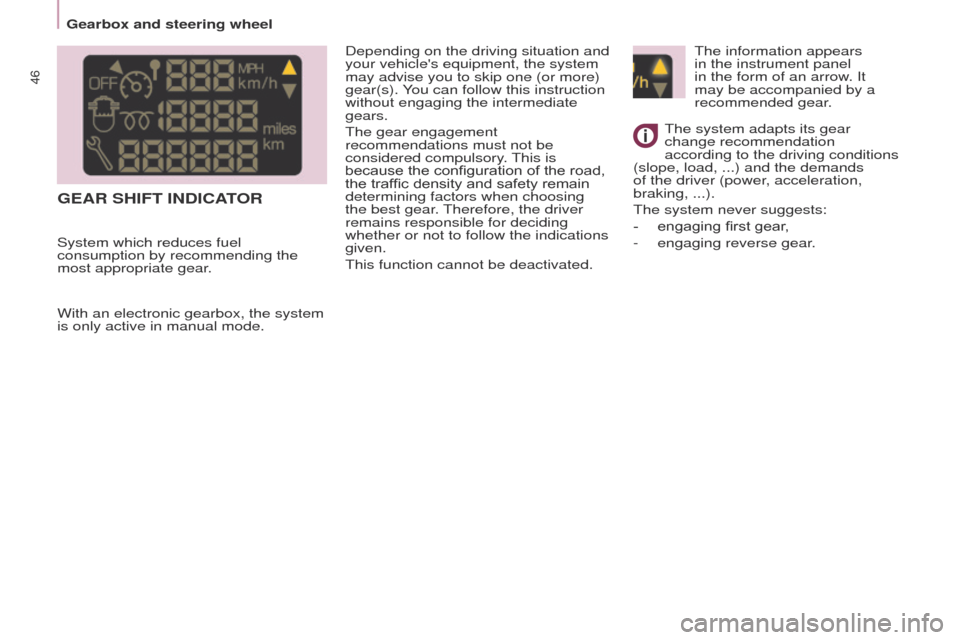
GEAR SHIFT INDICATOR
Depending on the driving situation and
your vehicle's equipment, the system
may advise you to skip one (or more)
gear(s). You can follow this instruction
without engaging the intermediate
gears.
The gear engagement
recommendations must not be
considered compulsory. This is
because the configuration of the road,
the traffic density and safety remain
determining factors when choosing
the best gear. Therefore, the driver
remains responsible for deciding
whether or not to follow the indications
given.
This function cannot be deactivated.
With an electronic gearbox, the system
is only active in manual mode. The system adapts its gear
change recommendation
according to the driving conditions
(slope, load,
...) and the demands
of the driver (power, acceleration,
braking,
...).
The system never suggests:
-
engaging first gear
,
-
engaging reverse gear
.
The information appears
in the instrument panel
in the form of an arrow. It
may be accompanied by a
recommended gear.
System which reduces fuel
consumption by recommending the
most appropriate gear.
Gearbox and steering wheel
Page 50 of 260
48
Partner-2-VU_en_Chap03_Pret-a-partir_ed02-2016
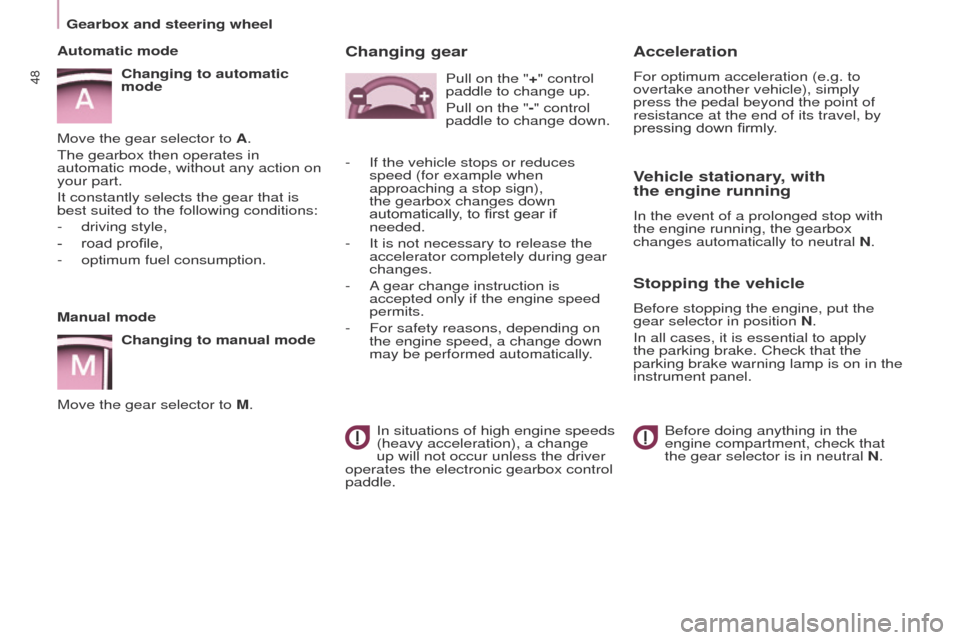
Manual modeChanging to manual mode
Move the gear selector to M.
Automatic mode
Changing to automatic
mode
Move the gear selector to A.
The gearbox then operates in
automatic mode, without any action on
your part.
It constantly selects the gear that is
best suited to the following conditions:
-
driving style,
-
road profile,
-
optimum fuel consumption.
Vehicle stationary, with
the
engine running
In the event of a prolonged stop with
the engine running, the gearbox
changes automatically to neutral N.
Stopping the vehicle
Before stopping the engine, put the
gear selector in position N.
In all cases, it is essential to apply
the parking brake. Check that the
parking brake warning lamp is on in the
instrument panel.
Before doing anything in the
engine compartment, check that
the gear selector is in neutral N.
Acceleration
For optimum acceleration (e.g. to
overtake another vehicle), simply
press the pedal beyond the point of
resistance at the end of its travel, by
pressing down firmly.
Changing gear
In situations of high engine speeds
(heavy acceleration), a change
up will not occur unless the driver
operates the electronic gearbox control
paddle. Pull on the "+" control
paddle to change up.
Pull on the "-" control
paddle to change down.
-
If the vehicle stops or reduces
speed (for example when
approaching a stop sign),
the gearbox changes down
automatically
, to first gear if
needed.
-
It is not necessary to release the
accelerator completely during gear
changes.
-
A
gear change instruction is
accepted only if the engine speed
permits.
-
For safety reasons, depending on
the engine speed, a change down
may be performed automatically
.
Gearbox and steering wheel
Page 51 of 260
49
Partner-2-VU_en_Chap03_Pret-a-partir_ed02-2016
STOP & START
The Stop & Start system puts the
engine temporarily on standby - ST OP
mode - during stops in the traffic (red
lights, traffic jams, or other...).
The engine restarts automatically -
START mode - as soon as you want to
move off.
The restart takes place instantly,
quickly and silently.
Perfect for urban use, the Stop & Start
system reduces fuel consumption and
exhaust emissions as well as the noise
level when stationary.
Operation
Going into engine STOP mode
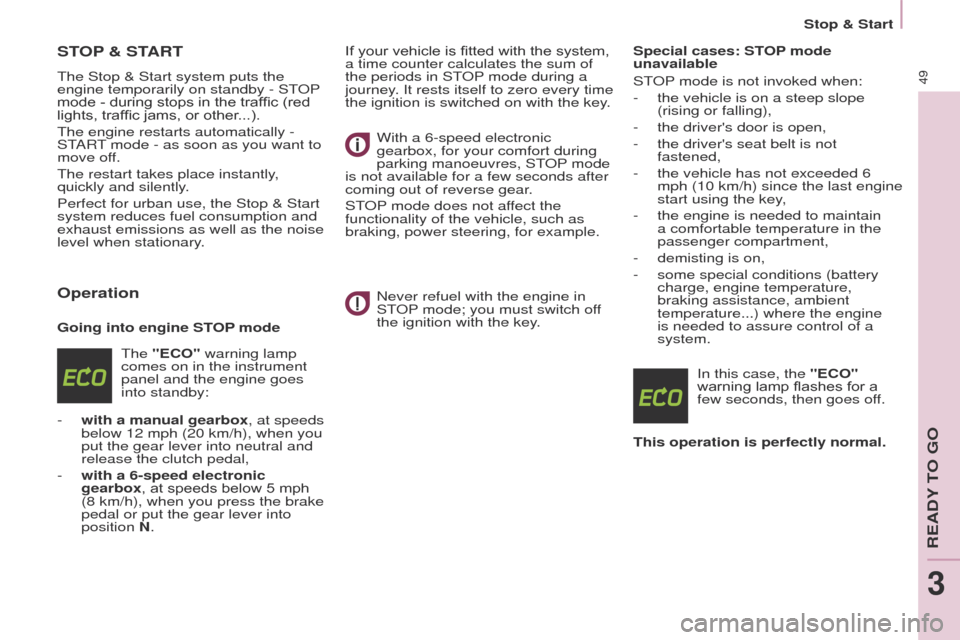
The "ECO" warning lamp
comes on in the instrument
panel and the engine goes
into standby:
-
with a manual gearbox
, at speeds
below 12 mph (20 km/h), when you
put the gear lever into neutral and
release the clutch pedal,
-
with a 6-speed electronic
gearbox
, at speeds below 5 mph
(8 km/h), when you press the brake
pedal or put the gear lever into
position N. If your vehicle is fitted with the system,
a time counter calculates the sum of
the periods in STOP mode during a
journey. It rests itself to zero every time
the ignition is switched on with the key.
With a 6-speed electronic
gearbox, for your comfort during
parking manoeuvres, STOP mode
is not available for a few seconds after
coming out of reverse gear.
STOP mode does not affect the
functionality of the vehicle, such as
braking, power steering, for example.
Never refuel with the engine in
STOP mode; you must switch off
the ignition with the key. Special cases: STOP mode
unavailable
STOP mode is not invoked when:
-
the vehicle is on a steep slope
(rising or fallin
g),
-
the driver's door is open,
-
the driver's seat belt is not
fastened,
-
the vehicle has not exceeded 6
mph (10 km/h) since the last engine
start using the key
,
-
the engine is needed to maintain
a comfortable temperature in the
passenger compartment,
-
demisting is on,
-
some special conditions (battery
charge, engine temperature,
braking assistance, ambient
temperature...) where the engine
is needed to assure control of a
system.
In this case, the
"ECO"
warning lamp flashes for a
few seconds, then goes off.
This operation is perfectly normal.
READY TO GO
3
Stop & Start
Page 62 of 260
60
Partner-2-VU_en_Chap04_Ergonomie_ed02-2016
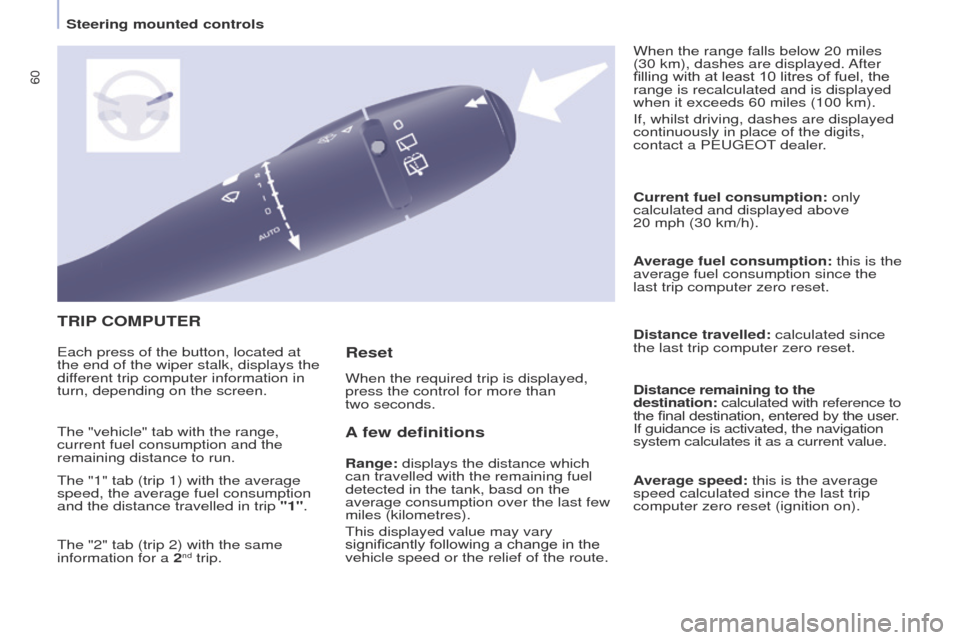
TRIP COMPUTER
A
few definitions
Range: displays the distance which
can travelled with the remaining fuel
detected in the tank, basd on the
average consumption over the last few
miles (kilometres).
This displayed value may vary
significantly following a change in the
vehicle speed or the relief of the route. Current fuel consumption:
only
calculated and displayed above
20 mph (30 km/h).
Average fuel consumption: this is the
average fuel consumption since the
last trip computer zero reset.
Distance travelled: calculated since
the last trip computer zero reset.
Distance remaining to the
destination: calculated with reference to
the final destination, entered by the user.
If guidance is activated, the navigation
system calculates it as a current value.
Average speed: this is the average
speed calculated since the last trip
computer zero reset (ignition on).
Each press of the button, located at
the end of the wiper stalk, displays the
different trip computer information in
turn, depending on the screen.
When the required trip is displayed,
press the control for more than
two seconds. When the range falls below 20 miles
(30 km), dashes are displayed. After
filling with at least 10 litres of fuel, the
range is recalculated and is displayed
when it exceeds 60 miles (100 km).
If, whilst driving, dashes are displayed
continuously in place of the digits,
contact a PEUGEOT dealer.
The "vehicle" tab with the range,
current fuel consumption and the
remaining distance to run.
The "1" tab (trip 1) with the average
speed, the average fuel consumption
and the distance travelled in trip "1".
The "2" tab (trip 2) with the same
information for a 2
nd trip.
Reset
Steering mounted controls
Page 99 of 260
97
Driving safely
Partner-2-VU_en_Chap05_Securite_ed02-2016
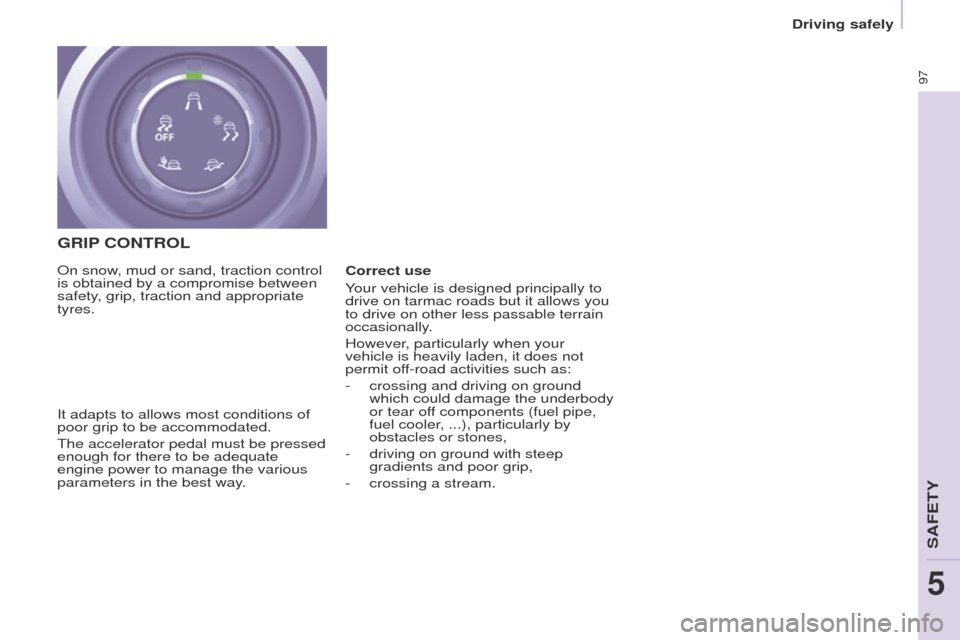
GRIP CONTROL
It adapts to allows most conditions of
poor grip to be accommodated.
The accelerator pedal must be pressed
enough for there to be adequate
engine power to manage the various
parameters in the best way. On snow, mud or sand, traction control
is obtained by a compromise between
safety, grip, traction and appropriate
tyres. Correct use
Your vehicle is designed principally to
drive on tarmac roads but it allows you
to drive on other less passable terrain
occasionally.
However, particularly when your
vehicle is heavily laden, it does not
permit off-road activities such as:
-
crossing and driving on ground
which could damage the underbody
or tear of
f components (fuel pipe,
fuel cooler, ...), particularly by
obstacles or stones,
-
driving on ground with steep
gradients and poor grip,
-
crossing a stream.
SAFETY
5
Page 134 of 260
132
Partner-2-VU_en_Chap07_Verification_ed02-2016
REFUELLING
Low fuel level
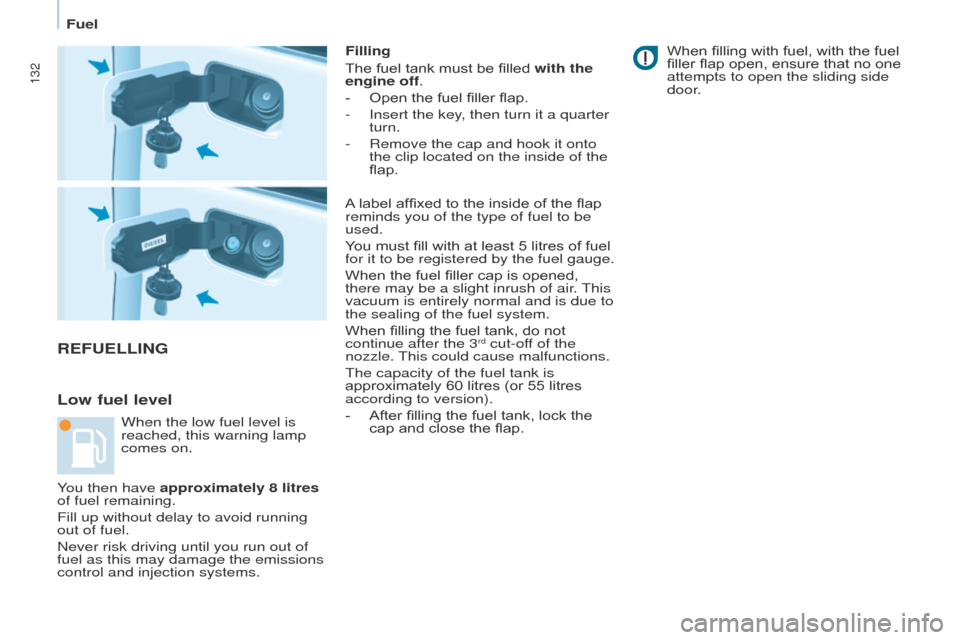
Filling
The fuel tank must be filled with the
engine off.
-
Open the fuel filler flap.
-
Insert the key
, then turn it a quarter
turn.
-
Remove the cap and hook it onto
the clip located on the inside of the
flap. When fillin
g with fuel, with the fuel
filler flap open, ensure that no one
attempts to open the sliding side
door.
When the low fuel level is
reached, this warning lamp
comes on.
You then have approximately 8 litres
of fuel remaining.
Fill up without delay to avoid running
out of fuel.
Never risk driving until you run out of
fuel as this may damage the emissions
control and injection systems. A label affixed to the inside of the flap
reminds you of the type of fuel to be
used.
You must fill with at least 5 litres of fuel
for it to be registered by the fuel gauge.
When the fuel filler cap is opened,
there may be a slight inrush of air. This
vacuum is entirely normal and is due to
the sealing of the fuel system.
When filling the fuel tank, do not
continue after the 3
rd cut-off of the
nozzle. This could cause malfunctions.
The capacity of the fuel tank is
approximately 60 litres (or 55 litres
according to version).
-
After fillin
g the fuel tank, lock the
cap and close the flap.
Fuel
Page 135 of 260
133
Partner-2-VU_en_Chap07_Verification_ed02-2016
Travelling abroad
Certain fuels could damage the
engine of your vehicle. In certain
countries, the use of a particular
fuel may be required (specific
octane rating, specific sales
name…) to ensure correct operation
of the engine.
For any additional information, contact
your dealer.
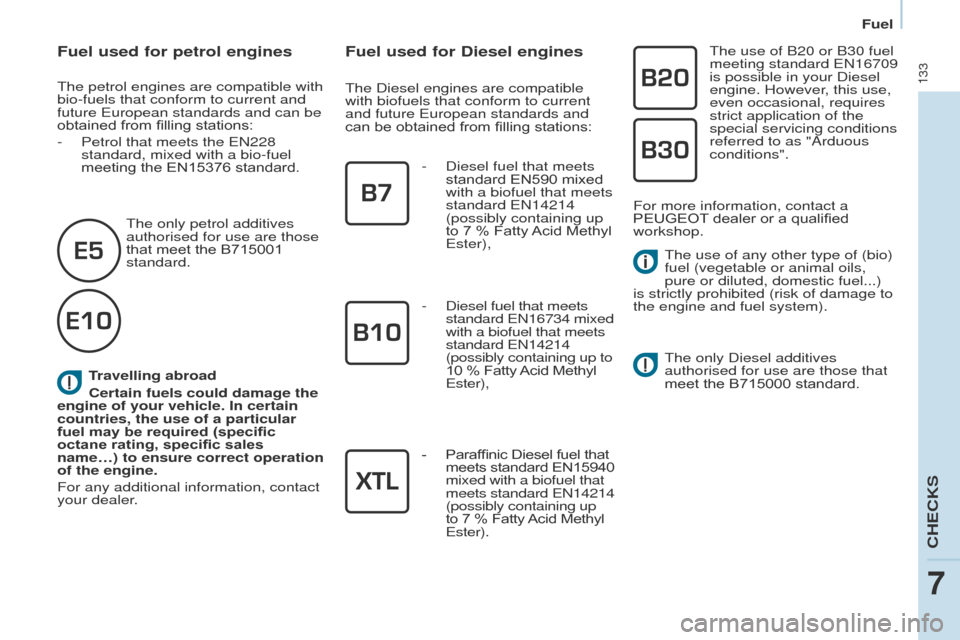
Fuel used for petrol engines
The petrol engines are compatible with
bio-fuels that conform to current and
future European standards and can be
obtained from filling stations:
-
Petrol that meets the EN228
standard, mixed with a bio-fuel
meeting the EN15376 standard.
The only petrol additives
authorised for use are those
that meet the B715001
standard.
Fuel used for Diesel engines
The Diesel engines are compatible
with biofuels that conform to current
and future European standards and
can be obtained from filling stations: -
Diesel fuel that meets
standard EN590 mixed
with a biofuel that meets
standard EN14214
(possibly containing up
to 7 % Fatty
Acid Methyl
Ester), The use of B20 or B30 fuel
meeting standard EN16709
is possible in your Diesel
engine. However, this use,
even occasional, requires
strict application of the
special servicing conditions
referred to as "Arduous
conditions".
-
Diesel fuel that meets
standard EN16734 mixed
with a biofuel that meets
standard EN14214
(possibly containing up to
10 % Fatty Acid Methyl
Ester), For more information, contact a
PEUGEOT dealer or a qualified
workshop.
-
Paraffinic Diesel fuel that
meets standard EN15940
mixed with a biofuel that
meets standard EN14214
(possibly containing up
to 7 % Fatty Acid Methyl
Ester). The use of any other type of (bio)
fuel (vegetable or animal oils,
pure or diluted, domestic fuel...)
is strictly prohibited (risk of damage to
the engine and fuel system).
The only Diesel additives
authorised for use are those that
meet the B715000 standard.
CHECKS
7
Fuel