ECU Peugeot Partner 2019 User Guide
[x] Cancel search | Manufacturer: PEUGEOT, Model Year: 2019, Model line: Partner, Model: Peugeot Partner 2019Pages: 312, PDF Size: 9.56 MB
Page 70 of 312
68
On the floor, behind the front seats, a
vertical partition protects the driver and front
passengers against the risk of load movement.
Steel or glass partitions separate the loading
area from the cab.When washing your vehicle, never clean
the inside directly using a water jet.
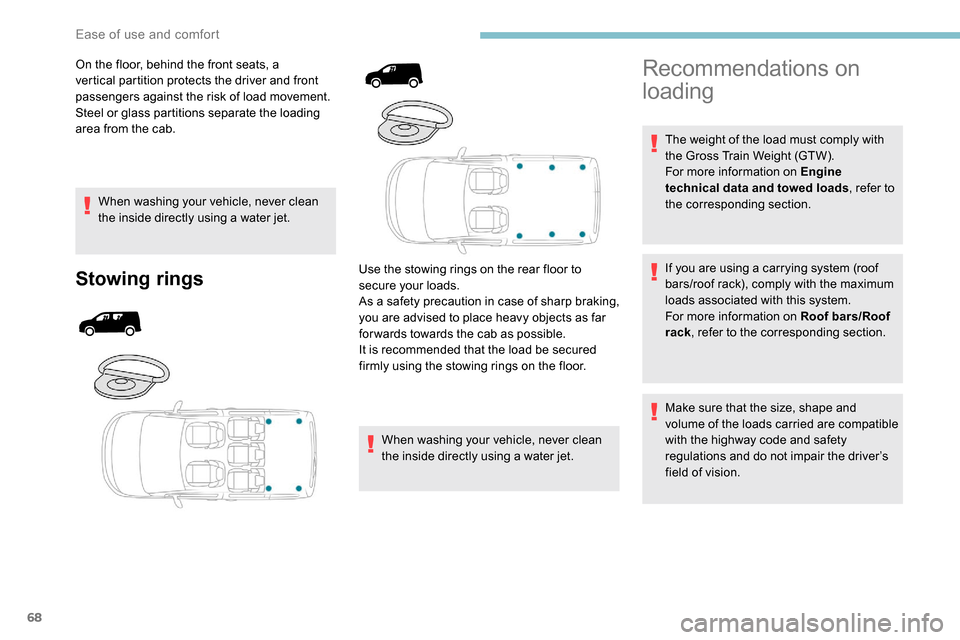
Stowing ringsUse the stowing rings on the rear floor to
secure your loads.
As a safety precaution in case of sharp braking,
you are advised to place heavy objects as far
for wards towards the cab as possible.
It is recommended that the load be secured
firmly using the stowing rings on the floor.
When washing your vehicle, never clean
the inside directly using a water jet.
Recommendations on
loading
The weight of the load must comply with
the Gross Train Weight (GTW).
For more information on Engine
technical data and towed loads , refer to
the corresponding section.
If you are using a carrying system (roof
bars/roof rack), comply with the maximum
loads associated with this system.
For more information on Roof bars/Roof
rack , refer to the corresponding section.
Make sure that the size, shape and
volume of the loads carried are compatible
with the highway code and safety
regulations and do not impair the driver’s
field of vision.
Ease of use and comfort
Page 71 of 312
69
Firmly secure all parts of the load using
the stowing rings on the floor of the
loading area.
For more information on the Interior
fittings and in particular on the stowing
rings, refer to the corresponding section. To avoid the risk of injury or accident,
the load must be made stable so that it
cannot slide, tip over, fall or be projected.
To do this, use only retaining straps that
conform to the current standards (DIN, for
example).
For more information on putting straps
in place, refer to the manufacturer’s user
guide.
There must not be any open space
between the components of the load.
When there is the risk of the load sliding,
there must not be any open space
between the load and the panels of the
vehicle.
As well as the straps, optimise the stability
of the load with stable handling equipment
(wedges, rigid blocks of wood or padding).
When washing your vehicle, never clean
the inside directly using a water jet.
For the Multi-Flex bench
seat and the Crew cab
Do not place sharp or pointed objects in
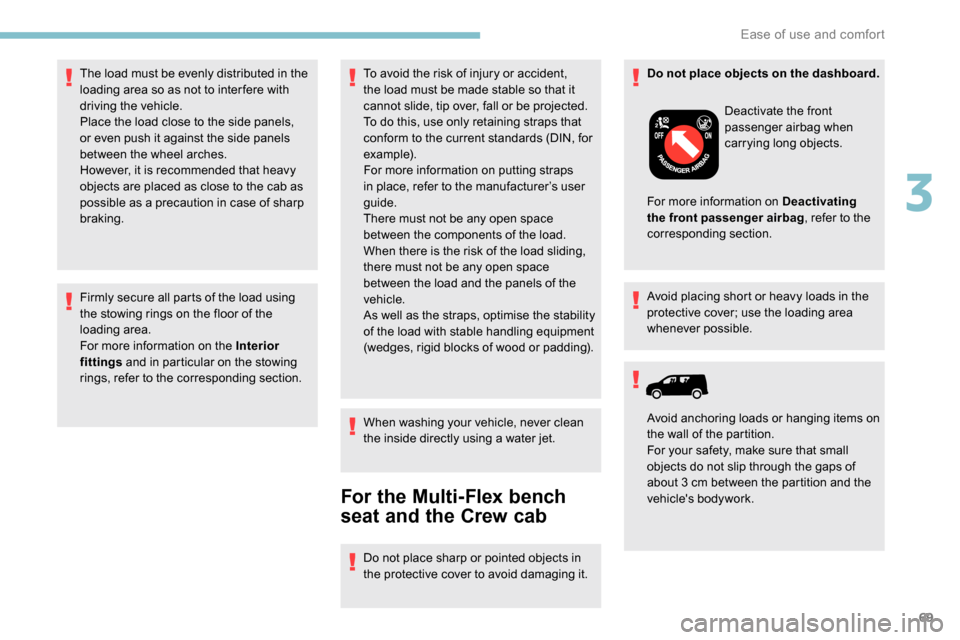
the protective cover to avoid damaging it.Do not place objects on the dashboard.
Avoid placing short or heavy loads in the
protective cover; use the loading area
whenever possible.
The load must be evenly distributed in the
loading area so as not to inter fere with
driving the vehicle.
Place the load close to the side panels,
or even push it against the side panels
between the wheel arches.
However, it is recommended that heavy
objects are placed as close to the cab as
possible as a precaution in case of sharp
braking.
Deactivate the front
passenger airbag when
carrying long objects.
For more information on Deactivating
the front passenger airbag , refer to the
corresponding section.
Avoid anchoring loads or hanging items on
the wall of the partition.
For your safety, make sure that small
objects do not slip through the gaps of
about 3 cm between the partition and the
vehicle's bodywork.
3
Ease of use and comfort
Page 73 of 312
71
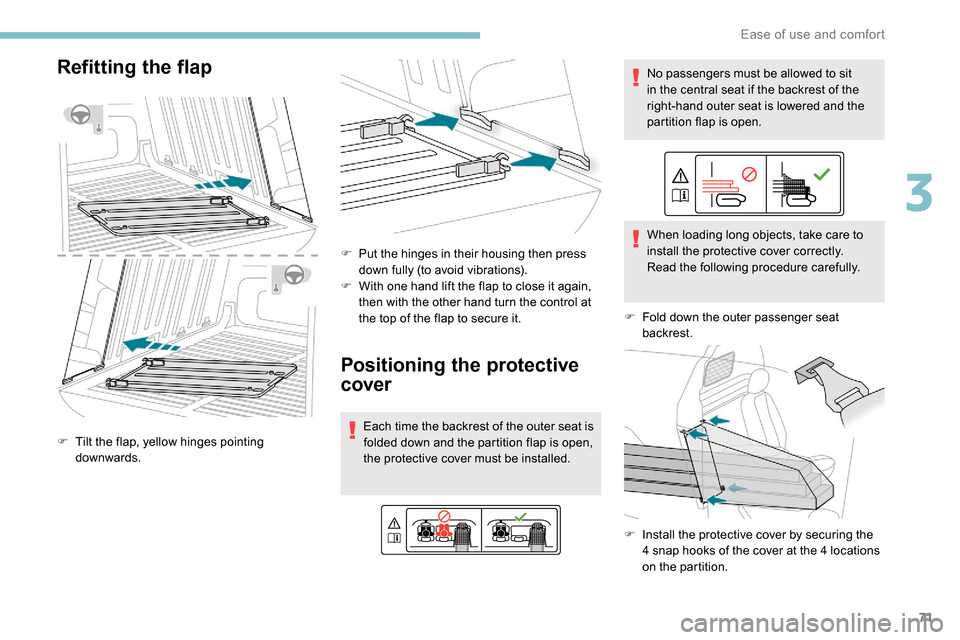
Refitting the flap
F Tilt the flap, yellow hinges pointing downwards. F
P
ut the hinges in their housing then press
down fully (to avoid vibrations).
F
W
ith one hand lift the flap to close it again,
then with the other hand turn the control at
the top of the flap to secure it.
Positioning the protective
cover
Each time the backrest of the outer seat is
folded down and the partition flap is open,
the protective cover must be installed. No passengers must be allowed to sit
in the central seat if the backrest of the
right-hand outer seat is lowered and the
partition flap is open.
When loading long objects, take care to
install the protective cover correctly.
Read the following procedure carefully.
F
F
old down the outer passenger seat
backrest.
F
I
nstall the protective cover by securing the
4 snap hooks of the cover at the 4 locations
on the partition.
3
Ease of use and comfort
Page 76 of 312
74
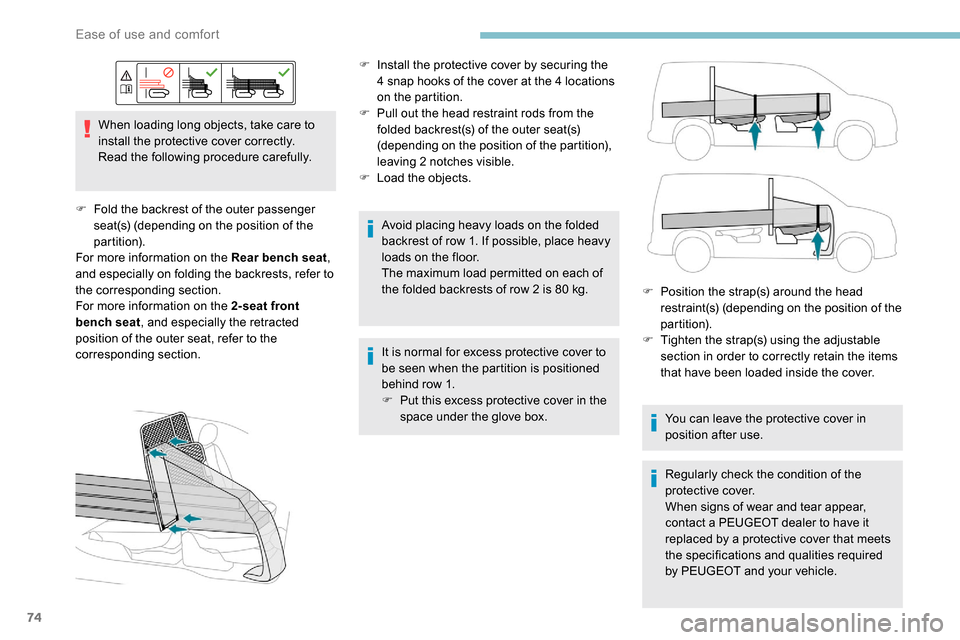
When loading long objects, take care to
install the protective cover correctly.
Read the following procedure carefully.
F
F
old the backrest of the outer passenger
seat(s) (depending on the position of the
partition).
For more information on the Rear bench seat ,
and especially on folding the backrests, refer to
the corresponding section.
For more information on the 2-seat front
bench seat , and especially the retracted
position of the outer seat, refer to the
corresponding section. F
I
nstall the protective cover by securing the
4 snap hooks of the cover at the 4 locations
on the partition.
F P ull out the head restraint rods from the
folded backrest(s) of the outer seat(s)
(depending on the position of the partition),
leaving 2 notches visible.
F
L
oad the objects.
Avoid placing heavy loads on the folded
backrest of row 1. If possible, place heavy
loads on the floor.
The maximum load permitted on each of
the folded backrests of row 2 is 80
kg.
It is normal for excess protective cover to
be seen when the partition is positioned
behind row 1.
F
P
ut this excess protective cover in the
space under the glove box. F
P
osition the strap(s) around the head
restraint(s) (depending on the position of the
partition).
F
T
ighten the strap(s) using the adjustable
section in order to correctly retain the items
that have been loaded inside the cover.
You can leave the protective cover in
position after use.
Regularly check the condition of the
protective cover.
When signs of wear and tear appear,
contact a PEUGEOT dealer to have it
replaced by a protective cover that meets
the specifications and qualities required
by PEUGEOT and your vehicle.
Ease of use and comfort
Page 107 of 312
105
Advice
The driver must ensure that passengers
use the seat belts correctly and that they
are all fastened before setting off.
Wherever you are seated in the vehicle,
always fasten your seat belt, even for
short journeys.
Do not interchange the seat belt buckles
as they will not fulfil their role fully.
The seat belts are fitted with an inertia
reel permitting automatic adjustment of
the length of the strap to your size. The
seat belt is stowed automatically when not
in use.
Before and after use, ensure that the seat
belt is reeled in correctly.
The lower part of the strap must be
positioned as low as possible on the
pelvis.
The upper part must be positioned in the
hollow of the shoulder.
The inertia reels have an automatic
locking device at the time of a collision,
during sudden braking or if the vehicle
turns over. You can release the device by
pulling the strap firmly and then releasing
it so that it reels in slightly.Advice
In order to be effective, a seat belt must:
-
b
e tightened as close to the body as
possible,
-
b
e pulled in front of you with a smooth
movement, checking that it does not
twist,
-
b
e used to restrain only one person,
-
n
ot show any signs of cuts or fraying,
-
n
ot be converted or modified to avoid
affecting its performance.
In accordance with current safety
regulations, for all repairs on your
vehicle's seat belts, go to a qualified
workshop with the skills and equipment
needed, which a PEUGEOT dealer is able
to provide.
Have your seat belts checked regularly
by a PEUGEOT dealer or a qualified
workshop, particularly if the straps show
signs of damage.
Clean the seat belt straps with soapy
water or a textile cleaning product, sold by
PEUGEOT dealers.
After folding or moving a seat or rear
bench seat, ensure that the seat belt is
positioned and reeled in correctly. Instructions for children
Use a suitable child seat, if the passenger
is less than 12
years old or shorter than
one and a half metres.
Never use the same seat belt to secure
more than one person.
Never allow a child to travel on your lap.
For more information on Child seats , refer
to the corresponding section.
In case of impact
Depending on the nature and
seriousness of the impact , the
pyrotechnic system may be deployed
before and independent of the airbags.
Deployment of the pretensioners is
accompanied by a slight discharge of
harmless smoke and a noise, due to the
activation of the pyrotechnic cartridge
incorporated in the system.
In all cases, the airbag warning lamp is lit.
After an impact, get the seat belt system
checked and if necessary have it replaced
by a PEUGEOT dealer or a qualified
workshop.
5
Safety
Page 110 of 312
108
Advice
For the airbags to be fully effective,
observe the safety recommendations
below.
Adopt a normal and upright sitting
position.
Wear a correctly adjusted seat belt.
Do not leave anything between the
occupants and the airbags (a child, pet,
object, etc.), nor fix or attach anything
close to or in the way of the airbag release
trajectory; this could cause injuries during
their deployment.
Do not place objects on the dashboard.
Never modify the original definition of your
vehicle, particularly in the area directly
around the airbags.
After an accident or if the vehicle has
been stolen, have the airbag systems
checked.
All work on the airbag systems must be
carried out by a PEUGEOT dealer or a
qualified workshop.
Even if all of the precautions mentioned
are obser ved, a risk of injury or of minor
burns to the head, chest or arms when an
airbag is deployed cannot be ruled out.
The airbag inflates almost instantly (within
a few milliseconds) then deflates within
the same time discharging the hot gas via
openings provided for this purpose.Front airbags
Do not drive holding the steering wheel
by its spokes or resting your hands on the
centre part of the wheel.
Passengers must not place their feet on
the dashboard.
Do not smoke as deployment of the
airbags can cause burns or the risk of
injury from a cigarette or pipe.
Never remove or pierce the steering wheel
or hit it violently.
Do not fix or attach anything to the
steering wheel or dashboard, as this
could cause injuries when the airbags are
deployed.
Curtain airbags
Do not fix or attach anything to the roof,
as this could cause head injuries when the
curtain airbag is deployed.
If fitted to your vehicle, do not remove the
grab handles installed on the roof, they
play a part in securing the curtain airbags.
Lateral airbags
Use only approved covers on the seats,
compatible with the deployment of the
lateral airbags. For information on the
product range of seat covers suitable for
your vehicle, contact a PEUGEOT dealer.
Do not fix or attach anything to the seat
backrests (clothes, etc.), as this could
cause injuries to the thorax or arm when
the lateral airbag is deployed.
Do not sit with the upper part of the body
any nearer to the door than necessary.
The vehicle's front door panels include
side impact sensors.
A damaged door or any unauthorised or
incorrectly executed work (modification or
repair) on the front doors or their interior
trim could compromise the operation of
these sensors – risk of malfunction of the
lateral airbags!
Such work must only be done by a
PEUGEOT dealer or a qualified workshop.
Safety
Page 113 of 312
111
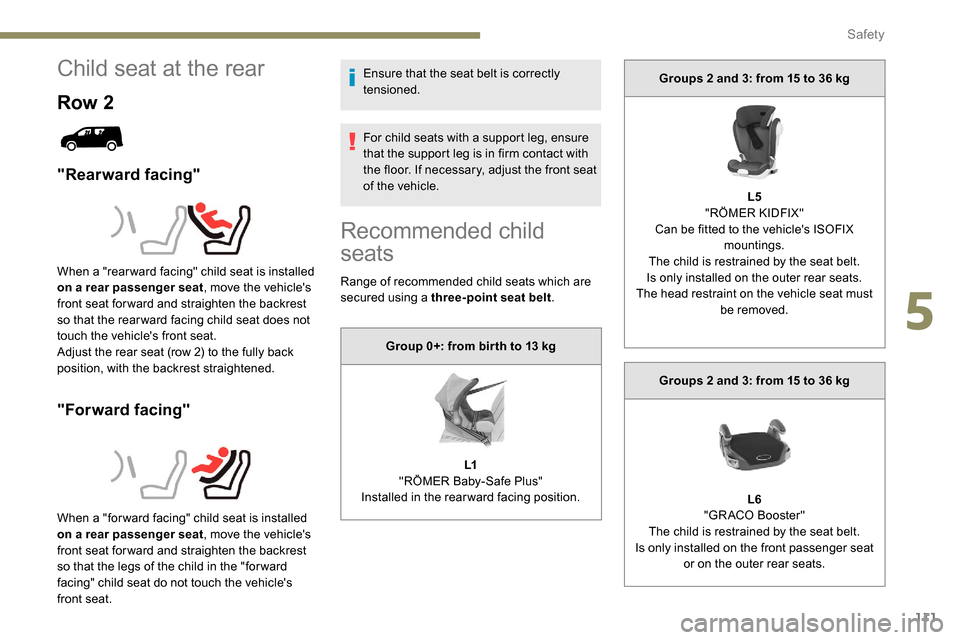
Child seat at the rear
Row 2
"Rearward facing"
"Forward facing"
Ensure that the seat belt is correctly
tensioned.
For child seats with a support leg, ensure
that the support leg is in firm contact with
the floor. If necessary, adjust the front seat
of the vehicle.
When a "rear ward facing" child seat is installed
on a rear passenger seat , move the vehicle's
front seat for ward and straighten the backrest
so that the rear ward facing child seat does not
touch the vehicle's front seat.
Adjust the rear seat (row 2) to the fully back
position, with the backrest straightened.
When a "for ward facing" child seat is installed
on a rear passenger seat , move the vehicle's
front seat for ward and straighten the backrest
so that the legs of the child in the "for ward
facing" child seat do not touch the vehicle's
front seat.
Recommended child
seats
Range of recommended child seats which are
secured using a three-point seat belt .
Group 0+: from bir th to 13
kg
L1
"RÖMER Baby-Safe Plus"
Installed in the rearward facing position. Groups 2 and 3: from 15 to 36
kg
L5
"RÖMER KIDFIX"
Can be fitted to the vehicle's ISOFIX mountings.
The child is restrained by the seat belt.
Is only installed on the outer rear seats.
The head restraint on the vehicle seat must be removed.
Groups 2 and 3: from 15 to 36
kg
L6
"GRACO Booster"
The child is restrained by the seat belt.
Is only installed on the front passenger seat or on the outer rear seats.
5
Safety
Page 114 of 312
112
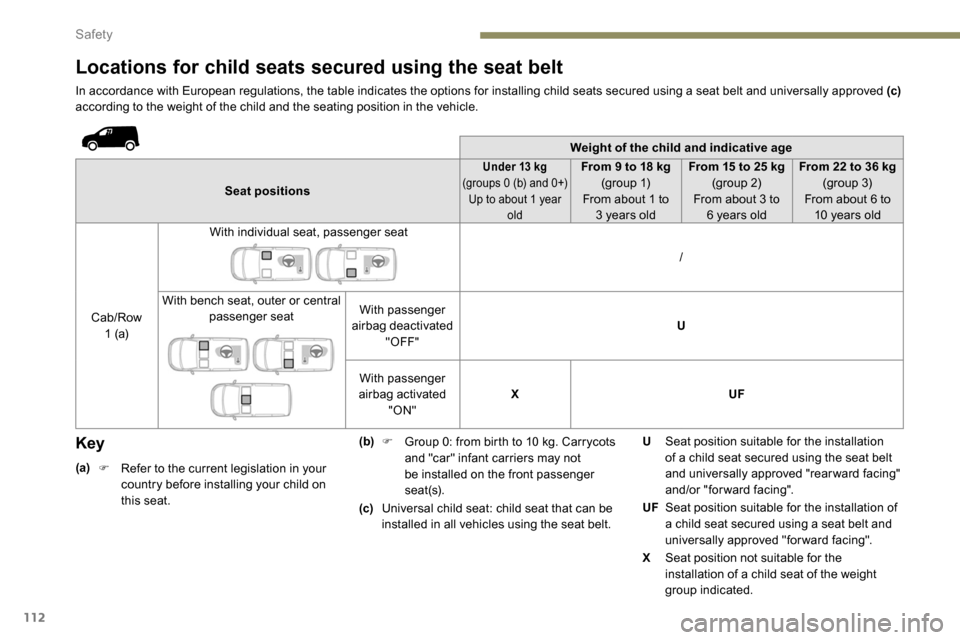
Locations for child seats secured using the seat belt
In accordance with European regulations, the table indicates the options for installing child seats secured using a seat belt and universally approved (c)
according to the weight of the child and the seating position in the vehicle.
Weight of the child and indicative age
Seat positions
Under 13 kg
(
groups 0 (b) and 0+)
Up to about 1 year oldFrom 9 to 18 kg
( group 1)
From about 1 to 3
years old From 15 to 25
kg
(group 2)
From about 3 to 6
years oldFrom 22 to 36
kg
(group 3)
From about 6 to 10
years old
Cab/Row 1 (a) With individual seat, passenger seat
/
With bench seat, outer or central passenger seat With passenger
airbag deactivated "OFF" U
With passenger
airbag activated "ON" X
UF
Key
(a)
F R efer to the current legislation in your
country before installing your child on
this seat. (b)
F
G
roup 0: from birth to 10 kg. Carrycots
and "car" infant carriers may not
be installed on the front passenger
seat(s).
(c) Universal child seat: child seat that can be
installed in all vehicles using the seat belt. U
Seat position suitable for the installation
of a child seat secured using the seat belt
and universally approved "rearward facing"
and/or "forward facing".
UF Seat position suitable for the installation of
a child seat secured using a seat belt and
universally approved "forward facing".
X Seat position not suitable for the
installation of a child seat of the weight
group indicated.
Safety
Page 115 of 312
113
Advice
An incorrectly installed child seat
compromises the child's safety in the
event of an accident.
Ensure that there is no seat belt or seat
belt buckle under the child seat, as this
could destabilise it.
Remember to fasten the seat belts or the
child seat harnesses keeping the slack
relative to the child's body to a minimum,
even for short journeys.
When installing a child seat using the seat
belt, ensure that the seat belt is tightened
correctly on the child seat and that it
secures the child seat firmly on the seat
of your vehicle. If your passenger seat is
adjustable, move it forwards if necessary.
The head restraint must be removed
before installing a child seat with a
backrest on a passenger seat.
Ensure that the head restraint is stored or
attached securely to prevent it from being
thrown around the vehicle in the event
of sharp braking. Refit the head restraint
once the child seat has been removed.Children in the front
Deactivate the front passenger airbag
when a rear ward facing child seat is
installed on the front passenger seat.
Otherwise, the child would risk being
seriously injured or killed if the airbag
were deployed.Installing a booster seat
The chest part of the seat belt must be
positioned on the child's shoulder without
touching the neck.
Ensure that the lap part of the seat belt
passes correctly over the child's thighs.
We recommend using a booster seat with
a backrest equipped with a belt guide at
shoulder level.
Additional protections
To prevent accidental opening of the doors
and rear windows, use the child lock.
Take care not to open the rear windows by
more than one third.
To protect young children from the rays
of the sun, fit side blinds on the rear
windows.
As a safety precaution, do not leave:
-
a c
hild or children alone and
unattended in a vehicle,
-
a c
hild or an animal in a vehicle
which is exposed to the sun, with the
windows closed,
-
t
he keys within reach of children inside
the vehicle.
Children in the rear
In the rear seats, always leave sufficient
space between the front seat and:
-
a r
ear ward facing child seat,
-
t
he child's feet for a child seat fitted
forward facing.
To do this, move the front seat for wards
and, if necessary, move its backrest into
the upright position.
For optimal installation of the forward
facing child seat, verify that its backrest is
as close as possible to the backrest of the
vehicle seat, if possible in contact with it.
5
Safety
Page 151 of 312
149
The system is not intended for the
following situations:
-
i
f the front end of the vehicle has
been modified (addition of long-range
headlamps, painting of the front
bumper),
-
d
riving on a racing circuit,
-
r
unning on a rolling road,
-
u
se of snow chains, non-slip covers or
studded tyres.
The use of mats not approved by
PEUGEOT may inter fere with the
operation of the cruise control.
To avoid any risk of jamming the pedals:
-
e
nsure that the mat is secured
c o r r e c t l y,
-
d
o not place one mat on top of another.
The following situations may interfere with
the operation of the system or prevent it
from working:
-
d
riving on a winding road,
-
p
oor visibility (inadequate street
lighting, falling snow, heavy rain, dense
fog, etc.),
-
d
azzle (headlamps of an oncoming
vehicle, low sun, reflections on a damp
road, leaving a tunnel, alternating
shade and light, etc.),
-
c
amera obstructed (mud, frost, snow,
condensation, etc.).
In these situations, detection performance
may be reduced.Malfunction
If the cruise control
malfunctions, dashes are
displayed instead of the
cruise control speed setting.
If this warning lamp comes
on, accompanied by an alert
message and an audible
signal, this confirms a
malfunction.
The adaptive cruise control deactivates
automatically if the use of a "space-saver"
type spare wheel is detected or if there is
a malfunction on the lateral brake lamps or
trailer brake lamps (for approved trailers).
The cruise control operates by day and
night, in fog or moderate rainfall.
However, it is strongly recommended that
you always keep a safe distance from
vehicles ahead, according to the driving
conditions, the weather and the road
sur face.
Use the cruise control only where the
driving conditions allow running at a
constant speed and keeping an adequate
safety distance.
Do not activate the cruise control in urban
areas where pedestrians are likely to
cross the road, in heavy traffic (except for
versions with EAT8 gearbox), on winding
or steep roads, on slippery or flooded
roads, when there is snowfall, if the
windscreen is damaged or when the brake
lamps have failed.
In certain circumstances, it may not
be possible for the speed setting to be
maintained or even attained: loaded
vehicle, ascending a steep hill, etc.
Have the system checked by a PEUGEOT
dealer or a qualified workshop.
Memorising speeds
Linked to the speed limiter and programmable
cruise control, this function allows speed limits
to be registered which will then be suggested
as settings for these two systems.
You can memorise several speed settings for
each system.
6
Driving