ESP Peugeot Partner 2019 User Guide
[x] Cancel search | Manufacturer: PEUGEOT, Model Year: 2019, Model line: Partner, Model: Peugeot Partner 2019Pages: 312, PDF Size: 9.56 MB
Page 51 of 312
49
This button is unavailable if the vehicle
has been locked or deadlocked from
outside (using the key, the remote control
or the Keyless Entry and Starting,
according to equipment) or if any of the
doors are still open.
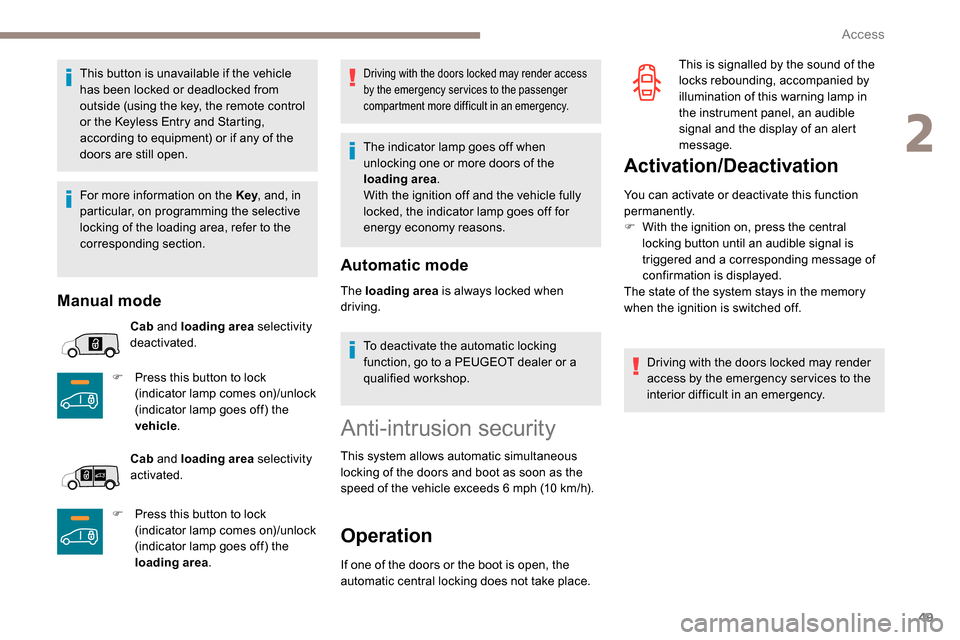
Manual mode
Cab and loading area selectivity
deactivated.
F
P
ress this button to lock
(indicator lamp comes on)/unlock
(indicator lamp goes off) the
vehicle .
Cab and loading area selectivity
activated.
F
P
ress this button to lock
(indicator lamp comes on)/unlock
(indicator lamp goes off) the
loading area .
Driving with the doors locked may render access
by the emergency services to the passenger
compartment more difficult in an emergency.
The indicator lamp goes off when
unlocking one or more doors of the
loading area.
With the ignition off and the vehicle fully
locked, the indicator lamp goes off for
energy economy reasons.
Automatic mode
The loading area is always locked when
driving.
To deactivate the automatic locking
function, go to a PEUGEOT dealer or a
qualified workshop.
Anti-intrusion security
This system allows automatic simultaneous
locking of the doors and boot as soon as the
speed of the vehicle exceeds 6 mph (10 km/h).
Operation
If one of the doors or the boot is open, the
automatic central locking does not take place.
Activation/Deactivation
You can activate or deactivate this function
permanently.
F
W
ith the ignition on, press the central
locking button until an audible signal is
triggered and a corresponding message of
confirmation is displayed.
The state of the system stays in the memory
when the ignition is switched off.
Driving with the doors locked may render
access by the emergency services to the
interior difficult in an emergency. This is signalled by the sound of the
locks rebounding, accompanied by
illumination of this warning lamp in
the instrument panel, an audible
signal and the display of an alert
message.
For more information on the Key , and, in
particular, on programming the selective
locking of the loading area, refer to the
corresponding section.
2
Access
Page 55 of 312
53
Self-protection function
The system checks for the disconnection
of any of its components.
The alarm is triggered if the battery,
button or siren wiring is disconnected or
damaged.
For all work on the alarm system, contact
a PEUGEOT dealer or a qualified
workshop.
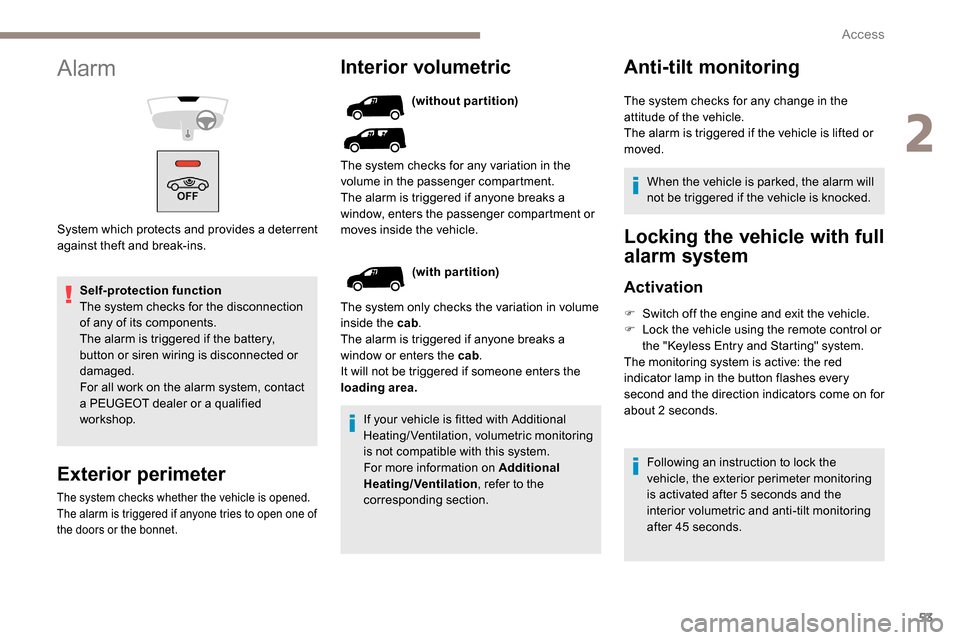
Interior volumetric
If your vehicle is fitted with Additional
Heating/Ventilation, volumetric monitoring
is not compatible with this system.
For more information on Additional
Heating/Ventilation, refer to the
corresponding section. (without partition)
Anti-tilt monitoring
(with partition)
The system only checks the variation in volume
inside the cab .
The alarm is triggered if anyone breaks a
window or enters the cab .
It will not be triggered if someone enters the
loading area. The system checks for any variation in the
volume in the passenger compartment.
The alarm is triggered if anyone breaks a
window, enters the passenger compartment or
moves inside the vehicle. The system checks for any change in the
attitude of the vehicle.
The alarm is triggered if the vehicle is lifted or
moved.
When the vehicle is parked, the alarm will
not be triggered if the vehicle is knocked.
Locking the vehicle with full
alarm system
Activation
F Switch off the engine and exit the vehicle.
F L ock the vehicle using the remote control or
the "
K
eyless Entry and Starting" system.
The monitoring system is active: the red
indicator lamp in the button flashes every
second and the direction indicators come on for
about 2
seconds.
Following an instruction to lock the
vehicle, the exterior perimeter monitoring
is activated after 5
seconds and the
interior volumetric and anti-tilt monitoring
after 45
seconds.
Exterior perimeter
The system checks whether the vehicle is opened.
The alarm is triggered if anyone tries to open one of
the doors or the bonnet.
Alarm
System which protects and provides a deterrent
against theft and break-ins.
2
Access
Page 59 of 312
57
Steering wheel adjustment
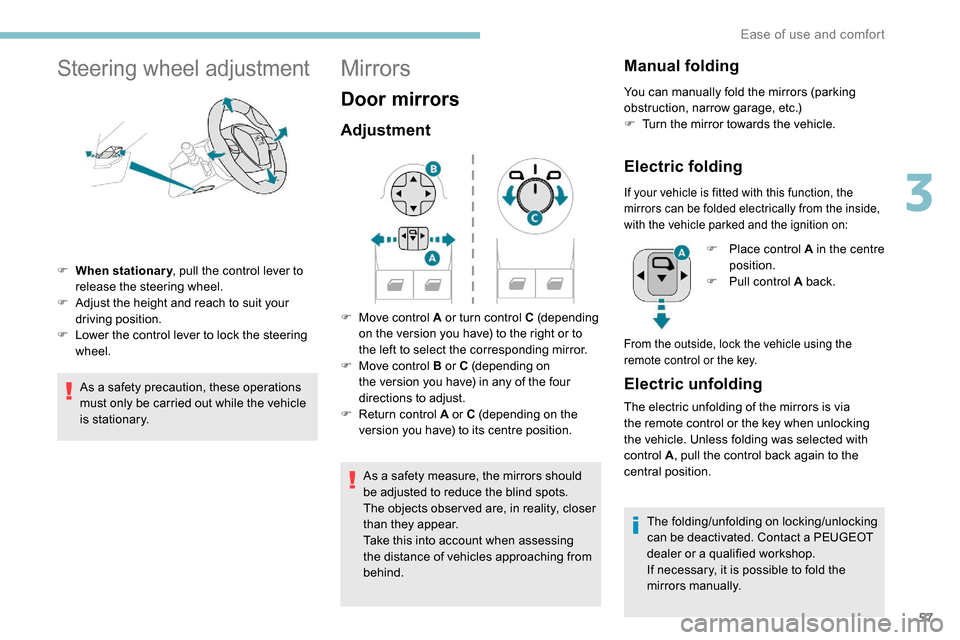
F When stationary, pull the control lever to
release the steering wheel.
F
A
djust the height and reach to suit your
driving position.
F
L
ower the control lever to lock the steering
wheel.
As a safety precaution, these operations
must only be carried out while the vehicle
is stationary.
Mirrors
Door mirrors
Adjustment
As a safety measure, the mirrors should
be adjusted to reduce the blind spots.
The objects obser ved are, in reality, closer
than they appear.
Take this into account when assessing
the distance of vehicles approaching from
behind.
Manual folding
You can manually fold the mirrors (parking
obstruction, narrow garage, etc.)
F
T
urn the mirror towards the vehicle.
Electric folding
F Move control A or turn control C (depending on the version you have) to the right or to
the left to select the corresponding mirror.
F
M
ove control B or C (depending on
the version you have) in any of the four
directions to adjust.
F
R
eturn control A or C (depending on the
version you have) to its centre position.
If your vehicle is fitted with this function, the
mirrors can be folded electrically from the inside,
with the vehicle parked and the ignition on:
Electric unfolding
The electric unfolding of the mirrors is via
the remote control or the key when unlocking
the vehicle. Unless folding was selected with
control A , pull the control back again to the
central position.
The folding/unfolding on locking/unlocking
can be deactivated. Contact a PEUGEOT
dealer or a qualified workshop.
If necessary, it is possible to fold the
mirrors manually. F
P
lace control A in the centre
position.
F
P
ull control A back.
From the outside, lock the vehicle using the
remote control or the key.
3
Ease of use and comfort
Page 60 of 312
58
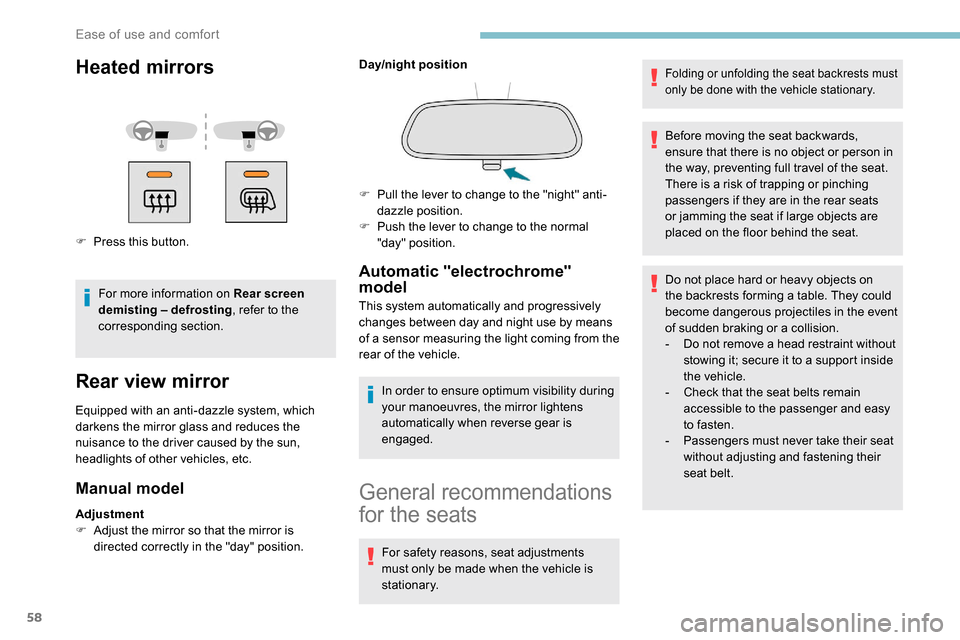
Heated mirrors
F Press this button.For more information on Rear screen
demisting – defrosting , refer to the
corresponding section.
Rear view mirror
Equipped with an anti-dazzle system, which
darkens the mirror glass and reduces the
nuisance to the driver caused by the sun,
headlights of other vehicles, etc.
Manual model
Adjustment
F A djust the mirror so that the mirror is
directed correctly in the "day" position. Day/night position
Automatic "electrochrome"
model
This system automatically and progressively
changes between day and night use by means
of a sensor measuring the light coming from the
rear of the vehicle.
In order to ensure optimum visibility during
your manoeuvres, the mirror lightens
automatically when reverse gear is
engaged.
F
P
ull the lever to change to the "night" anti-
dazzle position.
F
P
ush the lever to change to the normal
"day" position.
General recommendations
for the seats
For safety reasons, seat adjustments
must only be made when the vehicle is
stationary.
Folding or unfolding the seat backrests must
only be done with the vehicle stationary.
Before moving the seat backwards,
ensure that there is no object or person in
the way, preventing full travel of the seat.
There is a risk of trapping or pinching
passengers if they are in the rear seats
or jamming the seat if large objects are
placed on the floor behind the seat.
Do not place hard or heavy objects on
the backrests forming a table. They could
become dangerous projectiles in the event
of sudden braking or a collision.
-
D
o not remove a head restraint without
stowing it; secure it to a support inside
the vehicle.
-
C
heck that the seat belts remain
accessible to the passenger and easy
to fasten.
-
P
assengers must never take their seat
without adjusting and fastening their
seat belt.
Ease of use and comfort
Page 62 of 312
60
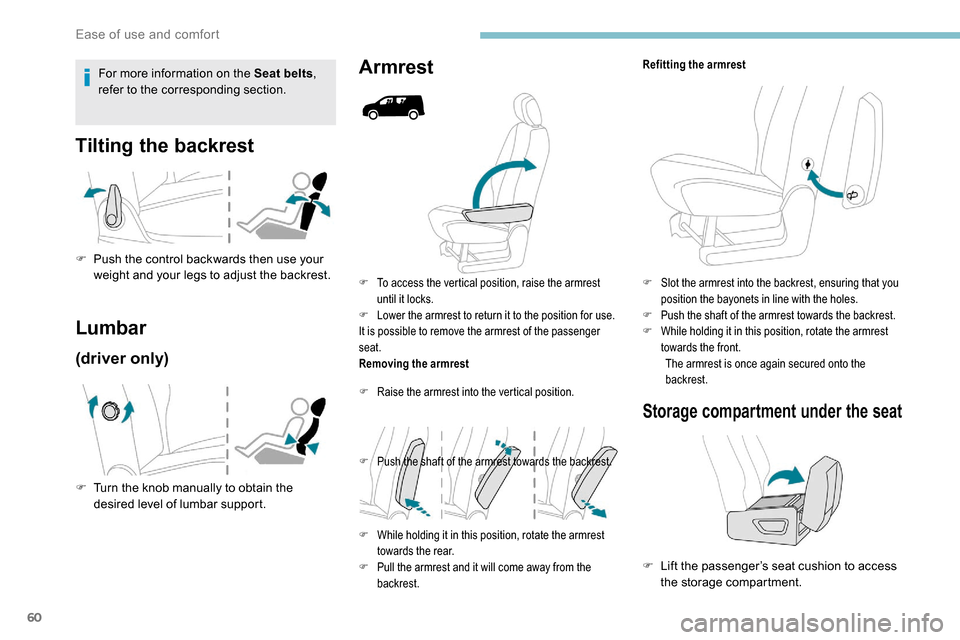
F To access the vertical position, raise the armrest until it locks.
F
L
ower the armrest to return it to the position for use.
It is possible to remove the armrest of the passenger
seat.
Removing the armrest
F
R
aise the armrest into the vertical position.
F
P
ush the shaft of the armrest towards the backrest.
F
W
hile holding it in this position, rotate the armrest
towards the rear.
F
P
ull the armrest and it will come away from the
backrest.
Tilting the backrest
Lumbar
(driver only)
F Turn the knob manually to obtain the desired level of lumbar support.
Armrest
F Push the control backwards then use your weight and your legs to adjust the backrest.
Storage compartment under the seat
Refitting the armrest
F
S
lot the armrest into the backrest, ensuring that you
position the bayonets in line with the holes.
F
P
ush the shaft of the armrest towards the backrest.
F
W
hile holding it in this position, rotate the armrest
towards the front. The armrest is once again secured onto the
backrest.For more information on the Seat belts ,
refer to the corresponding section.
F
L
ift the passenger’s seat cushion to access
the storage compartment.
Ease of use and comfort
Page 65 of 312
63
Never put your hand underneath the seat
cushion to guide the seat downwards or
upwards, you could get your fingers trapped.
Always just use the strap.
Before carrying out these manoeuvres, check
that nothing and nobody is obstructing the
moving elements and their locking.
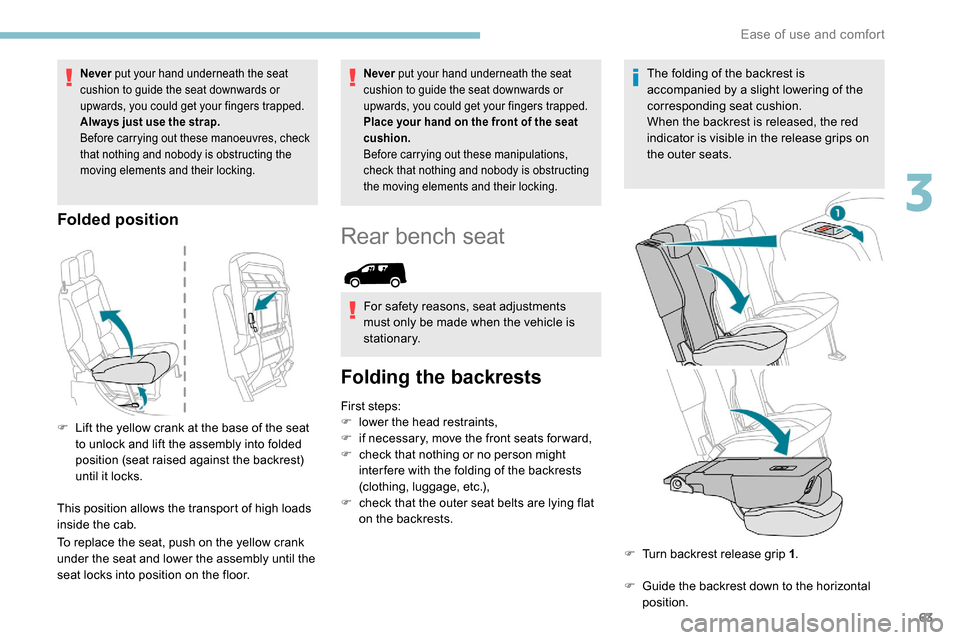
Folded position
This position allows the transport of high loads
inside the cab.
To replace the seat, push on the yellow crank
under the seat and lower the assembly until the
seat locks into position on the floor.F
L
ift the yellow crank at the base of the seat
to unlock and lift the assembly into folded
position (seat raised against the backrest)
until it locks.
Never put your hand underneath the seat
cushion to guide the seat downwards or
upwards, you could get your fingers trapped.
Place your hand on the front of the seat
cushion.
Before carrying out these manipulations,
check that nothing and nobody is obstructing
the moving elements and their locking.
Rear bench seat
For safety reasons, seat adjustments
must only be made when the vehicle is
stationary.
Folding the backrests
First steps:
F l ower the head restraints,
F
i
f necessary, move the front seats for ward,
F
c
heck that nothing or no person might
inter fere with the folding of the backrests
(clothing, luggage, etc.),
F
c
heck that the outer seat belts are lying flat
on the backrests. The folding of the backrest is
accompanied by a slight lowering of the
corresponding seat cushion.
When the backrest is released, the red
indicator is visible in the release grips on
the outer seats.
F
T
urn backrest release grip 1.
F
G
uide the backrest down to the horizontal
position.
3
Ease of use and comfort
Page 66 of 312
64
Repositioning the backrests
First check that the outer seat belts are
lying vertically flat alongside the backrest
latching rings.
F
P
ut the backrest in the upright position and
push it firmly to latch it home.
F
C
heck that the red indicator in the release
grip 1 is no longer visible.
F
E
nsure that the outer seat belts are not
trapped during the manoeuvre.
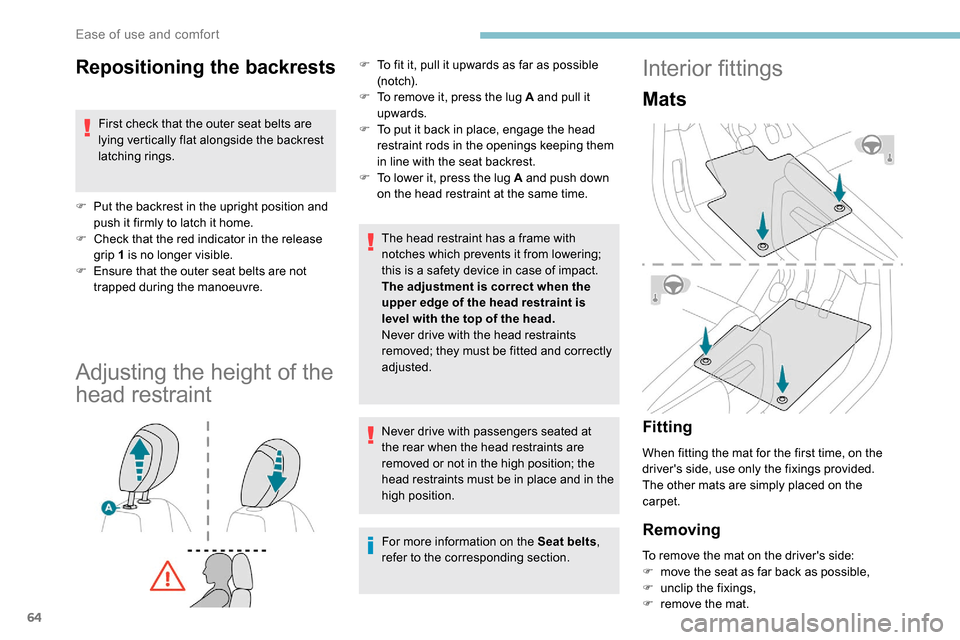
Adjusting the height of the
head restraint
The head restraint has a frame with
notches which prevents it from lowering;
this is a safety device in case of impact.
The adjustment is correct when the
upper edge of the head restraint is
level with the top of the head.
Never drive with the head restraints
removed; they must be fitted and correctly
adjusted.
Never drive with passengers seated at
the rear when the head restraints are
removed or not in the high position; the
head restraints must be in place and in the
high position.
For more information on the Seat belts ,
refer to the corresponding section.
F
T
o fit it, pull it upwards as far as possible
(n otc h).
F
T
o remove it, press the lug A and pull it
upwards.
F
T
o put it back in place, engage the head
restraint rods in the openings keeping them
in line with the seat backrest.
F
T
o lower it, press the lug A and push down
on the head restraint at the same time.
Interior fittings
Mats
Fitting
When fitting the mat for the first time, on the
driver's side, use only the fixings provided.
The other mats are simply placed on the
carpet.
Removing
To remove the mat on the driver's side:
F m ove the seat as far back as possible,
F
un
clip the fixings,
F
r
emove the mat.
Ease of use and comfort
Page 70 of 312
68
On the floor, behind the front seats, a
vertical partition protects the driver and front
passengers against the risk of load movement.
Steel or glass partitions separate the loading
area from the cab.When washing your vehicle, never clean
the inside directly using a water jet.
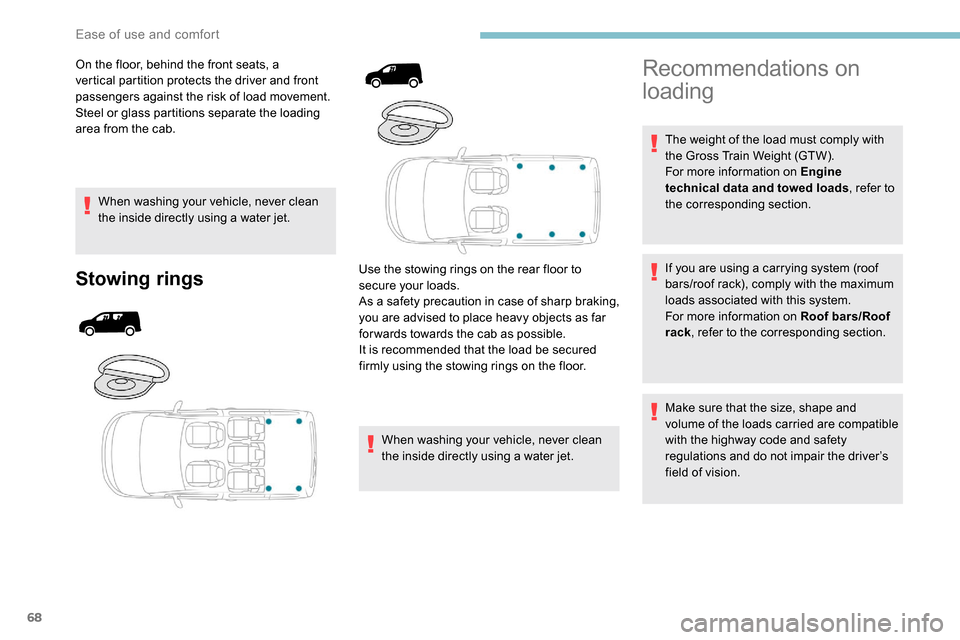
Stowing ringsUse the stowing rings on the rear floor to
secure your loads.
As a safety precaution in case of sharp braking,
you are advised to place heavy objects as far
for wards towards the cab as possible.
It is recommended that the load be secured
firmly using the stowing rings on the floor.
When washing your vehicle, never clean
the inside directly using a water jet.
Recommendations on
loading
The weight of the load must comply with
the Gross Train Weight (GTW).
For more information on Engine
technical data and towed loads , refer to
the corresponding section.
If you are using a carrying system (roof
bars/roof rack), comply with the maximum
loads associated with this system.
For more information on Roof bars/Roof
rack , refer to the corresponding section.
Make sure that the size, shape and
volume of the loads carried are compatible
with the highway code and safety
regulations and do not impair the driver’s
field of vision.
Ease of use and comfort
Page 71 of 312
69
Firmly secure all parts of the load using
the stowing rings on the floor of the
loading area.
For more information on the Interior
fittings and in particular on the stowing
rings, refer to the corresponding section. To avoid the risk of injury or accident,
the load must be made stable so that it
cannot slide, tip over, fall or be projected.
To do this, use only retaining straps that
conform to the current standards (DIN, for
example).
For more information on putting straps
in place, refer to the manufacturer’s user
guide.
There must not be any open space
between the components of the load.
When there is the risk of the load sliding,
there must not be any open space
between the load and the panels of the
vehicle.
As well as the straps, optimise the stability
of the load with stable handling equipment
(wedges, rigid blocks of wood or padding).
When washing your vehicle, never clean
the inside directly using a water jet.
For the Multi-Flex bench
seat and the Crew cab
Do not place sharp or pointed objects in
the protective cover to avoid damaging it.Do not place objects on the dashboard.
Avoid placing short or heavy loads in the
protective cover; use the loading area
whenever possible.
The load must be evenly distributed in the
loading area so as not to inter fere with
driving the vehicle.
Place the load close to the side panels,
or even push it against the side panels
between the wheel arches.
However, it is recommended that heavy
objects are placed as close to the cab as
possible as a precaution in case of sharp
braking.
Deactivate the front
passenger airbag when
carrying long objects.
For more information on Deactivating
the front passenger airbag , refer to the
corresponding section.
Avoid anchoring loads or hanging items on
the wall of the partition.
For your safety, make sure that small
objects do not slip through the gaps of
about 3 cm between the partition and the
vehicle's bodywork.
3
Ease of use and comfort
Page 72 of 312
70
Multi-Flex bench seatRemove the flap
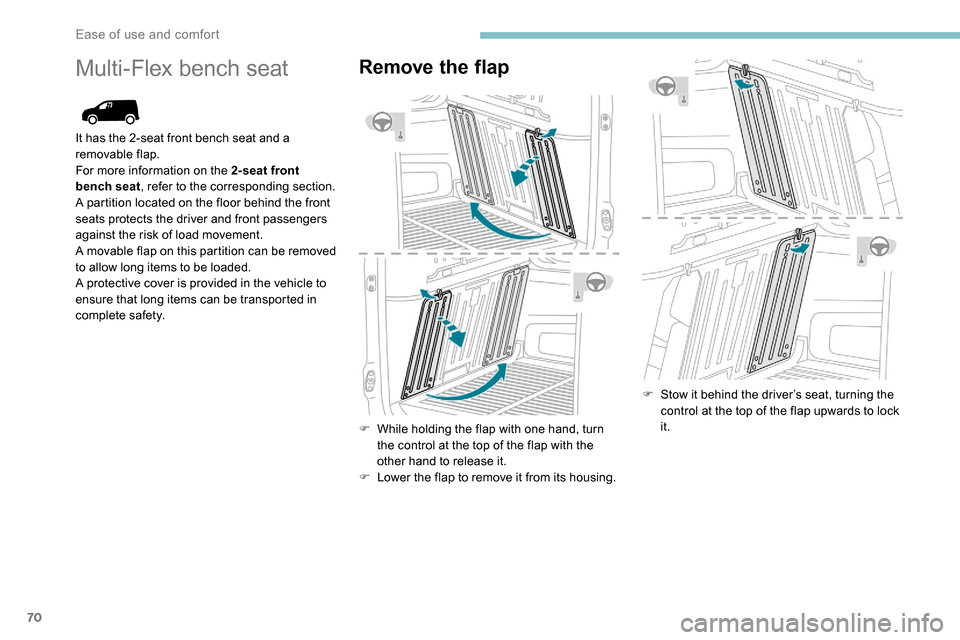
F While holding the flap with one hand, turn the control at the top of the flap with the
other hand to release it.
F
L
ower the flap to remove it from its housing. F
S
tow it behind the driver’s seat, turning the
control at the top of the flap upwards to lock
it.
It has the 2-seat front bench seat and a
removable flap.
For more information on the 2-seat front
bench seat
, refer to the corresponding section.
A partition located on the floor behind the front
seats protects the driver and front passengers
against the risk of load movement.
A movable flap on this partition can be removed
to allow long items to be loaded.
A protective cover is provided in the vehicle to
ensure that long items can be transported in
complete safety.
Ease of use and comfort