tow PEUGEOT PARTNER TEPEE 2020 Owner's Manual
[x] Cancel search | Manufacturer: PEUGEOT, Model Year: 2020, Model line: PARTNER TEPEE, Model: PEUGEOT PARTNER TEPEE 2020Pages: 216, PDF Size: 8.46 MB
Page 73 of 216

71
Lighting control stalk
Front and rear lamps
Lamps off
Lamps with automatic illumination
Sidelamps
Dipped headlamps (green)
Main beam (blue)
Switching between dipped and
main beam
F Pull the stalk fully towards you.
Reminder, lamps on
When switching off the ignition, all of the lamps
turn off, except for dipped beam if the guide-
me-home lighting is activated.
F
T
o activate the lighting control stalk, set the
ring to position 0 (lamps off), then to the
desired position.
When the driver's door is opened, if the lamps
are on, an audible signal will sound.
To avoid discharging the battery, the Economy
mode is triggered after thirty minutes without
any action by the user. The functions are put on
standby and the battery warning lamp flashes.
The sidelamps are not affected by the
Economy mode.
For more information on the Economy
mode , refer to the corresponding section.
Front and rear foglamps
These work with the sidelamps and dipped
headlamps.
They are selected by rotating the ring for wards to
switch on and to the rear to switch off.
The state is indicated by the indicator lamp in the
instrument panel.
Front foglamps (green, the ring is
turned forwards once).
Rear foglamps (amber, the ring is
turned for wards twice).
To turn the rear and front foglamps off, turn the
ring twice to the rear.
In clear weather or in rain, both day and
night, rear foglamps dazzle and their use
is prohibited.
Do not forget to switch them off when they
are no longer necessary.
Automatic illumination of headlamps
switches the rear foglamps off, but the
front foglamps stay on.
Selection is made by rotating this ring.
4
Lighting and visibility
Page 76 of 216
74
Manual wiping
2Fast wiping (heavy rain).
1 Normal wiping (moderate rain).
I Intermittent wiping.
0 Of f.
â Single wipe
(press downwards).
In I ntermittent position, the wiping frequency is
proportional to the speed of the vehicle.
After the ignition has been switched off for
more than a minute, with the wiper control
stalk in position 2, 1 or I, the control must be
reactivated.
-
M
ove the control to any position.
-
S
witch it to the desired position.
Automatic windscreen
wipers
Do not obstruct the rain sensor,
located in the centre of the
windscreen, behind the rear view
m i r r o r.
In AUTO position, the wipers operate
automatically and adapt their speed to the
intensity of the rain. Activation
F
P
ress the control downwards. Activation of
the function is accompanied by a message
on the screen.
If the ignition has been off for more than one
minute, the automatic rain sensitive windscreen
wipers must be reactivated by pushing the
control stalk downwards.
Deactivation
F
P
lace the wiper control stalk in position I
, 1
or 2 .
Deactivation of the function is accompanied by
a message on the screen.
If a fault occurs with the automatic rain
sensitive wipers, the wipers will operate in
intermittent mode.
Contact a PEUGEOT dealer or a qualified
workshop to have the system checked.
During an automatic wash, turn off the
ignition to avoid automatic wiping being
triggered.
In winter, it is advisable to wait until the
windscreen is completely clear of ice before
activating the automatic rain sensitive wipers.
F Pull the control towards you, the screenwash action will be accompanied by
a timed operation of the wipers.
Windscreen washer
This fluid level should be checked
regularly, particularly during winter.
For more information on Checking levels
and, in particular, the screenwash, refer to
the corresponding section.
Special position of the
windscreen wipers
Operate the wiper stalk within one minute after
switching off the ignition to position the wiper
blades along the windscreen pillars.
This action allows the wipers to be taken up for
winter parking, cleaning or replacement.
For more information on Changing a
wiper blade , refer to the corresponding
section.
To return the wiper blades to the normal
position, switch on the ignition and operate the
wiper stalk.
Lighting and visibility
Page 84 of 216
82
Rear seat belts (5 seat
version)
The rear seats are fitted with
three-point inertia reel seat belts.
Rear seat belts (7 seat
version)
In row 2In row 3
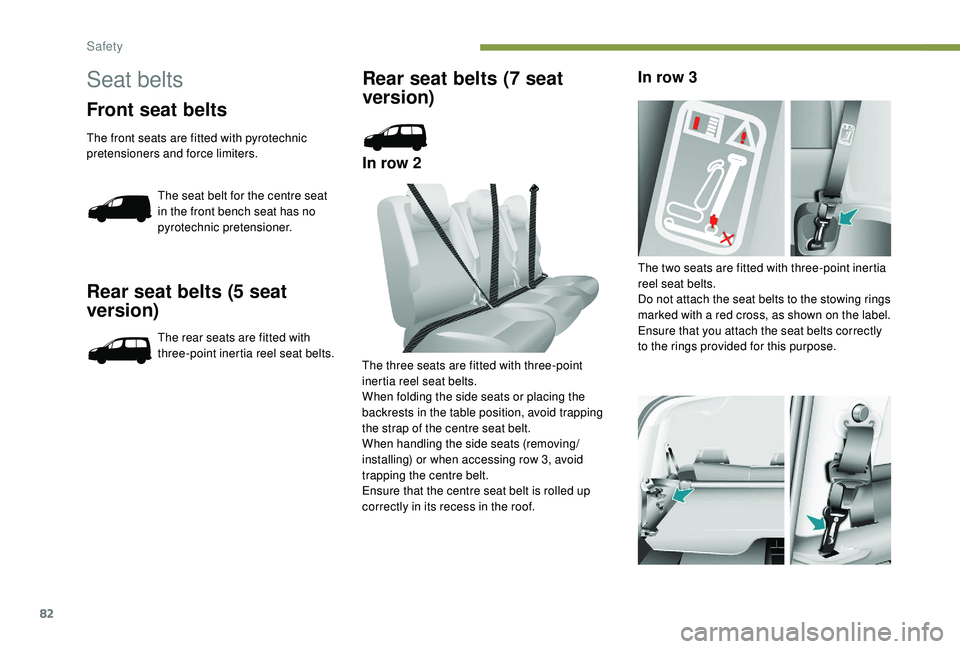
The three seats are fitted with three-point
inertia reel seat belts.
When folding the side seats or placing the
backrests in the table position, avoid trapping
the strap of the centre seat belt.
When handling the side seats (removing/
installing) or when accessing row 3, avoid
trapping the centre belt.
Ensure that the centre seat belt is rolled up
correctly in its recess in the roof. The two seats are fitted with three-point inertia
reel seat belts.
Do not attach the seat belts to the stowing rings
marked with a red cross, as shown on the label.
Ensure that you attach the seat belts correctly
to the rings provided for this purpose.
Seat belts
Front seat belts
The front seats are fitted with pyrotechnic
pretensioners and force limiters.
The seat belt for the centre seat
in the front bench seat has no
pyrotechnic pretensioner.
Safety
Page 86 of 216
84
Advice
The driver must ensure that passengers use
the seat belts correctly and that they are all
fastened before setting off.
Wherever you are seated in the vehicle,
always fasten your seat belt, even for short
journeys.
Do not interchange the seat belt buckles as
they will not fulfil their role fully.
The seat belts are fitted with an inertia reel
permitting automatic adjustment of the length
of the strap to your size. The seat belt is
stowed automatically when not in use.
Before and after use, ensure that the seat belt
is reeled in correctly.
The lower part of the strap must be positioned
as low as possible on the pelvis.
The upper part must be positioned in the
hollow of the shoulder.
The inertia reels have a device for automatic
locking in the event of a collision, sudden
braking or if the vehicle turns over. You can
release the device by pulling the strap firmly
and then releasing it so that it reels in slightly.In order to be effective, a seat belt must:
-
b e tightened as close to the body as
possible,
-
b
e pulled in front of you with a smooth
movement, checking that it does not twist,
-
b
e used to restrain only one person,
-
n
ot show any signs of cuts or fraying,
-
n
ot be converted or modified to avoid
affecting its performance.
In accordance with current safety regulations,
for all repairs on your vehicle's seat belts, go
to a qualified workshop with the skills and
equipment needed, which a PEUGEOT dealer
is able to provide.
Have your seat belts checked regularly by a
PEUGEOT dealer or a qualified workshop,
particularly if the straps show signs of
damage.
Clean the seat belt straps with soapy water or
a textile cleaning product, sold by PEUGEOT
dealers.
After folding or moving a seat or rear bench
seat, ensure that the seat belt is positioned
and reeled in correctly. Recommendations for children
Use a suitable child seat if the passenger is
less than 12
years old or shorter than one and
a half metres.
Never use the same seat belt to secure more
than one person.
Never allow a child to travel on your lap.
For more information on Child seats , refer to
the corresponding section.
In the event of an impact
Depending on the nature and seriousness
of the impact , the pyrotechnic device may
be deployed before and independently of the
airbags. Deployment of the pretensioners
is accompanied by a slight discharge of
harmless smoke and a noise, due to the
activation of the pyrotechnic cartridge
incorporated in the system.
In all cases, the airbag warning lamp comes
on.
Following an impact, have the seat belts
system checked and, if necessary, replaced,
by a PEUGEOT dealer or a qualified
workshop.
Safety
Page 87 of 216
85
Airbags
General
The airbags do not operate when the
ignition is switched off.
This equipment will only deploy once. If a
second impact occurs (during the same or
a subsequent accident), the airbag will not
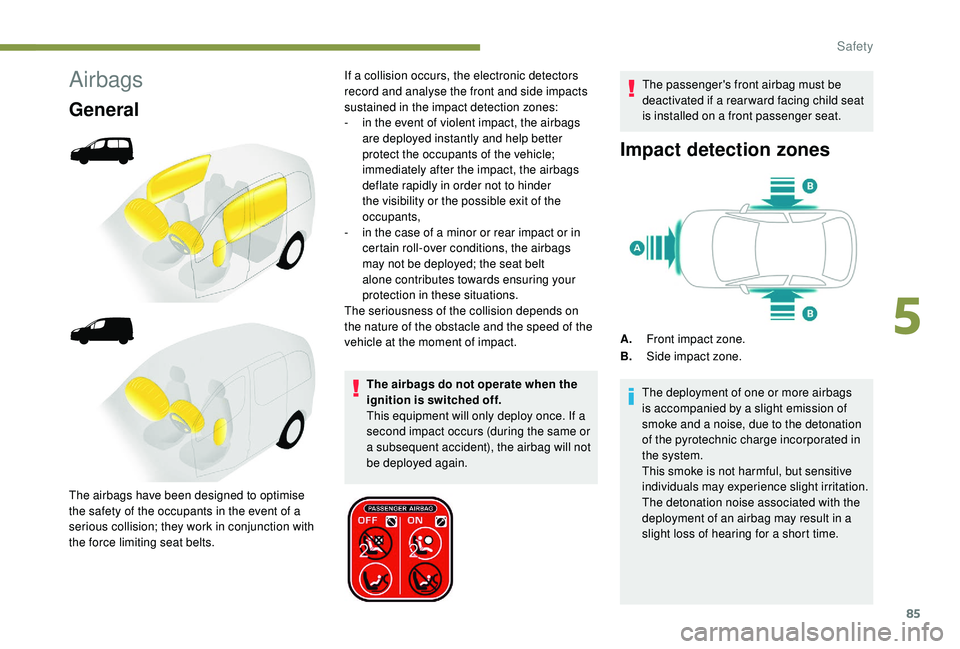
be deployed again.The passenger's front airbag must be
deactivated if a rear ward facing child seat
is installed on a front passenger seat.
Impact detection zones
A.
Front impact zone.
B. Side impact zone.
The deployment of one or more airbags
is accompanied by a slight emission of
smoke and a noise, due to the detonation
of the pyrotechnic charge incorporated in
the system.
This smoke is not harmful, but sensitive
individuals may experience slight irritation.
The detonation noise associated with the
deployment of an airbag may result in a
slight loss of hearing for a short time.
If a collision occurs, the electronic detectors
record and analyse the front and side impacts
sustained in the impact detection zones:
-
i
n the event of violent impact, the airbags
are deployed instantly and help better
protect the occupants of the vehicle;
immediately after the impact, the airbags
deflate rapidly in order not to hinder
the visibility or the possible exit of the
occupants,
-
i
n the case of a minor or rear impact or in
certain roll-over conditions, the airbags
may not be deployed; the seat belt
alone contributes towards ensuring your
protection in these situations.
The seriousness of the collision depends on
the nature of the obstacle and the speed of the
vehicle at the moment of impact.
The airbags have been designed to optimise
the safety of the occupants in the event of a
serious collision; they work in conjunction with
the force limiting seat belts.
5
Safety
Page 88 of 216
86
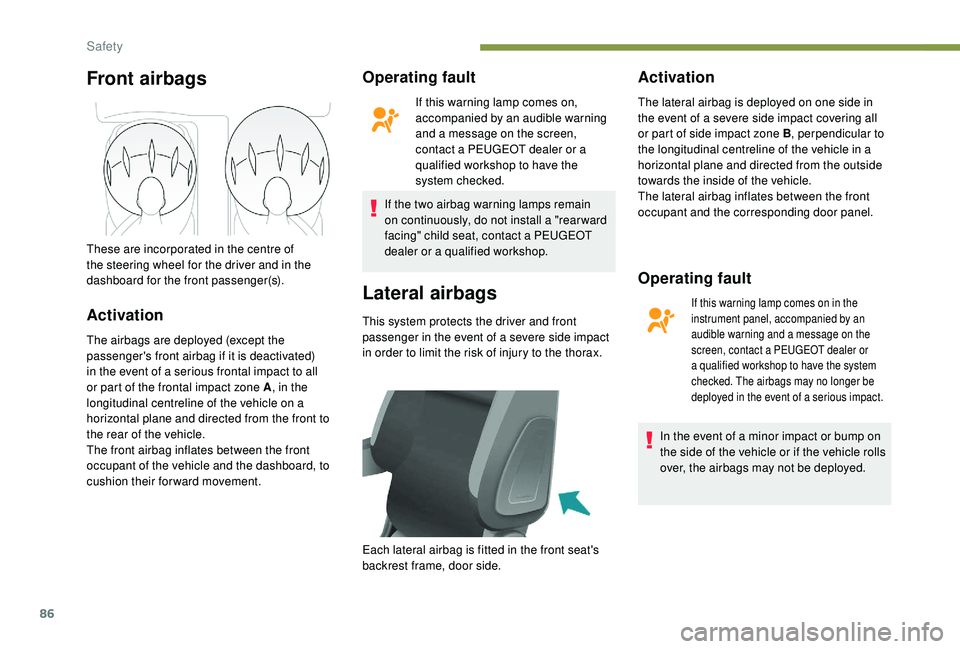
Front airbags
Activation
The airbags are deployed (except the
passenger's front airbag if it is deactivated)
in the event of a serious frontal impact to all
or part of the frontal impact zone A, in the
longitudinal centreline of the vehicle on a
horizontal plane and directed from the front to
the rear of the vehicle.
The front airbag inflates between the front
occupant of the vehicle and the dashboard, to
cushion their forward movement.
Operating fault
If this warning lamp comes on,
accompanied by an audible warning
and a message on the screen,
contact a PEUGEOT dealer or a
qualified workshop to have the
system checked.
If the two airbag warning lamps remain
on continuously, do not install a "rear ward
facing" child seat, contact a PEUGEOT
dealer or a qualified workshop.
Lateral airbags
This system protects the driver and front
passenger in the event of a severe side impact
in order to limit the risk of injury to the thorax.
These are incorporated in the centre of
the steering wheel for the driver and in the
dashboard for the front passenger(s).
Each lateral airbag is fitted in the front seat's
backrest frame, door side.
Activation
The lateral airbag is deployed on one side in
the event of a severe side impact covering all
or part of side impact zone B, perpendicular to
the longitudinal centreline of the vehicle in a
horizontal plane and directed from the outside
towards the inside of the vehicle.
The lateral airbag inflates between the front
occupant and the corresponding door panel.
Operating fault
If this warning lamp comes on in the
instrument panel, accompanied by an
audible warning and a message on the
screen, contact a PEUGEOT dealer or
a qualified workshop to have the system
checked. The airbags may no longer be
deployed in the event of a serious impact.
In the event of a minor impact or bump on
the side of the vehicle or if the vehicle rolls
over, the airbags may not be deployed.
Safety
Page 89 of 216
87
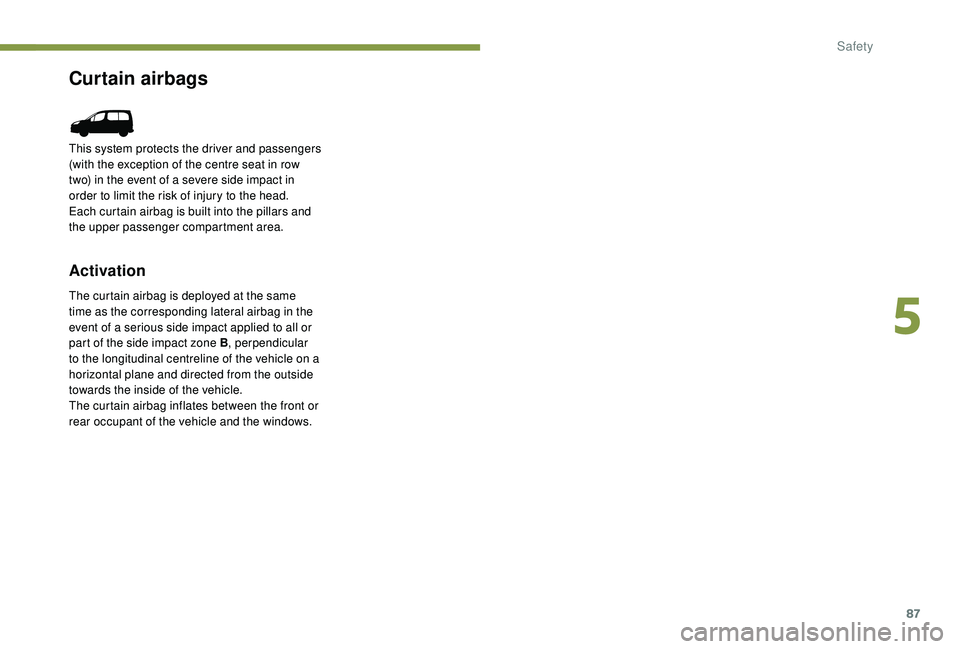
Curtain airbags
Activation
The curtain airbag is deployed at the same
time as the corresponding lateral airbag in the
event of a serious side impact applied to all or
part of the side impact zone B, perpendicular
to the longitudinal centreline of the vehicle on a
horizontal plane and directed from the outside
towards the inside of the vehicle.
The curtain airbag inflates between the front or
rear occupant of the vehicle and the windows. This system protects the driver and passengers
(with the exception of the centre seat in row
two) in the event of a severe side impact in
order to limit the risk of injury to the head.
Each curtain airbag is built into the pillars and
the upper passenger compartment area.
5
Safety
Page 100 of 216
98
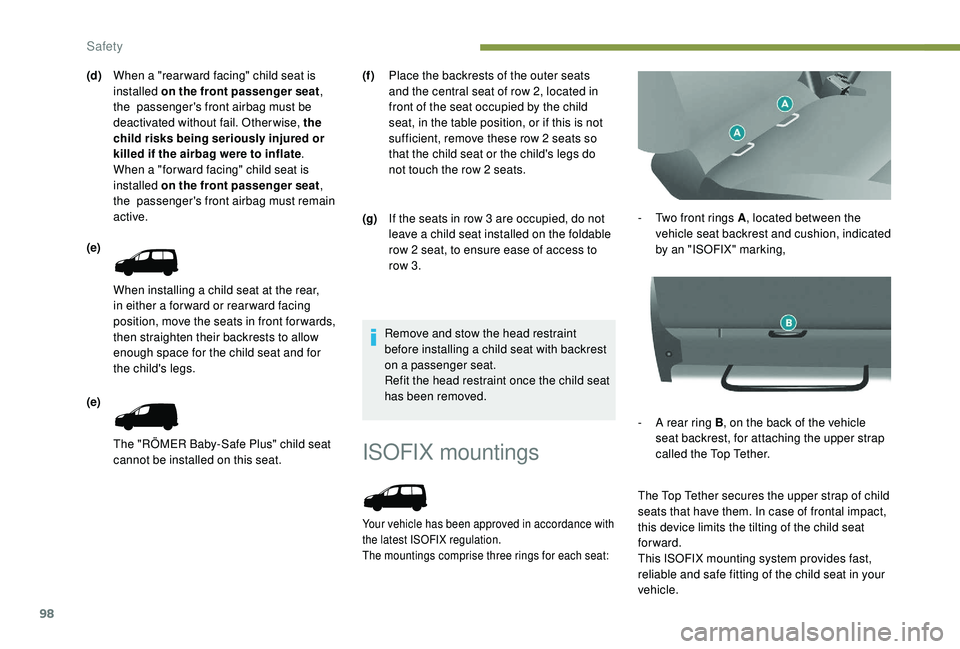
ISOFIX mountings
Your vehicle has been approved in accordance with
the latest ISOFIX regulation.
The mountings comprise three rings for each seat:
- Two front rings A, located between the
vehicle seat backrest and cushion, indicated
by an "ISOFIX" marking,
-
A r
ear ring B , on the back of the vehicle
seat backrest, for attaching the upper strap
called the Top Tether.
The Top Tether secures the upper strap of child
seats that have them. In case of frontal impact,
this device limits the tilting of the child seat
forward.
This ISOFIX mounting system provides fast,
reliable and safe fitting of the child seat in your
vehicle.
Remove and stow the head restraint
before installing a child seat with backrest
on a passenger seat.
Refit the head restraint once the child seat
has been removed.
(d)
When a "rear ward facing" child seat is
installed on the front passenger seat ,
the passenger's front airbag must be
deactivated without fail. Otherwise, the
child risks being seriously injured or
killed if the airbag were to inflate .
When a "for ward facing" child seat is
installed on the front passenger seat ,
the passenger's front airbag must remain
active.
(e)
When installing a child seat at the rear,
in either a for ward or rear ward facing
position, move the seats in front for wards,
then straighten their backrests to allow
enough space for the child seat and for
the child's legs.
(e)
The "RÖMER Baby-Safe Plus" child seat
cannot be installed on this seat. (f )
Place the backrests of the outer seats
and the central seat of row 2, located in
front of the seat occupied by the child
seat, in the table position, or if this is not
sufficient, remove these row 2 seats so
that the child seat or the child's legs do
not touch the row 2 seats.
(g) If the seats in row 3 are occupied, do not
leave a child seat installed on the foldable
row 2 seat, to ensure ease of access to
row 3.
Safety
Page 101 of 216
99
The ISOFIX child seats are fitted with two
latches which are secured on the two front
rings A.
Some also have an upper strap which is
attached to rear ring B .
To secure the child seat to the Top Tether:
-
r
emove and stow the head restraint before
installing a child seat on this seat (refit it
once the child seat has been removed),
-
r
un the strap of the child seat behind the top
of the seat backrest, centring it between the
holes for the head restraint rods,
-
f
ix the hook of the upper strap to rear ring B ,
-
t
ighten the upper strap.The incorrect installation of a child seat in
a vehicle compromises the protection of
the child in the event of an accident.
Strictly follow the fitting instructions
provided in the installation guide supplied
with the child seat.
For information on the possibilities for
installing ISOFIX child seats in your
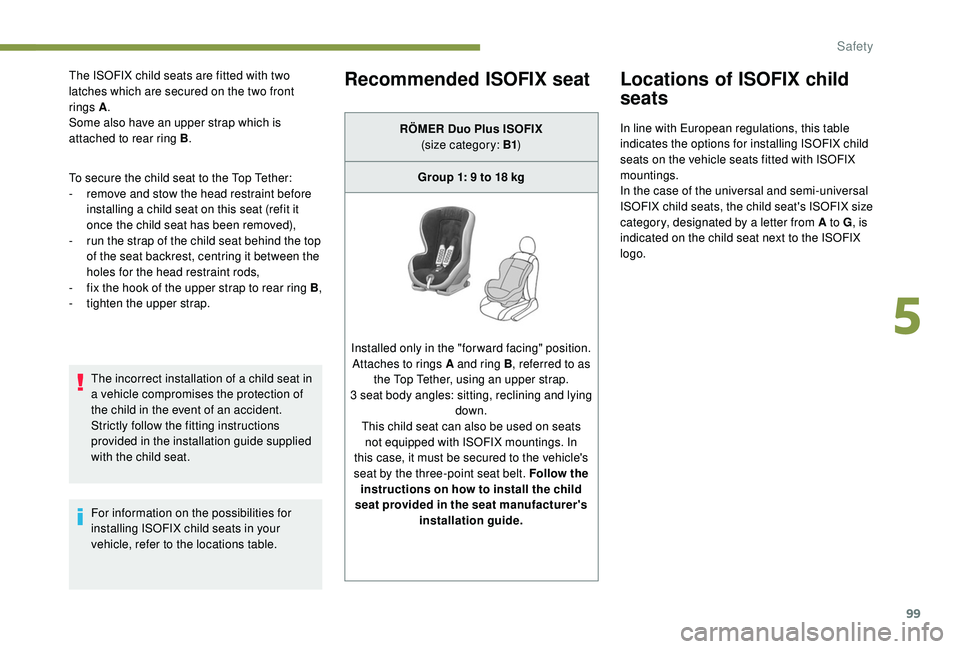
vehicle, refer to the locations table.Recommended ISOFIX seat Locations of ISOFIX child seats
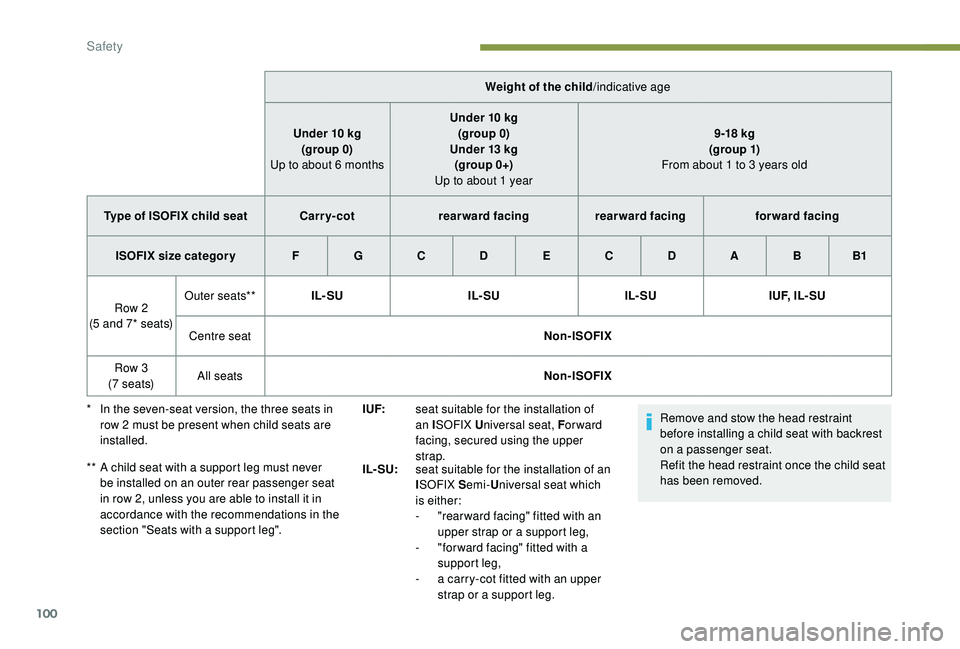
In line with European regulations, this table
indicates the options for installing ISOFIX child
seats on the vehicle seats fitted with ISOFIX
mountings.
In the case of the universal and semi-universal
ISOFIX child seats, the child seat's ISOFIX size
category, designated by a letter from A to G , is
indicated on the child seat next to the ISOFIX
logo.
RÖMER Duo Plus ISOFIX
(size category: B1 )
Group 1: 9 to 18
kg
Installed only in the "forward facing" position. Attaches to rings A and ring B , referred to as
the Top Tether, using an upper strap.
3 seat body angles: sitting, reclining and lying down.
This child seat can also be used on seats not equipped with ISOFIX mountings. In
this case, it must be secured to the vehicle's
seat by the three-point seat belt. Follow the instructions on how to install the child
seat provided in the seat manufacturer's installation guide.
5
Safety
Page 102 of 216
100
Remove and stow the head restraint
before installing a child seat with backrest
on a passenger seat.
Refit the head restraint once the child seat
has been removed.
Weight of the child
/indicative age
Under 10
kg
(group 0)
Up to about 6
months
Under 10
kg
(group 0)
Under 13
kg
(group 0+)
Up to about 1 year 9 -18
kg
(g ro up 1)
From about 1 to 3 years old
Type of ISOFIX child seat Carr y- cotrearward facing rearward facing forward facing
ISOFIX size categor y F G C D E C D A B B1
Row 2
(5 and 7* seats) Outer seats**
IL- SU IL- SUIL- SUI U F, I L - S U
Centre seat Non-ISOFIX
Row 3
(7 seats) All seats
Non-ISOFIX
*
I
n the seven-seat version, the three seats in
row 2
must be present when child seats are
installed.
**
A c
hild seat with a support leg must never
be installed on an outer rear passenger seat
in row 2, unless you are able to install it in
accordance with the recommendations in the
section "Seats with a support leg". I UF:
seat suitable for the installation of
an ISOFIX U niversal seat, F or ward
facing, secured using the upper
strap.
IL- SU: seat suitable for the installation of an
ISOFIX S emi-Universal seat which
is either:
-
"
rear ward facing" fitted with an
upper strap or a support leg,
-
"
for ward facing" fitted with a
support leg,
-
a c
arry-cot fitted with an upper
strap or a support leg.
Safety