tire size PONTIAC BONNEVILLE 1993 Owners Manual
[x] Cancel search | Manufacturer: PONTIAC, Model Year: 1993, Model line: BONNEVILLE, Model: PONTIAC BONNEVILLE 1993Pages: 322, PDF Size: 16.31 MB
Page 107 of 322
Features Controls
Brake System Warning Light
(CONT.)
Your brake system may not be
working properly if the brake
warning light is on. Driving with
the brake warning light
on can lead
to an accident. If the light is still
on after you’ve pulled off the road
and stopped carefully, have the
vehicle towed for service.
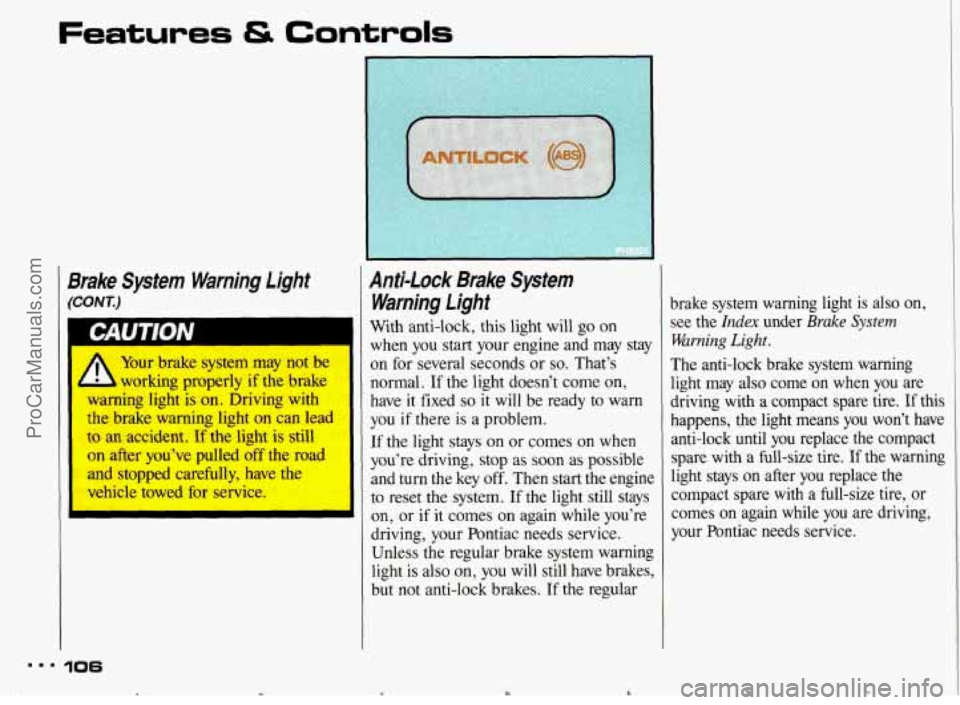
Anti-lock Brake System
Warning light
With anti-lock, this light will go on
when you start your engine and may stay
on for several seconds or
so. That’s
normal. If the light doesn’t come on,
have it fixed
so it will be ready to warn
you
if there is a problem.
If the light stays on or comes on when
you’re driving, stop as soon as possible
and turn the key off. Then start the engine
to reset the system.
If the light still stays
on, or if it comes on again while you’re
driving, your Pontiac needs service.
Unless the regular brake system warning
light is also on, you will still have brakes,
but not anti-lock brakes.
If the regular
mm. 106
c Y
brake system warning light is also on,
see the
Index under Brake System
Warning Light.
The anti-lock brake system warning
light may also come on when you are
driving with a compact spare tire.
If this
happens, the light means you won’t have
anti-lock until you replace the compact
spare with a full-size tire.
If the warning
light stays
on after you replace the
compact spare with a full-size tire, or
comes
on again while you are driving,
your Pontiac needs service.
ProCarManuals.com
Page 187 of 322

Your Driving and the Road
I4
If bu Do Decide to Pull a Trailer
(CONT.)
Total Weight on Your Vehicle’s Tires
Be sure your vehicle’s tires are inflated
to the limit for cold tires. You will find
these numbers on the Certification
label at the rear edge of the driver’s
door (or, see the
Index under 7ire
Loading).
Then be sure you don’t go
over the
GVW limit for your vehicle.
186
Hitches
It’s important to have the correct hitch
equipment. Crosswinds, large trucks
going by, and rough roads are a
few
reasons why you’ll need the right hitch.
Here are some rules to follow:
If you’ll be pulling a trailer that, when
loaded, will weigh more than 2,000
pounds (900 kg), be sure to use a
properly mounted, weight-distributing
hitch and sway control
of the proper
size. This equipment is very important
for proper vehicle loading
and good
handling when you’re driving.
Will you have to make any holes in the
body of your vehicle, when you install
a trailer hitch?
If you do, then be sure
to seal the holes later when you remove
the hitch.
If you don’t seal them, deadly
carbon monoxide
(CO) from your
exhaust can get into your vehicle. (See
the
Index under Carbon Monoxide in
Exhaust.) Dirt and water can, too.
The bumpers on your vehicle are not
intended for hitches. Do not attach
rental hitches or other bumper-type
hitches to them. Use only a frame-
mounted hitch that does not attach to
the bumper.
ProCarManuals.com
Page 218 of 322

Don’t try to put the wheel cover on the
compact spare tire. It won’t
fit. Store the
wheel cover in the trunk until you have
replaced the compact spare tire with a
regular tire.
Wheel covers won’t fit on your
compact spare. If you try to put
a
wheel cover on your compact
spare, you could damage the cover
or the spare.
19. Store the flat tire as far forward in
the trunk as possible. Store the jack
and wheel wrench
in their
compartment in the trunk.
1 Storing a jack, a tire, or other
equipment in the passenger
compartment of the vehicle could
cause injury. In a sudden stop or
collision, loose equipment could
strike
someone. Store all these in
I the proper place.
The compact spare is for temporary use
only. Replace the compact spare tire
with a full-size tire as soon as you can.
See
Compact Spare Tire later in this
section.
Compact Spare Tire
Although the compact spare was fully
inflated when your vehicle was new, it
can lose air after a time. Check the
inflation pressure regularly. It should be
60 psi (420 kPa). The compact spare is
made to
go up to 3,000 miles (5 000 km),
so you can finish your trip and have
your full-size tire repaired
or replaced
where you want. Of course, it’s best to replace your spare with
a fill-size tire as
soon as you can. Your spare will last
longer and be
in good shape in case you
need it again.
r
ProCarManuals.com
Page 249 of 322

Service & Appearance Care
Windshield Wiper Blade
Replacement
Replacement blades come in different
types and are removed
in different ways.
Here’s how to remove the type with a
release clip:
1. Pull the windshield wiper arm away
2. Lift the release clip with a
from
the windshield.
screwdriver and pull the blade
assembly off the wiper arm.
the wiper arm.
3. Push the new wiper blade securely on
Loading bur Vehicle
Two labels on your vehicle show how
much weight it may properly carry. The
Tire-Loading Information label found on
the rear edge of the driver’s door tells
you the proper size, speed rating and
recommended inflation pressures for the
tires on your vehicle. It also gives you
important information about the number
of people that can be in your vehicle and
the total weight that you can carry. This
weight is called the Vehicle Capacity
Weight and includes the weight of all
occupants, cargo, and all nonfactory-
installed options.
The other label is the Certification
label,
also on the rear edge of the
driver’s door. It tells you the gross
weight capacity of your vehicle, called the
GVWR (Gross Vehicle Weight
Rating). The GVWR includes the
weight of the vehicle, all occupants, fuel
and cargo. Never exceed the GVWR for
your vehicle, or
the Gross Axle Weight
Rating (GAWR) for either the front or
rear axle.
And, if you do have a heavy load,
you
should spread it out. Don’t carry more
than
176 lbs. (80 kg) in your trunk.
On vehicles equipped with electronic
level control, the rear of the vehicle
is
automatically kept level as you load or
unload your vehicle.
... 248
ProCarManuals.com
Page 253 of 322

Service & Appearance Care
Tire Inspection and Rotation
(CONT)
r st or dirt on a wheel, or on
tne parts to which it is
stened, can
make the wheel nuts
“dome loose
after a time. The
wheel could come
off and cause an
.. - cident . When you change a
wheel, remove any
rust or dirt
from places where
the wheel
attaches to the vehicle.
In an
emergency, you can use
a cloth or
a paper towel to do this; but be
sure to use a scraper or wire brush ’ -kr, if you need to, to get all the
,,Adder
changing a Flat Ere.
st or dirt off. See the Index
I
... 252
When It’s Time for New Tires
One way to tell when it’s time for new
tires is
to check the treadwear
indicators, which will appear when your
tires have only
2/32 inch (1.6 mm) or
less of tread remaining.
You need a new tire if
You can see the indicators at three
You can see cord or fabric showing
The tread or sidewall is cracked, cut
places around the
tire.
through the tire’s rubber.
or snagged deep enough
to show cord
or fabric.
The tire has a bump, bulge or split.
The tire has a puncture, cut, or other
damage that can’t be repaired well
because
of the size or location of the
damage.
Buying New Tires
To find out what kind and size of tires
you need, look at the Tire-Loading
Information label. The tires installed
on
your vehicle when it was new had a Tire
Performance Criteria Specification
(TPC Spec) number
on each tire’s
sidewall. When you get new tires, get
ones with that same TPC Spec number.
That way, your vehicle will continue to
have tires that are designed to give
proper endurance, handling, speed rating, traction, ride and other things
during normal service
on your vehicle.
If your tires have an all-season tread
design, the TPC number will be followed
by a
“MS” (for mud and snow).
If you ever replace your tires with those
not having a TPC Spec number, make sure they are the same size, load range,
speed rating and construction type (bias,
bias-belted or radial) as your original
tires.
ProCarManuals.com
Page 254 of 322

I CAUTION
A
Mixing tires could cause you
to lose control while driving.
If you
mix tires of different sizes
or types (radial and bias-belted
tires), the vehicle may not handle
properly, and you could have a
crash. Be sure to use the same size
and type tires on all wheels. It’s all
right to drive with your compact
spare, though. It was developed for
limited use on your vehicle.
rn Uniform Tire Quality
Grading
The following information relates to the
system developed by the United States
National Highway Traffic Safety
Administration which grades tires by
treadwear, traction and temperature
performance. (This applies only to
vehicles sold in the United States.)
Treadwear
The treadwear grade is a comparative
rating based on the wear rate
of the tire
when tested under controlled conditions
on a specified government test course.
For example, a tire graded
150 would
wear one and a half
(1%) times as well
on the government course as a tire
graded
100. The relative performance of
tires depends upon the actual conditions
of their use, however, and may depart
significantly from the norm due to
variations in driving habits, service
practices and differences
in road
characteristics and climate.
253
ProCarManuals.com
Page 271 of 322
Service & Appearance Care
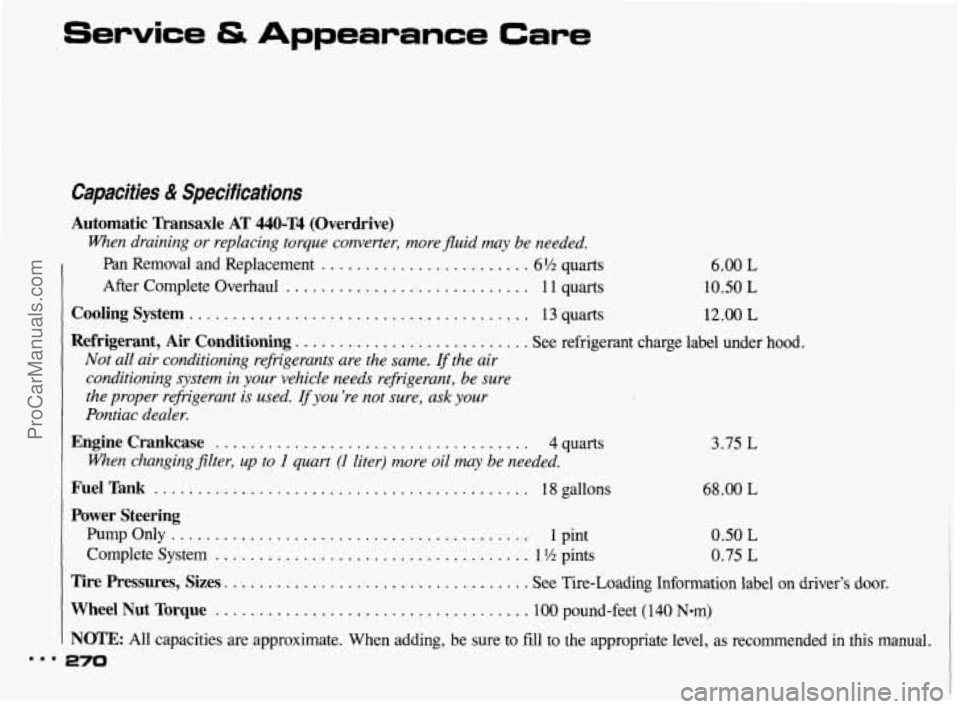
Capacities & Specifications
Automatic Transaxle AT 440-T4 (Overdrive)
When draining or replacing torque converter, more fluid may be needed.
Pan Removal and Replacement ........................ 6% quarts
After Complete Overhaul
............................ 1 1 quarts
I Cooling System ....................................... 13 quarts
6.00 L
10.50 L
12.00 L
Refrigerant, Air Conditioning ........................... See refrigerant charge label under hood.
Not all air conditioning refrzgerants are the same. If the air
conditioning system in your vehicle needs refiigerant, be sure
the proper refngerant is used.
If you 're not sure, ask your
Pontiac dealer.
Engine Crankcase .................................... 4 quarts
Fuel Tank ........................................... 18 gallons
When changing filter, up to I quart (I liter) more oil may be needed.
3.75 L
68.00 L
Power Steering
Pump Only ......................................... 1 pint 0.50 L
Complete System .................................... 1 !h pints 0.75 L
Tire Pressures, Sizes. .................................. See Tire-Loading Information label on driver's door.
Wheel Nut Torque ..................................... 100 pound-feet (140 Nom)
NOTE: All capacities are approximate. When adding, be sure to fill to the appropriate level, as recommended in this manual.
270 I..
ProCarManuals.com