brake PONTIAC FIREBIRD 1996 Owner's Manual
[x] Cancel search | Manufacturer: PONTIAC, Model Year: 1996, Model line: FIREBIRD, Model: PONTIAC FIREBIRD 1996Pages: 386, PDF Size: 19.18 MB
Page 115 of 386

You can store the sunshades two different ways:
0 When the T-tops are in use, store the sunshades in
their storage area in the rear of the vehicle, and
make
sure the close-out panel is in its closed,
upright position.
0 When you have the T-tops off and in their storage
slots, store the sunshades on the T-tops, in their
installed position.
Convertible Top
The following procedures explain the proper operation
of your convertible top.
Lowering Your Convertible Top
Don’t leave your convertible out with the top
down for any long periods of time. The sun and
the rain can damage your seat material and other
1. Park on a level surface. Set the parking brake firmly,
shift
an automatic transmission into PARK (PI or a
manual transmission into
REVERSE (R). The
ignition must be in the ACC or RUN position. Lower
both
sun visors.
2-66
ProCarManuals.com
Page 118 of 386

3. Install the middle section of the cover by sliding
the tabs into the slots on right side cover. Lower
the cover and engage latch.
4. Close the trunk.
Raising Your Convertible Top
1. Park on a level surface. Set the parking brake fdy.
If you have an automatic transmission, shift into
PARK (I?). If you have a manual transmission, shift
into REVERSE (R). The ignition must be in the ACC
or RUN position or RAP must be on. Lower both sun
visors. Lower both windows at least 3 inches (8 cm).
If the boot cover is in place, it must be removed first.
2. Open the trunk. Remove the middle piece of the
cover by pushing in on the latch and lifting up on
the cover.
2-69
ProCarManuals.com
Page 122 of 386
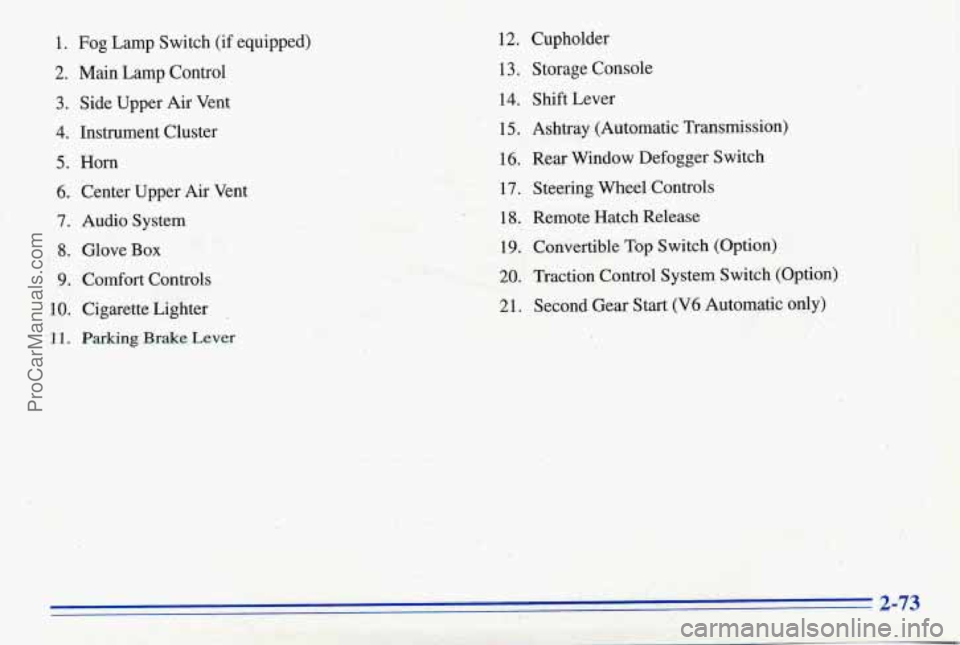
1. Fog Lamp Switch (if equipped)
2. Main Lamp Control
3. Side Upper Air Vent
4. Instrument Cluster
5. Horn
6. Center Upper Air Vent
7.
Audio System
8. Glove Box
9. Comfort Controls
10. Cigarette Lighter .
1 1. Parking Brake Lever
12. Cupholder
13. Storage Console
14. Shift Lever
15. Ashtray (Automatic Transmission)
16. Rear Window Defogger Switch
17. Steering Wheel Controls
18. Remote Hatch Release
19. Convertible Top Switch (Option)
20. Traction Control System Switch (Option)
21. Second Gear Start (V6 Automatic only)
2-73
ProCarManuals.com
Page 126 of 386

Air Bag Readiness Light
There is an air bag readiness light on the instrument
panel, which shows AIR
BAG. The system checks the
air bag’s electrical system for malfunctions. The light
tells you if there
is an electrical problem. The system
check includes
the air bag sensors, the air bag modules,
the wiring and the crash sensing and diagnostic module.
For more information on the air bag system, sed “Air
Bag” in the Index.
AIR
BAG
You will see this light flash
for a few seconds when you
turn your ignition to
RUN
or START. Then the light
should go out. This means
the system is ready.
If the air bag readiness light doesn’t come on when you
start your vehicle, or stays on, or comes on when you
are driving, your air bag system may not work properly.
Have your vehicle serviced right away.
Voltmeter
I p4
You can read battery
voltage on
your voltmeter.
If it reads less than 11 volts
or more than 16 volts while
your engine
is running,
and it stays there, you may
have
a problem with the
electrical charging system.
Have it checked right away. Driving with the voltmeter
reading in a warning zone could drain your battery.
If you idle your engine for a while, the voltmeter
reading might move into the yellow zone, If the reading
stays in the yellow zone while you are driving, you may
have a problem with the electrical charging system.
Have it checked. While the voltmeter reads in the
yellow
zone, your battery may not be able to power certain
electrical accessories,
like ABS. (If this happens, your
ABS INOP light will come on. See “Anti-Lock Brake
System Warning Light” in this
part.)
If you must drive a short distance with the voltmeter
reading in a warning zone,
turn off all your accessories,
including your comfort control and audio system.
ProCarManuals.com
Page 127 of 386

Brake System Warming Light
Your Pontiac’s hydraulic brake system is divided into
two parts. If one part isn’t working, the other part can
still work and stop
you. For good braking, though, you
need both parts working well.
If the warning light comes on, there could be a brake
problem. Have your brake system inspected right away.
BRAKE
This light should come on
briefly when you turn the
ignition key
to RUN. If it
doesn’t come on then,
have it-fixed so it will be
ready to warn you if there’s
a problem.
If the light comes on while you are driving, pull off the
road and
stop carefully. You may notice that the pedal is
harder to push. Or,
the pedal may go closer to the floor.
11 may take longer to stop. IE the light is still on, or if the
anti-lock brake system warning light is flashing, have
the vehicle towed for service. (See “Anti-Lock Brake
System Warning Light”
and “Towing Your Vehicle” in
the Index.)
Your brake system may not be working properly
if the brake system warning light is on. Driving
with the brake system warning light on can lead
to an accident. If the light is still on or if the
anti-lock brake system warning light is flashing
after you’ve pulled
off the road and stopped
carefully, have the vehicle towed for service.
When the ignition is on, the brake system warning light
will also come on when you set your parking brake. The
light will stay on if your parking brake doesn’t release
fully.
If it stays on after your parking brake is fully
released,
it means .;.; -< . . you have a brake problem. ?>- ?-L,- .‘ ., : .
ProCarManuals.com
Page 128 of 386
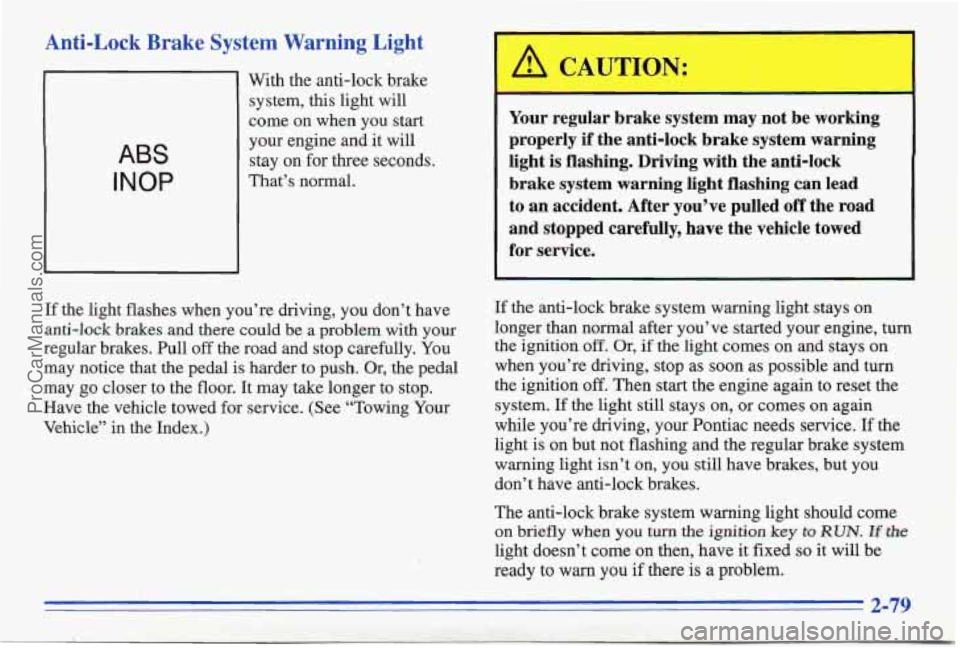
Anti-Lock Brake System Warning Light
ABS
INOP
With the anti-lock brake system, this light will
come on when you start
your engine and it will
stay on for three seconds.
That’s normal.
,4 :._ :< If he fight flashes when driving, fbu ~~$~~~~e
anti-lock brakes and there could be a problem with your
regular brakes. Pull
off the road and stop carefully. You
may notice that the pedal is harder to push.
Or, the pedal
Have the vehicle towed for service. (See “Towing
Your
Vehicle” in the Index.)
, may go closer to the floor. It may take longer to stop.
Your regular brake system may not be working
properly
if the anti-lock brake system warning
light is flashing. Driving with the anti-lock
brake system warning light flashing can lead
to an accident. After you’ve pulled
off the road
and stopped carefully, have the vehicle towed
for service.
If the anti-lock brake system warning light stays on
longer than normal after you’ve started your engine, turn
the ignition
off. Or, if the light comes on and stays on
when you’re driving, stop as soon as possible and turn
the ignition off. Then start the engine again to reset
the
system. If the light still stays on, or comes on again
while you’re driving, your Pontiac needs service.
If the
light is on but not flashing and the regular brake system
warning light isn’t on, you still have brakes, but you
don’t have anti-lock brakes.
The anti-lock brake system warning light should come
on
briefly when you turn the ignition key to RUN. If the
light doesn’t come on then, have it fixed so it will be
ready to warn you
if there is a problem.
2-79
ProCarManuals.com
Page 129 of 386

Traction Control System Warning Light (Option)
T’CS
OFF
This warning light should
come on briefly as you start
the engine.
If the warning
light doesn’t come on then,
have it fixed
so it will be
ready to
warn you if there’s
a problem.
I. . . -,.L-,-
If it stays on, or comes‘0n’’when you’re driving, there
may be a problem with
your traction control system and
your vehicle may need service. When this warning light
is
OW, the system will not lifnit wheel spin. Adjust your
driving accordingly.
If your brakes begin to overheat, the brake portion of the
traction control system will shut down, but the throttle
and engine spark control wiil continue to work. The
warning light will not
come on when this happens.
The traction control system warning light may come on
for the following reasons:
If you turn the system off by pressing the button
located on the center of the console behind the shift
lever (Automatic Transmission) or in front of the
shiftboot (Manual Transmission), the warning light
will
come on and stay on. To turn the system back
on, press the button again. The warning light should
go
off. (See “Traction Control System’’ in the Index
for more information.)
If the temperature of the throttle control begins
to rise, the system will turn off and the warning
light will come on until the system cools down.
The system,does this
to prevent damage from
overheating.
If the tmchan CQII~XQ~ system warning light comes on
and stays on
for an extended period of time when the
system is turned on, your vehicle needs service.
ProCarManuals.com
Page 130 of 386

Low Traction Light
LOW
TRAC
When your anti-lock system
is adjusting brake pressure
to help avoid a braking skid,
this light will come on.
If you have the traction control system, this light will
also come on when the system is limiting wheel spin.
Slippery road conditions may exist if the low traction
light comes
on, so adjust your driving accordingly. The
light will stay on for a few seconds after the anti-lock
system stops adjusting brake pressure or the traction
control system stops limiting wheel spin.
The low traction light also comes
on briefly wlien you
turn the ignition key to
RUN. If the light doesn’t come
on then, have
it fixed so it will be there to tell you
when the anti-lock brake system or traction control
system
is active.
Engine Coolant Temperature Gage
This gage shows the engine
coolant temperature.
If ’
‘the gage pointer moves
into the red area, your
engine is too hot! It means
that your engine coolant
has overheated.
If you have been operating your vehicle under normal
driving conditions, you should pull
off the road, stop
your vehicle and turn
off the engine as soon as possible.
In “Problems on the Road”, this section
shows what to
do. See “Engine Overheating” in the Index.
ProCarManuals.com
Page 162 of 386

v Section 4 Your Driving and the Road
Here you’ll find information about driving on different
kinds of roads and in varying weather conditions. We’ve
also included many other useful tips on driving.
Defensive Driving
The best advice anyone can give about driving is:
Drive defensively.
our
Please start with a very important safety device in
Y
Pontiac: Buckle up. (See “Safety Belts” in the Index.)
Defensive driving really means “be ready for anything.”
On city streets, rural roads or freeways, it means
“always expect the unexpected.”
Assume that pedestrians or other drivers are going to be
careless and make mistakes. Anticipate what they might
do. Be ready for their mistakes.
Rear-end collisions are about the most preventable
of
accidents. Yet they are common. Allow enough
following distance. It’s
the best defensive driving
maneuver, in both city and rural driving. You never
know when the vehicle in front of you
is going to brake
or turn suddenly.
4-1
ProCarManuals.com
Page 166 of 386

Control of a Vehicle Braking
You
have three systems that make your vehicle go where Braking action involves perception time and
you want it to go. They are the brakes, the steering and reaction time.
the accelerator. All three systems have to do their work
First, you have to decide to push on the brake pedal.
at the places where the tires meet the road.
That’s perception time. Then you have to bring up
your fo.ot and do
it. That’s reaction time.
Average reaction time
is about 314 of a second. But
that’s only an average. It might be less with
one driver
and as long as two or three seconds or more with
another. Age, physical condition, alertness, coordination
and eyesight all play a part.
So do alcohol, drugs and
frustration. But even
in 3/4 of a second, a vehicle
moving at
60 mph (100 km/h) travels 66 feet (20 m).
That could be a lot
of distance in an emergency, so
keeping enough space between your vehicle and others
is important.
And, of course, actual stopping distances vary greatly
with the surface
of the road (whether it’s pavement or
gravel); the condition of the road (wet, dry, icy); tire
tread; and the condition
of your brakes.
Sometimes, as when you’re driving on snow or ice, it’s
easy
to ask more of those control systems than the tires
and road can provide. That means you can lose control
of your vehicle.
4-5
ProCarManuals.com