brake PONTIAC G6 2010 Owners Manual
[x] Cancel search | Manufacturer: PONTIAC, Model Year: 2010, Model line: G6, Model: PONTIAC G6 2010Pages: 448, PDF Size: 2.5 MB
Page 5 of 448
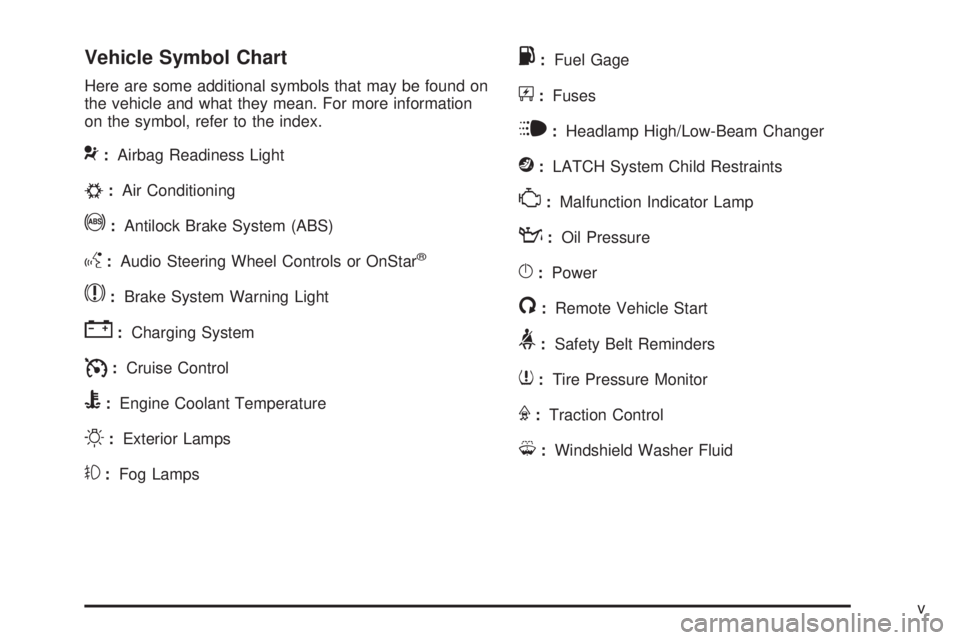
Vehicle Symbol Chart
Here are some additional symbols that may be found on
the vehicle and what they mean. For more information
on the symbol, refer to the index.
9:Airbag Readiness Light
#:Air Conditioning
!:Antilock Brake System (ABS)
g:Audio Steering Wheel Controls or OnStar®
$:Brake System Warning Light
":Charging System
I:Cruise Control
B:Engine Coolant Temperature
O:Exterior Lamps
#:Fog Lamps
.:Fuel Gage
+:Fuses
i:Headlamp High/Low-Beam Changer
j:LATCH System Child Restraints
*:Malfunction Indicator Lamp
::Oil Pressure
}:Power
/:Remote Vehicle Start
>:Safety Belt Reminders
7:Tire Pressure Monitor
F:Traction Control
M:Windshield Washer Fluid
v
Page 27 of 448
Driving for Better Fuel Economy
Driving habits can affect fuel mileage. Here are some
driving tips to get the best fuel economy possible.
•Avoid fast starts and accelerate smoothly.
•Brake gradually and avoid abrupt stops.
•Avoid idling the engine for long periods of time.
•When road and weather conditions are appropriate,
use cruise control, if equipped.
•Always follow posted speed limits or drive more
slowly when conditions require.
•Keep vehicle tires properly inflated.
•Combine several trips into a single trip.
•Replace the vehicle’s tires with the same TPC Spec
number molded into the tire’s sidewall near the size.
•Follow recommended scheduled maintenance.
Roadside Assistance Program
U.S.:1-800-ROADSIDE (762-3743)
TTY Users:1-888-889-2438
Canada:1-800-268-6800
As the owner of a new Pontiac, you are automatically
enrolled in the Roadside Assistance program. This
program provides technically trained advisors who are
available 24 hours a day, 365 days a year, minor repair
information or towing arrangements.
Roadside Assistance and OnStar
If you have a current OnStar subscription, press the
OnStar button and the current GPS location will be sent
to an OnStar Advisor who will assess your problem,
contact Roadside Assistance, and relay exact location to
get you the help you need.
Pontiac Owner Center
The Pontiac Owner Center is a complimentary service
that includes online service reminders, vehicle
maintenance tips, online owner manual, special
privileges and more.
Sign up today at:www.gmownercenter.com/pontiac
(U.S.) orwww.gm.ca(Canada).
1-21
Page 96 of 448

The parts of the airbag that come into contact with you
may be warm, but not too hot to touch. There may
be some smoke and dust coming from the vents in the
deflated airbags. Airbag inflation does not prevent
the driver from seeing out of the windshield or being
able to steer the vehicle, nor does it prevent people from
leaving the vehicle.
{WARNING:
When an airbag inflates, there may be dust in the
air. This dust could cause breathing problems for
people with a history of asthma or other breathing
trouble. To avoid this, everyone in the vehicle
should get out as soon as it is safe to do so. If
you have breathing problems but cannot get out of
the vehicle after an airbag inflates, then get fresh
air by opening a window or a door. If you
experience breathing problems following an airbag
deployment, you should seek medical attention.The vehicle has a feature that may automatically unlock
the doors, turn on the interior lamps and hazard
warning flashers, and shut off the fuel system after the
airbags inflate. You can lock the doors, turn off the
interior lamps and hazard warning flashers by using the
controls for those features.
{WARNING:
A crash severe enough to inflate the airbags may
have also damaged important functions in the
vehicle, such as the fuel system, brake and
steering systems, etc. Even if the vehicle appears
to be drivable after a moderate crash, there may
be concealed damage that could make it difficult
to safely operate the vehicle.
Use caution if you should attempt to restart the
engine after a cash has occurred.
2-66
Page 107 of 448
Keys...............................................................3-2
Remote Keyless Entry (RKE) System................3-3
Remote Keyless Entry (RKE) System
Operation...................................................3-3
Remote Vehicle Start......................................3-5
Doors and Locks.............................................3-8
Door Locks....................................................3-8
Power Door Locks..........................................3-8
Door Ajar Reminder........................................3-9
Delayed Locking.............................................3-9
Automatic Door Lock.......................................3-9
Programmable Automatic Door Unlock.............3-10
Rear Door Security Locks..............................3-10
Lockout Protection........................................3-11
Trunk..........................................................3-11
Windows........................................................3-13
Power Windows............................................3-14
Sun Visors...................................................3-16
Theft-Deterrent Systems..................................3-16
Content Theft-Deterrent.................................3-16
PASS-Key
®III+ Electronic Immobilizer.............3-18
PASS-Key®III+ Electronic Immobilizer
Operation.................................................3-18
Starting and Operating Your Vehicle................3-20
New Vehicle Break-In....................................3-20
Ignition Positions..........................................3-20
Retained Accessory Power (RAP)...................3-21Starting the Engine.......................................3-21
Engine Coolant Heater..................................3-23
Automatic Transmission Operation...................3-24
Parking Brake..............................................3-29
Shifting Into Park (Automatic Transmission)......3-30
Shifting Out of Park......................................3-31
Parking Over Things That Burn.......................3-32
Engine Exhaust............................................3-32
Running the Vehicle While Parked..................3-33
Mirrors...........................................................3-34
Manual Rearview Mirror.................................3-34
Automatic Dimming Rearview Mirror................3-34
Compass.....................................................3-35
Outside Power Mirrors...................................3-36
Outside Convex Mirror...................................3-36
Storage Areas................................................3-37
Glove Box...................................................3-37
Cupholders..................................................3-37
Center Console Storage.................................3-37
Convenience Net..........................................3-37
Sunroof.........................................................3-37
Retractable Hardtop........................................3-38
Lowering the Retractable Hardtop...................3-38
Raising the Retractable Hardtop......................3-41
Section 3 Features and Controls
3-1
Page 126 of 448

Starting and Operating Your
Vehicle
New Vehicle Break-In
Notice:The vehicle does not need an elaborate
break-in. But it will perform better in the long run if
you follow these guidelines:
Do not drive at any one constant speed, fast
or slow, for the rst 500 miles (805 km).
Do not make full-throttle starts. Do not exceed
5,000 engine rpm. Avoid downshifting to
brake or slow the vehicle.
Avoid making hard stops for the rst 200 miles
(322 km) or so. During this time the new brake
linings are not yet broken in. Hard stops
with new linings can mean premature wear and
earlier replacement. Follow this breaking-in
guideline every time you get new brake linings.
Do not tow a trailer during break-in. SeeTowing
a Trailer on page 5-27for the trailer towing
capabilities of your vehicle and more
information.
Following break-in, engine speed and load can be
gradually increased.
Ignition Positions
The ignition switch has
four different positions.
Notice:Using a tool to force the key to turn in the
ignition could cause damage to the switch or
break the key. Use the correct key, make sure it is
all the way in, and turn it only with your hand. If the
key cannot be turned by hand, see your
dealer/retailer.
9(LOCK/OFF):This is the only position from which
you can remove the key. The shift lever must be in
P (Park) with the ignition in LOCK/OFF to remove
the key.
3-20
Page 130 of 448

Automatic Transmission Operation
The vehicle will have one of these styles of shifter
located in the center console between the seats.P (Park):This position locks the front wheels. It is the
best position to use when starting the engine because
the vehicle cannot move easily.
{WARNING:
It is dangerous to get out of the vehicle if the shift
lever is not fully in P (Park) with the parking brake
firmly set. The vehicle can roll.
Do not leave the vehicle when the engine is
running unless you have to. If you have left the
engine running, the vehicle can move suddenly.
You or others could be injured. To be sure the
vehicle will not move, even when you are on fairly
level ground, always set the parking brake and
move the shift lever to P (Park). SeeShifting Into
Park (Automatic Transmission) on page 3-30.If
you are pulling a trailer, seeTowing a Trailer on
page 5-27.
Make sure the shift lever is fully in P (Park) before
starting the engine. The vehicle has an automatic
transmission shift lock control system. You must apply
the regular brake first, then press the shift lever
3-24
Page 131 of 448

button before shifting from P (Park) while the ignition
key is in ON/RUN. If you cannot shift out of P (Park),
ease pressure on the shift lever and push the shift lever
all the way into P (Park) as you maintain brake
application. Press the shift lever button and then move
the shift lever into another gear. SeeShifting Out of
Park on page 3-31later in this section.
R (Reverse):Use this gear to back up.
Notice:Shifting to R (Reverse) while the vehicle is
moving forward could damage the transmission.
The repairs would not be covered by the vehicle
warranty. Shift to R (Reverse) only after the vehicle
is stopped.
To rock the vehicle back and forth to get out of snow,
ice, or sand without damaging the transmission,
seeIf Your Vehicle is Stuck in Sand, Mud, Ice, or Snow
on page 5-17.
N (Neutral):In this position, the engine does not
connect with the wheels. To restart the engine when the
vehicle is already moving, use N (Neutral) only. Also,
use N (Neutral) when the vehicle is being towed.
{WARNING:
Shifting into a drive gear while the engine is
running at high speed is dangerous. Unless your
foot is firmly on the brake pedal, the vehicle could
move very rapidly. You could lose control and hit
people or objects. Do not shift into a drive gear
while the engine is running at high speed.
Notice:Shifting out of P (Park) or N (Neutral) with
the engine running at high speed may damage
the transmission. The repairs would not be covered
by the vehicle warranty. Be sure the engine is
not running at high speed when shifting the vehicle.
D (Drive):This position is for normal driving. It
provides the best fuel economy. If you need more
power for passing, and you are:
•Going less than 35 mph (55 km/h), push the
accelerator pedal about halfway down.
•Going about 35 mph (55 km/h) or more, push the
accelerator all the way down.
Downshifting the transmission in slippery road conditions
could result in skidding, see “Skidding” underLoss of
Control on page 5-10.
3-25
Page 132 of 448
Notice:If your vehicle seems to accelerate slowly
or not shift gears when you go faster, and you
continue to drive your vehicle that way, you could
damage the transmission. Have your vehicle
serviced right away. You can drive in L (Low) when
you are driving less than 35 mph (56 km/h) and
D (Drive) for higher speeds until then.
3 (Third):This position is also used for normal driving.
However, it reduces vehicle speed more than D (Drive)
without using the brakes. Here are some times you
might choose 3 (Third) instead of D (Drive):
•When driving on hilly, winding roads.
•When towing a trailer, so there is less shifting
between gears.
•When going down a steep hill.
L (Low):This position reduces vehicle speed more
than 3 (Third) without using the brakes. You can
use L (Low) on hills. It can help control vehicle speed
going down steep mountain roads along with using
the brakes off and on.
You can use L (Low) on very steep hills, in deep snow
or mud. If the shift lever is in L (Low), the transmission
will not shift into first gear until the vehicle is going
slowly enough.Notice:Driving in LOW (L) for more than 25 miles
(40 km) or at speeds over 55 mph (90 km/h) may
damage the transmission. Also, shifting into
LOW (L) at speeds above 65 mph (105 km/h) can
cause damage. Drive in THIRD (3) or DRIVE (D)
instead of LOW (L).
Notice:Spinning the tires or holding the vehicle in
one place on a hill using only the accelerator
pedal may damage the transmission. The repair will
not be covered by the vehicle warranty. If you
are stuck, do not spin the tires. When stopping on a
hill, use the brakes to hold the vehicle in place.
M (Manual Mode):This position allows you to change
gears similar to a manual transmission. If the vehicle
has this feature, see Manual Shift Mode (MSM)
following.
Manual Shift Mode (MSM) (If Equipped)
To use this feature,
1. Move the shift lever from D (Drive) rearward into
the M (Manual Mode).
While driving in manual mode, the transmission will
remain in the driver selected gear.
2. Press the shift lever forward to upshift or rearward
to downshift.
3-26
Page 135 of 448

Parking Brake
To set the parking brake, pull up on the parking brake
handle. If the ignition is on, the brake system warning
light will come on. SeeBrake System Warning Light on
page 4-30.To release the parking brake:
1. Hold the brake pedal down.
2. Pull the parking brake handle up until you can
press the release button.
3. Hold the release button in as you move the brake
handle all the way down.
Notice:Driving with the parking brake on can
overheat the brake system and cause premature
wear or damage to brake system parts. Make sure
that the parking brake is fully released and the brake
warning light is off before driving.
If you are towing a trailer and you are parking on a hill,
seeTowing a Trailer on page 5-27.
GT and GTP Shown, SE Similar
3-29
Page 136 of 448

Shifting Into Park (Automatic
Transmission)
{WARNING:
It can be dangerous to get out of the vehicle if the
shift lever is not fully in P (Park) with the parking
brake firmly set. The vehicle can roll. If you have
left the engine running, the vehicle can move
suddenly. You or others could be injured. To be
sure the vehicle will not move, even when you are
on fairly level ground, use the steps that follow. If
you are pulling a trailer, seeTowing a Trailer on
page 5-27.
Use this procedure to shift into P (Park):
1. Hold the brake pedal down and set the parking
brake.
SeeParking Brake on page 3-29for more
information.
2. Move the shift lever into P (Park) by holding in the
button on the shift lever and pushing the lever all
the way toward the front of the vehicle.3. Turn the ignition key to LOCK/OFF.
4. Remove the key and take it with you. If you can
leave the vehicle with the ignition key in your
hand, the vehicle is in P (Park).
Leaving Your Vehicle With the Engine
Running
{WARNING:
It can be dangerous to leave the vehicle with the
engine running. The vehicle could move suddenly if
the shift lever is not fully in P (Park) with the parking
brake firmly set. And, if you leave the vehicle with
the engine running, it could overheat and even
catch fire. You or others could be injured. Do not
leave the vehicle with the engine running.
If you have to leave the vehicle with the engine running,
be sure the vehicle is in P (Park) and the parking
brake is firmly set before you leave it. After you have
moved the shift lever into P (Park), hold the brake pedal
down. Then, see if you can move the shift lever away
from P (Park) without first pushing the button.
If you can, it means that the shift lever was not fully
locked into P (Park).
3-30