engine PONTIAC GRAND-AM 1994 User Guide
[x] Cancel search | Manufacturer: PONTIAC, Model Year: 1994, Model line: GRAND-AM, Model: PONTIAC GRAND-AM 1994Pages: 274, PDF Size: 15.01 MB
Page 63 of 274
Features & Controls
Shifting the Automatic
Transaxle
(3 or 4 Speeds) (CONT.)
I NOTICE: I
Damage to your transaxle caused by
shifting out of
“P’ (Park) or “N”
(Neutral) with the engine racing
isn’t covered by your warranty.
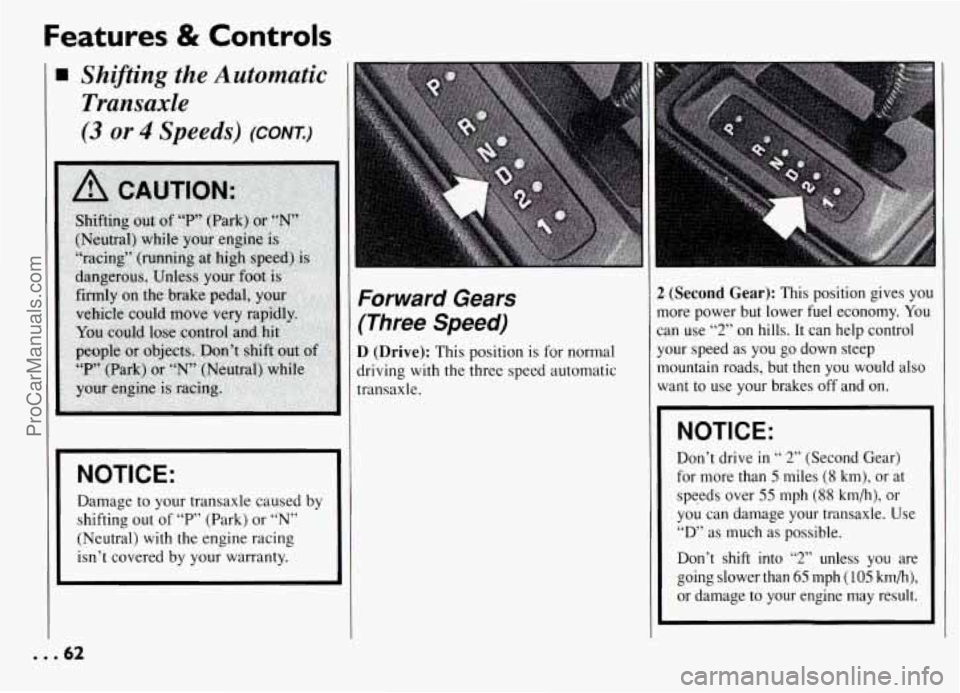
Forward Gears
(Three Speed)
D (Drive): This position is for normal
driving with the three speed automatic
transaxle.
2 (Second Gear): This position gives you
more power but lower fuel economy.
You
can use “2” on hills. It can help control
your speed as
you go down steep
mountain roads, but then you would also
want to use your brakes off and on.
NOTICE:
Don’t drive in “ 2” (Second Gear)
for more than
5 miles (8 km), or at
speeds over
55 mph (88 km/h), or
you can damage your transaxle. Use
“D” as much as possible.
Don’t shift into “2” unless you are
going slower than
65 mph (105 km/h),
or damage to your engine may result.
I
... 62
ProCarManuals.com
Page 66 of 274
1 3 5
2 4 R
C
E
il
F
4
h
II
t'
C
4
I1
C
F
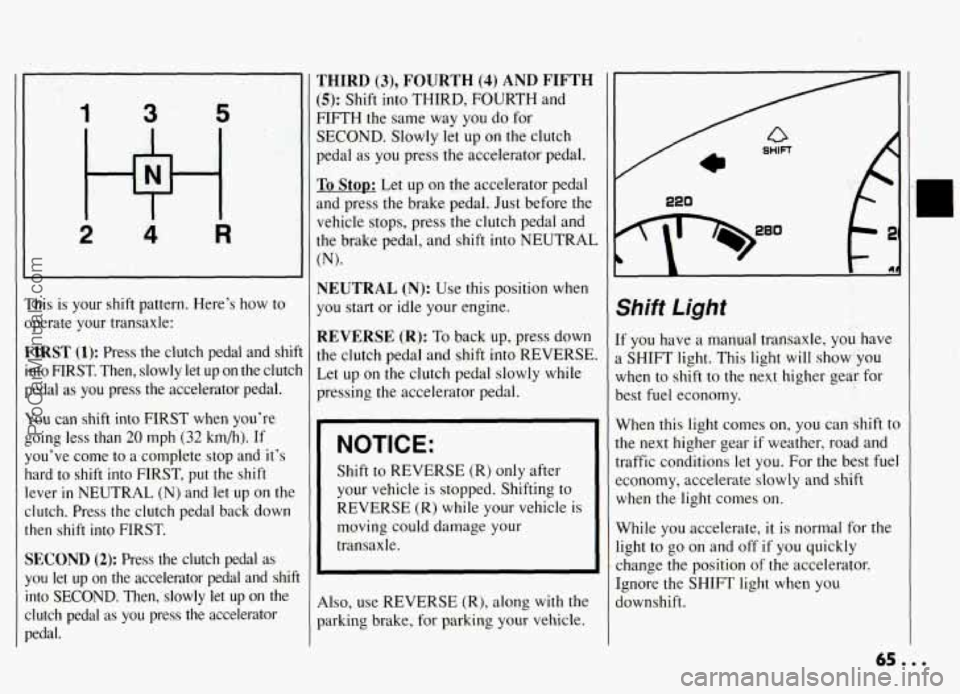
'his is your shift pattern. Here's how to
bperate your transaxle:
rIRST (1): Press the clutch pedal and shi
nto FIRST. Then, slowly let up on the clutc
kedal as you press the accelerator pedal.
lou can shift into FIRST when you're
;oing less than
20 mph (32 km/h). If
fou've come to a complete stop and it's
lard to
shift into FIRST, put the shift
ever
in NEUTRAL (N) and let up on the
Iutch. Press the clutch pedal back down
hen shift into FIRST.
iECOND (2): Press the clutch pedal as
'ou let up on the accelerator pedal and shij
nto
SECOND. Then, slowly let up on the
:lutch pedal as
you press the accelerator
Iedal.
HIRD (3), FOURTH (4) AND FIFTH
;): Shift into THIRD, FOURTH and
IFTH the same way you do for
ECOND. Slowly let up on the clutch
:dal as you press the accelerator pedal.
o Stop: Let up on the accelerator pedal
Id press the brake pedal. Just before the
:hicle stops, press
the clutch pedal and
le brake pedal, and shift into NEUTRAL
9.
'EUTRAL (N): Use this position when
3u start or idle your engine.
.EVERSE (R): To back up, press down
Le clutch pedal and shift into REVERSE.
et
up on the clutch pedal slowly while
ressing the accelerator pedal. ~
NOTICE:
Shift
to REVERSE (R) only after
your vehicle is stopped. Shifting to
REVERSE (R) while your vehicle is
moving could damage your
transaxle.
ho, use REVERSE (R), along with the
arking brake, for parking your vehicle.
Shift Light
If you have a manual transaxle, you have
a SHIFT light. This light will show you
when to shift to the next higher gear for
best fuel economy.
When this light comes on, you can shift to
the next higher gear if weather, road and
traffic conditions let you. For the best fuel
economy, accelerate slowly and shift
when the light comes on.
While you accelerate, it is normal for the
light to go on and off if you quickly
change the position of the accelerator.
Ignore the SHIFT light when you
downshift.
ProCarManuals.com
Page 67 of 274
Features & Controls
Shift Speeds
(Manual Transaxle)
This chart shows when to shift to the next
higher gear for best fuel economy.
Acceleration Shift Speeds for 2.3L
OHC and 2.3L High Output Quad 4
Engines (Codes 3 and A):
FIRST to SECOND 15 mph (24 km/h)
SECOND to THIRD
25 mph (40 km/h)
THIRD to FOURTH 40 mph
(64 km/h)
FOURTH to FIFTH 45 mph (72 km/h)
If your speed drops below 20 mph
(32 km/h), or if the engine is not running
smoothly, you should downshift to the
next lower gear.
You may have to
downshift two or more gears to keep the
engine running smoothly or for good
performance.
NOTICE:
If you skip more than one gear
when you downshift, or if you race
the engine when you downshift, you
can damage the clutch or transaxle.
Parking Brake
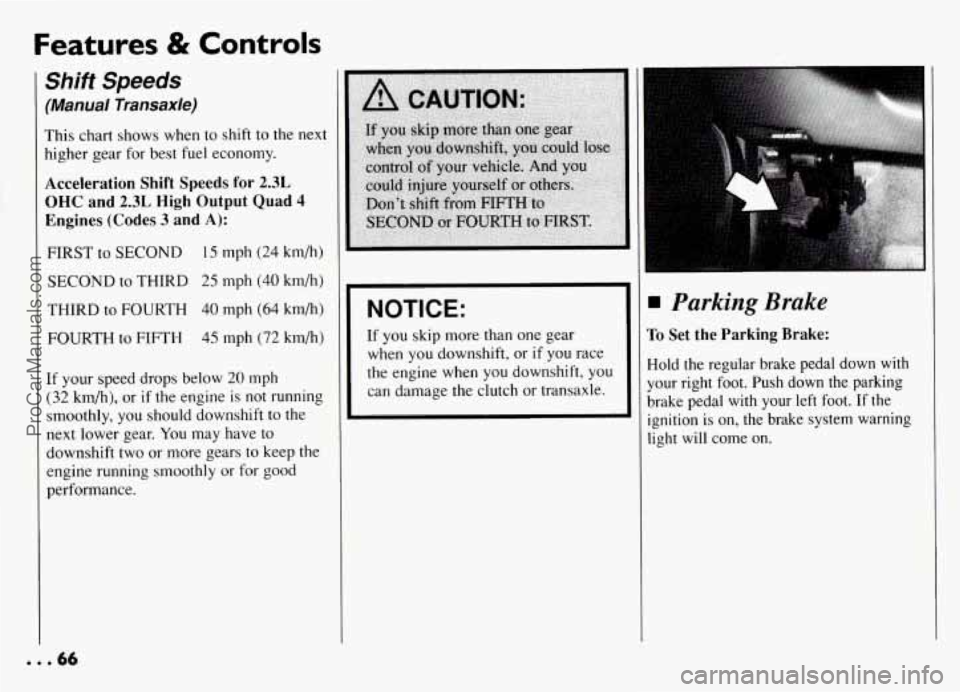
To Set the Parking Brake:
Hold the regular brake pedal down with
your right foot. Push down the parking
brake pedal with your left foot. If the
ignition is on, the brake system warning
light will come on.
... 66
ProCarManuals.com
Page 69 of 274
Features & Controls
T
Shifting Into
PARK (P)
(Automatic Transaxle
Models Only) (cow)
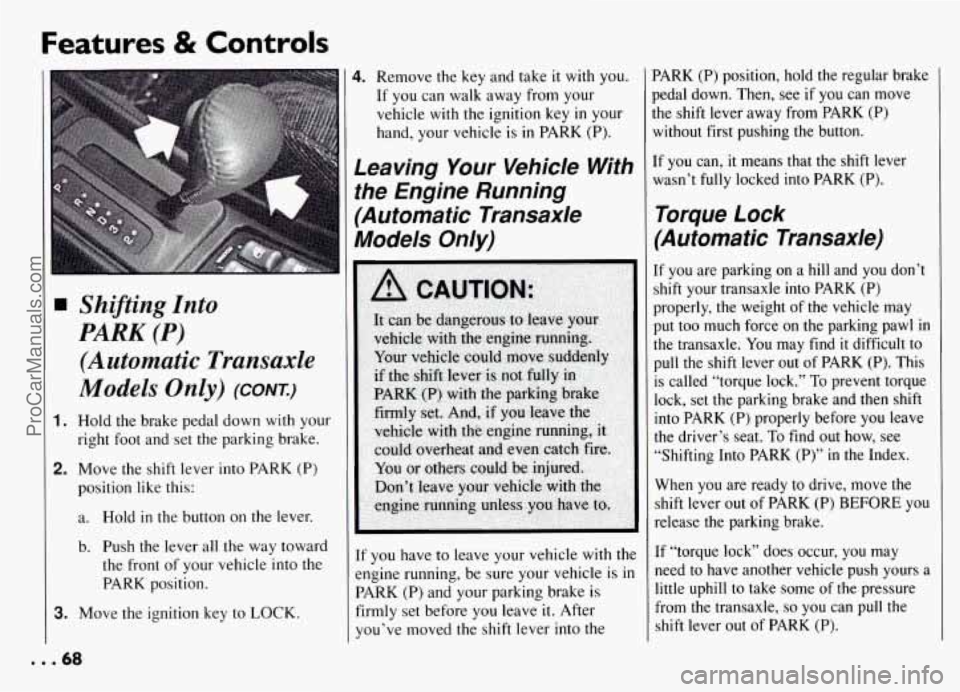
1. Hold the brake pedal down with your
right foot and set the parking brake.
2. Move the shift lever into PARK (P)
position like this:
a. Hold
in the button on the lever.
b.
Push the lever all the way toward
the front of your vehicle into the
PARK position.
3. Move the ignition key to LOCK.
4. Remove the key and take it with you.
If you can walk away from your
vehicle
with the ignition key in your
hand, your vehicle
is in PARK (P).
Leaving Your Vehicle With
the Engine Running
(Automatic Transaxle
Models Only)
If you have to leave your vehicle with the
engine running, be sure your vehicle is
in
PARK (P) and your parking brake is
firmly set before you leave it. After
you’ve moved the shift lever into the
’ARK (P) position, hold the regular brake
Jedal down. Then, see
if you can move
he shift lever away from
PARK (P)
without first pushing the button.
:f you can, it means that the shift lever
wasn’t
fully locked into PARK (P).
Torque Lock
(Automatic Transaxle)
[f you are parking on a hill and you don’t
shift your transaxle into PARK (P)
properly, the weight of the vehicle may
put too much force on the parking pawl
in
[he transaxle. You may find it difficult to
pull the shift lever out of PARK (P). This
is called “torque lock.” To prevent torque
lock, set the parking brake and then shift
into
PARK (P) properly before you leave
the driver’s seat.
To find out how, see
”Shifting Into
PARK (P)” in the Index.
When you are ready to drive, move the
shift lever out of PARK (P) BEFORE you
release the parking brake.
If “torque lock” does occur, you may
need to have another vehicle push yours a
little uphill to take some of the pressure
from the transaxle,
so you can pull the
shift lever out of
PARK (P).
... 68
ProCarManuals.com
Page 71 of 274
Features & Controls
Engine Exhaust Running Your Engine
While You’re Parked
(Automatic Transaxle)
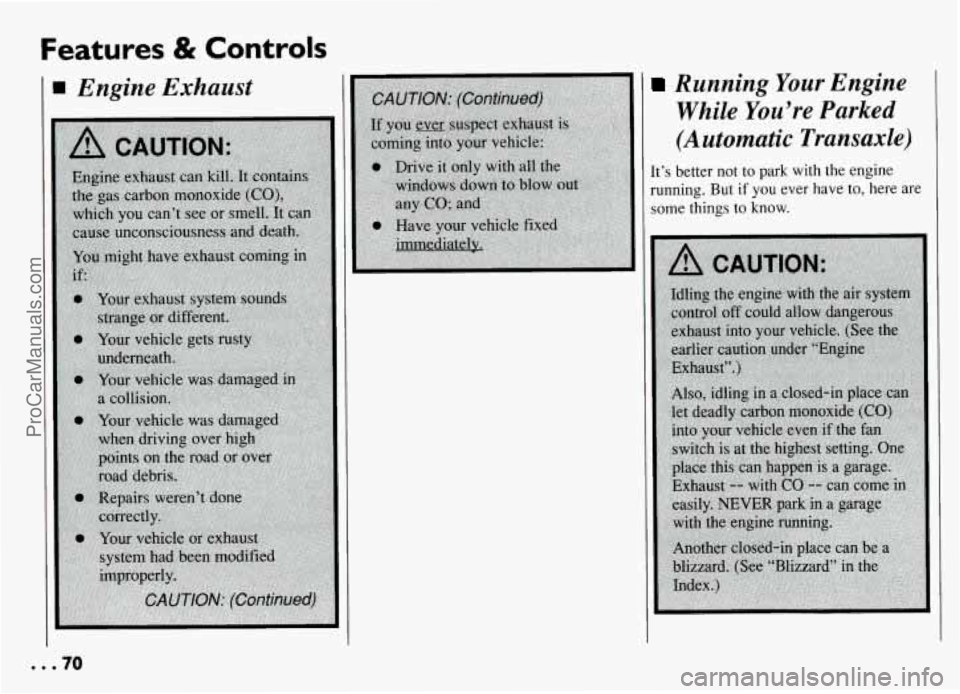
It’s better not to park with the engine
running. But
if you ever have to, here are
some things
to know.
... 70
ProCarManuals.com
Page 93 of 274
Features & Controls
Speedometer and
Odometer
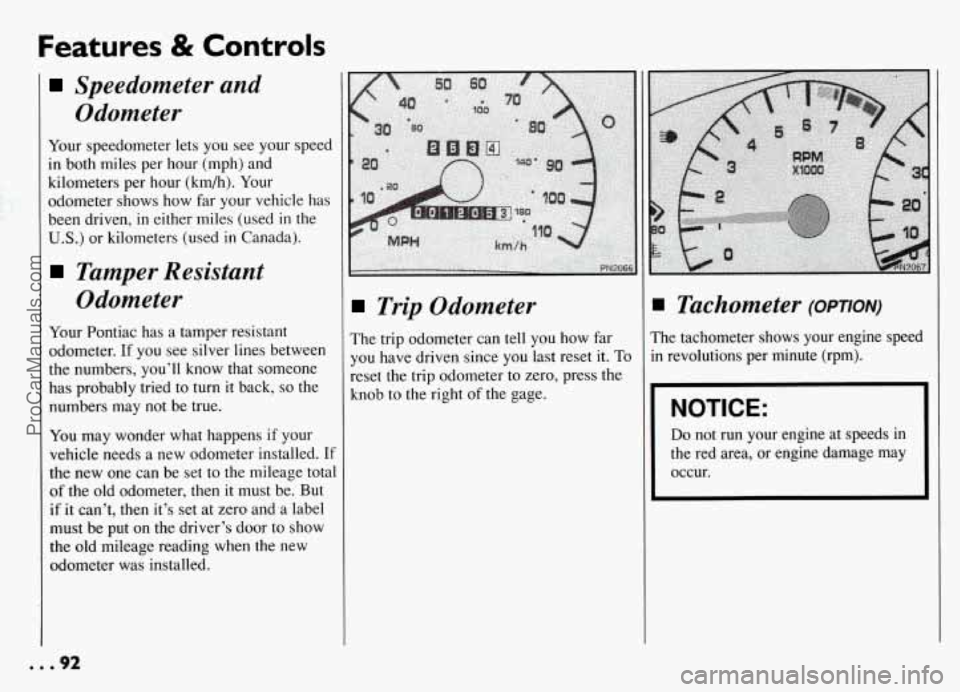
Your speedometer lets you see your speed
in both miles per hour (mph) and
kilometers per hour (km/h). Your
odometer shows how far your vehicle has
been driven, in either miles (used in the
U.S.) or kilometers (used in Canada).
Tamper Resistant
Odometer
Your Pontiac has a tamper resistant
odometer.
If you see silver lines between
the numbers, you’ll know that someone
has probably tried to turn it back,
so the
numbers may not be true.
You may wonder what happens if your
vehicle needs a new odometer installed.
If
the new one can be set to the mileage total
of the old odometer, then it must be. But
if
it can’t, then it’s set at zero and a label
must be put
on the driver’s door to show
the old mileage reading when the new
odometer was installed.
Trip Odometer
The trip odometer can tell you how far
you have driven since you last reset it.
To
reset the trip odometer to zero, press the
knob to the right of the gage.
Tachometer (OPTION)
The tachometer shows your engine speed
in revolutions per minute (rpm).
I NOTICE:
I
Do not run your engine at speeds in
the red area, or engine damage may
I
I Occur.
... 92
ProCarManuals.com
Page 95 of 274
Features & Controls
Fuel Gage (CONT.)
0 It takes a little more or less fuel to fill
up than the gage indicated. For
example, the gage may have indicated
the tank was half full, but it actually
took a little more or less than half the
tank’s capacity to fill the tank.
0 The gage moves a little when you turn
a corner or speed up.
0 The gage doesn’t go back to “E” when
you turn off the ignition.
For your fuel tank capacity, see “Service
Station Information”
on the last page of
this manual.
Engine Coolant Temperature Warning
Light
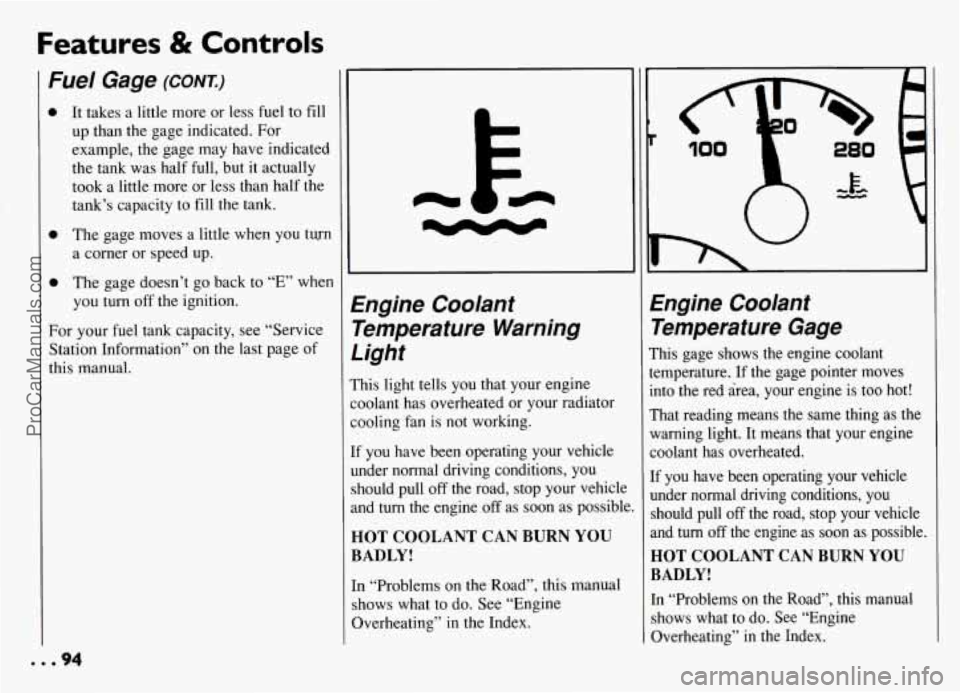
This light tells you that your engine
coolant has overheated or your radiator
cooling fan is not working.
If you have been operating your vehicle
under normal driving conditions, you should pull
off the road, stop your vehicle
and
turn the engine off as soon as possible
HOT COOLANT CAN BURN YOU
BADLY!
In “Problems on the Road”, this manual
shows what to do. See “Engine
Overheating” in the Index.
Engine Coolant
Temperature Gage
This gage shows the engine coolant
temperature. If the gage pointer moves
into the red area, your engine is too hot!
That reading means the same thing as the
warning light. It means that your engine
coolant has overheated.
If you have been operating your vehicle
under normal driving conditions, you
should pull
off the road, stop your vehicle
and
turn off the engine as soon as possible.
HOT COOLANT CAN BURN YOU
BADLY!
In “Problems on the Road”, this manual shows what to do. See “Engine
Overheating” in the Index.
ProCarManuals.com
Page 96 of 274
LOW
COOLANT
Low Coolant Warning
Light
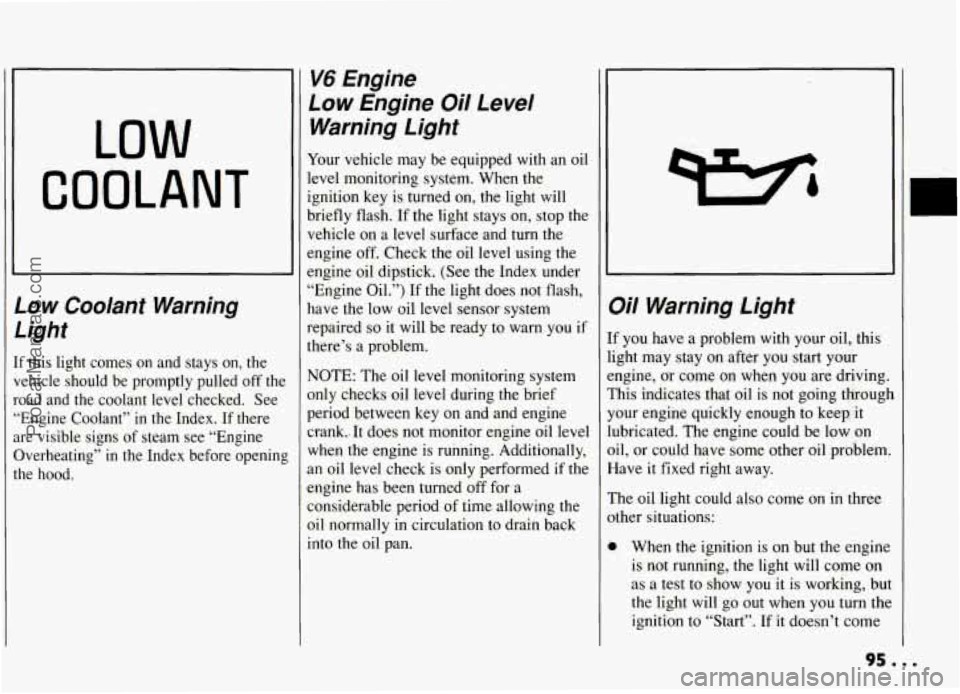
F this light comes on and stays on, the
ehicle should be promptly pulled off the
Dad and the coolant level checked. See
Engine Coolant” in the Index. If there
re visible signs of steam see “Engine
herheating” in the Index before opening
le hood.
V6 Engine
Low Engine
Oil Level
Warning Light
Your vehicle may be equipped with an oil
level monitoring system. When the
ignition key is turned on, the light will
briefly flash. If the light stays on, stop the
vehicle on a level surface and turn the
engine off. Check the oil level using the
engine oil dipstick. (See the Index under
“Engine Oil.”) If the light does not flash,
have the low oil level sensor system
repaired
so it will be ready to warn you if
there’s a problem.
NOTE: The oil level monitoring system
only checks oil level during the brief
period between key on and and engine
crank.. It does not monitor engine ail level
when the engine
is running. Additionally,
an oil level check is only performed if the
engine has been turned off for a
considerable period of time allowing the
oil normally in circulation to drain back
into the oil pan.
Oiil Warning Light
If you have a problem with your oil, this
light may stay on after you start your
engine, or come on when you are driving.
This indicates that oil is not going through
your engine quickly enough to
keep it
lubricated. The engine could be low on
oil, or could have some other oil problem.
Have
it fixed right away.
The oil light could also come on in three
other situations:
0 When the ignition is on but the engine
is not running, the light will come on
as a test to show you it is working, but
the light will go out when you turn the
ignition to “Start”. If it doesn’t come
ProCarManuals.com
Page 97 of 274
Features & Controls
Oil Warning Light (CONT.)
on with the ignition on, you may have
a problem with the fuse or bulb. Have
it fixed right away.
0 Sometimes when the engine is idling
at a stop, the light may blink
on and
off. This is normal.
0 If you make a hard stop; the light may
come
on for a moment. This is normal.
NOTICE:
Damage to your engine from
neglected oil problems can be costly
and is
not covered by your warranty.
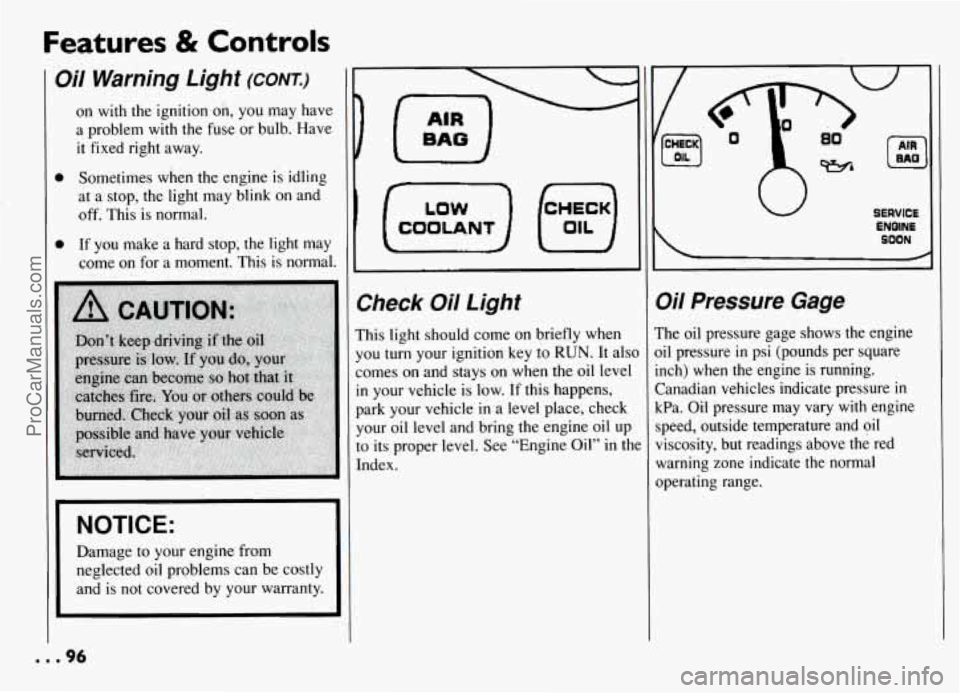
?heck Oil Light
’his light should come on briefly when
‘ou turn your ignition key to
RUN. It alsi
omes
on and stays on when the oil level
n your vehicle is low. If this happens,
ark your vehicle
in a level place, check
our oil level and bring the engine oil up
its proper level. See “Engine Oil” in th
Idex.
ENQINE
SOON
Oil Pressure Gage
The oil pressure gage shows the engine
oil pressure
in psi (pounds per square
inch) when the engine is running.
Canadian vehicles indicate pressure in
kPa. Oil pressure may vary with engine
speed, outside temperature and oil
viscosity, but readings above the red
warning zone indicate the normal
operating range.
... 96
ProCarManuals.com
Page 98 of 274
A reading in the red zone may be caused
by a dangerously low oil level or other
problem causing low oil pressure. Have
your vehicle serviced immediately.
NOTICE:
Damage to your engine from
neglected oil problems can be costly
and is not covered
by your warranty.
-
-
(
T
b
tt
SI
0
rl
dl
el
ir
dl
H
th
If
li;
ac
C(
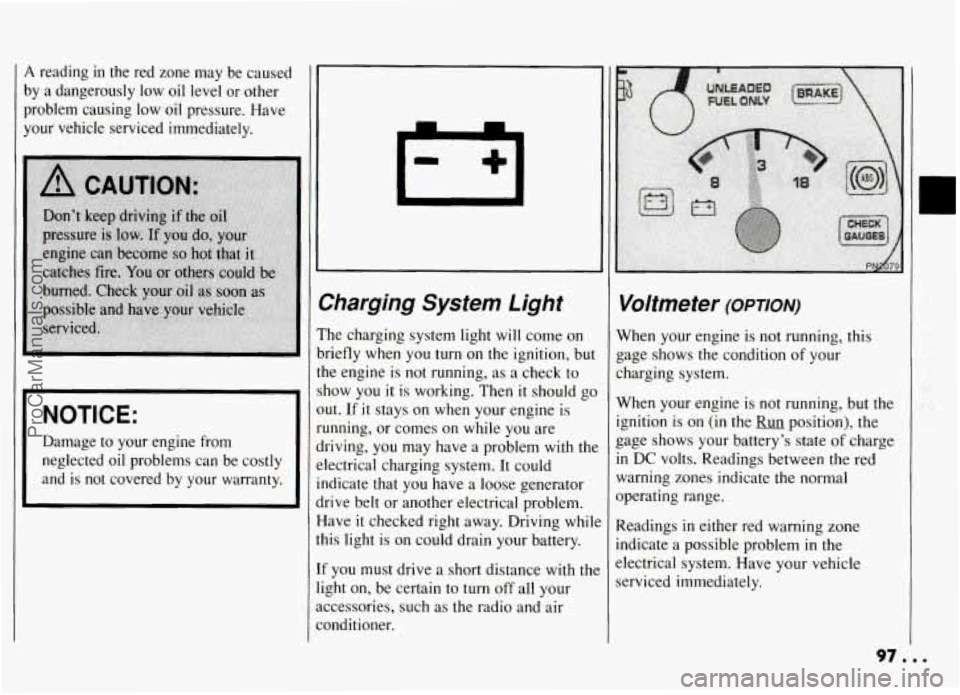
3harging System Light
'he charging system light will come on
riefly when you turn on
the ignition, but
le engine is not running, as a check to
low you
it is working. Then it should gc
ut. If it stays on when your engine is
Inning, or comes on while you are
riving, you may have a problem
with thc
lectrical charging system. It could
tdicate that you have a loose generator
rive belt or another electrical problem.
ave
it checked right away. Driving whih
lis light is on could drain your battery.
'you must drive a short distance with thc
ght on, be certain to turn off all your
xessories, such as the radio and air
mditioner.
Voltmeter (OPTION)
When your engine is not running, this
gage shows the condition
of your
charging system.
When your engine is not running, but the
ignition is on (in the Run position), the
gage shows your battery's state
of charge
in DC volts. Readings between the red
warning zones indicate the normal
operating range.
Readings in either red warning zone
indicate a possible problem in the
electrical system. Have your vehicle
serviced immediately.
970..
ProCarManuals.com