key PONTIAC GRAND AM 2003 Owner's Manual
[x] Cancel search | Manufacturer: PONTIAC, Model Year: 2003, Model line: GRAND AM, Model: PONTIAC GRAND AM 2003Pages: 354, PDF Size: 16.3 MB
Page 94 of 354
Ensure the shift lever is fully in PARK (P) before starting
the engine. Your vehicle has an automatic transaxle
shift lock control system. You have to apply your regular
brake before you can shift from PARK (P) when the
ignition key is in
ON. If you cannot shift out of PARK (P),
ease pressure on the shift lever and push the shift
lever all the way into PARK (P) as you maintain brake
application. Then move the shift lever into the gear
you wish. Press the shift lever button before moving the
shift lever. See
Shifting Out of Park (P) on page 2-32
later in this section.
REVERSE (R): Use this gear
to back up.
Notice: Shifting to REVERSE (R) while your vehicle
is moving forward could damage your transaxle.
Shift to REVERSE (R) only after your vehicle
is stopped.
To rock your vehicle back and forth to get out of snow,
ice or sand without damaging your transaxle, see
If
You Are Stuck: In Sand, Mud, Ice or Snow on
page 4-3 1.
NEUTRAL (N): In this position, your engine doesn’t
connect with the wheels.
To restart when you’re already
moving, use NEUTRAL (N) only. Also, use
NEUTRAL (N) when your vehicle is being towed.
Shifting into
a drive gear while your engine is
“racing” (running at high speed) is dangerous. Unless your foot is firmly on the brake pedal,
your vehicle could move very rapidly. You could lose control and
hit people or objects.
Don’t shift into a drive gear while your engine
is racing.
~~
Notice: Damage to your transaxle caused by
shifting into a drive gear with the engine racing
isn’t
covered by your warranty.
2-25
Page 97 of 354
NEUTRAL: Use this position when you start or idle
your engine.
REVERSE (R): To back up, press down the clutch
pedal and
lift up on the ring on the shift lever to shift into
REVERSE
(R). Let up on the clutch pedal slowly
while pressing the accelerator pedal.
Notice: Shift into REVERSE (R) only after your
vehicle
is stopped. Shifting into REVERSE (R) while
your vehicle is moving could damage your
transaxle. The repairs would not be covered by your
warranty.
Also, use REVERSE (R), along with the parking brake,
for parking your vehicle.
Once the shift lever is in REVERSE (R), the ignition can
be turned to OFF and the key removed.
S ft Speec'
If you skip a gear when you downshift, you
could lose control
of your vehicle. You could
injure yourself or others. Don't shift down
more than one gear
at a time when you
downshift.
Up-Shift Light
If you have a manual
transaxle, you may have a
SHIFT light located on
the instrument panel
cluster. This light will show
you when to shift to the
next higher gear for
the best fuel economy.
When this light comes
on, you can shift to the next
higher gear
if the weather, road and traffic conditions
permit. For the best fuel economy, accelerate slowly and
shift when the light comes on.
2-28
Page 99 of 354
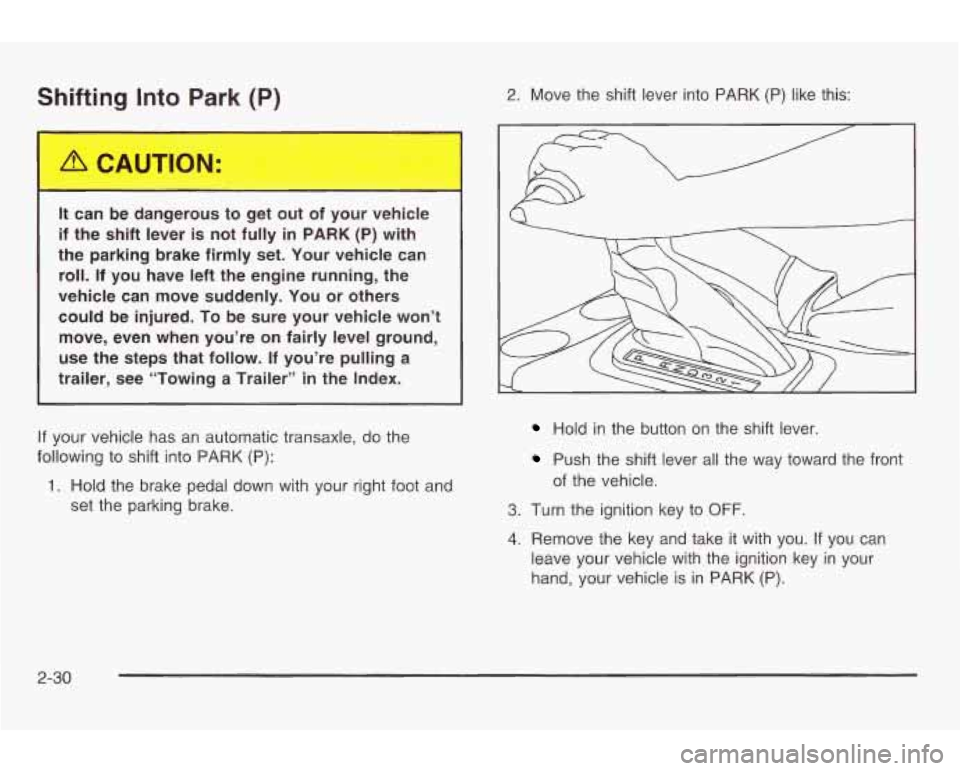
Shifting Into Park (P) 2. Move the shift lever into PARK (P) like this:
It can be dangerous to get out of your vehicle
if the shift lever
is not fully in PARK (P) with
the parking brake firmly set. Your vehicle can roll. If you have left the engine running, the
vehicle can move suddenly. You or others
could be injured. To be sure your vehicle won’t
move, even when you’re on fairly level ground,
use
the steps that follow. If you’re pulling a
trailer, see “Towing a Trailer” in the Index.
If your vehicle has an automatic transaxle, do the
following
to shift into PARK (P):
1. Hold the brake pedal down with your right foot and
set the parking brake.
Hold in the button on the shift lever.
Push the shift lever all the way toward the front
of the vehicle.
3. Turn the ignition key to OFF.
4. Remove the key and take it with you. If you can
leave your vehicle with the ignition key in your
hand, your vehicle is in PARK (P).
2-30
Page 101 of 354
Shifting Out of Park (P)
If your vehicle has an automatic transaxle it has an
automatic transaxle shift lock control system. You have
to apply your regular brake before you can shift from
PARK (P) when the ignition
is in ON. See Automatic
Transaxle Operation on page
2-24.
If you cannot shift out of PARK (P), ease pressure on
the shift lever and push the shift lever all the way
into PARK (P) as you maintain brake application. Then
move the shift lever into the gear you wish. Press
the shift lever button before moving the shift lever.
If you ever hold the brake pedal down but still can’t shift
out of PARK (P), try this:
1. Turn the ignition key to ACCESSORY.
2. Apply and hold the regular brake until the end of
Step
5.
3. Shift to NEUTRAL (N).
4. Turn the ignition key to START, to start the vehicle.
5. Shift to the drive gear you want.
6. Have the vehicle fixed as soon as you can.
Parking Your Vehicle/Key Removal
Before leaving your manual transaxle model vehicle,
fully press the clutch pedal in, move the shift lever into
REVERSE
(R) and firmly apply the parking brake.
Once the shift lever has been placed in REVERSE (R)
with the clutch pedal pressed in, you can turn the
ignition key
to OFF, remove the key and release the
clutch. See
Manual Transaxle Operation on page 2-27.
2-32
Page 111 of 354
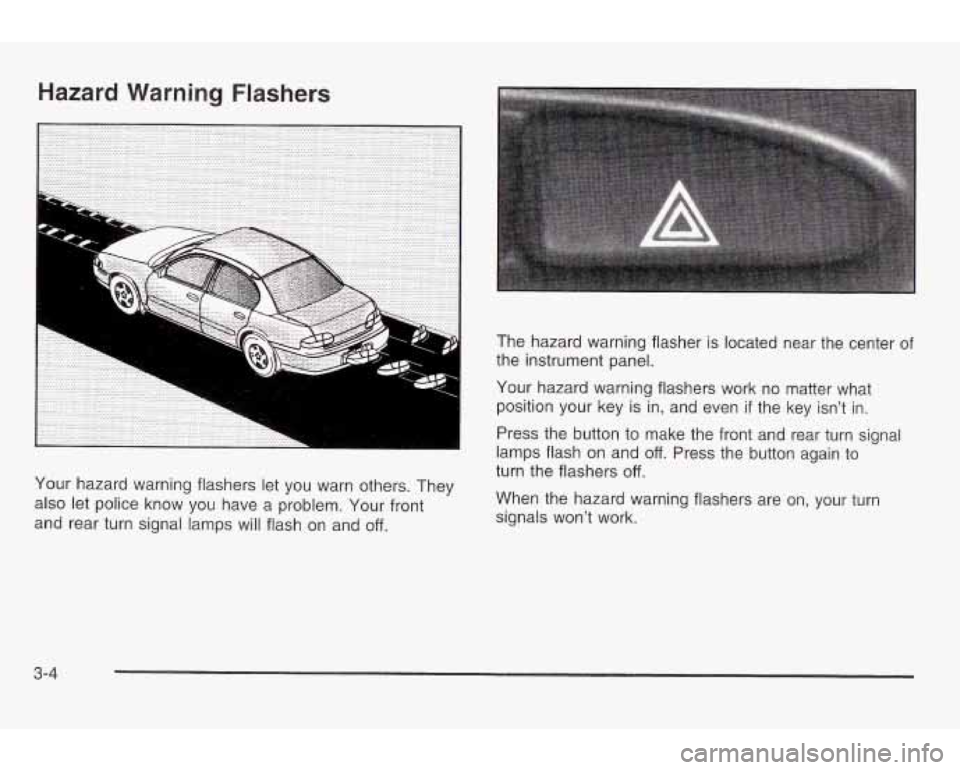
Hazard Warning Flashers
Your hazard warning flashers let you warn others. They
also let police know you have a problem. Your front
and rear turn signal lamps will flash on and
off.
The hazard warning flasher is located near the center of
the instrument panel.
Your hazard warning flashers work no matter what
position your key is in, and even
if the key isn’t in.
Press the button to make the front and rear turn signal
lamps flash on and
off. Press the button again to
turn the flashers off.
When the hazard warning flashers are on, your turn
signals won’t work.
3-4
Page 122 of 354

Headlamps Off in Park (P) Fog Lamps
To turn the headlamps off when it is dark outside, turn
the exterior lamps control
to the parking lamp position.
In this position, the parking lamps, sidemarker lamps,
taillamps, license plate lamps and instrument panel
lights will be on, but the headlamps will be
off.
To turn on the headlamps along with the other lamps
when it is dark outside, turn the exterior lamps control
to
the AUTO or headlamp position.
Delayed Headlamps
The delayed headlamps feature will continue to
illuminate the headlamps for 20 seconds after the key is
turned to OFF, then the headlamps will automatically
turn
off.
To override the 20 second delayed headlamp feature
while
it is active turn the turn signaVmultifunction
lever up one position and then back
to AUTO. If
your vehicle has this
feature, the button for your
fog lamps is located on
the instrument panel,
to the
left of the steering wheel,
beside the instrument
panel brightness
thumbwheel.
When using the fog lamps, the ignition must be on as
well as the parking lamps or the low-beam headlamps.
Press the button
to turn the fog lamps on. An indicator
light on the button will glow when the fog lamps are on.
Press the button again
to turn the fog lamps off. The
fog lamps will turn
off whenever the high-beam
headlamps are turned on. When the high beams are
turned
off, the fog lamps will come on again.
3-1 5
Page 123 of 354
Interior Lamps
Instrument Panel Brightness
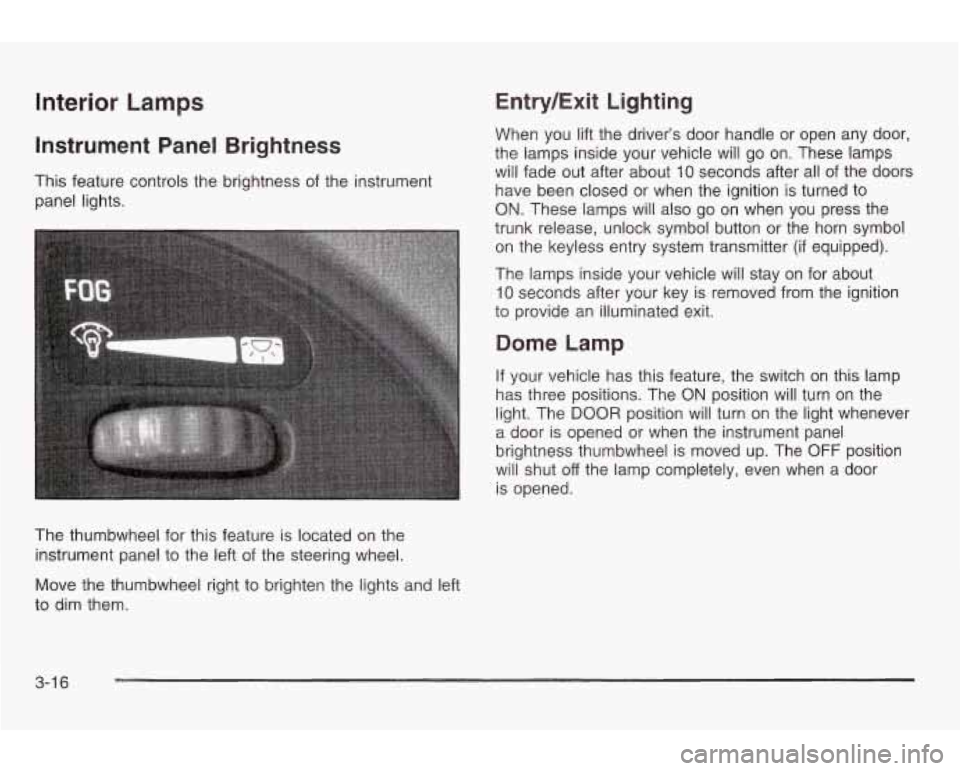
This feature controls the brightness of the instrument
panel lights.
The thumbwheel for this feature
is located on the
instrument panel
to the left of the steering wheel.
Entry/Exit Lighting
When you lift the driver’s door handle or open any door,
the lamps inside your vehicle will go on. These lamps
will fade out after about
10 seconds after all of the doors
have been closed or when the ignition is turned to
ON. These lamps will also go on when you press the
trunk release, unlock symbol button or the horn symbol on the keyless entry system transmitter (if equipped).
The lamps inside your vehicle will stay on for about
10 seconds after your key is removed from the ignition
to provide an illuminated exit.
Dome Lamp
If your vehicle has this feature, the switch on this lamp
has three positions. The
ON position will turn on the
light. The
DOOR position will turn on the light whenever
a door is opened or when the instrument panel
brightness thumbwheel is moved up. The OFF position
will shut
off the lamp completely, even when a door
is opened.
Move the thumbwheel right
to brighten the lights and left
to dim them.
3-1 6
Page 124 of 354
Trunk Lamp Battery Run-Down Protection
The trunk lamp comes on when you open your trunk.
Your vehicle has a battery run-down feature designed
to
protect your vehicle’s battery.
When any interior lamp (trunk, reading lamps, dome
lamp or glove box) is left on when the ignition is turned
off, the battery run-down protection system will
automatically shut the lamp
off after 20 minutes. This
will avoid draining the battery.
To reactivate the interior lamps, do one of the following:
Lift the driver’s door handle,
open any door or
press any remote keyless entry transmitter button
(if equipped),
press the power door lock switch,
~r~~~ rei-,-iGte ti-Ufik Gr
turn the lamp that was left on to off and then to on
again.
Ashtrays and Cigarette Lighter
To use the lighter, just push it in all the way and
Nofices Don’t put papers or other flammable
items into your ashtrays. Hot cigarettes or otl let
go.
her
smoking materials could ignite them, causing
SI damaging fire.
Nofice: Don’t hold a cigarette lighter in with your
hand while
it is heating. If you do, it won’t be able to
back away from the heating element when
it’s
ready. That can make it overheat, damaging the
lighter and
the heating element. It can also blow
the fuse.
3-1 7
Page 132 of 354
Safety Belt Reminder Light
When the key is turned to ON or START, a chime will
come on for several seconds to remind people
to fasten
their safety belts, unless the driver's safety belt is
already buckled.
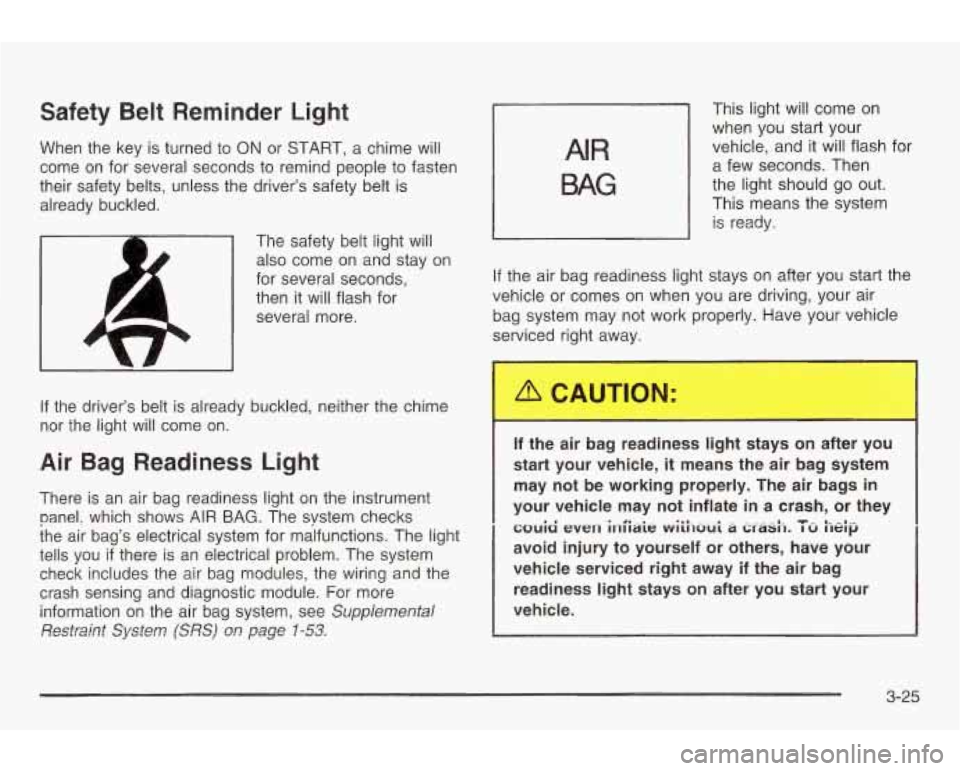
The safety belt light will
also come on and stay on
for several seconds,
then it will flash for
several more.
If the driver's belt is already buckled, neither the chime
nor the light will come on.
Air Bag Readiness Light
There is an air bag readiness light on the instrument
panel, which shows AIR BAG. The system checks
the air bag's electrical system for malfunctions. The light
tells you
if there is an electrical problem. The system
check includes the air bag modules, the wiring and the
crash sensing and diagnostic module. For more
information on the air bag system, see
Supplemental
I Rnctmint '""'1UIII. VJIVL"' Cwctnm /.CR.S) \"' 'V, 0.n p~p 1-53.
AIR
BAG
This light will come on
when you start your
vehicle, and it will flash for
a few seconds. Then
the light should go out.
This means the system
is ready.
If the air bag readiness light stays on after you start the
vehicle or comes
on when you are driving, your air
bag system may not work properly. Have your vehicle
serviced right away.
If the air bag readiness light stays on after you
start your vehicle, it means the air bag system
may not be working properly. The air bags in
your vehicle may not inflate in a crash, or they
avoid injury to yourself or others, have your
vehicle serviced right away if the air bag
readiness light stays on after you start your
vehicle.
couid even inbit: wiiiiuui a CfaSi-1. Tu ii&p
3-25
Page 133 of 354
The air bag readiness light should flash for a few
seconds when you turn the ignition key to
ON. If the
light doesn’t come on then, have it fixed
so it will
be ready to warn you
if there is a problem.
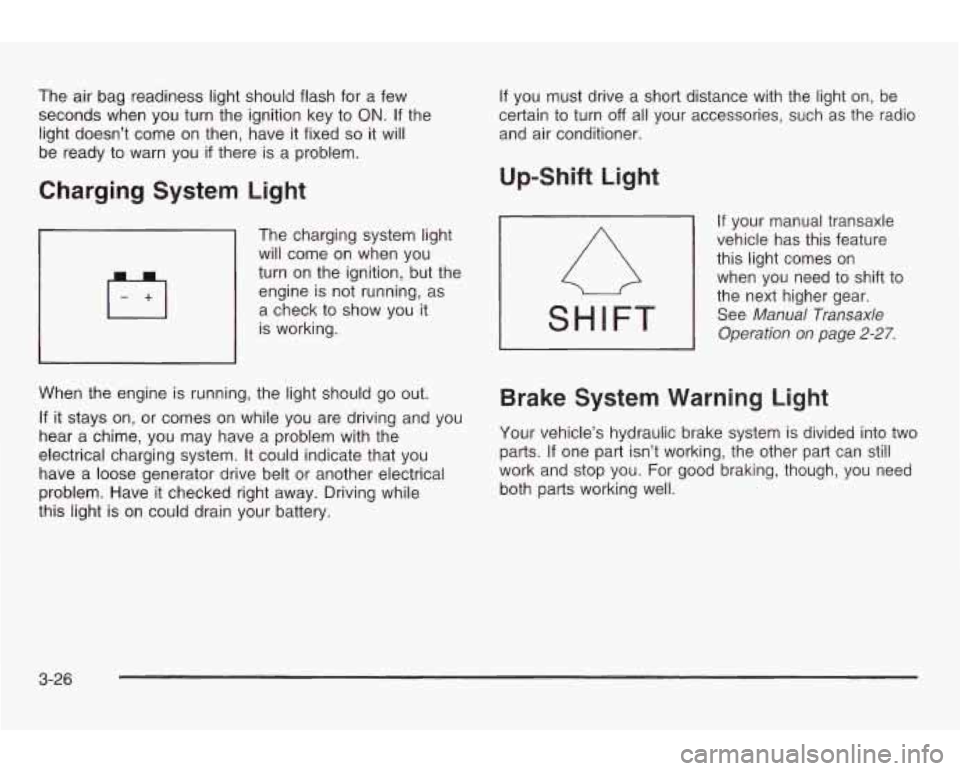
Charging System Light
The charging system light
will come on when you
turn on the ignition, but the
II engine is not running, as
a check to show you
it
is working.
When the engine is running, the light should go out.
If it stays on, or comes on while you are driving and you
hear a chime, you may have a problem with the
electrical charging system. It could indicate that you have a loose generator drive belt or another electrical
problem. Have it checked right away. Driving while
this light is on could drain your battery. If
you must drive a short distance with the light on, be
certain to turn
off all your accessories, such as the radio
and air conditioner.
Up-Shift Light
If your manual transaxle
vehicle has this feature
this light comes on
when you need to shift to
the next higher gear.
See
Manual Transaxle
Operation on page
2-27.
Brake System Warning Light
Your vehicle’s hydraulic brake system is divided into two
parts. If one part isn’t working, the other part can still
work and stop you.
For good braking, though, you need
both parts working well.
3-26