lock PONTIAC GRAND AM 2003 Repair Manual
[x] Cancel search | Manufacturer: PONTIAC, Model Year: 2003, Model line: GRAND AM, Model: PONTIAC GRAND AM 2003Pages: 354, PDF Size: 16.3 MB
Page 219 of 354
Safety Chains
You should always attach chains between your vehicle and your trailer. Cross the safety chains under the
tongue of the trailer
so that the tongue will not drop to
the road if it becomes separated from the hitch.
Instructions about safety chains may be provided by the
hitch manufacturer or by the trailer manufacturer.
Follow the manufacturer’s recommendation for attaching
safety chains and do not attach them to the bumper.
Always leave just enough slack
so you can turn
with your rig. And, never allow safety chains
to drag on
the ground.
Trailer Brakes
Does your trailer have its own brakes?
Be sure to read and follow the instructions for the trailer
brakes
so you’ll be able to install, adjust and maintain
them properly. And because you have anti-lock brakes,
do not
try to tap into your vehicle’s brake system. If
you do, both systems won’t work well, or at all.
Driving with a Trailer
Towing a trailer requires a certain amount of experience.
Before setting out for the open road, you’ll want to get
to know your rig. Acquaint yourself with the feel of
handling and braking with the added weight of the trailer.
And always keep in mind that the vehicle you are
driving is now a good deal longer and not nearly as
responsive as your vehicle is by itself.
Before you start, check the trailer hitch and platform
(and attachments), safety chains, electrical connector,
lamps, tires and mirror adjustment. If the trailer has
electric brakes, start your vehicle and trailer moving and
then apply the trailer brake controller by hand
to be
sure the brakes are working. This lets you check your
electrical connection at the same time.
During your trip, check occasionally to be sure that the
load is secure, and that the lamps and any trailer
brakes are still working.
4-40
Page 231 of 354
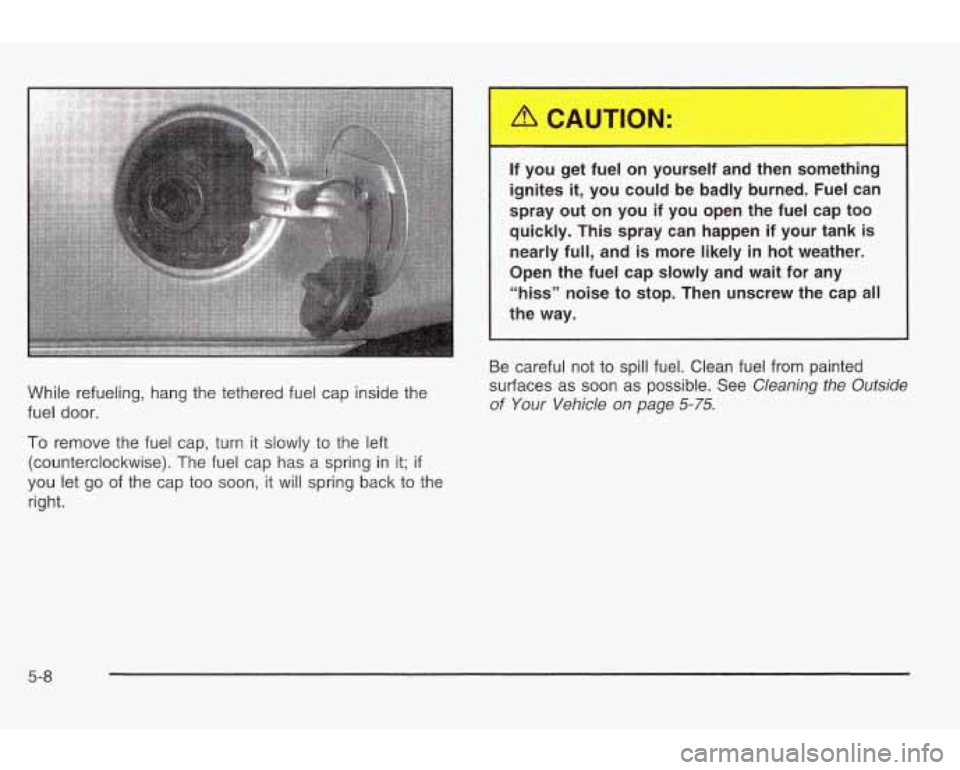
While refueling, hang the tethered fuel cap inside the
fuel door.
To remove the fuel cap, turn it slowly to the left
(counterclockwise). The fuel cap has
a spring in it; if
you let go of the cap too soon, it will spring back to the
right.
I
If you get fuel on yourself and then something
ignites
it, you could be badly burned. Fuel can
spray out
on you if you open the fuel cap too
quickly. This spray can happen
if your tank is
nearly full, and is more likely in hot weather.
Open the fuel cap slowly and wait for any
“hiss” noise to stop. Then unscrew
the cap all
the way.
Be careful not to spill fuel. Clean fuel from painted
surfaces as soon as possible. See
Cleaning the Outside
of Your Vehicle on page 5-75.
5-8
Page 232 of 354
When you put the fuel cap back on, turn it to the right
(clockwise) until you hear
a clicking sound. Make
sure you fully install the cap. The diagnostic system can
determine
if the fuel cap has been left off or improperly
installed. This would allow fuel to evaporate into the
atmosphere. See
Malfunction Indicator Lamp on
page 3-3 1.
Notice: If you need a new fuel cap, be sure to get
the right type. Your dealer can get one for you.
If you get the wrong type,
it may not fit properly.
This may cause your malfunction indicator lamp
to
light and may damage your fuel tank and emissions
system. See “Malfunction Indicator Lamp” in
the Index.
Filling a Portable Fuel Container
Never fill a portable fuel container while it is in
your vehicle. Static electricity discharge from
the container can ignite the gasoline vapor. You can be badly burned and your vehicle
damaged
if this occurs. To help avoid injury to
you and others:
0 Dispense gasoline only into approved
containers.
0 Do not fill a container while it is inside a
vehicle, in a vehicle’s trunk, pickup bed or
on any surface other than the ground.
Bring the fill nozzle in contact with the
inside of the fill opening before operating
the nozzle. Contact should be maintained
until the filling
is complete.
0 Don’t smoke while pumping gasoline.
5-9
Page 236 of 354
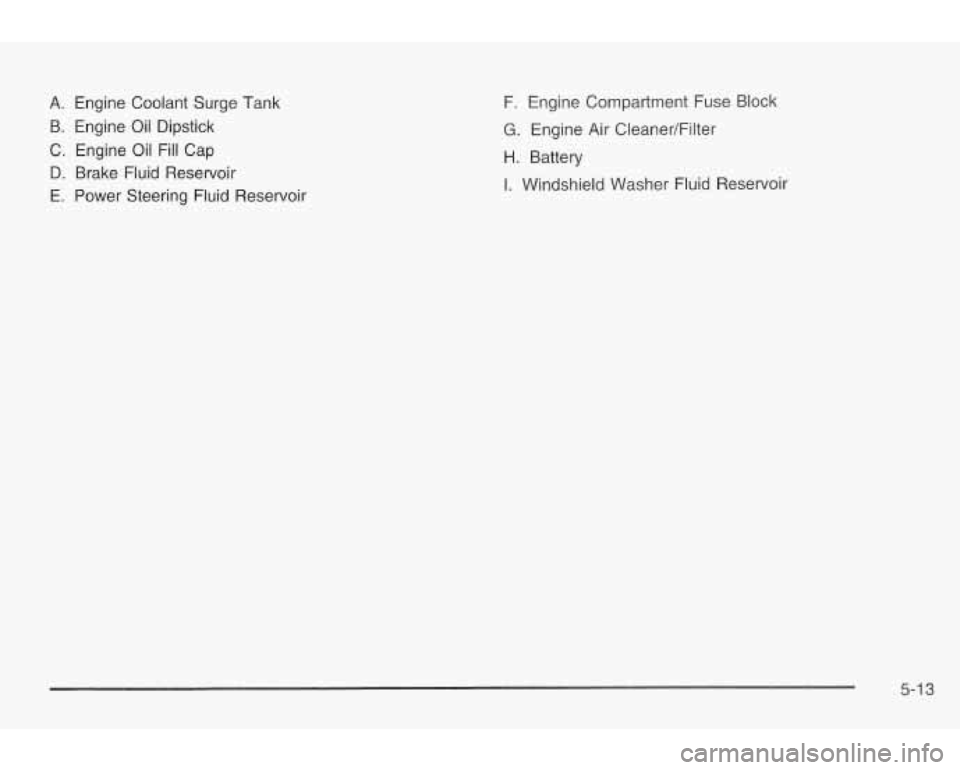
A. Engine Coolant Surge Tank
B. Engine Oil Dipstick
C. Engine
Oil Fill Cap
D. Brake Fluid Reservoir
E. Power Steering Fluid Reservoir F. Engine Compartment Fuse
Block
G. Engine Air Cleaner/Filter
H. Battery
I. Windshield Washer Fluid Reservoir
5-1 3
Page 243 of 354
How to Reset the Change Oil Light
The GM Oil Life SystemTM calculates when to change
your engine oil and filter based on vehicle use. Anytime
your oil is changed, reset the system
so it can
calculate when the next oil change is required.
If a
situation occurs where you change your oil prior
to a
CHANGE OIL light being turned on, reset the system.
After changing the engine oil, the system must be reset.
To reset the oil life indicator, do the following steps:
1. With the ignition key in ON (a short time after
turning
off the engine), press the RESET button
located in the driver’s side instrument panel
fuse block. See “Instrument Panel Fuse Block”
under
Fuses and Circuit Breakers on page 5-81.
2. When the CHANGE OIL light starts to flash, press
and hold the RESET button again.
The reset is complete when you hear the chimes and
the CHANGE OIL light goes out.
If your vehicle is equipped with a 2.2L L4 ECOTEC
engine, it has a unique oil filter element. When
reinstalling the filter cap do not exceed
18 Ib ft (25 N*m ).
Inspect the condition of the O-ring and replace if
damaged.
What to Do with Used Oil
Used engine oil contains certain elements that may be
unhealthy for your skin and could even cause cancer.
Don’t let used oil stay on your skin for very long. Clean
your skin and nails with soap and water, or a
good
hand cleaner. Wash or properly dispose of clothing or
rags containing used engine oil. See the manufacturer’s
warnings about the use and disposal of oil products.
Used oil can be a threat
to the environment. If you
change your own oil, be sure to drain all the oil from the
filter before disposal. Never dispose of oil by putting it
in the trash, pouring it on the ground, into sewers, or into
streams or bodies of water. Instead, recycle it by
taking it to a place that collects used oil. If you have a
problem properly disposing of your used oil, ask
your dealer, a service station or a local recycling center
for help.
See your dealer for additional information.
5-20
Page 257 of 354
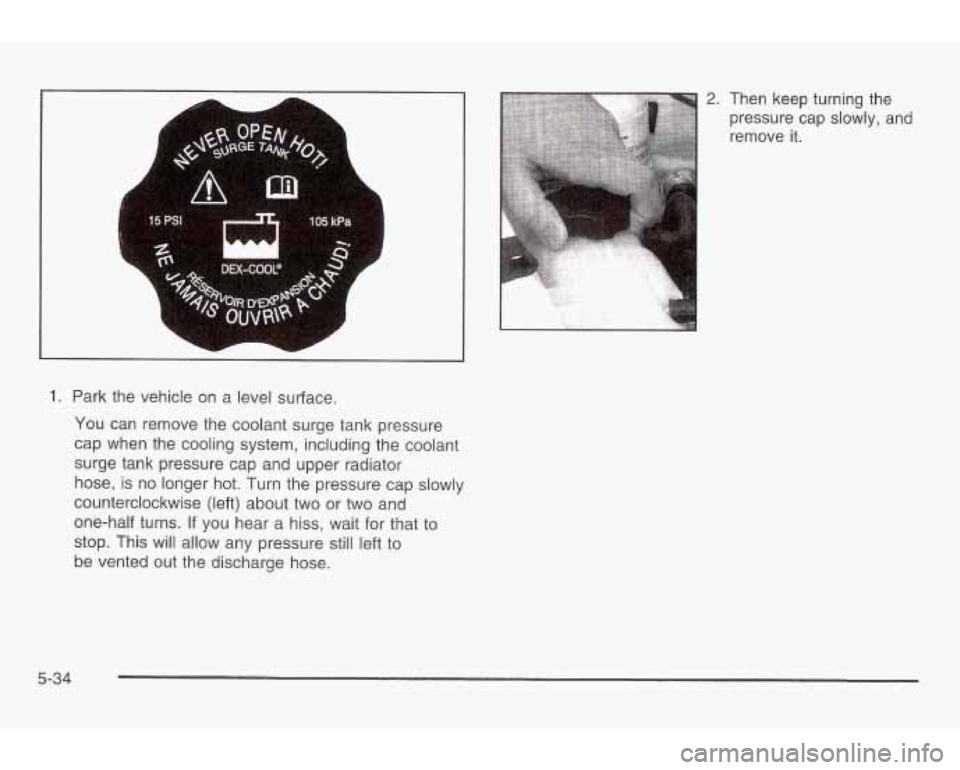
Park the vehicle on a level surface.
You can remove the coolant surge tank pressure
cap when the cooling system, including the coolant
surge tank pressure cap and upper radiator
hose, is no longer hot. Turn the pressure cap slowly
counterclockwise (left) about two
or two and
one-half turns.
If you hear a hiss, wait for that to
stop. This will allow any pressure still left to
be vented out the discharge hose.
2. Then keep turning the
pressure cap slowly, and remove
it.
5-34
Page 273 of 354
2.
3.
4.
5.
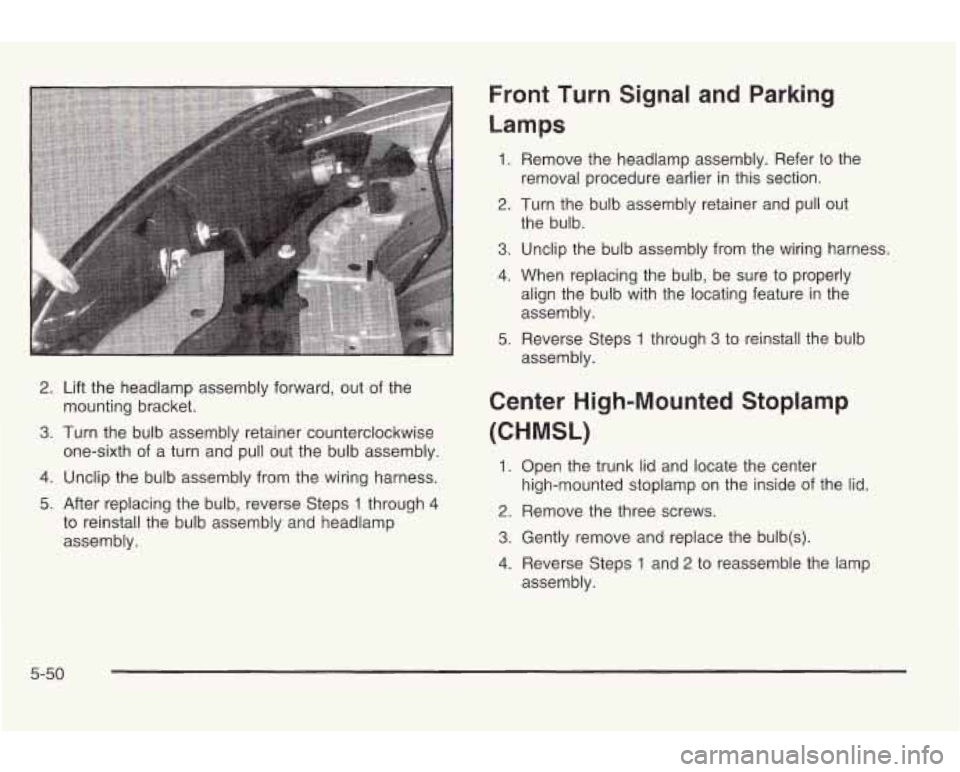
Lift the headlamp assembly forward, out of the
mounting bracket.
Turn the bulb assembly retainer counterclockwise
one-sixth of a turn and pull out the bulb assembly.
Unclip the bulb assembly from the wiring harness.
After replacing the bulb, reverse Steps
1 through 4
to reinstall the bulb assembly and headlamp
assembly.
Front Turn Signal and Parking
Lamps
1. Remove the headlamp assembly. Refer to the
removal procedure earlier in this section.
2. Turn the bulb assembly retainer and pull out
the bulb.
3. Unclip the bulb assembly from the wiring harness.
4. When replacing the bulb, be sure to properly
align the bulb with the locating feature in the
assembly.
5. Reverse Steps 1 through 3 to reinstall the bulb
assembly.
Center High-Mounted Stoplamp
(CHMSL)
1,
2,
3.
4
Open the trunk lid and locate the center
high-mounted stoplamp on the inside of the lid.
Remove the three screws.
Gently remove and replace the bulb(s).
Reverse Steps
1 and 2 to reassemble the lamp
assembly.
5-50
Page 285 of 354
Changing a Flat Tire
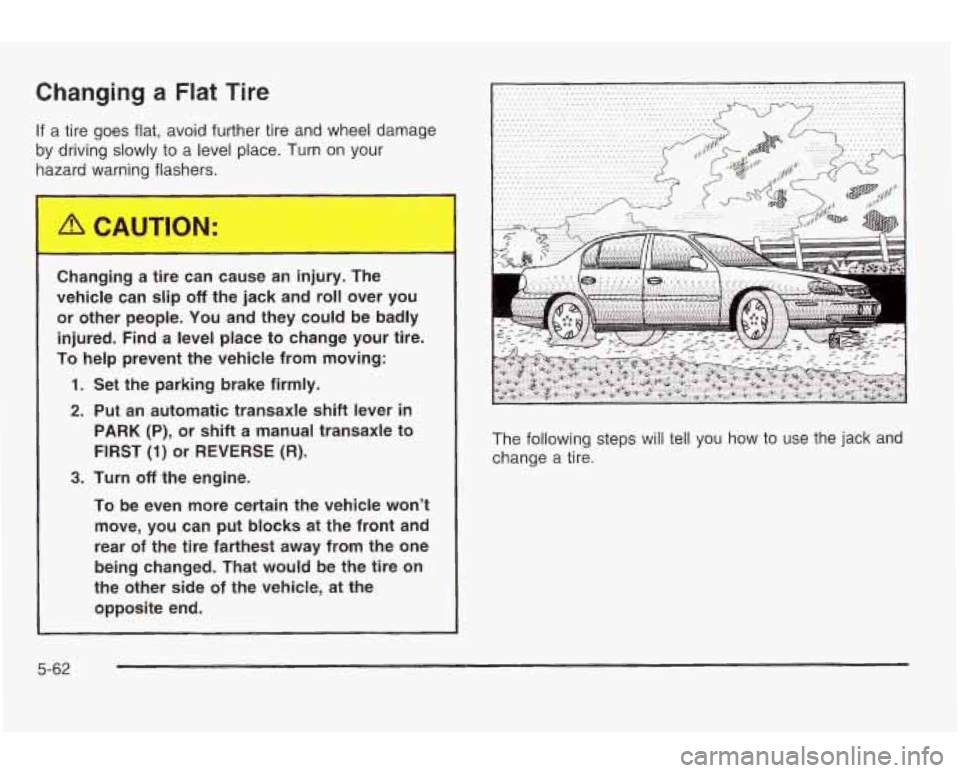
If a tire goes flat, avoid further tire and wheel damage
by driving slowly to
a level place. Turn on your
hazard warning flashers.
Changing a tire can cause an injury. The
vehicle can slip
off the jack and roll over you
or other people. You and they could be badly
injured. Find a level place to change your tire.
To help prevent the vehicle from moving:
1. Set the parking brake firmly.
2. Put an automatic transaxle shift lever in
PARK (P), or shift a manual transaxle to
FIRST
(1) or REVERSE (R).
3. Turn off the engine.
To be even more certain the vehicle won’t move, you can put blocks at
the front and
rear
of the tire farthest away from the one
being changed. That would be the tire on other side of the vehicle, at the The following steps
will tell you how to use the jack and
change a tire.
5-62
Page 286 of 354
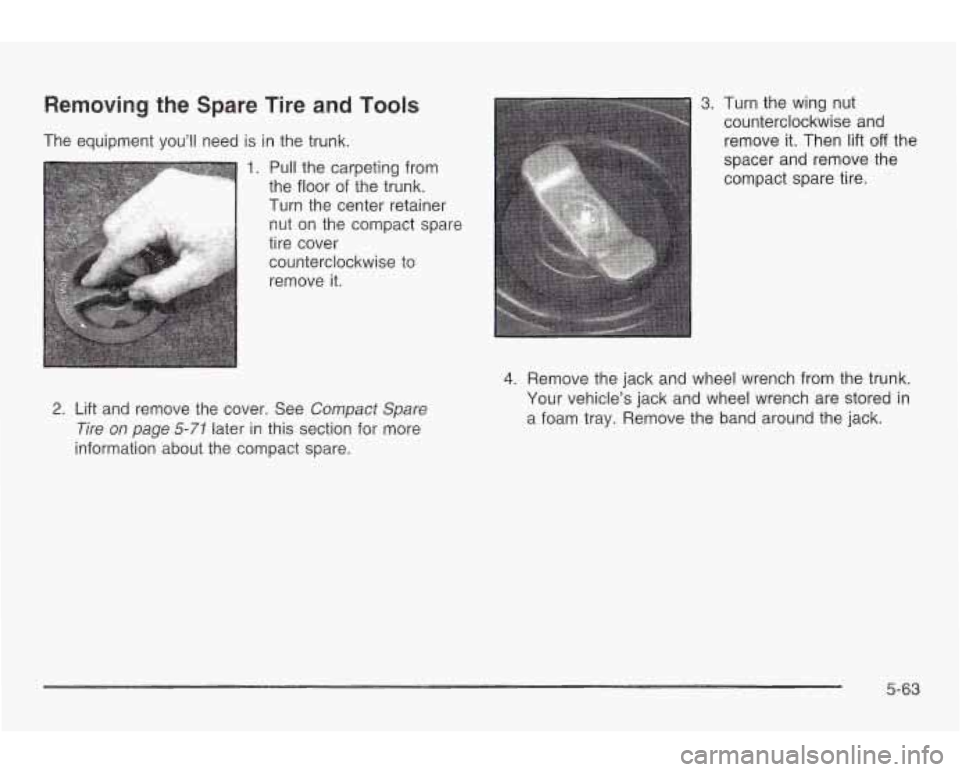
Removing the Spare Tire and Tools
The equipment you’ll need is in the trunk.
1. Pull the carpeting from
the floor of the trunk.
I Turn the center retainer
nut on the compact spare
tire cover
counterclockwise to
remove it.
2. Lift and remove the cover. See Compact Spare
Tire on page
5-71 later in this section for more
information about the compact spare.
3. Turn the wing nut
counterclockwise and
remove
it. Then lift off the
spacer and remove the
compact spare tire.
4. Remove the jack and wheel wrench from the trunk.
Your vehicle’s jack and wheel wrench are stored in
a foam tray. Remove the band around the jack.
5-63
Page 289 of 354
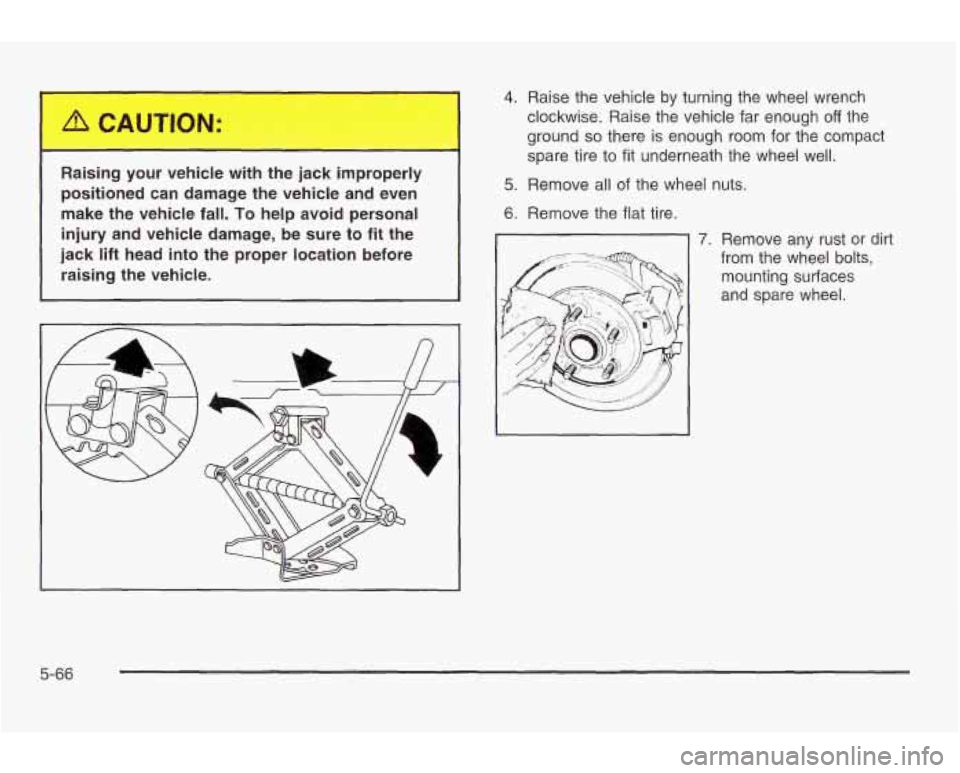
Raising your vehicle with the jack improperly
positioned can damage the vehicle and even
make the vehicle fall.
To help avoid personal
injury and vehicle damage, be sure to fit the
jack
lift head into the proper location before
raising the vehicle.
4. Raise the vehicle by turning the wheel wrench
clockwise. Raise the vehicle far enough
off the
ground
so there is enough room for the compact
spare tire
to fit underneath the wheel well.
5. Remove all of the wheel nuts.
6. Remove the flat tire.
7. Remove any rust or dirt
from the wheel
bolts,
mounting surfaces
and spare wheel.
5-66