lock PONTIAC GRAND AM 2003 Manual PDF
[x] Cancel search | Manufacturer: PONTIAC, Model Year: 2003, Model line: GRAND AM, Model: PONTIAC GRAND AM 2003Pages: 354, PDF Size: 16.3 MB
Page 291 of 354
c
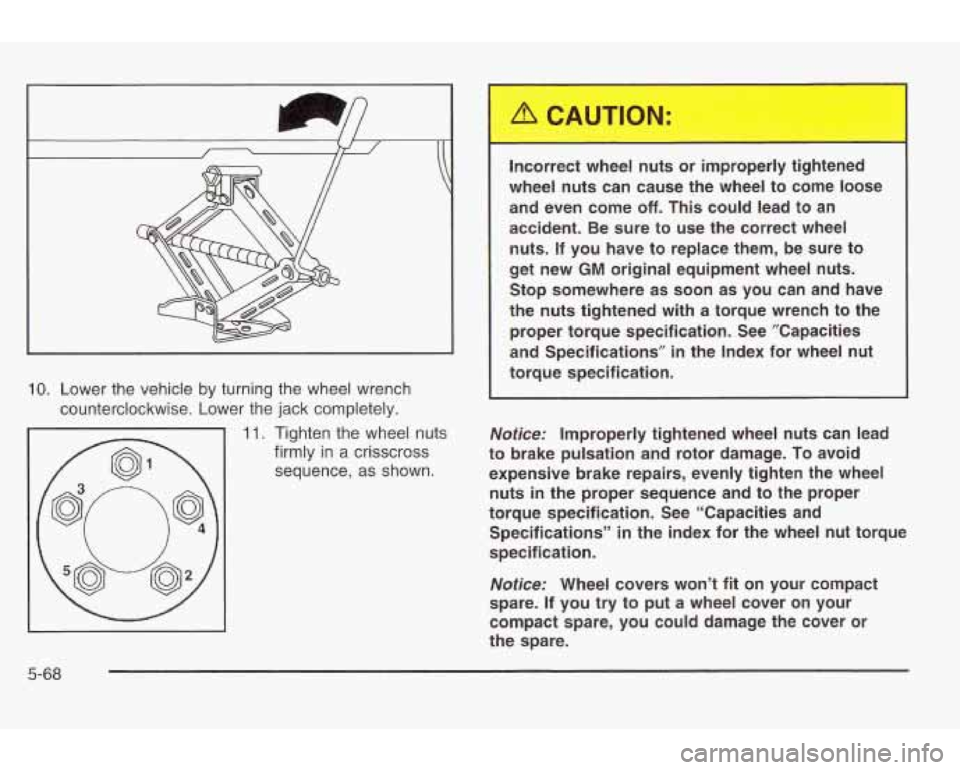
10. Lower the vehicle by turning the wheel wrench
counterclockwise. Lower the jack completely.
11. Tighten the wheel nuts
firmly in a crisscross
sequence, as shown.
E
Incorrect wheel nuts or improperly tightened
wheel nuts can cause the wheel to come loose
and even come
off. This could lead to an
accident. Be sure to use
the correct wheel
nuts. If you have to replace them, be sure to
get new
GM original equipment wheel nuts.
Stop somewhere as soon as you can and have
the nuts tightened with a torque wrench to the proper torque specification. See ”Capacities
and Specifications” in the Index for wheel nut
torque specification.
Notice: Improperly tightened wheel nuts can lead
to brake pulsation and rotor damage.
To avoid
expensive brake repairs, evenly tighten the wheel
nuts in the proper sequence and to the proper
torque specification. See “Capacities and
Specifications”
in the index for the wheel nut torque
specification.
Notice: Wheel covers won’t fit on your compact
spare. If you try to put a wheel cover on your
compact spare, you could damage the cover or
the spare.
5-68
Page 304 of 354
Electrical System
Add-On Electrical Equipment
Notice: Don’t add anything electrical to your
vehicle unless you check with your dealer first.
Some electrical equipment can damage your vehicle
and the damage wouldn’t be covered by your
warranty. Some add-on electrical equipment can
keep other components from working as they
should.
Your vehicle has an air bag system. Before attempting
to add anything electrical to your vehicle, see
Servicing Your Air Bag-Equipped Vehicle on page 1-59.
Windshield Wiper Fuses
The windshield wiper motor is protected by a circuit
breaker and a fuse. If the motor overheats due to heavy
the overload is caused by some electrical problem, have
it fixed.
SXLY, ek., the vvipec vviii Sup urliii iikle I~IIU~WI cuuis. ii
Power Windows and Qther Power
Options
A circuit breaker in the fuse panel protects the power
windows. When the current load is
too heavy, the circuit
breaker opens and closes, protecting the circuit until
the problem is fixed.
Fuses and Circuit Breakers
The wiring circuits in your vehicle are protected from
short circuits by a combination
of fuses, circuit breakers
and fusible links. This greatly reduces the chance of
damage caused by electrical problems.
Look at the silver-colored band inside the fuse.
If the
band is broken or melted, replace the fuse. Be sure
to
replace a bad fuse with a new one of the identical
size and rating.
There are three fuse blocks in your vehicle: two
instrument panel fuse blocks and the engine
rmpsrtment !LE? h!r\Ck.
There are four spare fuses located in the driver’s side
instrument panel end cap for your use.
Instrument Panel Fuse Blocks
There are two fuse panels for your vehic!~. One Is
located on the driver’s side of the instrument panel
the other
is located on the passenger’s side. and
5-81
Page 305 of 354

Instrument Panel Fuse Block
(Driver’s Side)
f
A) WIPER E) TRUNKREL RADIO AMP C) TURN LPS D) PWR MIRROR E) AIR BAG
G) PCMACC F) BFCBATT
H)
DRLOCK I) IPC/ BFC ACC J) STOP LPS
L) IPC / HVAC BATT
OIL
= H)n?I DR UNLOCK
El pq DR UNLOCK
Fuses Usage
WIPER Windshield Wiper Motor,
TRUNK REU Trunk Release
Relay/Motor,
RADIO AMP Audio AmplifiedRFA
TURN LPS Turn
Signal Lamps
Washer Pump Fuses
PWR MIRROR
AIR BAG
BFC BATT
PCM ACC
DR LOCK
I PC/BFC ACC
STOP LPS
HAZARD LPS
I PC/HVAC
BATT
Circuit Breakers
PWR SEAT
Relay
TRUNK REL
DR UNLOCK DR LOCK
DRIVER DR
UNLOCK Usage
Power Mirrors
Air Bags Body Computer (BFC)
Power Control Module (PCM)
Door Lock Motors
Cluster, Body Computer (BFC)
Stop Lamps Hazard Lamps HVAC Head, Cluster, Data Link
Connector
Usage Power Seats
Usage
Trunk Relay
Door Unlock Relay Door Lock Relay
Driver’s Door Unlock Relay
5-82
Page 306 of 354

Instrument Panel Fuse Block
(Passenger’s Side)
SEE OTHER END CAI
FOR FUSE PULLER
& SPARE FUSES
A) INST LPS
C) CRUISE SW B) CRUISE SW LPS
D) HVAC BLOWER E) CRUISE F) FOG LPS G) INT LPS H) RADIO BATT I) SUNROOF
*SEE OWNERS MANUAL /
Fuse
INST LPS
CRUISE
sw LPS
CRUISE SW
HVAC
BLOWER
CRUISE FOG LPS
INT LPS RADIO
BATT
SUNROOF Usage
Interior Lamp Dimming
Steering Wheel Cruise Control
Switch Lamps
Steering Wheel Cruise
Control Switches
HVAC Blower Motor
Cruise Control Fog Lamps
Interior Courtesy Lamps
Radio, XMTM Satellite Radio/DAB
Power Sunroof
Circuit Breaker Usage
PWR WNDW Power Windows
Relay
FOG LPS
Usage
Fog Lamps
5-83
Page 307 of 354

Engine Compartment Fuse Block
The engine compartment fuse block is located on the
driver’s side
of the engine compartment, near the
battery.
.
Fuse
1
2
Usage
Ignition Switch
Right Electrical Center-Fog Lamps,
Radio, Body Function Control
Module, Interior Lamps Fuse
3
4
5
6
7
8
Relays
9
10
11
12
13
14
15 Usage
Left Electrical Center-Stop Lamps,
Hazard Lamps, Body Function
Control Module, Cluster, Climate
Control System
Anti-Lock Brakes
Left Electrical Center-Power Seats,
Power Mirrors, Door Locks, Trunk
Release, Audio Amplifier, Remote
Keyless Entry
Not Used Ignition Switch
Cooling Fan
#I
Usage
Rear Defog
Not Used
Starter
Cooling Fan #1
HVAC Blower (Climate Control)
Cooling Fan #2
Cooling Fan
5-84
Page 308 of 354

Relays 16
17
18
19
20
21 22
Fuses 23-32
33
34
35
36
37
3e
39
40 Usage
Air Conditioning Compressor
Not Used
Fuel Pump
Automatic Headlamp System
Automatic Headlamp System
Horn
Daytime Running Lamps (DRL)
Usage
Spare Fuse Holder
Rear Defog
Accessory Power Outlets,
Cigarette Lighter
Generator
Not Used
Air Conditioning Compressor, Body
Function Control Module
Powertrain Control Module (PCM)
Anti-Lock Brakes (ABS)
At Itnmatir- TrQncQvlo , l,..."l, IULIV I I UI I"cIt\I"
Fuses
41
42
43
44
45 46
47
48 49 50
51 52
53
54
55 56
57 Usage
Ignition
System
Back-up Lamps, Brake Transaxle
Shift Interlock
Horn PCM Parking Lamps
Climate Control System,
Air Conditioning
Canister Vent Valve, Exhaust
Oxygen Sensors
Fuel Pump, injectors
Not Used
Right Headlamp
Left Headlamp
Cooling Fan
#2
HVAC Blower (Climate Control)
Crank
Coolina Fan #2 Ground
Fuse Puller for Mini Fuses
Not Used
5-85
Page 321 of 354
At Least Twice a Year
Restraint System Check
Make sure the safety belt reminder light and all your
belts, buckles, latch plates, retractors and anchorages
are working properly.
Look for any other loose or
damaged safety belt system parts. If you see anything
that might keep a safety belt system from doing its
job, have it repaired. Have any torn or frayed safety belts
replaced.
Also look for any opened or broken air bag coverings,
and have them repaired or replaced. (The air bag
system does not need regular maintenance.)
Wiper Blade Check
Inspect wiper blades for wear or cracking. Replace
blade inserts that appear worn or damaged or that
streak or miss areas of the windshield.
Also see
Cleaning the Outside of Your Vehicle on page 5-75.
Weatherstrip Lubrication
Silicone grease on weatherstrips will make them last
longer, seal better,' and not stick or squeak. Apply
silicone grease with a clean cloth. During very cold,
damp weather more frequent application may be required. See
Part D: Recommended Fluids and
Lubricants on page
6- 15.
Manual Transaxle Check
It is not necessary to check the transaxle fluid level.
Check for leaks. A fluid leak is the only reason for fluid
loss. Have the system inspected and repaired if
needed.
Automatic Transaxle Check
It is not necessary to check the transaxle fluid level. A
transaxle fluid leak is the only reason for fluid loss.
Check for leaks. If a leak occurs, take the vehicle to your
dealer and have
it repaired as soon as possible.
Hydraulic Clutch System Check
Check the fluid level in the clutch reservoir. See
Hydraulic Clutch on page 5-23. A fluid loss in this
system could indicate a problem. Have the system
inspected and repaired at once.
At Least Once a Year
Key Lock Cylinders Service
Lubricate the key lock cylinders with the lubricant
specified in Part
D.
Body Lubrication Service
Lubricate all the door hinges and latches, including
those for the hood and the trunk lid. Part D tells
you what to use. More frequent lubrication may be
required when exposed to a corrosive environment.
6-1 0
Page 322 of 354
Starter Switch Check
1
When you are doing this check, the vehicle
could move suddenly.
If it does, you or others
could be injured. Follow the steps below.
Automatic Transaxle Shift Lock Control
1. Before you start, be sure you have enough room
around the vehicle.
2. Firmly apply both the parking brake and the regular
brake. See
Parking Brake on page 2-29 if
necessary.
Do not use the accelerator pedal, and be ready to
turn off the engine immediately
if it starts.
3. Try to start the engine in each gear. The starter
should work only in PARK (P) or NEUTRAL (N).
ii ine starier WOI-KS in any oiner posiiion, your
vehicle needs service.
System Check
When you are doing this check, the vehicle
could move suddenly.
If it does, you or others
could be injured.
Follow the steps below.
1. Before you start, be sure you have enough room
around the vehicle. It should be parked on a level
su dace.
2. Firmly apply the parking brake. See Parking Brake
on page
2-29 if necessary.
Be ready to apply the regular brake immediately
if
the vehicle begins to move.
3. With the engine off, turn the key to the ON position,
but don’t start the engine. Without applying the
regular brake, try
to move the shitt lever out
of PARK (P) with normal effort. If the shift lever
moves out of PARK (P), your vehicle needs sewice.
6-1 1
Page 323 of 354
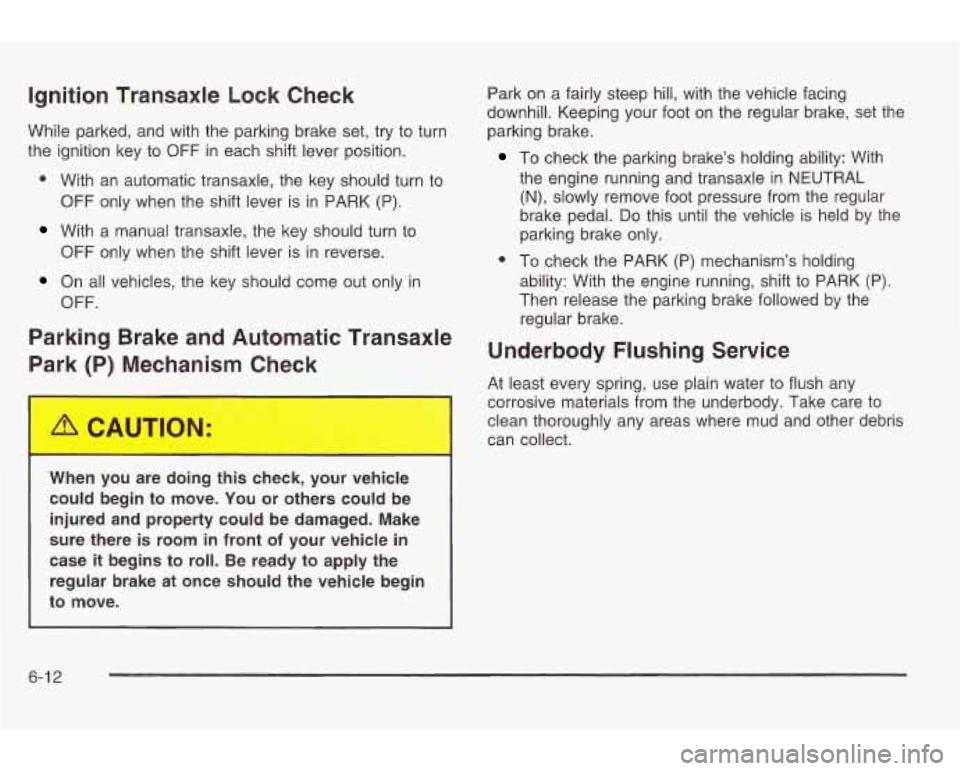
Ignition Transaxle Lock Check
While parked, and with the parking brake set, try to turn
the ignition key to
OFF in each shift lever position.
* With an automatic transaxle, the key should turn to
OFF only when the shift lever is in PARK
(P).
With a manual transaxle, the key should turn to
OFF only when the shift lever
is in reverse.
On all vehicles, the key should come out only in
OFF.
Parking Brake and Automatic Transaxle
Park
(P) Mechanism Check
When you are doing this check, your vehicle
could begin to move. You
or others could be
injured and property could be damaged. Make
sure there is
room in front of your vehicle in
case it begins to roll.
Be ready to apply the
regular brake at once should the vehicle begin
to move. Park
on a fairly steep hill, with the vehicle facing
downhill. Keeping your foot on the regular brake, set the
parking brake.
To check the parking brake’s holding ability: With
the engine running and transaxle in NEUTRAL
(N), slowly remove foot pressure from the regular
brake pedal.
Do this until the vehicle is held by the
parking brake only.
ability: With the engine running, shift to PARK (P).
Then release the parking brake followed by the
regular brake.
* To check the PARK (P) mechanism’s holding
Underbody Flushing Service
At least every spring, use plain water to flush any
corrosive materials from the underbody. Take care to
clean thoroughly any areas where mud and other debris
can collect.
6-1
2
Page 326 of 354
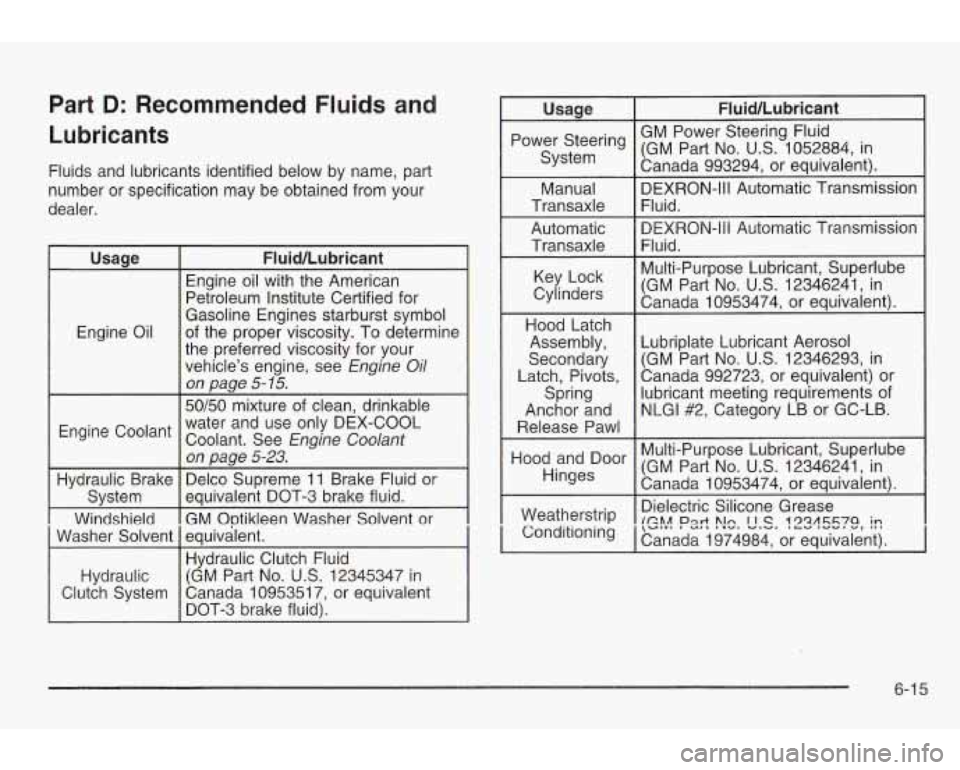
Part D: Recommended Fluids and
Lubricants
Fluids and lubricants identified below by name, part
number or specification may be obtained from your
dealer.
Usage
Engine Oil Fluid/Lubricant
Engine oil with the American
Petroleum Institute Certified for
Gasoline Engines starburst symbol
of the proper viscosity.
To determine
the preferred viscosity for your
vehicle’s engine, see
Engine Oil
on page 5-15.
Engine Coolant
Hydraulic Brake Svstem
Windshield
Washer Solvent
Hydraulic
Clutch System 50/50
mixture of clean, drinkable
water and use only DEX-COOL
Coolant. See Engine Coolant
on page
5-23.
Delco Supreme 11 Brake Fluid or
equivalent DOT-3 brake fluid.
GM Optikleen Washer Solvent or
equivalent.
Hydraulic Clutch Fluid
(GM Part No.
U.S. 12345347 in
Canada 1095351 7, or equivalent
DOT-3 brake fluid). Usage
Power Steering System
Manual
Transaxle
Automatic Transaxle
Key Lock
Cylinders
Hood Latch Assembly,
Secondary
Latch, Pivots,
Spring
Anchor and
Release Pawl
Hood and Door Hinges
Weatherstrip Conditioning Fluid/Lubricant
GM Power Steering Fluid
(GM Part No.
U.S. 1052884, in
Canada 993294, or equivalent).
DEXRON-Ill Automatic Transmission
Fluid.
DEXRON-Ill Automatic Transmission
Fluid.
Multi-Purpose Lubricant, Superlube
(GM Part No.
US. 12346241, in
Canada 10953474, or equivalent).
Lubriplate Lubricant Aerosol
(GM Part No.
US. 12346293, in
Canada 992723, or equivalent) or
lubricant meeting requirements of
NLGl
#2, Category LB or GC-LB.
Multi-Purpose Lubricant, Superlube
(GM Part No.
U.S. 12346241, in
Canada 10953474, or equivalent).
Dielectric Silicone Grease
Canada 1974984, or equivalent).
(a! Part ?!e. V.S. 123?557S, Ir!
6-1 5