light PONTIAC GRAND AM 2003 Manual PDF
[x] Cancel search | Manufacturer: PONTIAC, Model Year: 2003, Model line: GRAND AM, Model: PONTIAC GRAND AM 2003Pages: 354, PDF Size: 16.3 MB
Page 263 of 354
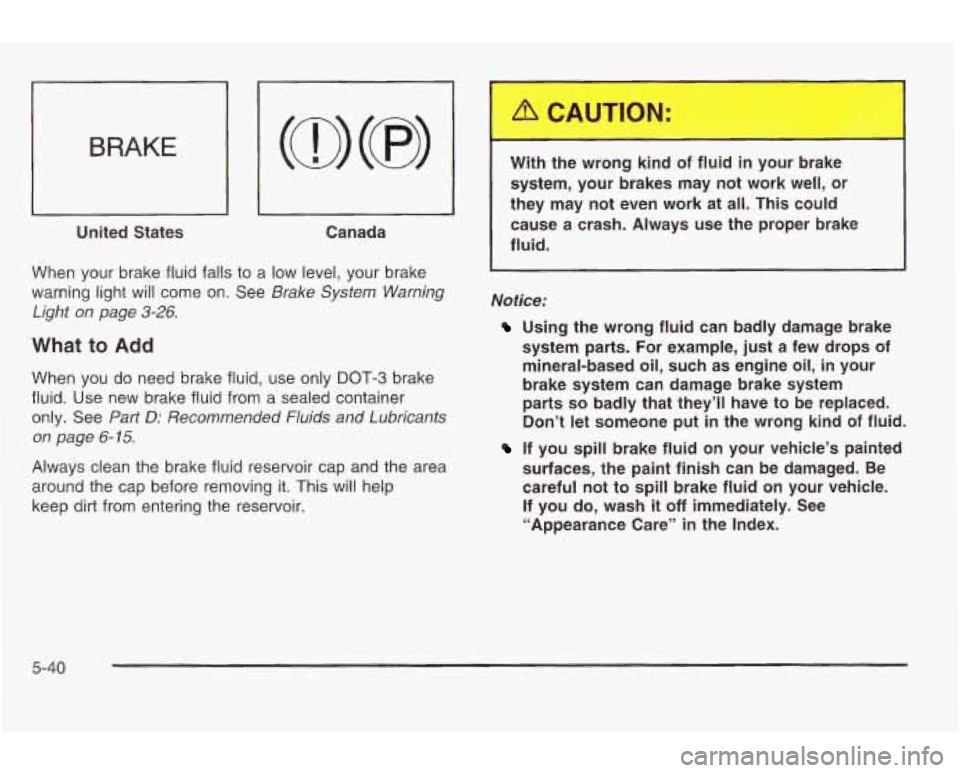
BRAKE
United States Canada
When your brake fluid falls to a low level, your brake
warning light will come on. See
Brake System Warning
Light on page
3-26.
What to Add
When you do need brake fluid, use only DOT-3 brake
fluid. Use new brake fluid from a sealed container
only. See
Part D: Recommended Fluids and Lubricants
on page
6- 15.
Always clean the brake fluid reservoir cap and the area
around the cap before removing it. This will help
keep dirt from entering the reservoir.
With the wrong kind of fluid in your brake
system, your brakes may not work well, or
they may not even work at all. This could
cause
a crash. Always use the proper brake
fluid.
Notice:
Using the wrong fluid can badly damage brake
system parts. For example, just
a few drops of
mineral-based oil, such as engine oil, in your
brake system can damage brake system parts
so badly that they’ll have to be replaced.
Don’t let someone put in the wrong kind of fluid.
If you spill brake fluid on your vehicle’s painted
surfaces, the paint finish can be damaged. Be
careful not to spill brake fluid on your vehicle.
If you do, wash it off immediately. See
“Appearance Care” in the Index.
5-40
Page 264 of 354
Brake Wear
The GT Series has four-wheel disc brakes and the SE
Series has front disc brakes and rear drum brakes.
Disc brake pads have built-in wear indicators that make
a high-pitched warning sound when the brake pads
are worn and new pads are needed. The sound
may come and go or be heard all the time your vehicle
is moving (except when you are pushing on the
brake pedal firmly).
A CAUTION:
-
The brake wear warning sound means that
soon your brakes won’t work well. That could
lead to an accident. When you hear the brake
wear warning sound, have your vehicle
serviced.
Notice: Continuing to drive with worn-out brake
pads could result in costly brake repair.
Some driving conditions or climates may cause a brake
squeal when the brakes are first applied or lightly
applied. This does not mean something is wrong with
your brakes.
Properly torqued wheel nuts are necessary to help
prevent brake pulsation. When tires are rotated, inspect
brake pads for wear and evenly tighten wheel nuts in
the proper sequence to
GM torque specifications.
If you have rear drum brakes, they don’t have wear
indicators, but
if you ever hear a rear brake rubbing
noise, have the rear brake linings inspected immediately.
Also, the rear brake drums should be removed and
inspected each time the tires are removed for rotation or
changing. When you have the front brake pads
replaced, have the rear brakes inspected, too.
Brake linings should always be replaced as complete
axle sets.
See
Brake System Inspection on page 6-14.
5-4 1
Page 267 of 354
1. Check the other vehicle. It must have a 12-volt
battery with a negative ground system.
Notice: If the other system isn’t a 12-volt system
with a negative ground, both vehicles can be
damaged.
2. Get the vehicles close enough so the jumper cables
can reach, but be sure the vehicles aren’t touching
each other. If they are, it could cause a ground
connection you don’t want. You wouldn’t be able
to
start your vehicle, and the bad grounding could
damage the electrical systems.
To avoid the possibility of the vehicles rolling, set
the parking brake firmly on both vehicles involved in
the jump start procedure. Put an automatic
transaxle in PARK (P) or a manual transaxle in
NEUTRAL before setting the parking brake.
Notice: If you leave your radio on, it could be badly
damaged. The repairs wouldn’t be covered by
your warranty.
3. Turn off the ignition on both vehicles. Unplug
unnecessary accessories plugged into the cigarette
lighter. Turn
off the radio and all lamps that aren’t
needed. This will avoid sparks and help save
both batteries. And it could save your radio!
4. Open the hoods and locate the batteries. Find the
positive (+) and negative
(-) terminal locations on
each vehicle. See
Engine Compartment Overview
on page
5-12 for more information on location.
c
An electric fan can start up even when the
engine
is not running and can injure you. Keep
hands, clothing and tools away from any
underhood electric fan.
5-44
Page 268 of 354
Using a match near a battery can cause battery
gas to explode. People have been hurt doing
this, and some have been blinded. Use a
flashlight if you need more light.
Be sure the battery has enough water. You
don’t need to add water to the ACDelco@
battery installed in your new vehicle. But if a
battery has filler caps, be sure
the right
amount of fluid is there. If
it is low, add water
to take care of that first. If you don’t, explosive
gas could be present.
Battery fluid contains acid that can burn you.
Don’t get it on you. If you accidentally get
it in
your eyes or on your skin, flush the place with
water and get medical help immediately. Fans or other moving engine parts can injure
you badly. Keep your hands away from moving
parts
once the engine is running.
5. Check that the jumper cables don’t have loose or
missing insulation. If they do, you could get a
shock. The vehicles could be damaged too.
Before you connect the cables, here are some
basic things you should know. Positive
(+) will go to
positive
(+) or to a remote positive (+) terminal if
the vehicle has one. Negative (-) will go to a heavy,
unpainted metal engine part or to a remote
negative
(-) terminal if the vehicle with the dead
battery has one.
Don’t connect positive
(+) to negative (-) or you’ll
qet a short that would damage the battery and
maybe other parts, too. And don’t connect
the negative
(-) cable to the negative (-) terminal
on the dead battery because this can cause sparks.
5-45
Page 280 of 354
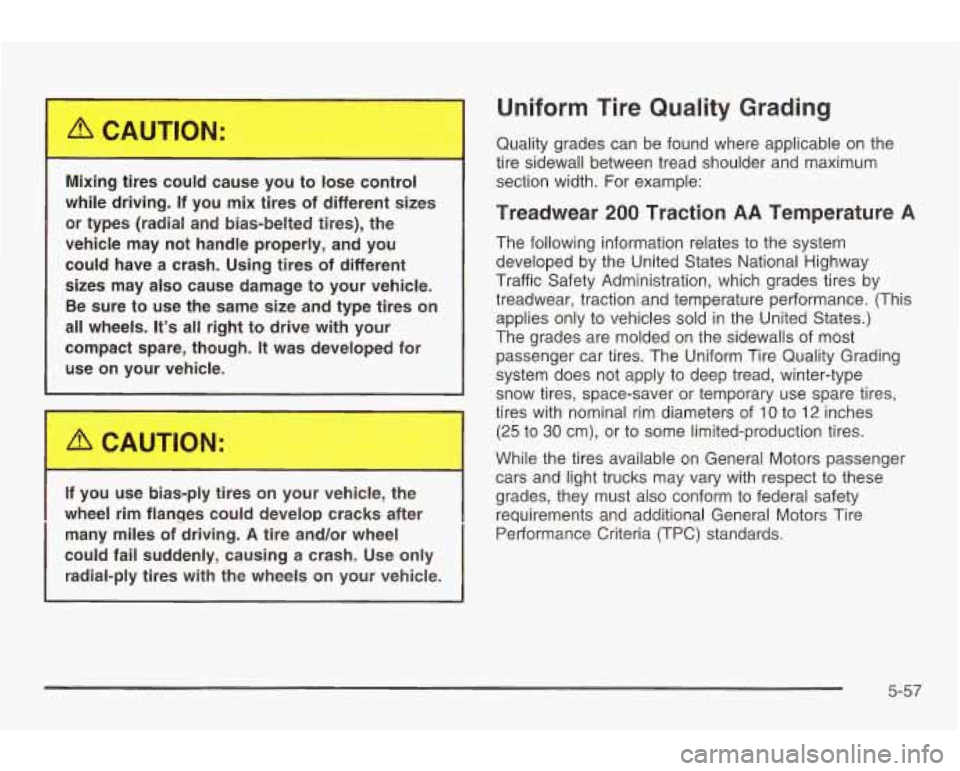
Mixing tires could cause you to lose control
while driving.
If you mix tires of different sizes
or
types (radial and bias-belted tires), the
vehicle may not handle properly, and you
could have a crash. Using tires of different
sizes may also cause damage
to your vehicle.
Be sure to use the same size and type tires on
all wheels. It’s all right to drive with your
compact spare, though.
It was developed for
use on your vehicle.
I
If you use bias-ply tires on your vehicle, the
wheel rim flanges could develop cracks after
I
many miles of driving. A tire and/or wheel
could fail suddenly, causing a crash. Use only radial-ply tires with the wheels on your vehicle.
I
Uniform Tire Quality Grading
Quality grades can be found where applicable on the
tire sidewall between tread shoulder and maximum
section width. For example:
Treadwear 200 Traction AA Temperature A
The following information relates to the system
developed by the United States National Highway
Traffic Safety Administration, which grades tires by
treadwear, traction and temperature performance. (This
applies only
to vehicles sold in the United States.)
The grades are molded on the sidewalls of most
passenger car tires. The Uniform Tire Quality Grading
system does
not apply to deep tread, winter-type
snow tires, space-saver or temporary use spare tires,
tires with nominal rim diameters of
10 to 12 inches
(25 to 30 cm), or to some limited-production tires.
While the tires available on General Motors passenger
cars and light trucks may vary with respect
to these
grades, they must also conform
to federal safety
requirements and additional General Motors Tire
Performance Criteria (TPC) standards.
5-57
Page 302 of 354
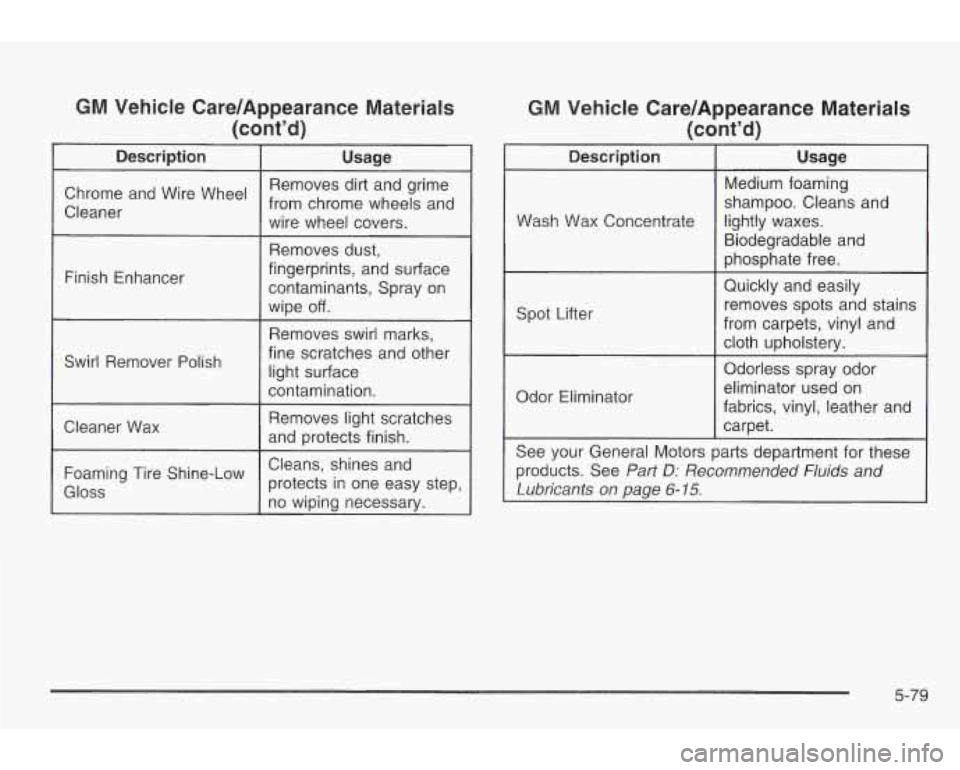
GM Vehicle Care/Appearance Materials
(cont’d)
Description I Usage
Chrome and Wire Wheel
Cleaner from chrome wheels
and
Removes dirt and grime
wire wheel covers.
I
I Removes dust,
Finish Enhancer fingerprints, and surface
contaminants, Spray
on
wipe
off.
Removes swirl marks,
..
Swirl Remover Polish light surface
fine scratches and other
I contamination. I
Cleaner Wax Removes light scratches
and protects finish.
GM Vehicle CardAppearance Materials
(cont’d)
Description
Wash Wax Concentrate
Spot Lifter
Odor Eliminator Usage
Medium foaming
shampoo. Cleans and
lightly waxes.
Biodegradable and
phosphate free.
Quickly and easily
removes spots and stains
from carpets, vinyl and
cloth upholstery.
Odorless spray odor
eliminator used on
fabrics, vinyl, leather and
carpet.
See your General Motors parts department for these
products. See
Part D: Recommended Fluids and
Lubricants on page 6-15.
5-79
Page 308 of 354

Relays 16
17
18
19
20
21 22
Fuses 23-32
33
34
35
36
37
3e
39
40 Usage
Air Conditioning Compressor
Not Used
Fuel Pump
Automatic Headlamp System
Automatic Headlamp System
Horn
Daytime Running Lamps (DRL)
Usage
Spare Fuse Holder
Rear Defog
Accessory Power Outlets,
Cigarette Lighter
Generator
Not Used
Air Conditioning Compressor, Body
Function Control Module
Powertrain Control Module (PCM)
Anti-Lock Brakes (ABS)
At Itnmatir- TrQncQvlo , l,..."l, IULIV I I UI I"cIt\I"
Fuses
41
42
43
44
45 46
47
48 49 50
51 52
53
54
55 56
57 Usage
Ignition
System
Back-up Lamps, Brake Transaxle
Shift Interlock
Horn PCM Parking Lamps
Climate Control System,
Air Conditioning
Canister Vent Valve, Exhaust
Oxygen Sensors
Fuel Pump, injectors
Not Used
Right Headlamp
Left Headlamp
Cooling Fan
#2
HVAC Blower (Climate Control)
Crank
Coolina Fan #2 Ground
Fuse Puller for Mini Fuses
Not Used
5-85
Page 316 of 354
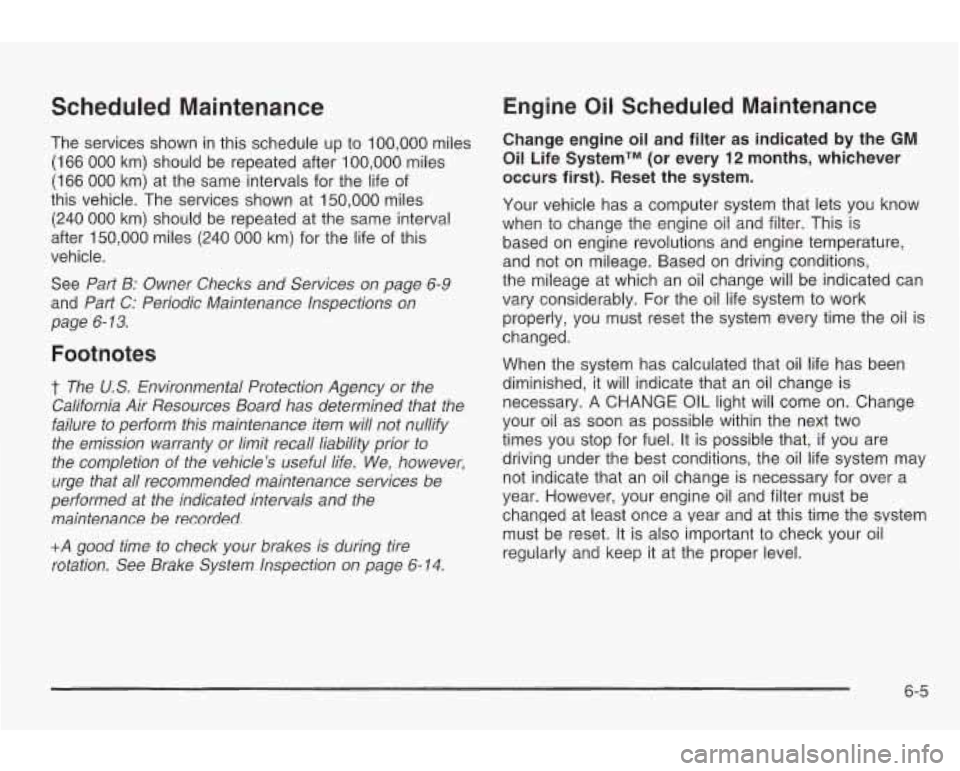
Scheduled Maintenance
The services shown in this schedule up to 100,000 miles
(1 66 000 km) should be repeated after 100,000 miles
(1 66 000 km) at the same intervals for the life of
this vehicle. The services shown at 150,000 miles
(240
QQO km) should be repeated at the same interval
after
150,000 miles (240 000 km) for the life of this
vehicle.
See
Part B: Owner Checks and Services on page 6-9
and Part C: Periodic Maintenance Inspections on
page
6- 13.
Footnotes
t The U.S. Environmental Protection Agency or the
California Air Resources Board has determined that the
failure to perform this maintenance item will not nullify
the emission warranty or limit recall liability prior to
the completion
of the vehicle's useful life. We, however,
urge that all recommended maintenance services be
performed at the indicated intervals and the
maintenance be recorded.
+A good time to check your brakes is during tire
rotation. See Brake System Inspection on page
6- 14.
Engine Oil Scheduled Maintenance
Change engine oil and filter as indicated by the GM
Oil Life SystemTM (or every 12 months, whichever
occurs first). Reset the system.
Your vehicle has a computer system that lets you know
when
to change the engine oil and filter. This is
based on engine revolutions and engine temperature,
and not on mileage. Based on driving conditions,
the mileage at which an oil change will be indicated can
vary considerably. For the oil life system
to work
properly, you must reset the system every time the oil is
changed.
When the system has calculated that oil life has been
diminished,
it will indicate that an oil change is
necessary.
A CHANGE OIL light will come on. Change
your
oil as soon as possible within the next two
times you stop for fuel.
It is possible that, if you are
driving under the best conditions, the oil life system may
not indicate that an oil change is necessary for over a
year. However, your engine oil and filter must be
changed at least once a year and at this time the svstem
must be reset.
It is also important to check your oil
regularly and keep it at the proper level.
6-5
Page 321 of 354
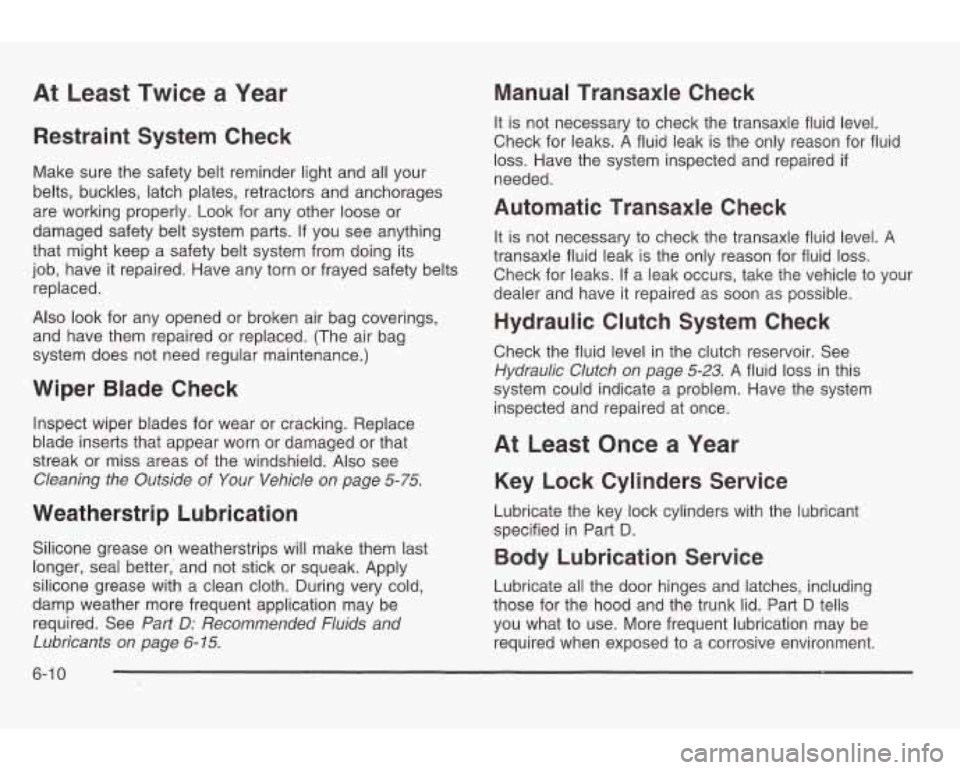
At Least Twice a Year
Restraint System Check
Make sure the safety belt reminder light and all your
belts, buckles, latch plates, retractors and anchorages
are working properly.
Look for any other loose or
damaged safety belt system parts. If you see anything
that might keep a safety belt system from doing its
job, have it repaired. Have any torn or frayed safety belts
replaced.
Also look for any opened or broken air bag coverings,
and have them repaired or replaced. (The air bag
system does not need regular maintenance.)
Wiper Blade Check
Inspect wiper blades for wear or cracking. Replace
blade inserts that appear worn or damaged or that
streak or miss areas of the windshield.
Also see
Cleaning the Outside of Your Vehicle on page 5-75.
Weatherstrip Lubrication
Silicone grease on weatherstrips will make them last
longer, seal better,' and not stick or squeak. Apply
silicone grease with a clean cloth. During very cold,
damp weather more frequent application may be required. See
Part D: Recommended Fluids and
Lubricants on page
6- 15.
Manual Transaxle Check
It is not necessary to check the transaxle fluid level.
Check for leaks. A fluid leak is the only reason for fluid
loss. Have the system inspected and repaired if
needed.
Automatic Transaxle Check
It is not necessary to check the transaxle fluid level. A
transaxle fluid leak is the only reason for fluid loss.
Check for leaks. If a leak occurs, take the vehicle to your
dealer and have
it repaired as soon as possible.
Hydraulic Clutch System Check
Check the fluid level in the clutch reservoir. See
Hydraulic Clutch on page 5-23. A fluid loss in this
system could indicate a problem. Have the system
inspected and repaired at once.
At Least Once a Year
Key Lock Cylinders Service
Lubricate the key lock cylinders with the lubricant
specified in Part
D.
Body Lubrication Service
Lubricate all the door hinges and latches, including
those for the hood and the trunk lid. Part D tells
you what to use. More frequent lubrication may be
required when exposed to a corrosive environment.
6-1 0
Page 340 of 354
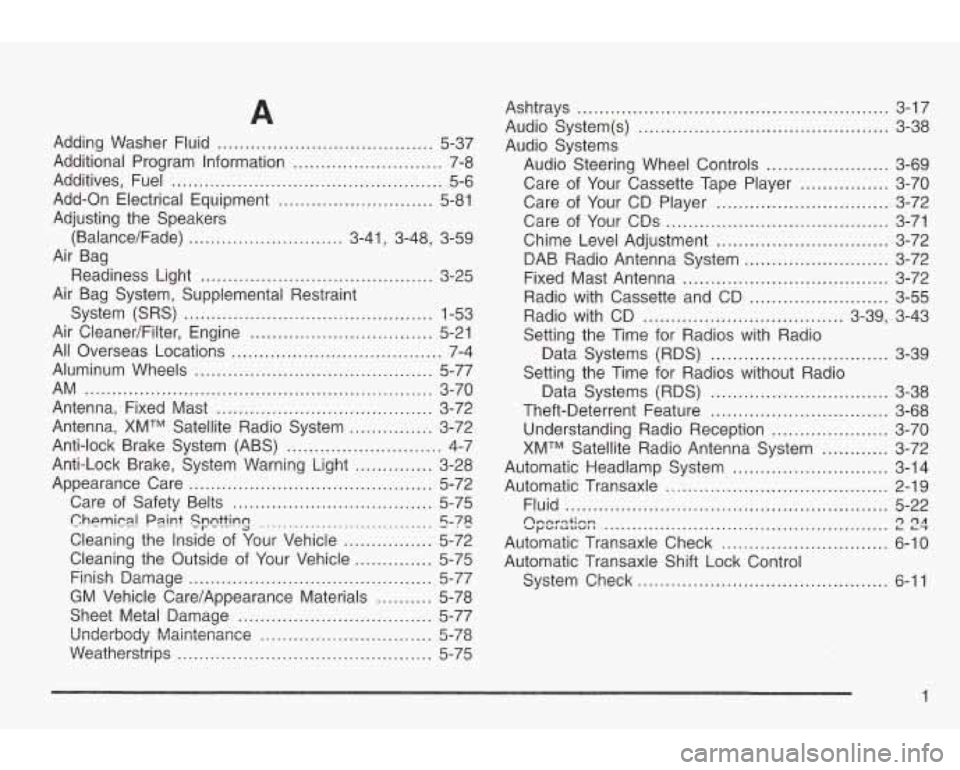
A
Adding Washer Fluid ....................................... 5-37
Additional Program Information
........................... 7-8
Additives, Fuel
................................................. 5-6
Add-On Electrical Equipment
............................ 5-81
Adjusting the Speakers
(Balance/Fade)
............................ 3-41 ~ 3-48, 3-59
Air Bag
Readiness Light
.......................................... 3-25
Air Bag System, Supplemental Restraint
System (SRS)
............................................. 1-53
Air CleanedFilter, Engine ................................. 5-21
All Overseas Locations ...................................... 7-4
Aluminum Wheels
........................................... 5-77
Antenna, Fixed Mast
....................................... 3-72
Antenna, XMTM Satellite Radio System
............... 3-72
Anti-lock Brake System (ABS)
............................ 4-7
Anti-Lock Brake, System Warning Light
.............. 3-28
Appearance Care
............................................ 5-72
Care
of Safety Belts .................................... 5-75
Cleaning the Inside
of Your Vehicle ................ 5-72
Finish Damage
............................................ 5-77
AM
............................................................... 3-70
ChPMim! Psi nt SFQttinCJ ............................... 5-78
Cleaning the Outside
of Your Vehicle .............. 5-75
GM Vehicle Care/Appearance Materials
.......... 5-78
Sheet Metal Damage
................................... 5-77
Underbody MaiGtenanee
............................... 5-78
Weatherstrips .............................................. 5-75 Ashtrays
........................................................ 3-17
Audio System(s)
............................................. 3-38
Audio Systems
Audio Steering Wheel Controls
...................... 3-69
Care
of Your Cassette Tape Player ................ 3-70
Care of Your CD Player
............................... 3-72
Care of Your CDs
........................................ 3-71
Chime Level Adjustment
............................... 3-72
DAB Radio Antenna System
.......................... 3-72
Fixed Mast Antenna
..................................... 3-72
Radio with Cassette and CD
......................... 3-55
Radio with CD
.................................... 3-39, 3-43
Setting the Time for Radios with Radio
Data Systems (RDS)
................................ 3-39
Setting the Time for Radios without Radio
Data Systems (RDS)
................................ 3-38
Theft-Deterrent Feature
................................ 3-68
Understanding Radio Reception
..................... 3-70
XMTM Satellite Radio Antenna System
............ 3-72
Automatic Headlamp System
............................ 3-14
Automatic Transaxle
........................................ 2-19
Fluid
.......................................................... 5-22
Automatic Transaxle Check
.............................. 6-10
Automatic Transaxle Shift Lock Control
System Check
............................................. 6-11
Annrqtinn vy- IULIVII 1 L-r r) r)A ...................................................
1