engine PONTIAC GRAND PRIX 2003 Owners Manual
[x] Cancel search | Manufacturer: PONTIAC, Model Year: 2003, Model line: GRAND PRIX, Model: PONTIAC GRAND PRIX 2003Pages: 378, PDF Size: 17.64 MB
Page 266 of 378
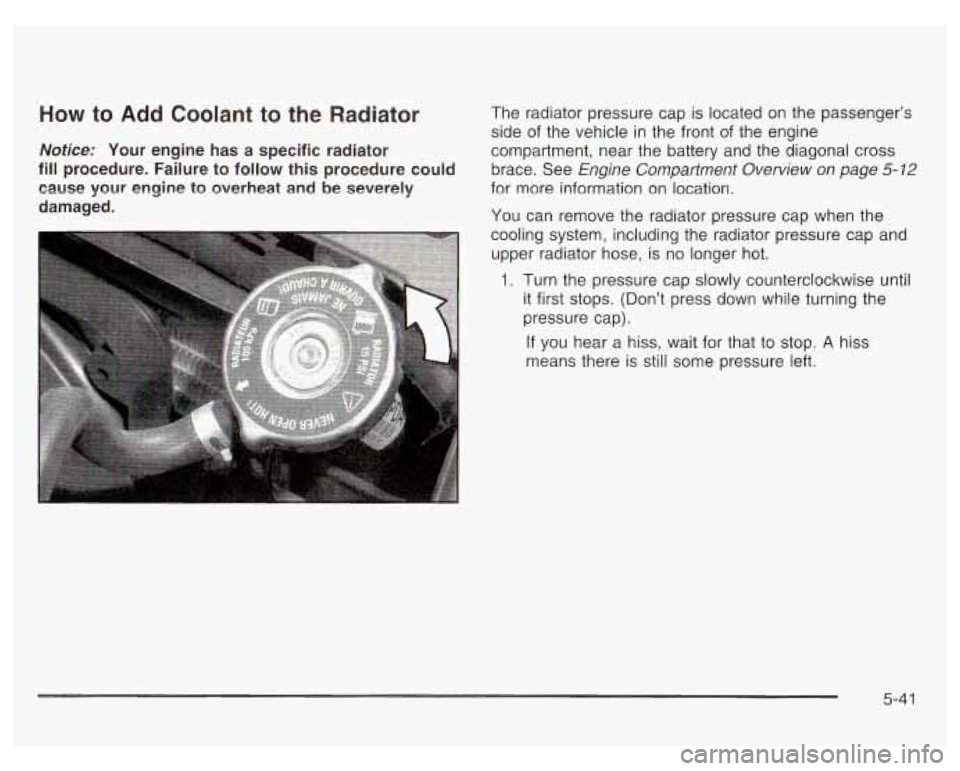
40w to Add Coolant to the Radiator The radiator pressure cap is located on the passenger’s
side of the vehicle
in the front of the engine
dotice: Your engine has a specific radiator compartment, near the battery and the diagonal cross
ill procedure. Failure to follow this procedure could brace. See Engine Compartment Overview on page 5-12
:ause your engine to overheat and be severely for more information on location.
lamaged. You can remove the radiator pressure cap when the
cooling system, including the radiator pressure cap and
upper radiator hose, is no longer hot.
1. Turn the pressure cap slowly counterclockwise until
it first stops. (Don’t press down while turning the
pressure cap).
If you hear a hiss, wait for that to stop. A hiss
means there is still some pressure left.
5-4 1
Page 267 of 378
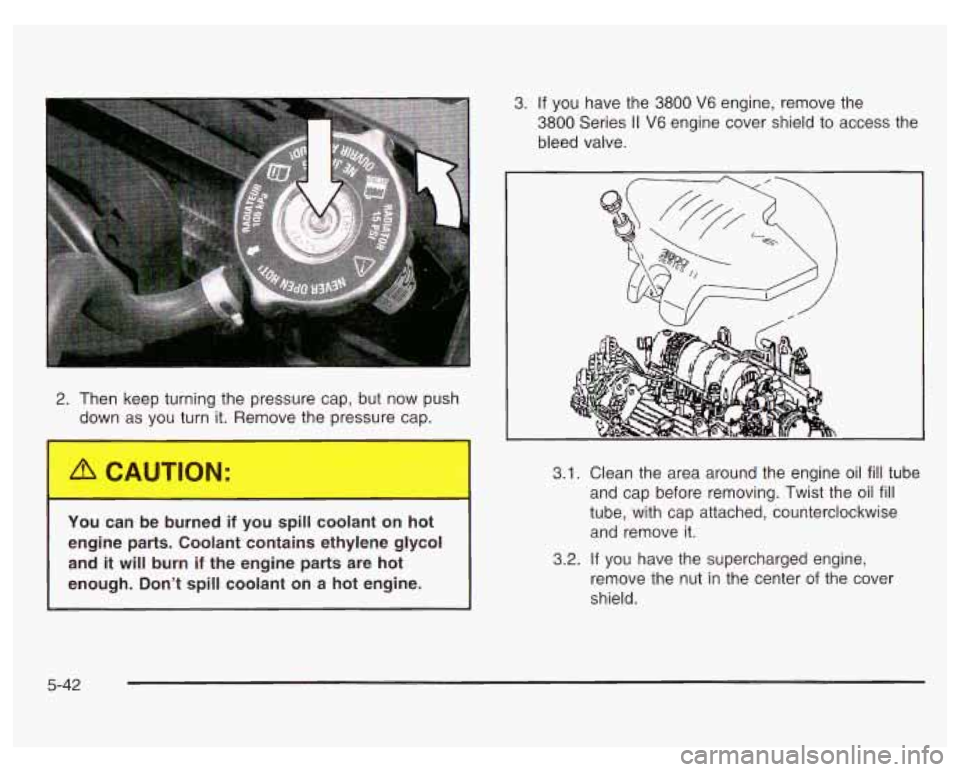
2. Then keep turning the pressure cap, but now push
down as you turn it. Remove the pressure cap.
You can be burned if you spill coolant on hot
engine parts. Coolant contains ethylene glycol
and it will burn if the engine parts are hot
enough. Don’t spill coolant on a hot engine.
I
3. If you have the 3800 V6 engine, remove the
3800 Series
II V6 engine cover shield to access the
bleed valve.
3.1. Clean the area around the engine oil
fill tube
and cap before removing. Twist the oil
fill
tube, with cap attached, counterclockwise
and remove it.
3.2.
If you have the supercharged engine,
remove the nut in the center
of the cover
shield.
5-42
Page 268 of 378
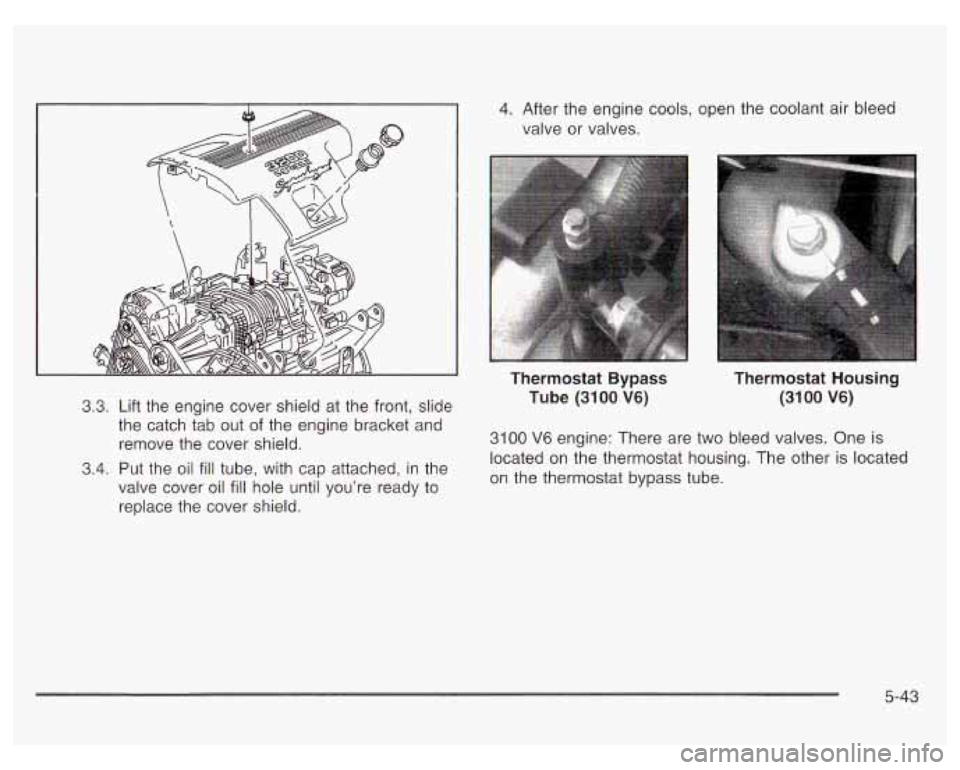
3.3. Lift the engine cover shield at the front, slide
the catch tab out
of the engine bracket and
remove the cover shield.
3.4. Put the oil fill tube, with cap attached, in the
valve cover oil
fill hole until you’re ready to
replace the cover shield. 4.
After the engine cools, open the coolant air bleed
valve or valves.
Thermostat Bypass Tube
(3100 V6)
Thermostat Housing
(31 00 V6)
3100 V6 engine: There are two bleed valves. One is
located on the thermostat housing. The other is located
on the thermostat bypass tube.
5-43
Page 269 of 378
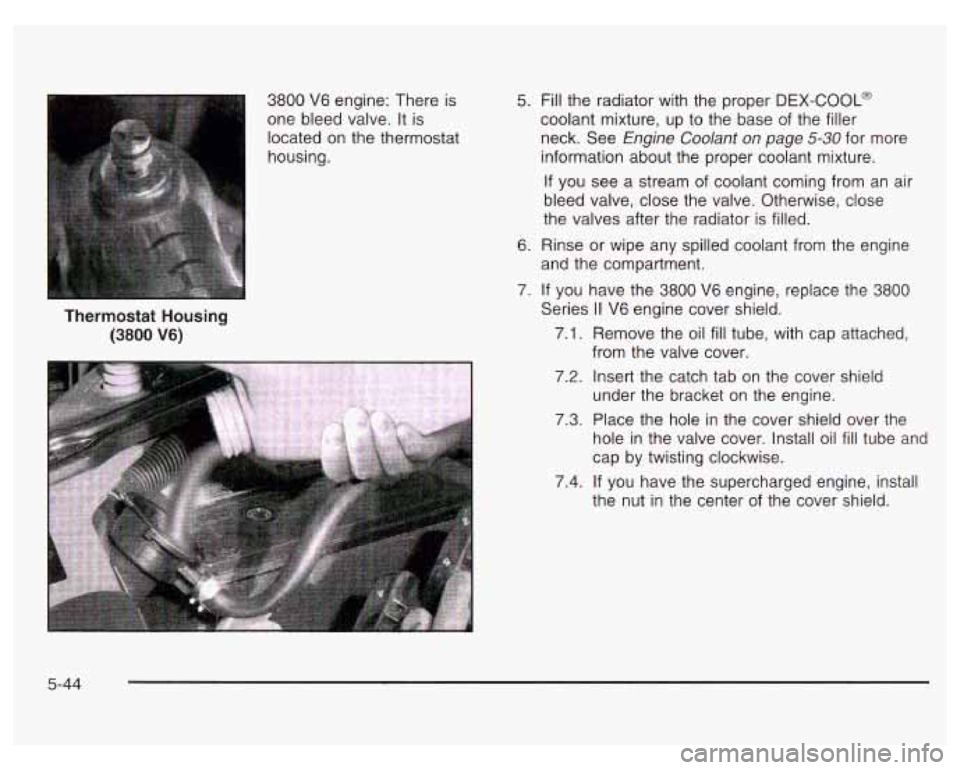
3800 V6 engine: There is
one bleed valve. It is
located on the thermostat
housing.
Thermostat Housing
(3800 V6)
5. Fill the radiator with the proper DEX-COOL@
coolant mixture, up to the base of the filler
neck. See Engine Coolant
on page 5-30 for more
information about the proper coolant mixture.
If you see a stream of coolant coming from an air
bleed valve, close the valve. Otherwise, close
the valves after the radiator is filled.
6. Rinse or wipe any spilled coolant from the engine
and the compartment.
7.
If you have the 3800 V6 engine, replace the 3800
7.1. Remove the oil fill tube, with cap attached,
Series
II V6
engine cover shield.
from the valve cover.
7.2. Insert the catch tab on the cover shield
under the bracket
on the engine.
7.3. Place the hole in the cover shield over the
hole
in the valve cover. Install oil fill tube and
cap by twisting clockwise.
7.4. If you have the supercharged engine, install
the nut in the center
of the cover shield.
5-44
Page 270 of 378
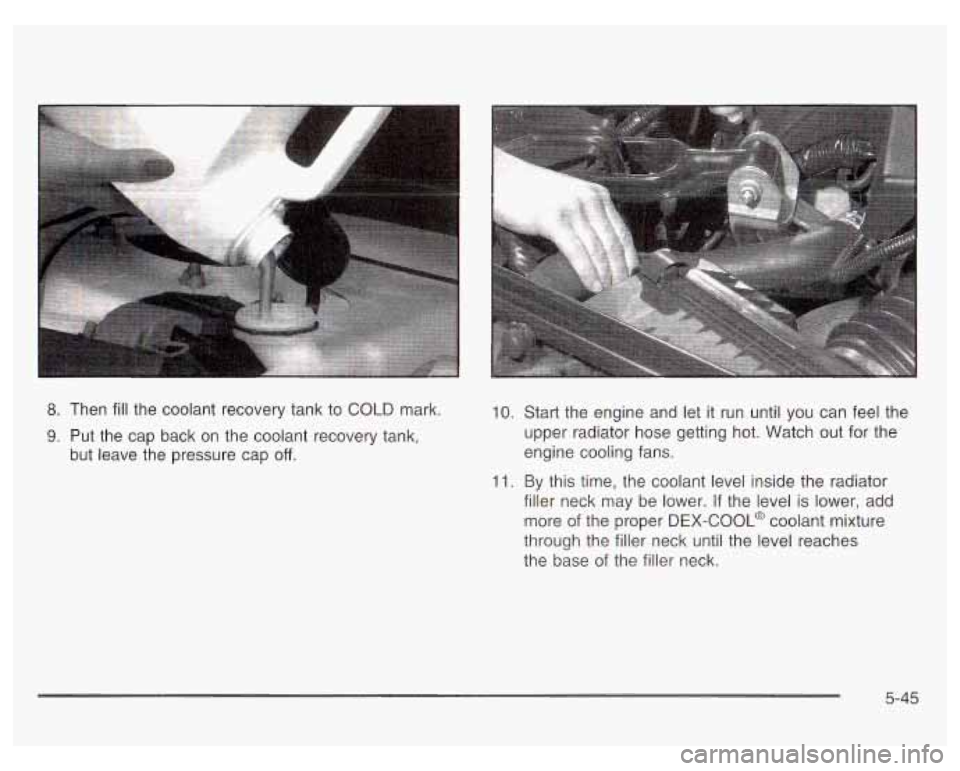
8. Then fill the coolant recovery tank to COLD mark.
9. Put the cap back on the coolant recovery tank,
but leave the pressure cap
off.
10. Start the engine and let it run until you can feel the
upper radiator hose getting hot. Watch out for the
engine cooling fans.
11. By this time, the coolant level inside the radiator
filler neck may be lower.
If the level is lower, add
more
of the proper DEX-COOL@ coolant mixture
through the filler neck until the level reaches
the base of the filler neck.
5-45
Page 271 of 378
Power Steering Fluid
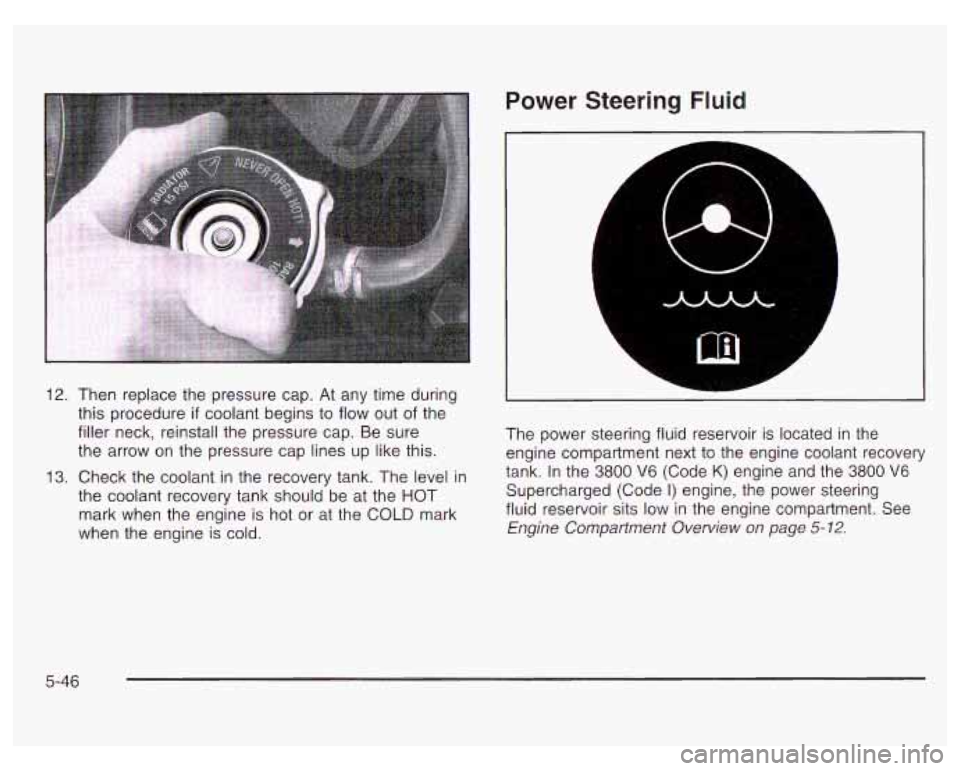
12. Then replace the pressure cap. At any time during
this procedure
if coolant begins to flow out of the
filler neck, reinstall the pressure cap. Be sure
the arrow on the pressure cap lines up like this.
13. Check the coolant in the recovery tank. The level in
the coolant recovery tank should be at the HOT
mark when the engine
is hot or at the COLD mark
when the engine is cold. The power
steering fluid reservoir is located in the
engine compartment next to the engine coolant recovery
tank. In the 3800 V6 (Code
K) engine and the 3800 V6
Supercharged (Code
I) engine, the power steering
fluid reservoir sits low in the engine compartment. See
Engine Compartment Overview on page
5- 12.
5-46
Page 272 of 378
When to Check Power Steering Fluid
It is not necessary to regularly check power steering fluid
unless you suspect there is a leak in the system or
you hear an unusual noise. A fluid loss in this system
couid indicate a problem. Have the system inspected
and repaired. See Engine Compartment Overview
on page
5-12 for reservoir location.
How to Check Power Steering Fluid
Turn the key off , let the engine compartment cool down,
wipe the cap and the top of the reservoir clean, then
unscrew the cap and wipe the dipstick with a clean rag.
Replace the cap and completely tighten it. Then remove
the cap again and look at the fluid level on the dipstick.
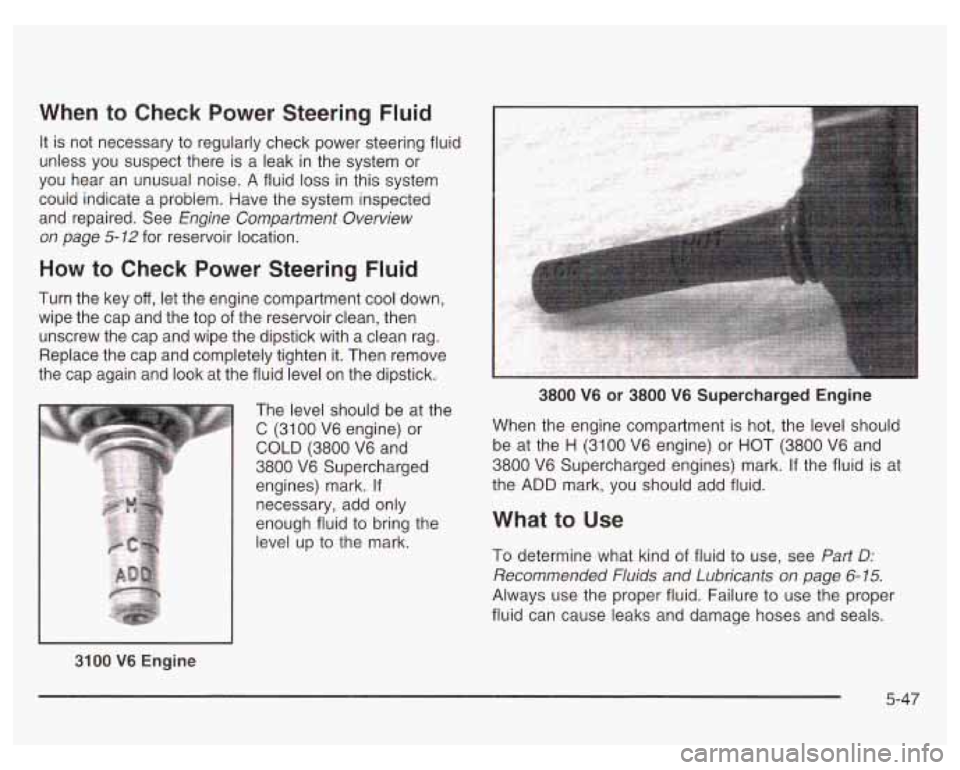
The level should be at the
C (3100 V6 engine)
or
COLD (3800 V6 and
3800 V6 Supercharged
engines) mark.
If
necessary, add only
enough fluid to bring the
level up to the mark.
3800 V6 or 3800 V6 Supercharged Engine
When the engine compartment is hot, the level should
be at the
H (3100 V6 engine) or HOT (3800 V6 and
3800 V6 Supercharged engines) mark.
If the fluid is at
the ADD mark, you should add fluid.
What to Use
To determine what kind of fluid to use, see Part D:
Recommended Fluids and Lubricants on page 6-15.
Always use the proper fluid. Failure to use the proper
fluid can cause leaks and damage hoses and seals.
3100 V6 Engine
5-47
Page 273 of 378
Windshield Washer Fluid
What to Use
When you need windshield washer fluid, be sure to read
the manufacturer’s instructions before use.
If you will be
operating your vehicle in an area where the temperature
may fall below freezing, use a fluid that has sufficient
protection against freezing. See
Engine Compartment
Overview on page 5-72 for reservoir location.
Adding Washer Fluid
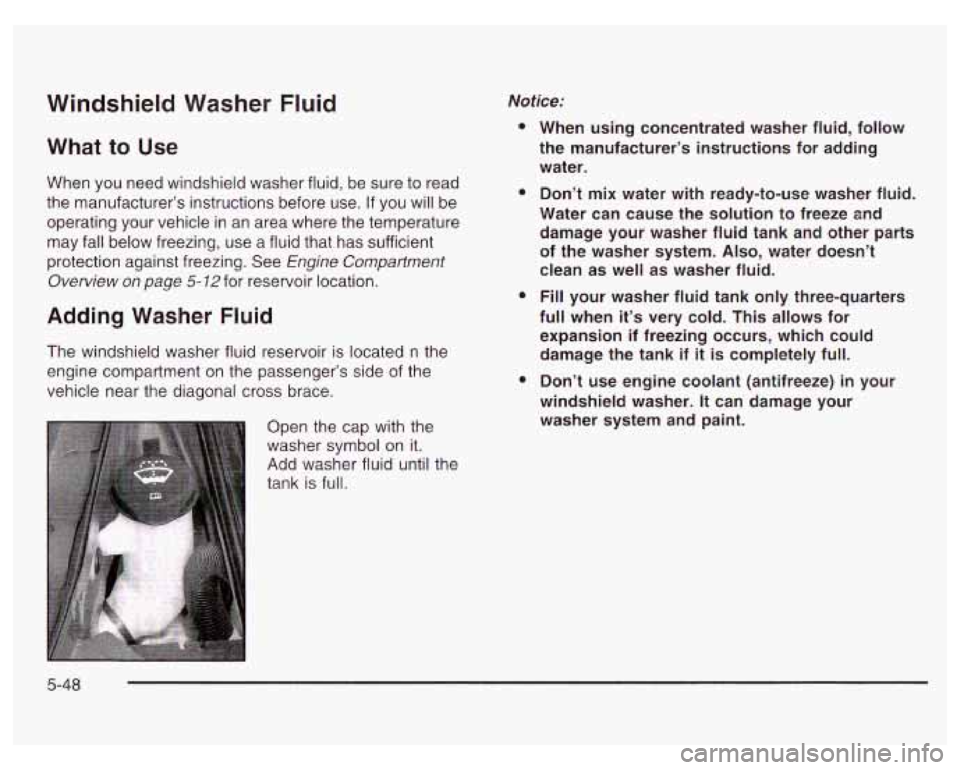
The windshield washer fluid reservoir is located n the
engine compartment on the passenger’s side of the
vehicle near the diagonal cross brace.
Open the cap with the
washer symbol on it.
Add washer fluid until the
tank is full.
Notice:
e
e
e
a
When using concentrated washer fluid, follow
the manufacturer’s instructions for adding
water.
Don’t mix water with ready-to-use washer fluid.
Water can cause the solution to freeze and
damage your washer fluid tank and other parts
of the washer system.
Also, water doesn’t
clean as well as washer fluid.
Fill your washer fluid tank only three-quarters
full when it’s very cold. This allows for
expansion if freezing occurs, which could damage the tank if
it is completely full.
Don’t use engine coolant (antifreeze) in your
windshield washer.
It can damage your
washer system and paint.
5-48
Page 274 of 378
Brakes
Brake Fluid
I
A L
r DOT3
7
L
normal brake lining wear. When new linings are put in,
the fluid level goes back up. The other reason
is
that fluid is leaking out of the brake system. If it is, you
should have your brake system fixed, since a leak
means that sooner
or later your brakes won’t work well,
or won’t work at all.
So, it isn’t a good idea to “top off’ your brake fluid.
Adding brake fluid won’t correct a leak. If you add fluid
when your linings are worn, then you’ll have too
much fluid when you get new brake linings. You should
add (or remove) brake fluid, as necessary, only when
work is done on the brake hydraulic system.
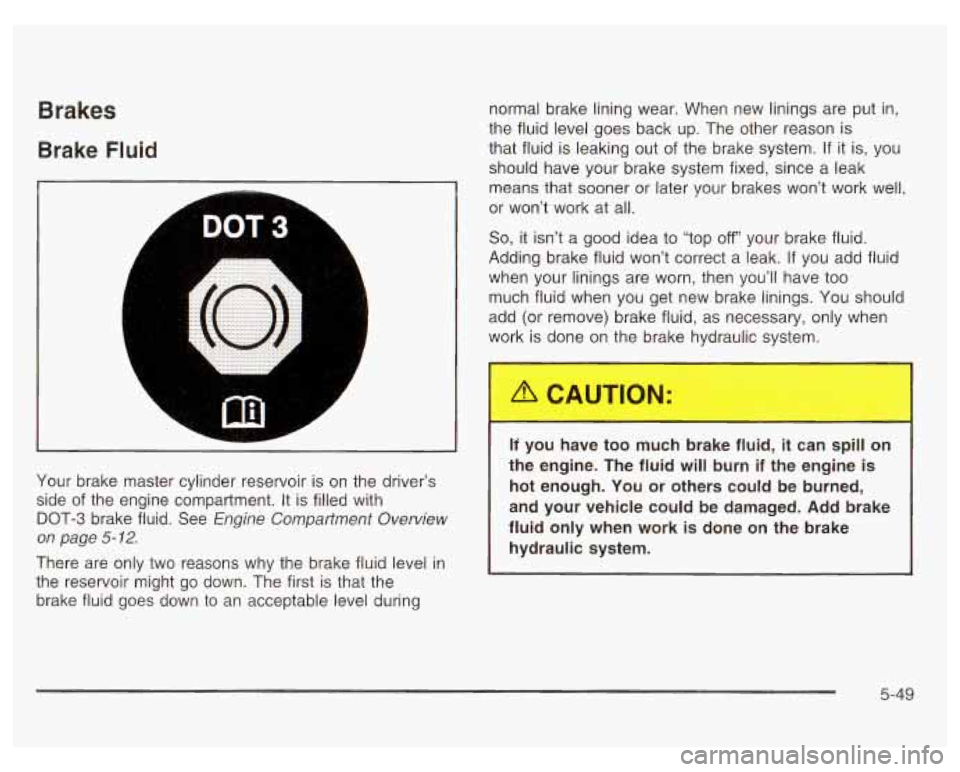
Your brake master cylinder reservoir is on the driver’s
side of the engine compartment. It is filled with
DOT-3 brake fluid. See Engine Compartment Overview
on page 5- 12.
There are only two reasons why the brake fluid level in
the reservoir might go down. The first is that the
brake fluid goes down
to an acceptable level during
If you have too much brake fluid, it can spill on
the engine. The fluid
will burn if the engine is
hot enough. You
or others could be burned,
and your vehicle could be damaged. Add brake
fluid only when work is done on the brake
hydraulic system.
5-49
Page 275 of 378
United States
~~
Canada
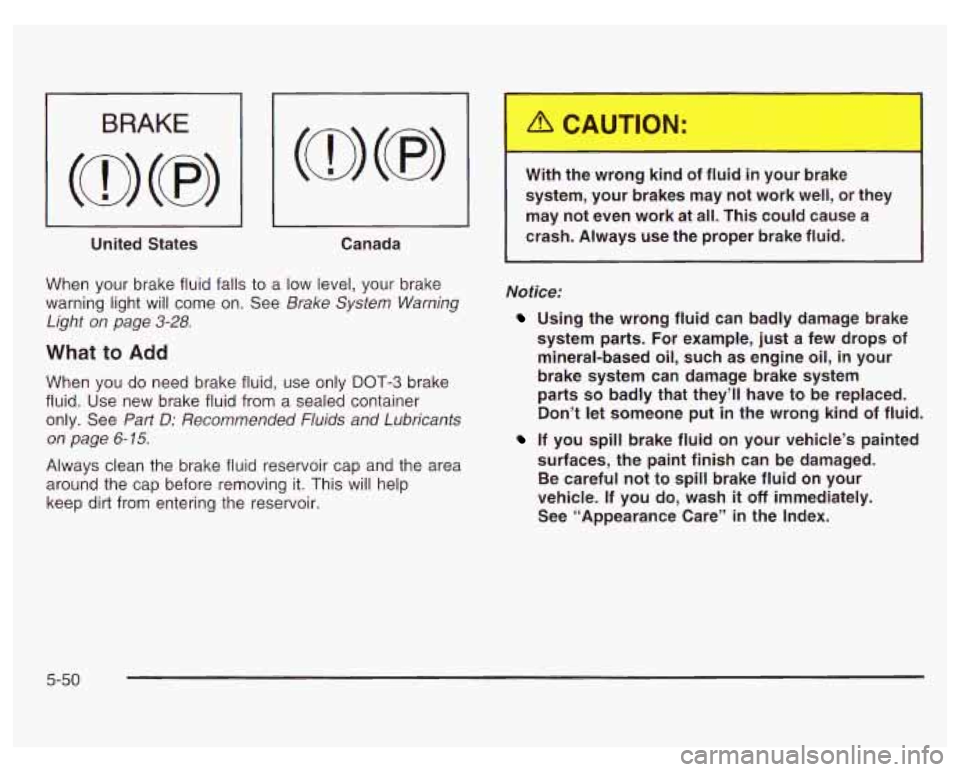
When your brake fluid falls to a low level, your brake
warning light will come on. See Brake System Warning
Light on page
3-28.
What to Add
When you do need brake fluid, use only DOT-3 brake
fluid. Use new brake fluid from a sealed container
only. See Part D: Recommended Fluids and Lubricants
on page
6- 15.
Always clean the brake fluid reservoir cap and the area
around the cap before removing it. This will help
keep
dirt from entering the reservoir.
r
With the wrong kind of fluid in your brake
system, your brakes may not work well, or they
may not even work at all. This could cause a
crash. Always
use the proper brake fluid.
Notice:
Using the wrong fluid can badly damage brake
system parts. For example, just a few drops of mineral-based oil, such as engine oil, in your
brake system can damage brake system
parts
so badly that they’ll have to be replaced.
Don’t let someone put in the wrong kind of fluid.
If you spill brake fluid on your vehicle’s painted
surfaces, the paint finish can be damaged.
Be careful not to spill brake fluid on your
vehicle. If you do, wash
it off immediately.
See “Appearance Care” in the Index.
5-50