engine PONTIAC GRAND PRIX 2003 Manual PDF
[x] Cancel search | Manufacturer: PONTIAC, Model Year: 2003, Model line: GRAND PRIX, Model: PONTIAC GRAND PRIX 2003Pages: 378, PDF Size: 17.64 MB
Page 245 of 378
I-
3100 . - Engine
A
A
*
SAE 1OW-30
m
I
3800 V6 or 3800 V6
Supercharged Engine
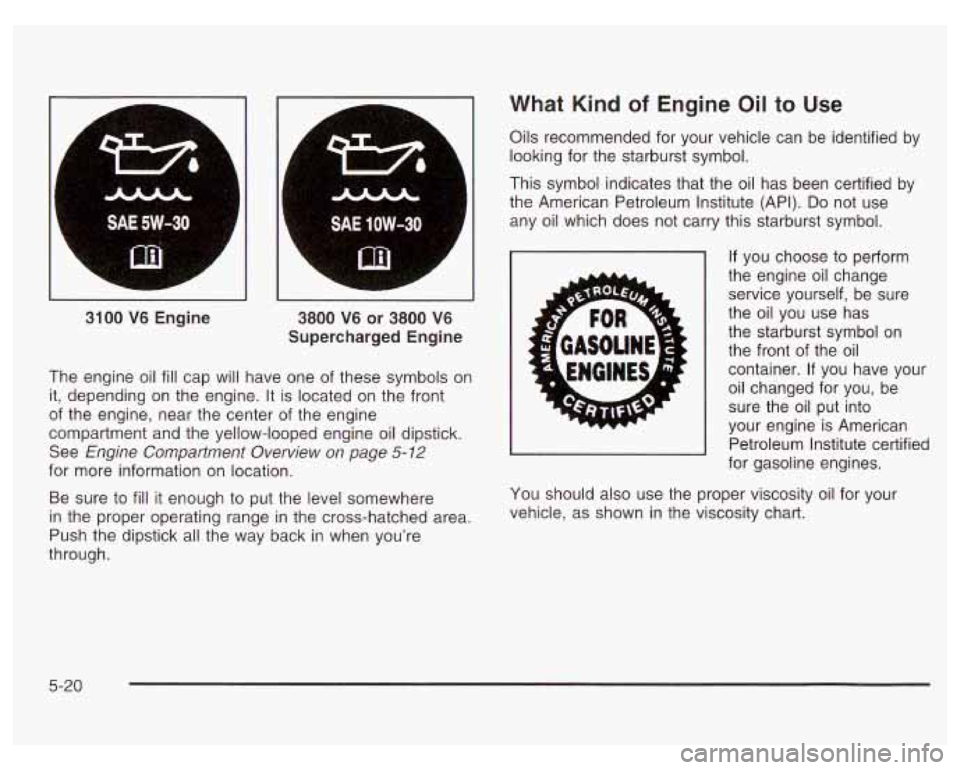
The engine oil fill cap will have one of these symbols on
it, depending on the engine. It is located on the front
of the engine, near the center of the engine
compartment and the yellow-looped engine oil dipstick.
See Engine Compartment Overview on page
5-12
for more information on location.
Be sure to
fill it enough to put the level somewhere
in the proper operating range in the cross-hatched area.
Push the dipstick
all the way back in when you're
through.
What Kind of Engine Oil to Use
Oils recommended for your vehicle can be identified by
looking for the starburst symbol.
This symbol indicates that the oil has been certified by
the American Petroleum Institute (API).
Do not use
any oil which does not carry this starburst symbol.
If you choose to perform
the engine oil change
service yourself, be sure
the oil you use has
the starburst symbol on
the front of the oil
container. If you have your
oil changed for you, be
sure the oil put into
your engine is American Petroleum Institute certified
for gasoline engines.
You should also use the proper viscosity oil for your
vehicle, as shown in the viscosity chart.
5-20
Page 246 of 378
RECOMMENDED SAE VISCOSITY GRADE ENGINE OILS
HOT
WEATHER
COLD
SAE S’W.
LOOK
FOR THIS
SYMBOL
.
1-11 SAE IOW-30 ACCEPTABLE r IF 5W-30 IS NOT -30 AVAILABLE
RECOMMENDED
WEATHER
DO NOT USE SAE 1OW-40, SAE 2OW-50 OR ANY OTHER VlSCOSlN GRADE OIL NOT RECOMMENDED
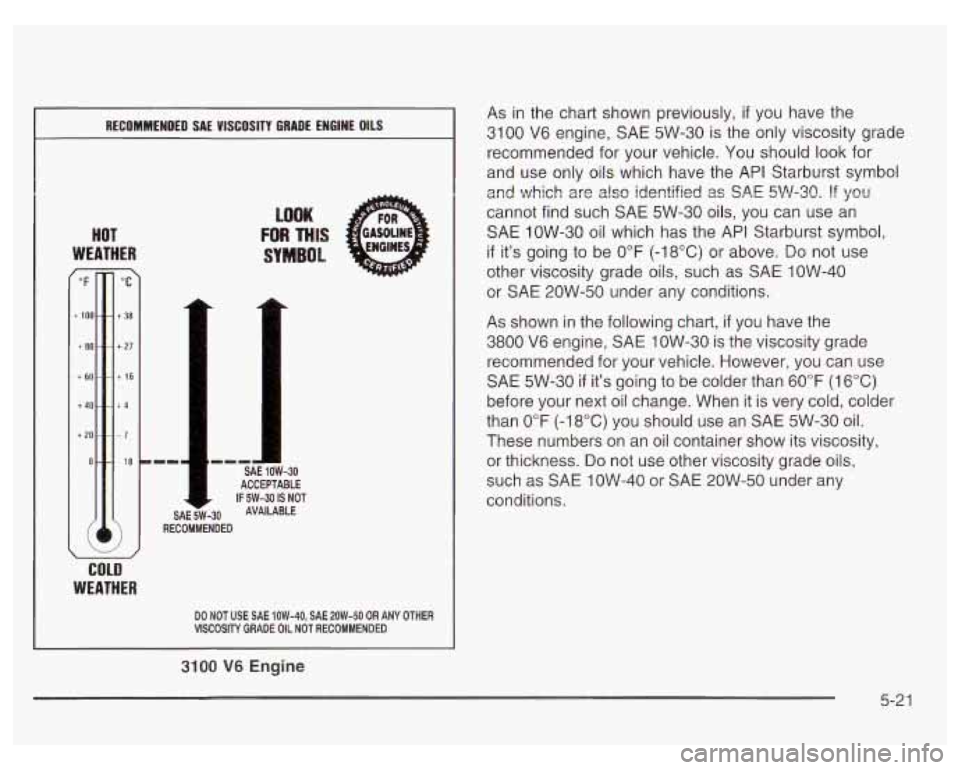
As in the chart shown previously, if you have the
3100 V6 engine, SAE 5W-30 is the only viscosity grade
recommended for your vehicle. You should look for
and use only oils which have the API Starburst symbol
and which are also identified as
SA€ 5W-30. If you
cannot find such SAE 5W-30 oils, you can use an
SAE IOW-30 oil which has the API Starburst symbol,
if it’s going to be 0°F (-18°C) or above. Do not use
other viscosity grade oils, such as SAE IOW-40
or SAE 20W-50 under any conditions.
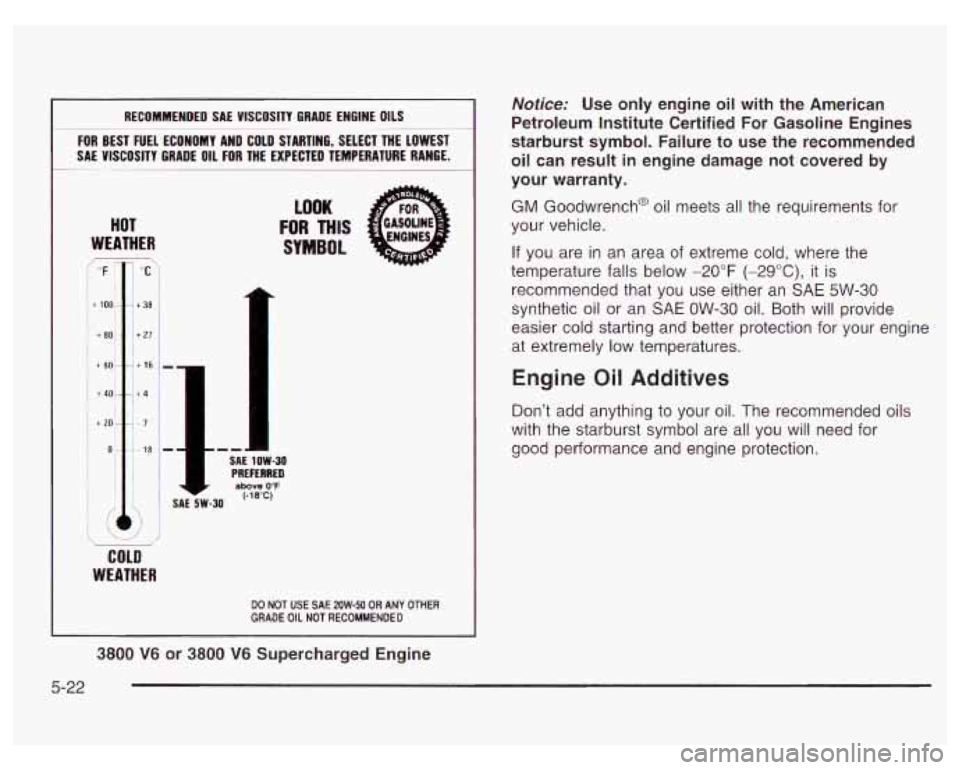
As shown in the following chart,
if you have the
3800 V6 engine, SAE IOW-30 is the viscosity grade
recommended for your vehicle. However, you can use
SAE 5W-30 if it’s going to be colder than 60°F (16°C)
before your next
oil change. When it is very cold, colder
than 0°F
(-1 8°C) you should use an SAE 5W-30 oil.
These numbers on an oil container show its viscosity,
or thickness.
Do not use other viscosity grade oils,
such as SAE 1
OW-40 or SAE 20W-50 under any
conditions.
3100 V6 Engine
5-2 1
Page 247 of 378
RECOMMENDED SAE VISCOSITY GRADE ENGINE OILS
FOR BEST FUEL ECONOMY AND COLD STARTING, SELECT THE LOWEST
SA€ VISCOSITY GRADE
OIL FOR THE EXPECTED TEMPERATURE RANGE.
~~~~ ~~~~~ ~~ -
HOT
WEATHER
SAE SW-30
LOOK
FOR THIS
SYMBOL
8- SAE I 1OW-30
PREFERRED above 0°F (-1 8°C)
Notice: Use only engine oil with the American
Petroleum Institute Certified For Gasoline Engines
starburst symbol. Failure to use the recommended
oil can result in engine damage not covered by
your warranty.
GM Goodwrench@ oil meets all the requirements for
your vehicle.
If you are in an area of extreme cold, where the
temperature falls below
-20°F (-29"C), it is
recommended that you use either an SAE
5W-30
synthetic oil or an SAE OW-30 oil. Both will provide
easier cold starting and better protection for your engine
at extremely low temperatures.
Engine Oil Additives
Don't add anything to your oil. The recommended oils
with the starburst symbol are
all you will need for
good performance and engine protection.
3800 V6 or 3800 V6 Supercharged Engine
5-22
Page 248 of 378
When to Change Engine Oil (GM Oil
Life SystemTM)
Your vehicle has a computer system that lets you know
when to change the engine
oil and filter. This is
based on engine revolutions and engine temperature,
and not on mileage. Based on driving conditions,
the mileage at which an oil change will be indicated
can vary considerably. For the oil life system to
work properly, you must reset the system every time
the oil is changed.
When the system has calculated that oil life has been
diminished, it will indicate that an oil change is
necessary.
A CHANGE OIL SOON light will come on.
Change your
oil as soon as possible within the next two
times you stop for fuel.
It is possible that, if you are
driving under the best conditions, the oil life system may
not indicate that an oil change is necessary for over a
year. However, your engine oil and filter must be
changed at least once a year and at this time the system
must be reset. It is also important to check your oil
regularly and keep it at the proper level.
If the system is ever reset accidentally, you must
change your oil at
3,000 miles (5 000 km) since your
last oil change. Remember
to reset the oil life system
whenever the oil is changed.
How to Reset the GM Oil Life System
The GM Oil Life SystemTM calculates when to change
your engine oil and filter based on vehicle use. Anytime
your oil is changed, reset the system
so it can calculate
when the next oil change is required.
If a situation occurs
where you change your oil prior to a CHANGE
OIL SOON
light being turned on, reset the system.
To reset the GM Oil Life SystemTM after the oil has
been changed, use one of the following two procedures:
Using the Driver Information Center (DIC)
1.
2.
3.
With the ignition key in RUN but the engine off, fully
push and release the accelerator pedal slowly three
times within five seconds.
If the CHANGE OIL SOON light flashes, the system
is resetting.
Turn the key to OFF after the light stops flashing,
then start the vehicle.
If the CHANGE OIL SOON light comes back on, the
engine oil life monitor has not reset. Repeat the
procedure.
Using the Trip Computer (If Equipped)
1. Press the MODE button until the light appears lit
2. Press and hold the RESET button for three seconds.
next to
OIL LIFE.
The
oil life percentage should change to 100%.
5-23
Page 249 of 378
What to Do with Used Oil
Used engine oil contains certain elements that may be
unhealthy for your skin and could even cause cancer.
Don't let used oil stay on your skin for very long. Clean
your skin and nails with soap and water, or a good
hand cleaner. Wash or properly dispose of clothing or
rags containing used engine oil. See the manufacturer's
warnings about the use and disposal of oil products.
Used oil can be a threat to the environment. If you
change your own oil, be sure to drain all the oil from the
filter before disposal. Never dispose of oil by putting it
in the trash, pouring it on the ground, into sewers, or into
streams or bodies of water. Instead, recycle it by
taking
it to a place that collects used oil. If you have a
problem properly disposing of your used oil, ask
your dealer, a service station or a local recycling
center for help.
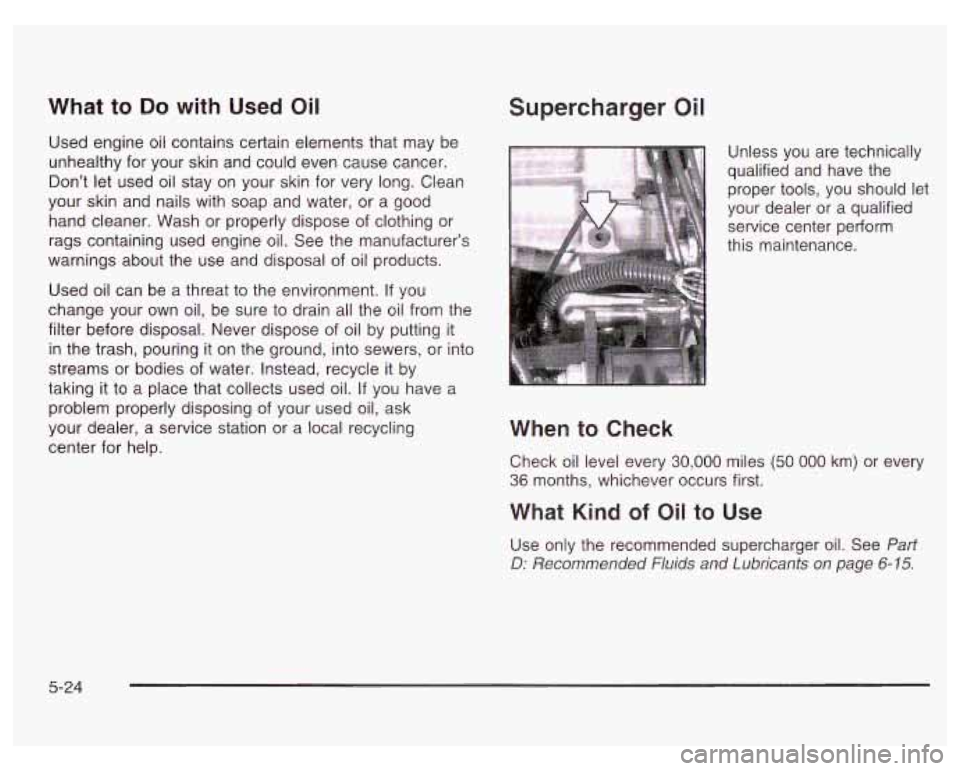
Supercharger Oil
Unless you are technically
qualified and have the
proper tools, you should let
your dealer or a qualified
service center perform
this maintenance.
When to Check
Check oil level every 30,000 miles (50 000 km) or every
36 months, whichever occurs first.
What Kind of Oil to Use
Use only the recommended supercharger oil. See Part
D: Recommended Fluids and Lubricants on page 6-15.
5-24
Page 250 of 378
How to Check and Add Oil
Park the vehicle on a level surface. Check oil only when
the engine is cold. Allow the engine to cool two to
three hours after running.
I
If you remove the supercharger oil fill plug
while the engine
is hot, pressure may cause
hot oil to blow out of the oil fill hole. You may
be burned. Do not remove the plug until the
engine
cools.
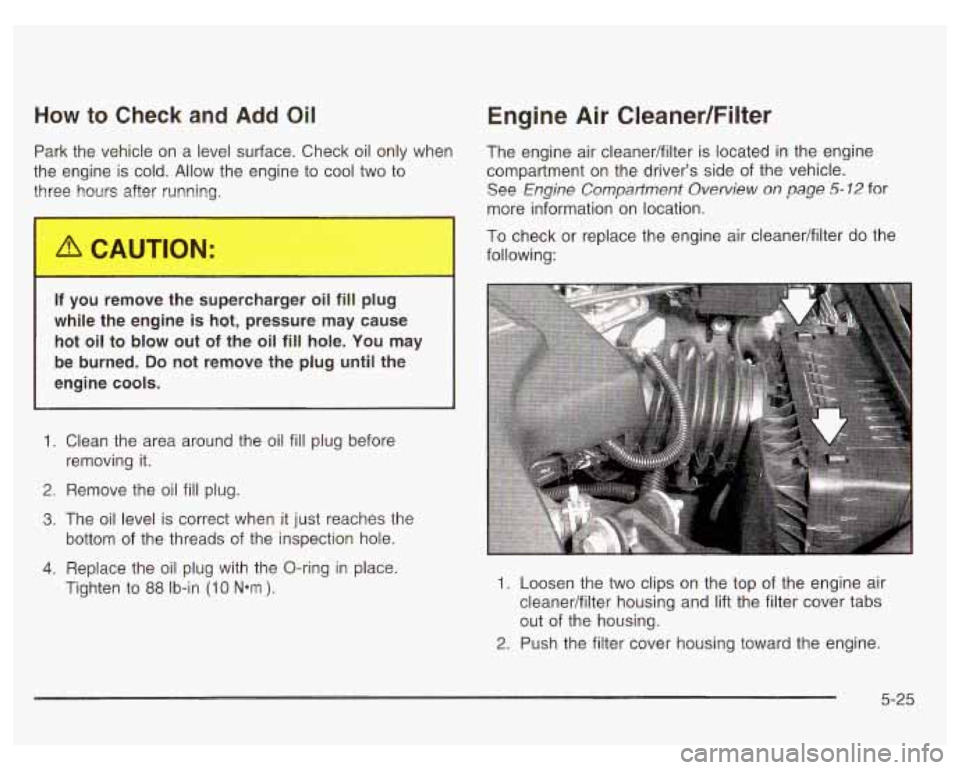
1. Clean the area around the oil fill plug before
removing it.
2. Remove the oil
fill plug.
3. The oil level is correct when it just reaches the
bottom of the threads of the inspection hole.
4. Replace the oil plug with the O-ring in place.
Tighten to
88 Ib-in (10 Nom ).
Engine Air Cleaner/Filter
The engine air cleanedfilter is located in the engine
compartment on the driver’s side of the vehicle.
See Engine Compartment Oven/iew on page 5-12 for
more information on location.
To check or replace the engine air cleanedfilter do the
following:
1. Loosen the two clips on the top of the engine air
cleaner/filter housing and lift the filter cover tabs
out of the housing.
2. Push the filter cover housing toward the engine.
5-25
Page 251 of 378
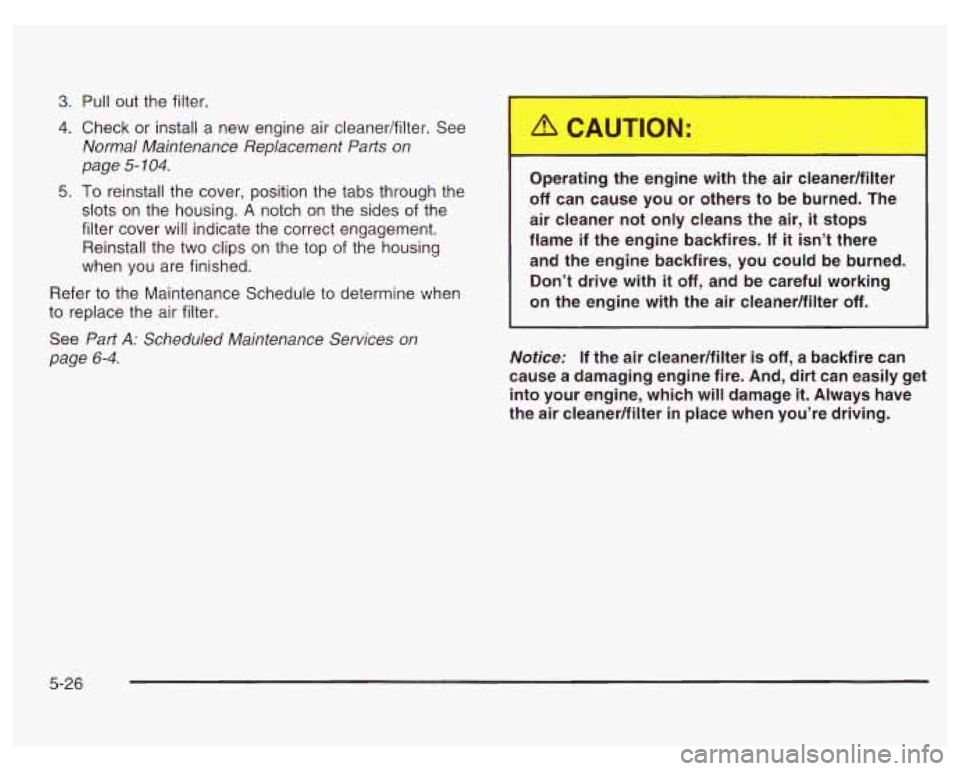
3. Pull out the filter.
4. Check or install a new engine air cleanerbiker. See
Normal Maintenance Replacement Parts on
page
5- 104.
5. To reinstall the cover, position the tabs through the
slots on the housing.
A notch on the sides of the
filter cover will indicate the correct engagement.
Reinstall the two clips on the top of the housing
when you are finished.
Refer to the Maintenance Schedule to determine when
to replace the air filter.
See Part A: Scheduled Maintenance Services on
page
6-4.
Operating t--. engine with the air cleaner/filter
off can cause you or others to be burned. The
air cleaner not only cleans the air,
it stops
flame if the engine backfires. If
it isn’t there
and the engine backfires, you could be burned. Don’t drive with
it off, and be careful working
on the engine with the air cleanedfilter
off.
Nofice: If the air cleaner/filter is off, a backfire can
cause a damaging engine fire. And, dirt can easily get
into your engine, which will damage
it. Always have
the air cleanedfilter in place when you’re driving.
5-26
Page 252 of 378
Automatic Transaxle Fluid
When to Check and Change
A good time to check your automatic transaxle fluid
level is when the engine oil is changed.
Change both the fluid and filter every 50,000 miles
(83
000 km) if the vehicle is mainly driven under one or
more of these conditions:
In heavy city traffic where the outside temperature
0 In hilly or mountainous terrain.
0 When doing frequent trailer towing.
0 Uses such as found in taxi, police or delivery service.
regularly reaches
90°F (32°C)
or higher.
If you do not use your vehicle under any of these
conditions, change the fluid and filter at
100,000 miles (166 000 km).
See Part
A: Scheduled Maintenance Services on
page
6-4.
How to Cheek
Because this operation can be a little difficult, you may
choose to have this done at the dealership service
department.
If you do it yourself, be sure to follow all the instructions
here, or you could get a false reading on the dipstick.
Nofice: Too much or too little fluid can damage
your transaxle.
Too much can mean that some of the
fluid could come out and fall on hot engine or
exhaust system parts, starting a fire.
Too little fluid
could cause the transaxle to overheat. Be sure
to get an accurate reading
if you check your
transaxle fluid.
Wait at least 30 minutes before checking the transaxle
fluid level
if you have been driving:
When outside temperatures are above
90°F (32°C).
At high speed for quite a while.
In heavy traffic
- especially in hot weather.
While pulling a trailer.
5-27
Page 253 of 378
To get the right reading, the fluid should be at normal
operating temperature, which is 180°F to 200°F
(82°C to 93°C).
Get the vehicle warmed up by driving about
15 miles
(24 km) when outside temperatures are above
50°F (1 0°C). If it's colder than 50°F (IO'C), you may
have to drive longer.
Checking the Fluid Level
Prepare your vehicle as follows:
Park your vehicle on a level place. Keep the engine
running.
With the parking brake applied, place the shift lever in
PARK (P).
With your foot on the brake pedal, move the shift
lever through each gear range, pausing for about
three seconds in each range. Then, position the shift
lever in PARK (P).
Let the engine run at idle for three to five minutes. Then,
without shutting
off the engine, follow these steps:
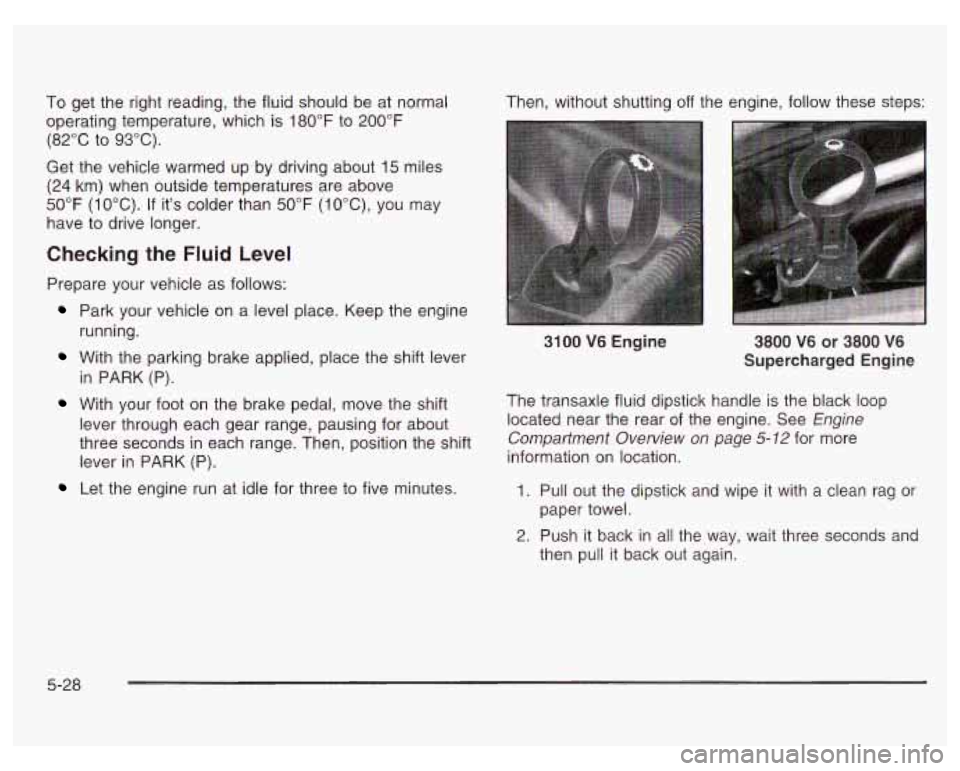
3100 V6 Engine 3800 V6 or 3800 V6
Supercharged Engine
The transaxle fluid dipstick handle is the black loop
located near the rear of the engine. See Engine
Comparfment Overview
on page 5-12 for more
information on location.
1. Pull out the dipstick and wipe it with a clean rag or
2. Push it back in all the way, wait three seconds and
paper
towel.
then pull it back out again.
5-28
Page 254 of 378
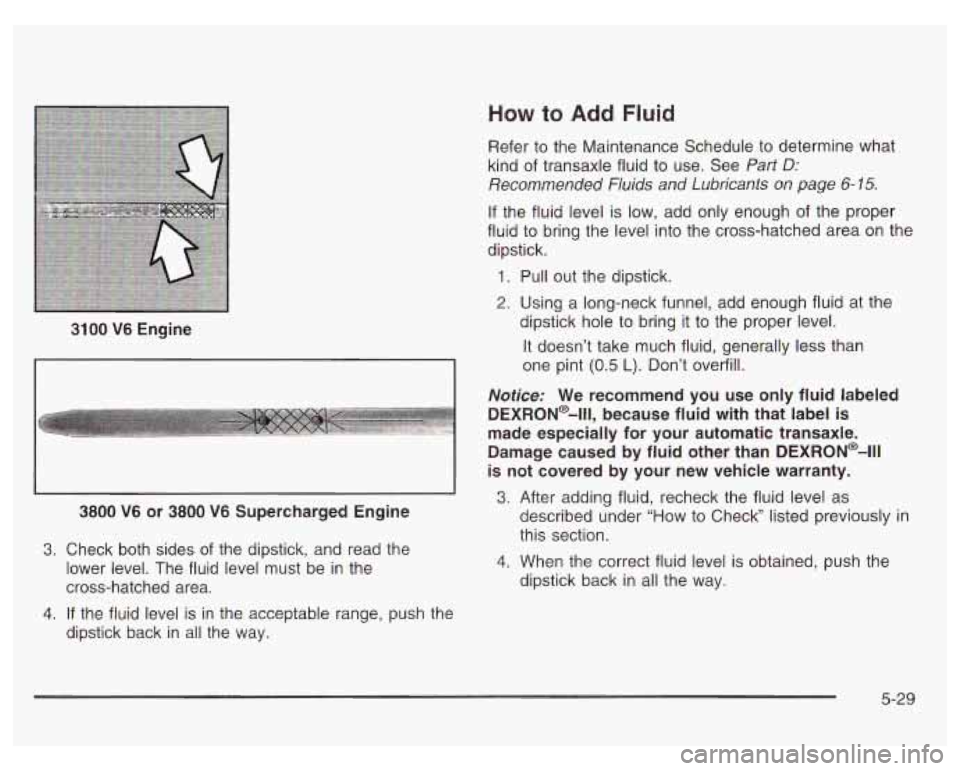
3100 V6 Engine
3.
4.
3800 V6 or 3800 V6 Supercharged Engine
Check both sides of the dipstick, and read the
lower level. The fluid level must be in the
cross-hatched area.
If the fluid level is in the acceptable range, push the
dipstick back in all the way.
How to Add Fluid
Refer to the Maintenance Schedule to determine what
kind of transaxle fluid to use. See Part
D:
Recommended Fluids and Lubricants on page 6-15.
If the fluid level is low, add only enough of the proper
fluid to bring the level into the cross-hatched area on the
dipstick.
1. Pull out the dipstick.
2. Using a long-neck funnel, add enough fluid at the
dipstick hole to bring it to the proper level.
It doesn’t take much fluid, generally less than
one pint
(0.5 L). Don’t overfill.
Notice: We recommend you use only fluid labeled
DEXRON@-Ill, because fluid with that label is
made especially for your automatic transaxle.
Damage caused by fluid other than DEXRON@-Ill
is not covered by your new vehicle warranty.
3.
4.
After adding fluid, recheck the fluid level as
described under “How to Check” listed previously in
this section.
When the correct fluid level is obtained, push the
dipstick back in all the way.
5-29