engine PONTIAC GRAND PRIX 2003 Owners Manual
[x] Cancel search | Manufacturer: PONTIAC, Model Year: 2003, Model line: GRAND PRIX, Model: PONTIAC GRAND PRIX 2003Pages: 378, PDF Size: 17.64 MB
Page 277 of 378
Replacing Brake System Parts
The braking system on a vehicle is complex. Its many
parts have to be of top quality and work well together
if
the vehicle is to have really good braking. Your
vehicle was designed and tested with top-quality
GM
brake parts. When you replace parts of your braking
system
- for example, when your brake linings
wear down and you need new ones put in
- be sure
you get new approved
GM replacement parts. If
you don’t, your brakes may no longer work properly.
For example,
if someone puts in brake linings that are
wrong for your vehicle, the balance between your
front and rear brakes can change
- for the worse.
The braking performance you’ve come to expect can
change in many other ways
if someone puts in the
wrong replacement brake parts.
Battery
Your new vehicle comes with a maintenance free
ACDelco@ battery. When it’s time for a new battery, get
one that has the replacement number shown on the
original battery’s label. We recommend an ACDelco@
battery. See Engine Compartment Overview on
page
5- 12 for battery location.
Warning: Battery posts, terminals and related
accessories contain lead and lead compounds,
chemicals known to the State of California to cause
cancer and reproductive harm. Wash hands after
handling.
If your battery has a very low charge or is dead, you
may not be able to remove the ignition key from
the ignition switch or shift out of Park (P). Refer to
Shifting Out of Park
(P) on page 2-30.
5-52
Page 279 of 378
Notice: If the other system isn’t a 12-volt system
with a negative ground, both vehicles can be
damaged.
1. Check the other vehicle. It must have a 12-volt
battery with a negative ground system.
2. Get the vehicles close enough so the jumper cables
can reach, but be sure the vehicles aren’t touching
each other. If they are, it could cause a ground
connection you don’t want. You wouldn’t be able to
start your vehicle, and the bad grounding could
damage the electrical systems.
To avoid the possibility of the vehicles rolling, set
the parking brake firmly on both vehicles involved in
the jump start procedure. Put an automatic
transaxle in PARK
(P) or a manual transaxle in
NEUTRAL before setting the parking brake.
Notice: If you leave your radio on, it could be badly
damaged. The repairs wouldn’t be covered by
your warranty.
3. Turn off the ignition on both vehicles. Unplug
unnecessary accessories plugged into the cigarette
lighter or in the accessory power outlet. Turn
off
the radio and all lamps that aren’t needed. This will
avoid sparks and help save both batteries. And it
could save your radio!
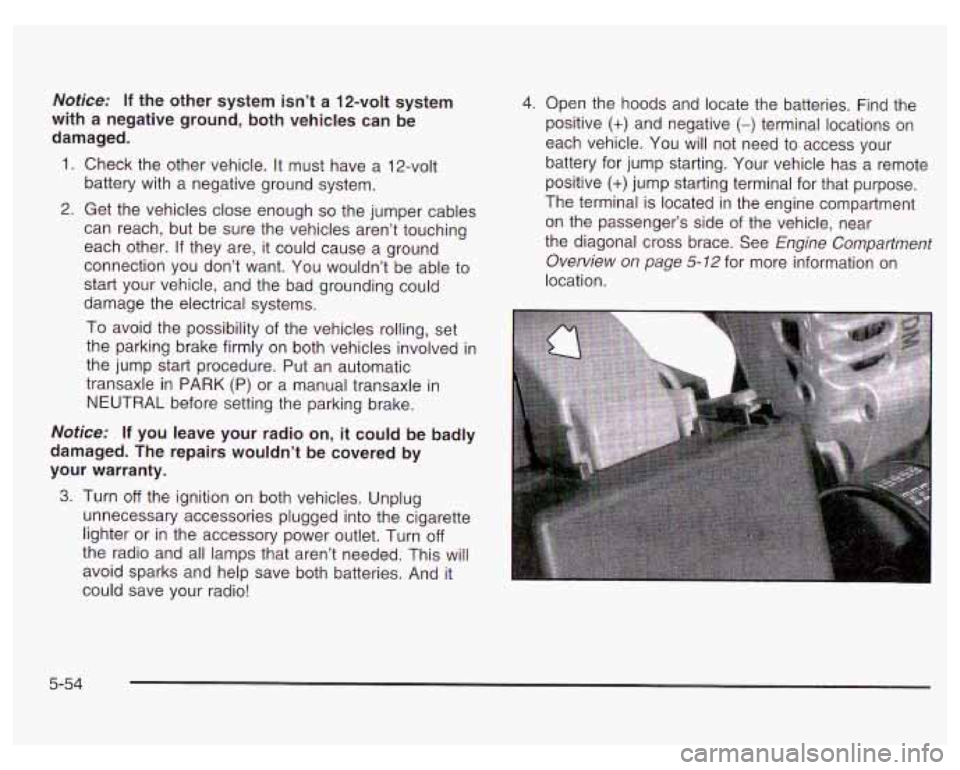
4. Open the hoods and locate the batteries. Find the
positive
(+) and negative (-) terminal locations on
each vehicle. You will not need to access your
battery for jump starting. Your vehicle has
a remote
positive
(+) jump starting terminal for that purpose.
The terminal is located in the engine compartment
on the passenger’s side of the vehicle, near
the diagonal cross brace. See Engine Compartment
Ovewiew
on page 5-72 for more information on
location.
5-54
Page 280 of 378
To uncover the remote positive (+) terminal, squeeze
the sides
of the plastic cap and slide the cap off.
You should always use the remote positive (+) terminal
instead
of the positive (+) terminal on the battery.
An electric fan can start up even when
rile
engine is not running and can injure you. Keep
hands, clothing and tools away from any
underhood electric fan.
Fans or other moving engine parts can injure
you badly. Keep your hands away from moving parts once the engine
is running.
I- -jng a ma I n r a battery can cause battery
gas to explode. People have been hurt doing
this, and some have been blinded. Use a
flashlight if you need more light.
Be sure the battery has enough water. You
don’t need to add water to the ACDelco@ battery installed in your new vehicle. But if a
battery has filler caps, be sure the right
amount of fluid is there. If
it is low, add water
to take care of that first. If you don’t, explosive gas could be present.
Battery fluid contains acid that can burn you.
Don’t get
it on you. If you accidentally get it in
your eyes or on your skin, flush the place with water and get medical help immediately.
5-55
Page 281 of 378
5. Check that the jumper cables don’t have loose or
missing insulation.
If they do, you could get a
shock. The vehicles could be damaged too. Don’t connect positive
(+) to
negative (-), or you’ll get a
short that would damage the battery and maybe
other parts, too. And don’t connect the negative
(-)
cable to the negative (-) terminal on the dead battery
because this can cause sparks.
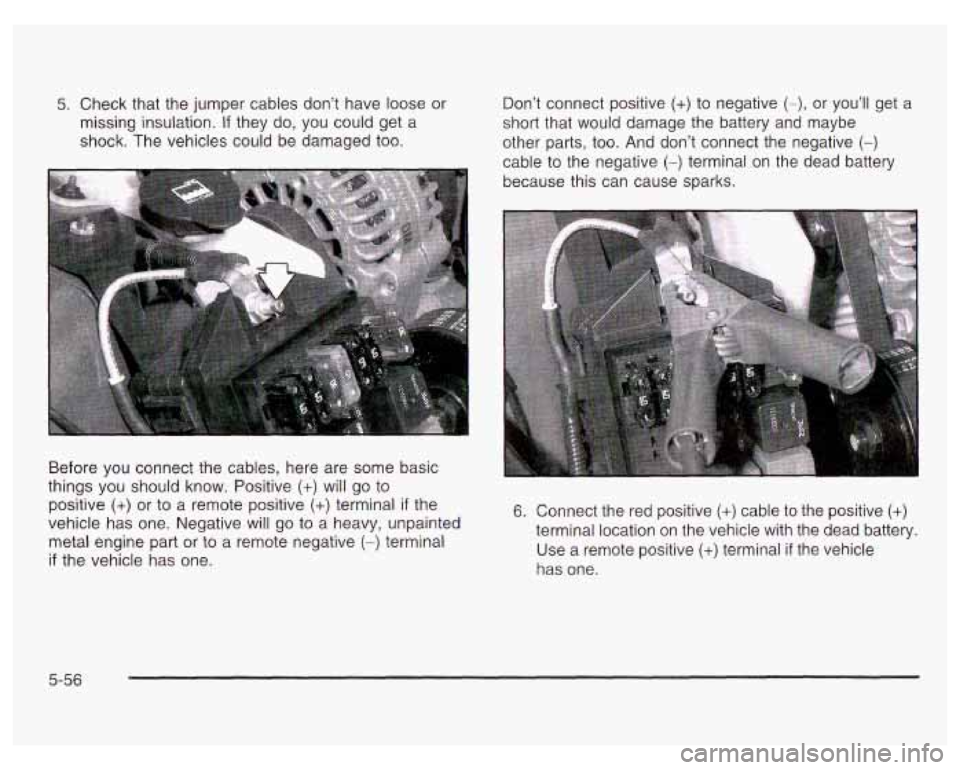
Before you connect the cables, here are some basic
things you should know. Positive
(+) will go to
positive
(+) or to a remote positive (+) terminal if the
vehicle has one. Negative will go to a heavy, unpainted
metal engine part or to a remote negative
(-) terminal
if the vehicle has one.
6. Connect the red positive (+) cable to the positive (+)
terminal location on the vehicle with the dead battery.
Use a remote positive
(+) terminal if the vehicle
has one.
5-56
Page 282 of 378

7. Don't let the other end
touch metal. Connect it
to the positive
(+)
terminal location on the
vehicle with the good
battery. Use a
remote positive
(+)
terminal if the vehicle
has one.
9. Don't let the other end touch anything until the next
step. The other end
of the negative (-) cable doesn't
go to the dead battery. It goes to a heavy, unpainted
metal part or to
a remote negative (c) terminal on the
vehicle with the dead battery.
8. Now connect the black
negative
(-) cable to
the negative
(-)
terminal location on the vehicle with the good
battery. Use a
remote negative
(-)
terminal if the vehicle
has one. 10. Connect the other end of the negative (-) cable at
least
18 inches (45 cm) away from the dead battery,
but not near engine parts that move. The electrical
connection is just
as good there, and the chance
of sparks getting back to the battery is much less.
5-57
Page 283 of 378
11. Now start the vehicle with the good battery and run
the engine for a while.
12. Try to start the vehicle that had the dead battery.
If
it won’t start after a few tries, it probably needs
service.
Notice: Damage to your vehicle may result from
electrical shorting
if jumper cables are removed
incorrectly. To prevent electrical shorting, take care
that the cables don’t touch each other or any
other metal. The repairs wouldn’t be covered by
your warranty.
I
w
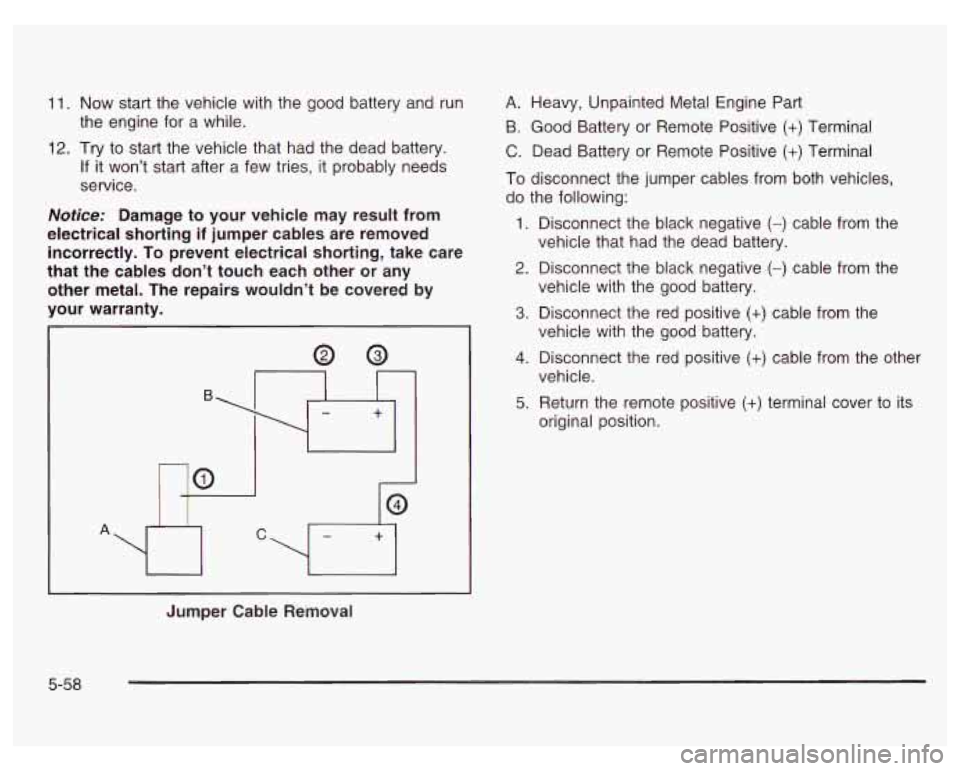
A. Heavy, Unpainted Metal Engine Part
B. Good Battery or Remote Positive
(+) Terminal
C. Dead Battery or Remote Positive (+) Terminal
To disconnect the jumper cables from both vehicles,
do the following:
1. Disconnect the black negative (-) cable from the
vehicle that had the dead battery.
2. Disconnect the black negative (-) cable from the
vehicle with the good battery.
3. Disconnect the red positive (+) cable from the
vehicle with the good battery.
4. Disconnect the red positive (+) cable from the other
vehicle.
5. Return the remote positive (+) terminal cover to its
original position.
Jumper Cable Removal
5-58
Page 301 of 378
If a Tire Goes Flat
It’s unusual for a tire to “blow out” while you’re driving,
especially
if you maintain your tires properly. If air
goes out of a tire, it’s much more likely
to leak out
slowly. But
if you should ever have a “blowout”, here are
a few tips about what to expect and what to do:
If a front tire fails, the flat tire will create a drag that
pulls the vehicle toward that side. Take your foot
off the
accelerator pedal and grip the steering wheel firmly.
Steer to maintain lane position, and then gently brake to
a stop well out of the traffic lane.
A rear blowout, particularly on a curve, acts much like a
skid and may require the same correction you’d use
in a skid. In any rear blowout, remove your foot from the
accelerator pedal. Get the vehicle under control by
steering the way you want the vehicle to go.
It may be
very bumpy and noisy, but you can still steer. Gently
brake to a stop
- well off the road if possible.
If a tire goes flat, the next part shows how to use your
jacking equipment to change a flat tire safely.
Changing a Flat Tire
If a tire goes flat, avoid further tire and wheel damage
by driving slowly to a level place. Turn
on your
hazard warning flashers.
I
Chant_ g a tire can cause an injury. The v icle
can slip
off the jack and roll over you or other
people.
You and they could be badly injured.
Find a level place to change your tire. To help
prevent the vehicle from moving:
1. Set the parking brake firmly.
2. Put the shift lever in PARK (P).
3. Turn off the engine.
To be even more certain the vehicle won’t move, you can put blocks at the front and
rear of the tire farthest away from
the one
being changed. That would be the tire on
the other side of the vehicle, at the
opposite end.
5-76
Page 321 of 378
Vehicle Identification
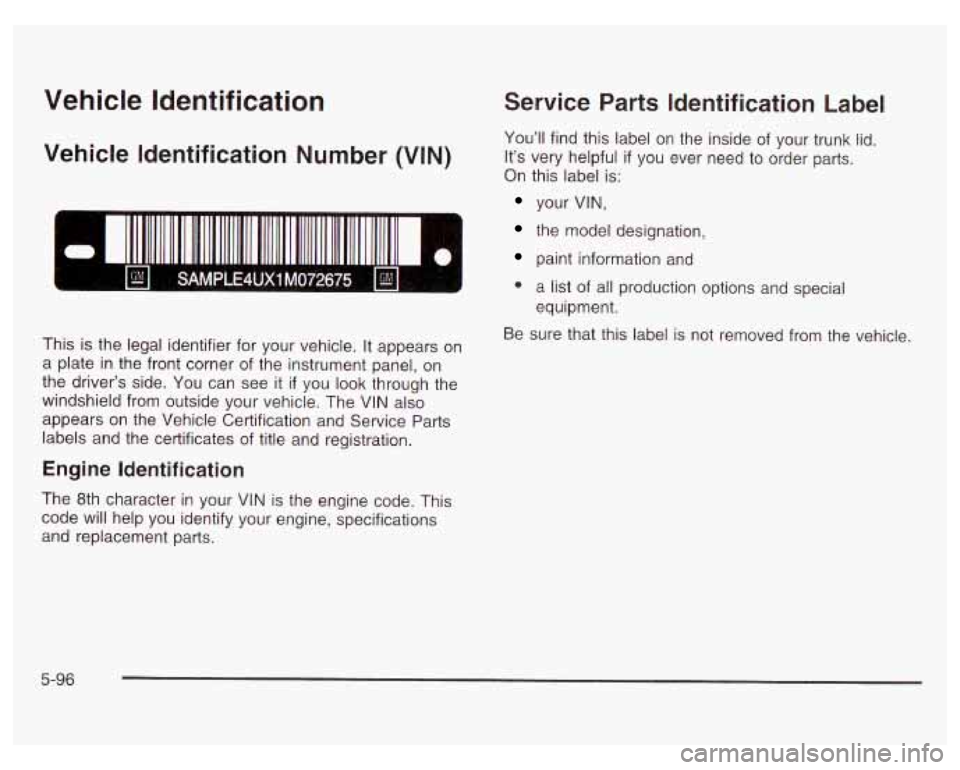
Vehicle Identification Number (VIN)
This is the legal identifier for your vehicle. It appears on
a plate
in the front corner of the instrument panel, on
the driver’s side. You can see it
if you look through the
windshield from outside your vehicle. The
VIN also
appears on the Vehicle Certification and Service Parts
labels and the certificates of title and registration.
Engine Identification
Service Parts Identification Label
You’ll find this label on the inside of your trunk lid.
It’s very helpful
if you ever need to order parts.
On this label is:
your VIN,
the model designation,
paint information and
a list of all production options and special
equipment.
Be sure that this label is not removed from the vehicle.
The 8th character in your
VIN is the engine code. This
code will help you identify your engine, specifications
and replacement parts.
5-96
Page 328 of 378
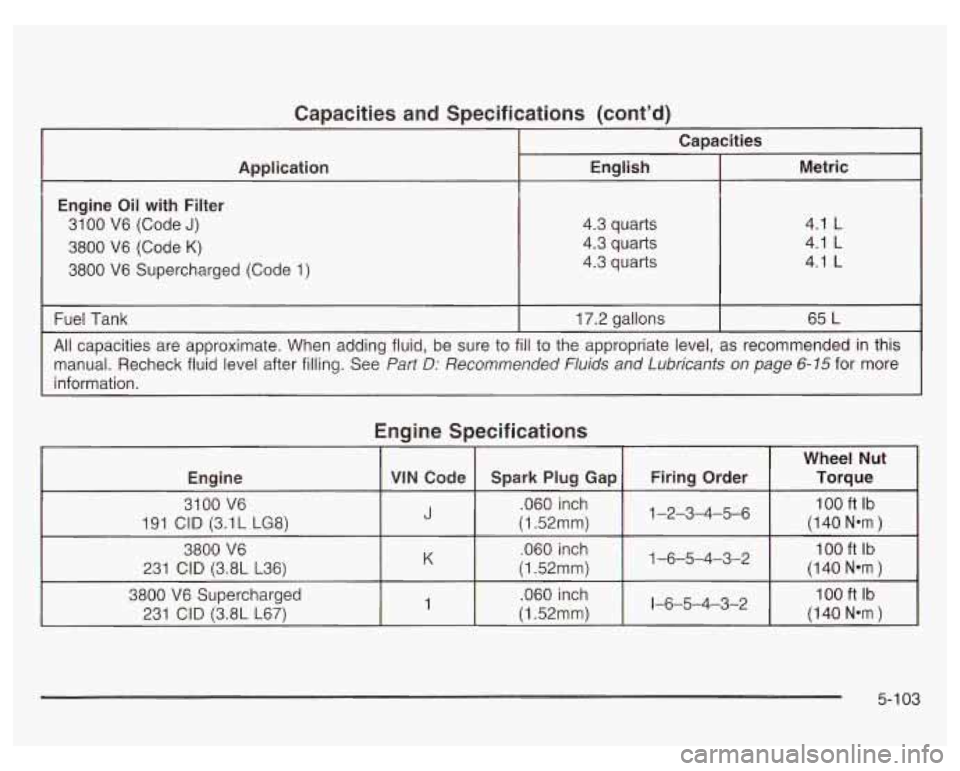
Capacities and Specifications (cont’d)
T
Application
Engine Oil with Filter
31 00 V6 (Code J)
3800 V6 (Code K)
3800 V6 Supercharged (Code 1)
Capacities
English
4.3 quarts
4.3 quarts
4.3 quarts
Metric
4.1 L
4.1 L
4.1 L
Fuel Tank
All capacities are approximate. When adding fluid, be sure to fill to the appropriate level, as recommended in this
manual. Recheck fluid level after filling. See
Pad D: Recommended Nuids and Lubricants on page 6-75 for more
information.
I 17.2 gallons 65 L
Engine Specifications
Wheel Nut
Engine Torque
Firing Order
Spark
Plug Gap VIN Code
3100 V6 J .060 inch 100 ft Ib
191
CID (3.1L LG8) (1.52mm) 1-2-3-4-5-6
(140 Nmm )
1-6-5-4-3-2
5-1 03
Page 330 of 378
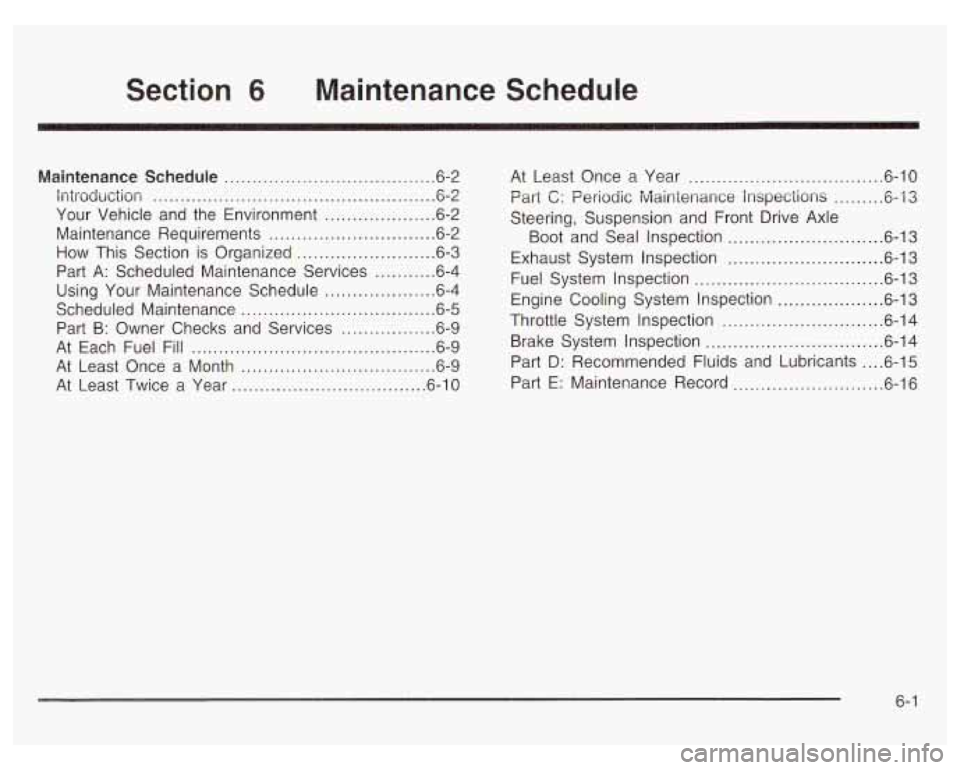
Section 6 Maintenance Schedule
Maintenance Schedule ...................................... 6-2
Introduction
................................................... 6-2
Your Vehicle and the Environment
.................... 6-2
Maintenance Requirements
.............................. 6-2
How This Section is Organized
......................... 6-3
Part A: Scheduled Maintenance Services
........... 6-4
Using Your Maintenance Schedule
.................... 6.4
Scheduled Maintenance
.................. ......... 6.5
Part B: Owner Checks and Services
.... ..... 6.9
At Each Fuel Fill
........................................ 6-9
At Least Once a Month
................................... 6.9
At Least Twice a Year
................................... 6.10 At
Least Once a Year
................................... 6.10
Pari C: Periodic
Maintenance inspections ......... 6.13
Steering, Suspension and Front Drive Axle
Boot and Seal Inspection
............................ 6-13
Exhaust System Inspection
............................ 6.13
Fuel System Inspection
.................................. 6.13
Engine Cooling System Inspection
................... 6.13
Throttle System Inspection
............................ -6-14
Brake System Inspection
................................ 6.14
Part D: Recommended Fluids and Lubricants
.... 6-15
Part
E: Maintenance Record ........................... 6.16
6- 1