PONTIAC GRAND PRIX 2003 Repair Manual
GRAND PRIX 2003
PONTIAC
PONTIAC
https://www.carmanualsonline.info/img/50/40843/w960_40843-0.png
PONTIAC GRAND PRIX 2003 Repair Manual
Page 231 of 378
California Fuel Additives
If
your vehicle is certified to meet California Emission
Standards (see the underhood emission control label),
it is designed to operate on fuels that meet California
specifications. If this fuel is not available in states
adopting California emissions standards, your vehicle
will operate satisfactorily on fuels meeting federal
specifications, but emission control system performance
may be affected. The malfunction indicator lamp may
turn on (see Malfunction Indicator
Lamp on page 3-32)
and your vehicle may fail a smog-check test. If this
occurs, return to your authorized
GM dealer for
diagnosis. If it is determined that the condition is caused
by the type of fuel used, repairs may not be covered
by your warranty. To
provide cleaner air, all gasolines in the United States
are now required
to contain additives that will help
prevent engine and fuel system deposits from forming,
allowing your emission control system to work
properly. You should not have to add anything to your
fuel. Gasolines containing oxygenates, such as
ethers and ethanol, and reformulated gasolines may be
available in your area to contribute to clean air.
General Motors recommends that you use these
gasolines, particularly
if they comply with the
specifications described earlier.
Notice: Your vehicle was not designed for fuel that
contains methanol. Don’t use fuel containing
methanol. It can corrode metal parts in your fuel
system and also damage the plastic and rubber
parts. That damage wouldn’t be covered under your
warranty.
5-6
Page 235 of 378
Checking Things Under
the
Hood
Ar. Jectric fan unl,.' the hood can start up
and injure you even when the engine is not
running. Keep hands, clothing and tools away
from any underhood electric fan.
Hood Release
To open the hood do the following:
Things that burn can get on ..__ -.. 3"'- parts
and start
a fire. These include liquids like fuel,
oil, coolant, brake fluid, windshield washer and
other fluids, and plastic or rubber. You or
others could be burned. Be careful not to drop
or spill things that
will burn onto a hot engine.
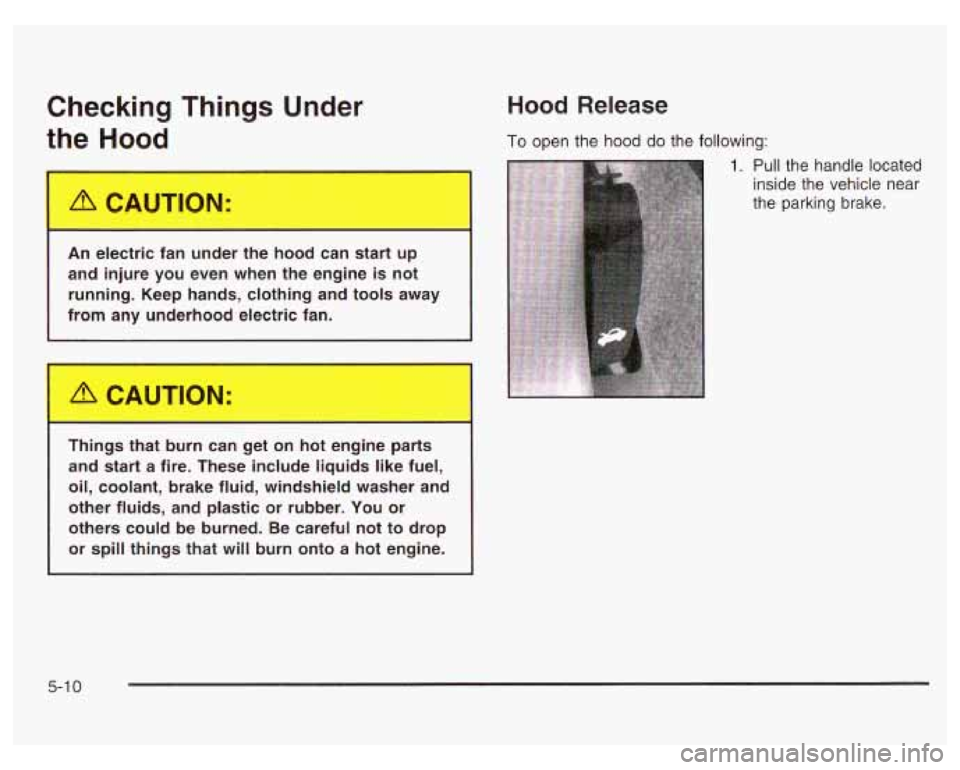
1. Pull the handle located
inside the vehicle near
the parking brake.
5-1 0
Page 237 of 378
Engine Compartment Overview
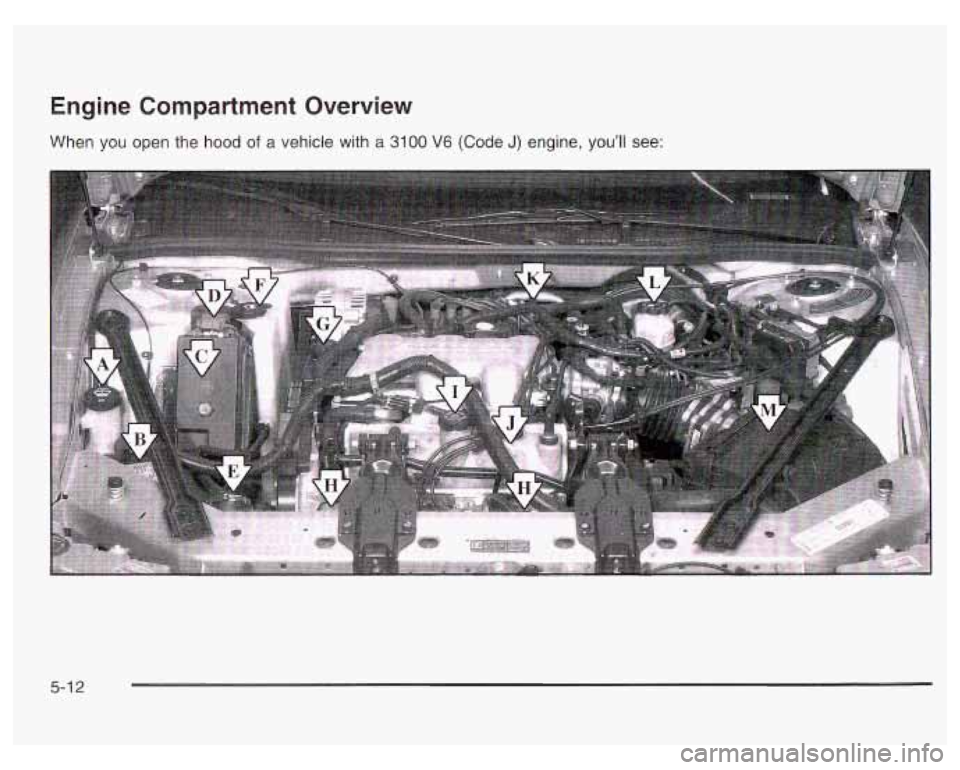
When you open the hood of a vehicle with a 3100 V6 (Code J) engine, you’ll see:
5-1 2
Page 238 of 378
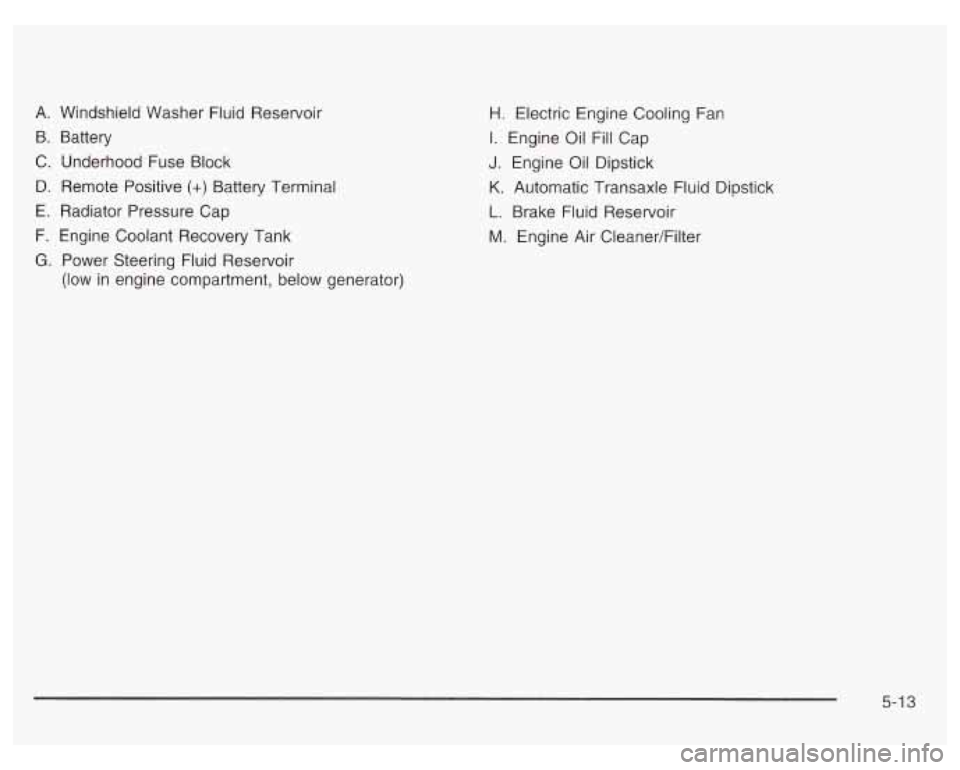
A. Windshield Washer Fluid Reservoir
B. Battery
C. Underhood Fuse Block
B. Remote Positive (+) Battery Terminal
E. Radiator Pressure Cap
F. Engine Coolant Recovery Tank
G. Power Steering Fluid Reservoir
(low in engine compartment, below generator)
H. Electric Engine Cooling Fan
I. Engine Oil Fill Cap
J. Engine Oil Dipstick
K. Automatic Transaxle Fluid Dipstick
L. Brake Fluid Reservoir
M. Engine Air CleanedFilter
5-1 3
Page 239 of 378
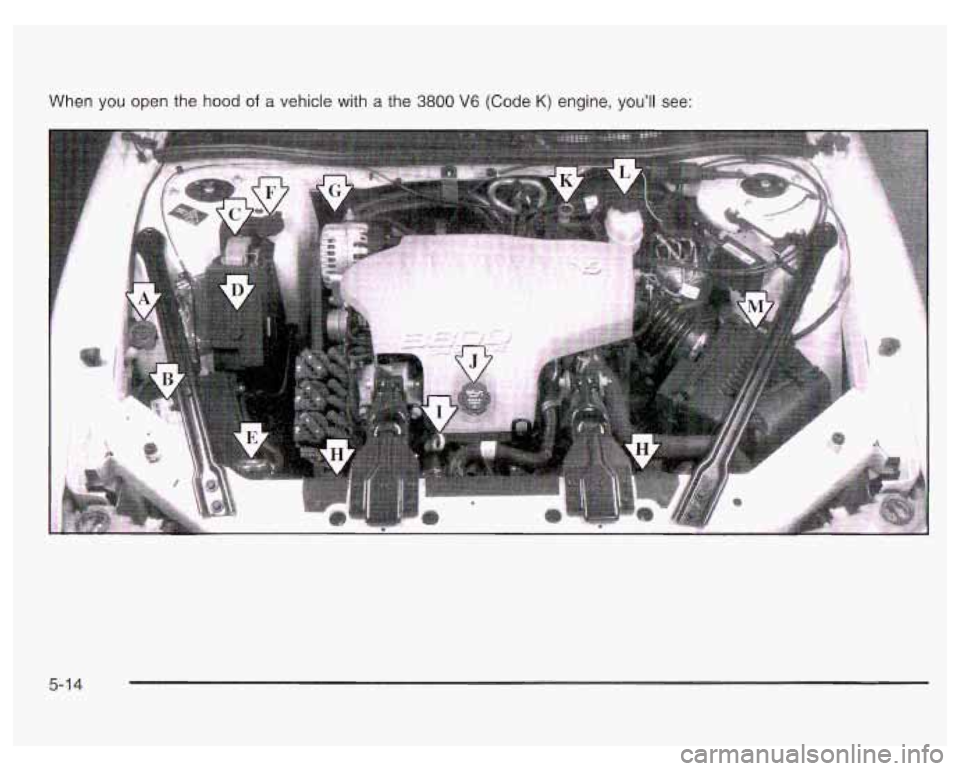
When you open the hood of a vehicle with a the 3800 V6 (Code K) engine, you’ll see:
5-1 4
Page 240 of 378
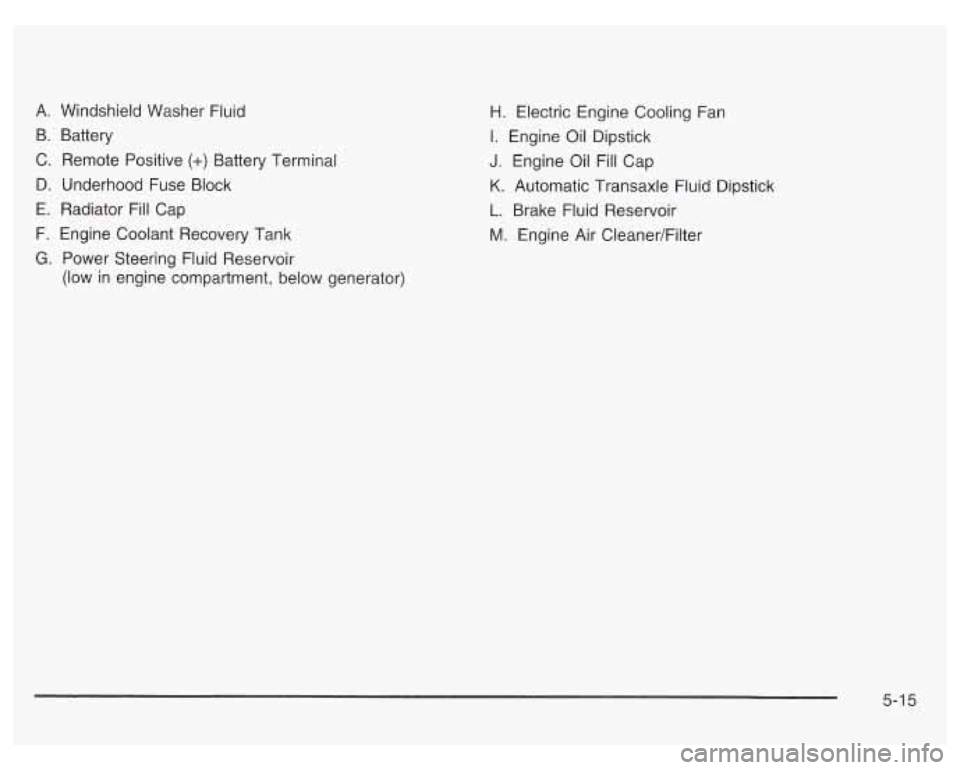
A. Windshield Washer Fluid
B. Battery
C. Remote Positive
(+) Battery Terminal
D. Underhood Fuse Block
E. Radiator Fill Cap
F. Engine Coolant Recovery Tank
G. Power Steering Fluid Reservoir
(low in engine compartment, below generator)
H. Electric Engine Cooling Fan
I. Engine Oil Dipstick
J. Engine Oil Fill Cap
K. Automatic Transaxle Fluid Dipstick
1. Brake Fluid Reservoir
M. Engine Air CleanedFilter
5-1 5
Page 241 of 378
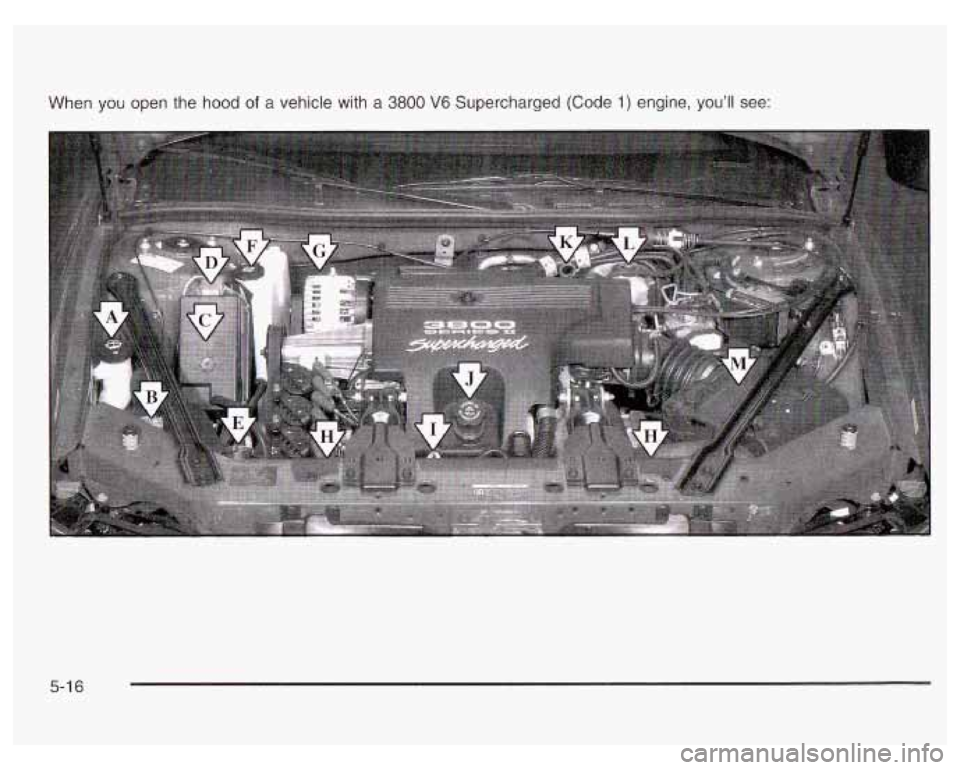
When you open the hood of a vehicle with a 3800 V6 Supercharged (Code 1) engine, you’ll see:
5-1 6
Page 242 of 378
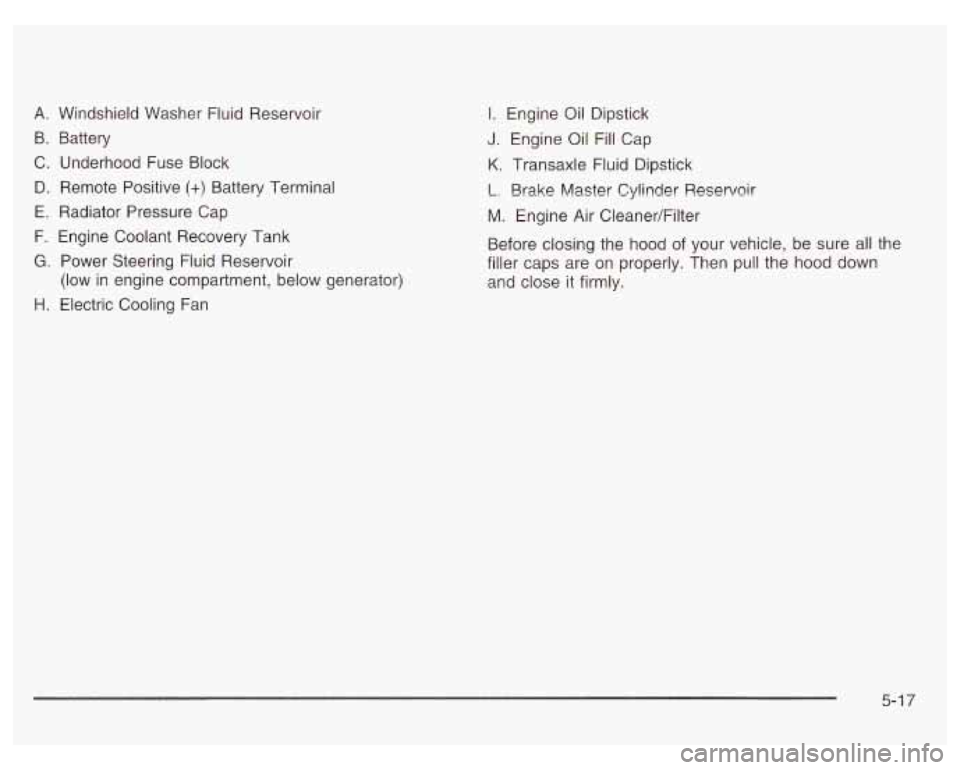
A. Windshield Washer Fluid Reservoir
B. Battery
C. Underhood Fuse Block D. Remote Positive
(+) Battery Terminal
E. Radiator Pressure Cap
F. Engine Coolant Recovery Tank
G. Power Steering Fluid Reservoir
H. Electric Cooling Fan
(low
in engine compartment, below generator)
I. Engine Oil Dipstick
J. Engine Oil Fill Cap
K. Transaxle Fluid Dipstick
L. Brake Master Cylinder Reservoir
M. Engine Air CleanedFilter
Before closing the hood
of your vehicle, be sure all the
filler caps are on properly. Then pull the
hood down
and close it firmly.
5-1 7
Page 243 of 378
Engine Oil
If the LOW OIL LEVEL
light appears on the
instrument cluster, it
means you need to
check your engine oil
level right away.
LOW OIL
LEVEL
For more information, see Low Oil Level Light on
page
3-36.
Checking Engine Oil
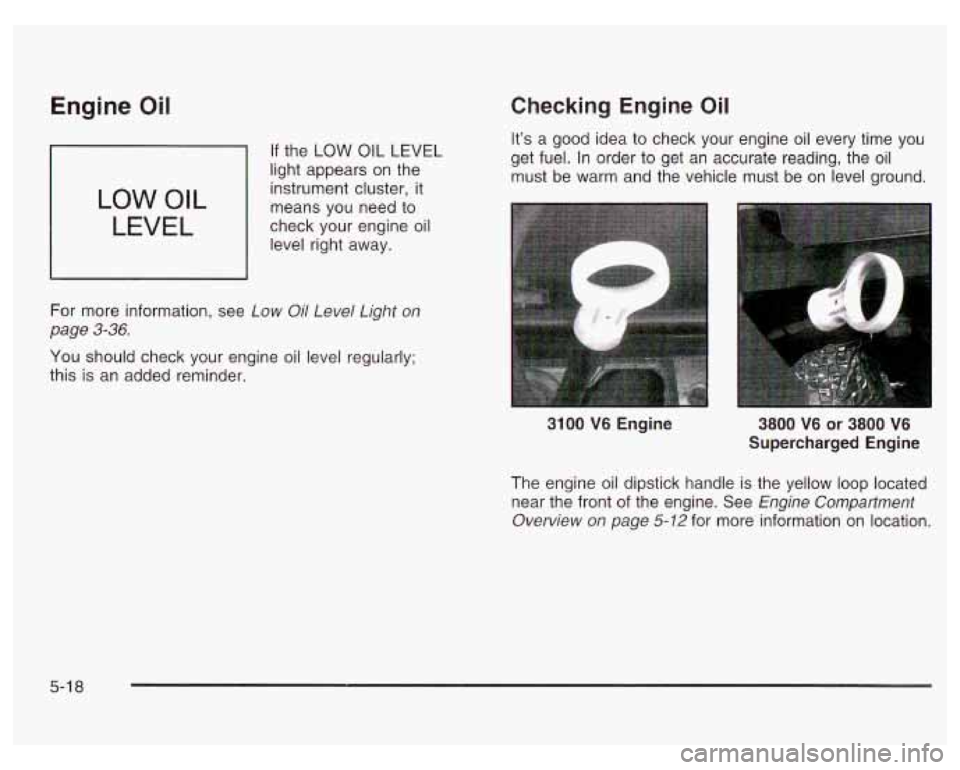
It’s a good idea to check your engine oil every time you
get fuel. In order to get an accurate reading, the oil
must be warm and the vehicle must be on level ground.
You should check your engine oil level regularly;
this is an added reminder.
3100 V6 Engine
3800 V6 or 3800 V6
Supercharged Engine
The engine oil dipstick handle is the yellow loop located
near the front of the engine. See Engine Comparfment
Overview on page
5-12 for more information on location.
5-1 8
Page 244 of 378
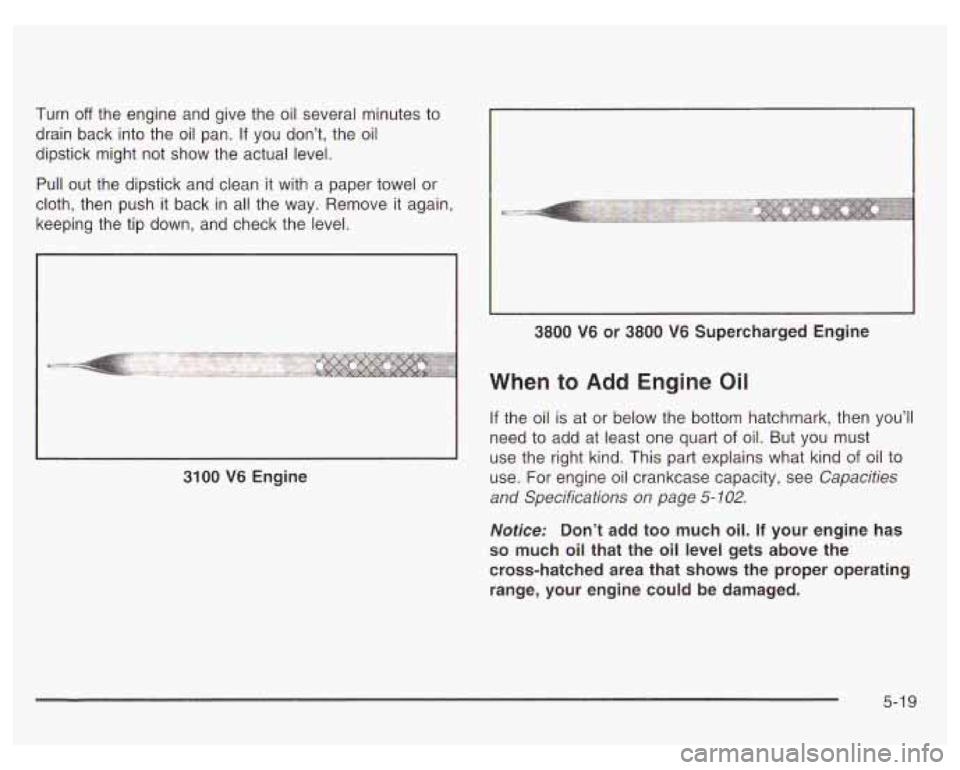
Turn off the engine and give the oil several minutes to
drain back into the oil pan. If you don’t, the oil
dipstick might not show the actual level.
Pull out the dipstick and clean it with a paper towel or
cloth, then push it back in all the way. Remove it again,
keeping the tip down, and check the level.
3100 V6 Engine 3800
V6 or 3800 V6 Supercharged Engine
When to Add Engine Oil
If the oil is at or below the bottom hatchmark, then you’ll
need
to add at least one quart of oil. But you must
use the right kind. This part explains what kind
of oil to
use. For engine oil crankcase capacity, see Capacities
and Specifications on page 5- 102.
Nofice: Don’t add too much oil. If your engine has
so much oil that the oil level gets above the
cross-hatched area that shows the proper operating range, your engine could be damaged.
5-1 9