battery PONTIAC VIBE 2010 Owner's Manual
[x] Cancel search | Manufacturer: PONTIAC, Model Year: 2010, Model line: VIBE, Model: PONTIAC VIBE 2010Pages: 318, PDF Size: 1.7 MB
Page 213 of 318
Vehicle Storage
{CAUTION
Batteries have acid that can burn
you and gas that can explode.
You can be badly hurt if you are
not careful. SeeJump Starting
on page 9-69 for tips on working
around a battery without
getting hurt.
Infrequent Usage: If the vehicle
is driven infrequently, remove the
black, negative (−) cable from the
battery. This helps keep the battery
from running down.
Extended Storage: For extended
storage of the vehicle, remove the
black, negative (−) cable from the
battery or use a battery trickle
charger. This helps maintain the
charge of the battery over an
extended period of time.
All-Wheel Drive
If you have an all-wheel-drive
vehicle, be sure to perform the
lubricant checks described in this
section.
Transfer Case
(Power Transfer Unit)
When to Check Lubricant
Refer to the Maintenance Schedule
to determine how often to check
the lubricant. See Scheduled
Maintenance on page 10-3 .
How to Check Lubricant
To get an accurate reading, the
vehicle should be on a level surface.
If the level is below the bottom of
the filler plug hole, you’ll need to add
some lubricant. Add enough lubricant
to raise the level to the bottom of the
filler plug hole.
What to Use
Refer to the Maintenance Schedule
to determine what kind of lubricant to
use. See Recommended Fluids and
Lubricants on page 10-15 .
Carrier Assembly-Differential
(Rear Drive Module)
When to Check and Change
Lubricant
Refer to the Maintenance Schedule
to determine how often to check the
lubricant and when to change it.
SeeScheduled Maintenance on
page 10-3.
How to Check Lubricant
To get an accurate reading, the
vehicle should be on a level surface.
If the level is below the bottom of
the filler plug hole, you’ll need to add
some lubricant. Add enough lubricant
to raise the level to the bottom of the
filler plug hole. A fluid loss could
indicate a problem; check and have
it repaired, if needed.
What to Use
Refer to the Maintenance Schedule
to determine what kind of lubricant to
use. See Recommended Fluids and
Lubricants on page 10-15 .
Vehicle Care 9-29
Page 253 of 318
Notice:When the compact spare
is installed, do not take the vehicle
through an automatic car wash
with guide rails. The compact
spare can get caught on the rails
which can damage the tire, wheel
and other parts of the vehicle.
Do not use the temporary spare on
other vehicles.
Do not mix the temporary spare
tire or wheel with other wheels or
tires. They will not fit. Keep the
spare tire and its wheel together.
Notice: Tire chains will not t
the compact spare. Using them
can damage the vehicle and can
damage the chains too. Do not use
tire chains on the compact spare.Jump Starting
If your vehicle’s battery has run
down, you may want to use another
vehicle and some jumper cables
to start your vehicle. Be sure to use
the following steps to do it safely.
{CAUTION
Batteries can hurt you. They can
be dangerous because:
•They contain acid that can
burn you.
•They contain gas that can
explode or ignite.
•They contain enough
electricity to burn you.
If you do not follow these steps
exactly, some or all of these
things can hurt you.
Notice: Ignoring these steps
could result in costly damage to
the vehicle that would not be
covered by the warranty. Trying to start the vehicle by
pushing or pulling it will not work,
and it could damage the vehicle.
1. Check the other vehicle. It must
have a 12-volt battery with a
negative ground system.
Notice: If the other vehicle’s
system is not a 12-volt system
with a negative ground, both
vehicles can be damaged. Only
use vehicles with 12-volt systems
with negative grounds to jump
start your vehicle.
2. Get the vehicles close enough so the jumper cables can reach,
but be sure the vehicles are not
touching each other. If they are, it
could cause a ground connection
you do not want. You would not
be able to start your vehicle, and
the bad grounding could damage
the electrical systems.
Vehicle Care 9-69
Page 254 of 318
To avoid the possibility of the
vehicles rolling, set the parking
brake firmly on both vehicles
involved in the jump start
procedure. Put an automatic
transmission in P (Park) or
a manual transmission in
NEUTRAL before setting
the parking brake.
Notice: If you leave the radio or
other accessories on during the
jump starting procedure, they
could be damaged. The repairs
would not be covered by the
warranty. Always turn off the
radio and other accessories
when jump starting the vehicle.
3. Turn off the ignition on both vehicles. Unplug unnecessary
accessories plugged into the
cigarette lighter. Turn off the radio
and all lamps that are not needed.
This will avoid sparks and help
save both batteries. And it could
save the radio! 4. Open the hoods and locate the
batteries. Find the positive (+)
and negative (−) terminal
locations on each vehicle.
See Engine Compartment
Overview on page 9-6 for
more information on location.
{CAUTION
An electric fan can start up even
when the engine is not running
and can injure you. Keep hands,
clothing and tools away from any
underhood electric fan.
{CAUTION
Using a match near a battery
can cause battery gas to explode.
People have been hurt doing this,
and some have been blinded. Use
a flashlight if you need more light.
(Continued)
CAUTION (Continued)
Be sure the battery has enough
water. You do not need to add
water to the battery installed in
your new vehicle. But if a battery
has filler caps, be sure the right
amount of fluid is there. If it is
low, add water to take care of that
first. If you don’t, explosive gas
could be present.
Battery fluid contains acid that
can burn you. Do not get it on
you. If you accidentally get it in
your eyes or on your skin, flush
the place with water and get
medical help immediately.
{CAUTION
Fans or other moving engine
parts can injure you badly. Keep
your hands away from moving
parts once the engine is running.
9-70 Vehicle Care
Page 255 of 318
5. Check that the jumper cablesdo not have loose or missing
insulation. If they do, you could
get a shock. The vehicles could
be damaged too.
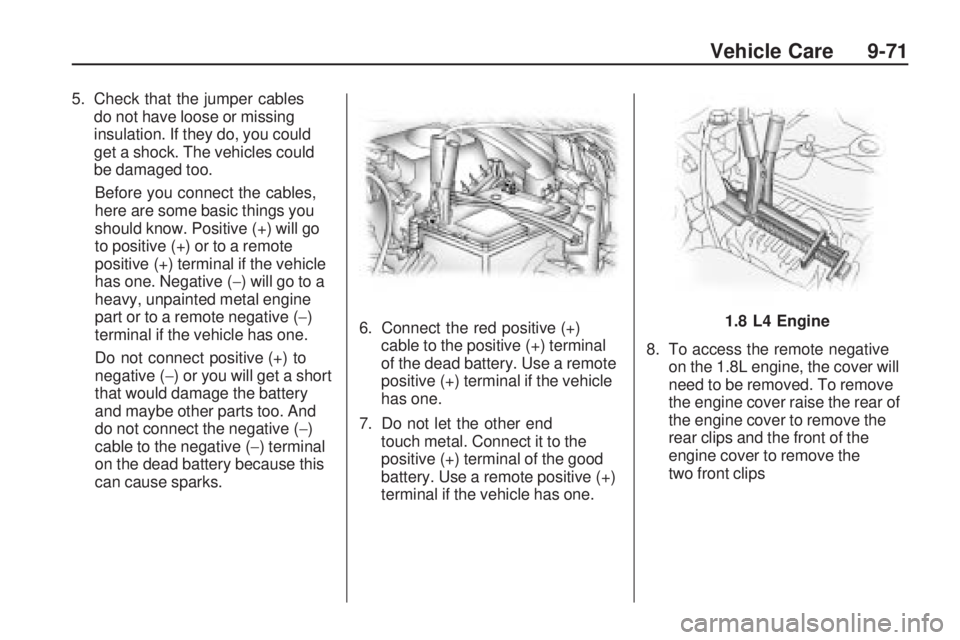
Before you connect the cables,
here are some basic things you
should know. Positive (+) will go
to positive (+) or to a remote
positive (+) terminal if the vehicle
has one. Negative (−) will go to a
heavy, unpainted metal engine
part or to a remote negative (−)
terminal if the vehicle has one.
Do not connect positive (+) to
negative (−) or you will get a short
that would damage the battery
and maybe other parts too. And
do not connect the negative ( −)
cable to the negative (−) terminal
on the dead battery because this
can cause sparks. 6. Connect the red positive (+)
cable to the positive (+) terminal
of the dead battery. Use a remote
positive (+) terminal if the vehicle
has one.
7. Do not let the other end touch metal. Connect it to the
positive (+) terminal of the good
battery. Use a remote positive (+)
terminal if the vehicle has one. 8. To access the remote negative
on the 1.8L engine, the cover will
need to be removed. To remove
the engine cover raise the rear of
the engine cover to remove the
rear clips and the front of the
engine cover to remove the
two front clips
1.8 L4 Engine
Vehicle Care 9-71
Page 256 of 318
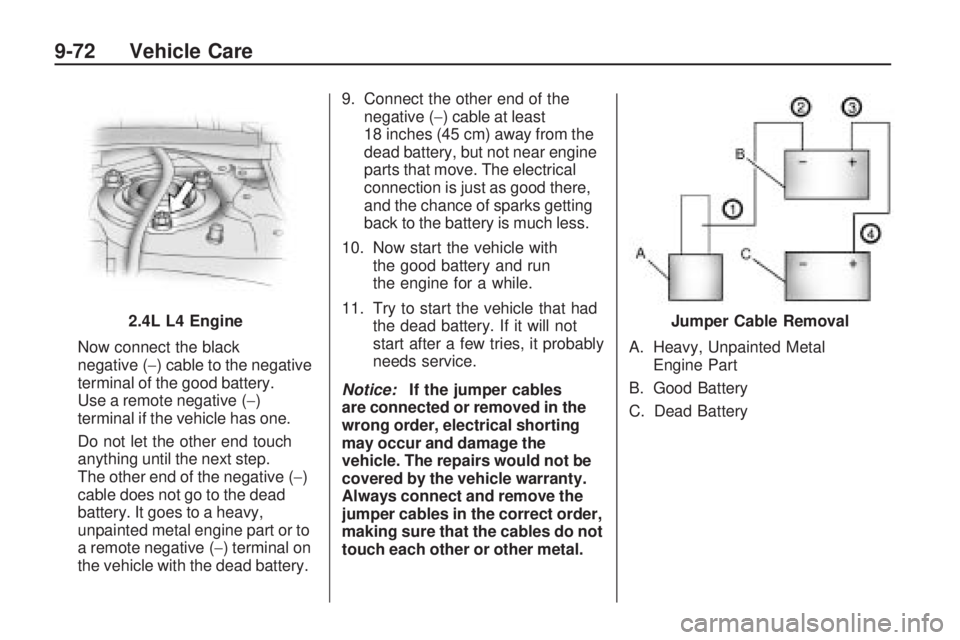
Now connect the black
negative (−) cable to the negative
terminal of the good battery.
Use a remote negative (−)
terminal if the vehicle has one.
Do not let the other end touch
anything until the next step.
The other end of the negative ( −)
cable does not go to the dead
battery. It goes to a heavy,
unpainted metal engine part or to
a remote negative (−) terminal on
the vehicle with the dead battery. 9. Connect the other end of the
negative (−) cable at least
18 inches (45 cm) away from the
dead battery, but not near engine
parts that move. The electrical
connection is just as good there,
and the chance of sparks getting
back to the battery is much less.
10. Now start the vehicle with the good battery and run
the engine for a while.
11. Try to start the vehicle that had the dead battery. If it will not
start after a few tries, it probably
needs service.
Notice: If the jumper cables
are connected or removed in the
wrong order, electrical shorting
may occur and damage the
vehicle. The repairs would not be
covered by the vehicle warranty.
Always connect and remove the
jumper cables in the correct order,
making sure that the cables do not
touch each other or other metal. A. Heavy, Unpainted Metal
Engine Part
B. Good Battery
C. Dead Battery
2.4L L4 Engine
Jumper Cable Removal
9-72 Vehicle Care
Page 257 of 318
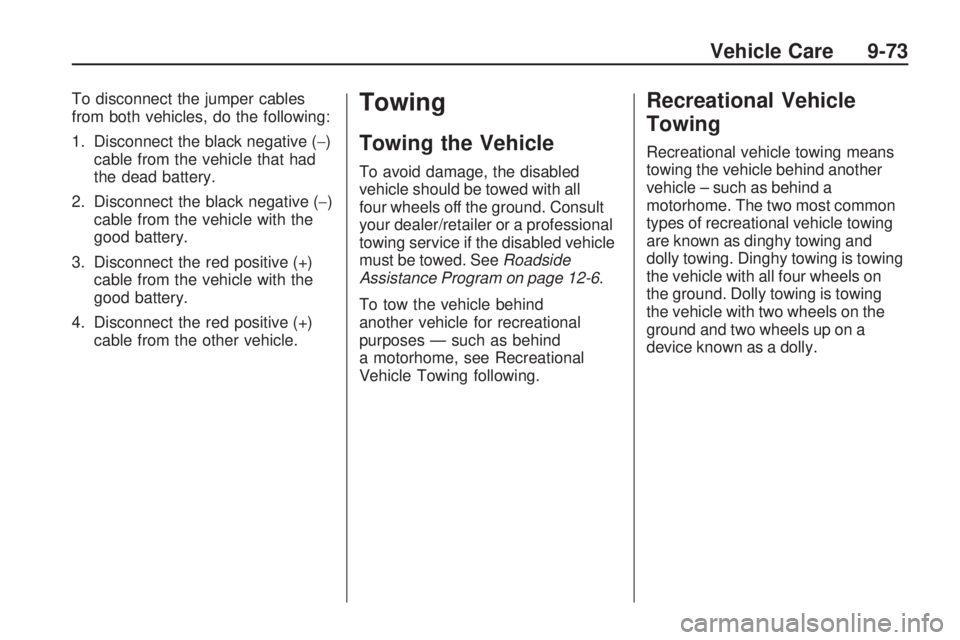
To disconnect the jumper cables
from both vehicles, do the following:
1. Disconnect the black negative (−)
cable from the vehicle that had
the dead battery.
2. Disconnect the black negative ( −)
cable from the vehicle with the
good battery.
3. Disconnect the red positive (+) cable from the vehicle with the
good battery.
4. Disconnect the red positive (+) cable from the other vehicle.Towing
Towing the Vehicle
To avoid damage, the disabled
vehicle should be towed with all
four wheels off the ground. Consult
your dealer/retailer or a professional
towing service if the disabled vehicle
must be towed. See Roadside
Assistance Program on page 12-6 .
To tow the vehicle behind
another vehicle for recreational
purposes — such as behind
a motorhome, see Recreational
Vehicle Towing following.
Recreational Vehicle
Towing
Recreational vehicle towing means
towing the vehicle behind another
vehicle – such as behind a
motorhome. The two most common
types of recreational vehicle towing
are known as dinghy towing and
dolly towing. Dinghy towing is towing
the vehicle with all four wheels on
the ground. Dolly towing is towing
the vehicle with two wheels on the
ground and two wheels up on a
device known as a dolly.
Vehicle Care 9-73
Page 299 of 318
•Flat Tire Change:Service is
provided to change a flat tire
with the spare tire. The spare tire,
if equipped, must be in good
condition and properly inflated.
It is the owner’s responsibility for
the repair or replacement of the
tire if it is not covered by the
warranty.
•Battery Jump Start: Service is
provided to jump start a dead
battery.
Services Not Included in
Roadside Assistance
•
Impound towing caused by
violation of any laws.
•Legal fines.
•Mounting, dismounting or
changing of snow tires, chains,
or other traction devices.
•Towing or services for vehicles
driven on a non-public road or
highway.
Services Specic to Canadian
Purchased Vehicles•
Fuel delivery: Reimbursement
is approximately $5 Canadian.
Diesel fuel delivery may be
restricted. Propane and other
fuels are not provided through
this service.
•Lock-Out Service: Vehicle
registration is required.
•Trip Routing Service: Detailed
maps of North America are
provided when requested either
with the most direct route or
the most scenic route. There is
a limit of six requests per year.
Additional travel information is
also available. Allow three weeks
for delivery.
•Trip Interruption Benets
and Assistance: Must be over
250 Kilometres from where your
trip was started to qualify. General
Motors of Canada Limited
requires pre-authorization,
original detailed receipts, and a
copy of the repair order. Once
authorization has been received,
the Roadside Assistance advisor
will help you make arrangements
and explain how to receive
payment.
•Alternative Service:
If assistance cannot be provided
right away, the Roadside
Assistance advisor may give you
permission to get local emergency
road service. You will receive
payment, up to $100, after
sending the original receipt to
Roadside Assistance. Mechanical
failures may be covered, however
any cost for parts and labor for
repairs not covered by the
warranty are the owner
responsibility.
Customer Information 12-7
Page 310 of 318
B
Battery............................... 9-28
Jump Starting ................... 9-69
Power Protection ................ 5-5
Blade Replacement, Wiper ....9-30
Brakes ............................... 9-26
Antilock ........................... 8-32
Fluid ............................... 9-27
Parking ........................... 8-33
Braking ................................ 8-4
Break-In, New Vehicle ..........8-16
Bulb Replacement ................9-37
Fog Lamps ........................ 5-4
Halogen Bulbs ..................9-33
Headlamp Aiming ..............9-32
Headlamps ...................... 9-33
Headlamps and Parking Lamps ......................... 9-33
License Plate Lamps .........9-36
Taillamps ......................... 9-35
Buying New Tires .................9-56
C
California
Fuel Requirements ............8-39
Perchlorate Materials Requirements ................. 9-3
Warning ............................ 9-2
Canadian Vehicle Owners .......... ii
Capacities and Specifications ................... 11-2
Carbon Monoxide Engine Exhaust ................8-23
Liftgate ............................. 1-6
Winter Driving .................... 8-9
Cargo Cover ............................... 3-2
Management System .......... 3-4
Tie Downs ......................... 3-4
Cautions, Danger, and Warnings ............................. iii
CD Player ............................ 6-9
Center Console Storage ......... 3-2
Chains, Tire ........................ 9-61
Charging System Light ..........4-14
Check Engine Lamp .............4-14Child Restraints
Infants and YoungChildren ....................... 2-38
Lower Anchors and Tethers for Children .................. 2-45
Older Children ..................2-37
Securing .................. 2-51, 2-53
Systems .......................... 2-41
Where to Put the Restraint ...................... 2-43
Cigarette Lighter .................... 4-8
Circuit Breakers ...................9-38
Climate Control Systems ......... 7-1
Cluster, IP ............................ 4-9
Clutch, Hydraulic ..................9-15
Collision Damage Repair .....12-10
Compact Spare Tire .............9-68
Control of a Vehicle ............... 8-3
Coolant Engine ............................ 9-19
Engine Temperature Gage . . . 4-11
Cooling System ...................9-19
Courtesy Transportation Program .......................... 12-8
i-2 INDEX
Page 315 of 318
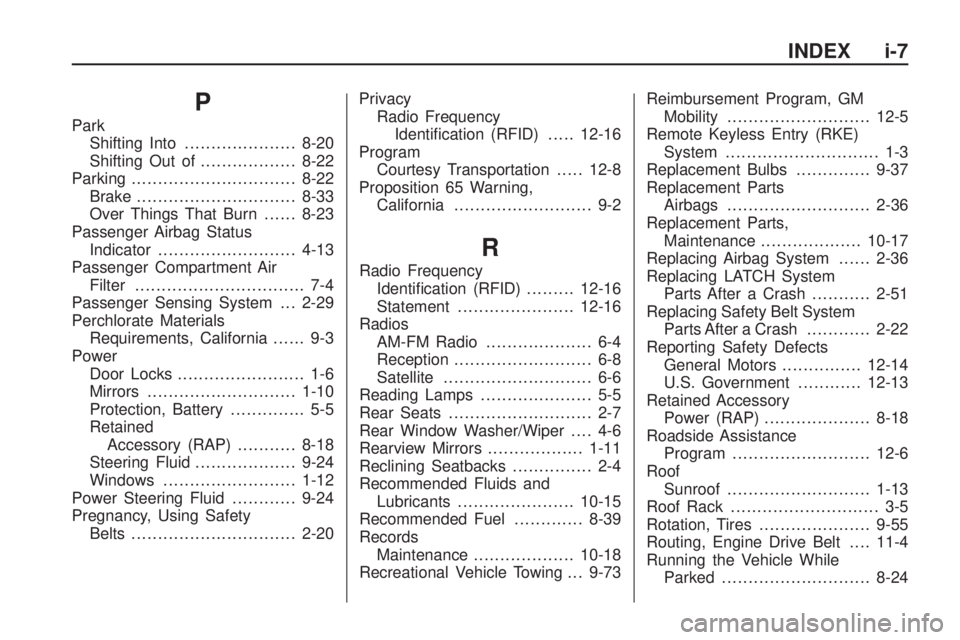
P
ParkShifting Into ..................... 8-20
Shifting Out of ..................8-22
Parking ............................... 8-22
Brake .............................. 8-33
Over Things That Burn ......8-23
Passenger Airbag Status Indicator .......................... 4-13
Passenger Compartment Air Filter ................................ 7-4
Passenger Sensing System . . . 2-29
Perchlorate Materials Requirements, California ...... 9-3
Power Door Locks ........................ 1-6
Mirrors ............................ 1-10
Protection, Battery .............. 5-5
Retained Accessory (RAP) ...........8-18
Steering Fluid ................... 9-24
Windows ......................... 1-12
Power Steering Fluid ............9-24
Pregnancy, Using Safety Belts ............................... 2-20Privacy
Radio FrequencyIdentification (RFID) .....12-16
Program Courtesy Transportation .....12-8
Proposition 65 Warning, California .......................... 9-2
R
Radio Frequency
Identification (RFID) .........12-16
Statement ...................... 12-16
Radios AM-FM Radio .................... 6-4
Reception .......................... 6-8
Satellite ............................ 6-6
Reading Lamps ..................... 5-5
Rear Seats ........................... 2-7
Rear Window Washer/Wiper .... 4-6
Rearview Mirrors ..................1-11
Reclining Seatbacks ............... 2-4
Recommended Fluids and Lubricants ...................... 10-15
Recommended Fuel .............8-39
Records Maintenance ................... 10-18
Recreational Vehicle Towing . . . 9-73 Reimbursement Program, GM
Mobility ........................... 12-5
Remote Keyless Entry (RKE) System ............................. 1-3
Replacement Bulbs ..............9-37
Replacement Parts Airbags ........................... 2-36
Replacement Parts, Maintenance ................... 10-17
Replacing Airbag System ......2-36
Replacing LATCH System Parts After a Crash ...........2-51
Replacing Safety Belt System Parts After a Crash ............2-22
Reporting Safety Defects General Motors ...............12-14
U.S. Government ............12-13
Retained Accessory Power (RAP) .................... 8-18
Roadside Assistance Program .......................... 12-6
Roof Sunroof ........................... 1-13
Roof Rack ............................ 3-5
Rotation, Tires ..................... 9-55
Routing, Engine Drive Belt ....11-4
Running the Vehicle While Parked ............................ 8-24
INDEX i-7