lock PONTIAC VIBE 2010 Manual Online
[x] Cancel search | Manufacturer: PONTIAC, Model Year: 2010, Model line: VIBE, Model: PONTIAC VIBE 2010Pages: 318, PDF Size: 1.7 MB
Page 225 of 318
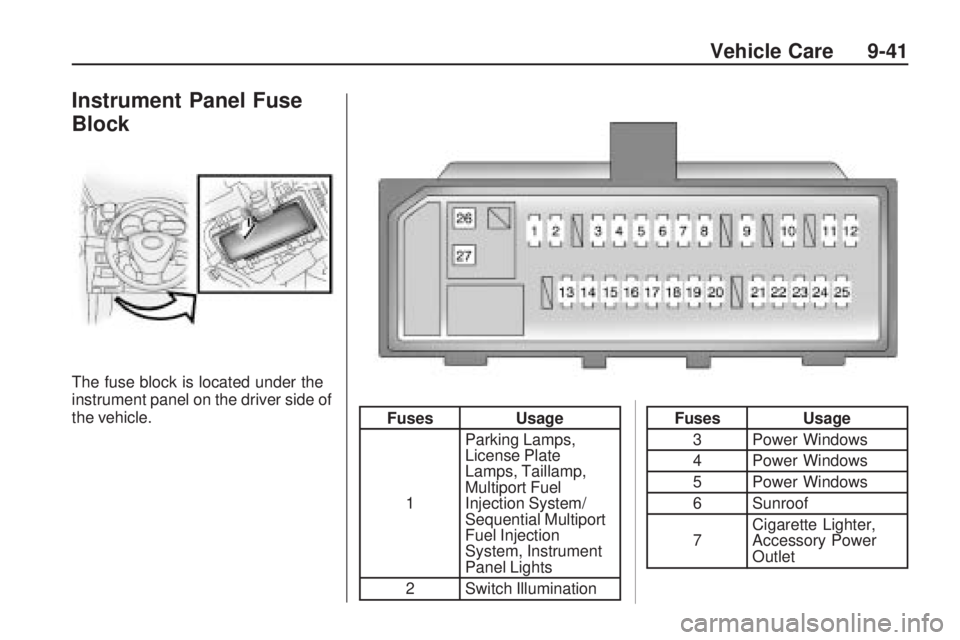
Instrument Panel Fuse
Block
The fuse block is located under the
instrument panel on the driver side of
the vehicle.
FusesUsage
1 Parking Lamps,
License Plate
Lamps, Taillamp,
Multiport Fuel
Injection System/
Sequential Multiport
Fuel Injection
System, Instrument
Panel Lights
2 Switch IlluminationFuses Usage
3 Power Windows
4 Power Windows
5 Power Windows
6 Sunroof
7 Cigarette Lighter,
Accessory Power
Outlet
Vehicle Care 9-41
Page 226 of 318
FusesUsage
8 Outside Rearview
Mirrors, Audio
System, Main Body
Engine Control
Unit (ECU), Clock,
Brake Transmission
Shift Interlock
9 Empty
10 Empty
11 Airbag System,
Multiport Fuel
Injection System/
Sequential Multiport
Fuel Injection
System, Front
Passenger Occupant
Classification
System
12 Gages and Meters
13 Air Conditioning
System, Rear
Window Defogger
14 Windshield Wipers
15 Rear Window WipersFuses Usage
16 Windshield Washer
17 Main Body ECU,
Electric Power
Steering, Electric
Cooling Fans,
Brake Transmission
Shift Interlock,
Antilock Braking
System (ABS),
Multiport Fuel
Injection System/
Sequential Multiport
Fuel Injection
System, Tire
Pressure Monitoring
System (TPMS),
Vehicle Stability
Control System
18 Back-up Lamps,
Charging System,
Rear Window
Defogger
19 Onboard Diagnosis
SystemFuses
Usage
20 Stoplamps, Center
High-Mounted
Stoplamps (CHMSL),
ABS, Vehicle
Stability Control
System, Multiport
Fuel Injection
System/Sequential
Multiport Fuel
Injection System,
Brake Transmission
Shift Interlock
21 Power Door Lock
System
22 Outside Rearview
Mirrors, Audio
System, Main Body
ECU, Clock, Brake
Transmission Shift
Interlock, Cigarette
Lighter
23 All-Wheel Drive
System
24 Front Foglamps
9-42 Vehicle Care
Page 227 of 318
FusesUsage
25 Ignition, Outside
Rearview Mirrors,
Audio System, Main
Body ECU, Clock,
Brake Transmission
Shift Interlock,
Cigarette Lighter
26 Rear Window
Defogger, Heated
Mirrors, Multiport
Fuel Injection
System/Sequential
Multiport Fuel
Injection System
27 Power WindowsWheels and Tires
Tires
Your new vehicle comes
with high-quality tires made
by a leading tire manufacturer.
If you ever have questions about
your tire warranty and where to
obtain service, see your vehicle
Warranty booklet for details.
For additional information refer
to the tire manufacturer.
{CAUTION
Poorly maintained and improperly
used tires are dangerous.
•Overloading your tires can
cause overheating as a result
of too much flexing. You
could have an air-out and a
serious accident. See Vehicle
Load Limits on page 8-12 .
(Continued)
CAUTION (Continued)
•Underinflated tires pose the
same danger as overloaded
tires. The resulting accident
could cause serious injury.
Check all tires frequently to
maintain the recommended
pressure. Tire pressure
should be checked when
your tires are cold. See Tire
Pressure on page 9-49 .
•Overinflated tires are more
likely to be cut, punctured
or broken by a sudden
impact — such as when you
hit a pothole. Keep tires at
the recommended pressure.
•Worn, old tires can cause
accidents. If your tread is
badly worn, or if your tires
have been damaged,
replace them.
Vehicle Care 9-43
Page 238 of 318

TPMS Reset
The TPMS sensors and transmitters
have unique identification codes.
Anytime you replace a TPMS sensor
or transmitter the identification codes
need to be registered and the TPMS
needs to be reset (initialized). When
the system is initialized, the current
air pressure in the tires is set as the
tire pressure benchmark. The tire
pressure warning system determines
decreased air pressure by comparing
tire pressure to the benchmark
pressure stored in the TPMS.
Do not reset the TPMS without first
correcting the cause of a low-tire
condition.
To reset the system:
1. Park the vehicle at a safe placeand apply the parking brake.
Turn the engine off.
2. Turn the ignition to ACC/ACCESSORY or
LOCK/OFF. 3. Adjust the tire pressure of all the
installed tires to the specified
cold tire inflation pressure level
indicated on the Tire and Loading
Information label attached to
the vehicle.
4. Turn the ignition to ON/RUN with the engine off.
5. Press and hold the tire pressure warning reset switch until the tire
pressure warning light flashes
slowly on/off three times.
Wait for a few minutes with the
ignition in ON/RUN, and then turn
the ignition to ACC/ACCESSORY
or LOCK/OFF. If the low-tire pressure warning
light does not flash three times
while you press and hold the
reset button, the reset has failed.
Repeat the reset process. If the
reset cannot be performed, see
your dealer/retailer for service.
If you press the tire pressure reset
switch while the vehicle is moving,
the reset is not performed. If you
press the tire pressure reset switch
accidentally and initialization is
performed, adjust the tire pressure to
the specified level and perform the
reset procedure again.
Tire Inspection
We recommend that you
regularly inspect your vehicle’s
tires, including the spare tire, if
the vehicle has one, for signs of
wear or damage. See When It Is
Time for New Tires on page 9-56
for more information.
9-54 Vehicle Care
Page 242 of 318
Different Size Tires and
Wheels
If you add wheels or tires that are
a different size than your original
equipment wheels and tires, this
could affect the way your vehicle
performs, including its braking,
ride and handling characteristics,
stability, and resistance to rollover.
Additionally, if your vehicle has
electronic systems such as anti-lock
brakes, traction control, and
electronic stability control, the
performance of these systems
can be affected.
SeeBuying New Tires on page 9-56
and Accessories and Modications
on page 9-3 for additional
information.
Uniform Tire Quality
Grading
Quality grades can be found
where applicable on the tire
sidewall between tread shoulder
and maximum section width.
For example:
Treadwear 200 Traction AA
Temperature A
The following information relates
to the system developed by the
United States National Highway
Traffic Safety Administration
(NHTSA), which grades tires
by treadwear, traction, and
temperature performance.
This applies only to vehicles
sold in the United States. The grades are molded on
the sidewalls of most passenger
car tires. The Uniform Tire
Quality Grading (UTQG) system
does not apply to deep tread,
winter-type snow tires,
space-saver, or temporary
use spare tires, tires with nominal
rim diameters of 10 to 12 inches
(25 to 30 cm), or to some
limited-production tires.
While the tires available on
General Motors passenger
cars and light trucks may vary
with respect to these grades,
they must also conform to
federal safety requirements
and additional General Motors
Tire Performance Criteria (TPC)
standards.
9-58 Vehicle Care
Page 247 of 318
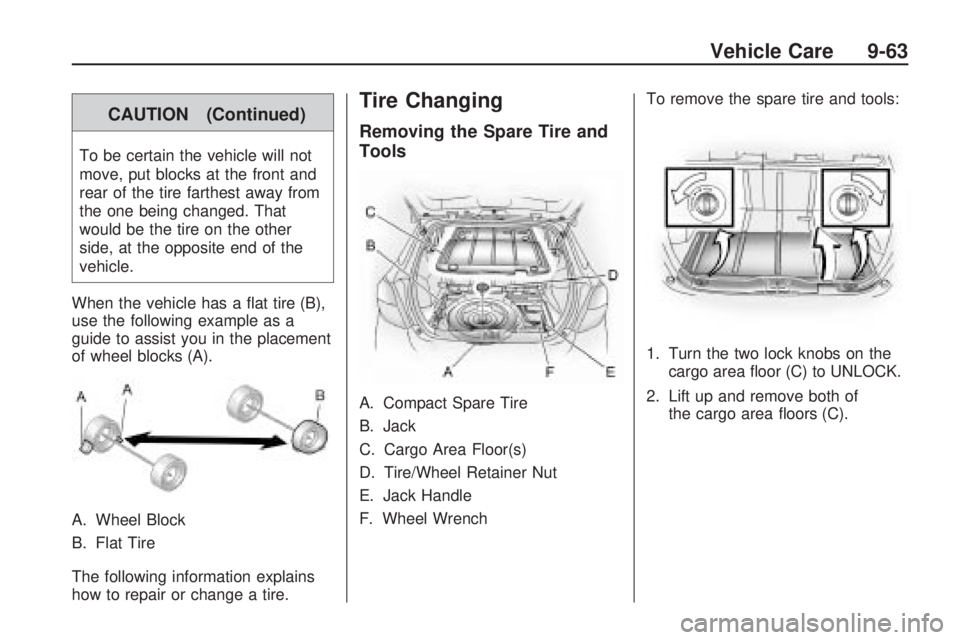
CAUTION (Continued)
To be certain the vehicle will not
move, put blocks at the front and
rear of the tire farthest away from
the one being changed. That
would be the tire on the other
side, at the opposite end of the
vehicle.
When the vehicle has a flat tire (B),
use the following example as a
guide to assist you in the placement
of wheel blocks (A).
A. Wheel Block
B. Flat Tire
The following information explains
how to repair or change a tire.
Tire Changing
Removing the Spare Tire and
Tools
A. Compact Spare Tire
B. Jack
C. Cargo Area Floor(s)
D. Tire/Wheel Retainer Nut
E. Jack Handle
F. Wheel Wrench To remove the spare tire and tools:
1. Turn the two lock knobs on the
cargo area floor (C) to UNLOCK.
2. Lift up and remove both of the cargo area floors (C).
Vehicle Care 9-63
Page 248 of 318
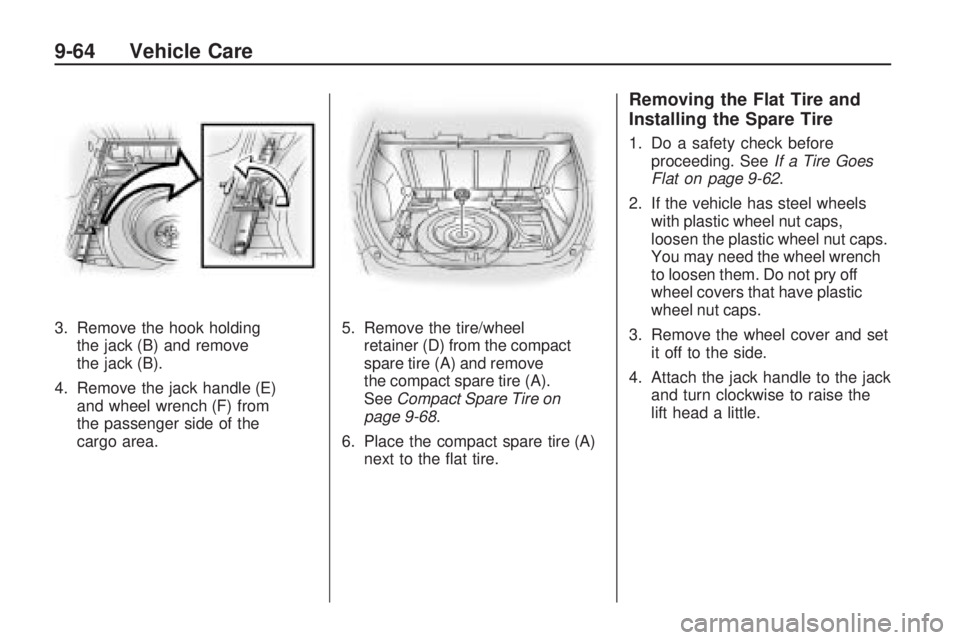
3. Remove the hook holdingthe jack (B) and remove
the jack (B).
4. Remove the jack handle (E) and wheel wrench (F) from
the passenger side of the
cargo area. 5. Remove the tire/wheel
retainer (D) from the compact
spare tire (A) and remove
the compact spare tire (A).
See Compact Spare Tire on
page 9-68.
6. Place the compact spare tire (A) next to the flat tire.
Removing the Flat Tire and
Installing the Spare Tire
1. Do a safety check beforeproceeding. See If a Tire Goes
Flat on page 9-62.
2. If the vehicle has steel wheels with plastic wheel nut caps,
loosen the plastic wheel nut caps.
You may need the wheel wrench
to loosen them. Do not pry off
wheel covers that have plastic
wheel nut caps.
3. Remove the wheel cover and set it off to the side.
4. Attach the jack handle to the jack and turn clockwise to raise the
lift head a little.
9-64 Vehicle Care
Page 249 of 318
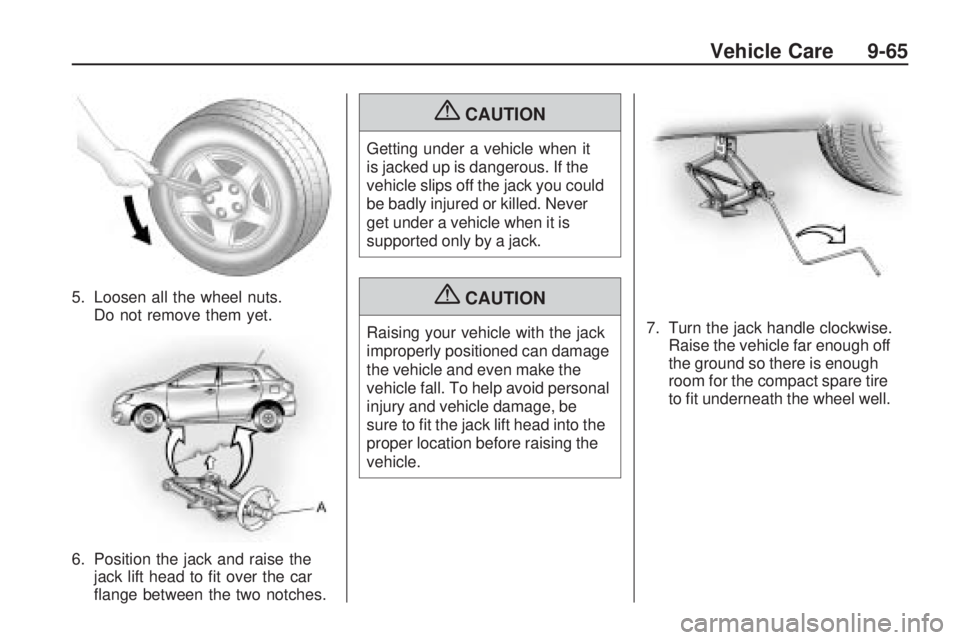
5. Loosen all the wheel nuts.Do not remove them yet.
6. Position the jack and raise the jack lift head to fit over the car
flange between the two notches.
{CAUTION
Getting under a vehicle when it
is jacked up is dangerous. If the
vehicle slips off the jack you could
be badly injured or killed. Never
get under a vehicle when it is
supported only by a jack.
{CAUTION
Raising your vehicle with the jack
improperly positioned can damage
the vehicle and even make the
vehicle fall. To help avoid personal
injury and vehicle damage, be
sure to fit the jack lift head into the
proper location before raising the
vehicle. 7. Turn the jack handle clockwise.
Raise the vehicle far enough off
the ground so there is enough
room for the compact spare tire
to fit underneath the wheel well.
Vehicle Care 9-65
Page 251 of 318
12. Reinstall the wheel nuts withthe rounded end of the nuts
toward the wheel. Tighten each
nut by hand until the wheel
is held against the hub.
13. Turn the jack handle counterclockwise. Lower
the jack completely.{CAUTION
Wheel nuts that are improperly
or incorrectly tightened can cause
the wheels to become loose or
come off. The wheel nuts should
be tightened with a torque wrench
to the proper torque specification
after replacing. Follow the torque
specification supplied by the
aftermarket manufacturer when
using accessory locking wheel
nuts. See Capacities and
Specications on page 11-2 for
original equipment wheel nut
torque specifications.
Notice: Improperly tightened
wheel nuts can lead to brake
pulsation and rotor damage.
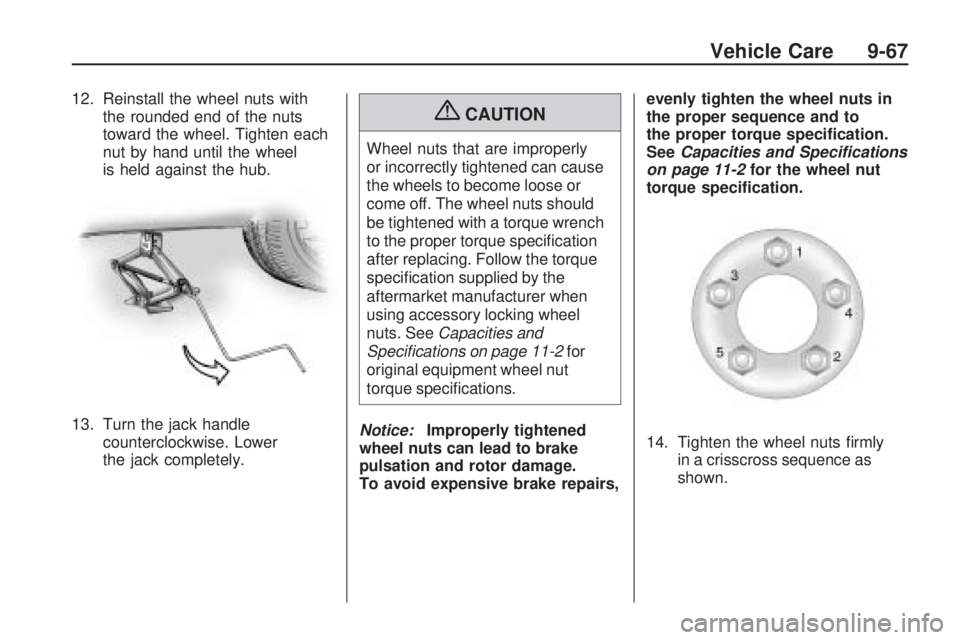
To avoid expensive brake repairs, evenly tighten the wheel nuts in
the proper sequence and to
the proper torque specication.
See
Capacities and Specifications
on page 11-2 for the wheel nut
torque specication.
14. Tighten the wheel nuts firmly in a crisscross sequence as
shown.
Vehicle Care 9-67
Page 252 of 318
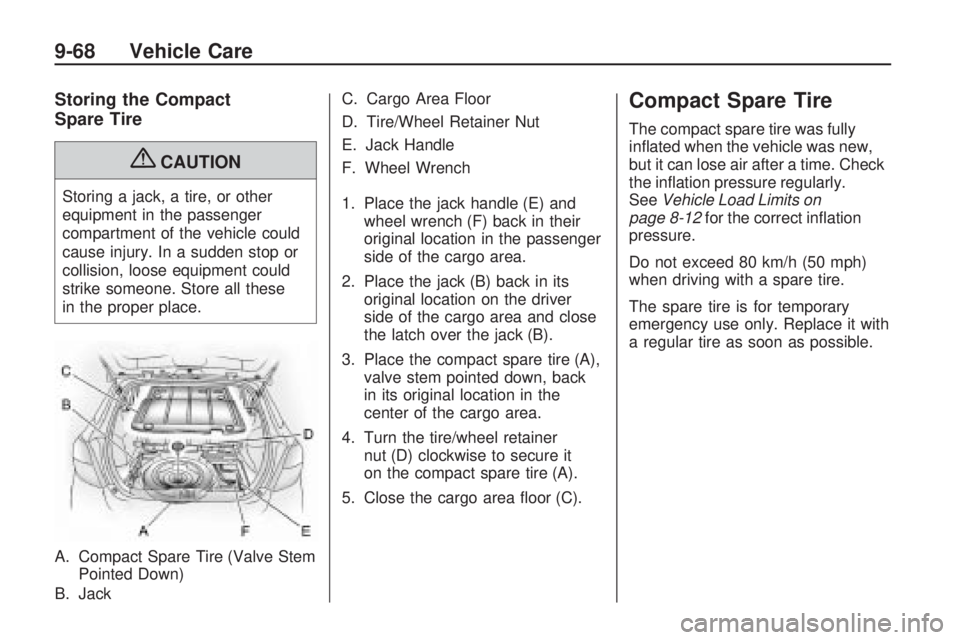
Storing the Compact
Spare Tire
{CAUTION
Storing a jack, a tire, or other
equipment in the passenger
compartment of the vehicle could
cause injury. In a sudden stop or
collision, loose equipment could
strike someone. Store all these
in the proper place.
A. Compact Spare Tire (Valve Stem Pointed Down)
B. Jack C. Cargo Area Floor
D. Tire/Wheel Retainer Nut
E. Jack Handle
F. Wheel Wrench
1. Place the jack handle (E) and
wheel wrench (F) back in their
original location in the passenger
side of the cargo area.
2. Place the jack (B) back in its original location on the driver
side of the cargo area and close
the latch over the jack (B).
3. Place the compact spare tire (A), valve stem pointed down, back
in its original location in the
center of the cargo area.
4. Turn the tire/wheel retainer nut (D) clockwise to secure it
on the compact spare tire (A).
5. Close the cargo area floor (C).
Compact Spare Tire
The compact spare tire was fully
inflated when the vehicle was new,
but it can lose air after a time. Check
the inflation pressure regularly.
See Vehicle Load Limits on
page 8-12 for the correct inflation
pressure.
Do not exceed 80 km/h (50 mph)
when driving with a spare tire.
The spare tire is for temporary
emergency use only. Replace it with
a regular tire as soon as possible.
9-68 Vehicle Care