page 2 PORSCHE 911 2009 5.G Owners Manual
[x] Cancel search | Manufacturer: PORSCHE, Model Year: 2009, Model line: 911, Model: PORSCHE 911 2009 5.GPages: 310, PDF Size: 3.39 MB
Page 240 of 310

238
Practical Tips, Emergency Service B Vehicle load limit
Is the maximum total weight limit specified of
the load (passengers and cargo) for the vehi-
cle. This is the maximum weight of passengers
and cargo that can be loaded into the vehicle.
Please see the chapter “LOADING INFORMA-
TION” on Page 246.
C Tire size for the front axle
Check with your authorized Porsche dealer
about the current release status.
D Recommended tire pressure for the front axle
These values are for cold tires (68 °F/20 °C).
E Tire size for the rear axle
Check with your authorized Porsche dealer
about the current release status.
F Recommended tire pressure for the rear axle.
These values are for cold tires (68 °F/20 °C).
G In vehicles with collapsible spare wheel:
Size and tire pressure of the spare wheel.
Tire traction
Warning!
When driving on wet or slushy roads, a
wedge of water may build up between the
tires and the road. This phenomenon is
known as “hydroplane” and may cause par-
tial or complete loss of traction, vehicle
control or stopping ability.
fReduce speed on wet surface to prevent this. Tire life Tire life depends on various factors, i. e., road
surfaces, traffic and weather conditions, driving
habits, type of tires and tire care.
fInspect your tires for wear and damage before
driving off. If you notice uneven or substantial
wear, wheels might need alignment or tires
should be balanced or replaced.
Tire wear The original equipment tires on your Porsche have
built-in tire wear indicators. They are molded into
the bottom of the tread grooves and will appear as
approximately 1/2 in. (12 mm) bands when the
tire tread depth is down to 1/16 of an in.
(1.6 mm).
When the indicators appear in two or more adja-
cent grooves, it is time to replace the tires. We
recommend, however, that you do not let the tires
wear down to this extent.
Worn tires cannot grip the road surface properly
and are even less effective on wet roads.
Snow tires lose their traction capability when their
tread depth falls below 5/32 in. (4 mm).
In the United States, state laws may govern the
minimum tread depth permissible. Follow all such
laws.
Page 241 of 310

Practical Tips, Emergency Service
239
Danger!
Driving on worn tires can result in loss of con-
trol of the vehicle and could cause serious
personal injuries or death.
fDo not drive with worn tires or tires showing
cuts or bruises as they may lead to sudden
deflation and loss of control which could cause
severe personal injury.
fSpecialized high performance tires on high
performance sports cars exhibit more wear
than those on a family sedan, or even a high
performance sedan.
Therefore, it is important to check your tire
pressure and condition at least every two weeks.
If you notice that tires are wearing unevenly, con-
sult your Porsche dealer.
Uneven wear may not always be due to improper
wheel alignment. It can be the result of individual
driving habits such as cornering at high speeds. If
the tire pressure is not checked and adjusted
regularly, abnormal tire wear can also occur.
Tire care fAvoid damaging tires and wheel rims.
fIf you must drive over a curb or other obstacle,
drive slowly and at an obtuse angle.
fCheck tires for uneven wear and damage
before driving off.
fRemove imbedded material.
fReplace worn or damaged tires immediately.
fKeep oil, fuel, brake fluid, etc. away from tires.
fReplace missing valve stem caps.
fKeep tires inflated correctly.
fWash tires when washing the vehicle. Also
clean inner side of wheels.
fDo not use abrasive cleaners when washing
the wheels.
fCheck wheel rims for corrosion.
fRemove road salt, if driving in winter.
Tire damage, puncture High-pressure cleaning units can damage the
tires.
fPlease see the chapter “HIGH-PRESSURE
CLEANING UNITS, STEAM CLEANERS” on
Page 224.
fCheck tires for imbedded material, cuts, punc-
tures, cracks and bulges (side wall) before driv-
ing off.
In case of tire damage, where it is uncertain wheth-
er there is a break in the ply with all its conse-
quences or tire damage caused by thermal or me-
chanical overloading due to loss of pressure or
any other prior damage, we recommend that the
tire be replaced for safety reasons.
If one faulty tire is replaced it should be noted that
the difference in tread depth on one axle must not
exceed 30%.
Handling inconsistencies may result.
fPerform a visual inspection if necessary.
Page 245 of 310

Practical Tips, Emergency Service
243
Snow chains
Caution!
Risk of damage to body, axle or brake com-
ponents.
fFit snow chains only to the rear wheels, and
only with the tire/rim combination listed in the
Technical Data.
To ensure adequate clearance between chain
and body, Porsche recommends only the use
of fine-link chains such as those approved by
Porsche.
fFollow instructions issued by the supplier of the chains.
Different states and countries have varying statu-
tory requirements regarding maximum speed.
Check with local authorities for possible restric-
tions.
fRemove chains as soon as the roads are free
of ice and snow. 911 Carrera, 911 Carrera S
Fitting snow chains
The use of snow chains is not permitted when
5 mm spacers are mounted.
Caution!
Risk of damage to the wheel housings if the
5 mm spacers are not removed before fitting
snow chains.
fTo permit the fitting of snow chains, have the 5 mm spacers removed on all 4 wheels.
fTo fit/remove the spacers:
Please consult an authorized Porsche dealer.
fPlease see the chapter “SPACERS 911
CARRERA, 911 CARRERA S” on Page 255.
Tire designations Due to new speed and load ratings for radial tires,
new designations have come into force for snow
tires for your Porsche.
The designation to be used for ZR tires is e.g.,
265/40 ZR 18 (Z = code letter for radial tires for
speeds above 150 mph / 240 km/h).
Page 248 of 310

246
Practical Tips, Emergency Service
Loading InformationDefinitionsThe Curb weight - actual weight of your vehicle -
vehicle weight including standard and optional
equipment, fluids and emergency tools. This
weight does not include passengers and cargo.
The Gross Vehicle Weight is sum of the curb
weight and the weight of passengers and cargo
combined.
The Gross Vehicle Weight Rating is the maxi-
mum total weight of vehicle, passengers, luggage
and optional equipment.
The Gross Axle Weight Rating is the maximum
load limit for the front or the rear axle. This infor-
mation is located on the safety compliance sticker
located in the driver’s side door jamb.
For determining the compatibility of the tire and
vehicle load capabilities:
fPlease see the chapter “TECHNICAL DATA” on
Page 286.
The load capacity coefficient (e.g. “100”) is a min-
imum requirement.The Gross Combined Weight Rating is the
maximum total weight rating of vehicle, passen-
gers and cargo.
The Vehicle Capacity Weight - Load Limit - is
the maximum total weight limit specified of the
load (passengers and cargo) for the vehicle. This
is the maximum weight of passengers and cargo
that can be loaded into the vehicle. This informa-
tion can be found on the tire pressure plate.
The maximum loaded vehicle weight is the
sum of curb weight, accessory weight, vehicle ca-
pacity weight and production options weight.
The load rating is the maximum load that a tire
is rated to carry for a given inflation pressure.
The maximum load rating is the load rating for
a tire at the maximum permissble inflation pres-
sure.
The cargo capacity is the permissible weight of
cargo, the substracted weight of passengers from
the load limit.
fNever exceed the permissible limits.
Danger!
Risk of loss of control, damage to the vehicle
and serious personal injury or death.
fNever exceed the specified axle loads.
Overloading can shorten the service life of the
tires and car, as well as lead to dangerous
vehicle reactions and long braking distances.
Damage due to overloading is not covered by the vehicle warranty.
Page 249 of 310
Practical Tips, Emergency Service
247
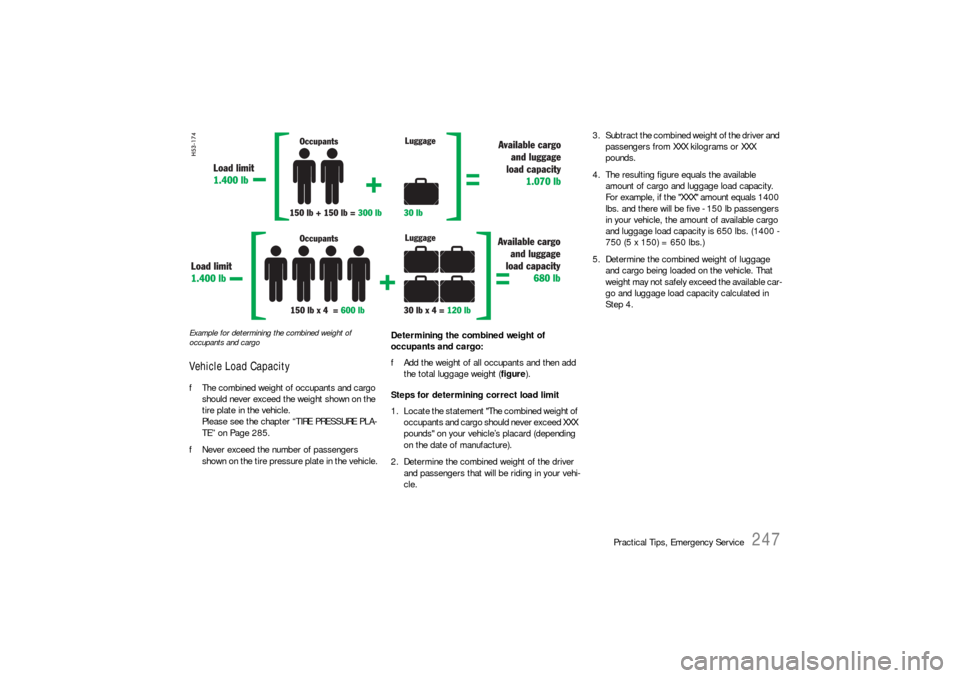
Example for determining the combined weight of
occupants and cargoVehicle Load CapacityfThe combined weight of occupants and cargo
should never exceed the weight shown on the
tire plate in the vehicle.
Please see the chapter “TIRE PRESSURE PLA-
TE” on Page 285.
fNever exceed the number of passengers
shown on the tire pressure plate in the vehicle.Determining the combined weight of
occupants and cargo:
fAdd the weight of all occupants and then add
the total luggage weight (figure).
Steps for determining correct load limit
1. Locate the statement "The combined weight of
occupants and cargo should never exceed XXX
pounds" on your vehicle’s placard (depending
on the date of manufacture).
2. Determine the combined weight of the driver
and passengers that will be riding in your vehi-
cle.
3. Subtract the combined weight of the driver and
passengers from XXX kilograms or XXX
pounds.
4. The resulting figure equals the available
amount of cargo and luggage load capacity.
For example, if the "XXX" amount equals 1400
lbs. and there will be five - 150 lb passengers
in your vehicle, the amount of available cargo
and luggage load capacity is 650 lbs. (1400 -
750 (5 x 150) = 650 lbs.)
5. Determine the combined weight of luggage
and cargo being loaded on the vehicle. That
weight may not safely exceed the available car-
go and luggage load capacity calculated in
Step 4.
Page 251 of 310

Practical Tips, Emergency Service
249
Changing a wheel
Warning!
Risk of serious personal injury or death. The
car may slip off the jack.
fMake sure that no one is in the vehicle when
jacking up and changing a wheel.
fAlways place the car on stable supports if work
has to be carried out under the car.
Risk of damage to the brake discs of the
Porsche Ceramic Composite Brake (PCCB).
fAlways screw in both assembly aids when changing a wheel.
Note
The tools required for changing a wheel (e.g. jack,
wheel bolt wrench, assembly aids) are not sup-
plied with the car.
Your authorized Porsche dealer will be pleased to
advise you.1. Apply the handbrake fully and engage 1st gear
or PDK selector-lever position P and remove
the ignition key.
2. Switch on the hazard warning lights if neces-
sary.
3. Secure the car against rolling away, e.g. by
means of wedges under the wheels on the op-
posite side.
This is particularly important on slopes.
4. Slightly slacken the wheel bolts of the wheel to
be changed.
5. Lift the car only at the specified jacking points.
6. Raise the car until the wheel lifts off the
ground.
Please see the chapter “LIFTING THE VEHICLE
WITH A LIFTING PLATFORM OR GARAGE LIFT”
on Page 254.
7. Remove 1 or 2 wheel bolts (see respective
illustration).
8. Screw in assembly aids instead of the wheel
bolts.
Screw in assembly aid for vehicles without Porsche
Ceramic Composite Brake9. Remove the remaining wheel bolts.
Note on operation
fTo remove or mount the spacers:
Please see the chapter “SPACERS 911
CARRERA, 911 CARRERA S” on Page 255.
Page 252 of 310
250
Practical Tips, Emergency Service
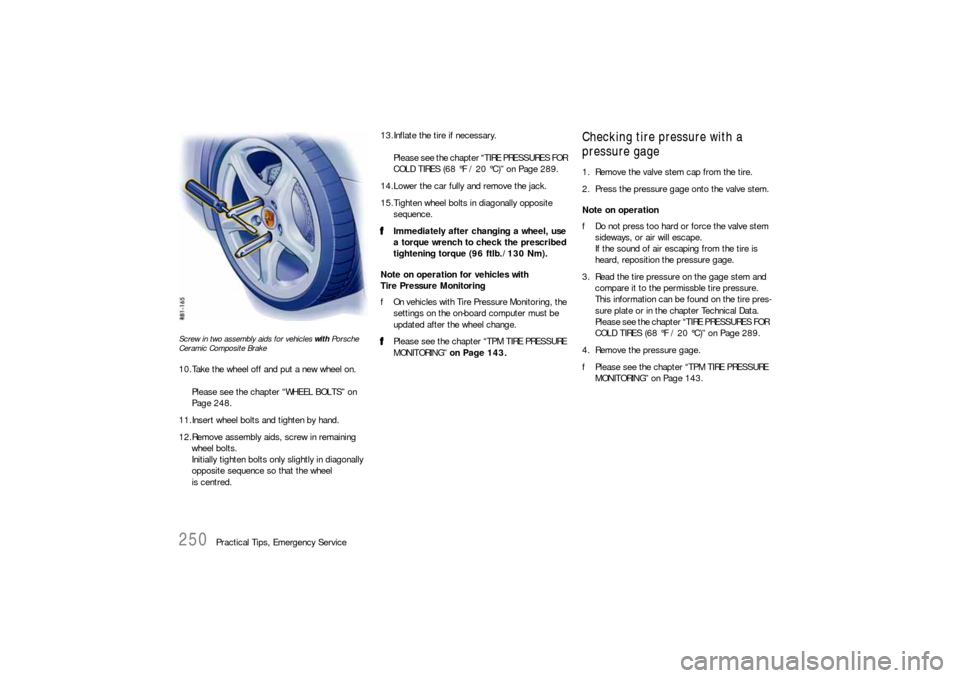
Screw in two assembly aids for vehicles with Porsche
Ceramic Composite Brake10.Take the wheel off and put a new wheel on.
Please see the chapter “WHEEL BOLTS” on
Page 248.
11.Insert wheel bolts and tighten by hand.
12.Remove assembly aids, screw in remaining
wheel bolts.
Initially tighten bolts only slightly in diagonally
opposite sequence so that the wheel
is centred.13.Inflate the tire if necessary.
Please see the chapter “TIRE PRESSURES FOR
COLD TIRES (68 °F / 20 °C)” on Page 289.
14.Lower the car fully and remove the jack.
15.Tighten wheel bolts in diagonally opposite
sequence.
fImmediately after changing a wheel, use
a torque wrench to check the prescribed
tightening torque (96 ftlb./130 Nm).
Note on operation for vehicles with
Tire Pressure Monitoring
fOn vehicles with Tire Pressure Monitoring, the
settings on the on-board computer must be
updated after the wheel change.
fPlease see the chapter “TPM TIRE PRESSURE
MONITORING” on Page 143.
Checking tire pressure with a
pressure gage1. Remove the valve stem cap from the tire.
2. Press the pressure gage onto the valve stem.
Note on operation
fDo not press too hard or force the valve stem
sideways, or air will escape.
If the sound of air escaping from the tire is
heard, reposition the pressure gage.
3. Read the tire pressure on the gage stem and
compare it to the permissble tire pressure.
This information can be found on the tire pres-
sure plate or in the chapter Technical Data.
Please see the chapter “TIRE PRESSURES FOR
COLD TIRES (68 °F / 20 °C)” on Page 289.
4. Remove the pressure gage.
fPlease see the chapter “TPM TIRE PRESSURE
MONITORING” on Page 143.
Page 255 of 310

Practical Tips, Emergency Service
253
A- Filler bottle
B- Filler hose
C- Plug of the filler hose
D-Valve turner
E-Valve insert
F- Tire valveInserting sealant
1. Leave the object that caused the puncture in
the tire.
2. Remove sealant and the enclosed sticker from
the luggage compartment.
3. Adhere the sticker in the driver's field of vision.
4. Shake filler bottle A.5. Screw filler hose B onto the filler bottle.
The filler bottle is now open.
6. Unscrew valve cap from tire valve F.
7. Remove valve insert E from the tire valve with
valve turner D.
Keep the valve insert in a clean and dry place.
8. Remove plug C of the filler hose B.
9. Push filler hose onto the tire valve.
10.Hold filler bottle higher than the level of the tire
valve and press it together forcefully until the
bottle is completely emptied into the tire.
11.Pull filler hose off the tire valve.
12.Twist the valve insert firmly into the tire valve
using the valve turner.
13.Connect the compressor to the cigarette light-
er and inflate the tire to the prescribed tire
pressure.
Please see the chapter “TIRE PRESSURES FOR
COLD TIRES (68 °F / 20 °C)” on Page 289.
14.Screw valve cap onto the tire valve.
15.Check the tire pressure after driving for around
10 minutes.
If the tire pressure is less than 22 psi (1.5 bar),
do not continue driving.
If a value of more than 22 psi (1.5 bar) is indi-
cated, correct the pressure to the prescribed
value.16.Please consult your authorized Porsche
dealer.
Note on operation for vehicles with
Tire Pressure Monitoring
fOn vehicles with Tire Pressure Monitoring, the
settings on the on-board computer must be
updated after the wheel change.
Please see the chapter “TPM TIRE PRESSURE
MONITORING” on Page 147.
Care Instructions
After drying, any sealant that emerges can be
peeled off like a film.
Warning!
Risk of accident, resulting in serious per-
sonal injury or death.
fHave the tire replaced by an authorized
Porsche dealer immediately.
fAvoid hard acceleration and high cornering
speeds.
fDo not exceed maximum speed of 50 mph
(80 km/h).
fPlease always observe the safety and opera-
ting instructions, which can be found in the
separate operating instructions for the sealant and on the compressor.
Page 257 of 310

Practical Tips, Emergency Service
255
Spacers911 Carrera, 911 Carrera SfUse the spacers only together with wheels and
fastening parts approved by Porsche.
Before having spacers fitted, find out about the
current approval status.
Mounting an emergency spare wheel
If 5 mm spacers are mounted, these must not be
removed to mount an emergency spare wheel.
Fitting snow chains
The use of snow chains is not permitted when
5 mm spacers are mounted.
Caution!
Risk of damage to the wheel housings if the
5 mm spacers are not removed before fitting
snow chains.
fTo permit the fitting of snow chains, have the 5 mm spacers removed on all 4 wheels.Note on operation
fTo fit/remove the spacers:
Please consult an authorized Porsche dealer.
fPlease see the chapter “CHANGING A WHEEL”
on Page 249.
Removing the spacers
1. Unscrew both countersunk screws (M6x16) on
the wheel hub.
2. Remove the spacer.
3. Fasten the brake disc with the short M6x12
countersunk screws, part No.:
900.269.047.09.
Tightening torque 7.5 ftlb. (10 Nm).
4. For wheel mounting without a spacer, 5 mm
shorter wheel bolts (part No.:
997.361.203.01) must be used.
Tightening torque: 96 ftlb. (130 Nm).
Mounting the spacers
Page 258 of 310

256
Practical Tips, Emergency Service 1. Remove wheel.
2. Unscrew both countersunk screws (M6x12) on
the break disc.
3. Fasten the spacer with the long M6x16
countersunk screws.
Tightening torque 7.5 ftlb. (10 Nm).
4. Fit wheel. To do this use the longer wheel
bolts for fastening the wheels.
Tightening torque: 96 ftlb. (130 Nm).
fPlease see the chapter “CHANGING A WHEEL”
on Page 249.
Required scope of parts if the spacers are
removed
Short countersunk screws (M6x12)
Part No: 900.269.047.09
1 set short wheel bolts
Part No: 997.361.203.01
Short anti-theft protection
Part No: 996.361.057.01
fFor information on the spacers: Please see the
chapter “SPACERS 911 CARRERA, 911
CARRERA S” on Page 255.
Long wheel bolt
X = bolt length approx. 49 mm
Arrows = spherical cap ringWheel bolt identifying features
For identification purposes, the movable spherical
cap ring is galvanised in red on the long wheel
bolts.
The long wheel bolts must only be used together
with 5 mm spacers fitted.
The short wheel bolts are not marked in colour.
The short wheel bolts must only be used without
5 mm spacers fitted.
fTightening torque for both wheel bolts:
96 ftlb. (130 Nm).