page 2 PORSCHE 911 2009 5.G Manual PDF
[x] Cancel search | Manufacturer: PORSCHE, Model Year: 2009, Model line: 911, Model: PORSCHE 911 2009 5.GPages: 310, PDF Size: 3.39 MB
Page 208 of 310

206
Maintenance, Car Care
Exercise Extreme Caution when
Working on your Vehicle
Danger!
Ignoring the following instructions may
cause serious personal injury or death.
fThe engine compartment of any motor vehicle
is a potentially hazardous area. If you are not
fully familiar with proper repair procedures, do
not attempt the adjustments described on the
following pages.
This caution also applies to the entire vehicle.
fO n l y w o r k o n y o u r v e h i c l e o u t d o o r s o r i n a w e l l
ventilated area.
fEnsure that there are no open flames in the
area of your vehicle at any time when fuel
fumes might be present. Be especially cau-
tious of such devices such as hot water heat-
ers which ignite a flame intermittently.
fBefore working on any part in the engine com-
partment, turn the engine off and let it cool
down sufficiently. Hot engine compartment
components can burn skin on contact.
fBe alert and cautious around engine at all
times while the engine is running.
If work has to be performed with the engine
running, always set the parking brake, and
make sure the shift lever is in neutral position
or the PDK selector lever in position P or N.fIn particular, be very careful to ensure that
items of clothing (ties, shirt, sleeves etc.),
jewelry, long hair, hand or fingers cannot get
caught in the engine-compartment blower, fan,
belts or other moving parts.
The radiator and radiator fans are in the front
of the car.
The engine-compartment blower is mounted
on the engine-compartment lid.
The engine-compartment blower can start or
continue running as a function of temperature,
even with the engine switched off.
Carry out work in these areas only with the en-
gine off, the ignition switched off, and exercise
extreme caution.
fYour Porsche is equipped with an electronic ig-
nition system. When the ignition is on, high
voltage is present in all wires connected with
the ignition system; therefore, exercise ex-
treme caution when working on any part of the
engine while the ignition is on or the engine is
running.
fAlways support your car with safety stands if it
is necessary to work under the car.
fWhen working under the car without safety
stands but with the wheels on the ground,
make sure the car is on level ground, the
wheels are blocked, and that the engine
cannot be started.
Remove the ignition key. fDo not smoke or allow an open flame around
the battery or fuel.
Keep a fire extinguisher in close reach.
fIncomplete or improper servicing may cause
problems in the operation of the car. If in doubt
about any servicing, have it done by your
authorized Porsche dealer.
Improper maintenance during the warranty
period may affect your Porsche warranty cov-
erage.
fSupplies of fluids, e.g. engine oil, brake fluid or
coolant, are hazardous to your health.
Keep these fluids out of children’s reach and
dispose of them in accordance with the appro-
priate regulations.
fSome countries require additional tools and
special spare parts to be carried in your vehi-
cle.
Please make enquiries before driving abroad.
Page 209 of 310
Maintenance, Car Care
207
Coolant LevelfPlease see the chapter “EXERCISE EXTREME
CAUTION WHEN WORKING ON YOUR VEHICLE”
on Page 206.
The cooling system is filled at the factory with a
permanent coolant.
It provides year-round protection from corrosion
and freezing down to –31 °F/–35 °C
.
fOnly use antifreeze authorized by Porsche.
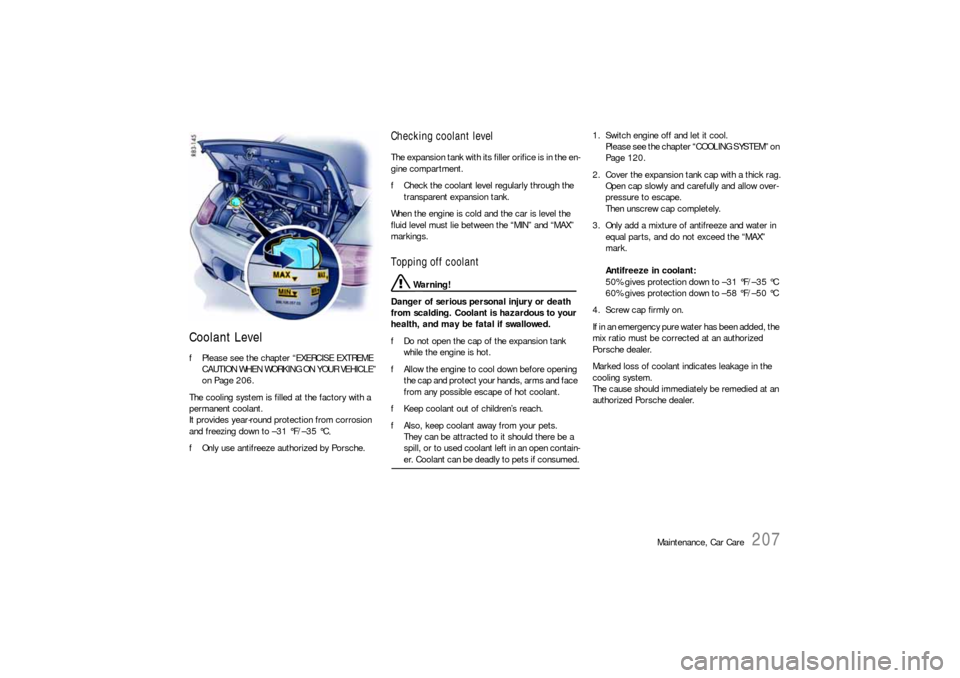
Checking coolant level The expansion tank with its filler orifice is in the en-
gine compartment.
fCheck the coolant level regularly through the
transparent expansion tank.
When the engine is cold and the car is level the
fluid level must lie between the “MIN” and “MAX”
markings. Topping off coolant
Warning!
Danger of serious personal injury or death
from scalding. Coolant is hazardous to your
health, and may be fatal if swallowed.
fDo not open the cap of the expansion tank
while the engine is hot.
fAllow the engine to cool down before opening
the cap and protect your hands, arms and face
from any possible escape of hot coolant.
fKeep coolant out of children’s reach.
fAlso, keep coolant away from your pets.
They can be attracted to it should there be a
spill, or to used coolant left in an open contain-er. Coolant can be deadly to pets if consumed.1. Switch engine off and let it cool.
Please see the chapter “COOLING SYSTEM” on
Page 120.
2. Cover the expansion tank cap with a thick rag.
Open cap slowly and carefully and allow over-
pressure to escape.
Then unscrew cap completely.
3. Only add a mixture of antifreeze and water in
equal parts, and do not exceed the “MAX”
mark.
Antifreeze in coolant:
50% gives protection down to –31 °F/–35 °C
60% gives protection down to –58 °F/–50 °C
4. Screw cap firmly on.
If in an emergency pure water has been added, the
mix ratio must be corrected at an authorized
Porsche dealer.
Marked loss of coolant indicates leakage in the
cooling system.
The cause should immediately be remedied at an
authorized Porsche dealer.
Page 210 of 310

208
Maintenance, Car Care
Engine-compartment blower,
radiator fan The radiator and radiator fans are in the front of
the car.
The engine-compartment blower is mounted on
the engine compartment lid.
Warning!
Risk of injury.
After the engine is switched off, the engine-
compartment temperature is monitored for
approx. 30 minutes.
During this period, and depending on tem-
perature, the engine-compartment blower
may continue to run or start to run.
fCarry out work in these areas only with the en-
gine off, the ignition off, and exercise extreme
caution.
Risk of injury. The radiator fans in the front
end of the car may be operating or
unexpectedly start operating when the
engine is switched on.
fCarry out work in these areas only with the en-gine switched off.
Engine Oil It is important to perform oil changes regularly in
accordance with the intervals specified in the
“Maintenance” booklet.
Engine oil consumption
It is normal for your engine to consume oil.
The rate of oil consumption depends on the quality
and viscosity of oil, the speed at which the engine
is operated, the climate, road conditions as well
as the amount of dilution and oxidation of the
lubricant.
If the vehicle is used for repeated short trips, and
consumes a normal amount of oil, the engine oil
measurement may not show any drop in the oil
level at all, even after 600 miles (1,000 km) or
more. This is because the oil is gradually becom-
ing diluted with fuel or moisture, making it appear
that the oil level has not changed.
The diluting ingredients evaporate out when the
vehicle is driven at high speeds, as on an express-
way, making it then appear that oil is excessively
consumed after driving at high speeds.
If the conditions you drive your vehicle in are
dusty, humid, or hot, the frequency of the oil
change intervals should be greater. If the vehicle is driven at a high rate of speed,
climatic conditions are warm, and the load is high,
the oil should be checked more frequently, as
driving conditions will determine the rate of oil
consumption.
– The engine in your vehicle depends on oil to
lubricate and cool all of its moving parts.
Therefore, the engine oil should be checked
regularly and kept at the required level.
– Make it a habit to have the engine oil level
checked at every fuel filling.
– The oil pressure warning light is not an oil level
indicator.
The oil pressure warning light indicates serious
engine damage may be occuring when lit, if en-
gine rpm is above idle speed.
Engine Oil Level fPlease see the chapter “EXERCISE EXTREME
CAUTION WHEN WORKING ON YOUR VEHICLE”
on Page 206.
fRegularly check the oil level using the on-board
computer after the vehicle is refuelled.
Please see the chapter “OIL DISPLAY AND
MEASUREMENT OF THE ENGINE OIL LEVEL”
on Page 153.
The difference between the minimum and maxi-
mum marks on the segment display is approx.
1.3 quarts (1.25 liters).
Each segment of the display corresponds to ap-
prox. 0.42 quart (0.4 liter).
Page 212 of 310

210
Maintenance, Car Care
Engine Oil RecommendationPorsche recommends .
The right oil for your vehicle.1) Generally, you can find details of the
manufacturer approvals on the oil containers or as
a notice displayed by the retailer.
The current approval status is also available from
your Porsche partner.2) SAE viscosity class - Example: SAE 0W - 40
Specification 0W = Viscosity specification for
low temperatures (winter).
Specification 40 = Viscosity specification for
high temperatures.3) For all temperature ranges.4) For the temperature range over --13 °F (--25 °C).Always observe the following points:
– Use engine oils approved by Porsche only. This
is a precondition for optimum and problem-free
operation of your vehicle.
– Regular oil changes are part of servicing.
It is important that the service intervals,
particularly the oil change intervals, are
observed in accordance with the specifications
in the “Maintenance” booklet.
– Oils approved by Porsche can be mixed with
each other.
– Porsche engines are designed so that no oil
additives may be used.
– A label is located in the engine compartment,
which provides you with information on suitable
oil for your engine.
Your Porsche partner will be pleased to advise
you.
Oil changeThe engine oil has to be changed regularly at the
intervals listed in your Maintenance Schedule.
fPlease see the chapter “CAPACITIES” on
Page 290.
We recommend that you have the engine oil
changed at your Porsche dealer, who has the re-
quired oils and the necessary filling equipment.
If you suspect an oil leak in the engine have your
dealer check it out immediately.
All current engine oils are compatible with each
other, i.e. when making an oil change it is not nec-
essary to flush the engine if you wish to use a dif-
ferent brand or grade of oil.
Since, however, each brand of oil has a special
composition, you should, if possible, use the
same oil brand if it becomes necessary to top up
between oil changes.
Porsche engines have long intervals between oil
changes. You can make best use of these long oil
change intervals by using multigrade oils since
these are largely independent of seasonal fluctua-
tions in temperature. Complies with
approval
1)
Viscosity class
2)
Porsche A40 SAE 0W - 40
3)
SAE 5W - 40
4)
SAE 5W - 50
4)
Page 214 of 310
212
Maintenance, Car Care
Brake Fluid LevelfPlease see the chapter “EXERCISE EXTREME
CAUTION WHEN WORKING ON YOUR VEHICLE”
on Page 206.
fUse only new (unused) Original Porsche
brake fluid.
Warning!
Brake fluid is hazardous to your health, and
may be fatal if swallowed.
Brake fluid also attacks paintwork.
fKeep brake fluid out of children’s reach.
fTake care while topping off brake fluid not to
soil the luggage compartment or items of lug-gage.
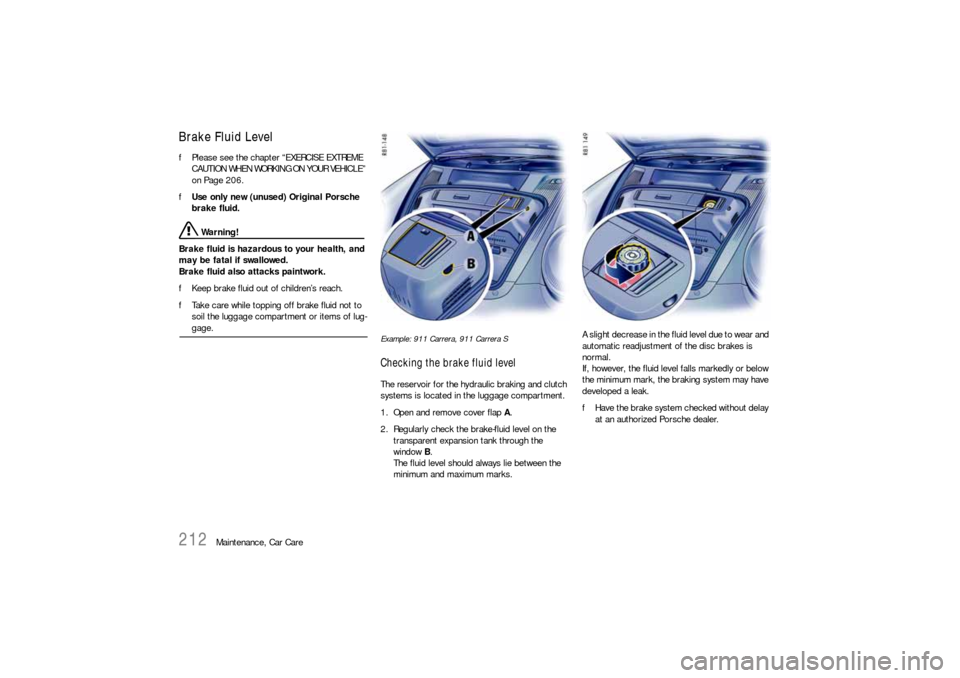
Example: 911 Carrera, 911 Carrera SChecking the brake fluid levelThe reservoir for the hydraulic braking and clutch
systems is located in the luggage compartment.
1. Open and remove cover flap A.
2. Regularly check the brake-fluid level on the
transparent expansion tank through the
window B.
The fluid level should always lie between the
minimum and maximum marks.A slight decrease in the fluid level due to wear and
automatic readjustment of the disc brakes is
normal.
If, however, the fluid level falls markedly or below
the minimum mark, the braking system may have
developed a leak.
fHave the brake system checked without delay
at an authorized Porsche dealer.
Page 217 of 310
Maintenance, Car Care
215
Fuel
Warning!
Fuel is highly flammable and harmful to
health.
fFire, open flame and smoking are prohibited
when handling fuel.
fAvoid contact with skin or clothing.
fDo not inhale fuel vapors.
To prevent damage to the emission control
system and engine:
fNever drive the tank completely out of fuel.
fAvoid high cornering speeds after the warning lights have come on.
fPlease see the chapter “FUEL ECONOMY” on
Page 214.
Please see the chapter “EMISSION CONTROL
SYSTEM” on Page 218.
Please see the chapter “LEVEL GAGE” on
Page 122.
Check engine warning light
If the warning lights in the instrument panel and on-
board computer come on and remain on while
driving, it suggests:
– a potential engine control problem and the
need for system service or
– an improperly fastened tank cap or – refueling with engine running.
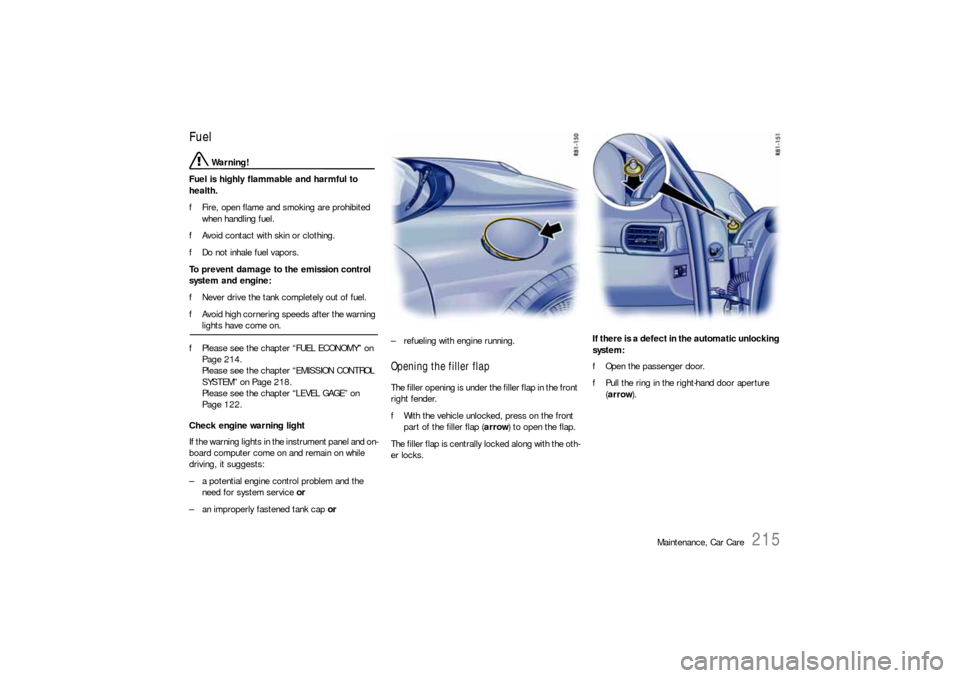
Opening the filler flapThe filler opening is under the filler flap in the front
right fender.
fWith the vehicle unlocked, press on the front
part of the filler flap (arrow) to open the flap.
The filler flap is centrally locked along with the oth-
er locks. If there is a defect in the automatic unlocking
system:
fOpen the passenger door.
fPull the ring in the right-hand door aperture
(arrow).
Page 218 of 310

216
Maintenance, Car Care
Refueling Fuel tank capacity is listed under “Capacities”.
Porsche does not recommend the use of fuel ad-
ditives.
Fuel is highly flammable and harmful to
health.
fPlease see the chapter “CAPACITIES” on
Page 290.1.Important: Stop the engine and switch off the
ignition.
2. Slowly unscrew the tank cap.
Hang the tank cap's plastic strap on the hook
on the inside wall of the filler flap.
3. Insert fuel-hose nozzle fully into the filler neck
with the handle of the fuel-hose nozzle facing
down.
4. Do not add further fuel once the correctly op-
erated automatic fuel-hose nozzle has
switched off.
Fuel could spray or could run over in warm
temperatures.
5. Replace the tank cap immediately after
refueling and turn it until you hear it and feel it
engage.
If you lose the tank cap, you must replace it
only with an original part to reduce the
possibility of a fire in the event of a collision.
Caution!
Risk of damage. Decorative film may fade if
it comes into contact with fuel.
fWipe off any emerging fuel immediately.
Fuel Recommendations Your Porsche is equipped with catalytic convert-
ers and must use UNLEADED FUEL ONLY.
Your engine is designed to provide optimum per-
formance and fuel economy using unleaded premi-
um fuel with an octane rating of 98 RON
(93
CLC or AKI). Porsche therefore recom-
mends the use of these fuels in your vehicle.
Porsche also recognizes that these fuels may not
always be available. Be assured that your vehicle
will operate properly on unleaded premium fuels
with octane numbers of at least
95 RON
(90 CLC or AKI), since the engine’s “Electronic
Oktane™ knock control” will adapt the ignition tim-
ing, if necessary.
It is important to observe the regular service inter-
vals, and particularly the oil change intervals,
specified in the “Maintenance” booklet.
The use of UNLEADED FUEL ONLY is critically
important to the life of the catalytic
converters. Deposits from leaded fuels will
ruin the converters and make it ineffective
as an emission control device.
Cars with catalytic converters have a smaller fuel
tank opening, and gas station pumps have smaller
nozzles. This will prevent accidental pumping of
leaded fuel into cars with catalytic converters.
Page 223 of 310

Maintenance, Car Care
221
Power Steering Power steering is assisted by hydraulic auxiliary
forces.
The hydraulic fluid reservoir is located in the en-
gine compartment.
Note
The flow noise heard at full steering lock is design-
related and does not indicate a defect in the steer-
ing system.
Warning!
Risk of accident resulting in serious personal
injury or death.
When the engine is stopped (e.g. when being
towed) or the hydraulic system fails, there is
no assistance for steering.
Therefore, substantially more force will have
to be exerted in order to steer.
fExercise great care when being towed.
fHave the fault remedied at your nearest author-ized Porsche dealer.
Checking hydraulic fluid fPlease see the chapter “EXERCISE EXTREME
CAUTION WHEN WORKING ON YOUR VEHICLE”
on Page 206.
fOnly use hydraulic fluid authorized by Porsche.
Specification:
Please see the chapter “CAPACITIES” on
Page 290.
Check the fluid level with the engine stopped and
cold (approximately 68 °F/20 °C).
1. Open the engine compartment lid.
2. Open the reservoir cap.
3. Wipe measuring rod.
Close cap and reopen. The fluid level should lie
between the “MIN” and “MAX” marks.
Add hydraulic fluid if necessary.
4. Close cap carefully.
Close engine compartment lid.
Noticeable loss of fluid indicates leakage in the
system.
The cause should be remedied immediately at an
authorized Porsche dealer.
Page 224 of 310

222
Maintenance, Car Care
Air Filter A dirty air filter not only reduces engine perform-
ance, but can lead to premature engine wear.
Regular filter replacement is part of the routine
maintenance service.
fIn dusty conditions, check the filter element
more frequently and replace if necessary.Combination Filter The fresh air passing through the combination fil-
ter into the passenger compartment is virtually
free of dust, pollen, and unpleasant odors.
fIf the outside air is polluted by exhaust fumes,
press the circulating-air button.
A dirty filter can be the cause of reduced air flow:
fHave filter replaced by your authorized
Porsche dealer.
Regular filter replacement is part of the routine
maintenance service.
Fluids/Oils for Manual
Transmission and Porsche
Doppelkupplung (PDK)The transmission fluids/oils have to be checked
and changed at the intervals listed in your Mainte-
nance Schedule.
fPlease see the chapter “CAPACITIES” on
Page 290.
Do not tow the car or run the engine without fluid/
oil in the transmission. The transmission may be
damaged by even a tiny speck of dirt, only a clean
funnel or spout must be used when adding fluid/
oil.
We recommend that you have the fluids/oils
changed at your Porsche dealer, who has the re-
quired lubricants and the necessary filling equip-
ment.
fIf you suspect an oil leak in the transmission,
have your authorized Porsche dealer check it
out immediately.
Page 225 of 310

Maintenance, Car Care
223
Wiper Blades Wiper blades that are in perfect condition are vital
for a clear view.
fReplace the wiper blades twice per year (be-
fore and after the cold season) or whenever
wiper performance deteriorates.
Caution!
Risk of damage if the wiper arm accidentally
falls back on to the window.
fAlways hold the wiper arm securely when re-
placing the wiper blade.
Risk of damage if wiper blades that are fro-
zen in place are loosened improperly.
fThaw the wiper blades before loosening them.
Maintenance note
fPeriodically clean the wiper blades with win-
dow cleaner, especially after the vehicle has
been washed in a car wash.
We recommend the Porsche window cleaner. If
they are very dirty (e.g. with insect remains),
they can be cleaned with a sponge or cloth.If the wiper blades rub or squeak, this can be as a
result of the following:
– If the vehicle is washed in an automatic car
wash, wax residues may adhere to the wind-
shield. These wax residues can be removed
only by using window cleaner concentrate.
– The wiper blades may be damaged or worn.
fReplace damaged or worn wiper blades as
soon as possible.
fPlease see the chapter “WASHER FLUID” on
Page 220.
fPlease contact your authorized Porsche dealer
for further information.
Changing windshield wiper bladesfPlease read the separate instructions for fitting
wiper blades as supplied by the manufacturer.
fWe recommend that you get your authorized
Porsche dealer to replace the wiper blades.
Caution!
Risk of damage.
If the wiper blades are not changed properly,
they can come loose when the car is moving.
fCheck that the wiper blades are seated
securely. The wiper blades must engage properly in the wiper arm.