page 2 PORSCHE 911 2009 5.G Repair Manual
[x] Cancel search | Manufacturer: PORSCHE, Model Year: 2009, Model line: 911, Model: PORSCHE 911 2009 5.GPages: 310, PDF Size: 3.39 MB
Page 177 of 310

Shifting Gears
175
Depending on driving speed and engine speed,
you can shift up or down at any time.
Gear changes which would exceed the upper or
lower engine speed limit are not executed by the
controller.
There is no automatic upshift at the upper engine
speed limit in selector lever position M. Upshift
suppression can be cancelled by kickdown opera-
tion. If, for example, the engine speed limit is
reached during overtaking and the automatic
upshift does not occur, the transmission in this
case shifts up as a result of kickdown operation.
fSelect an appropriately low gear on upward
and downward slopes.
This will ensure optimum use of engine power
and engine braking.
In order to shift up automatically at the upper
engine speed limit:
fDepress the accelerator pedal beyond the full-
throttle point (kickdown).Failure of the selector lever display on the
instrument cluster
The warning “Transmission emergency run” is
displayed in red on the on-board computer.
–Effect:
No selector lever position is displayed on the
instrument cluster.
Vehicle can be driven only until it comes to a
stop.
Remedy:
It is not possible to continue driving. Immedi-
ately stop the vehicle in a suitable place. Have
the vehicle towed to an authorized Porsche
dealer.
StoppingfFor a brief stop (e.g. at a traffic light), leave the
selector lever in drive position and hold the
vehicle with the brake pedal.
fDo not hold the car on a slope using the
accelerator. Use the brake pedal or the
handbrake instead.
fBefore leaving the vehicle, always apply the
handbrake and move the selector lever to
position P.ParkingfGo easy on the accelerator!
fWhen parking or manoeuvring in a small
space, control the speed by careful use of the
footbrake.Driving in winterIn wintry road conditions it is advisable to take
steep inclines in manual mode. This prevents gear
changes occurring that could cause wheelspin.Tow-starting, towingfPlease see the chapter “TOWING” on
Page 280.
Page 181 of 310

Mobile Roofs
179
B - Closing the lifting/sliding rooffPress front of rocker switch B until lifting/slid-
ing roof reaches the desired position.C - Lifting the lifting/sliding rooffPress center of rocker switch C until lifting/
sliding roof reaches the desired position.
One-touch operation
fTouch the rocker switch C in the center.
Lifting/sliding roof opens to its end position.
Touch button again to stop in any position.B - Lowering the lifting/sliding rooffPress front of rocker switch B until lifting/slid-
ing roof reaches the desired position.
Emergency operation
Warning!
Risk of serious personal injury and damage
to the lifting/sliding roof during emergency
operation.
fDo not operate the lifting/sliding roof with the
rocker switch during and after emergency operation.
Before using emergency operation, please check
whether defective fuses are the cause of the mal-
function.
fPlease see the chapter “ELECTRICAL SYS-
TEM” on Page 257.
Closing the sliding roof
1. Carefully unclip both covers A with a screwdriv-
er.
If the car is equipped with HomeLink, the
HomeLink buttons must be carefully unclipped
instead of the covers.
2. Unscrew the two screws B.
Page 183 of 310

Mobile Roofs
181
Convertible Top Brief operating instructions can be found on the
back side of the driver’s sun visor.
fPlease see the chapter “CAR CARE INSTRUC-
TIONS” on Page 224.
Warning!
When opening or closing the convertible top,
serious personal injury may occur if a per-
son’s body parts are near or in the way of the
convertible top mechanism’s moving parts.
fMake absolutely sure that nobody can be in-
jured by the convertible-top mechanism or the convertible-top compartment lid.
Do not operate convertible top:
– At temperatures below 32 °F (0 °C).
– When one side of the car is on a curb, a hoist
or a jack.
– When items of luggage or other objects hinder
the convertible top movement.
– With the rollbars extended.fAvoid frequent operation of the convertible top
with the engine off; the vehicle battery would
be unintentionally discharged rapidly.
fDrive only with the convertible top fully open or
closed (end positions).
fWhen opening or closing the convertible top,
ensure there is sufficient clearance above the
convertible top (e.g. in the garage).
fTo prevent damp stains and abrasions, only
open the convertible top in a dry, clean state.
fPark your car in the shade whenever possible,
as the fabric, rubber material and color can be
harmed by long exposure to sunlight.
fThe convertible top may only be actuated dur-
ing driving on even surfaces.
fThe convertible top must not be used with
strong counter wind (over approx. 50 mph/
80 km/h).
Door windows and side windows The side windows are lowered automatically when
the convertible top is opened. The door windows
close automatically if convertible top operation is
not interrupted when the convertible top reaches
its final position.
When the door windows are closed, the rear side
windows can also be closed.
When opening the door windows, the rear win-
dows open automatically.
The side windows are lowered automatically when
the convertible top is closed. All windows close
automatically if convertible top operation is not in-
terrupted when the convertible top reaches its fi-
nal position.
Page 185 of 310

Mobile Roofs
183
If the convertible top does not lock in the
windshield frame
fOpen convertible top again, start the engine
and close the convertible top again using the
switch.
Assist with the closing process by grasping the
convertible top at the handhold and pulling it
toward the windshield frame (arrow).
fPlease see the chapter “WARNINGS ON THE
INSTRUMENT PANEL AND THE ON-BOARD
COMPUTER” on Page 158.
Messages in on-board computerIf the engine compartment lid is open when acti-
vating the convertible top, a message appears in
the on-board computer. The convertible top can-
not be opened.
fClose engine compartment lid.
fPlease see the chapter “WARNINGS ON THE
INSTRUMENT PANEL AND THE ON-BOARD
COMPUTER” on Page 158.
Emergency operation
of the convertible top fBefore performing emergency operation,
please check:
Was the ignition switched on and was the en-
gine compartment lid closed during operation
of the convertible top with the switch?
Are electrical fuses defective?
Please see the chapter “ELECTRICAL SYS-
TEM” on Page 257.
Warning!
There is danger of injury and damage during
emergency operation.
There is danger of crushing or trapping body
parts at all movable convertible top parts
which could cause serious personal injury.
fTake great care when performing emergency
operation.
fDo not operate the convertible top during and after emergency operation.
Before emergency operation
fRemove the ignition key so that the convertible
top is not operated unintentionally.
fTake screwdriver out of the tool kit.
fFold the rear seat backrests forward.
Rear lid
Convertible top status
Page 193 of 310
Mobile Roofs
191
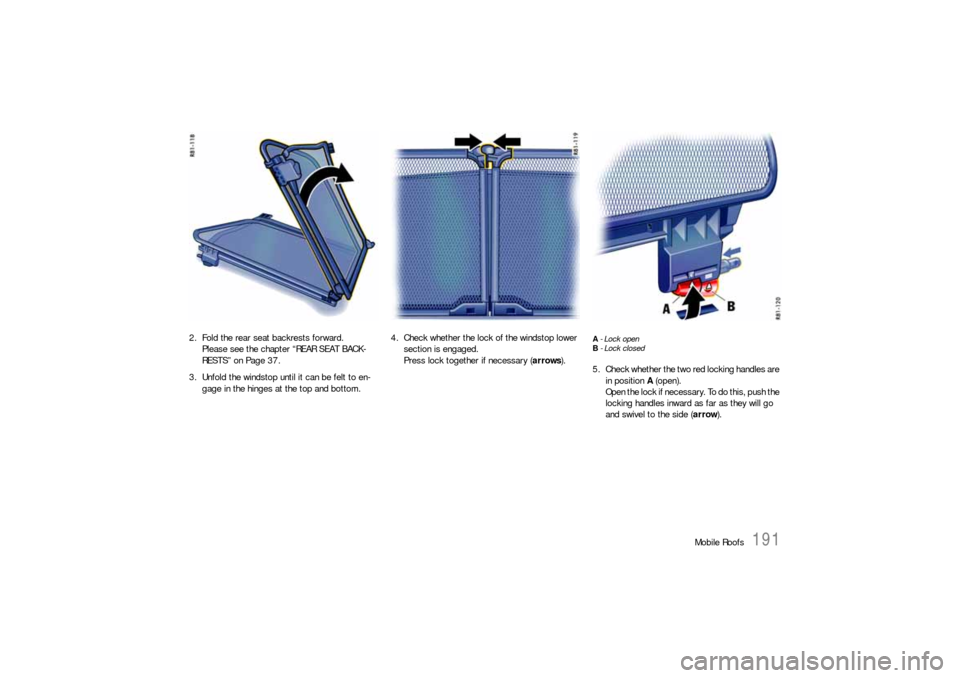
2. Fold the rear seat backrests forward.
Please see the chapter “REAR SEAT BACK-
RESTS” on Page 37.
3. Unfold the windstop until it can be felt to en-
gage in the hinges at the top and bottom. 4. Check whether the lock of the windstop lower
section is engaged.
Press lock together if necessary (arrows).
A - Lock open
B - Lock closed 5. Check whether the two red locking handles are
in position A (open).
Open the lock if necessary. To do this, push the
locking handles inward as far as they will go
and swivel to the side (arrow).
Page 195 of 310
Mobile Roofs
193
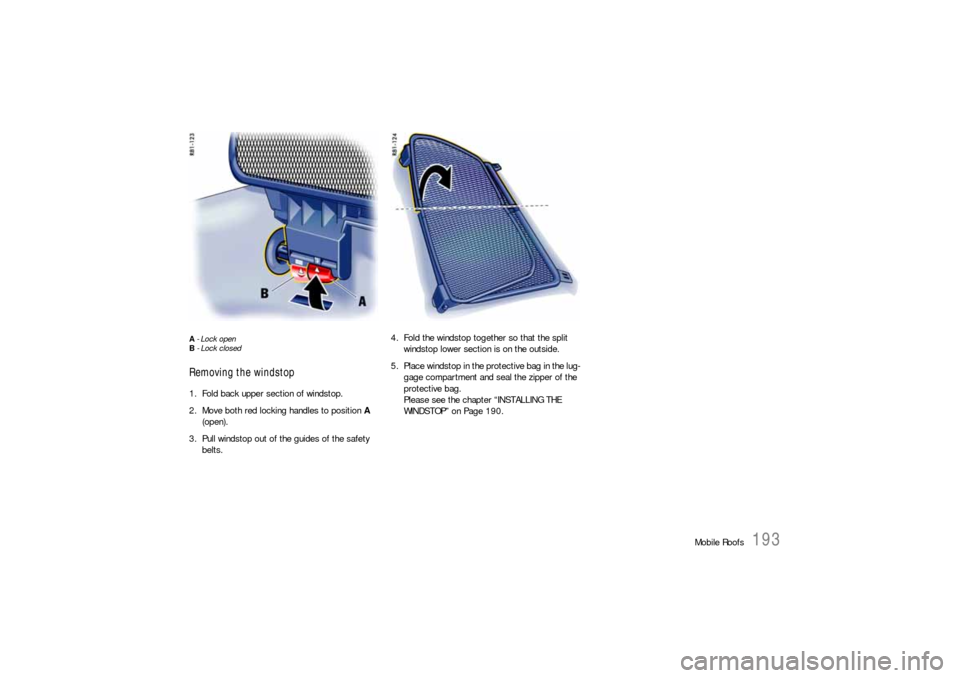
A - Lock open
B - Lock closed Removing the windstop1. Fold back upper section of windstop.
2. Move both red locking handles to position A
(open).
3. Pull windstop out of the guides of the safety
belts. 4. Fold the windstop together so that the split
windstop lower section is on the outside.
5. Place windstop in the protective bag in the lug-
gage compartment and seal the zipper of the
protective bag.
Please see the chapter “INSTALLING THE
WINDSTOP” on Page 190.
Page 198 of 310
196
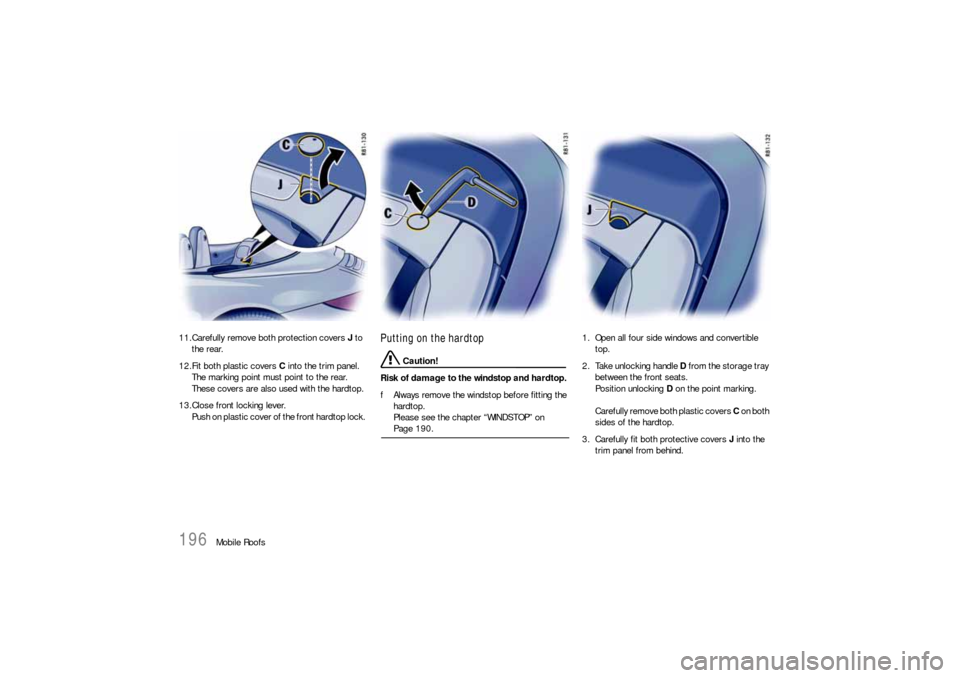
Mobile Roofs 11.Carefully remove both protection covers J to
the rear.
12.Fit both plastic covers C into the trim panel.
The marking point must point to the rear.
These covers are also used with the hardtop.
13.Close front locking lever.
Push on plastic cover of the front hardtop lock.
Putting on the hardtop
Caution!
Risk of damage to the windstop and hardtop.
fAlways remove the windstop before fitting the
hardtop.
Please see the chapter “WINDSTOP” on Page 190.1. Open all four side windows and convertible
top.
2. Take unlocking handle D from the storage tray
between the front seats.
Position unlocking D on the point marking.
Carefully remove both plastic covers C on both
sides of the hardtop.
3. Carefully fit both protective covers J into the
trim panel from behind.
Page 203 of 310
Mobile Roofs
201
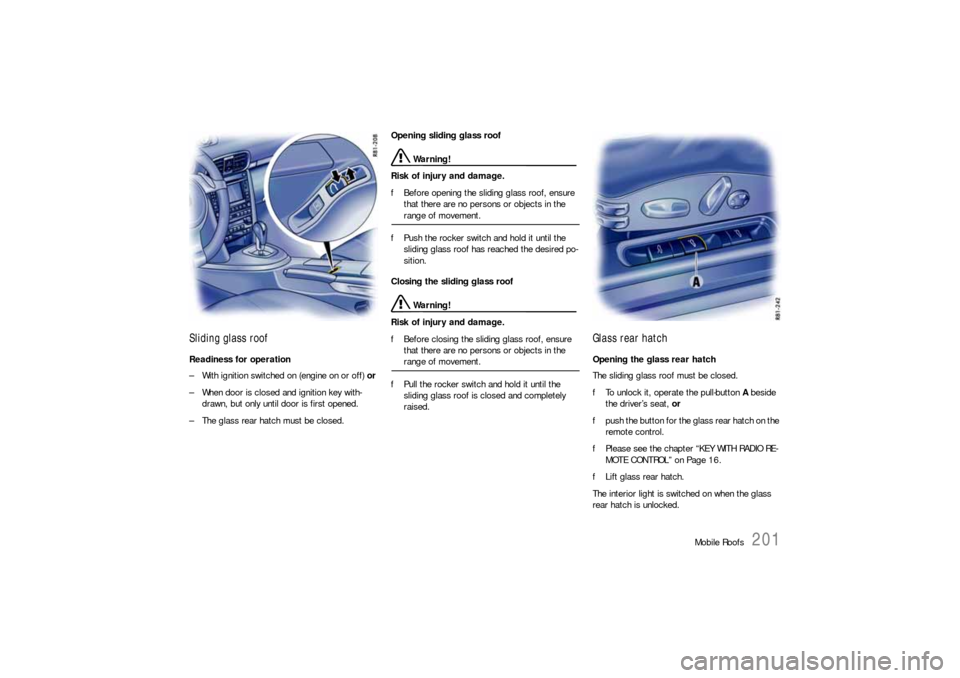
Sliding glass roofReadiness for operation
– With ignition switched on (engine on or off) or
– When door is closed and ignition key with-
drawn, but only until door is first opened.
– The glass rear hatch must be closed.Opening sliding glass roof
Warning!
Risk of injury and damage.
fBefore opening the sliding glass roof, ensure
that there are no persons or objects in the range of movement.
fPush the rocker switch and hold it until the
sliding glass roof has reached the desired po-
sition.
Closing the sliding glass roof Warning!
Risk of injury and damage.
fBefore closing the sliding glass roof, ensure
that there are no persons or objects in the range of movement.
fPull the rocker switch and hold it until the
sliding glass roof is closed and completely
raised.
Glass rear hatchOpening the glass rear hatch
The sliding glass roof must be closed.
fTo unlock it, operate the pull-button A beside
the driver’s seat, or
fpush the button for the glass rear hatch on the
remote control.
fPlease see the chapter “KEY WITH RADIO RE-
MOTE CONTROL” on Page 16.
fLift glass rear hatch.
The interior light is switched on when the glass
rear hatch is unlocked.
Page 204 of 310
202
Mobile Roofs Closing glass rear hatch
Warning!
Risk of pinching. The glass rear hatch is
automatically pulled into the lock and
locked.
fEnsure that your fingers are not caught under the glass rear hatch.
fPlace your hand on the glass rear hatch.
fLower the glass rear hatch until it is automati-
cally closed and locked.
Message in on-board computer Glass rear hatch
A message appears on the on-board computer if
the glass rear hatch is not completely closed.
fFully close the glass rear hatch.
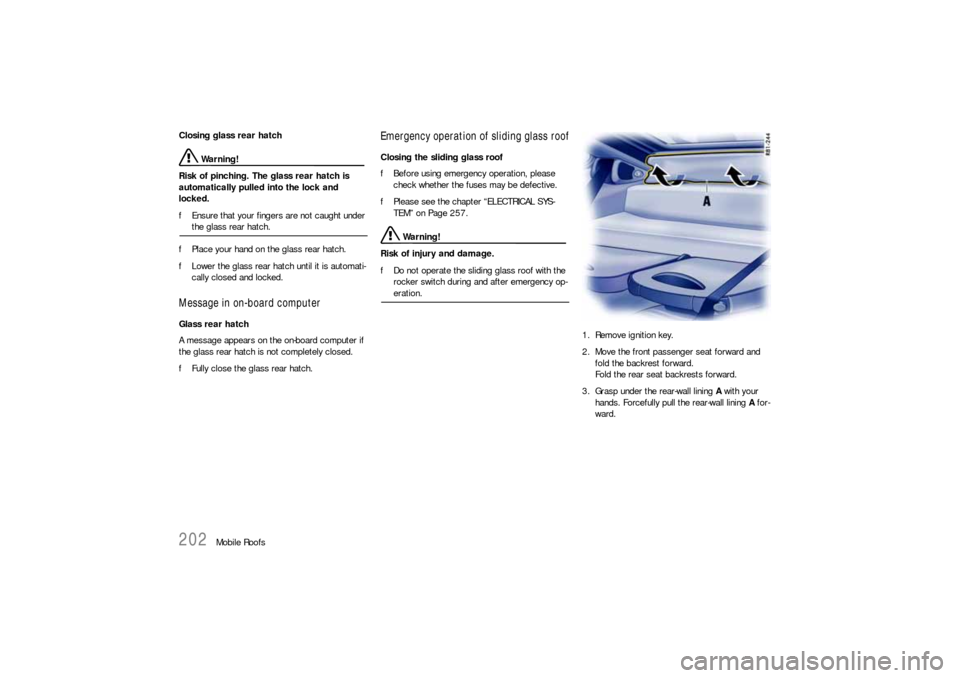
Emergency operation of sliding glass roofClosing the sliding glass roof
fBefore using emergency operation, please
check whether the fuses may be defective.
fPlease see the chapter “ELECTRICAL SYS-
TEM” on Page 257.
Warning!
Risk of injury and damage.
fDo not operate the sliding glass roof with the
rocker switch during and after emergency op-eration.
1. Remove ignition key.
2. Move the front passenger seat forward and
fold the backrest forward.
Fold the rear seat backrests forward.
3. Grasp under the rear-wall lining A with your
hands. Forcefully pull the rear-wall lining A for-
ward.
Page 206 of 310

204
Mobile Roofs
Roof Transport System(Coupé only)
fPlease follow the separate instructions for fit-
ting the Roof Transport System.
fOnly use Roof Transport Systems from the
Porsche Tequipment product range or Roof
Transport Systems which have been tested
and approved for your car by Porsche.
Fitting normal commercially available luggage
racks is not possible.
The Porsche Roof Transport System allows you
to carry various sports and hobby equipment.
Your authorized Porsche dealer will be pleased to
tell you about the various different uses of the
Roof Transport System.
Safety notes!
fCompletely remove the Roof Transport System
before using an automatic car wash – risk of
damage to the vehicle!
fDo not exceed the maximum permitted pay-
load, the maximum permitted gross weight
and the maximum permitted axle loads.
Please see the chapter “WEIGHTS COUPÉ” on
Page 291.
fDistribute load evenly, with heavy items as low
as possible.
Items of luggage must not project beyond the
side of the load area.
fFix and secure every item to the basic carrier
with a rope or lashing strap (do not use elastic
rubber tensioners).
fBefore every journey, and at regular intervals
during long trips, check that Roof Transport
System and load are secure. Re-tighten if nec-
essary and secure additionally by locking.When the Roof Transport System is loaded, the
maximum speed depends on the nature, size and
weight of the load being carried.
Driving, braking and steerin g b e h a v i o r c h a n g e d u e
to the higher center of gravity and the greater
wind-resistant area. You should adapt your driving
style appropriately.
Since fuel consumption and noise are increased
with the Roof Transport System fitted, it should
not remain on the vehicle if not in use.