page 2 PORSCHE 911 2009 5.G User Guide
[x] Cancel search | Manufacturer: PORSCHE, Model Year: 2009, Model line: 911, Model: PORSCHE 911 2009 5.GPages: 310, PDF Size: 3.39 MB
Page 28 of 310

26
Operation, Safety
Opening/closing windowsfFor the Cabriolet, select front or rear power
windows with rocker switch C.
The selection is displayed by the respective
light-emitting diode.
The two rocker switches A and B in the driver’s
door and the switch in the passenger’s door have
a two-stage function:
Opening
fPress the rocker switch down to the first stage
until the window has reached the desired
position.
Closing
fPress the rocker switch upwards to the first
stage until the window has reached the desired
position.
One-touch operation
fPress the rocker switch upwards or
downwards to the second stage.
Window moves to its final position.
Press again to stop the window in the desired
position.
Coupé, Targa
One-touch operation for closing the passenger’s
window is available once the window is approxi-
mately half-way closed.
Anti-crushing protectionIf a side window is blocked during closing, it will
stop and open again by about an inch.
Warning!
Risk of serious personal injuries.
If the rocker switch is pressed again within
10
seconds of the window being blocked, the
window will close with its full closing force.
Anti-crushing protection is disabled.
fOnce the anti-crushing protection acts to stop
the window and opens it slightly, do not press
the rocker switch again within 10 seconds
without checking to make sure that nothing is
blocking the path of the window.The window will close with full closing force.
One-touch operation is disabled for 10 seconds
after blockage of a side window.
Automatic window lowering fPlease see the chapter “DOORS” on Page 18.
fPlease see the chapter “CONVERTIBLE TOP”
on Page 181.Storing end position of the windowsIf the battery is disconnected and reconnected,
the windows will not be raised automatically when
the door is closed.
1. Close the windows with the rocker switch
once.
2. Press the rocker switch upwards again to store
the end position of the windows in the control
unit.
Page 29 of 310
Operation, Safety
27
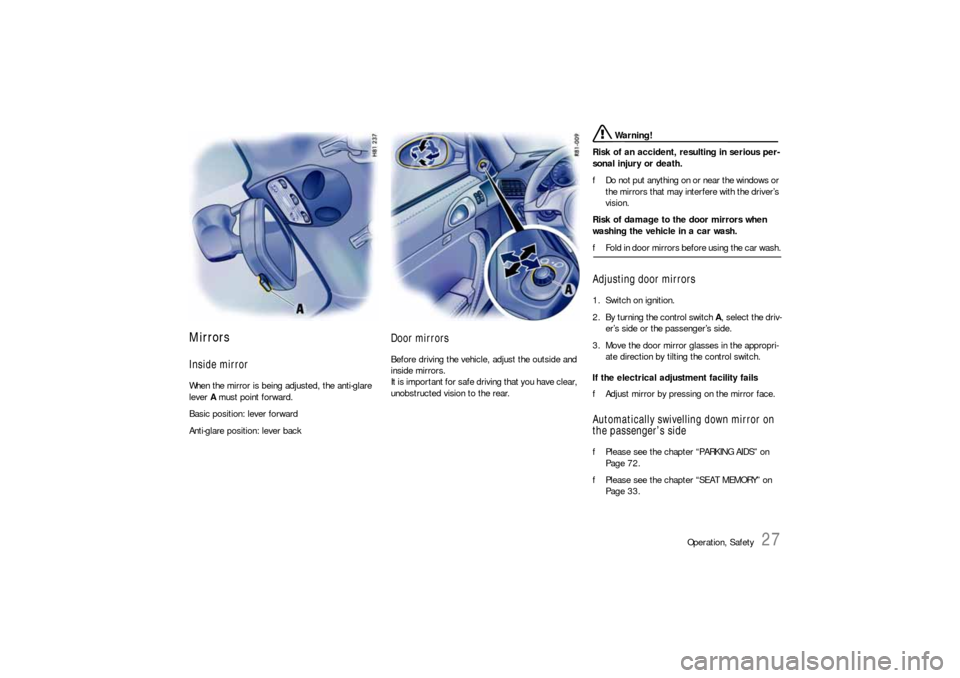
Mirrors Inside mirrorWhen the mirror is being adjusted, the anti-glare
lever A must point forward.
Basic position: lever forward
Anti-glare position: lever back
Door mirrorsBefore driving the vehicle, adjust the outside and
inside mirrors.
It is important for safe driving that you have clear,
unobstructed vision to the rear.
Warning!
Risk of an accident, resulting in serious per-
sonal injury or death.
fDo not put anything on or near the windows or
the mirrors that may interfere with the driver’s
vision.
Risk of damage to the door mirrors when
washing the vehicle in a car wash.
fFold in door mirrors before using the car wash.Adjusting door mirrors1. Switch on ignition.
2. By turning the control switch A, select the driv-
er’s side or the passenger’s side.
3. Move the door mirror glasses in the appropri-
ate direction by tilting the control switch.
If the electrical adjustment facility fails
fAdjust mirror by pressing on the mirror face.Automatically swivelling down mirror on
the passenger’s sidefPlease see the chapter “PARKING AIDS” on
Page 72.
fPlease see the chapter “SEAT MEMORY” on
Page 33.
Page 43 of 310

Operation, Safety
41
Safety Belts
Warning!
Always make sure your and your passengers’
safety belts are properly fastened while the
vehicle is in motion.
Failure to follow safety belt warnings may re-
sult in serious personal injury or death.
fFor your and your passengers’ protection, use
safety belts at all times while the vehicle is in
motion.
fUse appropriate child restraint systems for all
small children.
Proper wearing of safety belts
fSafety belts must be positioned on the body as
to restrain the upper body and lap from sliding
forward. Improperly positioned safety belts
can cause serious personal injury or death in
case of an accident.
fThe shoulder belt should always rest on your
upper body. The shoulder belt should never be
worn behind your back or under your arm.
fFor maximum effectiveness, the lap belt
should be worn low across the hips.
fPregnant women should position the belt as
low as possible across the pelvis. Make sure it
is not pressing against the abdomen. fBelts should not be worn twisted.
fDo not wear belts over rigid or breakable ob-
jects in or on your clothing, such as eye glass-
es, pens, keys, etc. as these may cause injury.
fSeveral layers of heavy clothing may interfere
with proper positioning of belts.
fBelts must not rub against sharp objects or
damage may occur to the belt.
fTwo occupants should never share the same
belt at the same time.
Care and maintenance
fKeep belt buckles free of any obstruction that
may prevent a secure locking.
fBelts that have been subjected to excessive
stretch forces in an accident must be inspect-
ed or replaced to ensure their continued effec-
tiveness in restraining you.
The same applies to belt tensioner systems
which have been triggered.
In addition, the anchor points of the belts
should be checked.
fIf safety belts do not work properly, see your
authorized Porsche dealer immediately.
fIf the belts show damage to webbing, bindings,
buckles or retractors, they should be replaced
to ensure safe operation.
fDo not modify or disassemble the safety belts
in your vehicle. fThe belts must be kept clean or the retractors
may not work properly.
Please see the chapter “CAR CARE INSTRUC-
TIONS” on Page 224.
fNever bleach or dye safety belts.
fDo not allow safety belts to retract until they
are completely dry after cleaning or this may
cause damage to the belt.
Belt tensioner Depending on the force of an impact, fastened
front seat safety belts are tightened in an acci-
dent.
The belt tensioners are triggered in:
– Front, side and rear impacts of sufficient
severity.
– For the Cabriolet, in cases of vehicle rollover.
Note
The belt-tensioner system can be triggered only
once; the system must be replaced afterward.
If there is a fault in the belt-tensioner system, the
airbag warning light lights up.
Work may be performed on the belt-tensioner sys-
tem only by an authorized Porsche dealer.
Smoke is released when the belt tensioners are
triggered. This does not indicate a fire in the
vehicle.
Page 44 of 310
42
Operation, Safety An audio-visual warning system is interconnect-
ed with the driver’s safety belt.
Every time the ignition is turned on, the gong will
sound for about 6 seconds to remind driver and
passenger to buckle up.
In addition, the gong will sound for approx. 90 sec-
onds if vehicle speed exceeds 15 mph/24 km/h.
The safety belt warning lights in the instrument
panel and on-board computer will go off as soon
as the driver has buckled up.
Inertia reel retractor The combination lap/shoulder belt with inertia reel
locking mechanism adjusts automatically to your
size and movements as long as the pull on the belt
is slow.
Rapid deceleration during hard braking or a colli-
sion locks the belt. The belt will also lock when you
drive up or down a steep hill or in a sharp curve,
otherwise, the shoulder belt will not inhibit your
upper body movement.
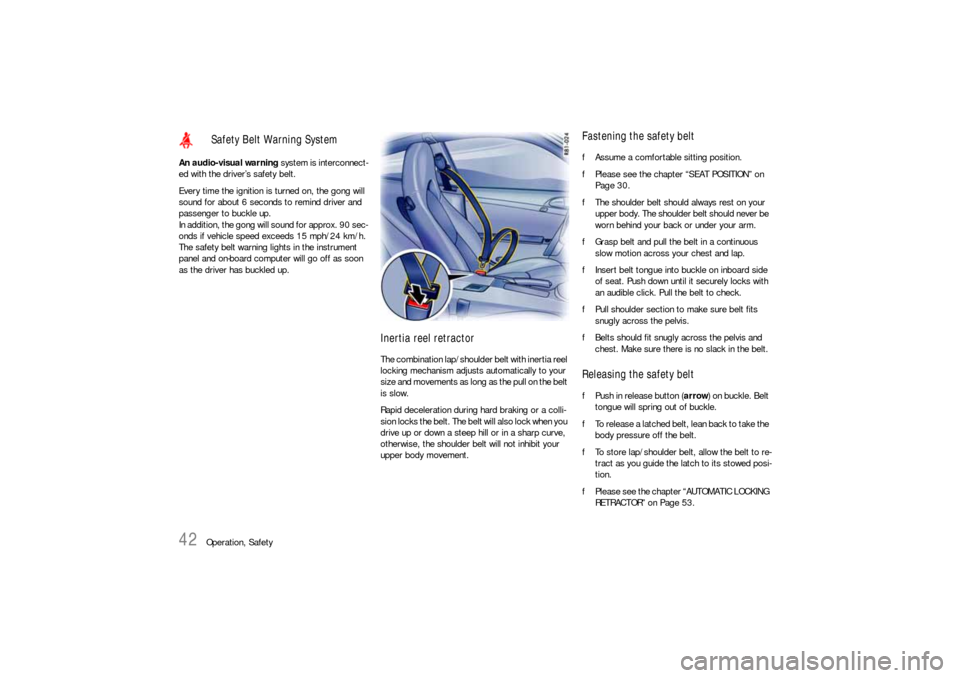
Fastening the safety beltfAssume a comfortable sitting position.
fPlease see the chapter “SEAT POSITION” on
Page 30.
fThe shoulder belt should always rest on your
upper body. The shoulder belt should never be
worn behind your back or under your arm.
fGrasp belt and pull the belt in a continuous
slow motion across your chest and lap.
fInsert belt tongue into buckle on inboard side
of seat. Push down until it securely locks with
an audible click. Pull the belt to check.
fPull shoulder section to make sure belt fits
snugly across the pelvis.
fBelts should fit snugly across the pelvis and
chest. Make sure there is no slack in the belt. Releasing the safety beltfPush in release button (arrow) on buckle. Belt
tongue will spring out of buckle.
fTo release a latched belt, lean back to take the
body pressure off the belt.
fTo store lap/shoulder belt, allow the belt to re-
tract as you guide the latch to its stowed posi-
tion.
fPlease see the chapter “AUTOMATIC LOCKING
RETRACTOR” on Page 53.
Safety Belt Warning System
Page 46 of 310

44
Operation, Safety
Airbag SystemsThe airbags in combination with the safety belts
make up a safety system which offers the driver
and the passenger the greatest known protection
from injuries in case of accident.
Your vehicle is equipped with a weight sensing sys-
tem for the front passenger's seat in accordance
with U.S. Federal Motor Vehicle Safety Standard
208.
Even if your vehicle is equipped with airbags, the
safety belts must be worn at all times,
because the front airbag system is only deployed
by frontal collisions with an impact of sufficient se-
verity.
Below the deployment threshold of the airbag sys-
tem, and during types of collisions which do not
cause the actuation of the system, the safety belts
provide the primary protection to the occupants
when correctly worn.
Therefore, all persons within the vehicle
must wear safety belts at all times (in many
states, state law requires the use of safety belts).
fPlease see the chapter “SAFETY BELTS” on
Page 41.
The front airbags are located under the padded
steering wheel panel on the driver’s side and, on
the passenger's side, in the dashboard.
The side airbags for the front seats are installed
on the side in the seat backrests.
The head airbags are installed in the door linings.
Danger!
To provide optimal occupant protection, air-
bags must inflate at very high speed. If you
are not wearing your safety belt or are too
close to the airbag when it is deployed, inflat-
ing airbags can result in serious personal in-
jury or death.
fMake sure there are no people, animals or ob-
jects between the driver or passenger and the
area into which the airbag inflates.
fSit back as far from the dashboard or steering
wheel as is practical, while still maintaining full
vehicle control.
fAlways hold the steering wheel by the outer
rim. Never rest your hands on the airbag panel.
fAlways fasten seat belts because triggering
of the airbag system depends on the force and
angle of impact.
fDo not transport heavy objects on or in front of
the passenger’s seat. These could impair the
function of the airbag, the seat belts, and
weight sensing.
fDo not hang objects (e.g. jackets, coats, coat
hangers) over the backrest.fAlways keep the lid of the door storage com-
partment closed. Objects must not protrude
out of the door storage compartment.
fNo changes may be made to the wiring or
components of the airbag system.
fDo not add any additional coverings or stickers
to the steering wheel or in the area of the pas-
senger’s airbag, side airbags and head air-
bags. Doing so may adversely affect the func-
tioning of the airbag system or cause harm to
the occupants if the airbag system should de-
ploy.
Do not use protective seat covers.
fDo not modify the seat coverings. Do not at-
tach additional cushions, protective coverings,
or pillows to the passenger's seat. Do not affix
things to the passenger's seat or cover it with
other materials. Do not cover the back of the
backrest. Do not make changes to the passen-
ger's seat and to the seat base frame.
fDo not undertake any wiring for electrical ac-
cessory equipment in the vicinity of the airbag
wiring harnesses. Doing so may disable the air-
bag system or cause inadvertent inflation.
fIf the warning light comes on, the airbag sys-
tem should be repaired immediately by your
authorized Porsche dealer.
fAlways keep feet in the footwell while driving.
Do not put feet on the dashboard or the seat
area. Do not lean against the inside of the door
or outside the window while the vehicle is mov-
ing.
Page 48 of 310
46
Operation, Safety Seat adjustment for the front passenger's
seat Danger!
Safety belts only offer protection when the
backrest is upright and the belts are properly
positioned on the body. Improperly posi-
tioned safety belts can cause serious person-
al injury or death in an accident.
fDo not operate the car with the driver or
passenger backrests excessively reclined.
fPorsche recommends the use of L.A.T.C.H.
(Lower Anchorage and Tether for Children)
equipped Porsche child seat.
Do not install a child restraint system in
the Sports bucket seat.
The Sports bucket seat cannot be equipped with the LATCH system.
If the seat is in an extreme position (e.g., the back-
rest is in contact with the rear seat), the backrest
can warp. Warping of the backrest can lead to mal-
functions.
fCorrect the seat adjustment.
Ensure that the seat is not jammed and is self-
supporting.
Ensure that the backrest is in the upright posi-
tion.
fDo not transport a load and objects in the rear
footwell and under the passenger's seat.
If the load or objects are under the seat, it can
cause malfunctions.If the weight on the passenger's seat is reduced
significantly, e.g., by supporting weight on the
armrest, the passenger's airbag can be switched
off.
fSelect an upright seat position, and do not sup-
port weight on the armrests or lean out of the
window.
Always keep feet in the footwell while driving.
Do not put feet on the dashboard or the seat
area. Do not lean against the inside of the door
or outside the window while the vehicle is mov-
ing.
If the passenger's seat is warped significantly, a
message is displayed on the on-board computer:
fCorrect the seat adjustment.
fPlease see the chapter “WARNINGS ON THE
INSTRUMENT PANEL AND THE ON-BOARD
COMPUTER” on Page 158.
Vehicle modifications to accommodate
persons with disabilities
Because modifications to your vehicle could com-
promise your advanced airbag system, please call
1-800-PORSCHE prior to having your vehicle mod-
ified.Automatic deactivation of the front
passenger’s airbag.
Danger!
The use of a child restraint system in the
front passenger’s seat can result in serious
personal injury or death to the child from an
airbag deployment.
fPlease see the chapter “PASSENGER AIRBAG
OFF INDICATOR LAMP DOES NOT LIGHT UP”
on Page 47.
fBefore transporting a child on the passenger’s
seat:
Please see the chapter “CHILD RESTRAINT
SYSTEMS” on Page 50.
fDo not install a child restraint system in the Sports bucket seat.
– When an up to one-year old child is seated
in the child restraint system, the front airbag is
automatically deactivated on the passenger’s
side.
– When an adult is seated in the front seat, the
front airbag remains active on the passenger‘s
side.
Page 49 of 310
Operation, Safety
47
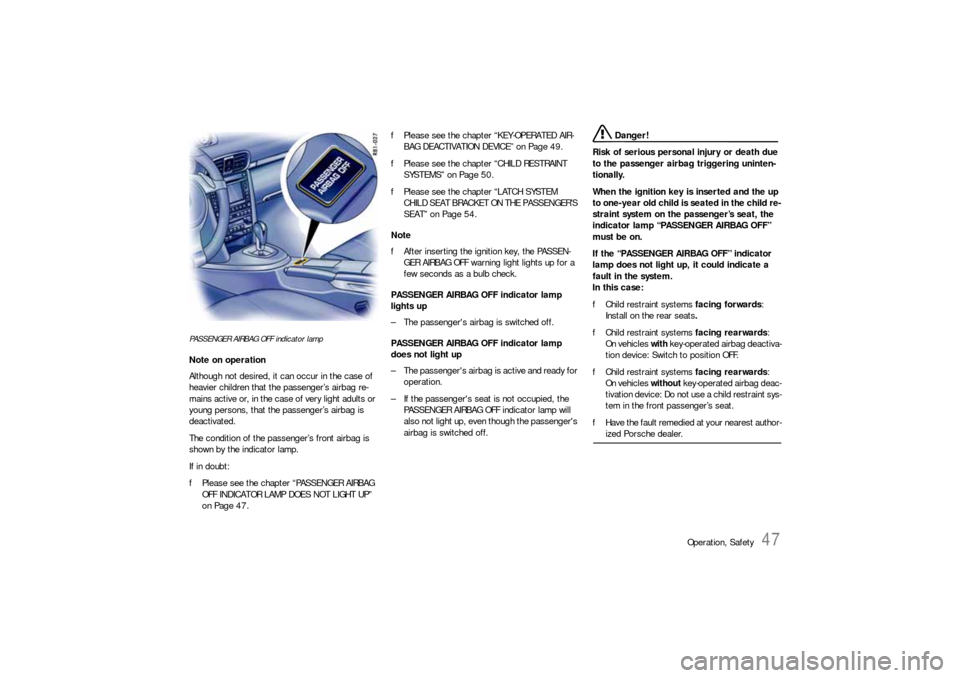
PASSENGER AIRBAG OFF indicator lampNote on operation
Although not desired, it can occur in the case of
heavier children that the passenger’s airbag re-
mains active or, in the case of very light adults or
young persons, that the passenger’s airbag is
deactivated.
The condition of the passenger’s front airbag is
shown by the indicator lamp.
If in doubt:
fPlease see the chapter “PASSENGER AIRBAG
OFF INDICATOR LAMP DOES NOT LIGHT UP”
on Page 47.fPlease see the chapter “KEY-OPERATED AIR-
BAG DEACTIVATION DEVICE” on Page 49.
fPlease see the chapter “CHILD RESTRAINT
SYSTEMS” on Page 50.
fPlease see the chapter “LATCH SYSTEM
CHILD SEAT BRACKET ON THE PASSENGER’S
SEAT” on Page 54.
Note
fAfter inserting the ignition key, the PASSEN-
GER AIRBAG OFF warning light lights up for a
few seconds as a bulb check.
PASSENGER AIRBAG OFF indicator lamp
lights up
– The passenger's airbag is switched off.
PASSENGER AIRBAG OFF indicator lamp
does not light up
– The passenger's airbag is active and ready for
operation.
– If the passenger's seat is not occupied, the
PASSENGER AIRBAG OFF indicator lamp will
also not light up, even though the passenger's
airbag is switched off.
Danger!
Risk of serious personal injury or death due
to the passenger airbag triggering uninten-
tionally.
When the ignition key is inserted and the up
to one-year old child is seated in the child re-
straint system on the passenger’s seat, the
indicator lamp “PASSENGER AIRBAG OFF”
must be on.
If the “PASSENGER AIRBAG OFF” indicator
lamp does not light up, it could indicate a
fault in the system.
In this case:
fChild restraint systems facing forwards:
Install on the rear seats.
fChild restraint systems facing rearwards:
On vehicles with key-operated airbag deactiva-
tion device: Switch to position OFF.
fChild restraint systems facing rearwards:
On vehicles without key-operated airbag deac-
tivation device: Do not use a child restraint sys-
tem in the front passenger’s seat.
fHave the fault remedied at your nearest author-ized Porsche dealer.
Page 50 of 310

48
Operation, Safety Note
The key switch for switching off the passenger’s
airbag in combination with the LATCH attachment
bracket are not installed at the factory. They can
be retrofitted.
fPlease see your authorized Porsche dealer.
Faults are indicated by a warning light in the instru-
ment panel and a message on the on-board com-
puter.
fPlease see the chapter “WARNINGS ON THE
INSTRUMENT PANEL AND THE ON-BOARD
COMPUTER” on Page 158.
fIn the following cases you should immedi-
ately consult an authorized Porsche
dealer in order to assure the airbag sys-
tem is functioning properly:
– If the warning light does not light up when the
ignition key is inserted or
– If the warning light does not go out once the
engine is running or
– If the warning light appears while driving.
Airbag maintenanceIn order to ensure long-term functioning, the air-
bag system must be inspected by an authorized
Porsche dealer at the intervals recommended in
your Maintenance Booklet.
Important information
If you sell your Porsche, notify the purchaser that
the vehicle is equipped with airbags, and refer
them to the chapter, “Airbag Systems“, in the
Owner's Manual (safety and disposal rules).
Further information on the airbag system can be
found on stickers attached to the sun visors.
For special recommendations on the use of child
restraints:
fPlease see the chapter “CHILD RESTRAINT
SYSTEMS” on Page 50.
Warning light and warning
message
Page 52 of 310

50
Operation, Safety
Child Restraint SystemsfDo not install a child restraint system in
the Sports bucket seat.
The Sports bucket seat cannot be
equipped with the LATCH system.
Porsche recommends that all infants and children
be restrained in child restraint systems at all times
while the vehicle is in motion in accordance with
applicable laws.
Use only child restraint systems with the LATCH-
system recommended by Porsche. These sys-
tems have been tested and adjusted to the interior
of your Porsche and the appropriate child weight
groups. Other systems have not been tested and
could entail an increased risk of injury or death.
You can obtain child seats that are LATCH compa-
tible at your authorized Porsche dealer.
fAlways observe the separate installation in-
structions for your child seat.
The use of infant or child restraints is required by
law in all 50 states of the U.S. and all Canadian
provinces. The child restraint system should be
one that complies with U.S. Federal Motor Vehicle
Safety Standards and should be secured by a lap
belt or lap belt portion of a lap-shoulder belt or for
child seats equipped with the LATCH sytem (Low-
er Anchorage and Tether for Children, also known
as ISOFIX) to the LATCH anchorages.
A statement by the seat manufacturer of compli-
ance with this standard can be found on the in-
struction label on the restraint and in the instruc-tion manual provided with the restraint.
Danger!
The use of a child restraint system in the
front passenger’s seat can result in serious
personal injury or death to the child from an
airbag deployment.
To reduce risk of injury from an inflating air-
bag in an accident, Porsche strongly recom-
mends:
fPlease see the chapter “PASSENGER AIRBAG
OFF INDICATOR LAMP DOES NOT LIGHT UP”
on Page 47.
fPlease see the chapter “CHILD RESTRAINT
SYSTEMS” on Page 50.
fDo not install a child restraint system in
the Sports bucket seat.
The Sports bucket seat cannot be equipped with the LATCH system.
Note
The key switch for switching off the passenger’s
airbag and the LATCH attachment bracket are not
installed at the factory. They can be retrofitted (not
on vehicles with Sports bucket seats).
fPlease see your authorized Porsche dealer.
Danger!
Risk of serious personal injury or death to the
child.
fFollow all child restraint instructions and warnings in this manual.
– When using an infant or child restraint system,
be sure to follow all manufacturer's instruc-
tions on installation and use.
– Infants and small children should never be held
on the lap, nor should they share a safety belt
with another occupant while the vehicle is in
motion.
– Children too big for child restraint systems
should use regular safety belts. A shoulder belt
can be used providing it does not cross the
face or the neck of the child.
– Choose a child restraint system according to
the weight of the child.
– Child restraint systems that are damaged or
h a v e b e e n h e a v i l y s t r e s s e d i n a n a c c i d e n t m u s t
be replaced immediately.
– Children could be endangered in a crash if their
child restrains are not properly secured in the
vehicle.
– Do not affix things to child restraint systems or
cover it with other materials.
Page 53 of 310

Operation, Safety
51
– Your authorized Porsche dealer will be glad to
advise you about the installation possibility for
a Porsche child restraint system which allows
a key-operated airbag deactivation of the pas-
senger’s airbag.
– The key-operated airbag deactivation device
installation requires special programming
available only from your authorized Porsche
dealer.
fPlease see the chapter “KEY-OPERATED
AIRBAG DEACTIVATION DEVICE” on Page 49.
Direction of installation for child restraint
systemsAccording to accident statistics, children are safer
when properly restrained in the rear seating
positions than in the front seating positions.
Under all normal circumstances, the forward
facing child seat must be placed in the rear.
Group 0 and 0+: Children up to 29 lbs (13 kg)
Children of this weight must be transported in a
restraint system which is installed on the
passenger’s seat facing rearward.
Group I: Children in between 20 lbs (9 kg)
and 40 lbs (18 kg)
Children of this weight are held in child restraint
systems facing forward.
Whenever possible, these child restraint systems
should be installed on the rear seats.
Group II: Children in between 33 lbs (15 kg)
and 55 lbs (25 kg)
Children of this weight are held in child restraint
systems facing forward.
Whenever possible, these child restraint systems
should be installed on the rear seats.Group III: Children in between 49 lbs (22 kg)
and 80 lbs (36 kg)
Children of this weight are held in child restraint
systems facing forward.
Whenever possible, these child restraint systems
should be installed on the rear seats.
If a child restraint system must be fastened to the
passenger’s seat, the passenger’s seat must be
adjusted to the lower rear position.
Note
If a child seat with top tether is adapted for use on
the front seat, the rear right (passenger’s side) an-
chor point must be used for anchoring the top
tether.
It is then not permitted for a passenger to use the
rear right (passenger’s side) seat.
It is then not permitted to install a child restraint
system on the rear right (passenger’s side) seat.
fPlease see the chapter “CHILD RESTRAINT
ANCHORAGES” on Page 55.