page 2 PORSCHE 911 2009 5.G Service Manual
[x] Cancel search | Manufacturer: PORSCHE, Model Year: 2009, Model line: 911, Model: PORSCHE 911 2009 5.GPages: 310, PDF Size: 3.39 MB
Page 95 of 310
Operation, Safety
93
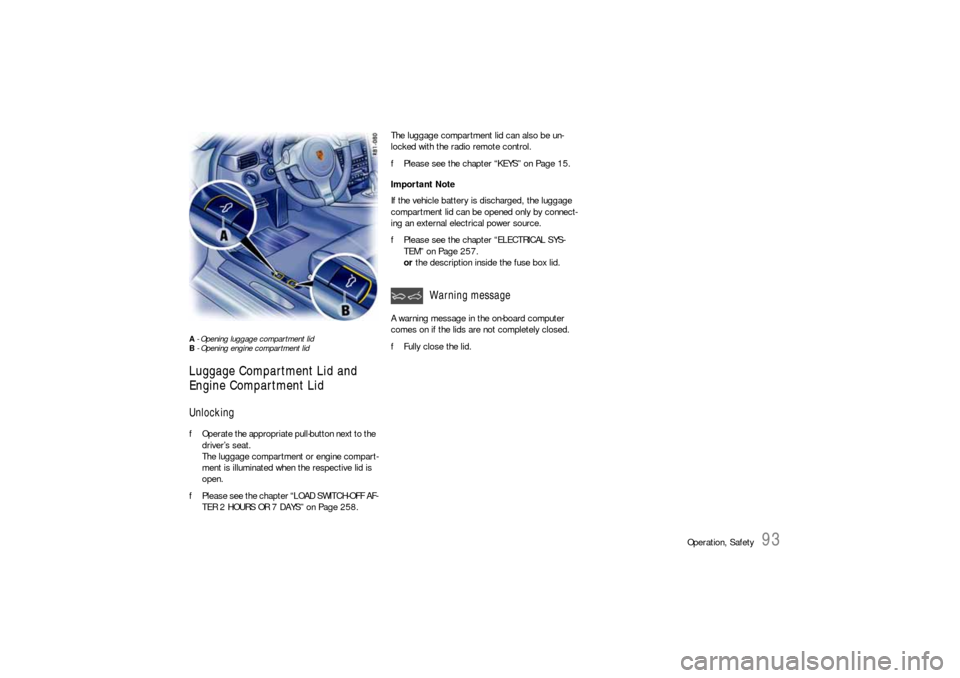
A - Opening luggage compartment lid
B - Opening engine compartment lid Luggage Compartment Lid and
Engine Compartment LidUnlocking fOperate the appropriate pull-button next to the
driver’s seat.
The luggage compartment or engine compart-
ment is illuminated when the respective lid is
open.
fPlease see the chapter “LOAD SWITCH-OFF AF-
TER 2 HOURS OR 7 DAYS” on Page 258.The luggage compartment lid can also be un-
locked with the radio remote control.
fPlease see the chapter “KEYS” on Page 15.
Important Note
If the vehicle battery is discharged, the luggage
compartment lid can be opened only by connect-
ing an external electrical power source.
fPlease see the chapter “ELECTRICAL SYS-
TEM” on Page 257.
or the description inside the fuse box lid.
A warning message in the on-board computer
comes on if the lids are not completely closed.
fFully close the lid.
Warning message
Page 100 of 310

98
Operation, Safety
Porsche Communication
Management (PCM) fRefer to the separate operating instructions
before putting the PCM into operation.
fPlease see the chapter “LOAD SWITCH-OFF
AFTER 2 HOURS OR 7 DAYS” on Page 258.
Warning!
There is a danger of accident if you set or
operate the on-board computer, radio, navi-
gation system, telephone or other equipment
when driving.
This could distract you from the traffic and
cause you to lose control of the vehicle re-
sulting in serious personal injury or death.
fOperate the components while driving only if
the traffic situation allows you to do so safely.
fCarry out any complicated operating or setting procedures only with the vehicle stationary.
The reception conditions for the radio module
integrated in the PCM change continuously as you
drive. Interference from buildings, terrain and the
weather is unavoidable.
FM stereo reception is particularly susceptible to
varying reception conditions.
Electronic accessories should only be retrofitted
by your authorized Porsche dealer.Accessories which have not been tested and
approved by Porsche may impair radio function
and reception.
NavigationWhen put into operation for the first time, a
distance of approx. 30 miles (50 km) must be
driven in order for the navigation system to
complete the process of fine calibration.
The same applies when the tires are changed (e.g.
summer/snow tires) or new tires fitted.
Full location accuracy is not yet achieved during
the fine-calibration process.
If the vehicle has been transported (e.g. ferry, car
train), the system may take a few minutes to deter-
mine the current location after it has been
switched on.
Serious tire slip (e.g. spinning wheels on snow)
may result in temporarily inaccurate navigation.
When the battery has been disconnected, it may
take up to 15 minutes before the navigation
system is operational again.
Car Audio Operation/Tips For radio operation see your radio manual
which is included with your on-board litera-
ture.
fPlease see the chapter “LOAD SWITCH-OFF AF-
TER 2 HOURS OR 7 DAYS” on Page 258.
FM reception
A vehicle is not an ideal place to listen to a radio.
Because the vehicle moves, reception conditions
are constantly changing.
Buildings, terrain, signal distance and noise from
other vehicles are all working against good recep-
tion.
Some conditions affecting FM may appear to be
problems when they are not.
The following characteristics are completely nor-
mal for a given reception area, and they do not in-
dicate any problem with the radio itself.
Note
Electronic accessories should only be installed by
your authorized Porsche dealer.
Equipment which has not been tested and ap-
proved by Porsche may impair radio reception.
Page 101 of 310
Operation, Safety
99
Fading and drifting
FM range is limited to about 25 miles (40 km),
except for some high power stations.
If a vehicle is moving away from the desired sta-
tion’s transmitter, the signal will tend to fade and/
or drift. This condition is more prevalent with FM
than AM, and is often accompanied by distortion.
Fading and drifting can be minimized to a certain
degree by careful attention to fine tuning or selec-
tion of a stronger signal.
Static and fluttering
When the line-of-sight link between a transmitter
and vehicle is blocked by large buildings or moun-
tains, the radio sound may be accompanied with
static or fluttering because of the characteristic of
FM.
In a similar effect, a fluttering noise is sometimes
heard when driving along a tree-lined road.
This static and fluttering can be reduced by adjust-
ing the tone control for greater bass response un-
til the disturbance has passed.
Multipath
Because of the reflecting characteristics of FM,
direct and reflected signals may reach the antenna
at the same time (multipath) and cancel each other
out.
As a vehicle moves through these electronic dead
spots, the listener may hear a momentary flutter
or loss of reception. Station swapping
When two FM stations are close to each other, and
an electronic dead spot, such as static or multi-
path area, interrupts the original signal, some-
times the stronger second signal will be selected
automatically until the original one returns.
This swapping can also occur as you drive away
from the selected station and approach another
station of a stronger signal.
Compact disc player
Caution!
To avoid damage to compact disc player and
discs.
fUse only compact discs labeled as shown, hav-
ing no dirt, damage or warpage.
fNever attempt to disassemble or oil any part
of the player unit.
Do not insert any object other than a disc into
the slot.
Remember there are no user-serviceable parts
inside the compact disc player.
fDo not allow the disc to sustain any finger-
prints, scrapes or stickers on the surfaces.
This may cause poor sound quality.
Hold the disc only on the edge or center hole. fWhen not in use, take the disc out of the player,
put the disc back into its case and store it
away from dust, heat, damp and direct
sunlight.
Leaving the disc on the dashboard in the sun
can damage the disc.
fIf the disc gets dirty, clean the disc by wiping
the surfaces from the center to the outside in
a radial direction with a soft cloth.
Do not use a conventional record cleaner or
anti-static record preservative.
Disc cleaners are available in audio stores.
Page 119 of 310

Instruments, On-Board Computer, Warnings
117
Dimming instrument illumination
fTurn adjustment button A in the appropriate di-
rection and hold it until the desired brightness
has been reached.
The chosen level of brightness is indicated by a
bar display in the display field of the on-board
computer.
Trip Odometer
Warning!
Risk of loss of control or accident, resulting
in serious personal injury or death.
fDo not reach through the steering-wheel spokes while driving.
Resetting to zero fPress adjustment button A for approximately
one second or
fReset the distance in the “SET” menu of the on-
board computer.
Please see the chapter “SET BASIC SETTING
ON ON-BOARD COMPUTER” on Page 155.
After exceeding 6,213 miles or 9,999 kilometers,
the counter returns to “0”.
Page 120 of 310
118
Instruments, On-Board Computer, Warnings
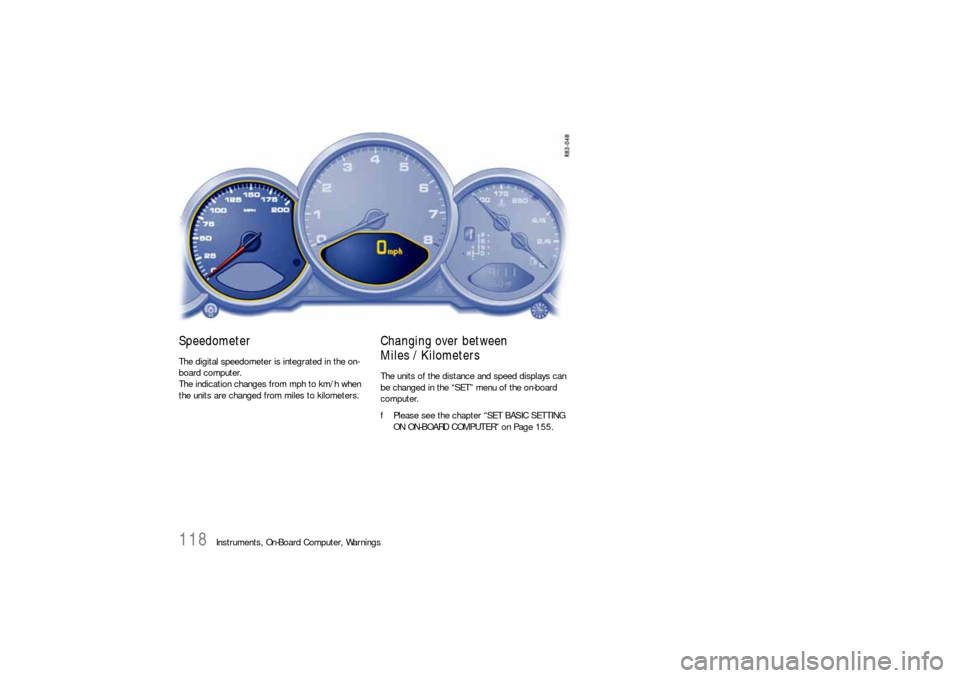
Speedometer The digital speedometer is integrated in the on-
board computer.
The indication changes from mph to km/h when
the units are changed from miles to kilometers.
Changing over between
Miles / Kilometers The units of the distance and speed displays can
be changed in the “SET” menu of the on-board
computer.
fPlease see the chapter “SET BASIC SETTING
ON ON-BOARD COMPUTER” on Page 155.
Page 122 of 310
120
Instruments, On-Board Computer, Warnings
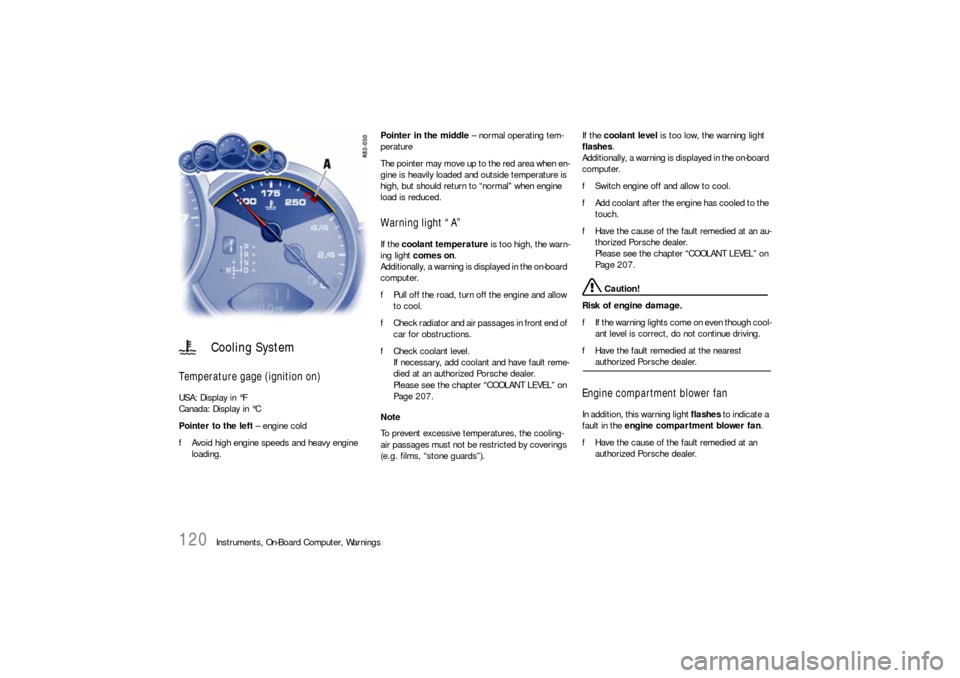
Temperature gage (ignition on) USA: Display in °F
Canada: Display in °C
Pointer to the left – engine cold
fAvoid high engine speeds and heavy engine
loading. Pointer in the middle – normal operating tem-
perature
The pointer may move up to the red area when en-
gine is heavily loaded and outside temperature is
high, but should return to “normal” when engine
load is reduced.
Warning light “A” If the coolant temperature is too high, the warn-
ing light comes on.
Additionally, a warning is displayed in the on-board
computer.
fPull off the road, turn off the engine and allow
to cool.
fCheck radiator and air passages in front end of
car for obstructions.
fCheck coolant level.
If necessary, add coolant and have fault reme-
died at an authorized Porsche dealer.
Please see the chapter “COOLANT LEVEL” on
Page 207.
Note
To prevent excessive temperatures, the cooling-
air passages must not be restricted by coverings
(e.g. films, “stone guards”). If the coolant level is too low, the warning light
flashes.
Additionally, a warning is displayed in the on-board
computer.
fSwitch engine off and allow to cool.
fAdd coolant after the engine has cooled to the
touch.
fHave the cause of the fault remedied at an au-
thorized Porsche dealer.
Please see the chapter “COOLANT LEVEL” on
Page 207.
Caution!
Risk of engine damage.
fIf the warning lights come on even though cool-
ant level is correct, do not continue driving.
fHave the fault remedied at the nearest authorized Porsche dealer.
Engine compartment blower fan In addition, this warning light flashes to indicate a
fault in the engine compartment blower fan.
fHave the cause of the fault remedied at an
authorized Porsche dealer.
Cooling System
Page 123 of 310
Instruments, On-Board Computer, Warnings
121
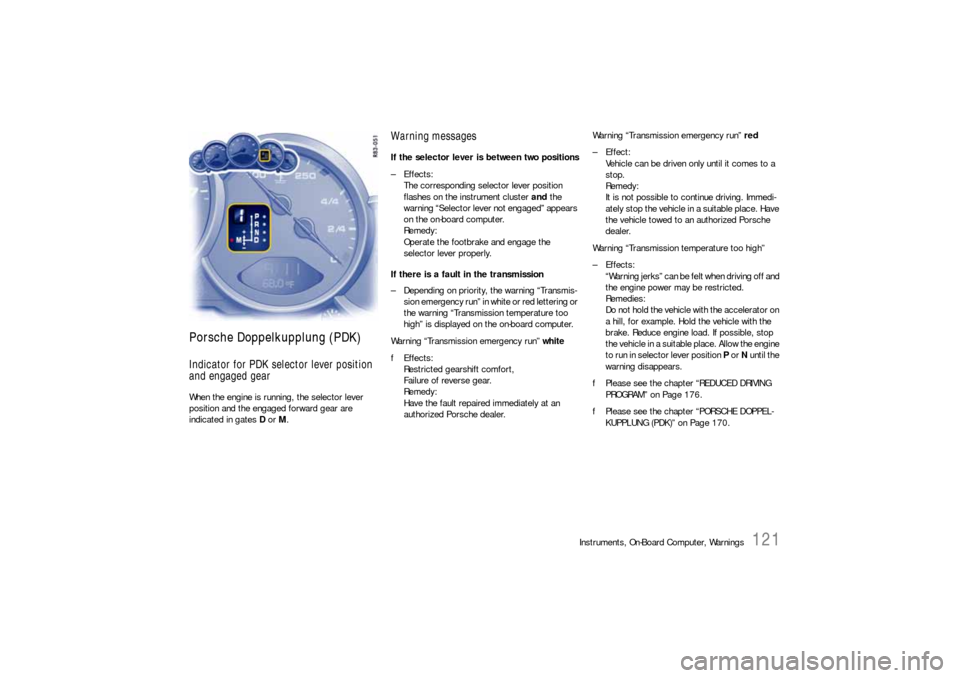
Porsche Doppelkupplung (PDK)Indicator for PDK selector lever position
and engaged gearWhen the engine is running, the selector lever
position and the engaged forward gear are
indicated in gates D or M.
Warning messagesIf the selector lever is between two positions
–Effects:
The corresponding selector lever position
flashes on the instrument cluster and the
warning “Selector lever not engaged” appears
on the on-board computer.
Remedy:
Operate the footbrake and engage the
selector lever properly.
If there is a fault in the transmission
– Depending on priority, the warning “Transmis-
sion emergency run” in white or red lettering or
the warning “Transmission temperature too
high” is displayed on the on-board computer.
Warning “Transmission emergency run” white
fEffects:
Restricted gearshift comfort,
Failure of reverse gear.
Remedy:
Have the fault repaired immediately at an
authorized Porsche dealer.Warning “Transmission emergency run” red
– Effect:
Vehicle can be driven only until it comes to a
stop.
Remedy:
It is not possible to continue driving. Immedi-
ately stop the vehicle in a suitable place. Have
the vehicle towed to an authorized Porsche
dealer.
Warning “Transmission temperature too high”
–Effects:
“Warning jerks” can be felt when driving off and
the engine power may be restricted.
Remedies:
Do not hold the vehicle with the accelerator on
a hill, for example. Hold the vehicle with the
brake. Reduce engine load. If possible, stop
the vehicle in a suitable place. Allow the engine
to run in selector lever position P or N until the
warning disappears.
fPlease see the chapter “REDUCED DRIVING
PROGRAM” on Page 176.
fPlease see the chapter “PORSCHE DOPPEL-
KUPPLUNG (PDK)” on Page 170.
Page 124 of 310

122
Instruments, On-Board Computer, Warnings
Level gage
When the ignition is on the fuel level is displayed.
fPlease see the chapter “CAPACITIES” on
Page 290.
If the vehicle’s inclination changes (e.g. going up
or downhill), minor deviations in the indication may
occur. Note
If a small quantity of fuel is added to a nearly emp-
ty fuel tank, the fuel gage cannot measure the add-
ed fuel accurately. The „remaining range“ readout
will also be incorrect.
Warning light “A” When the engine is running, the warning light
of the level gage lights up if less than approx.
2.6 U.S. gallons (10
liters) of fuel remains in the
tank.
Additionally, a warning is displayed in the on-board
computer.
fFill up at the next opportunity.
Caution!
To prevent damage to the emission control
system and engine.
fNever drive the tank completely out of fuel.
fAvoid high cornering speeds after the warning lights have come on.
fPlease see the chapter “EMISSION CONTROL
SYSTEM” on Page 218.If the level gage warning light flashes, there
has been a system fault.
Additionally, a warning is displayed in the on-board
computer.
There will then be no reserve warning.
fTo remedy the fault, go to an authorized
Porsche dealer.
Fuel
Page 126 of 310

124
Instruments, On-Board Computer, Warnings The oil pressure is controlled as required and
should be at least 3.5 bar at an engine speed of
5000 rpm.
The engine oil pressure varies depending on the
engine speed, engine load and engine tempera-
ture.If oil pressure drops abruptly and a message
is displayed on the on-board computer when
the engine is running on or when driving:
fStop immediately in a suitable place.
fSwitch off the engine.
fCheck whether there is an obvious oil leak on
or under the car.
fIf no oil leak can be detected: With the engine
idling, measure the oil level with the on-board
computer.
fPlease see the chapter “OIL DISPLAY AND
MEASUREMENT OF THE ENGINE OIL LEVEL”
on Page 153.
fPlease see the chapter “ENGINE OIL LEVEL”
on Page 208.
fAdd engine oil if necessary.
Caution!
Risk of engine damage.
fDo not continue driving if there is an obvious oil
leak.
fDo not continue driving if the warning lights
come on even though oil level is correct.
fHave the fault remedied at the nearest authorized Porsche dealer.If the battery voltage drops abruptly, a warning
message will be displayed by the on-board compu-
ter.
If the warning is displayed by the on-board
computer while the engine is running or while
driving:
fStop the car in a safe place and stop the
engine.
Possible causes
– Defect in the battery charging system.
– Broken drive belt.
Warning!
Risk of engine damage with resultant loss of
control and accident, leading to serious per-
sonal injury or death.
A broken drive belt means there is no power
assistance to the steering (more effort is re-
quired to steer) and coolant pump function
will stop.
fDo not continue driving.
fHave the fault remedied at the nearest author-ized Porsche dealer.
Engine Oil Pressure
Battery
Page 127 of 310

Instruments, On-Board Computer, Warnings
125
Check Engine
(Emission Control)The emission control system detects malfunctions
early that could, for example, cause increased
pollutant emissions or consequential damage.
Faults are indicated by a continuously lit or
flashing instrument panel warning light.
The faults are recorded in the control unit's fault
memory.
The warning light in the instrument panel lights up
when the ignition is switched on as a bulb check
and goes out approx. 4 seconds after the engine
starts. If the warning light does not light up, have
the bulb replaced promptly.
The warning light in the instrument panel flashes to
indicate operating states (e.g. engine misfiring)
which might cause damage to certain parts of the
emission control system.
fIn this case, immediately reduce the engine
load by easing off the accelerator.
fIn order to avoid consequential damage to the
engine or emission control system (e.g. cata-
lytic converter), have the fault diagnosed and
rectified immediately at the nearest authorized
Porsche dealer.If the warning light in the instrument panel lights up
permanently without flashing before and remains
on while driving, it suggests:
– a potential engine control problem and the
need for system service or
– an improperly fastened tank cap or
– the vehicle was refueled while the engine was
running.
fStop immediately at a suitable and secure
place and check tank cap for proper fastening.
If tank cap was fastened correctly, see your au-
thorized Porsche dealer for service as soon as
possible.
Caution!
If the check engine warning light in the in-
strument panel is flashing, serious catalytic
converter damage and power loss will soon
occur.
Prolonged driving with the check engine war-
ning light on could cause damage to the
emission control system. It also could affect
fuel economy and driveability.
fHave the fault remedied at the nearest authorized Porsche dealer immediately.The central warning light on the instrument panel
lights up if there are warning messages in the
INFO menu.
The messages can be called in the on-board
computer INFO menu:
fPlease see the chapter “INFO WARNING MES-
SAGES” on Page 132.
The warning light on the instrument panel lights
up:
– if the handbrake is on,
– if the brake fluid level is low,
– if the brake pads have reached the wear limit,
– if the brake circuit division is defective.
Additionally, a warning is displayed by the on-
board computer.
fPlease see the chapter “WARNINGS ON THE
INSTRUMENT PANEL AND THE ON-BOARD
COMPUTER” on Page 158.
Warning Light
Central Warning Light
Brake Warning Light USA
Brake Warning Light Canada