page 2 PORSCHE 911 2009 5.G Owner's Manual
[x] Cancel search | Manufacturer: PORSCHE, Model Year: 2009, Model line: 911, Model: PORSCHE 911 2009 5.GPages: 310, PDF Size: 3.39 MB
Page 54 of 310
52
Operation, Safety
Using child restraint systems in the front
passenger seatfDo not install a child restraint system in
the Sports bucket seat.
Danger!
The use of a child restraint system in the
front passenger seat can result in serious
personal injury or death to the child from an
airbag deployment.
To reduce risk of injury from an inflating air-
bag in an accident, Porsche strongly recom-
mends:
fPlease see the chapter “PASSENGER AIRBAG
OFF INDICATOR LAMP DOES NOT LIGHT UP”
on Page 47.
fPlease see the chapter “CHILD RESTRAINT
SYSTEMS” on Page 50.
fDo not install a child restraint system in
the Sports bucket seat.
The Sports bucket seat cannot be equipped with the LATCH system. Child restraint system for up to one-year old
children
– Make sure that the PASSENGER AIRBAG OFF
indicator lamp lights up.
– Adjust the passenger's seat as far away from
the airbag as possible.
Danger!
Risk of serious personal injury or death due
to the passenger’s airbag triggering uninten-
tionally.
When the ignition is on and the up to one-
year old child is seated in the child restraint
system on the passenger’s seat the indicator
lamp „PASSENGER AIRBAG OFF“ must be on.
If the “PASSENGER AIRBAG OFF” indicator
lamp does not light up, it could indicate a
fault in the system.
In this case:
fOn vehicles with key-operated airbag deactiva-
tion device: Switch to position OFF.
fOn vehicles without key-operated airbag deac-
tivation device: Do not use a child restraint sys-
tem in the front passenger’s seat.
fHave the fault remedied at your nearest autho-rized Porsche dealer.Child restraint system for children older than
one year
Your vehicle is equipped with a weight sensing sys-
tem for the passenger's seat in accordance with
U.S. Federal Motor Vehicle Safety Standard 208.
Depending on the weight acting on the passen-
ger's seat, the passenger's airbag will automati-
cally be switched on or off.
Small adult passengers
Make sure that the PASSENGER AIRBAG OFF indi-
cator lamp does not light up.
Danger!
Risk of serious personal injury or death due
to the passenger’s airbag not triggering.
When the ignition key is inserted and the
small adult passenger is seated on the pas-
senger’s seat, the indicator lamp “PASSEN-
GER AIRBAG OFF” must be off.
If the “PASSENGER AIRBAG OFF” indicator
lamp lights up, it could indicate a fault in the
system.
In this case:
fThe passenger should sit in the rear seat until
the fault is repaired.
fHave the fault remedied at the nearest autho-rized Porsche dealer.
Page 55 of 310

Operation, Safety
53
Automatic locking retractorfDo not install a child restraint system in
the Sports bucket seat.
The Sports bucket seat cannot be
equipped with the LATCH system.
The safety belts for the front passenger and rear
seats are equipped with an automatic locking re-
tractor for securing the child restraint system.
When activated, this retractor allows you to se-
curely fasten the child restraint system in place so
that inadvertent movements will not occur.
Danger!
The use of a child restraint system on the
front passenger seat can result in serious
personal injury or death to the child from an
airbag deployment.
To reduce risk of injury from an inflating air-
bag in an accident, Porsche strongly recom-
mends:
fUnder all normal circumstances, forward fa-cing child seats must be placed in the rear.
Before transporting a child on the passenger’s
seat:
fPlease see the chapter “CHILD RESTRAINT
SYSTEMS” on Page 50.
Danger!
Risk of serious personal injury or death to the
child, when excessive force is acting on the
passenger's seat due to the seat belt.
In such cases, the passenger's airbag can be
switched on unintentionally.
fAfter fastening the child restraint system, do
not adjust the seat.
fCheck the condition of the passenger’s airbag
shown by the indicator lamp in the central con-sole.Activating the automatic locking retractor
1. If a child restraint system must be fastened to
the passenger's seat, adjust the passenger's
seat as far away from the airbag as possible.
2. Fasten child seat.
3. Pull the safety belt retractor completely out. At
this point the locking mechanism is activated.
4. Insert the safety belt tongue into the buckle
and make certain that it is properly latched.
Make no more adjustments to the seat.
5. Allow the safety belt to retract until it is tight on
the child restraint system. You may further
tighten the belt by pulling on it to allow more of
it to retract.
Make sure that excessive seat belt forces do
not occur by moving the seat with the child
seat installed.
Releasing the safety belt
1. Unbuckle the safety belt latch.
2. Then make certain that the belt has fully
retracted. At this point the automatic locking
feature will be disengaged.
Seek appropriate advice from your authorized
Porsche dealer about the possible installation
of a Porsche child restraint system.
Page 56 of 310
54
Operation, Safety
LATCH SystemChild seat bracket on the passenger’s
seatfDo not install a child restraint system in
the Sports bucket seat.
The Sports bucket seat cannot be
equipped with the LATCH system.
The key switch for switching off the passenger’s
airbag and the LATCH attachment bracket are not
installed at the factory. They can be retrofitted
(not on vehicles with Sports bucket seats).
fPlease see your authorized Porsche dealer.
Porsche recommends the use of a Porsche Child
Seat with Lower Anchorage and Tether for Chil-
dren system (LATCH).
These systems have been tested and adjusted to
the interior of your Porsche and the appropriate
child weight groups. Other systems have not been
tested and could entail an increased risk of injury.
You can obtain child seats that are LATCH compat-
ible at your authorized Porsche dealer.
fAlways observe the separate installation in-
structions for your child seat.
fPlease see the chapter “CHILD RESTRAINT
SYSTEMS” on Page 50.
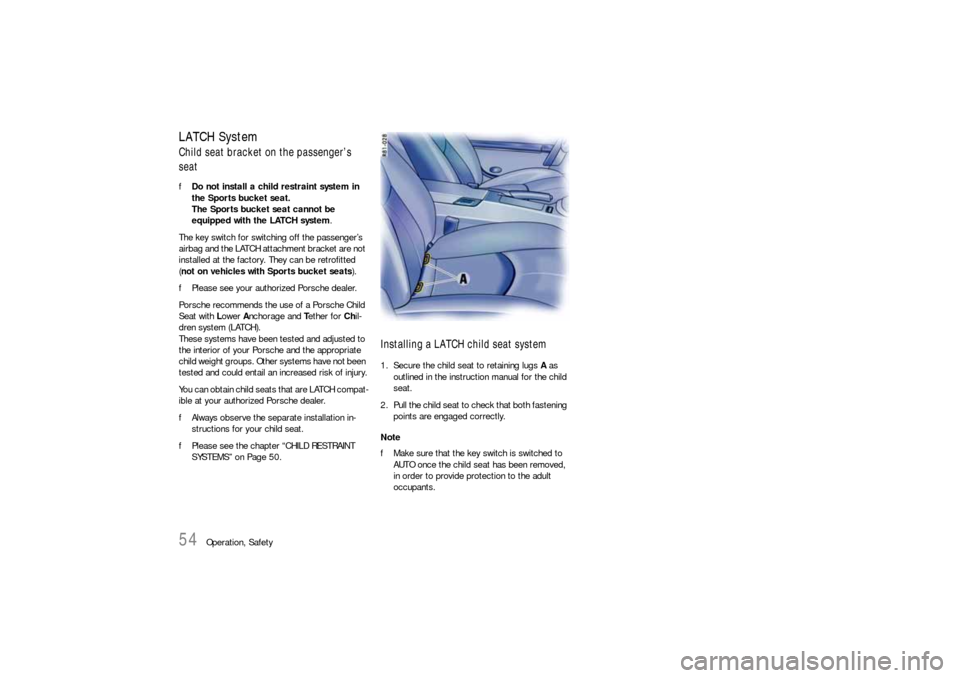
Installing a LATCH child seat system1. Secure the child seat to retaining lugs A as
outlined in the instruction manual for the child
seat.
2. Pull the child seat to check that both fastening
points are engaged correctly.
Note
fMake sure that the key switch is switched to
AUTO once the child seat has been removed,
in order to provide protection to the adult
occupants.
Page 57 of 310
Operation, Safety
55
Child Restraint Anchorages (Coupé and Targa)
fPlease see the chapter “AUTOMATIC LOCKING
RETRACTOR” on Page 53.
fDo not install a child restraint system in
the Sports bucket seat.
The Sports bucket seat cannot be
equipped with the LATCH system.
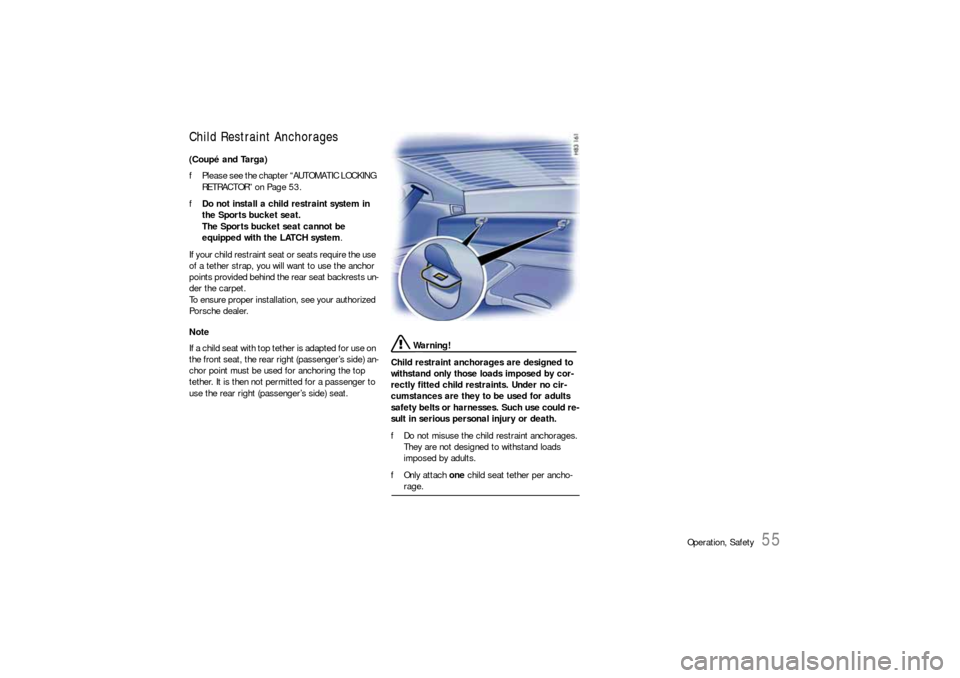
If your child restraint seat or seats require the use
of a tether strap, you will want to use the anchor
points provided behind the rear seat backrests un-
der the carpet.
To ensure proper installation, see your authorized
Porsche dealer.
Note
If a child seat with top tether is adapted for use on
the front seat, the rear right (passenger’s side) an-
chor point must be used for anchoring the top
tether. It is then not permitted for a passenger to
use the rear right (passenger’s side) seat.
Warning!
Child restraint anchorages are designed to
withstand only those loads imposed by cor-
rectly fitted child restraints. Under no cir-
cumstances are they to be used for adults
safety belts or harnesses. Such use could re-
sult in serious personal injury or death.
fDo not misuse the child restraint anchorages.
They are not designed to withstand loads
imposed by adults.
fOnly attach one child seat tether per ancho-rage.
Page 58 of 310

56
Operation, Safety
Rollover Protection System The Rollover Protection System on the Cabriolet
consists of two supplemental safety bars that to-
gether with the front windshield frame help to cre-
ate occupant survival space in case of rollover. Be-
cause of the extreme and unpredictable forces
which can be encountered in a rollover, it is not
possible to guarantee that occupants will be pro-
tected from all contact with exterior objects or the
ground. However, the Rollover Protection System
is designed to maintain the occupant survival
space.
The Rollover Protection System is activated auto-
matically in the event of an accident or extreme
driving situation.
The protective devices are located behind each
rear seat and rapidly deploy within a fraction of a
second. If necessary, the seat-belt tensioners will
be activated.
fPlease see the chapter “BELT TENSIONER” on
Page 41.
They can deploy under:
– Extreme tilting of the vehicle.
– Loss of ground contact (e.g. Going over the
crest of a hill at high speed).
Danger!
Risk of death or serious injury.
fDo not block area of supplemental safety bars
with objects.
In the event of a deployment event, such
objects could potentially prevent such deploy-
ment from occuring, or such objects could
impact the car occupants at high speed.
fDo not tamper with or work on wiring and or
components of Rollover Protection System.
fAll work regarding this system must be carried
out by your authorized Porsche dealer.
fCheck functions and periodic service intervals
according to maintenance schedule (see your
authorized Porsche dealer).
To avoid damage to the convertible top:
fIf the supplemental safety bars are extended
for any reason, do not open or close converti-ble top.Faults in the Rollover Protection System are indi-
cated by the airbag warning light in the instrument
panel.
Extension of the supplemental safety bars is no
longer ensured.
fSee your authorized Porsche dealer immedi-
ately and have the fault remedied.
Lowering the supplemental safety bars
after deployment fHave this work performed by an authorized
Porsche dealer.
Warning light
Page 65 of 310

Operation, Safety
63
Porsche Traction Management
(PTM)With PTM, the engine power is variably distributed
to the front and rear wheels.
Power distribution between the front and rear ax-
les is performed by a map-conrolled multiple-disc
clutch.
Distribution of the engine power also depends on
the difference in wheel speed between the two ax-
les.
The multiple-disc clutch always delivers sufficient
drive power to the front wheels to ensure optimum
propulsion even on an unfavorable road surface.
In combination with the Porsche Stability Manage-
ment (PSM), the PTM ensures optimum handling
and high driving stability.
Warning!
The increased control that is provided should
not induce you to take greater risks with your
safety. The limits dictated by the laws of phy-
sics cannot be overcome, even with PTM.
The risk of accidents due to inappropriate
speed cannot be reduced, even by PTM.
The driver bears the responsibility for all dri-
ving maneuvers.
fAdapt your driving style to the prevailing road
and weather conditions.
fObey all traffic laws.
Dynamometer testing procedure Some U.S. states and Canadian provinces con-
duct emissions inspection/maintenance testing in-
volving the use of two-wheel dynamometer.
A two-wheeled dynamometer is a treadmill type
device upon which a single axle of the car, the dri-
ving axle of the vehicle, rotates to simulate vehicle
operation on the road while the vehicle remains
stationary.
Your vehicle has a full-time four-wheel drive system
which cannot be disabled. Severe damage to the
powertrain can result if tested on a two-wheel dy-
namometer.
Warning!
Risk of severe powertrain damage and a pos-
sible unexpected movement of the vehicle.
fDo not test your vehicle on a two-wheel dyna-
mometer.
fAdvise the emission station of this warning be-fore testing the vehicle.
Brake testsBrake tests must be performed only on plate-type
test stands or roller test stands.
The ignition must be off.
The following limit values must not be exceeded
on roller test stands:
– Testing speed 5 mph (8 km/h)
– Test duration 20 seconds Handbrake tests Handbrake tests on the roller test stand must only
be carried out with the ignition switched off. Balancing wheels on the vehicle During finish balancing of the wheels, the vehicle
must be hoisted and all the wheels able to rotate
freely. Towing fPlease see the chapter “TOWING” on
Page 280.Wheels/TiresThe PTM control unit is adapted to the approved
tire sizes. The use of non-approved tire sizes may
lead to deviations in wheel speeds and it may influ-
ence handling or result in the PTM switching off.
Page 66 of 310

64
Operation, Safety
Sport ModeA sportier car set-up is obtained when Sport mode
is switched on. Interventions by the Porsche
control systems are intentionally shifted towards
greater agility and driving performance:
– PASM (Porsche Active Suspension Manage-
ment) is automatically changed to Sport mode,
resulting in a stiffer suspension setup.
– When Sport mode is active, the PDK transmis-
sion switches to a sporty gear-changing map
and shortens the gear shifting times. Gear
changes take place faster, but fuel consump-
tion is also increased.
PSM (Porsche Stability Management) control
gives a sportier road-feel to the vehicle. PSM
interventions take place later than in Normal
mode. The driver can maneuver the vehicle
with greater agility at its performance limits,
without having to dispense with the assistance
of PSM in emergency situations. This helps to
achieve optimal lap times, particularly on race
circuits with a dry road surface.
– The electronic accelerator pedal reacts
sooner, and the engine is more responsive to
throttle inputs. When Sport mode is switched
on, this function is activated only after the
driver has floored the accelerator pedal or
released it briefly.– The rpm limiter characteristic is “harder”, i.e.
the engine is immediately throttled when the
performance limits are reached (only in manual
selection mode for vehicles with PDK transmis-
sion).
fPlease observe the chapters on PSM, PASM
and PDK.
Switching Sport mode on and offSwitching Sport mode on and off simultaneously
activates and deactivates the Sport mode in
PA S M .
If PASM Sport mode was activated with the PASM
button, PASM remains active.
After the ignition is switched off, Sport mode is
automatically reset to Normal mode.
SPORT button
fPress SPORT button A in the center console.
When Sport mode is switched on, the light-
emitting diode in the SPORT button is lit.
A sporty gear-changing map is enabled and the
gear shifting times are shortened for the PDK
transmission.
A sporty driving style is recognized more quickly
and the gear-changing speeds are adapted to
driving performance.
Deceleration downshifts are commenced earlier.
Downshifts are made during slight decelerations,
even at higher engine speeds.
fPlease see the chapter “SPORT MODE
(“SPORT” AND “SPORT PLUS” MODES)” on
Page 172.
Page 67 of 310
Operation, Safety
65
SPORT PLUS button
(only on vehicles with PDK transmission)
In “Sport Plus” mode, the PDK transmission
changes to a shift program designed for driving
on race circuits. 7th gear is not selected.
The gear-changing performance is enhanced
significantly again compared with “Sport” mode.
fPlease see the chapter “SPORT MODE
(“SPORT” AND “SPORT PLUS” MODES)” on
Page 172.
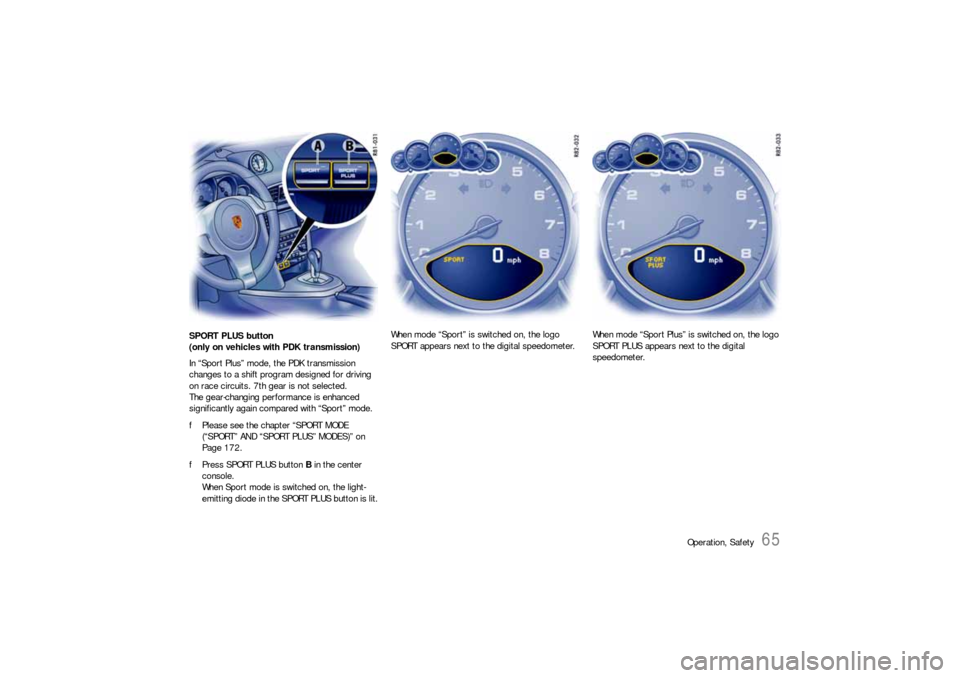
fPress SPORT PLUS button B in the center
console.
When Sport mode is switched on, the light-
emitting diode in the SPORT PLUS button is lit.When mode “Sport” is switched on, the logo
SPORT appears next to the digital speedometer.When mode “Sport Plus” is switched on, the logo
SPORT PLUS appears next to the digital
speedometer.
Page 70 of 310

68
Operation, Safety
Sport modeA sportier car set-up is obtained when Sport or
Sport Plus mode is switched on.
PSM interventions are later than in Normal mode;
the vehicle can be maneuverd with greater agility
at its performance limits, without dispensing with
the assistance of PSM in emergency situations.
This helps to achieve optimal lap times, particu-
larly on race circuits and a dry road surface.
– The multifunctional light on the instrument
panel lights up for a lamp check when the
ignition is switched on.
– The light indicates a control operation by
flashing, including when PSM is switched off
(brake control in the event of one-sided wheel
spin).
– In conjunction with a message on the on-board
computer, the light indicates that PSM is
switched off.
An acoustic signal also sounds.
– The light indicates a fault in conjunction with a
message on the on-board computer.
PSM is out of order.fPlease have the fault remedied at an author-
ized Porsche dealer.
fPlease see the chapter “PUTTING VEHICLE
INTO OPERATION” on Page 263.
TowingfPlease see the chapter “TOWING” on
Page 280.Checks on test standsBrake tests
Brake tests must be performed only on plate-type
test stands or roller test stands.
The ignition must be switched off.
The following limit values must not be exceeded
on roller test stands:
– Testing speed 5 mph (8 km/h)
– Test duration 20 seconds
Handbrake tests
Handbrake tests on the roller test stand must be
performed only with the ignition switched off.
PSM multifunctional light
Page 73 of 310
Operation, Safety
71
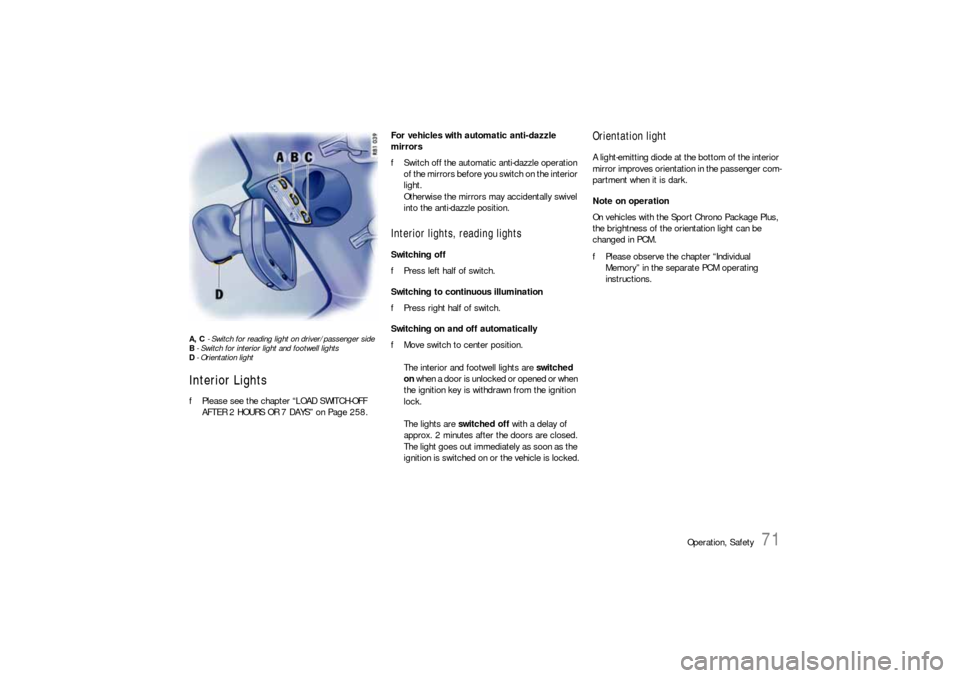
A, C - Switch for reading light on driver/passenger side
B- Switch for interior light and footwell lights
D- Orientation lightInterior LightsfPlease see the chapter “LOAD SWITCH-OFF
AFTER 2 HOURS OR 7 DAYS” on Page 258.For vehicles with automatic anti-dazzle
mirrors
fSwitch off the automatic anti-dazzle operation
of the mirrors before you switch on the interior
light.
Otherwise the mirrors may accidentally swivel
into the anti-dazzle position.
Interior lights, reading lightsSwitching off
fPress left half of switch.
Switching to continuous illumination
fPress right half of switch.
Switching on and off automatically
fMove switch to center position.
The interior and footwell lights are switched
on when a door is unlocked or opened or when
the ignition key is withdrawn from the ignition
lock.
The lights are switched off with a delay of
approx. 2 minutes after the doors are closed.
The light goes out immediately as soon as the
ignition is switched on or the vehicle is locked.
Orientation lightA light-emitting diode at the bottom of the interior
mirror improves orientation in the passenger com-
partment when it is dark.
Note on operation
On vehicles with the Sport Chrono Package Plus,
the brightness of the orientation light can be
changed in PCM.
fPlease observe the chapter “Individual
Memory” in the separate PCM operating
instructions.