engine PORSCHE 911 TURBO 2014 6.G Owners Manual
[x] Cancel search | Manufacturer: PORSCHE, Model Year: 2014, Model line: 911 TURBO, Model: PORSCHE 911 TURBO 2014 6.GPages: 300, PDF Size: 10.61 MB
Page 257 of 300
Minor Repairs 255
fBefore you change a wheel, be sure the ground is level and firm. If necessary, use a board under the jack to ensure that the jack does not sink into the ground.fSet the electric parking brake and block the wheels opposite the flat tire on the other side of the vehicle.fThe jack is only to be used for changing a wheel. Do not use it as a support to work under the car.fThe car must be jacked up only at the illustrated jacking points. Lifting at any other place may result in personal injury.
Risk of damage to the engine or vehicle if you lift the vehicle improperly.fThe car must be jacked up only at the illustrated jacking points. Lifting at any other place may result in damage to the vehicle.fNever jack up the car by the body, bumpers, engine, transmission or at the axles.fDo not damage any sensitive components in the vicinity of the jacking points.fFor safety reasons do not use tire inflating bot-tles. Do not use commercially available sealant bottles. Use only the tire inflating bottle located in the luggage compartment.
Information
The tools required for changing a wheel (e.g. jack, wheel bolt wrench, assembly aids) are not supplied as standard with the vehicle. Your authorized Porsche dealer will be pleased to advise you.
Information
The tire and wheel sizes on both axles are different.fDo not fit the wrong wheels on the wrong axle.fOnly use wheels/tires with approved dimensions for the relevant axle.
Sequence of operation
The jack must be used only to raise the car for wheel changing. The jack must never be used as a support to work underneath the vehicle. If the jack is accidentally dislodged, you or bystanders could suffer severe personal injury.fNever jack up other vehicles or other loads with the jack.fAlways place the car on stable supports if you have to work under it. When working under the vehicle, always use safety stands specifically designed for this purpose.
fPlease use a suitable knee rest to protect your clothing against soiling.1. Activate the electric parking brake and move the PDK selector lever to position P. Remove the ignition key or control unit on vehicles with Porsche Entry & Drive.2. Switch on the emergency flasher if necessary.
3. Secure the vehicle to prevent it from rolling away, e.g. by means of wedges under the wheels on the opposite side.This is particularly important on slopes.4. Slightly loosen the wheel bolts on the wheel to be changed.5. Lift the vehicle only at the specified jacking points.6. Raise the vehicle until the wheel lifts off the ground. fPlease see the chapter “RAISING THE VEHICLE WITH A LIFTING PLATFORM, TROLLEY JACK OR STANDARD JACK” on page 254.7. Remove 1 or 2 wheel bolts (see corresponding figure).NOTICE
Working Under VehicleWARNINGh
14_991_Turbo_21.book Seite 255 Mittwoch, 9. April 2014 2:19 14
Page 267 of 300
Minor Repairs 265
Flat Tire
1.Stop the vehicle as far away from the driving lane as possible.The vehicle must be parked on a firm and flat surface offering adequate grip.2. Switch emergency flasher on. 3. Apply the parking brake. 4. Move the PDK selector lever to position P. 5. Straighten the front wheels. 6. Remove the ignition key, or the control unit on vehicles with Porsche Entry & Drive, in order to lock the steering and prevent the engine from being started.7. Get all passengers to leave the vehicle. 8. Set up the warning triangle at a suitable distance.
Filling in tire sealant
The tire sealant can be found in the right-hand box in the luggage compartment. The compressor is located under the cover in the luggage compartment.
The tire sealant can be used to seal small cuts, especially in the tire tread.
Sealing the tire with the tire sealant is only an emergency solution so you can drive to the nearest workshop. Even if the tire is air-tight, it may only be used for short journeys in an emergency.
The tire sealant set comprises: – a filler bottle– a filler hose– a valve turner– a spare valve insert– a sticker with the maximum permitted speed– a compressor– operating instructions
Always observe the following points:fUse the tire sealant only in the case of cuts or punctures no larger than 0.15 in. (4 mm).fNever use the tire sealant if the rim is damaged.
The sealant is highly flammable and harmful to health.fFire, naked flame and smoking are prohibited when handling tire sealant.fAvoid contact with skin, eyes or clothing due to caustic chemical properties of the tire sealant.fKeep tire sealant away from children.fDo not inhale vapors, due to the consequent harm to personal health resulting in serious personal injury or death.
In the event of contact with sealant:
fIf sealant gets on your skin or into your eyes, thoroughly rinse the affected part of your body immediately with plenty of water.fChange soiled clothing immediately.fSee a doctor immediately in the event of an allergic reaction.fIf sealant is swallowed, thoroughly rinse out the mouth without delay and drink plenty of water. Do not induce vomiting.See a doctor immediately.
Limits on Tire Sealant Use
Tire Sealant Flammability
WARNINGh
WARNINGh
14_991_Turbo_21.book Seite 265 Mittwoch, 9. April 2014 2:19 14
Page 269 of 300
Minor Repairs 267
Electrical System
In order to avoid damage and faults in electrical or electronic systems, electrical accessories should be installed at an authorized Porsche dealerfUse only accessories approved by Porsche.
Replacing fuses or relays with the engine running or the ignition on could cause electrical shock.fDisconnect the negative terminal on the battery during all work on the electrical system.fPlease see the chapter “BATTERY (12 VOLT)” on page 271.
Relays
Relays should be checked or changed only at an authorized workshop.
Changing fuses
In order to prevent damage to the electrical system due to short circuits and overloads, the individual circuits are protected by fuses.
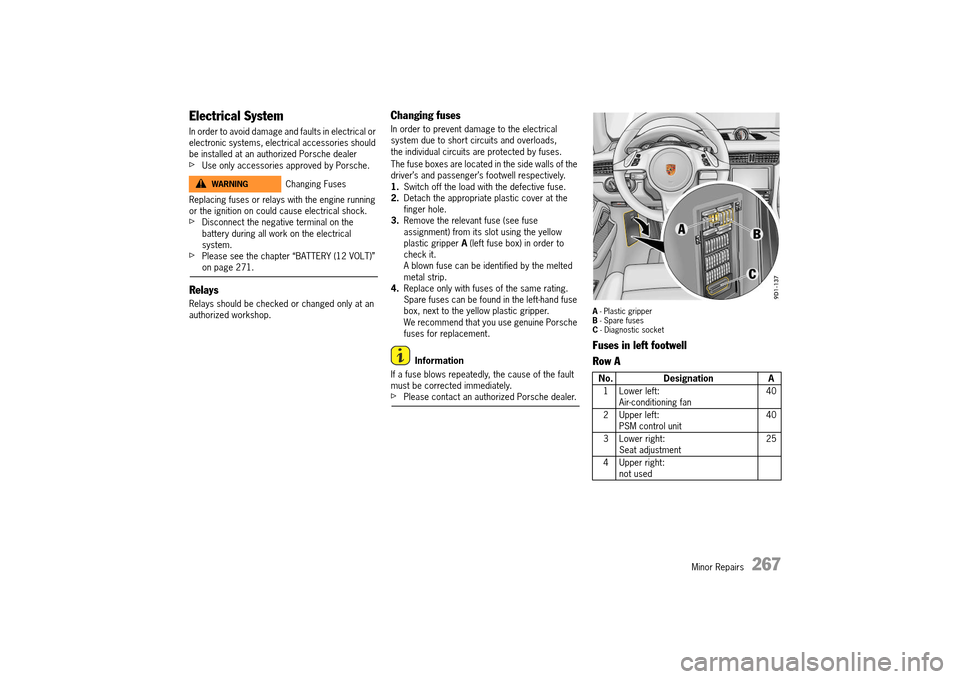
The fuse boxes are located in the side walls of the driver’s and passenger’s footwell respectively. 1. Switch off the load with the defective fuse. 2. Detach the appropriate plastic cover at the finger hole.3. Remove the relevant fuse (see fuse assignment) from its slot using the yellow plastic gripper A (left fuse box) in order to check it.A blown fuse can be identified by the melted metal strip.4. Replace only with fuses of the same rating. Spare fuses can be found in the left-hand fuse box, next to the yellow plastic gripper.We recommend that you use genuine Porsche fuses for replacement.
Information
If a fuse blows repeatedly, the cause of the fault must be corrected immediately.fPlease contact an authorized Porsche dealer.
A - Plastic gripper B - Spare fuses C - Diagnostic socket
Fuses in left footwell
Row A
Changing FusesWARNINGh
No. Designation A
1 Lower left: Air-conditioning fan 40
2 Upper left: PSM control unit 40
3 Lower right: Seat adjustment 25
4 Upper right: not used
14_991_Turbo_21.book Seite 267 Mittwoch, 9. April 2014 2:19 14
Page 272 of 300
270 Minor Repairs
Row D Emergency unlocking of luggage compartment lid
If the battery is discharged, the luggage compartment lid can be opened only with the aid of a donor battery.
Information
The engine cannot be started with this method.fPlease see the chapter “EXTERNAL POWER SUPPLY, EMERGENCY STARTING WITH JUMPER CABLES” on page 273.
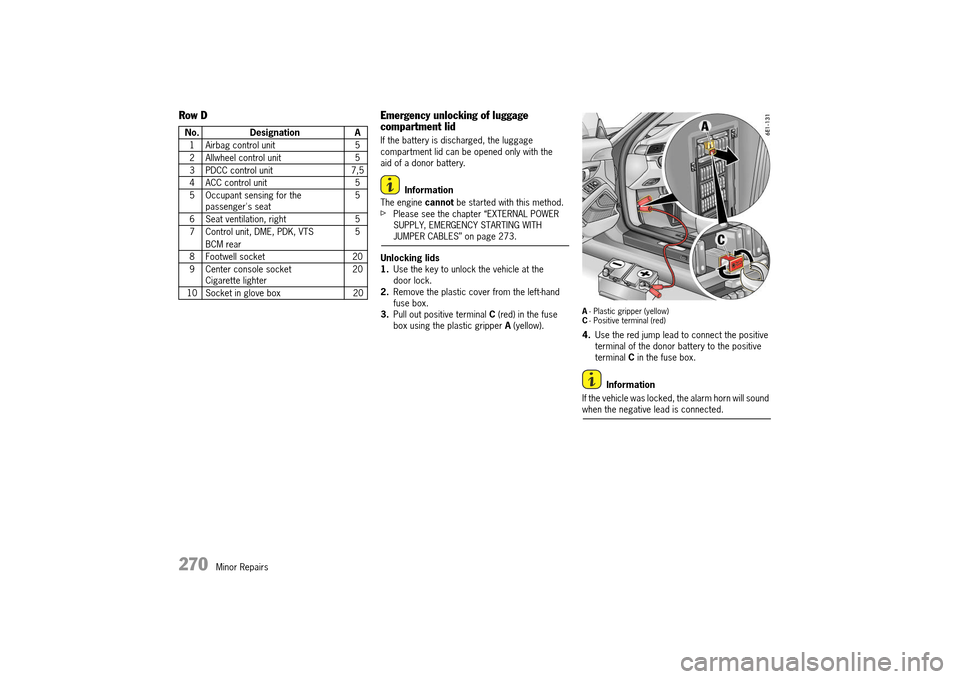
Unlocking lids 1. Use the key to unlock the vehicle at the door lock.2. Remove the plastic cover from the left-hand fuse box.3. Pull out positive terminal C (red) in the fuse box using the plastic gripper A (yellow).
A- Plastic gripper (yellow) C - Positive terminal (red)
4.Use the red jump lead to connect the positive terminal of the donor battery to the positive terminal C in the fuse box.
Information
If the vehicle was locked, the alarm horn will sound when the negative lead is connected.
No. Designation A
1 Airbag control unit 5
2 Allwheel control unit 5
3 PDCC control unit 7,5
4 ACC control unit 5
5 Occupant sensing for the passenger's seat 5
6 Seat ventilation, right 5
7 Control unit, DME, PDK, VTS
BCM rear
5
8 Footwell socket 20
9 Center console socket Cigarette lighter 20
10 Socket in glove box 20
14_991_Turbo_21.book Seite 270 Mittwoch, 9. April 2014 2:19 14
Page 274 of 300
272 Minor Repairs
Risk of damage to the fabric, metal or paint from battery acid or electrolyte.fDo not allow battery acid to come in contact with fabric or painted surfaces.fSpilled electrolyte must be rinsed off at once with a solution of baking soda and water to neutralize the acid.
Charge state
A well-charged battery prevents starting problems and has a longer service life.
In order to avoid unintentional battery discharge:
fSwitch off unnecessary electrical loads in city traffic, on short trips or in a line of traffic.fAlways remove the ignition key when leaving the vehicle orswitch off the ignition on vehicles with Porsche Entry & Drive.fAvoid using the Porsche Communication Management system and the audio system when the engine is not running.fPlease see the chapter “CHARGING THE BATTERY” on page 274.
Information
In the cold season in particular or if the vehicle is used primarily for short distances, it may be necessary to recharge the battery from time to time.
Battery care
fEnsure that battery is securely mounted.fKeep battery surface clean and dry.fKeep terminals and connections clean. Corrosion can be prevented by coating the terminals and connections with petroleum jelly or silicone spray.fEnsure that terminal clamps and the vent hose are firmly secured.
Winter driving
The ability of the battery to deliver and store power decreases at low outside temperatures. Moreover, the battery is more heavily loaded in the winter months, e.g. by the heated rear window, the more frequent use of additional lights, the blower and the windshield wipers, etc.fHave the battery checked before the start of winter.
Information
Keep the battery fully charged to prevent it from freezing.
A discharged battery can already freeze at –5 ºC, but a fully charged one only freezes at –40 ºC. fIf the battery is frozen, thaw it out before connecting jump leads.
Laying up the vehicle
If the vehicle is left for long periods in the garage or workshop, the doors and lids should be closed.fRemove the ignition key or disconnect the battery if necessary.
Information
fWhen the battery is disconnected, the alarm system ceases to function.
If the vehicle was locked before the battery was disconnected, the alarm will be triggered when the battery is reconnected.To deactivate the alarm system: fLock the vehicle and unlock it again.
Alarm system, central locking
fThe status of the central locking and alarm system does not change when you disconnect the battery.
Information
Even if you put your vehicle out of operation, the battery still discharges.fThe battery must be charged, i.e. connected to a charger, approximately every 6 weeks in order to preserve battery function.fStore a battery that has been removed in a dark, cool place that is not exposed to frost.
Replacing the battery
The battery is subject to normal wear: its service life depends heavily on the care you give it, climatic conditions and the conditions of use (distances, loads).
It is not possible to use the details on the battery case to determine a comparable battery that meets all the specific requirements of Porsche.fHave the battery removed and installed only by your authorized Porsche dealer.fOnly use an original Porsche battery, with the correct part number, as a replacement. Only this battery meets the specific requirements of the vehicle.
NOTICE
14_991_Turbo_21.book Seite 272 Mittwoch, 9. April 2014 2:19 14
Page 275 of 300
Minor Repairs 273
fAfter you install a new battery, it must be initialized in the control unit.Please contact your authorized Porsche dealer.fPlease observe the disposal instructions for batteries.
Putting vehicle into operation
After the battery is connected or after a fully discharged battery is charged, the PSM warning light lights up on the instrument panel and a message appears on the multi-function display in the instrument panel to indicate a fault.
This fault can be corrected with a few simple steps: 1. Start the engine. To do this, turn the ignition key or the control unit (on vehicles with Porsche Entry & Drive) to ignition lock position 2 twice. 2. With the vehicle stationary, perform a few steering movements to the left and right and then drive a short distance in a straight line until the PSM warning light goes out and the message is erased from the multi-function display in the instrument panel.3. If the warnings do not disappear, then: Drive carefully to the nearest authorized Porsche dealer.Have the fault corrected.4. After the warnings go out: Stop the vehicle in a suitable place.5. Store the end position for the power windows.
For information on storing the end positions for the power windows: fPlease see the chapter “STORING END POSITION OF THE WINDOWS AFTER CONNECTING THE VEHICLE BATTERY” on page 63.6. Teach tires on vehicles with Tire Pressure Monitoring.
For information on teaching the Tire Pressure Monitoring System (TPMS): fPlease see the chapter “TIRE PRESSURE MENU (TIRE PRESSURE MONITORING SYSTEM, TPMS)” on page 105.7. Store end position on vehicles with a sunroof.
For information on storing the end position for the sunroof: fPlease see the chapter “STORING END POSITION OF THE SUNROOF” on page 66.fPlease see the chapter “STORING END POSITION OF THE ROLL-UP SUNBLIND” on page 67.
External Power Supply, Emergency
starting with jumper cables
If the battery is flat, the battery of another vehicle can be used for starting or as an external power supply with the help of jump leads.
Both batteries must be 12 V batteries. The capacity (Ah) of the donor battery must not be substantially less than that of the flat battery.
The flat battery must be connected correctly to the vehicle’s electrical system.
A short circuit may be caused if unsuitable jumper cables are used or if jumper cable starting is not performed properly. Such short circuits can cause a fire.fUse only standard jumper cables with sufficient cross section and completely insulated alligator clips. Follow the instructions provided by the jumper cable manufacturer.fRoute the jumper cables so that they cannot be caught by moving parts in the engine compartment.The jumper cables must be long enough so that neither vehicles nor cables touch another.fThe vehicles must not touch, otherwise current might flow as soon as the positive terminals are connected.fEnsure that tools or conductive jewelry (rings, chains, watch straps) do not come into contact with the positive jumper cable, the positive battery post or live parts of the vehicle.fImproper hook-up of jumper cables can ruin the alternator.
Jumper Cable HazardsWARNINGh
14_991_Turbo_21.book Seite 273 Mittwoch, 9. April 2014 2:19 14
Page 276 of 300
274 Minor Repairs
fDo not lean over the battery due to danger of chemical burns from leaking acid.
fImproper use of booster battery to start a vehicle may cause an explosion.fKeep sources of ignition away from the battery, e.g. naked flame, burning cigarettes or sparks due to cable contact.fBefore connecting jumper cables, it is essential to thaw out a frozen battery.
Risk of damage due to short circuit.fNever connect jumper cables directly to the battery. Always connect jumper cables to the emergency starting terminals in the luggage compartment.
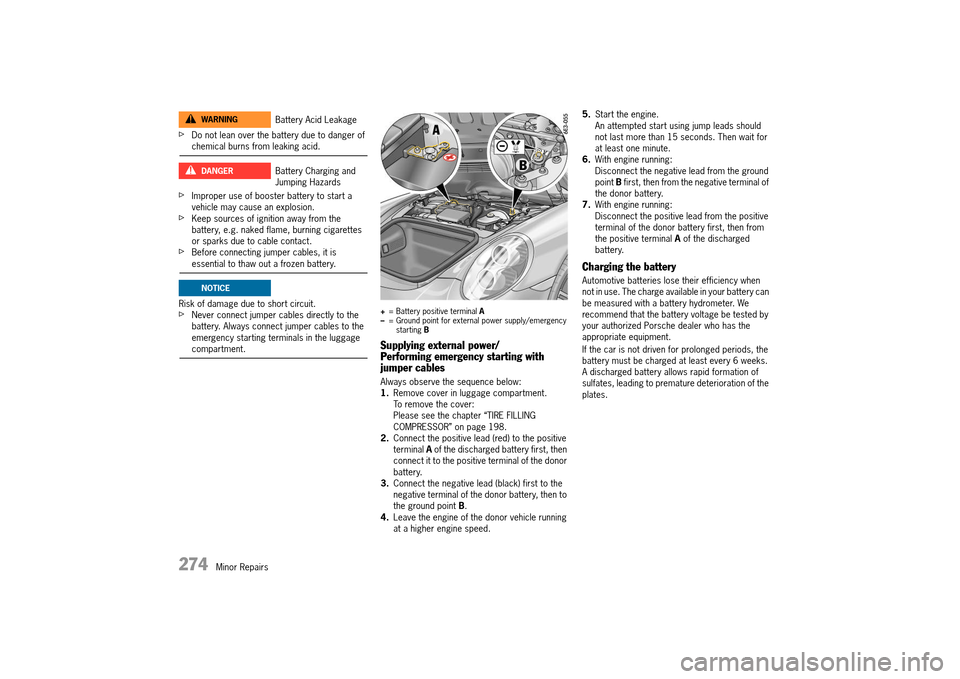
+ = Battery positive terminal A – = Ground point for external power supply/emergency starting B
Supplying external power/ Performing emergency starting with jumper cables
Always observe the sequence below: 1. Remove cover in luggage compartment. To remove the cover:Please see the chapter “TIRE FILLING COMPRESSOR” on page 198.2. Connect the positive lead (red) to the positive terminal A of the discharged battery first, then connect it to the positive terminal of the donor battery.3. Connect the negative lead (black) first to the negative terminal of the donor battery, then to the ground point B. 4. Leave the engine of the donor vehicle running at a higher engine speed.
5. Start the engine. An attempted start using jump leads should not last more than 15 seconds. Then wait for at least one minute.6. With engine running: Disconnect the negative lead from the ground point B first, then from the negative terminal of the donor battery.7. With engine running: Disconnect the positive lead from the positive terminal of the donor battery first, then from the positive terminal A of the discharged battery.
Charging the battery
Automotive batteries lose their efficiency when not in use. The charge available in your battery can be measured with a battery hydrometer. We recommend that the battery voltage be tested by your authorized Porsche dealer who has the appropriate equipment.
If the car is not driven for prolonged periods, the battery must be charged at least every 6 weeks. A discharged battery allows rapid formation of sulfates, leading to premature deterioration of the plates.
Battery Acid Leakage
Battery Charging and Jumping Hazards
WARNINGh
DANGERh
NOTICE
14_991_Turbo_21.book Seite 274 Mittwoch, 9. April 2014 2:19 14
Page 280 of 300
278 Minor Repairs
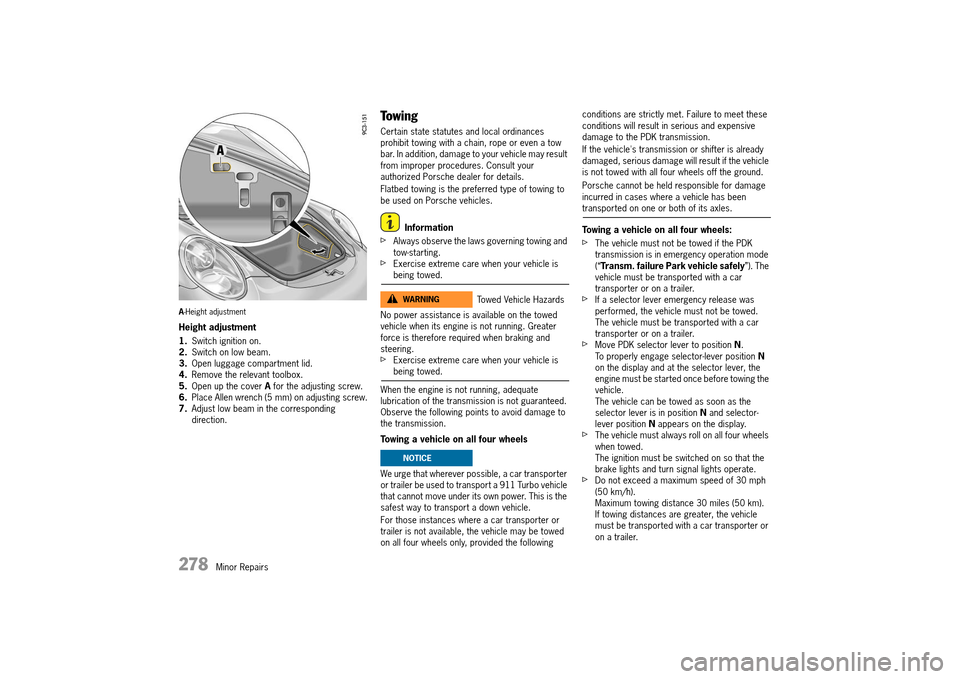
A-Height adjustment
Height adjustment
1. Switch ignition on. 2. Switch on low beam. 3. Open luggage compartment lid. 4. Remove the relevant toolbox. 5. Open up the cover A for the adjusting screw. 6. Place Allen wrench (5 mm) on adjusting screw. 7. Adjust low beam in the corresponding direction.
Towing
Certain state statutes and local ordinances prohibit towing with a chain, rope or even a tow bar. In addition, damage to your vehicle may result from improper procedures. Consult your authorized Porsche dealer for details.
Flatbed towing is the preferred type of towing to be used on Porsche vehicles.
Information
fAlways observe the laws governing towing and tow-starting.fExercise extreme care when your vehicle is being towed.
No power assistance is available on the towed vehicle when its engine is not running. Greater force is therefore required when braking and steering.fExercise extreme care when your vehicle is being towed.
When the engine is not running, adequate lubrication of the transmission is not guaranteed. Observe the following points to avoid damage to the transmission.
Towing a vehicle on all four wheels
We urge that wherever possible, a car transporter or trailer be used to transport a 911 Turbo vehicle that cannot move under its own power. This is the safest way to transport a down vehicle.
For those instances where a car transporter or trailer is not available, the vehicle may be towed on all four wheels only, provided the following
conditions are strictly met. Failure to meet these conditions will result in serious and expensive damage to the PDK transmission.
If the vehicle's transmission or shifter is already damaged, serious damage will result if the vehicle is not towed with all four wheels off the ground.
Porsche cannot be held responsible for damage incurred in cases where a vehicle has been transported on one or both of its axles.
Towing a vehicle on all four wheels:
fThe vehicle must not be towed if the PDK transmission is in emergency operation mode (“ Transm. failure Park vehicle safely”). The vehicle must be transported with a car transporter or on a trailer.fIf a selector lever emergency release was performed, the vehicle must not be towed. The vehicle must be transported with a car transporter or on a trailer.fMove PDK selector lever to position N. To properly engage selector-lever position N on the display and at the selector lever, the engine must be started once before towing the vehicle. The vehicle can be towed as soon as the selector lever is in position N and selector- lever position N appears on the display.fThe vehicle must always roll on all four wheels when towed.The ignition must be switched on so that the brake lights and turn signal lights operate.fDo not exceed a maximum speed of 30 mph (50 km/h).Maximum towing distance 30 miles (50 km).If towing distances are greater, the vehicle must be transported with a car transporter or on a trailer.
Towed Vehicle HazardsWARNINGh
NOTICE
14_991_Turbo_21.book Seite 278 Mittwoch, 9. April 2014 2:19 14
Page 281 of 300
Minor Repairs 279
Towing a vehicle on one axle:
Raising an axle, irrespective of whether at the front or rear, is only permissible if the drive shaft (cardan shaft) has been removed beforehand. The ignition must be switched off.fThe vehicle must not be towed if the PDK transmission is in emergency operation mode (yellow or red “ Transm. failure Park vehicle safely ” warning message). The vehicle must be transported with a car transporter or on a trailer.fIf a selector lever emergency release was performed, the vehicle must not be towed. The vehicle must be transported with a car transporter or on a trailer.fMove PDK selector lever to position N. To properly engage selector-lever position N on the display and at the selector lever, the engine must be started once before towing the vehicle. The vehicle can be towed as soon as the selector lever is in position N and selector- lever position N appears on the display.fSwitch ignition off. The ignition key must remain in the ignition lock so that the steering lock does not engage.The control unit must be removed from the ignition lock and the key inserted in vehicles with Porsche Entry & Drive. fPlease see the chapter “EMERGENCY OPERATION – UNLOCKING THE IGNITION KEY/CONTROL UNIT” on page 28.fMake sure that the vehicle is adequately illuminated.
fDo not exceed a maximum speed of 30 mph (50 km/h).Maximum towing distance 30 miles (50 km).If towing distances are greater, the vehicle must be transported with a car transporter or on a trailer.
Pulling out a vehicle stuck in snow, sand, etc.
fAlways pull out the stuck vehicle with the greatest care.fDo not pull out the vehicle abruptly or at an angle. fIf possible, pull the vehicle out backwards in its own tracks.
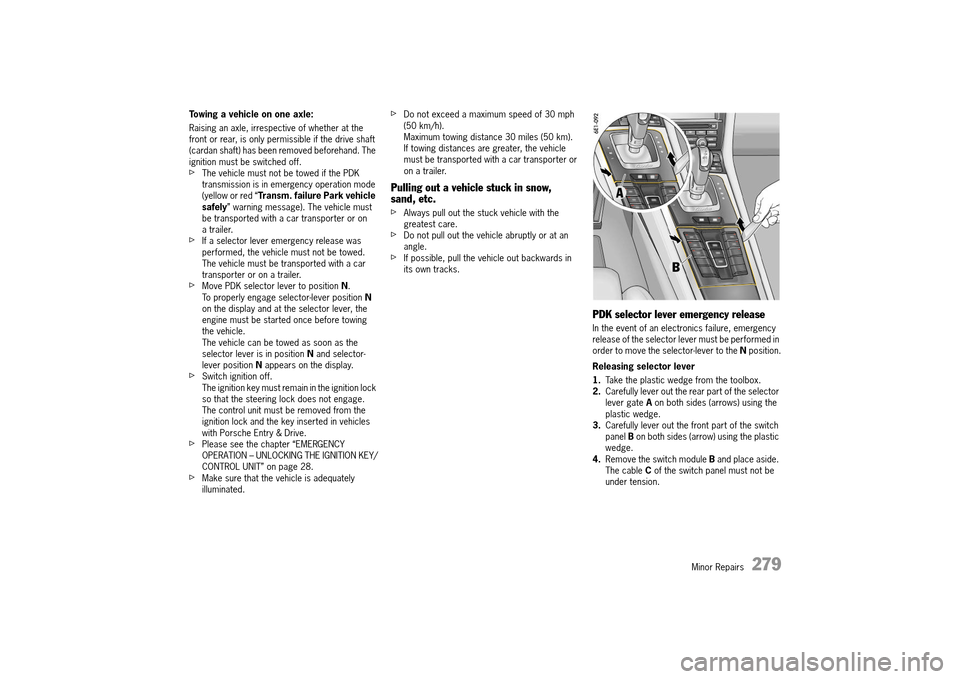
PDK selector lever emergency release
In the event of an electronics failure, emergency release of the selector lever must be performed in order to move the selector-lever to the N position.
Releasing selector lever
1. Take the plastic wedge from the toolbox. 2. Carefully lever out the rear part of the selector lever gate A on both sides (arrows) using the plastic wedge.3. Carefully lever out the front part of the switch panel B on both sides (arrow) using the plastic wedge.4. Remove the switch module B and place aside. The cable C of the switch panel must not be under tension.
14_991_Turbo_21.book Seite 279 Mittwoch, 9. April 2014 2:19 14
Page 285 of 300
Tire Pressure and Technical Data 283
Tire Pressure and Technical Data
Vehicle Identification Data ............................284 Engine Data ................................................285Driving Performance....................................285Wheels, Tires ..............................................286Tire Pressure for Cold Tires (68 °F/ 20 °C) ...287Weights ......................................................288Dimensions.................................................288Filling Capacities .........................................289
Reifendruck_TechnischeDaten.fm Seite 283 Mittwoch, 9. April 2014 3:12 15