engine PORSCHE 911 TURBO 2014 6.G Repair Manual
[x] Cancel search | Manufacturer: PORSCHE, Model Year: 2014, Model line: 911 TURBO, Model: PORSCHE 911 TURBO 2014 6.GPages: 300, PDF Size: 10.61 MB
Page 181 of 300
Driving and Driving Safety 179
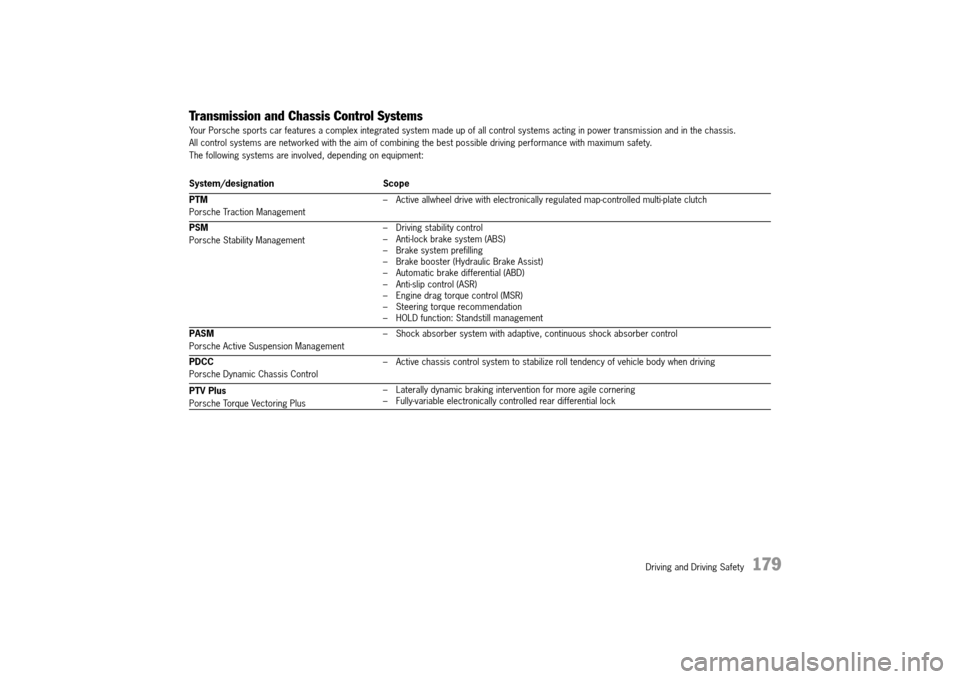
Transmission and Chassis Control Systems
Your Porsche sports car features a complex integrated system made up of all control systems acting in power transmission and in the chassis.
All control systems are networked with the aim of combining the best possible driving performance with maximum safety.
The following systems are involved, depending on equipment:
System/designation Scope
PTM
Porsche Traction Management
– Active allwheel drive with electronically regulated map-controlled multi-plate clutch
PSM
Porsche Stability Management
– Driving stability control – Anti-lock brake system (ABS)– Brake system prefilling– Brake booster (Hydraulic Brake Assist)– Automatic brake differential (ABD)– Anti-slip control (ASR)– Engine drag torque control (MSR)– Steering torque recommendation– HOLD function: Standstill management
PASM
Porsche Active Suspension Management
– Shock absorber system with adaptive, continuous shock absorber control
PDCC
Porsche Dynamic Chassis Control
– Active chassis control system to stabilize roll tendency of vehicle body when driving
PTV Plus
Porsche Torque Vectoring Plus
– Laterally dynamic braking intervention for more agile cornering – Fully-variable electronically controlled rear differential lock
14_991_Turbo_21.book Seite 179 Mittwoch, 9. April 2014 2:19 14
Page 183 of 300
Driving and Driving Safety 181
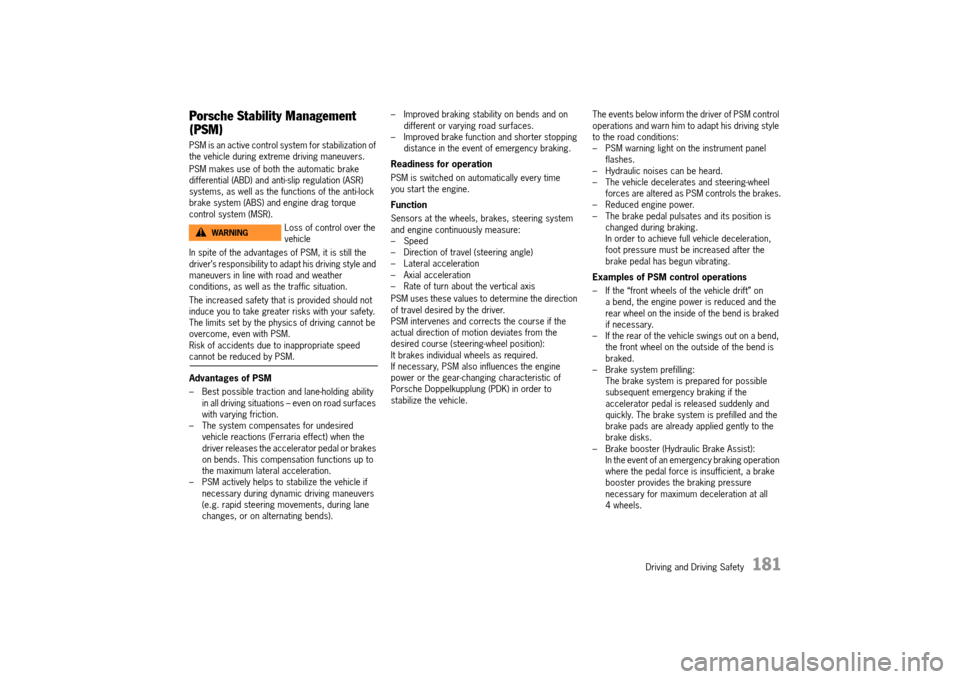
Porsche Stability Management
(PSM)
PSM is an active control system for stabilization of the vehicle during extreme driving maneuvers.
PSM makes use of both the automatic brake differential (ABD) and anti-slip regulation (ASR) systems, as well as the functions of the anti-lock brake system (ABS) and engine drag torque control system (MSR).
In spite of the advantages of PSM, it is still the driver’s responsibility to adapt his driving style and maneuvers in line with road and weather conditions, as well as the traffic situation.
The increased safety that is provided should not induce you to take greater risks with your safety. The limits set by the physics of driving cannot be overcome, even with PSM.Risk of accidents due to inappropriate speed cannot be reduced by PSM.
Advantages of PSM
– Best possible traction and lane-holding ability in all driving situations – even on road surfaces with varying friction.– The system compensates for undesired vehicle reactions (Ferraria effect) when the driver releases the accelerator pedal or brakes on bends. This compensation functions up to the maximum lateral acceleration.– PSM actively helps to stabilize the vehicle if necessary during dynamic driving maneuvers (e.g. rapid steering movements, during lane changes, or on alternating bends).
– Improved braking stability on bends and on different or varying road surfaces.– Improved brake function and shorter stopping distance in the event of emergency braking.
Readiness for operation
PSM is switched on automatically every time you start the engine.
Function
Sensors at the wheels, brakes, steering system and engine continuously measure:– Speed– Direction of travel (steering angle)– Lateral acceleration– Axial acceleration– Rate of turn about the vertical axis
PSM uses these values to determine the direction of travel desired by the driver.PSM intervenes and corrects the course if the actual direction of motion deviates from the desired course (steering-wheel position):It brakes individual wheels as required. If necessary, PSM also influences the engine power or the gear-changing characteristic of Porsche Doppelkupplung (PDK) in order to stabilize the vehicle.
The events below inform the driver of PSM control operations and warn him to adapt his driving style to the road conditions:– PSM warning light on the instrument panel flashes.– Hydraulic noises can be heard.– The vehicle decelerates and steering-wheel forces are altered as PSM controls the brakes.– Reduced engine power.– The brake pedal pulsates and its position is changed during braking.In order to achieve full vehicle deceleration, foot pressure must be increased after the brake pedal has begun vibrating.
Examples of PSM control operations
– If the “front wheels of the vehicle drift” on a bend, the engine power is reduced and the rear wheel on the inside of the bend is braked if necessary.– If the rear of the vehicle swings out on a bend, the front wheel on the outside of the bend is braked.– Brake system prefilling:The brake system is prepared for possible subsequent emergency braking if the accelerator pedal is released suddenly and quickly. The brake system is prefilled and the brake pads are already applied gently to the brake disks.– Brake booster (Hydraulic Brake Assist):In the event of an emergency braking operation where the pedal force is insufficient, a brake booster provides the braking pressure necessary for maximum deceleration at all 4 wheels.
Loss of control over the vehicleWARNINGh
14_991_Turbo_21.book Seite 181 Mittwoch, 9. April 2014 2:19 14
Page 184 of 300
182 Driving and Driving Safety
Combined operation of PSM and PTV Plus
In order to ensure optimum stabilization of the vehicle, the center differential lock is influenced when PSM interventions occur on vehicles with PTV Plus.
Combined operation of PSM and PTM
In order to ensure optimum stabilization of the vehicle, torque distribution between the front and rear wheels is adapted and the differential lock is influenced when PSM interventions occur on vehicles with PTV Plus.
In the event of a PTM fault, PSM cannot be switched off.If PSM is switched off, it is switched on again automatically.
Automatic brake differential (ABD)
The ABD system controls the front and rear axles separately. If one wheel of an axle starts to spin, it is braked so that the other wheel on the same axle can be driven.
ABD recognizes different driving states, and it features control strategies adapted to these states. In situations in which little propulsive power is required, such as when the vehicle moves off on a level gravel surface, traction control already becomes active at low engine speeds. If a large amount of propulsive power is required, e.g. when driving off on an uphill slope or for rapid acceleration, the ABD system is adapted accordingly.
Anti-slip control (ASR)
The anti-slip control system prevents the wheels from spinning by adjusting the engine power, thereby ensuring good lane-holding ability and stable handling.
Engine drag torque control (MSR)
In conditions of excessive slip, the engine drag torque control system prevents all driven wheels from locking up when the vehicle is overrunning. This is also the case for downshifts on a slippery road.
Steering torque pulse
The steering torque pulse provides the driver with steering assistance when braking on road surfaces with differing friction values.Additional steering forces also assist the driver during counter steering.
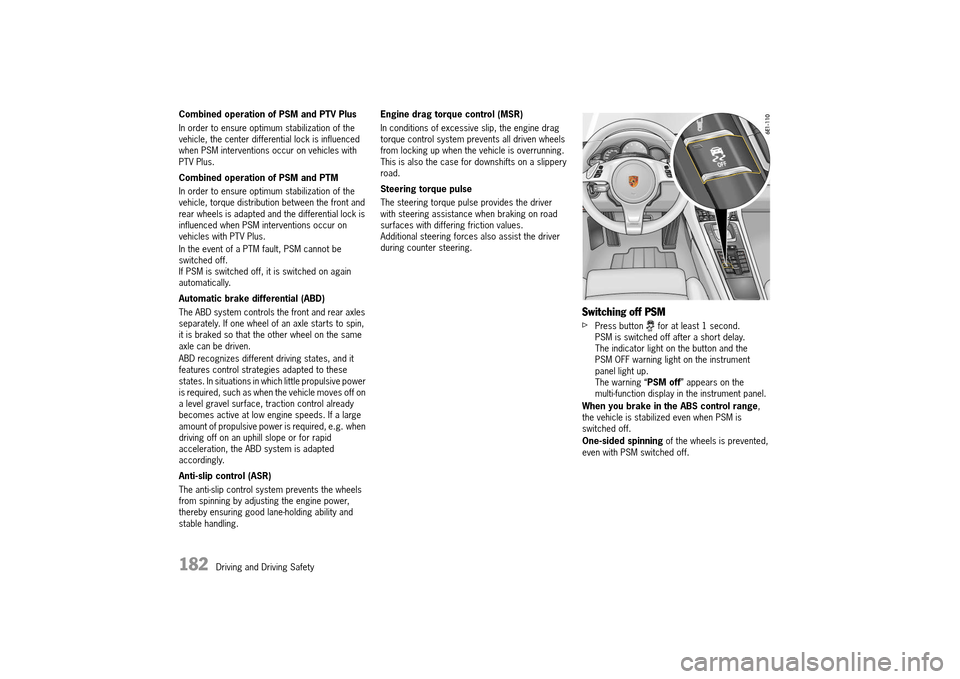
Switching off PSM
fPress button for at least 1 second.PSM is switched off after a short delay.The indicator light on the button and the PSM OFF warning light on the instrument panel light up.The warning “ PSM off” appears on the multi-function display in the instrument panel.
When you brake in the ABS control range , the vehicle is stabilized even when PSM is switched off.
One-sided spinning of the wheels is prevented, even with PSM switched off.
14_991_Turbo_21.book Seite 182 Mittwoch, 9. April 2014 2:19 14
Page 187 of 300

Driving and Driving Safety 185
Function
The decisive advantage of ABS lies in the driving stability and maneuverability of the vehicle in hazardous situations.
ABS prevents locking of the wheels during full braking, on almost all road surfaces, until just before the vehicle stops.
ABS begins to control the braking process as soon as a wheel shows a tendency to lock.This controlled braking process is comparable with extremely rapid cadence braking.The pulsating brake pedal and a “juddering noise” warn the driver to adapt his driving speed to the road conditions.fIf full braking is necessary, press the brake pedal fully during the whole braking operation, even though the pedal is pulsating. Do not reduce brake pressure.
Warning light USA
Warning light Canada
If the ABS warning light lights up on the instrument panel while the engine is running, the ABS has switched off because of a fault.The warning message “ ABS/PSM failure Adapted driving permitted ” appears on the multi-function display in the instrument panel.
For information on warning messages on the multi- function display: fPlease see the chapter “OVERVIEW OF WARNING AND INFORMATION MESSAGES” on page 129.
In this case, the braking system will operate without lock prevention , as in vehicles without ABS.fAdapt your driving style to the changed braking behavior.The ABS must be checked by your authorized Porsche dealer in order to prevent the occurrence of further faults with unpredictable consequences.Please contact an authorized Porsche dealer.
The ABS control unit is adjusted for the approved tire dimensions.The use of tires with non-approved dimensions can lead to different wheel speeds, causing ABS to switch off.
Porsche Active Suspension
Management (PASM)
The PASM system actively adjusts the shock absorbers. The adjustable damper system selects the appropriate damping level for each wheel according to the driving situation and driving conditions. Driving safety, agility and comfort are optimized.
Two different chassis setups can be selected at the push of a button:–“ Chassis Normal” –“ Chassis Sport”
In Normal mode the vehicle is in a sporty and comfortable setup.Sport mode offers very sporty shock absorber tuning (e.g. for driving on the race circuit).
In addition to manual mode selection, PASM also adjusts shock absorber tuning for either sporty or comfort driving, depending on the driving situation.
14_991_Turbo_21.book Seite 185 Mittwoch, 9. April 2014 2:19 14
Page 190 of 300
188 Driving and Driving Safety
Dynamic Engine Mounting (PADM)
On vehicles with Sport Chrono package
Dynamic Engine Mounting with variable damping is a system designed to enhance both driving dynamics and driving comfort. Depending on the driving situation, the ideal mounting rigidity and damping is automatically set in the range between an rigid engine-to-body connection (increase in driving dynamics) and decoupling of the engine from the body (increase in driving comfort).
“Sport” mode
When “ Sport” mode is switched on, a more rigid engine-to-body connection is achieved for a sporty driving style.
“Sport Plus” mode
When “ Sport Plus” mode is switched on, an optimal engine-to-body connection is achieved for driving on race circuits.
Warning message
Dynamic engine mounting faults are indicated by a warning message on the multi-function display.fPlease see the chapter “OVERVIEW OF WARNING AND INFORMATION MESSAGES” on page 129.
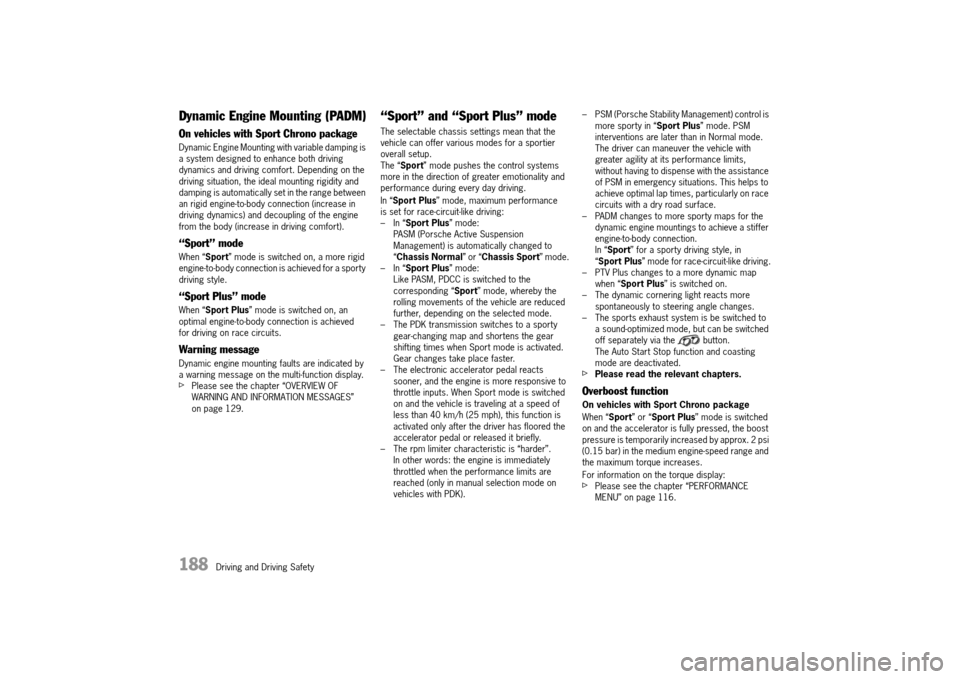
“Sport” and “Sport Plus” mode
The selectable chassis settings mean that the vehicle can offer various modes for a sportier overall setup.The “ Sport” mode pushes the control systems more in the direction of greater emotionality and performance during every day driving.
In “ Sport Plus” mode, maximum performance is set for race-circuit-like driving:– In “ Sport Plus” mode: PASM (Porsche Active Suspension Management) is automatically changed to “ Chassis Normal” or “Chassis Sport” mode. – In “ Sport Plus” mode: Like PASM, PDCC is switched to the corresponding “ Sport” mode, whereby the rolling movements of the vehicle are reduced further, depending on the selected mode.– The PDK transmission switches to a sporty gear-changing map and shortens the gear shifting times when Sport mode is activated. Gear changes take place faster.– The electronic accelerator pedal reacts sooner, and the engine is more responsive to throttle inputs. When Sport mode is switched on and the vehicle is traveling at a speed of less than 40 km/h (25 mph), this function is activated only after the driver has floored the accelerator pedal or released it briefly.– The rpm limiter characteristic is “harder”. In other words: the engine is immediately throttled when the performance limits are reached (only in manual selection mode on vehicles with PDK).
– PSM (Porsche Stability Management) control is more sporty in “ Sport Plus” mode. PSM interventions are later than in Normal mode. The driver can maneuver the vehicle with greater agility at its performance limits, without having to dispense with the assistance of PSM in emergency situations. This helps to achieve optimal lap times, particularly on race circuits with a dry road surface.– PADM changes to more sporty maps for the dynamic engine mountings to achieve a stiffer engine-to-body connection.In “ Sport” for a sporty driving style, in “ Sport Plus” mode for race-circuit-like driving. – PTV Plus changes to a more dynamic map when “ Sport Plus” is switched on. – The dynamic cornering light reacts more spontaneously to steering angle changes.– The sports exhaust system is be switched to a sound-optimized mode, but can be switched off separately via the button.The Auto Start Stop function and coasting mode are deactivated.fPlease read the relevant chapters.
Overboost function
On vehicles with Sport Chrono package
When “ Sport” or “Sport Plus” mode is switched on and the accelerator is fully pressed, the boost pressure is temporarily increased by approx. 2 psi (0.15 bar) in the medium engine-speed range and the maximum torque increases.
For information on the torque display:fPlease see the chapter “PERFORMANCE MENU” on page 116.
14_991_Turbo_21.book Seite 188 Mittwoch, 9. April 2014 2:19 14
Page 199 of 300
Storage, Luggage Compartment and Roof Transport System 197
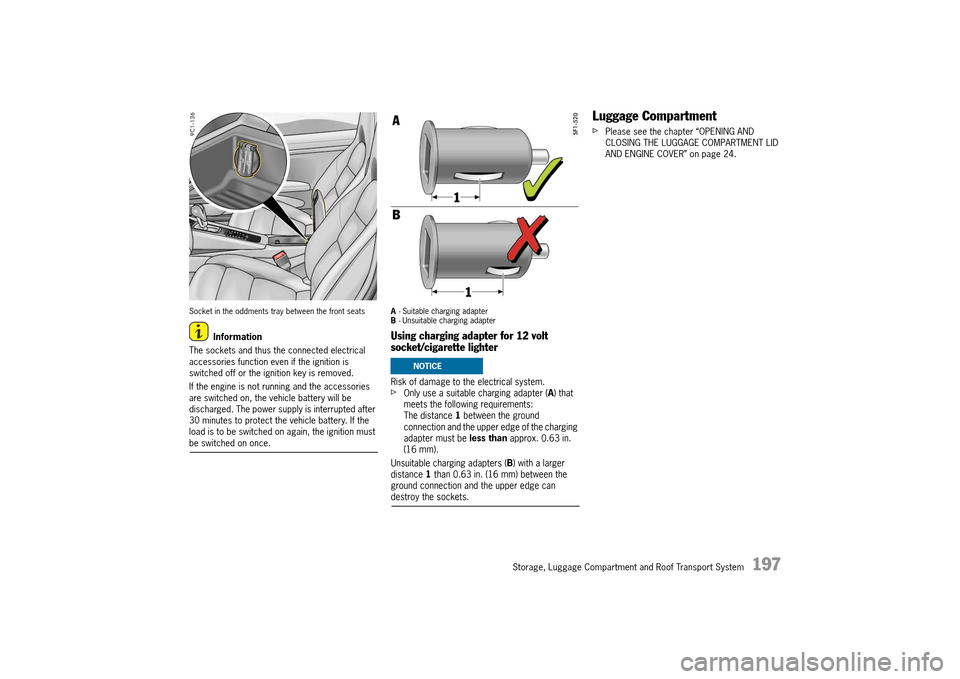
Socket in the oddments tray between the front seats
Information
The sockets and thus the connected electrical accessories function even if the ignition is switched off or the ignition key is removed.
If the engine is not running and the accessories are switched on, the vehicle battery will be discharged. The power supply is interrupted after 30 minutes to protect the vehicle battery. If the load is to be switched on again, the ignition must be switched on once.
A - Suitable charging adapter B - Unsuitable charging adapter
Using charging adapter for 12 volt socket/cigarette lighter
Risk of damage to the electrical system.fOnly use a suitable charging adapter ( A) that meets the following requirements:The distance 1 between the ground connection and the upper edge of the charging adapter must be less than approx. 0.63 in. (16 mm).
Unsuitable charging adapters ( B) with a larger distance 1 than 0.63 in. (16 mm) between the ground connection and the upper edge can destroy the sockets.
Luggage Compartment
fPlease see the chapter “OPENING AND CLOSING THE LUGGAGE COMPARTMENT LID AND ENGINE COVER” on page 24.
NOTICE
14_991_Turbo_21.book Seite 197 Mittwoch, 9. April 2014 2:19 14
Page 214 of 300
212 Parking
Operating the garage door opener
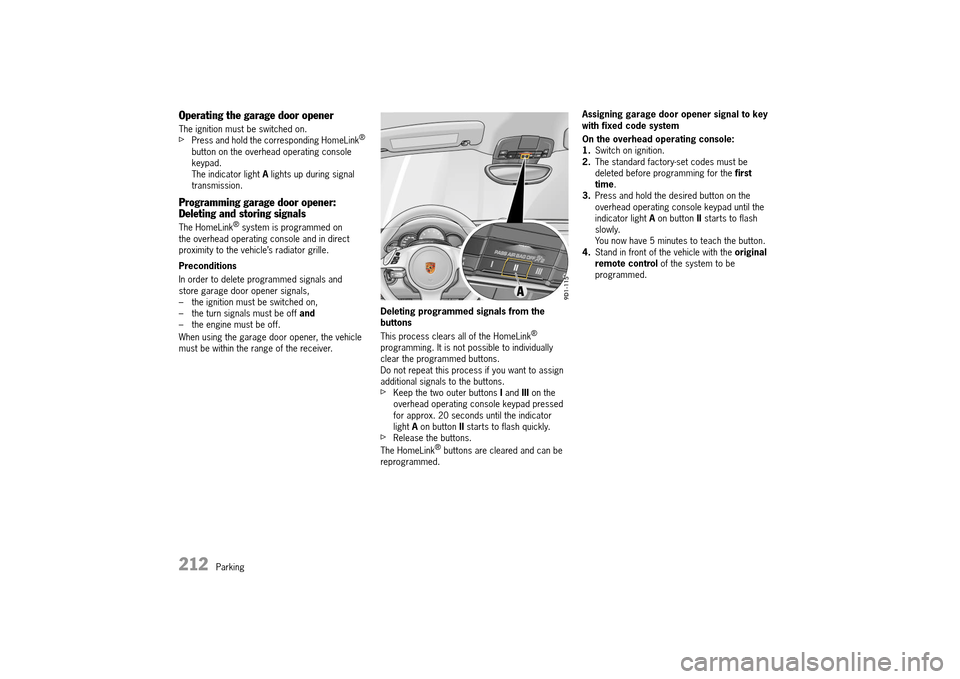
The ignition must be switched on.fPress and hold the corresponding HomeLink® button on the overhead operating console keypad.The indicator light A lights up during signal transmission.
Programming garage door opener: Deleting and storing signals
The HomeLink® system is programmed on the overhead operating console and in direct proximity to the vehicle’s radiator grille.
Preconditions
In order to delete programmed signals and store garage door opener signals,– the ignition must be switched on,– the turn signals must be off and – the engine must be off.
When using the garage door opener, the vehicle must be within the range of the receiver.
Deleting programmed signals from the buttons
This process clears all of the HomeLink® programming. It is not possible to individually clear the programmed buttons.Do not repeat this process if you want to assign additional signals to the buttons.fKeep the two outer buttons I and III on the overhead operating console keypad pressed for approx. 20 seconds until the indicator light A on button II starts to flash quickly.fRelease the buttons.
The HomeLink® buttons are cleared and can be reprogrammed.
Assigning garage door opener signal to key with fixed code system
On the overhead operating console: 1. Switch on ignition. 2. The standard factory-set codes must be deleted before programming for the first time . 3. Press and hold the desired button on the overhead operating console keypad until the indicator light A on button II starts to flash slowly.You now have 5 minutes to teach the button.4. Stand in front of the vehicle with the original remote control of the system to be programmed.
14_991_Turbo_21.book Seite 212 Mittwoch, 9. April 2014 2:19 14
Page 218 of 300
216 Alarm System and Theft Protection
Alarm System and Passenger
Compartment Monitoring
FCC Numbers :
This device complies with Part 15 of the FCC Rules and RSS-210 of Industry Canada.
Operation of this device is subject to the following two conditions:1. This device may not cause harmful interference, and 2. this device must accept any interference received including interference that may cause undesired operation.
Changes or modifications not expressly approved by the party responsible for compliance could void the user's authority to operate the equipment.
Information
The manufacturer is not responsible for any radio or TV interference caused by unauthorized modifications to this equipment. Such modification could void the user's authority to operate the equipment.
The alarm system monitors the following alarm contacts:– Alarm contacts in doors, luggage compartment lid, engine compartment lid and headlights.– Interior surveillance: Movement in the interior when the vehicle is locked, e.g. attempted theft after breaking a window.– Inclination sensor country-specific equipment: inclination of the vehicle (e.g. when attempting to tow).
If one of these alarm contacts is interrupted, the alarm horn sounds for approx. 30 seconds and the emergency flasher flashes.After 5 seconds of interruption, the alarm is triggered again. This cycle is repeated up to ten times.
Switching on
fThe alarm system is activated when the vehicle is locked.
Switching off
fThe alarm system is deactivated when the vehicle is unlocked.
Information
fIf you unlock the vehicle with the emergency key in the door lock, you must switch the ignition on (ignition lock position 1) within 10 seconds of opening the door in order to prevent the alarm system from being triggered.
Information
If button on the car key is pressed and a door or the luggage compartment lid is not opened, the vehicle is locked again automatically after 30 seconds.
Switching off the alarm system if it is triggered
fUnlock vehicle or switch on ignition.
Switching off interior surveillance and inclination sensor
If people or animals are remaining in the locked vehicle or the vehicle is being transported on, e.g. a train or ship, the interior surveillance system and inclination sensor must be switched off temporarily.fInform any persons remaining in the vehicle that the alarm system will be triggered if the door is opened.
Using the car key
fQuickly press button on the car key twice within 2 seconds.The emergency flasher flashes slowly once.The doors are locked, but can be opened from inside.
USA: KR55WK50138
Canada: 7812D-5WK50138
14_991_Turbo_21.book Seite 216 Mittwoch, 9. April 2014 2:19 14
Page 219 of 300
Alarm System and Theft Protection 217
On vehicles with Porsche Entry & Drive
fQuickly press button A in the door handle twice within 2 seconds. The emergency flasher flashes slowly once.The doors are locked, but can be opened from inside.
Information
The interior surveillance system and inclination sensor remain switched off if:– The interior surveillance system and inclination sensor were switched off when you last locked the vehicleandIf button A was pressed and a door or the luggage compartment lid was not opened.
Function indication
On vehicles without Porsche Entry & Drive, the locking condition of the vehicle is indicated by the indicator lights in the central locking button flashing at different frequencies.The indicator lights go out when the vehicle is unlocked.
On vehicles with Porsche Entry & Drive, the locking condition of the vehicle is indicated by the indicator lights in the doors flashing at different frequencies.
Alarm system is activated
– The indicator lights flash quickly twice when the vehicle is being locked, then flash normally.
Alarm system is activated, interior surveillance and inclination sensor are switched off
– The indicator lights flash quickly while you are locking the vehicle, go out for 10 seconds and then flash normally.
Faults in the central locking system and alarm system
The indicator lights come on for 10 seconds, flash at double speed for 20 seconds and then flash normally.
Avoiding false alarms
fIf people or animals are remaining in the locked vehicle or the vehicle is being transported on a train or ship, for example, the interior surveillance system and inclination sensor must be switched off temporarily.fAlways close the sunroof and all door windows.
Immobilizer
There is a transponder (an electronic component), containing a stored code, in each key. Before the ignition is switched on, the ignition lock checks the code.
The immobilizer can be deactivated and the engine started using an authorized ignition key only.
Theft Protection
When leaving the vehicle, always:fClose the windows.fClose the sunroof.fClose the Convertible top (Cabriolet).fActivate the electric parking brake.fRemove the ignition key (or switch ignition off on vehicles with Porsche Entry & Drive).fClose the glove box.fClose all storage compartments.fRemove valuables, vehicle registration documents, telephone and house keys from the vehicle.fClose the luggage compartment lid.fClose the engine compartment lid.fLock the doors.
14_991_Turbo_21.book Seite 217 Mittwoch, 9. April 2014 2:19 14
Page 220 of 300
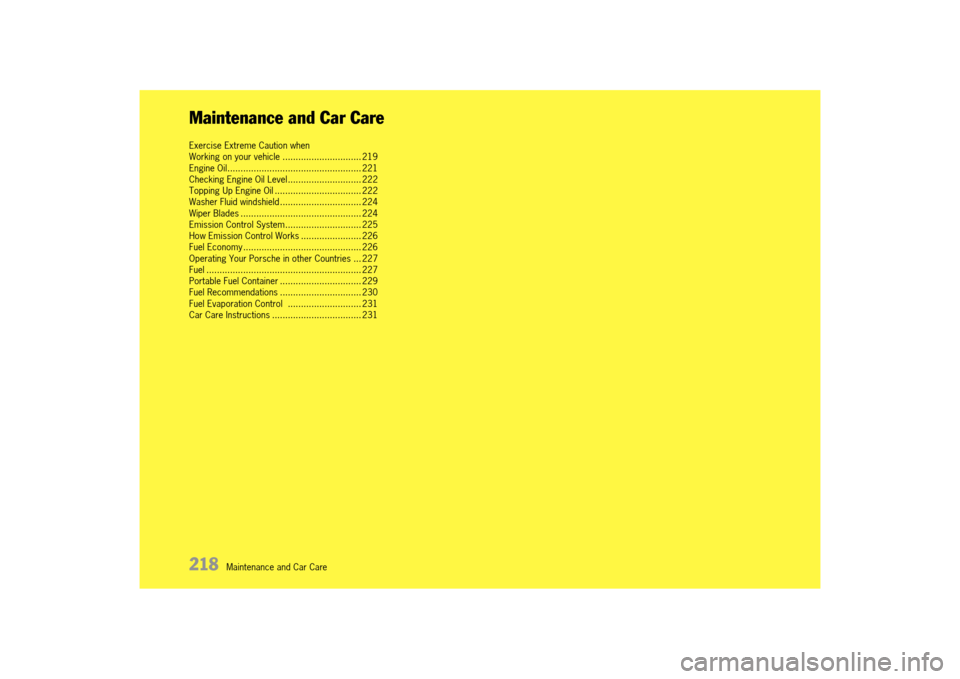
218 Maintenance and Car Care
Maintenance and Car Care
Exercise Extreme Caution when Working on your vehicle .............................. 219Engine Oil................................................... 221Checking Engine Oil Level ............................ 222Topping Up Engine Oil ................................. 222Washer Fluid windshield ............................... 224Wiper Blades .............................................. 224Emission Control System............................. 225How Emission Control Works ....................... 226Fuel Economy ............................................. 226Operating Your Porsche in other Countries ... 227Fuel ........................................................... 227Portable Fuel Container ............................... 229Fuel Recommendations ............................... 230Fuel Evaporation Control ............................ 231Car Care Instructions .................................. 231
14_991_Turbo_21.book Seite 218 Mittwoch, 9. April 2014 2:19 14