display PORSCHE 911 TURBO 2014 6.G Owners Manual
[x] Cancel search | Manufacturer: PORSCHE, Model Year: 2014, Model line: 911 TURBO, Model: PORSCHE 911 TURBO 2014 6.GPages: 300, PDF Size: 10.61 MB
Page 232 of 300
230 Maintenance and Car Care
Fuel Recommendations
Your Porsche is equipped with catalytic converters and must use UNLEADED FUEL WITHOUT METALLIC ADDITIVES ONLY .
Your engine is designed to provide optimum performance and fuel economy using unleaded premium fuel with an octane rating of 98 RON/ 88 MON (93 CLC or AKI) . Porsche therefore recommends the use of these fuels in your vehicle.
Porsche also recognizes that these fuels may not always be available. Be assured that your vehicle will operate properly on unleaded premium fuels with octane numbers of at least 95 RON/ 85MON (90 CLC or AKI) , since the engine’s “Electronic Octane™ knock control” will adapt the ignition timing, if necessary.
If fuels of less than 95 RON/85 MON (90 CLC or AKI) are used however, this could reduce performance and increase fuel consumption.fAvoid driving at full throttle.
It is important to observe the regular service intervals, and particularly the oil change intervals, specified in the “Maintenance” booklet.
The use of UNLEADED FUEL WITHOUT METALLIC ADDITIVES ONLY is critically important to the life of the catalytic converters. Deposits from leaded fuels or metallic additives will ruin the converters and make them ineffective as an emission control device. Metallic additives can cause serious engine damage.
Cars with catalytic converters have a smaller fuel tank opening, and gas station pumps that dispense unleaded fuel have smaller nozzles. This will prevent accidental pumping of leaded fuel into cars with catalytic converters.
Unleaded fuels may not be available outside the continental U.S. and Canada. Therefore, we recommend you do not take your car to areas or countries where unleaded fuel may not be available.
Information
In some countries the available fuel quality may not meet the requirements of your Porsche vehicle and can result in coking inside or around the injector bores or other serious damage to the engine, fuel system or exhaust system.
In this case, the fuel may be mixed only with the additive sold and recommended by Porsche after consulting your authorized Porsche dealer.
Porsche part number 000 043 206 89.fObserve the instructions and mixture ratios stated on the container.
It is important that the service intervals, particularly the oil change intervals, are observed in accordance with the specifications in the “Maintenance” booklet.
Risk of destruction of the engine, fuel system or exhaust system if non-approved additives are used.fUse only additives approved by Porsche. The use of other additives can result in destruction of the engine, fuel system or exhaust system of your vehicle.
Octane ratings
Octane rating indicates a fuel’s ability to resist detonation. Therefore, buying the correct octane gas is important to prevent engine “damage”.
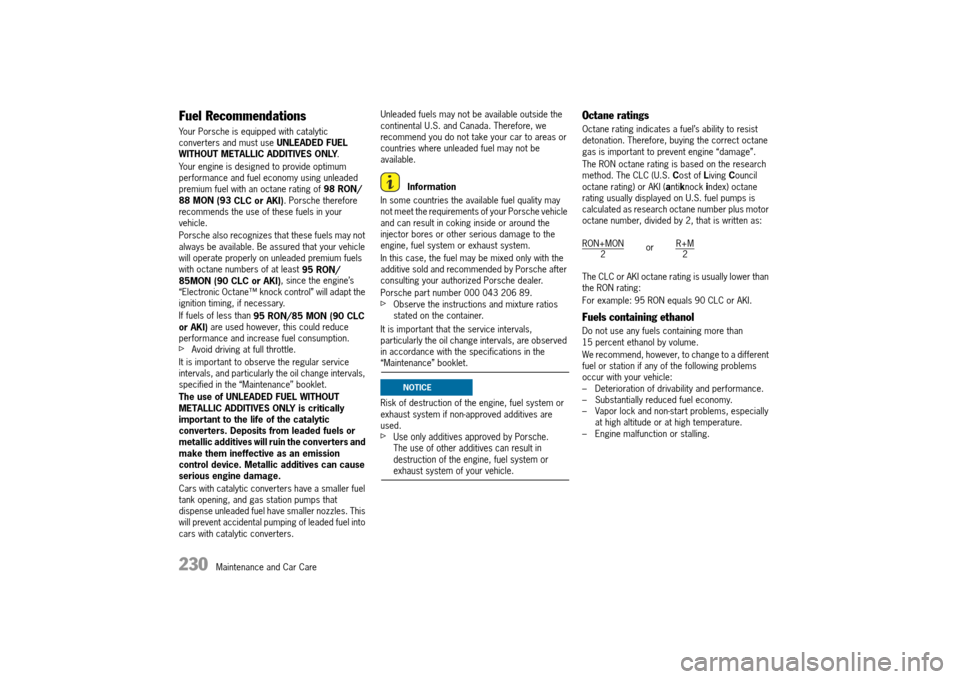
The RON octane rating is based on the research method. The CLC (U.S. Cost of Living Council octane rating) or AKI ( antiknock index) octane rating usually displayed on U.S. fuel pumps is calculated as research octane number plus motor octane number, divided by 2, that is written as:
The CLC or AKI octane rating is usually lower than the RON rating:
For example: 95 RON equals 90 CLC or AKI.
Fuels containing ethanol
Do not use any fuels containing more than 15 percent ethanol by volume.
We recommend, however, to change to a different fuel or station if any of the following problems occur with your vehicle: – Deterioration of drivability and performance. – Substantially reduced fuel economy. – Vapor lock and non-start problems, especially at high altitude or at high temperature. – Engine malfunction or stalling.
NOTICE
RON+MON2 R+M2 or
14_991_Turbo_21.book Seite 230 Mittwoch, 9. April 2014 2:19 14
Page 243 of 300
Minor Repairs 241
If the vehicle is not secured, or incorrectly secured, during repair work, it could move unexpectedly or fall from the car jack or car lift.fBe alert and cautious around the engine at all times while it is running. If you have to work on the engine while it is running, always apply the electric parking brake and put the PDK selector lever in position P or N.fAlways support your car with safety stands if it is necessary to work under the car. The jack supplied with the car is not adequate for this purpose.Switch off level control of air suspension and height adjustment.Please see the chapter “RAISING THE VEHICLE WITH A LIFTING PLATFORM, TROLLEY JACK OR STANDARD JACK” on page 254.fJack up the vehicle only at the specified jacking points on the underside of the vehicle.fNever start the engine when the vehicle is jacked or lifted up. Vibration from the engine could cause the vehicle to fall.fWhen working under the car without safety stands but with the wheels on the ground, make sure the car is on level ground, the wheels are blocked, and that the engine cannot be started.Withdraw ignition keys (switch ignition off in vehicles that have Porsche Entry & Drive).
Information
fIncomplete or improper servicing may cause problems in the operation of the car. If in doubt about any servicing, have it done by your authorized Porsche dealer.Improper maintenance during the warranty period may affect your Porsche warranty coverage.fSome countries require additional tools and special spare parts to be carried in your vehicle. Please make enquiries before driving abroad.
T
The engine-compartment blowers are mounted under the engine compartment lid.After the engine is switched off, the engine compartment temperature is monitored for approx. 30 minutes.During this period, and depending on temperature, the engine-compartment blowers may continue to run or start to run.fCarry out work in this area only with the engine off and exercise extreme caution.
The radiators and radiator fans are in the front of the vehicle.The radiator fans in the front of the vehicle may be operating or unexpectedly start operating when the engine is switched on.fCarry out work in these areas only with the engine switched off.fTake great care to ensure that parts of the body, items of clothing or jewelery cannot be drawn in by the radiator fan, engine-compartment blower, drive belt or other moving parts.
Measurements on test stands
Performance test
Performance tests on roller-type test stands are not approved by Porsche.
Brake tests
Brake tests must be performed only on roller-type test stands.
The following limit values must not be exceeded on roller-type test stands: – Test speed 4.7 mph (7.5 km/h)– Test duration 20 seconds
Testing the electric parking brake
Electric parking brake tests on the brake test stand must only be performed with the ignition switched on and the Porsche Doppelkupplung selector lever in position N. The vehicle switches automatically to brake test stand mode, in which the electric parking brake can be tested.The message “ Electric parking brake in service mode ” appears on the multi-function display in the instrument panel.
Balancing wheels on the vehicle
During finish balancing of the wheels, the entire vehicle must be lifted and the wheels must be free to turn.
Information
The tools required for changing a wheel (e.g. jack, wheel bolt wrench, assembly aids) are not supplied as standard with the vehicle. Your authorized Porsche dealer will be pleased to advise you.
Failure to Secure VehicleWARNINGh
Radiator Fans, Engine Compartment Blowers
WARNINGh
14_991_Turbo_21.book Seite 241 Mittwoch, 9. April 2014 2:19 14
Page 244 of 300
242 Minor Repairs
Checking the Coolant Level and
Adding Coolant
The coolant provides year-round protection from corrosion and freezing down to –31 °F (–35 °C)(–40 °F (–40 °C) in Nordic countries). Regular checking of the coolant level is part of servicing. The coolant level only needs to be checked when a warning message appears on the multi-function display in the instrument panel.fPlease see the chapter “OVERVIEW OF WARNING AND INFORMATION MESSAGES” on page 129.fUse only antifreeze authorized by Porsche.
Coolant is hazardous to health. Coolant can be deadly to children or pets if consumed.fKeep coolant out of children's reach.fAlso, keep coolant away from your pets. They can be attracted to it should there be a spill, or to used coolant left in an open container.
The coolant becomes very hot when the engine is running and can burn you.
The coolant reservoir is pressurized. Careless opening of the coolant reservoir can lead to hot coolant suddenly spraying out.fDo not open the cap on the reservoir when the engine is hot.fAllow the engine to cool down before opening the cap and protect your hands, arms and face from any possible escape of hot coolant.
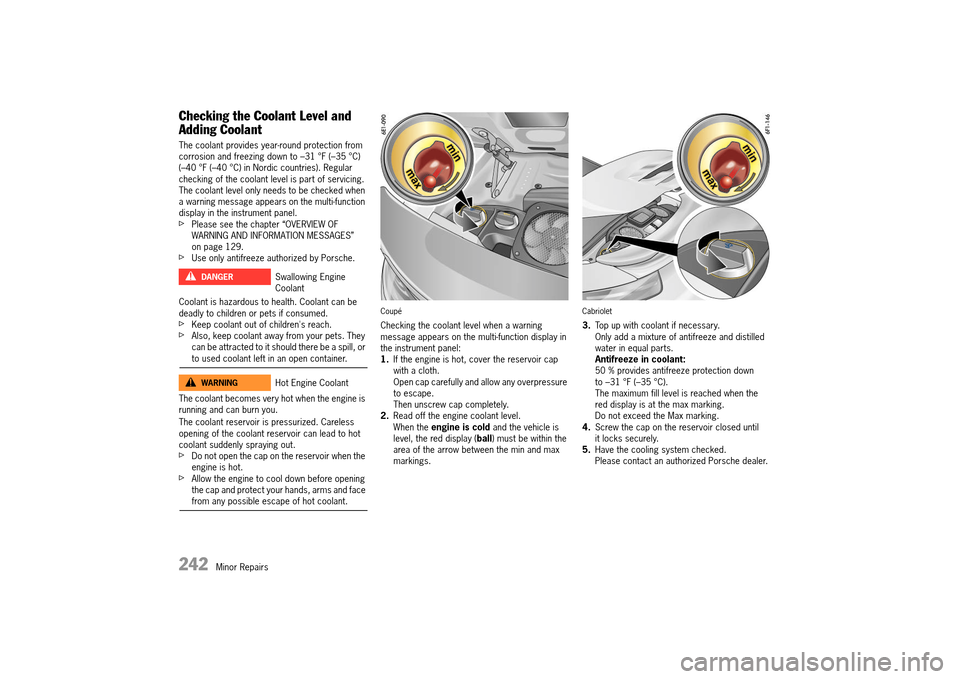
Coupé
Checking the coolant level when a warning message appears on the multi-function display in the instrument panel:1. If the engine is hot, cover the reservoir cap with a cloth.Open cap carefully and allow any overpressure to escape.Then unscrew cap completely.2. Read off the engine coolant level. When the engine is cold and the vehicle is level, the red display ( ball) must be within the area of the arrow between the min and max markings.
Cabriolet
3. Top up with coolant if necessary. Only add a mixture of antifreeze and distilled water in equal parts.Antifreeze in coolant:50 % provides antifreeze protection down to –31 °F (–35 °C).The maximum fill level is reached when the red display is at the max marking.Do not exceed the Max marking.4. Screw the cap on the reservoir closed until it locks securely.5. Have the cooling system checked. Please contact an authorized Porsche dealer.
Swallowing Engine Coolant
Hot Engine Coolant
DANGERh
WARNINGh
14_991_Turbo_21.book Seite 242 Mittwoch, 9. April 2014 2:19 14
Page 245 of 300
Minor Repairs 243
Information
If pure water is added in an emergency, the mixing ratio will have to be corrected.A significant loss of coolant indicates a leak in the cooling system.fThe cause must be eliminated without delay. Please contact an authorized Porsche dealer.
Hands, fingers, items of clothing (ties, sleeves, etc.), necklaces or long hair can be drawn in by moving parts, e.g. the engine-compartment blowers, drive belt, etc., when working in the engine compartment.
The engine-compartment blowers are mounted under the engine compartment lid.After the engine is switched off, the engine compartment temperature is monitored for approx. 30 minutes.During this period, and depending on temperature, the engine-compartment blowers may continue to run or start to run.fCarry out work in this area only with the engine off and exercise extreme caution.
The engine and adjacent components become very hot when the engine is running.fExercise extreme caution when working in the engine compartment.
Brake Fluid
Regular checking of the brake fluid is part of servicing.
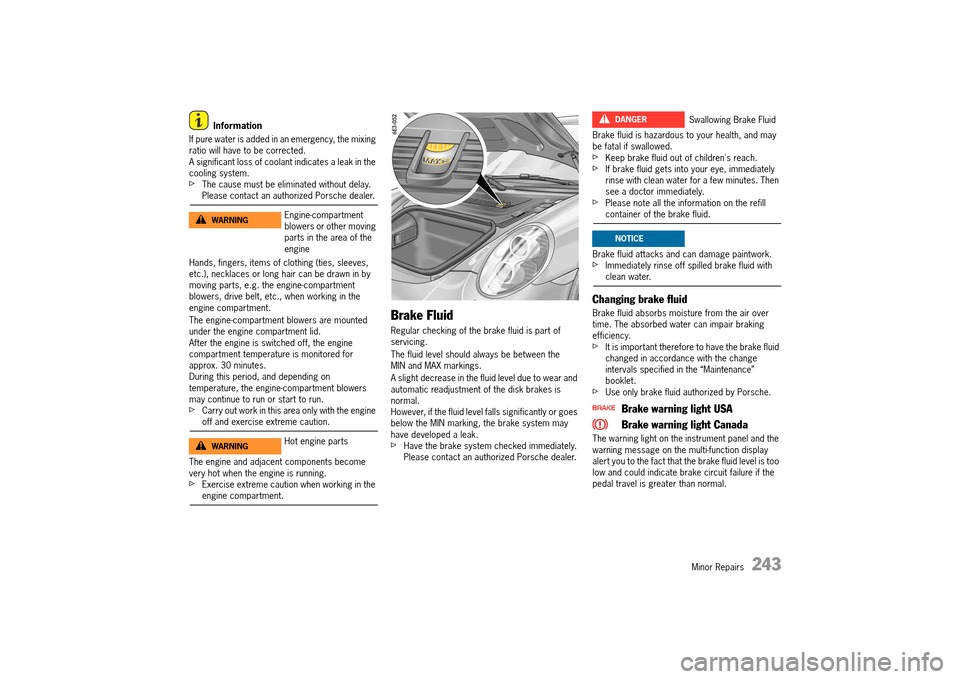
The fluid level should always be between the MIN and MAX markings.
A slight decrease in the fluid level due to wear and automatic readjustment of the disk brakes is normal.However, if the fluid level falls significantly or goes below the MIN marking, the brake system may have developed a leak.fHave the brake system checked immediately. Please contact an authorized Porsche dealer.
Brake fluid is hazardous to your health, and may be fatal if swallowed.fKeep brake fluid out of children's reach.fIf brake fluid gets into your eye, immediately rinse with clean water for a few minutes. Then see a doctor immediately.fPlease note all the information on the refill container of the brake fluid.
Brake fluid attacks and can damage paintwork.fImmediately rinse off spilled brake fluid with clean water.
Changing brake fluid
Brake fluid absorbs moisture from the air over time. The absorbed water can impair braking efficiency.fIt is important therefore to have the brake fluid changed in accordance with the change intervals specified in the “Maintenance” booklet.fUse only brake fluid authorized by Porsche.
Brake warning light USA
Brake warning light Canada
The warning light on the instrument panel and the warning message on the multi-function display alert you to the fact that the brake fluid level is too low and could indicate brake circuit failure if the pedal travel is greater than normal.
Engine-compartment blowers or other moving parts in the area of the engine
Hot engine parts
WARNINGh
WARNINGh
Swallowing Brake FluidDANGERh
NOTICE
14_991_Turbo_21.book Seite 243 Mittwoch, 9. April 2014 2:19 14
Page 246 of 300
244 Minor Repairs
Information
If the warning light and warning message appear when driving: fStop immediately in a suitable place.fDo not continue driving.Please contact an authorized Porsche dealer.
For information on warning messages on the multi- function display: fPlease see the chapter “OVERVIEW OF WARNING AND INFORMATION MESSAGES” on page 129.
Electromechanical Power Steering
When the engine is stopped (e.g. when on tow), no power steering assistance is available.Increased force is required for steering.fExercise extreme care when your vehicle is being towed.fHave the fault corrected. Please contact an authorized Porsche dealer.
Changing Air Cleaner
Regular replacement of the filter element is part of servicing.fIn dusty conditions, clean the filter element more frequently and replace it if necessary.fPlease see the chapter “MEASUREMENTS ON TEST STANDS” on page 241.
Changing Particle Filters
Regular replacement of the filters is part of servicing.
Dirty filters can be the cause of reduced air throughput, e.g. the windows can mist up.fHave the filters replaced.Please contact an authorized Porsche dealer.
Information
The particle filters ensure that the fresh air entering the passenger compartment is virtually free of dust and pollen.fIf the outside air is polluted by exhaust fumes, press the recirculated-air button.
Tires and Wheels
The original equipment tires and wheel rims on your Porsche comply with all applicable Federal Motor Vehicle Safety Standards.
Information
The summer tires of your Sports Car have been specially developed and adapted for high performance.The tire characteristics change at low outside temperatures (below 15 °C).This can result in noises when parking or maneuvering at low outside temperatures.
For your safety remember the following:
– Wheel rims and wheel bolts are matched to fit your Porsche.– If you intend to use other than original equipment wheels, be sure that they conform to Porsche specifications for your model. Only tires with the same make and with the same specification code (e.g. “N0”, “N1”...) can be mounted.– The use of wheel rims and wheel bolts that do not meet specifications of the original factory installed equipment will affect the safe operation of your vehicle and affect warranty coverage.– Before you plan on exchanging wheels, or snow tires already mounted on the wheel rims, consult your authorized Porsche dealer. Your dealer has the technical information necessary to advise you which wheel rims and wheel bolts are compatible with the original factory installations.
No Power Steering AssistWARNINGh
14_991_Turbo_21.book Seite 244 Mittwoch, 9. April 2014 2:19 14
Page 258 of 300
256 Minor Repairs
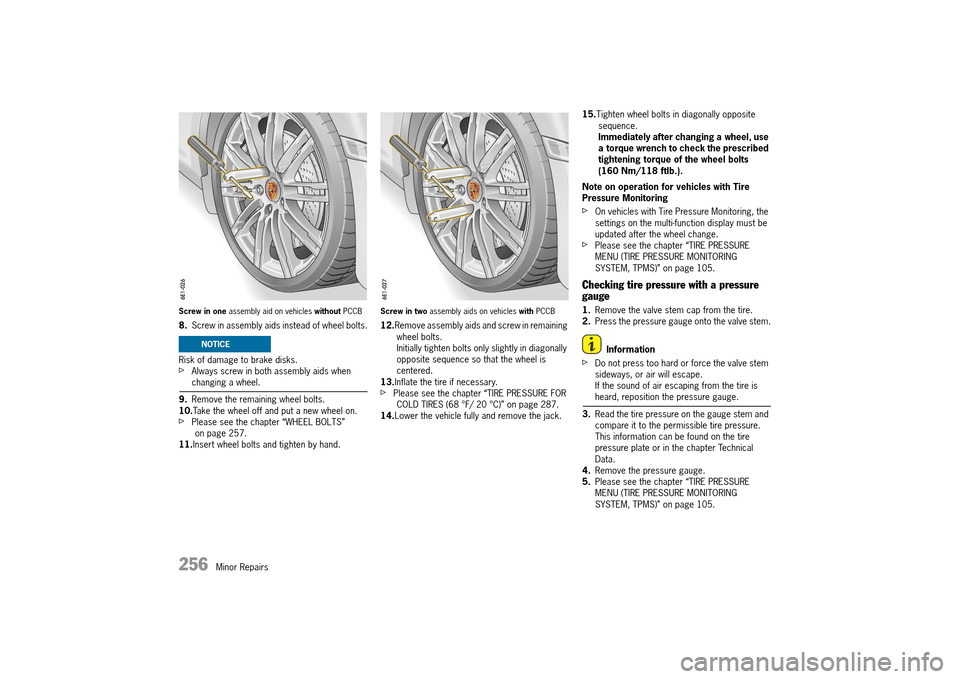
Screw in one assembly aid on vehicles without PCCB
8.Screw in assembly aids instead of wheel bolts.
Risk of damage to brake disks.fAlways screw in both assembly aids when changing a wheel.
9. Remove the remaining wheel bolts. 10. Take the wheel off and put a new wheel on.fPlease see the chapter “WHEEL BOLTS” on page 257.11. Insert wheel bolts and tighten by hand.
Screw in two assembly aids on vehicles with PCCB
12.Remove assembly aids and screw in remaining wheel bolts.Initially tighten bolts only slightly in diagonally opposite sequence so that the wheel is centered.13. Inflate the tire if necessary.fPlease see the chapter “TIRE PRESSURE FOR COLD TIRES (68 °F/ 20 °C)” on page 287.14. Lower the vehicle fully and remove the jack.
15. Tighten wheel bolts in diagonally opposite sequence.Immediately after changing a wheel, use a torque wrench to check the prescribed tightening torque of the wheel bolts (160 Nm/118 ftlb.).
Note on operation for vehicles with Tire Pressure Monitoring
fOn vehicles with Tire Pressure Monitoring, the settings on the multi-function display must be updated after the wheel change.fPlease see the chapter “TIRE PRESSURE MENU (TIRE PRESSURE MONITORING SYSTEM, TPMS)” on page 105.
Checking tire pressure with a pressure gauge
1. Remove the valve stem cap from the tire. 2. Press the pressure gauge onto the valve stem.
Information
fDo not press too hard or force the valve stem sideways, or air will escape.If the sound of air escaping from the tire is heard, reposition the pressure gauge.
3. Read the tire pressure on the gauge stem and compare it to the permissible tire pressure.This information can be found on the tire pressure plate or in the chapter Technical Data.4. Remove the pressure gauge. 5. Please see the chapter “TIRE PRESSURE MENU (TIRE PRESSURE MONITORING SYSTEM, TPMS)” on page 105.
NOTICE
14_991_Turbo_21.book Seite 256 Mittwoch, 9. April 2014 2:19 14
Page 275 of 300
Minor Repairs 273
fAfter you install a new battery, it must be initialized in the control unit.Please contact your authorized Porsche dealer.fPlease observe the disposal instructions for batteries.
Putting vehicle into operation
After the battery is connected or after a fully discharged battery is charged, the PSM warning light lights up on the instrument panel and a message appears on the multi-function display in the instrument panel to indicate a fault.
This fault can be corrected with a few simple steps: 1. Start the engine. To do this, turn the ignition key or the control unit (on vehicles with Porsche Entry & Drive) to ignition lock position 2 twice. 2. With the vehicle stationary, perform a few steering movements to the left and right and then drive a short distance in a straight line until the PSM warning light goes out and the message is erased from the multi-function display in the instrument panel.3. If the warnings do not disappear, then: Drive carefully to the nearest authorized Porsche dealer.Have the fault corrected.4. After the warnings go out: Stop the vehicle in a suitable place.5. Store the end position for the power windows.
For information on storing the end positions for the power windows: fPlease see the chapter “STORING END POSITION OF THE WINDOWS AFTER CONNECTING THE VEHICLE BATTERY” on page 63.6. Teach tires on vehicles with Tire Pressure Monitoring.
For information on teaching the Tire Pressure Monitoring System (TPMS): fPlease see the chapter “TIRE PRESSURE MENU (TIRE PRESSURE MONITORING SYSTEM, TPMS)” on page 105.7. Store end position on vehicles with a sunroof.
For information on storing the end position for the sunroof: fPlease see the chapter “STORING END POSITION OF THE SUNROOF” on page 66.fPlease see the chapter “STORING END POSITION OF THE ROLL-UP SUNBLIND” on page 67.
External Power Supply, Emergency
starting with jumper cables
If the battery is flat, the battery of another vehicle can be used for starting or as an external power supply with the help of jump leads.
Both batteries must be 12 V batteries. The capacity (Ah) of the donor battery must not be substantially less than that of the flat battery.
The flat battery must be connected correctly to the vehicle’s electrical system.
A short circuit may be caused if unsuitable jumper cables are used or if jumper cable starting is not performed properly. Such short circuits can cause a fire.fUse only standard jumper cables with sufficient cross section and completely insulated alligator clips. Follow the instructions provided by the jumper cable manufacturer.fRoute the jumper cables so that they cannot be caught by moving parts in the engine compartment.The jumper cables must be long enough so that neither vehicles nor cables touch another.fThe vehicles must not touch, otherwise current might flow as soon as the positive terminals are connected.fEnsure that tools or conductive jewelry (rings, chains, watch straps) do not come into contact with the positive jumper cable, the positive battery post or live parts of the vehicle.fImproper hook-up of jumper cables can ruin the alternator.
Jumper Cable HazardsWARNINGh
14_991_Turbo_21.book Seite 273 Mittwoch, 9. April 2014 2:19 14
Page 277 of 300
Minor Repairs 275
fCharge battery in a well-ventilated area due to hydrogen gas explosion risk.fNever charge a frozen battery. It may explode because of gas trapped in the ice. Allow a frozen battery to thaw out first.
fIf you get electrolyte, which is an acid, in your eyes or on your skin, immediately rinse with cold water for several minutes.
Your authorized Porsche dealer will be pleased to advise you about a suitable charger.fAlways observe the instructions provided by the charger manufacturer.fIf the battery is frozen, thaw it out first before charging it.fWhen charging the battery, ensure adequate ventilation.1. Connect the charger to the emergency starting terminals.Only plug into the mains and switch the charger on when it is connected up correctly.2. Switch on the charger. 3. After charging the battery, first switch off the charger and then disconnect it.fPlease see the chapter “PUTTING VEHICLE INTO OPERATION” on page 273.
Changing Car Key
(Remote Control) Battery
Information
fPlease observe the regulations for disposing of batteries.
Car key
If the battery in the remote control becomes too weak, the message “ Replace ignition key battery ” will appear on the multi-function display in the instrument panel.The battery should be changed in this case.
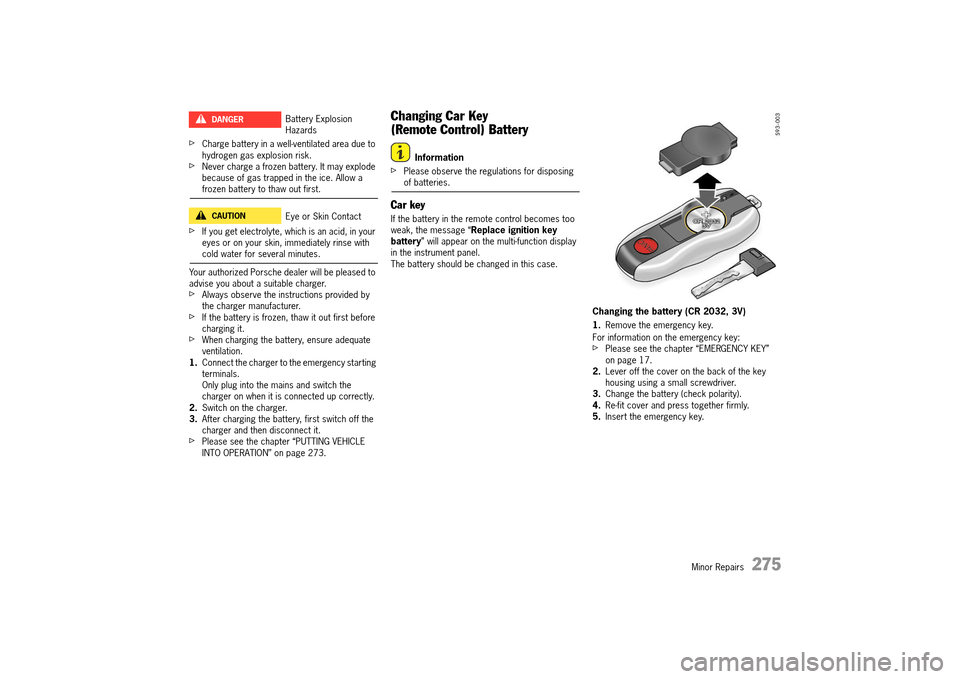
Changing the battery (CR 2032, 3V)
1. Remove the emergency key.
For information on the emergency key: fPlease see the chapter “EMERGENCY KEY” on page 17.2. Lever off the cover on the back of the key housing using a small screwdriver.3. Change the battery (check polarity). 4. Re-fit cover and press together firmly. 5. Insert the emergency key.
Battery Explosion Hazards
Eye or Skin Contact
DANGERh
CAUTIONh
14_991_Turbo_21.book Seite 275 Mittwoch, 9. April 2014 2:19 14
Page 280 of 300
278 Minor Repairs
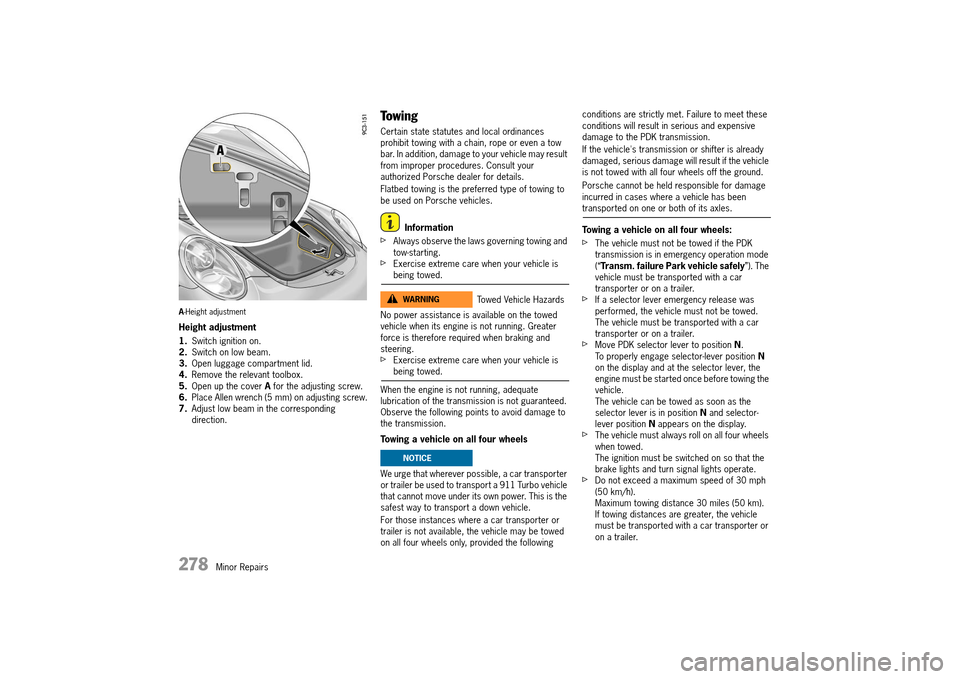
A-Height adjustment
Height adjustment
1. Switch ignition on. 2. Switch on low beam. 3. Open luggage compartment lid. 4. Remove the relevant toolbox. 5. Open up the cover A for the adjusting screw. 6. Place Allen wrench (5 mm) on adjusting screw. 7. Adjust low beam in the corresponding direction.
Towing
Certain state statutes and local ordinances prohibit towing with a chain, rope or even a tow bar. In addition, damage to your vehicle may result from improper procedures. Consult your authorized Porsche dealer for details.
Flatbed towing is the preferred type of towing to be used on Porsche vehicles.
Information
fAlways observe the laws governing towing and tow-starting.fExercise extreme care when your vehicle is being towed.
No power assistance is available on the towed vehicle when its engine is not running. Greater force is therefore required when braking and steering.fExercise extreme care when your vehicle is being towed.
When the engine is not running, adequate lubrication of the transmission is not guaranteed. Observe the following points to avoid damage to the transmission.
Towing a vehicle on all four wheels
We urge that wherever possible, a car transporter or trailer be used to transport a 911 Turbo vehicle that cannot move under its own power. This is the safest way to transport a down vehicle.
For those instances where a car transporter or trailer is not available, the vehicle may be towed on all four wheels only, provided the following
conditions are strictly met. Failure to meet these conditions will result in serious and expensive damage to the PDK transmission.
If the vehicle's transmission or shifter is already damaged, serious damage will result if the vehicle is not towed with all four wheels off the ground.
Porsche cannot be held responsible for damage incurred in cases where a vehicle has been transported on one or both of its axles.
Towing a vehicle on all four wheels:
fThe vehicle must not be towed if the PDK transmission is in emergency operation mode (“ Transm. failure Park vehicle safely”). The vehicle must be transported with a car transporter or on a trailer.fIf a selector lever emergency release was performed, the vehicle must not be towed. The vehicle must be transported with a car transporter or on a trailer.fMove PDK selector lever to position N. To properly engage selector-lever position N on the display and at the selector lever, the engine must be started once before towing the vehicle. The vehicle can be towed as soon as the selector lever is in position N and selector- lever position N appears on the display.fThe vehicle must always roll on all four wheels when towed.The ignition must be switched on so that the brake lights and turn signal lights operate.fDo not exceed a maximum speed of 30 mph (50 km/h).Maximum towing distance 30 miles (50 km).If towing distances are greater, the vehicle must be transported with a car transporter or on a trailer.
Towed Vehicle HazardsWARNINGh
NOTICE
14_991_Turbo_21.book Seite 278 Mittwoch, 9. April 2014 2:19 14
Page 281 of 300
Minor Repairs 279
Towing a vehicle on one axle:
Raising an axle, irrespective of whether at the front or rear, is only permissible if the drive shaft (cardan shaft) has been removed beforehand. The ignition must be switched off.fThe vehicle must not be towed if the PDK transmission is in emergency operation mode (yellow or red “ Transm. failure Park vehicle safely ” warning message). The vehicle must be transported with a car transporter or on a trailer.fIf a selector lever emergency release was performed, the vehicle must not be towed. The vehicle must be transported with a car transporter or on a trailer.fMove PDK selector lever to position N. To properly engage selector-lever position N on the display and at the selector lever, the engine must be started once before towing the vehicle. The vehicle can be towed as soon as the selector lever is in position N and selector- lever position N appears on the display.fSwitch ignition off. The ignition key must remain in the ignition lock so that the steering lock does not engage.The control unit must be removed from the ignition lock and the key inserted in vehicles with Porsche Entry & Drive. fPlease see the chapter “EMERGENCY OPERATION – UNLOCKING THE IGNITION KEY/CONTROL UNIT” on page 28.fMake sure that the vehicle is adequately illuminated.
fDo not exceed a maximum speed of 30 mph (50 km/h).Maximum towing distance 30 miles (50 km).If towing distances are greater, the vehicle must be transported with a car transporter or on a trailer.
Pulling out a vehicle stuck in snow, sand, etc.
fAlways pull out the stuck vehicle with the greatest care.fDo not pull out the vehicle abruptly or at an angle. fIf possible, pull the vehicle out backwards in its own tracks.
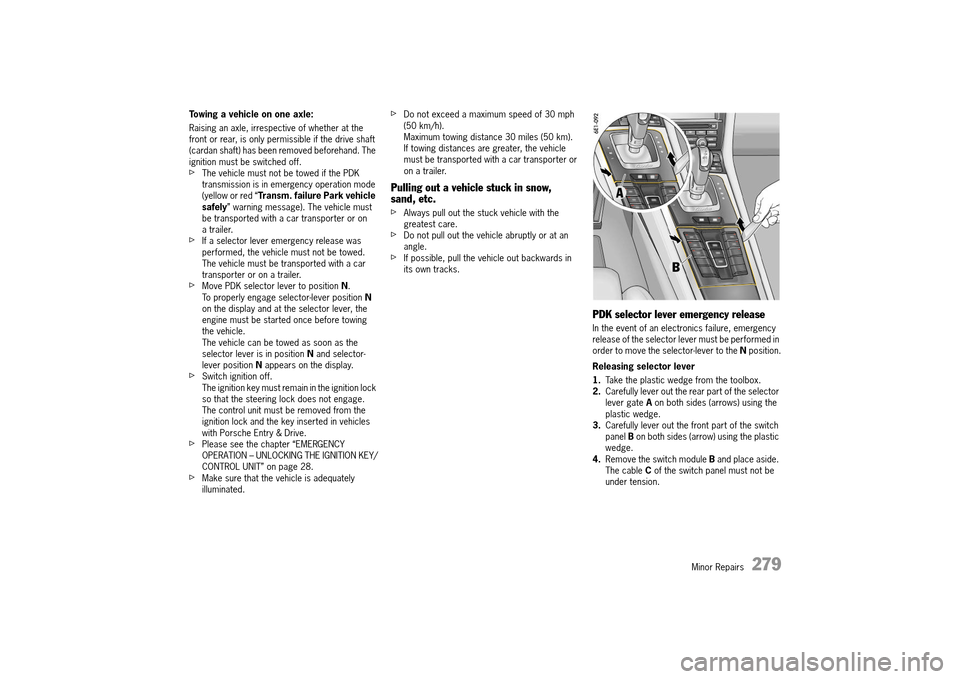
PDK selector lever emergency release
In the event of an electronics failure, emergency release of the selector lever must be performed in order to move the selector-lever to the N position.
Releasing selector lever
1. Take the plastic wedge from the toolbox. 2. Carefully lever out the rear part of the selector lever gate A on both sides (arrows) using the plastic wedge.3. Carefully lever out the front part of the switch panel B on both sides (arrow) using the plastic wedge.4. Remove the switch module B and place aside. The cable C of the switch panel must not be under tension.
14_991_Turbo_21.book Seite 279 Mittwoch, 9. April 2014 2:19 14